9 Best AI Customer Support Software Tools Reviewed for 2026
This comprehensive guide cuts through the noise of ai customer support software reviews by evaluating nine leading platforms—including Halo AI, Intercom, Zendesk, and more—across automation depth, integration breadth, and learning capabilities. It helps B2B and SaaS teams identify the right fit based on actual ticket resolution rates, escalation quality, and whether the tool is built AI-first or simply layered onto a legacy helpdesk.
 Matt PattoliFounder14 min read
If you've searched "AI customer support software reviews," you already know the problem: dozens of platforms make bold claims, but the differences that actually matter only become clear once you dig in. How many tickets does the AI actually resolve without human involvement? How gracefully does it escalate? How deeply does it connect to your broader stack?
This guide cuts through the noise. We've reviewed nine leading AI customer support platforms based on automation depth, integration breadth, learning capabilities, and value for B2B and SaaS teams. There's a meaningful difference between tools that bolt AI onto a legacy helpdesk and those built AI-first from the ground up. Use this list to find the right fit for your team's size, stack, and support volume.
1. Halo AI
Best for: B2B SaaS teams that want AI-first autonomous support without building on a legacy helpdesk
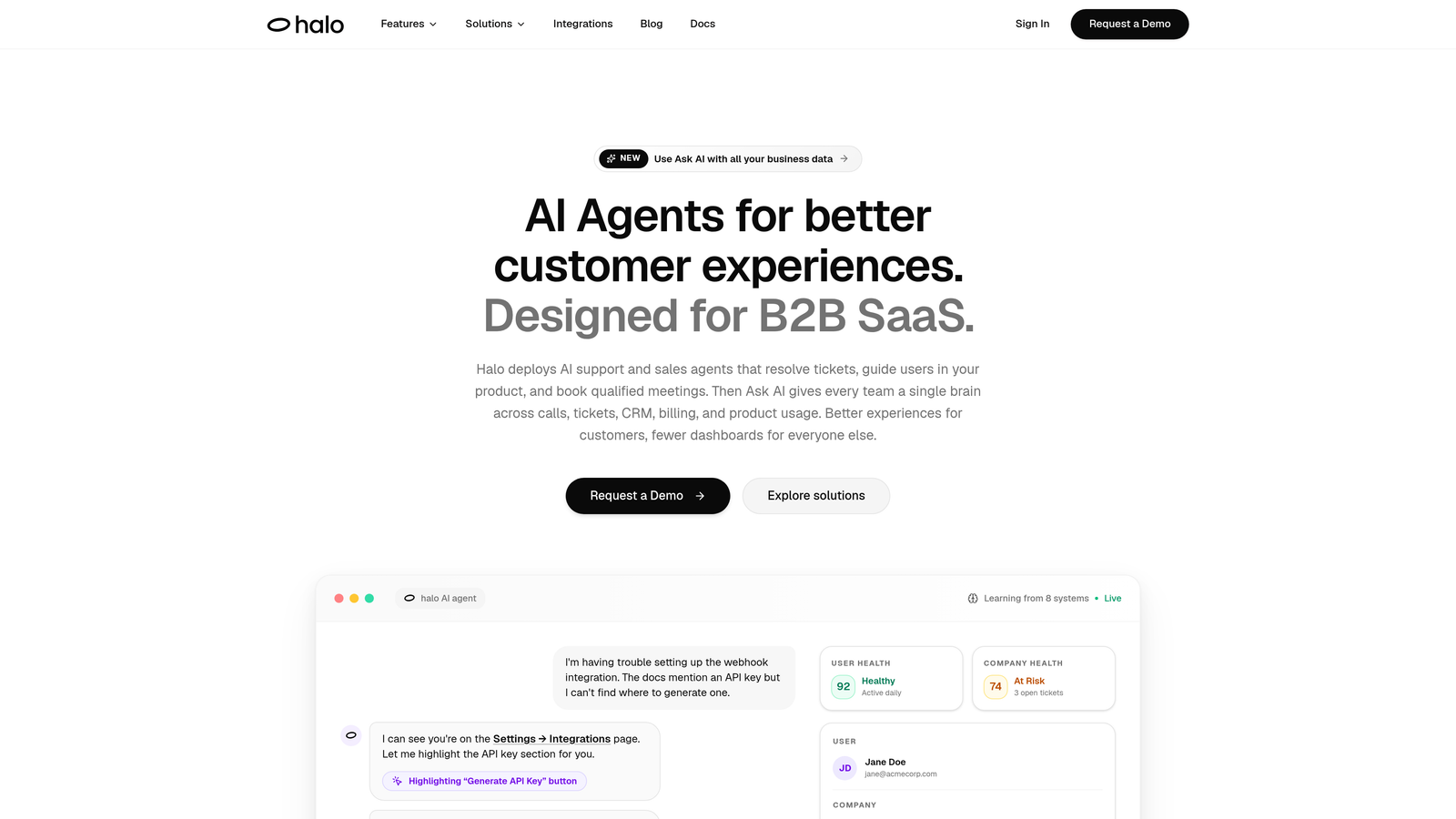
Halo AI is an AI-first customer support platform built specifically for B2B SaaS teams that need to scale support without scaling headcount.
Where This Tool Shines
What sets Halo apart from most tools in this category is the architecture. It wasn't built as a helpdesk that later added AI features. The entire platform is designed around autonomous resolution, continuous learning, and business intelligence, which means the AI isn't a layer on top of something else; it's the foundation.
The page-aware chat widget is a standout capability. Rather than responding to text alone, Halo's AI sees what the user sees on-screen, enabling it to provide contextual, visual guidance specific to where the user is in your product. Combine that with auto bug ticket creation that routes issues directly to Linear, and you have a platform that closes the loop between customer support and engineering without any manual handoff.
Key Features
Page-Aware Chat Widget: The AI understands the user's current page context, enabling precise, step-by-step visual guidance rather than generic answers.
Autonomous Ticket Resolution with Smart Handoff: Resolves tickets end-to-end and escalates to live agents with full conversation context preserved, so no customer ever has to repeat themselves.
Auto Bug Ticket Creation: Converts support issues into structured engineering tickets and routes them directly to Linear, bridging the gap between support and product teams.
Smart Inbox with Business Intelligence: Goes beyond ticket closure to surface customer health signals, revenue intelligence, and anomaly detection directly from support interactions.
Broad Integration Stack: Connects to Slack, HubSpot, Intercom, Stripe, Zoom, PandaDoc, Fathom, and Linear, making it a genuine hub across the business stack rather than an isolated support tool.
Continuous Learning: Every interaction improves resolution quality over time, meaning the platform gets smarter the more it's used.
Best For
Halo is best suited for B2B SaaS companies and product teams that want AI to do more than deflect tickets. If you need support intelligence to feed back into product development, customer success, and revenue operations, and you'd rather build on an AI-native foundation than retrofit AI onto an existing helpdesk, Halo is worth a close look.
Pricing
Pricing is not publicly listed. Contact the Halo team directly at haloagents.ai for a demo and custom pricing based on your team's needs.
2. Intercom
Best for: Teams wanting a mature all-in-one messaging platform with AI-powered front-line resolution
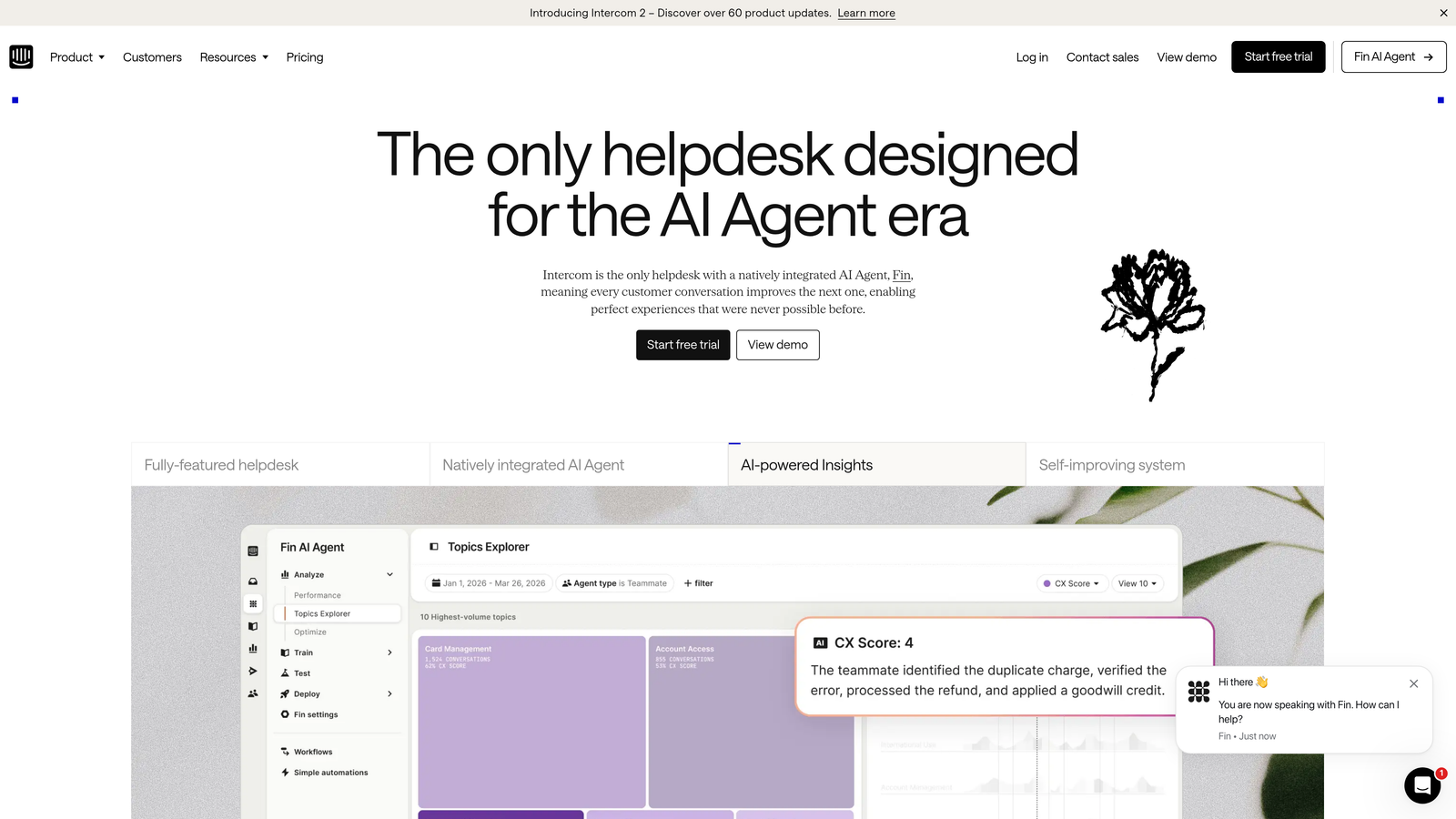
Intercom is a well-established customer messaging platform with Fin, its AI agent, handling front-line support resolution using help center content and LLM reasoning.
Where This Tool Shines
Intercom has been in the customer messaging space long enough to build one of the most polished unified inboxes available. Fin, their AI agent, handles a meaningful share of inbound queries autonomously by reasoning over your existing help center content. For teams that have already invested in documentation, this can translate to solid deflection rates without significant additional setup.
The broader Intercom ecosystem adds genuine value too. Product tours, onboarding flows, and a large app marketplace mean you can build a fairly complete customer experience layer within one platform. The trade-off is cost: Fin is charged per resolution, which can make pricing unpredictable at scale.
Key Features
Fin AI Agent: Resolves customer queries autonomously using LLM reasoning over your help center content, with configurable escalation to human agents.
Unified Inbox: Combines live chat, email, and in-app messaging into a single workspace for support teams.
Product Tours and Onboarding Flows: Enables in-product user education beyond reactive support.
AI-Powered Conversation Summaries: Gives agents a quick read on conversation history before they take over from Fin.
Extensive App Marketplace: Integrates with a wide range of CRM, analytics, and productivity tools.
Best For
Intercom suits teams that want a mature, all-in-one messaging platform and are willing to invest in building out a strong knowledge base to power Fin's resolution quality. It's a strong fit for growth-stage SaaS companies that want support, onboarding, and engagement in one place.
Pricing
Core plans start at approximately $39 per seat per month. Fin AI is charged per resolution, which means costs can scale significantly with support volume.
3. Zendesk AI
Best for: Enterprises already invested in the Zendesk ecosystem needing AI-powered triage and agent assist
Zendesk AI is enterprise-grade AI automation layered into the Zendesk Suite, offering intelligent triage, AI agents, and agent assist tools for high-volume support operations.
Where This Tool Shines
If your organization is already running on Zendesk, the AI features are a natural extension. Intelligent triage and intent detection route tickets automatically before a human ever touches them, while Agent Copilot provides suggested replies and next-best-action guidance to speed up resolution times for complex issues that do require human handling.
Zendesk's acquisition of Ultimate.ai has improved the depth of its AI capabilities, particularly around intent classification and multi-language support. The analytics layer is also strong, giving support managers a clear view of volume, resolution rates, and agent performance across the operation.
Key Features
AI-Powered Triage and Intent Detection: Automatically classifies and routes incoming tickets based on intent, reducing manual sorting and improving first-response time.
AI Agents (formerly Answer Bot): Deflects common queries with automated responses before tickets reach the agent queue.
Agent Copilot: Provides suggested replies and next-best-action recommendations to agents handling complex issues.
Advanced Analytics: Comprehensive reporting across support operations, including AI resolution rates and agent performance metrics.
Deep Zendesk Integration: AI features are tightly woven into existing ticketing, workflow, and routing infrastructure.
Best For
Zendesk AI is best for enterprises already committed to the Zendesk ecosystem that need AI to work within their existing workflows rather than replace them. It's less compelling for teams starting fresh who want an AI-native architecture.
Pricing
Suite Team starts at approximately $55 per agent per month. AI add-ons are available on higher-tier plans, with pricing varying based on features and volume.
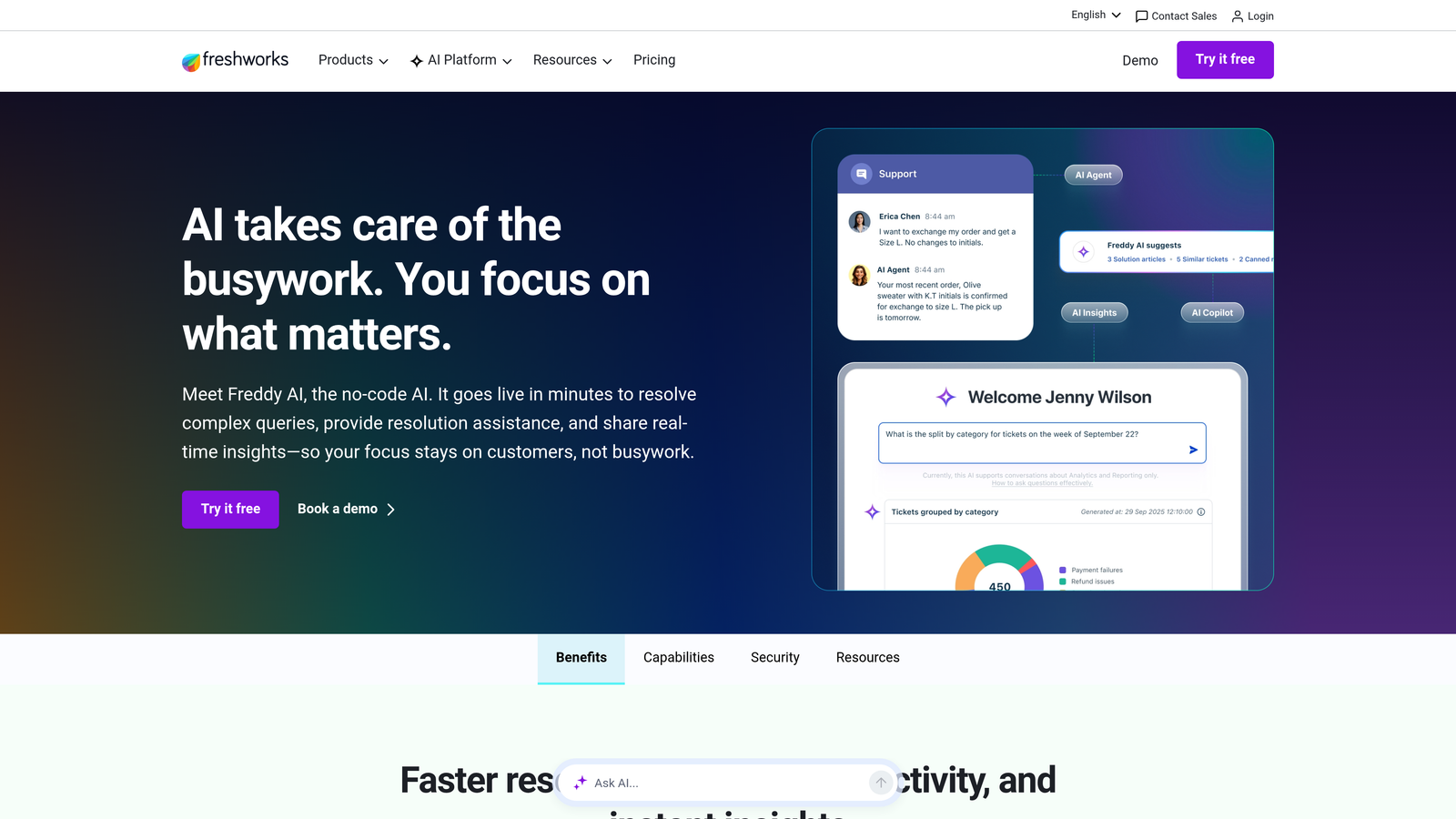
4. Freshdesk Freddy AI
Best for: SMBs and growing teams wanting affordable AI across support, CRM, and ITSM in one ecosystem
Freshdesk Freddy AI is Freshworks' AI layer spanning its support, CRM, and ITSM products, offering self-service bots and agent copilot features at an SMB-friendly price point.
Where This Tool Shines
Freshdesk's main advantage is breadth at a reasonable price. Freddy AI isn't limited to the support desk: it spans Freshsales and Freshservice too, which means teams that use multiple Freshworks products get AI assistance across the entire customer and IT operation. For SMBs that want to consolidate their stack without a Zendesk-level investment, this is a compelling proposition.
Freddy Copilot's agent assist features are practical and well-integrated: suggested replies, conversation summarization, and tone adjustment help agents work faster without requiring a complete workflow overhaul. The no-code bot builder also lowers the barrier for teams without technical resources.
Key Features
Freddy Self Service: Bot-based deflection and FAQ handling for common inbound queries without agent involvement.
Freddy Copilot: Assists agents with suggested replies, conversation summarization, and tone adjustment in real time.
Cross-Product AI: AI capabilities span Freshdesk, Freshsales, and Freshservice for a unified experience across the Freshworks suite.
No-Code Bot Builder: Allows non-technical teams to create custom conversation flows without engineering support.
Native Freshworks Integration: Tight integration across the ecosystem means data flows cleanly between support, sales, and IT.
Best For
Freshdesk Freddy AI is a strong fit for SMBs and mid-market teams already using or evaluating the Freshworks ecosystem. It's less suited for teams that need deep custom integrations outside the Freshworks stack.
Pricing
Growth plan starts at approximately $15 per agent per month. Freddy Copilot is available as a paid add-on on higher tiers.
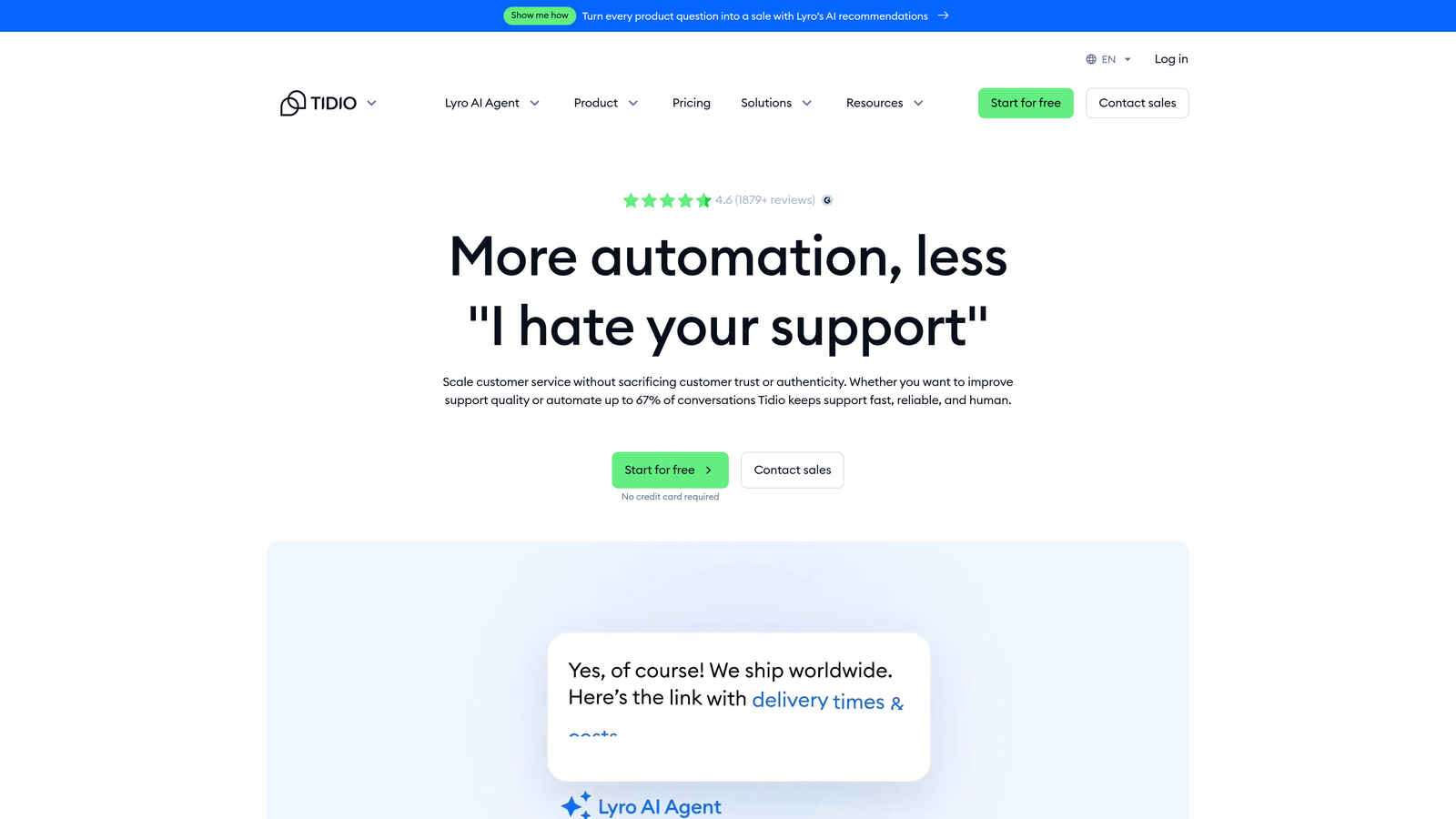
5. Tidio
Best for: E-commerce brands needing fast-to-deploy AI chat with native Shopify and WooCommerce support
Tidio is a fast-to-deploy AI chat platform with Lyro AI handling automated conversations, popular with e-commerce brands for its deep Shopify and WooCommerce integrations.
Where This Tool Shines
Tidio's main selling point is speed and simplicity. Teams can go from sign-up to a live chatbot in hours, not weeks. Lyro AI handles common customer queries conversationally, and the drag-and-drop bot builder means non-technical users can customize conversation flows without writing a line of code.
For e-commerce specifically, the native Shopify and WooCommerce integrations give Lyro access to order data, which enables it to answer order status and shipping queries automatically. It's not the deepest AI in this list, but for the use case it targets, it delivers a strong return on a modest investment.
Key Features
Lyro AI: Handles automated conversational support for common queries, with configurable escalation to live agents.
Visual Drag-and-Drop Bot Builder: Enables non-technical teams to build and modify conversation flows without code.
Native Shopify and WooCommerce Integrations: Connects directly to e-commerce platforms for order-aware support responses.
Live Chat Fallback: Routes conversations to human agents with notifications when Lyro can't resolve an issue.
Free Plan Available: Low-volume teams can get started without any upfront cost.
Best For
Tidio is best for e-commerce brands and small businesses that want a quick, affordable AI chat deployment. It's not the right fit for B2B SaaS teams that need deep integrations, business intelligence, or complex escalation logic.
Pricing
Free plan available for low-volume teams. Paid plans start at approximately $29 per month. Lyro AI conversations are priced separately based on volume.
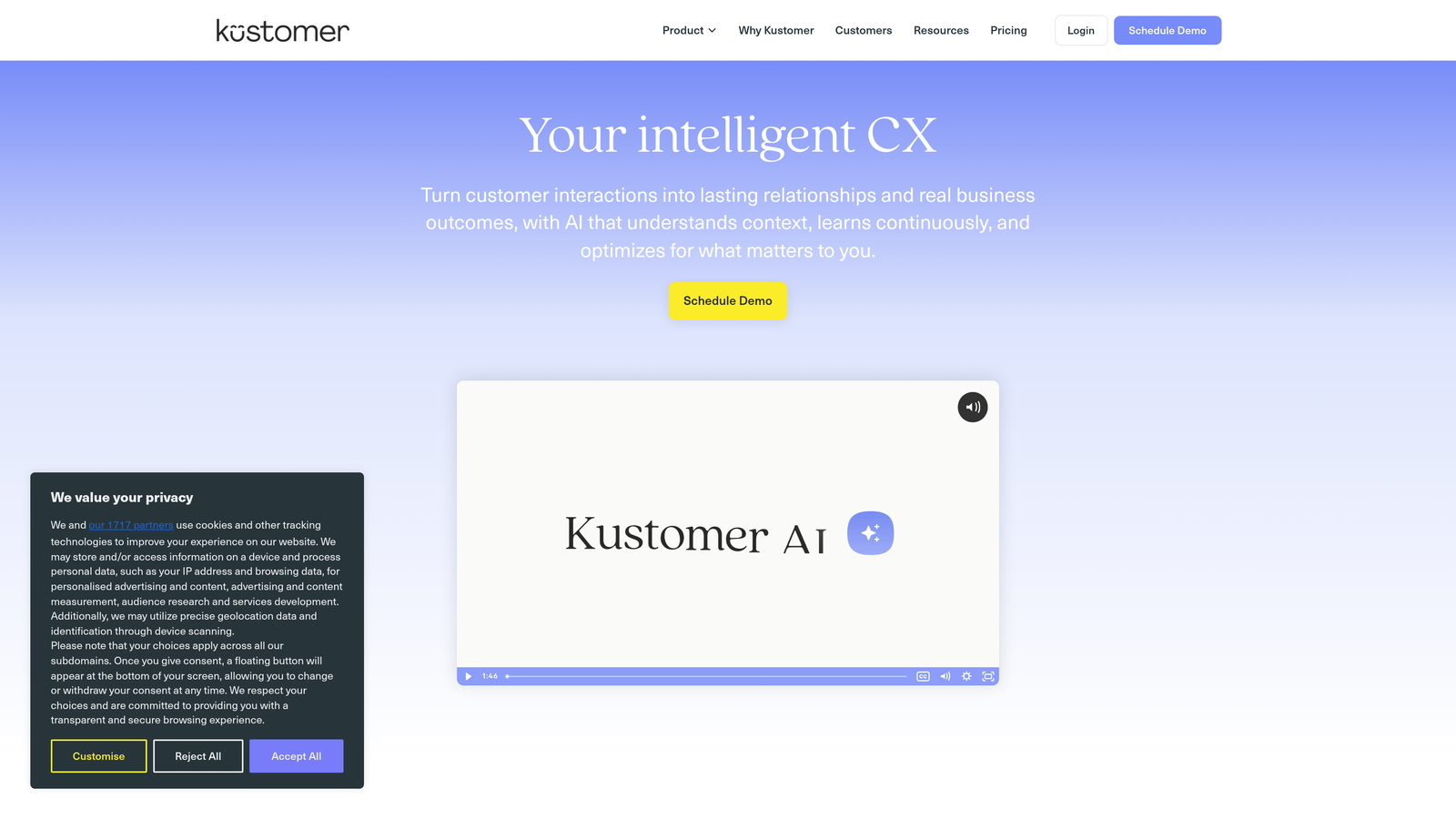
6. Kustomer
Best for: High-volume consumer brands needing a CRM-first support platform with AI-powered routing and automation
Kustomer is a CRM-first support platform owned by Meta, combining a full customer timeline with AI-powered routing, automation, and agent assist for high-volume consumer brands.
Where This Tool Shines
Kustomer's differentiator is the unified customer timeline. Rather than treating each support interaction in isolation, Kustomer aggregates every touchpoint, purchase, and conversation into a single view. When an agent or AI is handling a ticket, it has full customer context immediately, which meaningfully improves both resolution quality and customer experience.
The AI layer handles routing and queue management intelligently, directing tickets to the right team or automating resolution for repetitive workflows. For high-volume consumer brands in retail, D2C, or food delivery, this combination of CRM depth and AI automation is a compelling fit.
Key Features
Unified Customer Timeline: Aggregates all interactions, purchase history, and communication across channels into a single agent view.
AI-Powered Routing and Queue Management: Automatically directs tickets based on intent, priority, and customer context.
Automated Workflows: Handles repetitive support tasks without agent involvement, reducing queue load.
Omnichannel Support: Covers email, chat, social, SMS, and voice from a single platform.
Real-Time CRM Data for AI and Agents: Both the AI and human agents have access to full customer data at the moment of interaction.
Best For
Kustomer is best for consumer-facing brands with high support volumes where customer history and context are critical to resolution quality. It's less suited for B2B SaaS teams where the priority is product-aware AI and engineering integrations.
Pricing
Enterprise-focused pricing starting at approximately $89 per agent per month. Best suited for teams with the volume to justify the investment.
7. Help Scout
Best for: Customer-centric teams that want AI to assist agents rather than replace them
Help Scout is a human-first support platform with AI features designed to augment agents, built around a clean and intuitive shared inbox experience.
Where This Tool Shines
Help Scout takes a deliberately different philosophical stance from most tools in this list. Rather than optimizing for autonomous resolution, it focuses on making human agents faster and more effective. AI Assist helps draft replies; AI Summarize condenses long threads into a quick briefing. The goal is augmentation, not replacement.
This approach resonates strongly with teams where support quality and human touch are a brand differentiator. The Beacon widget adds in-app contextual help without requiring a heavy integration, and the shared inbox experience is consistently praised for its clean, low-friction UX.
Key Features
AI Assist: Drafts and improves agent replies, reducing the time spent on routine response composition.
AI Summarize: Condenses long conversation threads so agents can get up to speed quickly without reading every message.
Beacon Widget: Delivers in-app contextual help and chat without a heavy technical lift.
Shared Inbox with Collision Detection: Prevents two agents from replying to the same ticket simultaneously.
Integrated Knowledge Base: Knowledge base creation and management built directly into the support workflow.
Best For
Help Scout is ideal for teams where the human element of support is a deliberate choice, not a limitation. It suits customer-centric startups and small teams that want clean tooling and AI assistance without pushing toward full automation.
Pricing
Plans start at approximately $22 per user per month, with AI features included rather than gated behind add-ons.
8. Drift (Salesloft)
Best for: B2B go-to-market teams that want to blend support conversations with pipeline and revenue intent signals
Drift, now part of Salesloft, is a conversational AI platform focused on blending support and sales conversations with revenue intent signals for B2B go-to-market teams.
Where This Tool Shines
Drift's core strength is its ability to identify revenue intent within conversations. Where most support tools focus purely on resolving issues, Drift's AI is also watching for signals that a visitor or customer is ready to buy, expand, or escalate commercially. For B2B companies where support conversations can directly influence pipeline, this dual focus is genuinely valuable.
The integration with Salesforce, HubSpot, and Marketo means that conversation data flows directly into the revenue stack, giving sales and marketing teams visibility into what prospects and customers are asking about. The trade-off is that Drift is biased toward sales use cases, so teams looking for deep support automation may find it less specialized than other options here.
Key Features
Revenue Intent Detection: AI identifies high-intent visitors and surfaces them to sales in real time during or after conversations.
Meeting Scheduling Built into Chat: Enables direct calendar booking within the conversation flow, removing friction from sales handoffs.
Real-Time High-Intent Notifications: Alerts sales reps when target accounts are active on the site.
CRM and Marketing Automation Integrations: Connects to Salesforce, HubSpot, and Marketo for full revenue stack alignment.
Conversation Analytics with Revenue Attribution: Links conversation outcomes to pipeline and revenue metrics.
Best For
Drift is best for B2B companies where the line between support and sales is intentionally blurred, particularly those with account-based go-to-market motions. It's not the right choice for teams whose primary need is autonomous support ticket resolution.
Pricing
Enterprise pricing model; contact Drift directly for a quote. Not suited for small teams or those with limited budgets.
9. Chatbase
Best for: Startups and small teams that need a fast, low-cost AI chatbot trained on their own documentation
Chatbase is a lightweight no-code platform for building custom GPT-powered chatbots trained on your own documentation, ideal for fast deployment at minimal cost.
Where This Tool Shines
Chatbase earns its place on this list through sheer accessibility. Upload your PDFs, point it at your URLs, connect your Notion or Google Docs, and you can have a functioning AI chatbot embedded on your website within hours. For early-stage startups or small teams that need documentation-based deflection without a lengthy implementation, it's hard to beat the time-to-value ratio.
The simplicity is also the ceiling. Chatbase doesn't offer deep integrations, business intelligence, or sophisticated escalation logic. It's a focused tool for a specific job: answering questions based on your content, affordably and quickly.
Key Features
Multi-Source Training: Train your chatbot on PDFs, URLs, Notion pages, and Google Docs without any technical setup.
No-Code Setup: Fully operational chatbot deployable in hours, with no engineering resources required.
Embeddable Widget: Drop a chat widget onto any website with a simple embed code.
Basic Conversation Analytics: Tracks conversation topics and common user queries for basic insight into support demand.
API Access: Available for teams that want to build custom integrations beyond the standard widget.
Best For
Chatbase is best for startups, indie teams, and small businesses that need a quick, affordable way to deflect common questions using existing documentation. It's not suitable for teams that need enterprise integrations, live agent handoff, or AI that learns and improves over time.
Pricing
Free plan available for low-volume use. Paid plans start at approximately $19 per month, making it one of the most affordable options in this category.
Which Tool Is Right for Your Team?
The honest answer is that the best AI customer support tool depends entirely on what you're trying to build. Not every team needs the same depth of automation, and not every budget supports the same level of investment.
If you're a B2B SaaS team that wants AI to do more than deflect tickets, including closing the loop between support and engineering, surfacing business intelligence, and improving autonomously over time, Halo AI is the strongest fit. It's the only tool in this list built AI-first rather than retrofitted onto a legacy helpdesk.
For teams already running on Zendesk or Freshworks, the native AI layers in those platforms are the path of least resistance. Zendesk AI suits larger enterprises; Freshdesk Freddy AI is the better value play for SMBs. Intercom is a strong all-in-one choice for SaaS teams that want messaging, onboarding, and AI resolution in a single platform, provided the per-resolution pricing works at your volume.
For e-commerce, Tidio's Shopify and WooCommerce integrations make it the obvious starting point. For consumer brands with high support volume, Kustomer's CRM-first approach is worth the investment. Help Scout is the right call for teams where human-quality support is a deliberate brand choice. Drift fits B2B teams where support and sales overlap. And Chatbase is the fastest path to a working chatbot for teams with limited resources.
Your support team shouldn't scale linearly with your customer base. Let AI agents handle routine tickets, guide users through your product, and surface business intelligence while your team focuses on complex issues that need a human touch. See Halo in action and discover how continuous learning transforms every interaction into smarter, faster support.