9 Best AI Customer Support Solutions for Enterprises in 2026
This guide ranks the nine strongest AI customer support solutions for enterprises in 2026, evaluating each on autonomous resolution capability, integration depth, analytics quality, and security — so support leaders can find the right fit whether they're scaling an existing stack or rebuilding from scratch.
 Grant CooperFounder13 min read
Enterprise support teams are under mounting pressure: ticket volumes grow, customer expectations rise, and headcount budgets stay flat. Legacy helpdesks were built for human agents — they route, log, and report, but they don't resolve. AI customer support solutions change that equation by autonomously handling tickets, surfacing business intelligence, and escalating only what truly needs a human.
This list covers the nine strongest AI customer support platforms purpose-built for enterprise scale. We evaluated each on autonomous resolution capability, integration depth, analytics quality, security posture, and how well they handle the complexity of real enterprise environments — not just demo scenarios. Whether you're running a 50-person support team on Zendesk or rebuilding your stack from scratch, there's a fit here for your situation.
1. Halo AI
Best for: B2B SaaS companies building AI-first support with deep business stack integrations
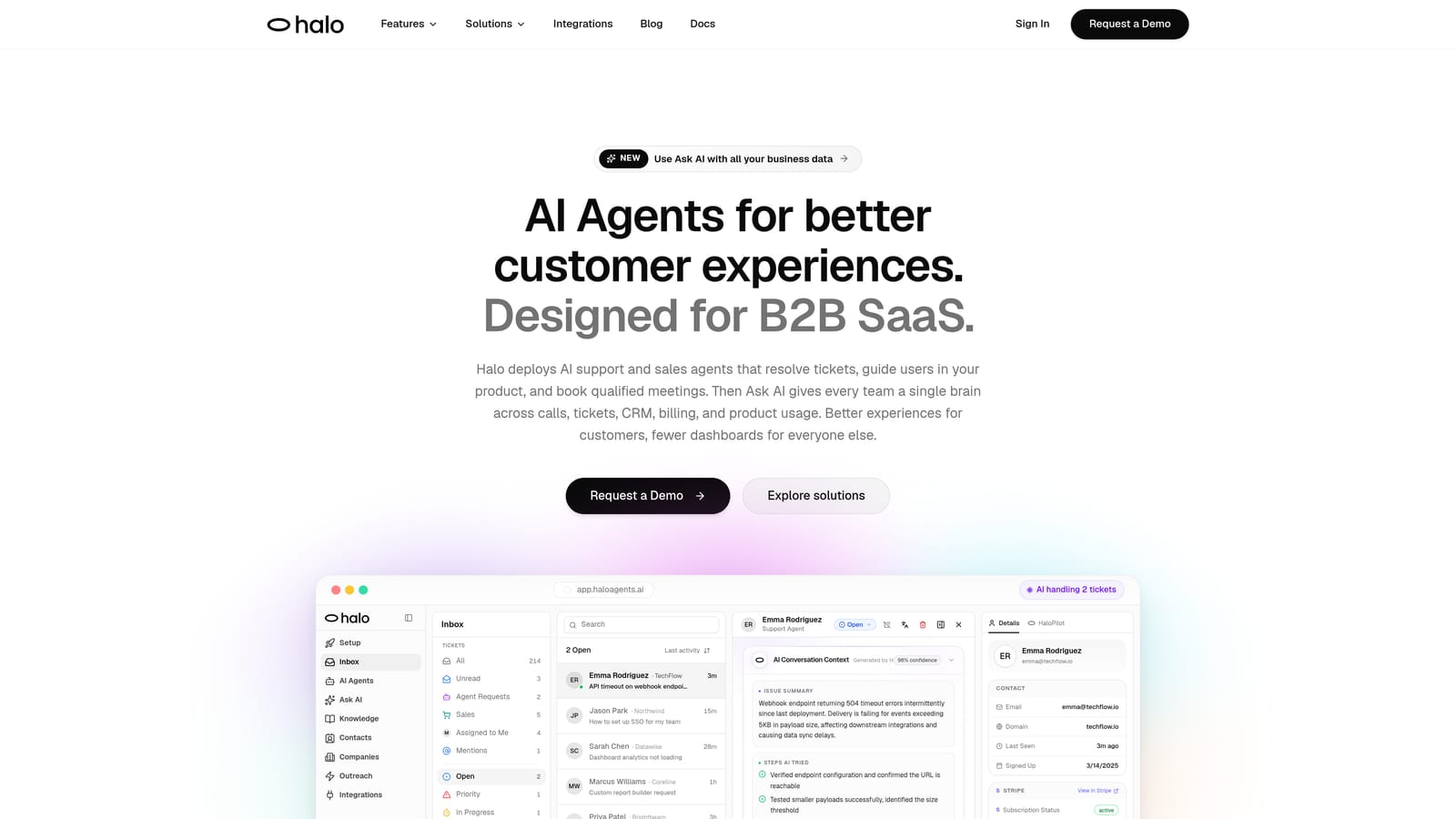
Halo AI is an AI-first customer support platform with page-aware agents, a business intelligence inbox, and integrations across the entire business stack.
Where This Tool Shines
What separates Halo from most platforms on this list is its architecture. It wasn't built as an AI layer on top of a legacy helpdesk — it was designed from the ground up around autonomous resolution. That distinction matters when you're evaluating how deeply AI can actually operate versus how well it can assist a human agent.
The page-aware chat widget is a particularly distinctive capability. The AI sees what the user sees on screen, enabling contextual UI guidance rather than generic knowledge base answers. For SaaS products with complex interfaces, this is the difference between an AI that resolves and one that redirects.
Key Features
Page-Aware Context: The AI observes the user's current screen state, enabling step-by-step UI guidance specific to where the user actually is in your product.
Autonomous Ticket Resolution: AI agents handle tickets end-to-end with continuous learning from every resolved interaction, improving over time without manual retraining.
Smart Inbox with Business Intelligence: The inbox surfaces customer health signals, revenue intelligence, and anomaly detection — turning support data into a signal layer for product and revenue teams.
Auto Bug Ticket Creation: Detects product issues from support conversations and automatically creates tickets in Linear, closing the loop between support and engineering.
Live Agent Handoff: Escalates complex issues to human agents with full conversation context preserved, so agents never start cold.
Integration Stack: Connects natively to HubSpot, Slack, Intercom, Stripe, Zoom, PandaDoc, Fathom, and Linear — covering CRM, billing, product, and internal comms in one platform.
Best For
B2B SaaS companies that want AI to do more than deflect tickets. Halo is particularly well-suited for teams that need support to feed intelligence back into product, revenue, and engineering workflows — not just close tickets faster. If you're evaluating an AI-native alternative to bolting AI onto Zendesk, this is the strongest starting point.
Pricing
Contact for enterprise pricing. A demo is available at haloagents.ai/demo.
2. Intercom (Fin AI Agent)
Best for: Existing Intercom customers wanting autonomous resolution without a platform migration
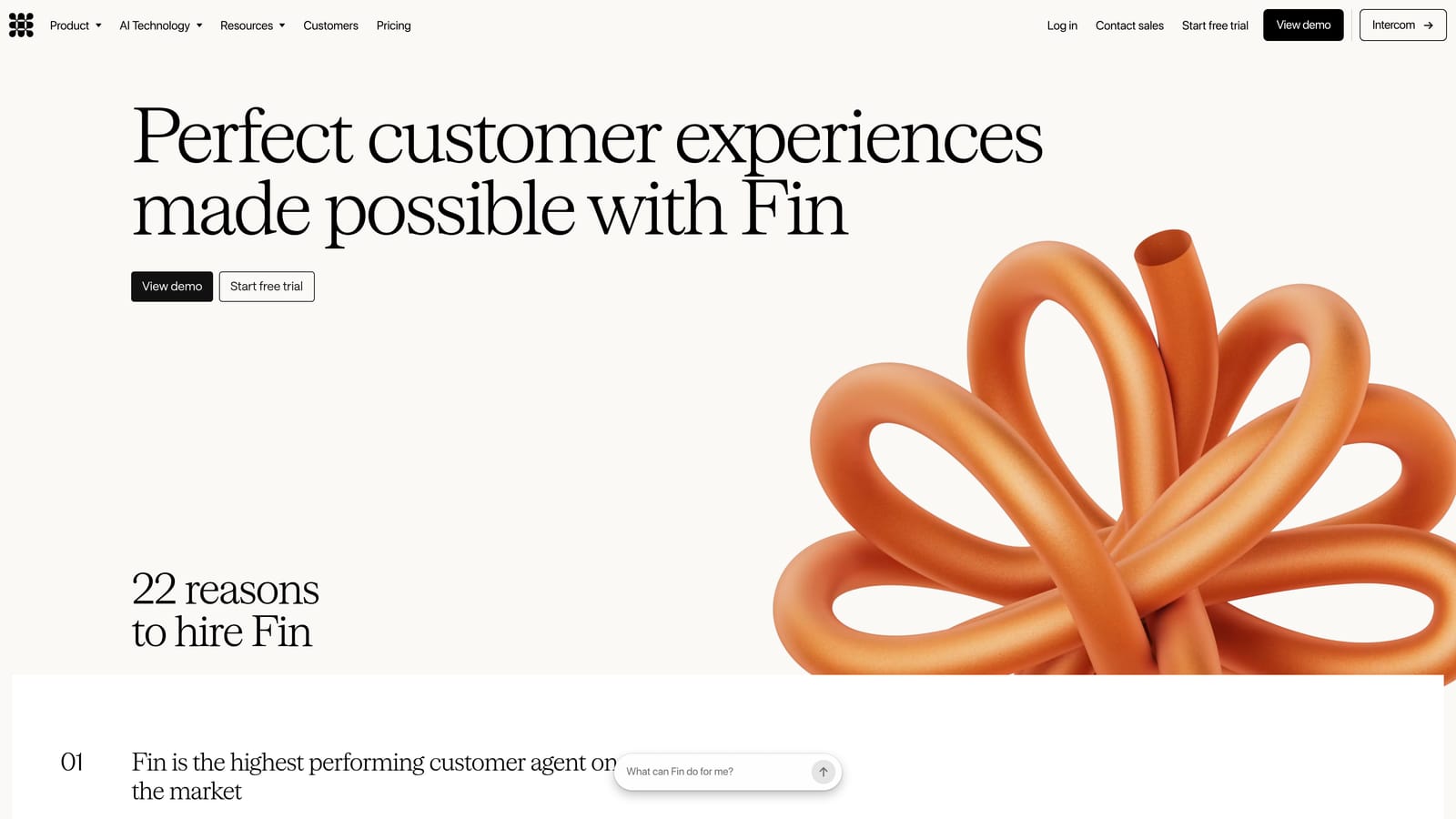
Intercom Fin is an LLM-powered AI agent natively embedded in Intercom's messaging platform, handling autonomous resolution across chat, email, and voice.
Where This Tool Shines
Fin's biggest advantage is its native integration with Intercom Messenger. For teams already running Intercom, deploying Fin requires no separate integration — the AI agent sits directly within the existing platform. That reduces implementation friction significantly compared to layering a third-party AI tool onto your current stack.
The addition of Fin Voice extends autonomous resolution to phone support, which is a meaningful capability gap for enterprises handling high inbound call volumes. The per-resolution pricing model is also worth noting: you pay for outcomes, not seats, which aligns cost directly with value delivered.
Key Features
Native Intercom Integration: Fin operates within Intercom Messenger without additional setup for existing customers, preserving existing workflows and conversation history.
Fin Voice: Extends AI-powered autonomous resolution to phone support, handling inbound calls without human agent involvement for qualifying inquiries.
Custom AI Personas: Enterprise teams can define tone, personality, and response style to align Fin with brand voice requirements.
Per-Resolution Pricing: Cost scales with actual resolutions delivered rather than seat count, making ROI calculation more straightforward.
Enterprise Security Controls: Includes SAML SSO, advanced permissions, and compliance controls suitable for regulated enterprise environments.
Best For
Enterprises already invested in the Intercom ecosystem who want to add autonomous resolution without changing platforms. Less compelling for teams not already on Intercom, where the platform switching cost needs to be factored into the evaluation.
Pricing
Per-resolution fee on top of Intercom platform subscription. Enterprise pricing available on request.
3. Zendesk AI
Best for: Enterprises with deep Zendesk investments wanting AI layered into existing workflows
Zendesk AI adds resolution and agent-assist capabilities across Zendesk Suite, one of the most established helpdesk platforms in the enterprise market.
Where This Tool Shines
Zendesk's strength is its ecosystem maturity. With over 1,500 marketplace integrations and years of enterprise deployments, it offers a level of workflow depth that newer platforms can't match. The AI Copilot feature is particularly useful for teams that aren't ready to go fully autonomous — it augments human agents with suggested replies and macro recommendations rather than replacing them.
The compliance posture is also a genuine differentiator for regulated industries. HIPAA, ISO 27001, and SOC 2 certifications are built into the platform, not add-ons, which simplifies procurement in healthcare, financial services, and other regulated sectors.
Key Features
AI Agents: Handle autonomous deflection and resolution for common ticket types, reducing volume reaching human agents.
AI Copilot: Assists human agents with suggested replies, macro recommendations, and ticket context surfacing in real time.
Workflow Automation: Deep integration with Zendesk's established triggers and macros system for complex routing and escalation logic.
Compliance Certifications: HIPAA, ISO 27001, and SOC 2 compliance built into the platform for regulated enterprise environments.
Marketplace Ecosystem: Access to 1,500+ integrations covering CRM, billing, analytics, and internal tools.
Best For
Enterprises with significant existing Zendesk deployments where ripping and replacing isn't practical. Teams that want to add AI incrementally rather than commit to a full AI-native rebuild will find Zendesk AI's layered approach more manageable.
Pricing
AI features available on Suite Professional and above. Enterprise pricing available on request.
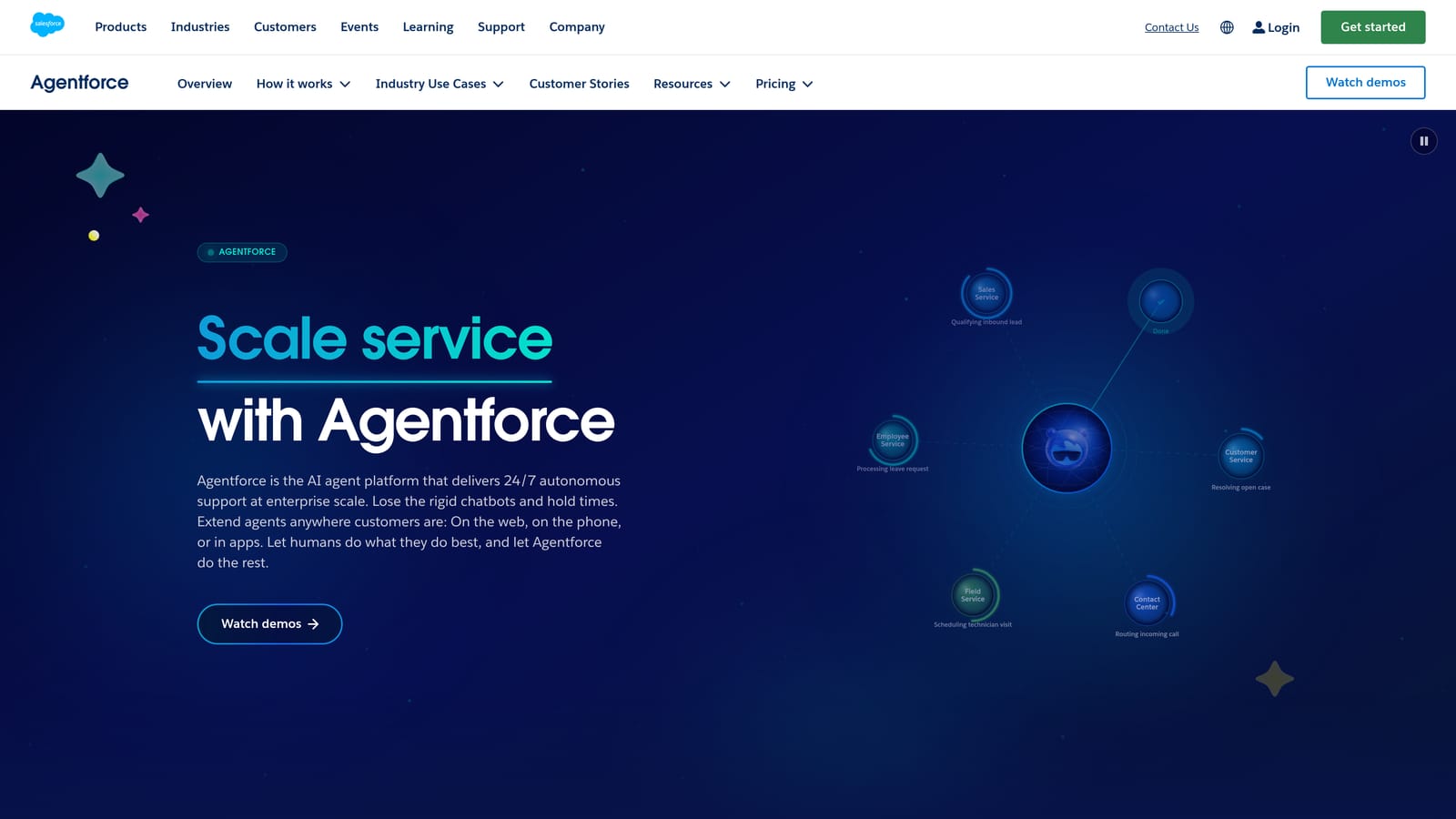
4. Salesforce Einstein Service Cloud (Agentforce)
Best for: Enterprises where Salesforce is already the system of record for customer data
Salesforce Agentforce is an AI-native support platform with full CRM data access, enabling deeply personalized autonomous resolution for enterprises running on Salesforce.
Where This Tool Shines
The core value proposition here is CRM data access. Because Agentforce operates natively within Salesforce, the AI has access to the full customer data model: account history, open opportunities, contract status, past interactions across every touchpoint. For enterprises where this data already lives in Salesforce, that context produces meaningfully better resolution quality than a standalone AI platform working with limited information.
Einstein Copilot extends this to agent assist, surfacing case history, recommended actions, and relevant knowledge articles for human agents handling escalations. The depth of personalization available here is difficult to replicate without native CRM access.
Key Features
Agentforce Autonomous Resolution: Self-service AI agent handling inbound inquiries with full access to Salesforce CRM data for personalized responses.
Einstein Copilot: AI assistant for human agents surfacing relevant case history, recommended next actions, and knowledge articles in context.
Native CRM Data Access: Full access to the Salesforce data model means AI responses are informed by complete customer context, not just recent ticket history.
Omnichannel Coverage: Handles chat, email, phone, and messaging channels within a unified platform.
Enterprise Compliance: Data residency options and enterprise-grade compliance controls for regulated industries.
Best For
Enterprises that have already standardized on Salesforce as their system of record. The AI's value scales directly with the quality and completeness of CRM data — organizations with fragmented or incomplete Salesforce data will see proportionally less benefit.
Pricing
Agentforce is priced per conversation. Service Cloud Einstein is an add-on to base Service Cloud licensing. Contact Salesforce for enterprise quotes.
5. Freshdesk Freddy AI
Best for: Mid-market enterprises evaluating cost-competitive alternatives to Zendesk or Salesforce
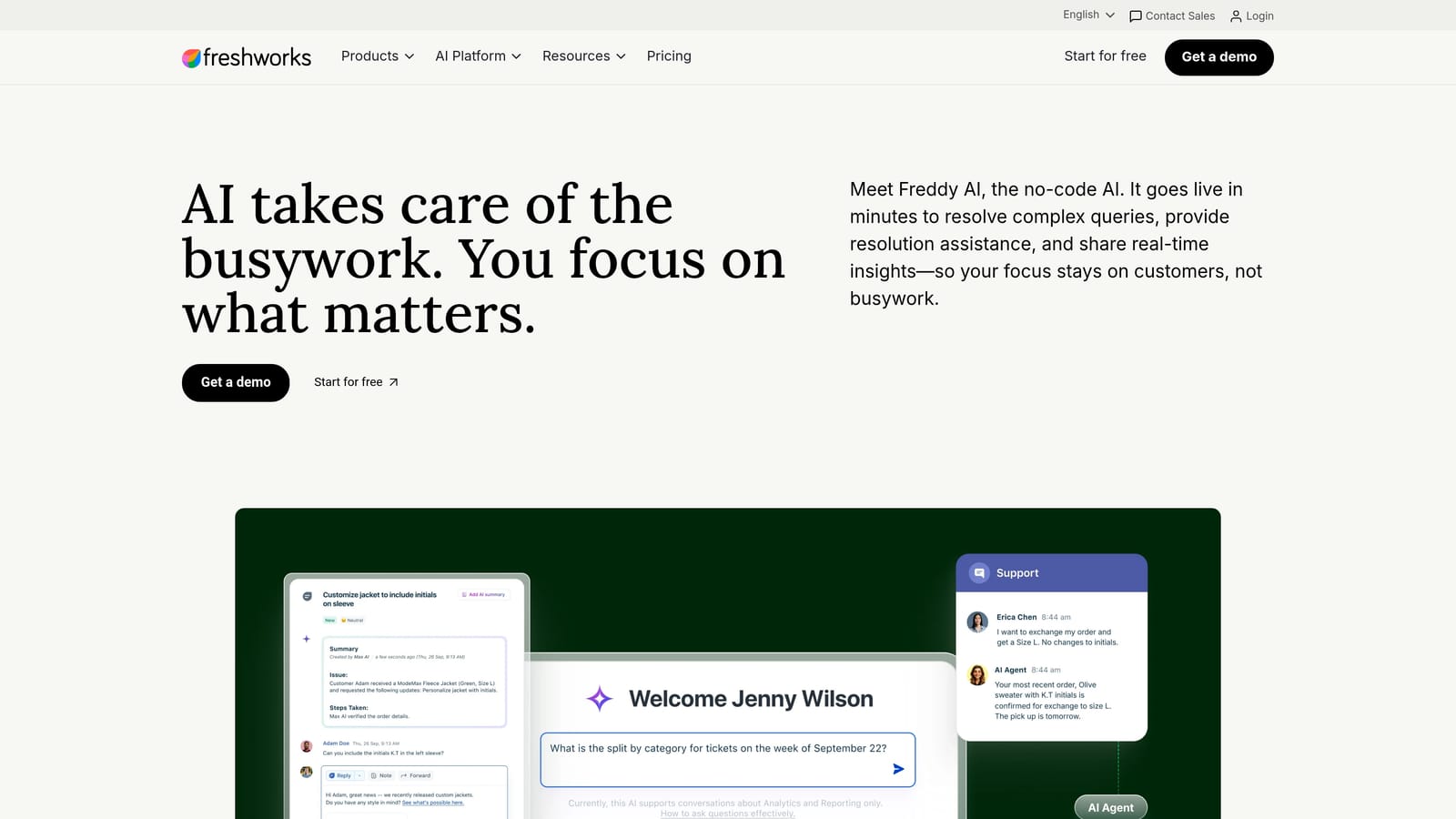
Freshdesk Freddy AI is a three-layer AI suite spanning self-service bots, agent copilot, and analytics — built natively into the Freshworks ecosystem.
Where This Tool Shines
Freddy AI's architecture covers three distinct layers: Freddy Self Service for customer-facing autonomous resolution, Freddy Copilot for agent assist, and Freddy Insights for analytics and trend detection. Having all three within a single platform reduces the integration overhead that comes with assembling a similar capability set from separate vendors.
Freshworks is frequently cited as a more cost-accessible alternative to Zendesk and Salesforce for enterprises that don't need the full weight of those platforms. For teams where pricing is a meaningful factor in the evaluation, Freshdesk often surfaces as a strong contender.
Key Features
Freddy Self Service: Customer-facing AI agent handling autonomous resolution for common inquiries across chat and email channels.
Freddy Copilot: Drafts replies, summarizes tickets, and suggests next steps for human agents handling complex or escalated cases.
Freddy Insights: Analytics layer detecting support trends, volume patterns, and resolution performance across the team.
Native Freshworks Integration: Works across Freshdesk, Freshchat, and Freshservice without additional configuration.
Enterprise Controls: Dedicated account management and advanced security controls on enterprise tiers.
Best For
Enterprises evaluating Zendesk or Salesforce alternatives where pricing is a factor, or teams already running Freshworks products that want to add AI without a platform change.
Pricing
Freddy Copilot is available as an add-on. Freddy Self Service is included in higher tiers. Enterprise pricing available on request.
6. ServiceNow AI Agents (Now Assist)
Best for: Large enterprises with ITSM, HRSD, or internal operations support workflows
ServiceNow Now Assist delivers AI agents purpose-built for ITSM, HRSD, and internal enterprise support — the dominant platform for IT and operations support at large enterprises.
Where This Tool Shines
ServiceNow is the established standard for internal enterprise support: IT helpdesks, HR case management, facilities requests, and operations workflows. Now Assist brings AI agents into these workflows with deep integrations into enterprise infrastructure — Active Directory, CMDB, and ERP systems — that external customer support platforms typically don't touch.
The governance and audit trail capabilities are particularly strong. For enterprises in regulated industries where every AI action needs to be logged and reviewable, ServiceNow's approach to compliance is a core product feature rather than an afterthought.
Key Features
Multi-Domain AI Agents: AI agents operating across IT, HR, facilities, and customer service workflows within a single platform.
Enterprise Infrastructure Integrations: Native connections to Active Directory, CMDB, and ERP systems for context-aware resolution in complex enterprise environments.
Generative AI Capabilities: Case summarization, resolution recommendations, and automated knowledge article creation from resolved cases.
Audit and Governance Controls: Strong audit trails and governance features for regulated enterprise environments requiring AI action logging.
Enterprise Security: Enterprise-grade security and compliance built into the core platform, not added as optional modules.
Best For
Large enterprises focused on internal IT and operations support. Less suited for external, customer-facing B2B SaaS support — this is the right choice when the primary use case is internal helpdesk, ITSM, or HR case management at scale.
Pricing
Enterprise licensing model. Contact ServiceNow directly for quotes.
7. Kustomer
Best for: High-volume B2C enterprises in retail, e-commerce, and consumer apps
Kustomer is a CRM-native customer service platform with AI spanning intent detection, routing, and automated resolution across every support channel.
Where This Tool Shines
Kustomer's defining architectural choice is its unified customer timeline. Every interaction — across chat, email, SMS, social, and phone — is stored on a single customer record. When AI is processing an inbound inquiry, it has access to the full relationship history, not just the current conversation. For high-volume consumer environments where customers contact support repeatedly across different channels, this context produces meaningfully better AI resolution.
The platform was acquired by Meta in 2022 and continues to operate as a standalone product. Its strongest deployments tend to be in consumer-facing enterprises handling large volumes of repetitive, high-frequency inquiries where AI can deflect effectively.
Key Features
Unified Customer Timeline: Every interaction across all channels is stored on a single customer record, giving AI complete relationship context for every inquiry.
AI Intent Detection: Predicts customer intent before routing, enabling more accurate assignment to the right resolution path.
Omnichannel Coverage: Chat, email, SMS, social, and phone handled within a single unified platform.
Automated Resolution: AI handles high-frequency, repetitive inquiry types autonomously, reducing human agent volume.
Deep Customization: Extensive configuration options for high-volume consumer enterprise environments with complex routing requirements.
Best For
High-volume B2C enterprises in retail, e-commerce, and consumer apps. Less commonly chosen for B2B SaaS support use cases where the interaction patterns and resolution complexity differ significantly from consumer support.
Pricing
Enterprise pricing on request. Contact Kustomer directly for quotes.
8. Ada
Best for: Enterprise teams wanting full AI control without engineering dependency
Ada is a no-code AI agent platform giving enterprise teams full control over AI persona, conversation flows, and escalation logic without engineering involvement.
Where This Tool Shines
Ada's positioning is distinctive: it's designed to be owned and operated by support and CX teams, not engineering. The no-code conversation builder lets non-technical teams build, test, and iterate on AI flows without filing tickets or waiting on development resources. For enterprises where the support team needs to move quickly without engineering bottlenecks, this is a meaningful operational advantage.
The AI Coach feature is particularly worth noting. Support managers can review live conversations, correct AI responses, and train the model through that feedback loop — without writing prompts or touching configuration files. It makes continuous improvement accessible to the people closest to the customer experience.
Key Features
No-Code Conversation Builder: Non-technical support teams can build and iterate AI conversation flows without engineering involvement.
AI Coach: Train and improve the AI by reviewing live conversations and correcting responses directly, creating a continuous feedback loop managed by support teams.
Brand Voice Controls: Define AI persona, tone, and escalation logic with strict controls to maintain brand consistency across every interaction.
Helpdesk Integration Layer: Integrates with Zendesk, Salesforce, and Freshdesk as an AI layer on top of existing platforms rather than replacing them.
Multilingual Support: Handles customer inquiries across dozens of languages, supporting global enterprise deployments.
Best For
Enterprises that want AI agent control to sit with the support team rather than engineering. Also well-suited for teams that want to add AI capabilities on top of an existing Zendesk, Salesforce, or Freshdesk deployment without a full platform migration.
Pricing
Enterprise pricing on request. No public pricing available.
9. Forethought
Best for: Enterprises wanting AI triage and intelligent routing as a layer on top of existing helpdesks
Forethought is an AI triage and intelligent routing platform that predicts ticket intent before agents engage, with modular products for resolution, routing, and agent assist.
Where This Tool Shines
Forethought's core strength is what happens before a ticket reaches an agent. Its Triage module predicts intent, sentiment, and priority from incoming tickets, routing them to the right queue or resolution path before any human touches them. For enterprises dealing with high ticket volumes and complex routing logic, this upstream intelligence can meaningfully reduce misrouting and the rework that follows.
The modular product structure — Solve, Triage, and Assist as separate but connected products — lets enterprises adopt incrementally. Teams can start with triage and routing, add autonomous resolution as confidence builds, and layer in agent assist without a full platform commitment upfront.
Key Features
Solve: Autonomous AI resolution for common, high-frequency ticket types — handling the full conversation without human agent involvement.
Triage: Predictive routing based on intent, sentiment, and priority signals extracted from incoming tickets before assignment.
Assist: AI copilot surfacing relevant knowledge articles and suggested responses for human agents handling escalated or complex cases.
Resolution Analytics: Reporting on resolution rates, deflection performance, and agent productivity to measure AI impact over time.
Helpdesk Integrations: Connects with Zendesk, Salesforce, Freshdesk, and other major helpdesk platforms as an intelligent layer on top.
Best For
Enterprises that want to improve triage and routing accuracy before committing to full autonomous resolution, or teams looking to add AI intelligence to an existing helpdesk without replacing the underlying platform.
Pricing
Enterprise pricing on request. Contact Forethought directly for quotes.
Which Platform Fits Your Enterprise Profile
The right choice here depends heavily on your current stack, your primary use case, and how far you want AI to go beyond ticket deflection.
If you're an existing Zendesk shop: Zendesk AI is the path of least resistance — it layers AI into workflows you've already built. Ada is also worth evaluating if you want stronger AI control without rebuilding your Zendesk setup. Forethought integrates with Zendesk and adds intelligent triage on top.
If your organization runs on Salesforce: Agentforce is the natural fit, particularly if your CRM data is clean and complete. The AI's resolution quality scales directly with the depth of customer data available in Salesforce.
If your primary need is internal ITSM or HR support: ServiceNow Now Assist is the clear choice. No other platform on this list matches its depth in IT and operations workflows at enterprise scale.
If you're a B2B SaaS company building AI-first support: Halo AI is the strongest starting point. The page-aware context, continuous learning architecture, and business intelligence capabilities go well beyond what most platforms offer — and the integration depth across your entire business stack means support stops being a cost center and starts being a signal layer for product, revenue, and engineering teams.
Your support team shouldn't scale linearly with your customer base. Let AI agents handle routine tickets, guide users through your product, and surface business intelligence while your team focuses on complex issues that need a human touch. See Halo in action and discover how continuous learning transforms every interaction into smarter, faster support.