9 Best AI-Enabled Customer Support Systems in 2026
AI-enabled customer support systems have become essential for B2B teams facing rising ticket volumes and stagnant headcount budgets. This guide evaluates nine leading platforms based on autonomous resolution capability, integration depth, and scalability, helping teams identify whether to replace legacy helpdesks or strategically augment existing workflows with purpose-built AI solutions.
 Grant CooperFounder14 min read
Customer support teams are under more pressure than ever. Ticket volumes keep climbing, customer expectations keep rising, and headcount budgets rarely keep pace with either. AI-enabled customer support systems have moved from experimental to essential, giving B2B teams the ability to resolve tickets autonomously, surface business intelligence, and scale without proportionally scaling headcount.
But not all AI support tools are built the same. Some bolt AI onto legacy helpdesk infrastructure. Others are built AI-first from the ground up. Some focus narrowly on chat deflection; others connect across your entire business stack to deliver context-aware, intelligent resolution.
This list covers nine of the strongest AI-enabled customer support systems available in 2026, evaluated on autonomous resolution capability, integration depth, learning over time, and how well they serve B2B product teams. Whether you're replacing a legacy helpdesk or augmenting an existing workflow, there's a fit here for your team.
For deeper context on what separates great AI support tools from average ones, see our guide to AI support tool features and our customer support AI software comparison.
1. Halo AI
Best for: B2B product teams wanting AI-first autonomous support with deep business intelligence
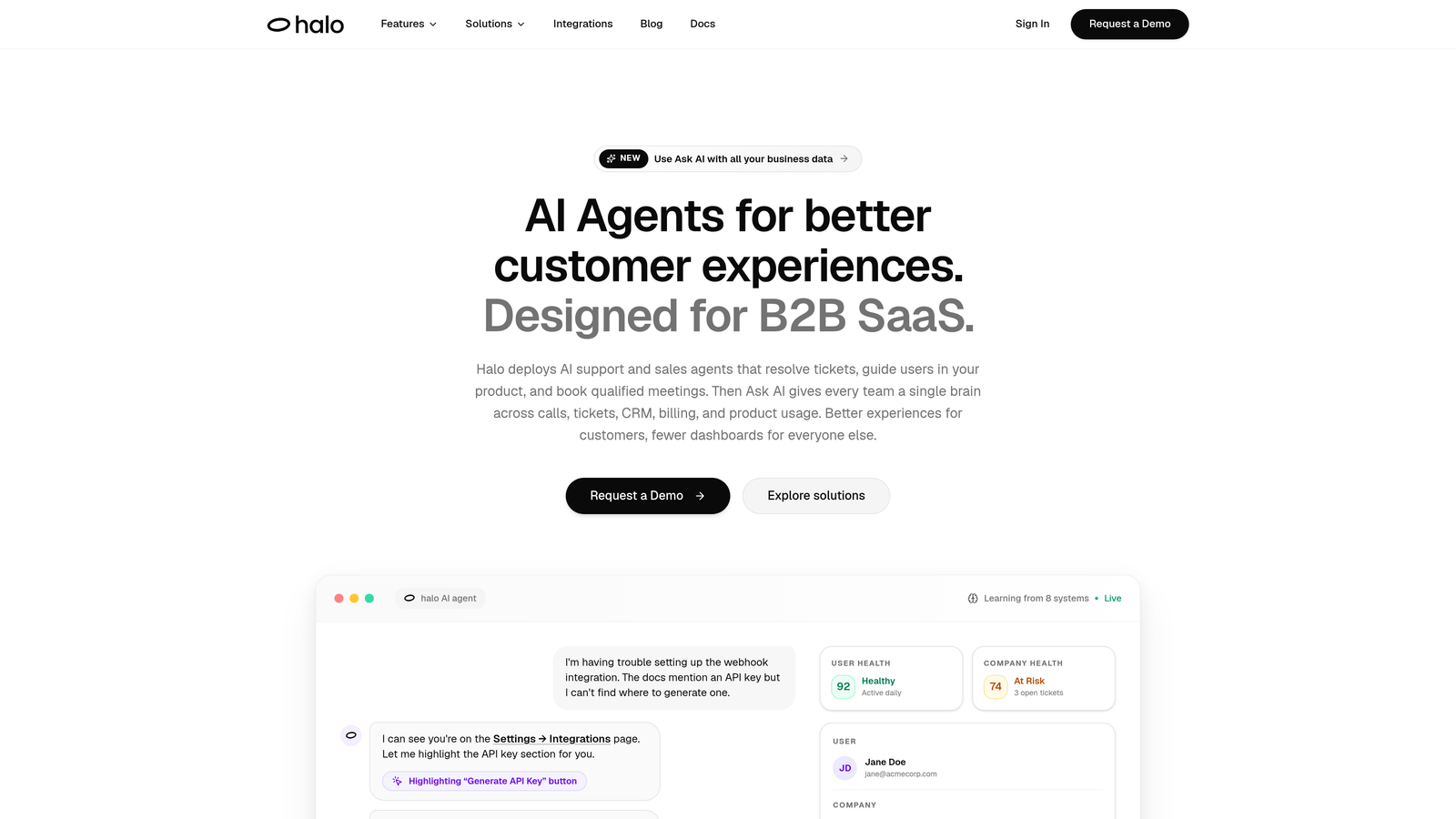
Halo AI is an AI-first customer support platform that deploys autonomous agents to resolve tickets, guide users through your product with page-aware visual assistance, and surface business intelligence — all while continuously learning from every interaction.
Where This Tool Shines
What makes Halo genuinely different is the architecture. This isn't a legacy helpdesk with an AI layer bolted on top. It was built from the ground up with autonomous resolution as the core design principle, which shows in capabilities that retrofitted platforms struggle to replicate.
The page-aware chat widget is a standout. The AI knows exactly what screen or product page a user is on when they ask for help, enabling contextual visual UI guidance rather than generic responses. Combine that with continuous learning from every resolved interaction, and the system gets measurably smarter over time rather than staying static.
Key Features
Page-Aware Chat Widget: Sees what the user sees in real time, delivering contextual visual guidance tied to their current product screen.
Autonomous Ticket Resolution: AI agents handle front-line tickets end-to-end, with intelligent live agent handoff that preserves full context for complex issues.
Auto Bug Ticket Creation: Automatically generates bug reports connected to tools like Linear, closing the loop between support and engineering without manual effort.
Smart Inbox with Business Intelligence: Surfaces customer health signals, revenue intelligence, and anomaly detection from support interactions — giving leadership visibility well beyond ticket metrics.
Deep Integration Stack: Connects natively to Linear, Slack, HubSpot, Intercom, Stripe, Zoom, PandaDoc, and Fathom for genuinely cross-functional context at the point of resolution.
Best For
Halo is the strongest fit for B2B SaaS product teams that want an AI-first system rather than an AI-augmented helpdesk. If your support queries are technical, your users are in-product when they need help, and you want support intelligence to feed back into product and revenue decisions, Halo is purpose-built for that workflow.
Pricing
Visit haloagents.ai for current pricing. Plans are designed for B2B teams at various stages of growth.
2. Zendesk AI
Best for: Enterprise teams already invested in the Zendesk ecosystem looking to add AI incrementally
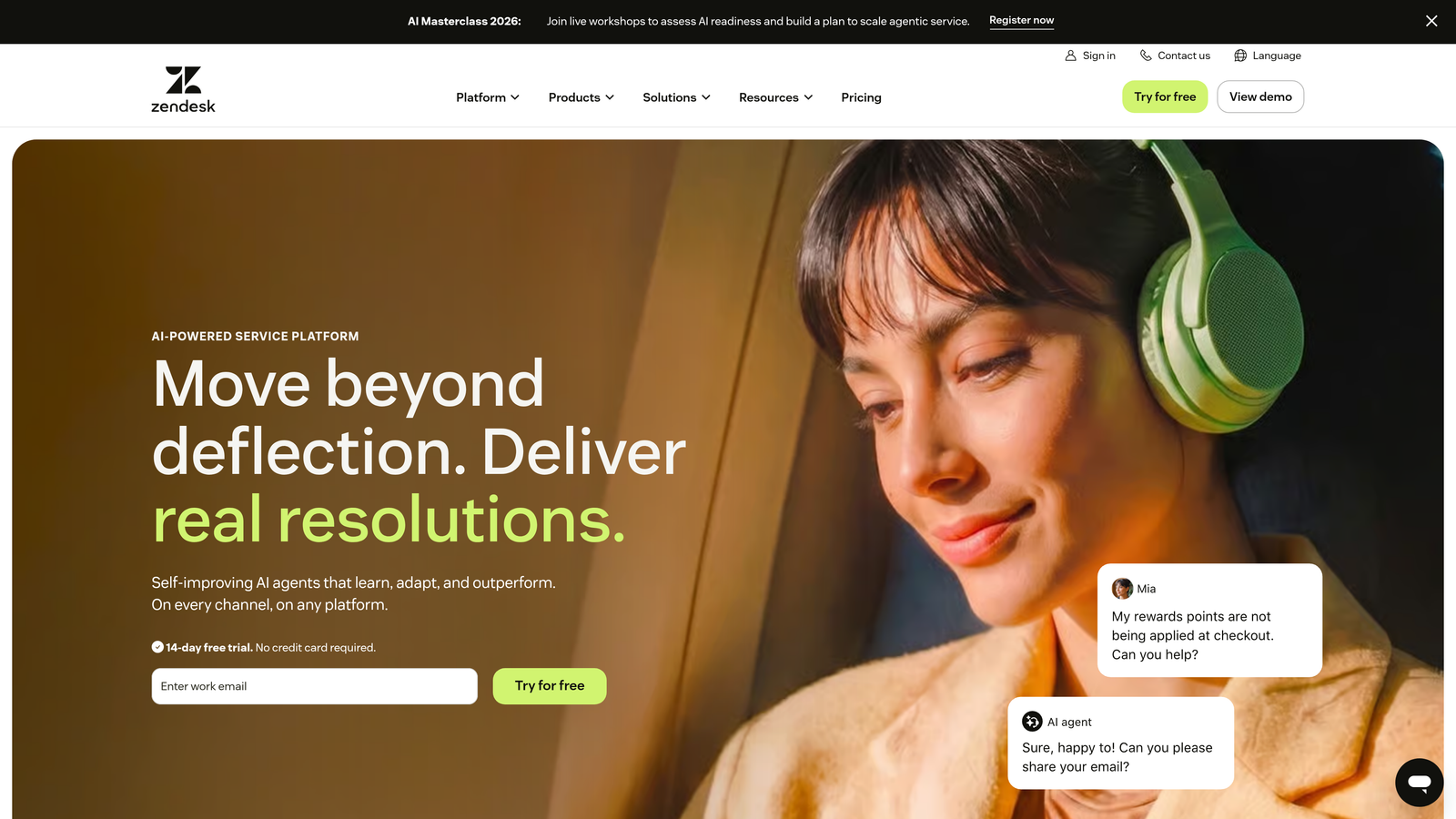
Zendesk AI is an enterprise-grade helpdesk platform with natively integrated AI capabilities for autonomous resolution, agent assist, and intelligent triage.
Where This Tool Shines
Zendesk's real strength is its maturity. The platform has years of enterprise feature development behind it: robust SLA management, a large app marketplace, complex routing logic, and broad channel support across email, chat, voice, and social. For organizations already running on Zendesk, the AI additions feel like natural extensions rather than separate tools to manage.
The Copilot feature for human agents is particularly well-executed, offering suggested replies, thread summarization, and next-best-action guidance that meaningfully reduces handle time without requiring agents to leave their existing workflow.
Key Features
AI Agents: Handle front-line autonomous resolution using your help center content and configured answer sources.
Agent Copilot: Provides suggested replies, conversation summarization, and contextual recommendations to speed up human agent responses.
Intent Detection and Sentiment Analysis: Intelligently routes tickets based on what customers are actually asking and how they're feeling when they ask it.
Enterprise SLA Management: Sophisticated SLA tracking and escalation rules suited to large support operations with complex tier structures.
Broad Channel Coverage: Unified support across email, chat, voice, and social channels with consistent AI context across all of them.
Best For
Zendesk AI is best suited for large enterprises with established Zendesk deployments that want to add AI capabilities without migrating platforms. It's less compelling as a greenfield choice for teams that want AI-first architecture from day one.
Pricing
AI features are available on higher-tier Suite plans. Contact Zendesk directly for enterprise pricing details, as costs scale significantly based on seat count and feature tier.
3. Intercom Fin
Best for: Teams that prioritize in-app chat UX and want LLM-powered front-line resolution
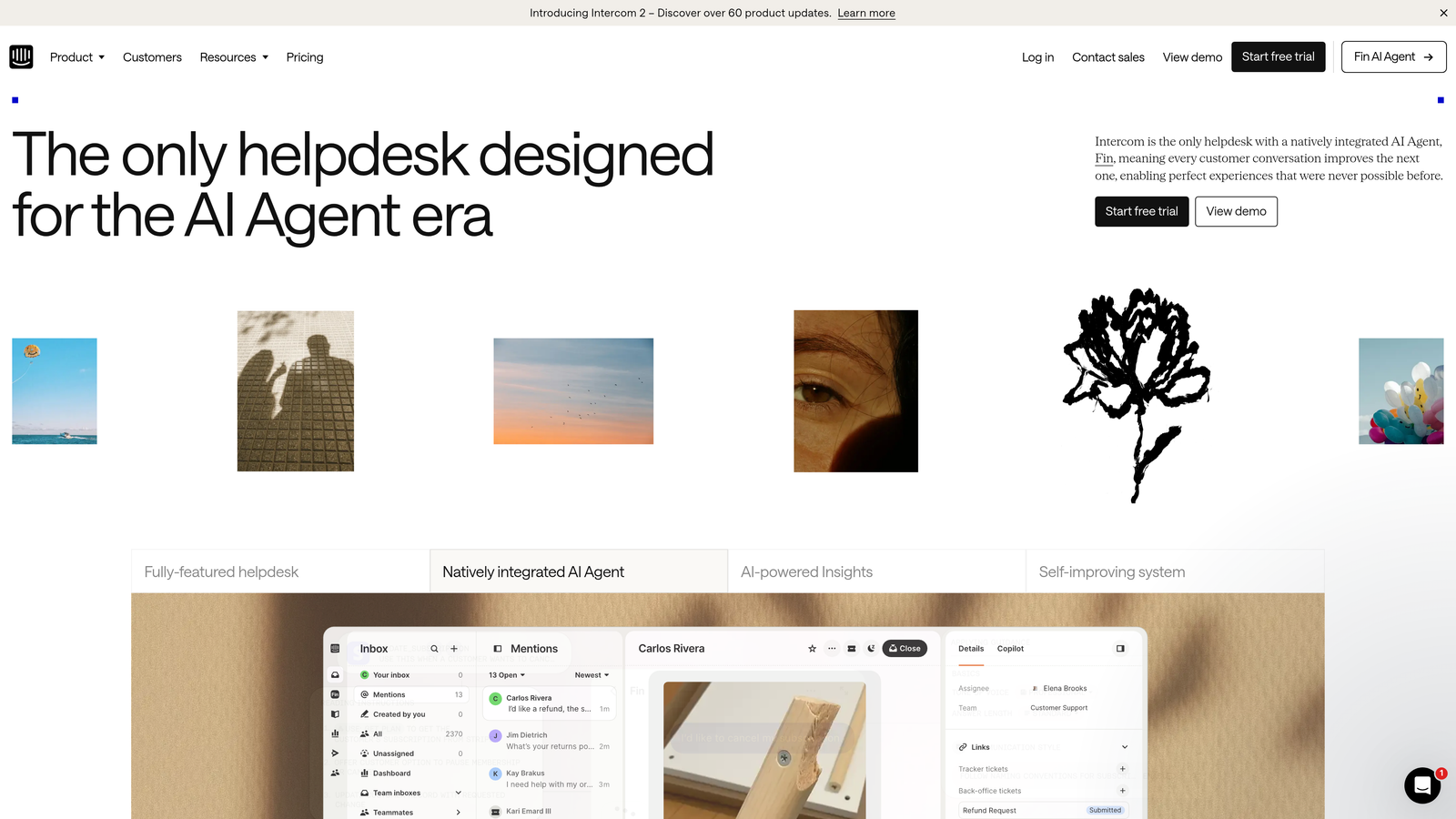
Intercom Fin is Intercom's LLM-powered AI agent designed to handle front-line customer conversations autonomously, built on top of Intercom's widely-used in-app messenger infrastructure.
Where This Tool Shines
Intercom's messenger has long been considered best-in-class for in-app chat experience, and Fin inherits that polish. The conversation interface is clean, the handoff to human agents is smooth, and the multi-source knowledge capability, drawing from help articles, PDFs, URLs, and custom answers, gives Fin a solid foundation for answering a wide range of queries.
The per-resolution pricing model is worth noting: you only pay when Fin successfully resolves a query without human intervention. For teams with predictable query volumes, this can make cost modeling straightforward.
Key Features
Fin AI Agent: Resolves customer queries autonomously using connected knowledge sources including help center articles, PDFs, and custom answer configurations.
Multi-Source Knowledge: Ingests content from multiple sources to build a comprehensive resolution knowledge base without requiring manual FAQ entry.
Seamless Human Handoff: Transfers conversations to human agents with full conversation context preserved, preventing customers from having to repeat themselves.
Best-in-Class Messenger UX: Intercom's in-app chat interface remains one of the most polished in the market for customer-facing conversation experiences.
Per-Resolution Pricing: Costs are tied directly to successful AI resolutions, creating a transparent value-to-cost relationship.
Best For
Fin is a strong choice for product teams already using Intercom's messenger who want to layer in autonomous resolution without switching platforms. It's particularly well-suited for SaaS companies with rich help center content that Fin can immediately draw from.
Pricing
Fin is priced per successful resolution in addition to Intercom's base plan. Base plans start at varying tiers; check Intercom.com for current rates as pricing structures have evolved.
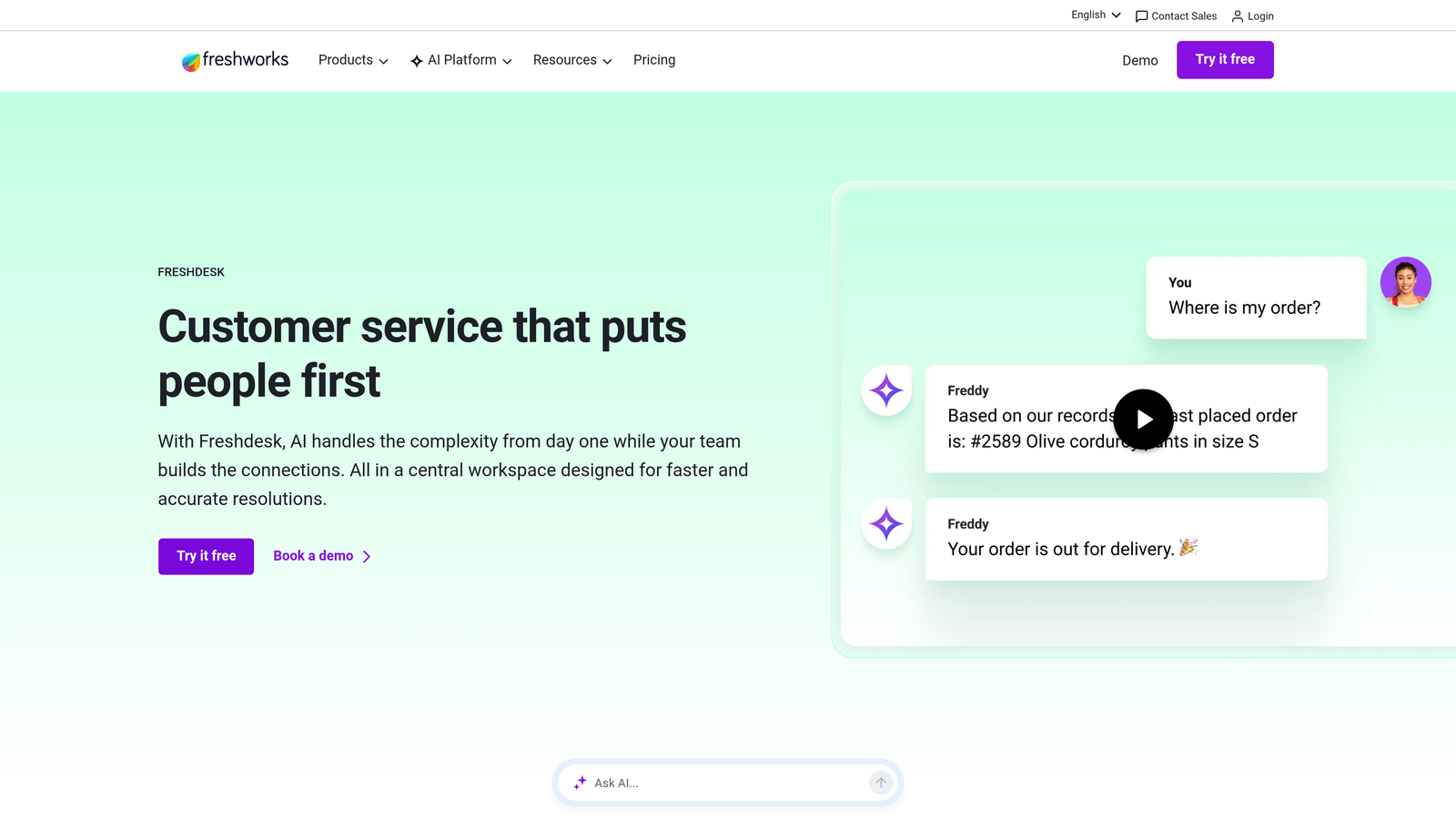
4. Freshdesk Freddy AI
Best for: SMB and mid-market teams wanting accessible AI across self-service, agent assist, and analytics
Freshdesk Freddy AI is Freshworks' AI layer across the Freshdesk helpdesk platform, offering self-service bots, agent copilot capabilities, and predictive analytics in an accessible pricing structure.
Where This Tool Shines
Freddy AI spans three distinct layers: self-service bots for customer-facing deflection, copilot assistance for human agents, and predictive analytics for support leaders. That breadth makes it a compelling option for teams that want AI working across the full support operation rather than just at the front line.
The Freshworks ecosystem integration is a genuine advantage for teams already using Freshsales or Freshservice. Data flows naturally between products, and Freddy's context spans the full customer relationship rather than just the support ticket.
Key Features
Freddy Self Service: AI bots that handle customer-facing query deflection before tickets reach the human queue.
Freddy Copilot: Provides agents with suggested replies, conversation summarization, and next-best-action recommendations during live interactions.
Freddy Insights: Predictive CSAT scoring and support analytics that help leaders anticipate issues before they escalate.
Freshworks Ecosystem Integration: Native connectivity with Freshsales and Freshservice means AI context spans sales, IT, and support in one coherent data environment.
SMB-Accessible Pricing: Freddy's pricing structure is designed to be approachable for smaller teams, not just enterprise budgets.
Best For
Freddy AI is a strong fit for SMB and mid-market teams that want practical AI capabilities across self-service, agent assist, and analytics without an enterprise implementation budget. Teams already in the Freshworks ecosystem will get the most value.
Pricing
Freddy Copilot is available as an add-on to base Freshdesk plans. Check Freshdesk.com for current pricing, as rates vary by plan tier and team size.
5. Salesforce Agentforce
Best for: Enterprises where support and CRM are tightly coupled and Salesforce is the system of record
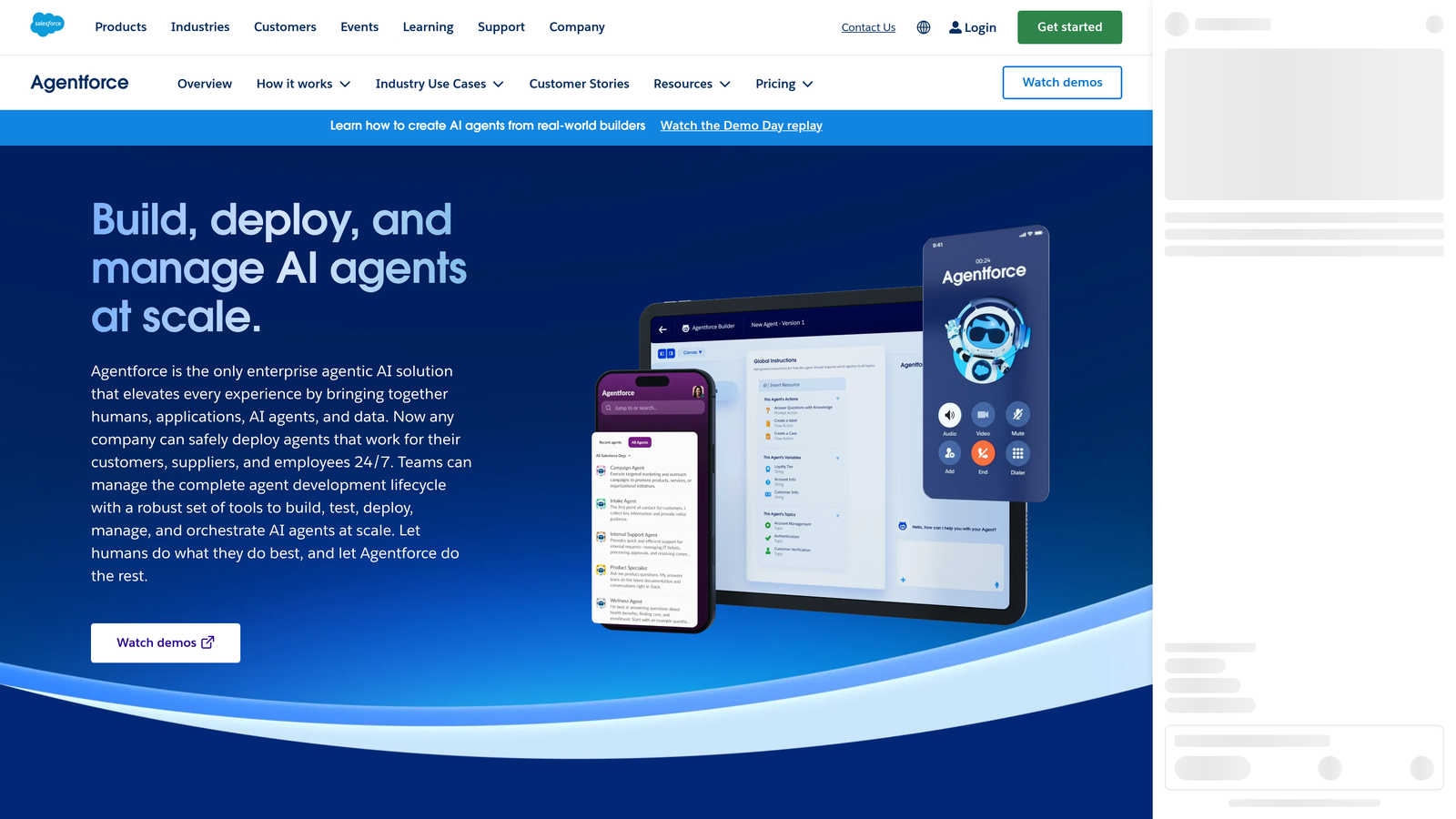
Salesforce Agentforce is Salesforce's autonomous AI agent platform, deeply embedded in the Salesforce ecosystem, enabling support AI agents that have full CRM context and customer history at the point of resolution.
Where This Tool Shines
The core differentiator for Agentforce is CRM depth. When an AI agent resolves a support ticket, it has access to the full Salesforce customer record: account history, open opportunities, contract details, previous interactions across sales and service. For enterprises where that context materially changes how support should respond, this is a significant capability that standalone support tools can't match.
The low-code agent builder allows teams to configure agent behaviors, guardrails, and escalation logic without heavy engineering involvement, which reduces the implementation burden relative to fully custom AI deployments.
Key Features
Einstein AI Foundation: Autonomous AI agents built on Salesforce's Einstein platform with access to the full Salesforce data model.
Full CRM Context: Agents resolve tickets with complete visibility into customer history, account status, and relationship data at the point of interaction.
Cross-Cloud Deployment: Agentforce can be deployed across Service Cloud, Sales Cloud, and custom Salesforce use cases from a single configuration environment.
Low-Code Agent Builder: Visual configuration tools for defining agent behaviors, topic handling, and escalation guardrails without requiring deep engineering resources.
Enterprise Security and Compliance: Salesforce's established security infrastructure, compliance certifications, and data governance controls apply to Agentforce deployments.
Best For
Agentforce is purpose-built for large enterprises where Salesforce is already the central system of record for customer relationships. Teams without a significant existing Salesforce investment will face a steep implementation curve relative to alternatives.
Pricing
Enterprise pricing applies. Contact Salesforce directly for a quote, as costs are highly dependent on existing Salesforce licensing and deployment scope.
6. Tidio Lyro
Best for: Smaller teams wanting fast AI chat deployment without a lengthy implementation project
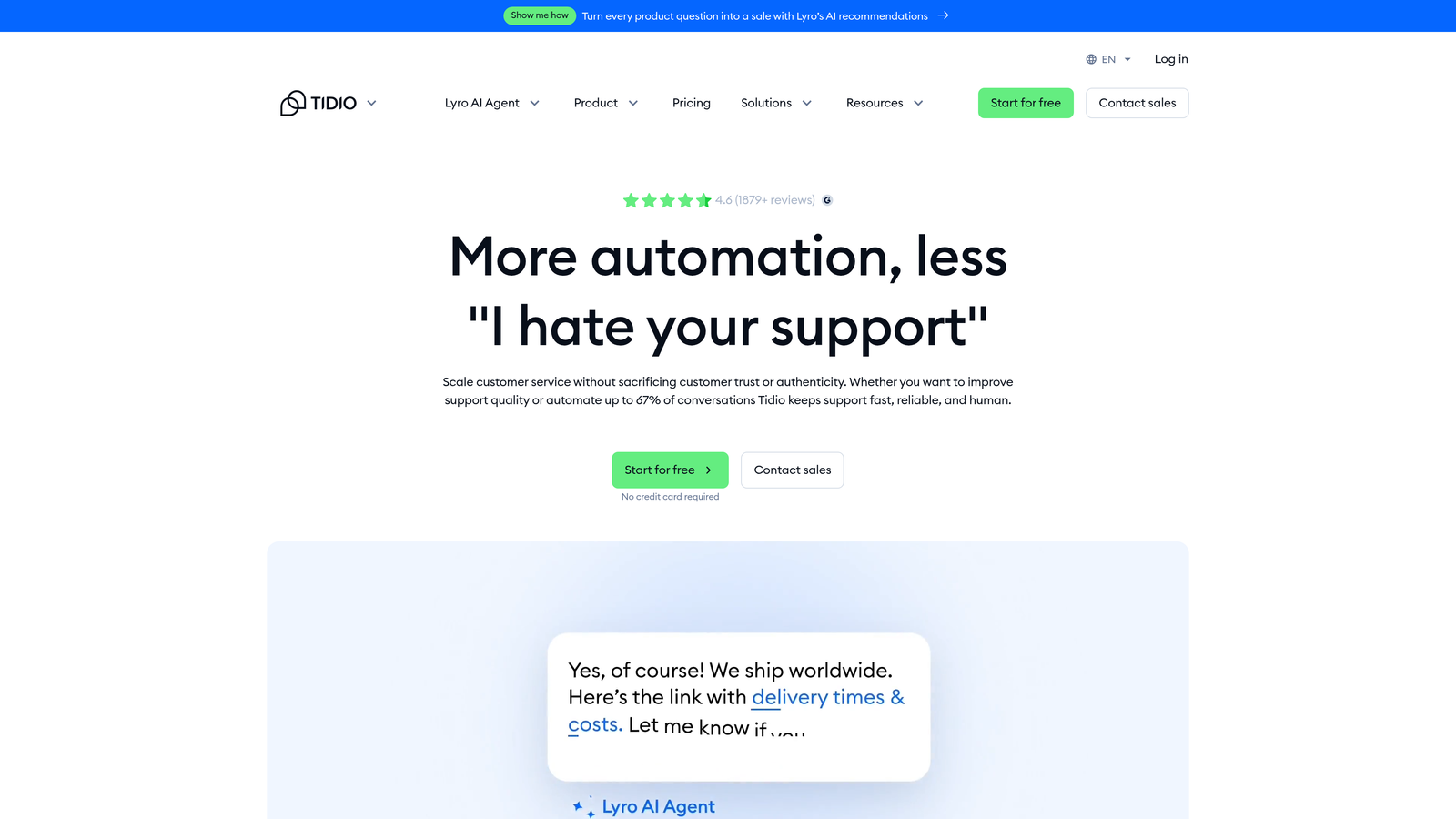
Tidio Lyro is Tidio's AI agent focused on fast deployment and accessibility, designed for smaller teams that need AI-powered chat support without a complex implementation project.
Where This Tool Shines
Lyro's primary appeal is speed to value. The AI learns from your existing help content with minimal setup, meaning teams can go from installation to live AI resolution in a short timeframe. For small businesses or early-stage teams that need working AI support quickly, that low barrier to entry is genuinely valuable.
The straightforward dashboard is designed for non-technical operators, which matters for teams that don't have dedicated support operations staff to manage complex configurations. What you sacrifice in depth, you gain in accessibility.
Key Features
Fast Knowledge Ingestion: Lyro learns from existing help content with minimal configuration, getting to useful resolution capability quickly.
Autonomous Query Handling: Handles common customer questions without human intervention and escalates appropriately when queries exceed its confidence threshold.
Multi-Channel Support: Covers live chat, email, and social channels from a single platform without requiring separate tools for each.
Non-Technical Dashboard: Designed for operators without technical backgrounds, with straightforward reporting and configuration interfaces.
Per-Conversation Pricing: Costs scale with usage volume, making expenses predictable and manageable for teams with lower conversation volumes.
Best For
Lyro is well-suited for small businesses and early-stage teams that need functional AI chat support quickly and at a manageable cost. It's less suited for complex B2B technical support environments where query depth and integration breadth matter significantly.
Pricing
Lyro is available as an add-on to Tidio plans and is priced per conversation. Check Tidio.com for current rates, as pricing tiers are updated periodically.
7. Help Scout AI
Best for: Teams where human relationship quality is the priority and AI should augment rather than replace agents
Help Scout is a human-first support platform that uses AI to make agents faster and more effective through reply drafting, thread summarization, and writing assistance, without positioning AI as a replacement for human connection.
Where This Tool Shines
Help Scout's AI philosophy is deliberately different from autonomous-resolution-first platforms. The AI is designed to reduce the cognitive load on human agents rather than route around them. AI Drafts generates reply suggestions for agents to review and edit before sending, which keeps the human voice in every response while dramatically reducing the time it takes to write one.
For teams where customer relationship quality is a competitive differentiator, this approach makes more sense than maximizing autonomous deflection. The platform is also genuinely clean and easy to use, which reduces training overhead for support teams.
Key Features
AI Drafts: Auto-generates reply drafts for agent review and editing, maintaining human oversight on every outbound response.
AI Summarize: Condenses long email threads into key points, helping agents get up to speed on complex conversations quickly.
AI Assist: Provides tone adjustment, translation, and note expansion tools that help agents communicate more effectively across contexts.
Unified Platform: Shared inbox, knowledge base, and live chat are combined in one product without requiring multiple tool subscriptions.
Relationship-Quality Focus: Platform design consistently prioritizes customer experience quality over pure automation metrics.
Best For
Help Scout is an excellent fit for teams in industries where trust and relationship quality drive retention, such as professional services, healthcare-adjacent SaaS, or any business where customers expect a human touch. It's not the right choice if autonomous ticket deflection at scale is the primary goal.
Pricing
AI features are included in Help Scout's higher-tier plans. Entry-level plans are accessible for small teams; check helpscout.com for current pricing tiers.
8. Kustomer AI
Best for: Omnichannel support teams that need CRM and helpdesk unified in a single platform
Kustomer is a CRM-native support platform that combines customer data and helpdesk functionality in one system, with AI automation that has access to the full customer timeline across every channel.
Where This Tool Shines
Kustomer's core architectural advantage is the unified customer timeline. Every interaction across email, chat, SMS, social, and voice is consolidated into a single customer record, and the AI has access to all of it at the point of resolution. This means AI routing, tagging, and auto-resolution decisions are informed by the complete relationship context, not just the current ticket.
The workflow automation capabilities through Kustomer IQ are particularly strong for teams with complex, multi-step resolution paths that don't fit simple chatbot decision trees. Custom workflows can handle nuanced scenarios that simpler AI tools would escalate unnecessarily.
Key Features
Unified Customer Timeline: Full interaction history across all channels consolidated in a single customer record accessible to both AI and human agents.
Kustomer IQ: AI-powered routing, tagging, intent detection, and auto-resolution that draws on complete customer context.
CRM and Helpdesk Combined: Eliminates the need for a separate CRM integration by building customer data management directly into the support platform.
Omnichannel Consistency: AI context is maintained consistently whether the customer contacts via email, chat, SMS, social, or voice.
Complex Workflow Automation: Multi-step resolution workflows that can handle nuanced scenarios beyond simple FAQ deflection.
Best For
Kustomer is a strong choice for mid-market and enterprise teams running omnichannel support operations where customer history across channels is critical to resolution quality. It's particularly compelling for teams that currently manage a separate CRM and helpdesk and want to consolidate.
Pricing
Enterprise pricing applies. Contact Kustomer directly for a quote based on your team size and channel requirements.
9. Capacity
Best for: Organizations wanting unified AI knowledge management across customer support, IT, and HR
Capacity is a knowledge management-first AI support platform that answers questions by drawing from a centralized knowledge base, spanning both customer support and internal use cases like IT helpdesk and HR.
Where This Tool Shines
Capacity approaches AI support from a different angle than most platforms on this list. Rather than leading with autonomous chat resolution or agent copilot features, it leads with knowledge infrastructure. The AI answers questions by pulling from a structured, centralized knowledge base rather than relying purely on LLM generation, which can produce more consistent and controllable responses in regulated or compliance-sensitive environments.
The cross-departmental scope is genuinely distinctive. Most support AI tools are scoped to customer-facing use cases. Capacity spans customer support, IT helpdesk, and HR, making it attractive for organizations that want a unified knowledge layer rather than separate AI tools for each department.
Key Features
Centralized AI Knowledge Base: A single structured knowledge repository that spans customer support, IT, and HR use cases within one platform.
Knowledge-Grounded Answers: AI responses are anchored to structured knowledge content, providing more consistent and auditable outputs than pure LLM generation.
Unified Support Platform: Helpdesk, live chat, and self-service portal are combined without requiring separate tool subscriptions for each function.
Enterprise Tool Integration: Connects with common enterprise tools for knowledge ingestion, reducing the manual effort of keeping the knowledge base current.
Cross-Department Scope: A single platform serves customer support, IT, and HR, making it efficient for organizations wanting to consolidate AI knowledge tools.
Best For
Capacity is best suited for larger organizations that want a unified AI knowledge layer across multiple departments, not just customer support. It's particularly relevant for teams in industries where answer consistency and auditability matter, such as financial services or healthcare-adjacent SaaS.
Pricing
Tiered plans are available. Contact Capacity for enterprise pricing details, as costs vary based on deployment scope and number of departments served.
Which Platform Is Right for Your Team
The right choice depends heavily on where you're starting from and what you're optimizing for. Here's a quick-reference guide by use case.
If you want AI-first architecture with deep integrations and business intelligence: Halo AI is purpose-built for this. The page-aware context, continuous learning, auto bug ticket creation, and smart inbox analytics go well beyond what retrofitted AI helpdesks offer.
If you're deeply invested in an existing platform: Zendesk AI and Freshdesk Freddy AI are the natural paths for incremental AI adoption without migration risk. Salesforce Agentforce is the equivalent for enterprises where Salesforce is the system of record.
If in-app chat experience is paramount: Intercom Fin remains one of the most polished options for LLM-powered front-line resolution with a best-in-class messenger interface.
If human relationship quality drives your retention: Help Scout's AI-augmented approach keeps humans in the loop on every response while meaningfully reducing agent workload.
If you need fast deployment at lower volume: Tidio Lyro offers the lowest barrier to entry for teams that need working AI chat support quickly without a large implementation project.
If omnichannel history and CRM context matter: Kustomer's unified timeline approach gives AI and human agents the full picture across every channel. Capacity is the right fit if unified knowledge management across support, IT, and HR is the primary goal.
Your support team shouldn't scale linearly with your customer base. Let AI agents handle routine tickets, guide users through your product, and surface business intelligence while your team focuses on complex issues that genuinely need a human touch. See Halo in action and discover how continuous learning transforms every interaction into smarter, faster support.