9 Best AI-First Customer Service Platforms in 2026
This guide evaluates the 9 best AI-first customer service platforms in 2026, focusing on solutions built with AI as the primary resolution engine rather than a legacy add-on. Each platform is assessed across five criteria—AI-native architecture, autonomous resolution, continuous learning, integration depth, and pricing transparency—to help businesses scale support operations and reduce costs.
 Matt PattoliFounder13 min read
Most customer service platforms were built for a world where humans handled every ticket and AI was an afterthought. The result? AI bolted onto legacy workflows as a sidebar feature, a suggested reply here, a deflection chatbot there, while the underlying architecture still assumes a human agent sits at the center of every interaction.
AI-first platforms flip that model entirely. The AI is the primary resolution engine. Human agents step in for complex or sensitive cases, not the other way around. That distinction matters enormously when you're evaluating total cost, resolution speed, and how well your support operation actually scales.
To build this list, we focused on five criteria: AI-native architecture, autonomous resolution capabilities beyond simple FAQ matching, continuous learning loops, integration depth with business tools, and pricing transparency. Here are the top AI-first customer service platforms worth evaluating in 2026.
1. Halo AI
Best for: B2B SaaS teams that need autonomous ticket resolution, product guidance, and business intelligence in one platform.
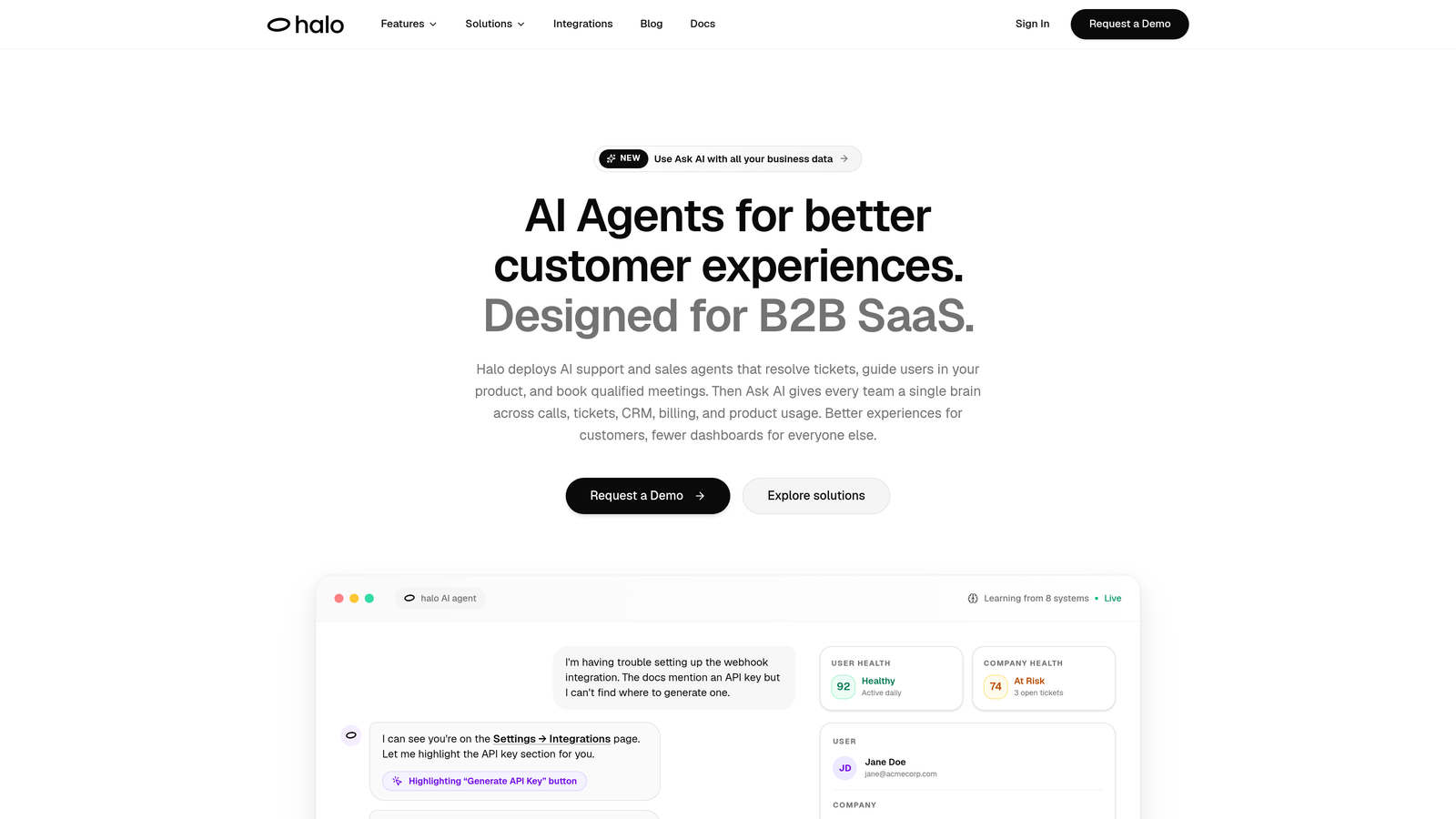
Halo AI is an AI-first customer support platform where intelligent agents resolve tickets, guide users visually through your product, and surface business intelligence — learning continuously from every interaction.
Where This Tool Shines
What separates Halo from most tools on this list is its page-aware context. The AI agent doesn't just read a user's message; it sees what they're looking at in your product and can provide visual UI guidance in real time. That's a meaningful leap beyond text-based Q&A.
The smart inbox adds another layer that most support platforms don't touch: business intelligence. Instead of just tracking ticket volume, Halo surfaces customer health signals, revenue insights, and anomaly detection, turning your support data into something your product and customer success teams can actually act on.
Key Features
Page-Aware Chat Widget: The AI sees the exact page and UI state a user is on, enabling contextual visual guidance rather than generic instructions.
Autonomous Ticket Resolution: AI agents handle support tickets end-to-end without human intervention, with escalation built in for edge cases.
Smart Inbox with Business Intelligence: Surfaces customer health signals, revenue insights, and anomaly detection alongside standard support metrics.
Auto Bug Ticket Creation: Automatically creates bug reports and routes them to Linear or other dev tools when issues are detected in support conversations.
Deep Integration Stack: Connects natively with Slack, HubSpot, Intercom, Stripe, Zoom, PandaDoc, and Fathom for a unified operational view.
Best For
Product-led SaaS companies and B2B teams that want AI handling the full support lifecycle, not just deflecting tickets. Particularly strong for teams already using Intercom, HubSpot, or Linear who want AI that connects their support data to the rest of the business.
Pricing
Contact for pricing; Halo operates on a usage-based model aligned with resolution volume rather than per-seat licensing, which tends to favor teams with high ticket-to-agent ratios.
2. Ada
Best for: Global enterprise deployments requiring multilingual, omnichannel AI with reasoning capabilities across complex customer inquiries.
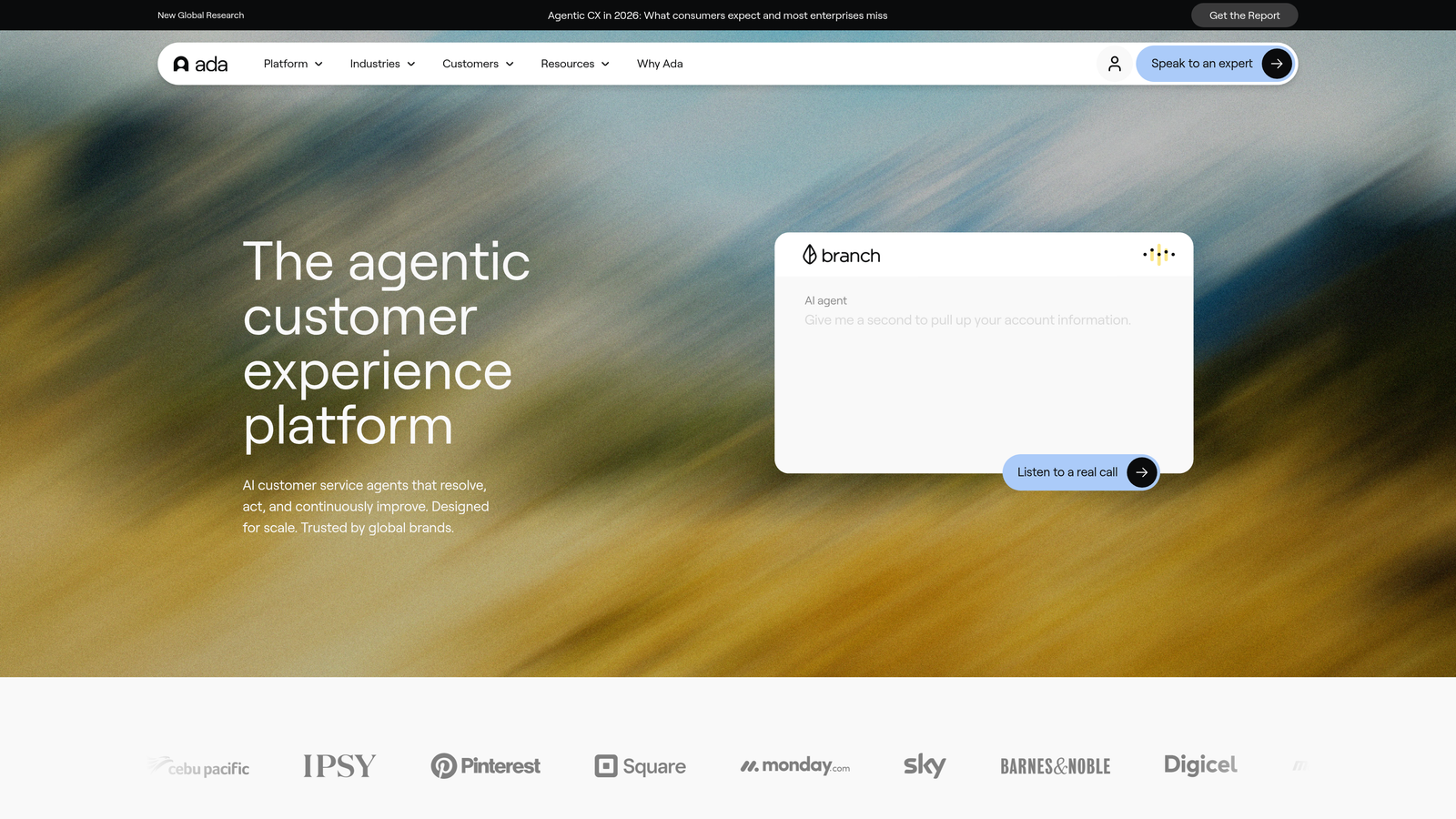
Ada is an enterprise-grade AI-first platform that replaces traditional chatbots with a reasoning AI agent designed for complex, multilingual customer interactions at scale.
Where This Tool Shines
Ada's core differentiator is its reasoning engine. Rather than navigating scripted decision trees, the AI reasons through customer inquiries dynamically, which matters when conversations don't follow predictable patterns. This makes it particularly effective for enterprises with large, complex product catalogs or nuanced support scenarios.
Its native support for 50+ languages without requiring separate configurations is a genuine advantage for companies operating across multiple markets. Ada also measures resolution quality rather than just deflection rates, which reflects a more mature understanding of what good AI support actually looks like.
Key Features
Reasoning Engine: Handles complex, non-linear customer inquiries without rigid scripted flows or decision trees.
50+ Language Support: Native multilingual capability for global enterprise deployment without additional configuration.
Omnichannel Coverage: Operates across web, mobile, social, SMS, and phone from a single platform.
Resolution Quality Metrics: Tracks whether issues were actually resolved, not just whether a human agent was avoided.
CRM and Helpdesk Integrations: Native connections to Salesforce, Zendesk, and other major platforms.
Best For
Large enterprises with global customer bases, high interaction volumes across multiple channels, and support scenarios complex enough to break simpler FAQ-matching systems. Less suited for SMBs or teams that need quick, low-configuration deployment.
Pricing
Custom enterprise pricing; contact Ada directly for quotes based on interaction volume and deployment scope.
3. Forethought
Best for: Teams already on Zendesk or Salesforce who want to add generative AI resolution and intelligent triage without migrating platforms.
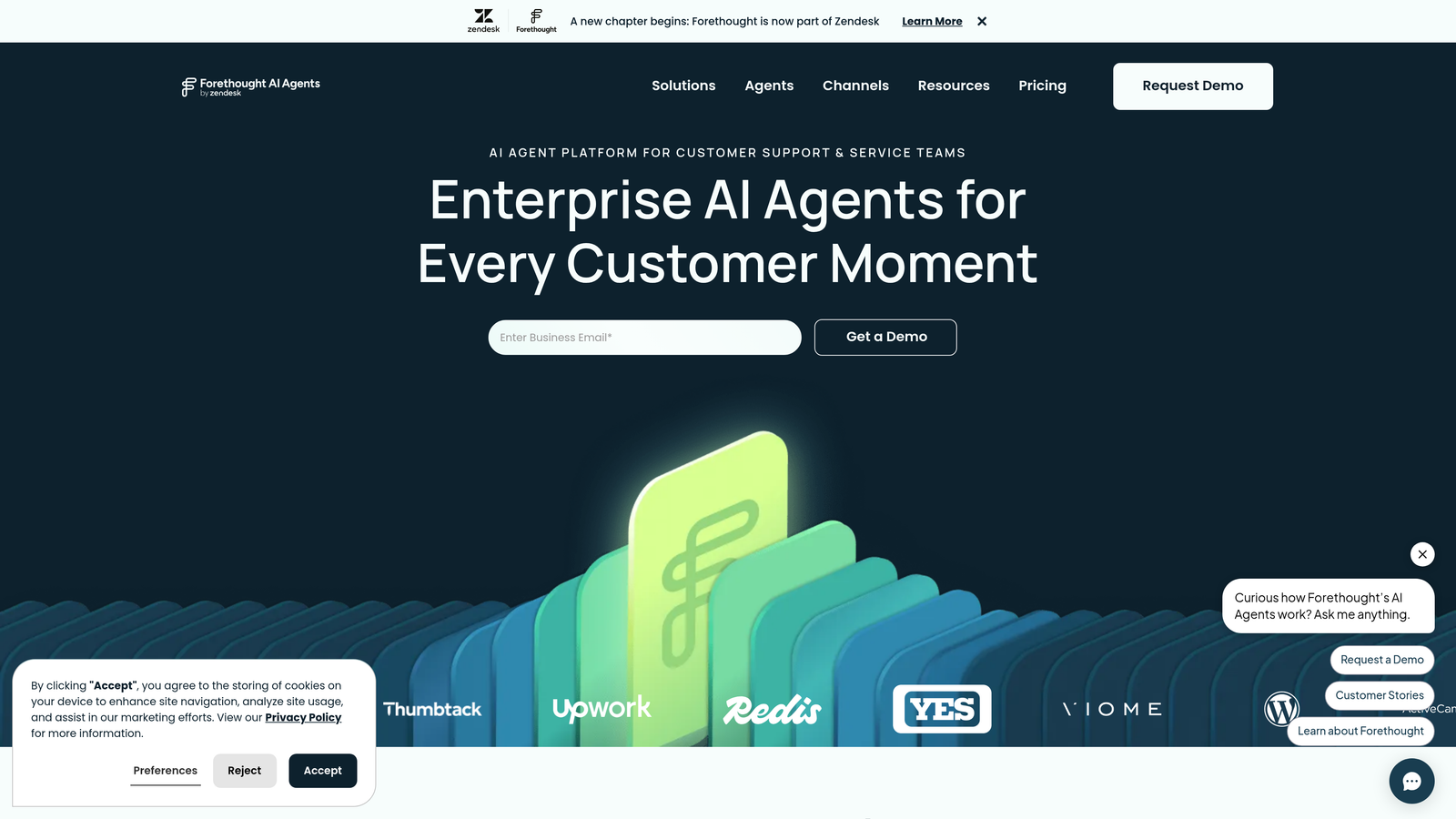
Forethought is an AI platform that layers intelligent triage, automated resolution, and agent assist capabilities on top of existing helpdesk systems.
Where This Tool Shines
Forethought's approach is deliberately additive. If you're deeply invested in Zendesk, Salesforce, or ServiceNow, Forethought enhances those systems with generative AI rather than asking you to replace them. SupportGPT handles ticket resolution using generative AI trained on your historical support data, which means it gets smarter as your ticket volume grows.
The agent assist layer is well-regarded for surfacing relevant knowledge articles and suggested responses during live conversations, reducing handle time even on tickets that do reach a human agent.
Key Features
SupportGPT: Generative AI-powered ticket resolution trained on your existing support history and knowledge base.
Intent Detection and Triage: Automatically identifies ticket intent, priority, and routing before a human ever sees it.
Agent Assist: Surfaces relevant knowledge and suggested responses to human agents during live conversations.
Workflow Automation: Handles multi-step processes like order lookups, account updates, and status checks.
Native Helpdesk Integrations: Deep integrations with Zendesk, Salesforce Service Cloud, and ServiceNow.
Best For
Mid-market and enterprise teams with existing helpdesk investments who want AI resolution capabilities without a full platform migration. Strong fit for Zendesk and Salesforce shops specifically.
Pricing
Custom pricing based on ticket volume; contact Forethought for a quote tailored to your support operation.
4. Ultimate (Zendesk AI)
Best for: Zendesk customers who want native AI agents without managing a third-party integration.
Ultimate is now Zendesk's core AI agent layer following acquisition, offering autonomous resolution built directly into the Zendesk Suite.
Where This Tool Shines
The main appeal here is tight native integration. Because Ultimate is now part of Zendesk rather than a connected third-party tool, there's no data syncing overhead, no separate vendor relationship, and no integration maintenance. If your team is already running on Zendesk, this is the lowest-friction path to AI-first resolution.
The pre-trained customer service intents also speed up deployment considerably. Rather than training the AI from scratch on what "I want a refund" or "my account is locked" means, those common intents are already understood out of the box.
Key Features
Native Zendesk Integration: AI agents operate directly within the Zendesk Suite without third-party connectors or data pipelines.
Autonomous Resolution with Escalation: Handles tickets end-to-end with intelligent handoff to human agents for complex cases.
Pre-Trained Intents: Comes with customer service intents already trained, reducing time to deployment.
Omnichannel Support: Covers email, chat, social, and messaging channels within the Zendesk ecosystem.
Marketplace Access: Leverages Zendesk's extensive app marketplace and reporting infrastructure.
Best For
Teams already committed to Zendesk as their primary helpdesk. Less compelling if you're platform-agnostic or considering a broader tool consolidation, since the value is largely tied to the Zendesk ecosystem.
Pricing
Included in Zendesk Suite plans; AI add-on pricing varies by tier. Check Zendesk's current pricing page for the most up-to-date structure.
5. Intercom Fin
Best for: Product and support teams already on Intercom who want AI resolution without adding a new vendor.
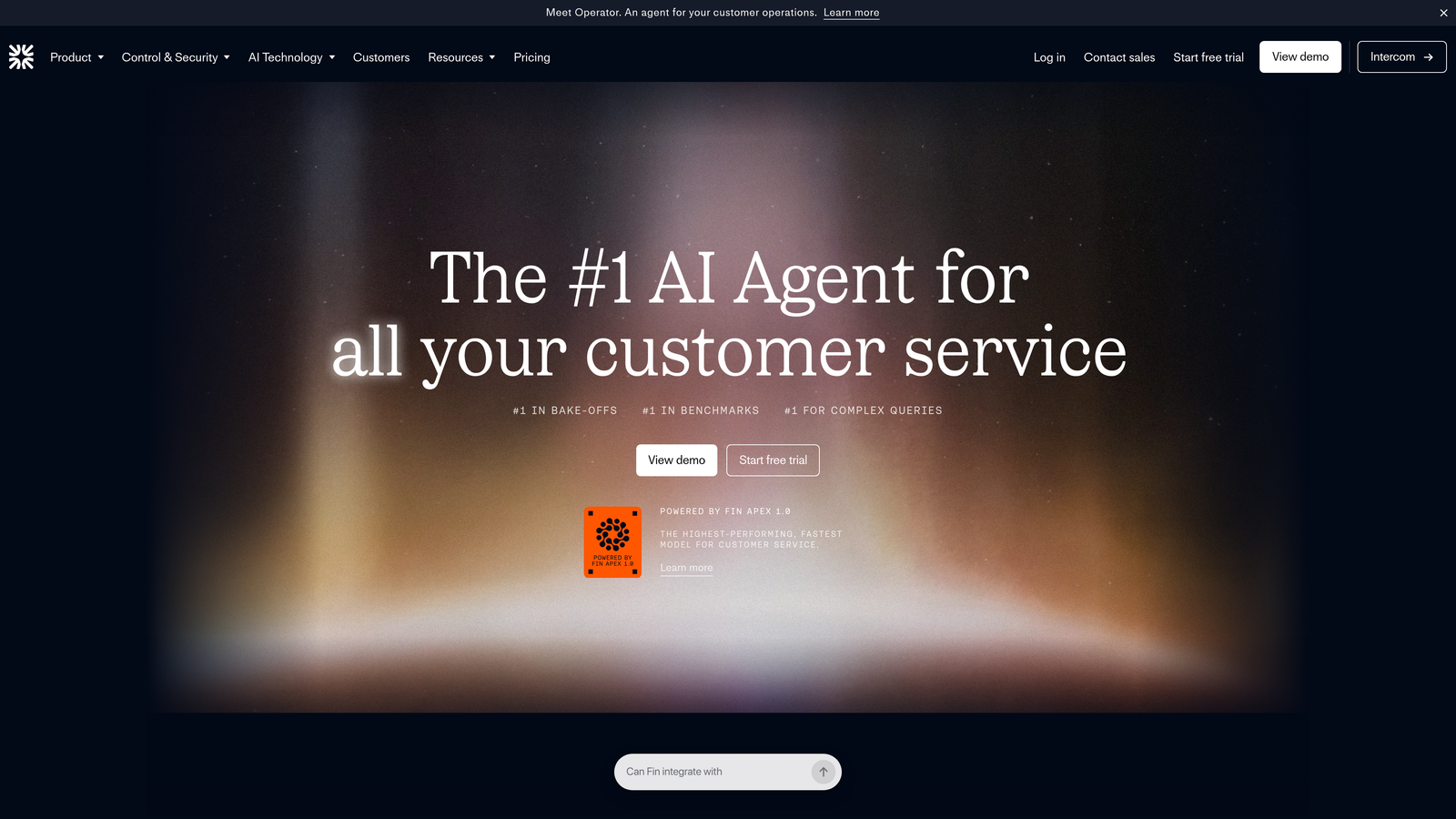
Intercom Fin is Intercom's AI agent that resolves customer questions directly from your help center, documentation, and past conversations.
Where This Tool Shines
Fin's strength is how naturally it fits into Intercom's existing conversational model. The handoff from AI to human agent happens inside the same inbox, which means customers don't experience the jarring context switch that often happens when a chatbot escalates to a live chat window from a different system.
The usage-based pricing model is also worth noting. At a per-resolution price point, Fin's cost scales directly with value delivered, which makes it easier to justify ROI compared to flat per-seat pricing on a tool that may not resolve every ticket.
Key Features
Knowledge-Based Resolution: Answers questions by drawing from your help center, documentation, and historical support conversations.
Seamless Human Handoff: Escalates to human agents within the same Intercom inbox without disrupting the conversation thread.
Custom AI Answers: Allows teams to define specific answers for nuanced, brand-sensitive, or policy-specific questions.
Product Tours Integration: Pairs AI support with Intercom's built-in onboarding flows and product tours.
Usage-Based Pricing: Charges per resolved conversation rather than per seat, aligning cost with actual resolution value.
Best For
Teams already using Intercom for customer messaging and in-app communication. The per-resolution pricing model suits companies with variable support volumes or those wanting to tie AI spend directly to outcomes.
Pricing
Starts at $0.99 per resolved conversation; Intercom platform plans start at $39 per seat per month. Pricing may vary based on plan tier and usage volume.
6. Decagon
Best for: Enterprise companies that need AI agents to take real actions, not just answer questions.
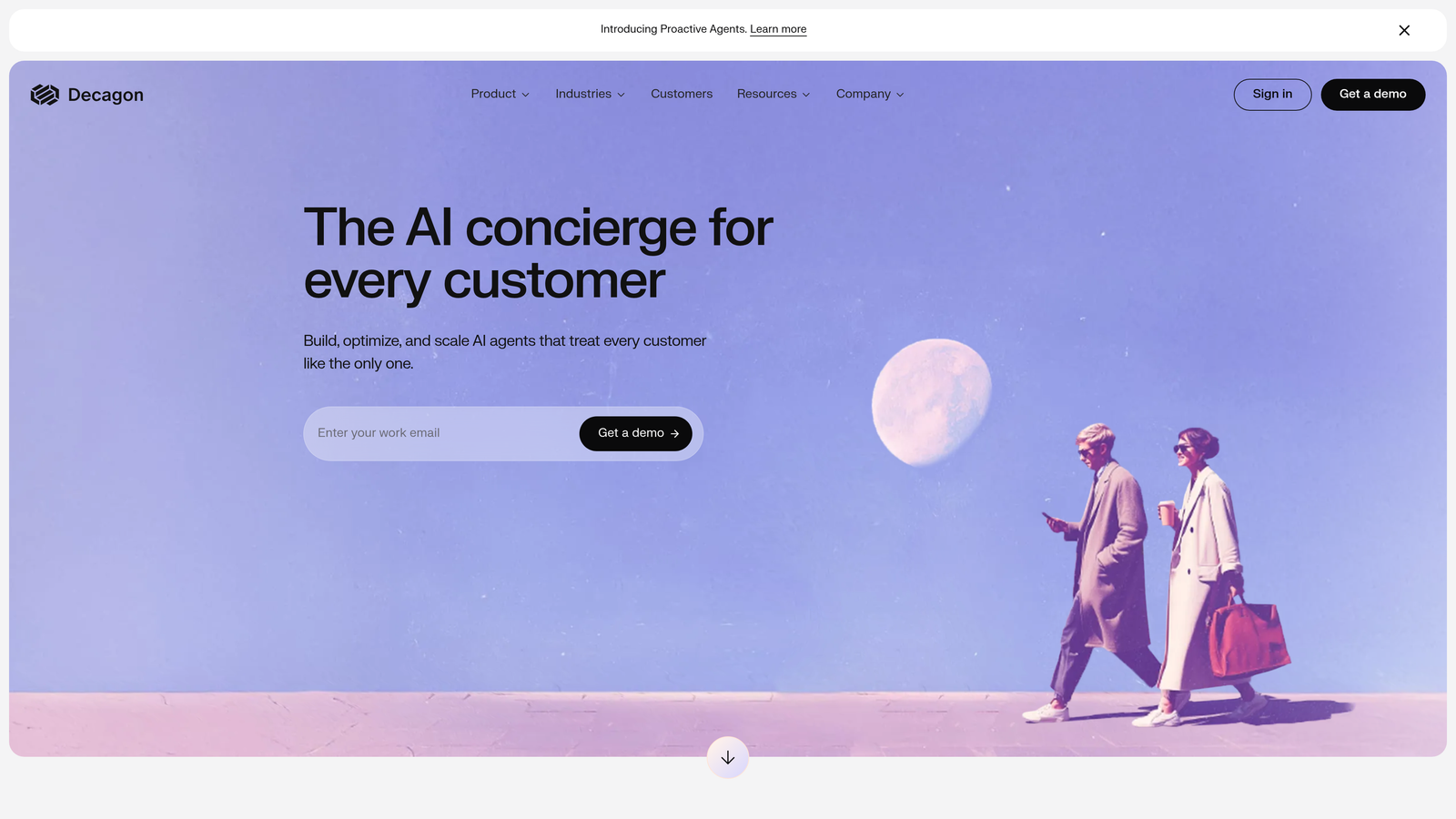
Decagon is an enterprise AI agent platform built around generative AI that executes complex workflows, including refunds, cancellations, and account changes, rather than simply providing information.
Where This Tool Shines
Most AI support tools answer questions. Decagon takes action. The distinction is significant: an AI that can actually process a refund, update a subscription, or cancel an order without routing to a human agent creates a fundamentally different support experience than one that says "here's how to request a refund."
This action-taking capability requires deep backend integrations, and Decagon has invested heavily in connecting to order management systems, billing platforms, and CRMs. The tradeoff is implementation complexity, which is why this platform is squarely positioned for enterprise deployments with dedicated technical resources.
Key Features
Agentic Action Execution: Processes refunds, cancellations, account changes, and other transactional requests autonomously.
Customizable Brand Voice: Highly configurable agent behavior, tone, and personality to match specific brand guidelines.
Backend System Integrations: Connects to order management, billing, and CRM systems for real-time data access and action execution.
Resolution Analytics: Dashboard tracking autonomous resolution rates, customer satisfaction, and agent performance.
Enterprise Security and Compliance: Built with enterprise-grade security standards and compliance certifications for regulated industries.
Best For
Enterprise consumer brands in e-commerce, subscriptions, and SaaS where a significant portion of support volume involves transactional requests that can be fully automated. Requires technical resources for implementation.
Pricing
Custom enterprise pricing; contact Decagon directly for details based on interaction volume and integration requirements.
7. Tidio (Lyro AI)
Best for: SMBs and e-commerce businesses that need affordable, fast-to-deploy AI support without a dedicated technical team.
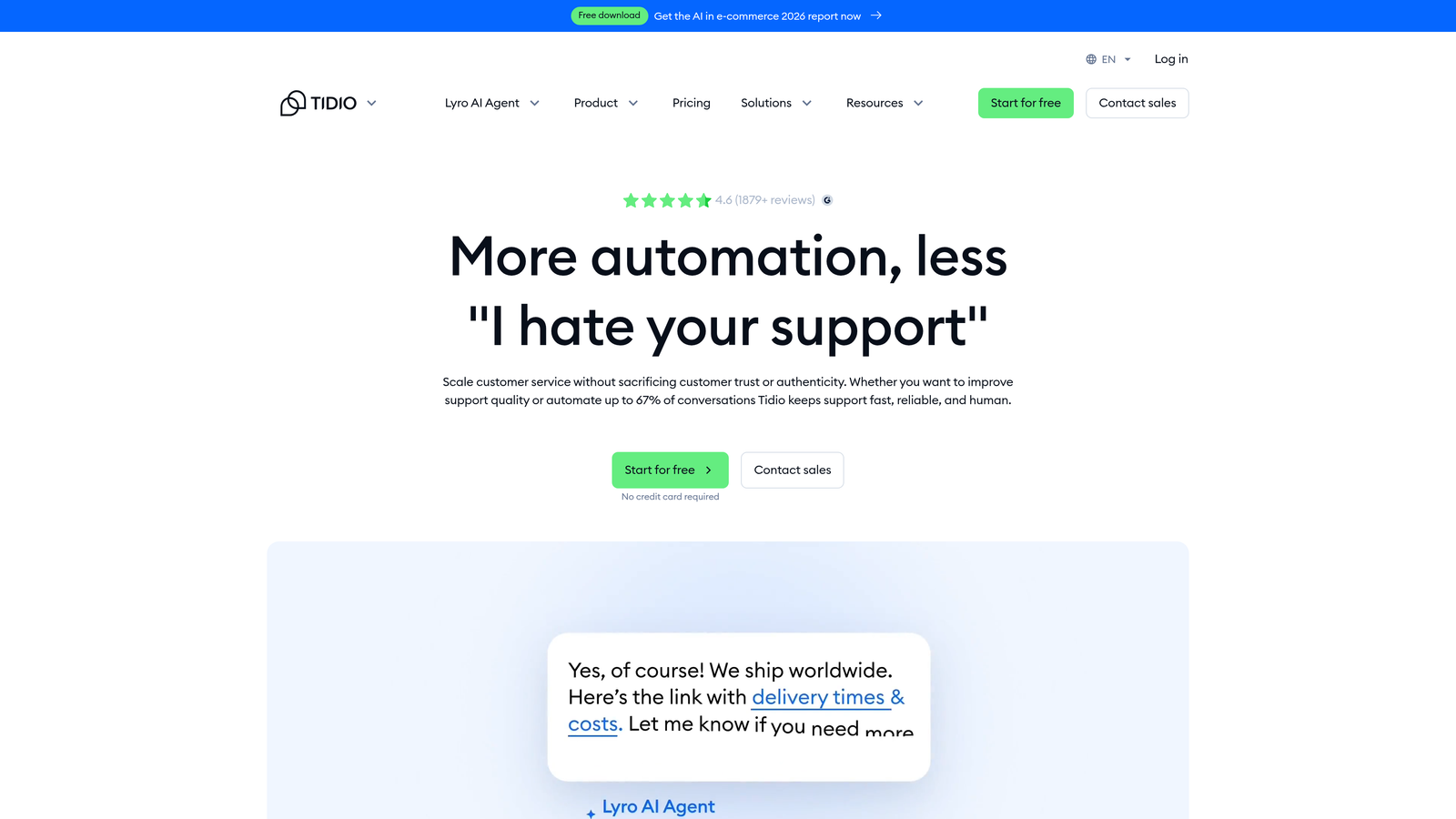
Tidio offers Lyro, a conversational AI agent designed to get SMBs and e-commerce stores up and running with AI-powered support in minutes rather than weeks.
Where This Tool Shines
Tidio's primary advantage is accessibility. Lyro learns from your existing FAQ content and help documentation quickly, which means a small team can have a functioning AI agent without a lengthy training or configuration process. The no-code visual builder also means non-technical users can customize conversation flows without developer involvement.
For e-commerce specifically, the native integrations with Shopify, WooCommerce, and BigCommerce are genuinely useful. Lyro can pull order data, answer shipping questions, and handle common post-purchase inquiries without any custom development.
Key Features
Lyro AI Agent: Learns from FAQ and help content quickly, enabling fast deployment without extensive training data requirements.
No-Code Visual Builder: Drag-and-drop chatbot builder for creating custom conversation flows without developer resources.
Live Chat Hybrid Model: Seamlessly escalates from AI to human agents within the same interface.
E-Commerce Integrations: Native connections to Shopify, WooCommerce, and BigCommerce for order-aware support.
Visitor Tracking and Analytics: Tracks visitor behavior and engagement patterns to inform support and sales conversations.
Best For
Small to mid-sized e-commerce businesses, DTC brands, and SMBs that need AI support capabilities without enterprise-level budgets or technical teams. Not the right fit for complex B2B or multi-system enterprise environments.
Pricing
Free tier available; Lyro AI starts at $39/month. Premium plans scale with usage and conversation volume.
8. Cognigy
Best for: Enterprise contact centers that need AI-first automation across both voice and digital channels with existing CCaaS infrastructure.
Cognigy is an enterprise conversational AI platform built specifically for contact center environments, covering voice AI alongside chat and messaging with deep integrations into CCaaS platforms.
Where This Tool Shines
Cognigy is one of the few platforms on this list that treats voice as a first-class channel rather than an afterthought. For contact centers where a significant portion of interactions still happen over the phone, this matters. The voice AI agents handle phone-based support with the same autonomous resolution capabilities as the digital channels.
The low-code conversation design studio is well-suited for contact center operations teams that need to build and maintain complex dialogue flows without full developer involvement. Combined with on-premise deployment options, this makes Cognigy particularly relevant for regulated industries with strict data residency requirements.
Key Features
Voice AI Agents: Handles phone-based customer support autonomously alongside chat and messaging channels.
Low-Code Conversation Studio: Visual design environment for building and managing complex, multi-turn dialogue flows.
CCaaS Platform Integrations: Native connections to Genesys, NICE, Avaya, and other major contact center infrastructure providers.
Real-Time Translation: Multilingual support with real-time translation for global contact center operations.
On-Premise Deployment: Supports on-premise and private cloud deployment for organizations with strict data governance requirements.
Best For
Large enterprise contact centers with significant voice channel volume, existing CCaaS infrastructure investments, or data residency requirements that rule out pure SaaS deployments. Overkill for teams without a traditional contact center footprint.
Pricing
Custom enterprise pricing; contact Cognigy directly for a quote based on channel mix, volume, and deployment requirements.
9. Sierra
Best for: Consumer-facing brands that need AI agents aligned with a specific brand personality, tone, and values.
Sierra is an AI agent platform co-founded by former Salesforce co-CEO Bret Taylor, focused on creating brand-aligned, empathetic AI experiences for consumer companies.
Where This Tool Shines
Sierra's differentiation is brand fidelity. Where many AI platforms optimize purely for resolution efficiency, Sierra invests heavily in making the AI agent feel like a genuine extension of the brand, matching tone, personality, and values rather than delivering generic responses. For consumer brands where customer experience is a core competitive differentiator, that distinction has real commercial weight.
The action-taking capabilities, including order management, subscription changes, and troubleshooting, are paired with continuous quality monitoring that flags interactions where the AI's behavior drifts from brand standards. That feedback loop is particularly useful for brands that have invested heavily in defining their customer experience identity.
Key Features
Brand-Aligned AI Agents: Configures agent tone, personality, and communication style to match specific brand guidelines and values.
Action Execution: Handles order management, subscription changes, and troubleshooting workflows autonomously.
Real-Time Quality Monitoring: Continuously monitors interactions to ensure AI behavior stays aligned with brand and quality standards.
Consumer Brand Focus: Designed specifically for retail, subscription, and hospitality use cases rather than B2B or contact center environments.
Trust and Safety Guardrails: Enterprise-grade safety controls to prevent off-brand, harmful, or non-compliant responses.
Best For
Consumer brands in retail, subscriptions, and hospitality where brand voice and customer experience consistency are as important as resolution efficiency. Less suited for B2B SaaS, technical support, or contact center environments.
Pricing
Custom pricing; contact Sierra directly for details.
Choosing the Right Platform for Your Team
The platforms on this list solve real problems, but they solve different problems. Picking the wrong one means paying for capabilities you don't need while lacking the ones you do.
If you're a B2B SaaS company that wants AI resolving tickets, guiding users through your product, and surfacing business intelligence across your full tool stack, Halo AI is built specifically for that use case. The page-aware context and smart inbox set it apart from platforms that treat support as an isolated function rather than a source of business signal.
For enterprise teams deeply embedded in Zendesk, Ultimate offers the lowest-friction path to AI-first resolution without adding a vendor. Intercom Fin makes the same argument for Intercom shops, with the added benefit of usage-based pricing that ties cost directly to resolved conversations.
If your support volume involves high rates of transactional requests like refunds, cancellations, and account changes, Decagon and Sierra are worth evaluating, with Decagon leaning more toward operational efficiency and Sierra toward brand experience quality. For contact centers with significant voice volume, Cognigy stands alone on this list in treating phone as a genuine first-class channel.
SMBs and e-commerce teams with limited technical resources will find Tidio the most accessible entry point, while Ada and Forethought serve global enterprises and helpdesk-augmentation use cases respectively.
The broader principle worth holding onto: AI bolted onto a legacy helpdesk and AI built as the foundational architecture are not the same product, even if they look similar in a demo. The difference shows up in resolution rates, learning velocity, and total cost as your customer base grows.
Your support team shouldn't scale linearly with your customer base. Let AI agents handle routine tickets, guide users through your product, and surface business intelligence while your team focuses on complex issues that need a human touch. See Halo in action and discover how continuous learning transforms every interaction into smarter, faster support.