9 Best AI-First Helpdesk Platforms for Smarter Support in 2026
Discover the 9 best ai first helpdesk platforms built with artificial intelligence as their foundation—not an afterthought—enabling autonomous ticket triage, resolution, and routing so support teams can scale efficiently while human agents focus only on complex cases that truly require their expertise.
 Grant CooperFounder12 min read
Traditional helpdesks were built for a world where humans did the heavy lifting and software just kept things organized. AI got added later, usually as a chatbot widget or a smart reply suggestion, bolted onto a ticketing system that was never designed with intelligence in mind. That era is ending.
AI-first helpdesk platforms flip this entirely. Instead of AI being an optional layer on top of legacy infrastructure, it's the foundation. These platforms handle triage, resolution, routing, and analytics natively through AI, with human agents stepping in for the edge cases that genuinely need them.
To make this list, each platform had to demonstrate: AI-native architecture (not just AI features), meaningful autonomous resolution capability, integration depth with modern business stacks, an intelligence layer that goes beyond basic ticket counts, and real scalability for growing teams.
Whether you're running a lean support team at a Series A startup or managing a complex enterprise operation, here are the top AI-first helpdesk platforms worth evaluating in 2026.
1. Halo AI
Best for: B2B SaaS teams that want autonomous ticket resolution with product-aware intelligence
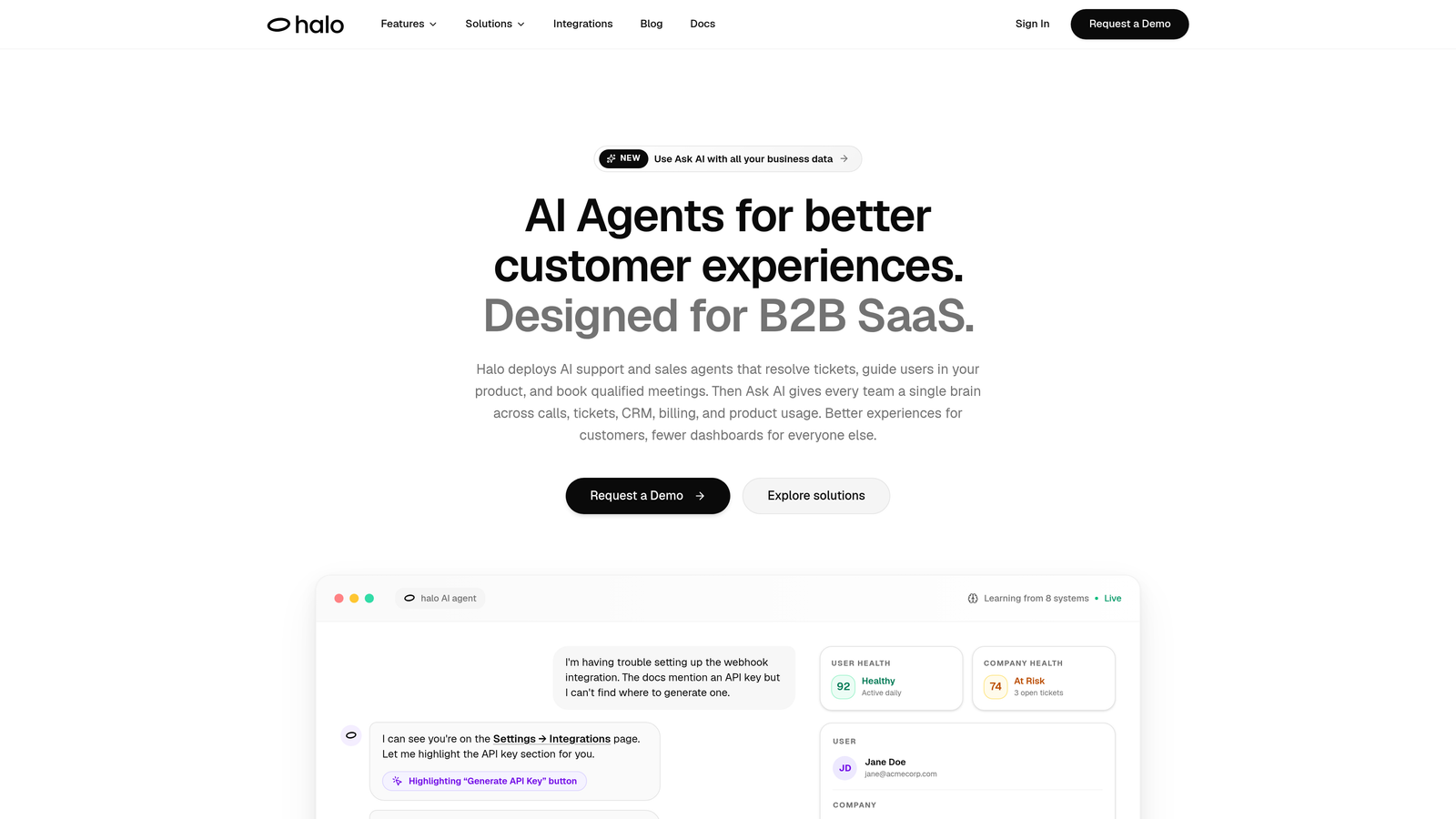
Halo AI is an AI-native customer support platform that deploys intelligent agents to resolve tickets, guide users visually through your product, and generate bug reports automatically.
Where This Tool Shines
What separates Halo from most platforms on this list is its page-aware architecture. The chat widget doesn't just respond to what a user types; it sees what the user sees. When someone is stuck on a specific screen, Halo's agent understands the context of that page and can provide visual UI guidance rather than generic instructions. That's a meaningful difference for product-led SaaS teams.
The continuous learning loop is the other standout. Every resolved ticket, every escalation, every user interaction feeds back into the system, making the AI progressively sharper over time. This isn't a static bot trained once and deployed. It's a system that gets better the more it works.
Key Features
Page-Aware Chat Widget: The AI sees the user's current page context to deliver precise, visual UI guidance rather than generic answers.
Autonomous Ticket Resolution: AI agents handle tickets end-to-end with continuous learning from every interaction, improving resolution quality over time.
Smart Inbox with Business Intelligence: Surfaces customer health signals, revenue intelligence, and anomaly detection beyond standard support metrics.
Auto Bug Ticket Creation: Automatically generates structured bug reports and routes them to the right team, with smooth live agent handoff for complex issues.
Deep Integration Stack: Native connections to Linear, Slack, HubSpot, Intercom, Stripe, Zoom, PandaDoc, and Fathom for a fully connected support operation.
Best For
B2B SaaS companies and product teams that want AI to do more than deflect tickets. Halo is particularly well-suited to teams where support data should inform product decisions, and where the line between customer success and engineering needs to be shorter.
Pricing
Contact for pricing. Designed for B2B SaaS teams scaling support operations without scaling headcount proportionally.
2. Intercom with Fin AI
Best for: Teams wanting conversational AI resolution built on existing help center content
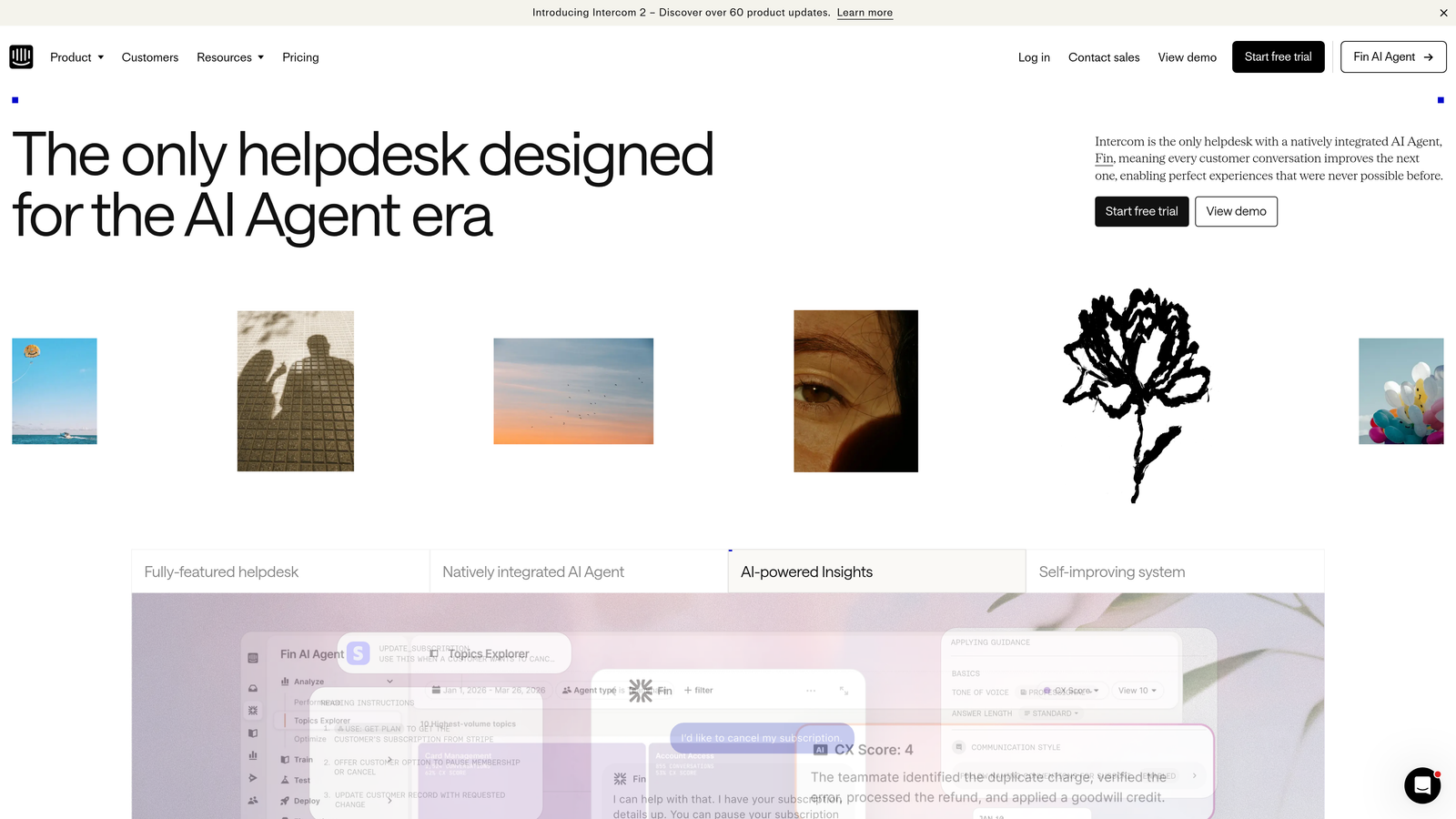
Intercom is a conversational support platform whose Fin AI agent resolves customer questions by drawing on your existing help center articles and conversation history.
Where This Tool Shines
Fin AI's biggest advantage is how quickly it can get to work. Point it at your existing help center content and it starts resolving tickets immediately, without requiring a lengthy training process or custom bot flows. For teams with well-maintained documentation, the time to value is genuinely fast.
Intercom also excels at proactive support: reaching out to users at the right moment in their journey rather than waiting for them to file a ticket. The combination of reactive AI resolution and proactive messaging creates a more complete support experience.
Key Features
Fin AI Agent: Trained on your help center articles for immediate autonomous resolution with no custom bot-building required.
Proactive Messaging: Trigger in-app messages based on user behavior to address issues before they become tickets.
Customizable Workflows: Build conversation routing and escalation logic with a visual workflow editor.
AI Resolution Reporting: Track Fin AI resolution rates, handoff rates, and agent performance in dedicated dashboards.
Best For
Product and support teams at SaaS companies that already use Intercom for customer communication and want to layer autonomous AI resolution on top of their existing content library.
Pricing
Base plans start at $39/seat/month. Fin AI is billed per resolution, so costs scale with usage rather than seat count.
3. Zendesk AI
Best for: Enterprise teams needing mature helpdesk infrastructure with AI layered throughout
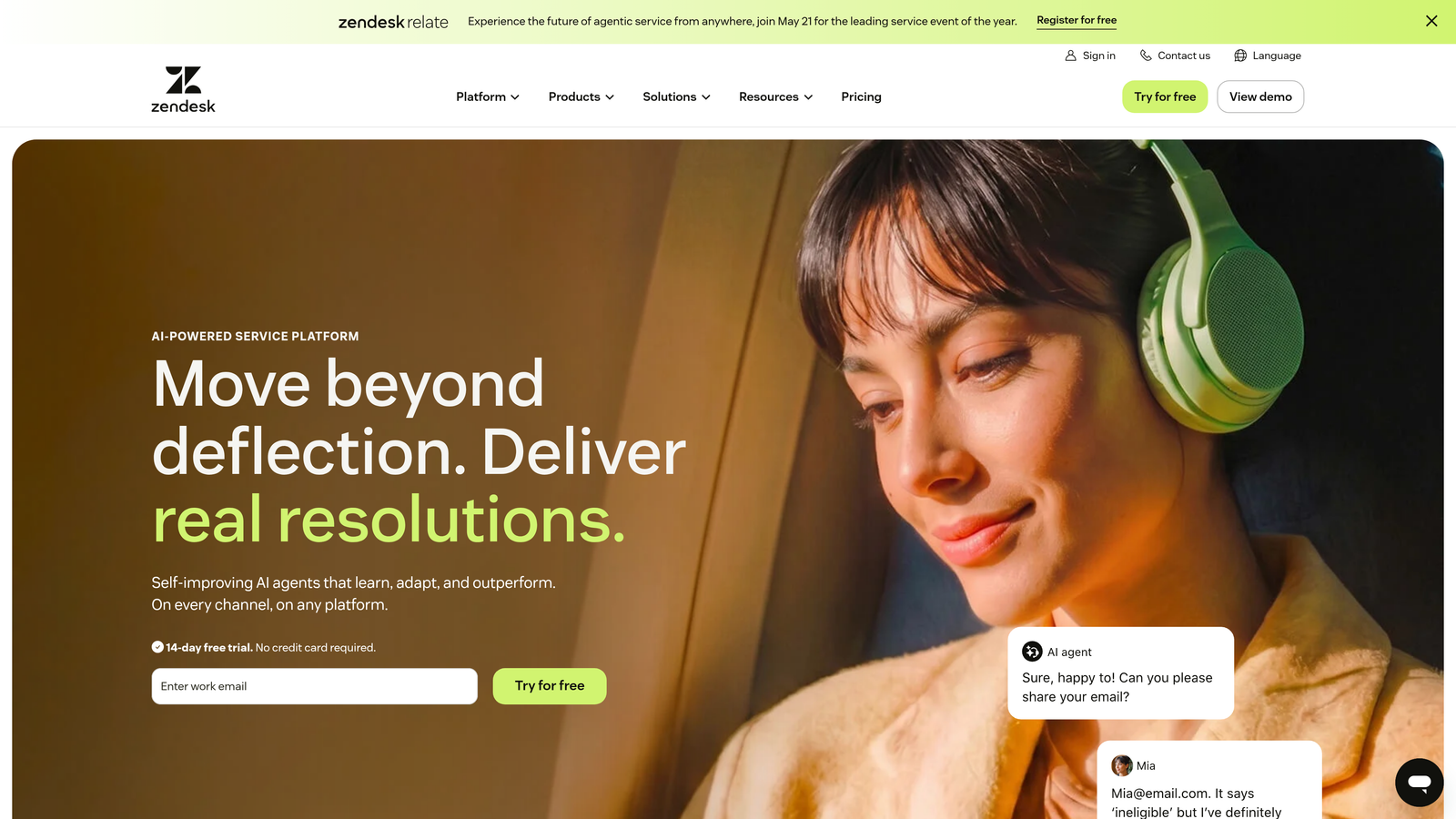
Zendesk is an enterprise-grade helpdesk platform with AI-powered intent detection, intelligent triage, and generative AI tools built into a well-established support ecosystem.
Where This Tool Shines
Zendesk's strength is its maturity. The platform has been refined over more than a decade, and its AI capabilities now sit on top of one of the most feature-complete helpdesk infrastructures available. For large teams with complex workflows, that stability matters.
The app marketplace is unmatched in breadth. If your support operation touches a tool that exists, Zendesk almost certainly has an integration for it. This makes it a strong choice for enterprises with established tech stacks they can't easily replace.
Key Features
AI Intent Detection: Automatically classifies incoming tickets by intent and sentiment for intelligent routing and prioritization.
Generative AI Assist: Suggests agent responses, summarizes long ticket threads, and helps agents resolve issues faster.
App Marketplace: Thousands of integrations covering virtually every business tool category.
Advanced Analytics: Custom reporting dashboards with deep filtering and historical trend analysis.
Best For
Enterprise support organizations with high ticket volumes, complex escalation hierarchies, and existing Zendesk investments they want to extend with AI rather than replace.
Pricing
Suite plans start at $55/agent/month. Advanced AI capabilities are available as a paid add-on on top of base plan pricing.
4. Freshdesk with Freddy AI
Best for: Budget-conscious teams wanting AI across self-service, agent assist, and analytics
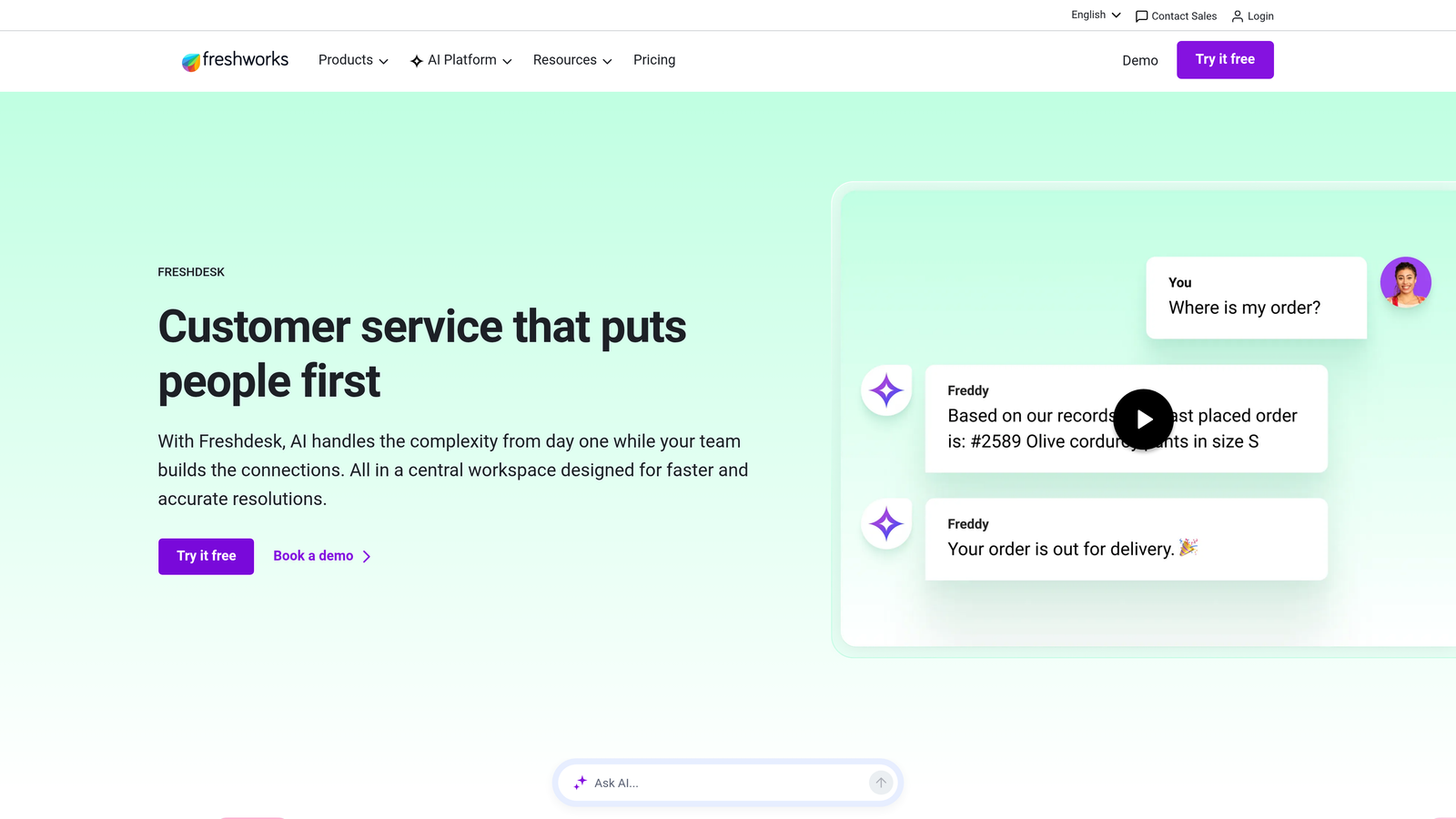
Freshdesk is an accessible helpdesk platform where Freddy AI spans the full support lifecycle, from self-service bots to agent assist to predictive analytics, within the broader Freshworks ecosystem.
Where This Tool Shines
Freshdesk punches above its price point. The Freddy AI suite covers more of the support workflow than you'd expect at these price levels, and the free tier makes it genuinely accessible for small teams getting started with AI-assisted support.
The Freshworks ecosystem is also a real advantage for teams that want CRM, ITSM, and support under one umbrella. If you're already using Freshsales or Freshservice, the integration is seamless and the unified data model adds meaningful context to every customer interaction.
Key Features
Freddy AI: Covers self-service bots, real-time agent assist suggestions, and predictive analytics across the support operation.
Free Tier: A genuinely functional free plan for small teams, not a stripped-down trial.
Freshworks Ecosystem: Native integration with Freshsales CRM and Freshservice ITSM for unified customer data.
Omnichannel Support: Manages conversations across email, live chat, phone, and social from a single inbox.
Best For
Small to mid-size businesses and growing startups that need AI-powered support without enterprise pricing, especially those already invested in the Freshworks product suite.
Pricing
Free plan available for basic use. Paid plans start at $15/agent/month, with Freddy AI features available on higher tiers.
5. Ada
Best for: Mid-market and enterprise teams prioritizing autonomous resolution across every channel
Ada is an AI-native customer service automation platform purpose-built for autonomous resolution across web, mobile, social, SMS, and email channels.
Where This Tool Shines
Ada's core philosophy is resolution, not deflection. Many chatbot platforms optimize for keeping customers away from agents; Ada optimizes for actually solving the problem. The distinction shows up in how the platform is designed: the AI agent builder focuses on resolution outcomes rather than conversation flows.
Its multilingual capability is also notable. Automated translation allows teams to deploy a single AI agent across markets without building separate bots for each language, which meaningfully reduces the operational overhead of global support.
Key Features
No-Code AI Agent Builder: Build resolution-focused AI agents without engineering resources, with an emphasis on outcomes over scripts.
Omnichannel Deployment: Single AI agent deployed consistently across web, mobile, social, SMS, and email.
CRM and Helpdesk Integration: Works as an AI resolution layer on top of existing helpdesk and CRM infrastructure.
Multilingual Support: Automated translation enables global deployment without building separate language-specific bots.
Best For
Mid-market and enterprise companies with high inbound volume across multiple channels who want to maximize autonomous resolution rates without replacing their existing helpdesk infrastructure.
Pricing
Custom pricing based on usage and scale. Typically suited for mid-market and enterprise organizations rather than early-stage startups.
6. Forethought
Best for: Enterprise support teams needing generative AI for ticket resolution and intelligent triage
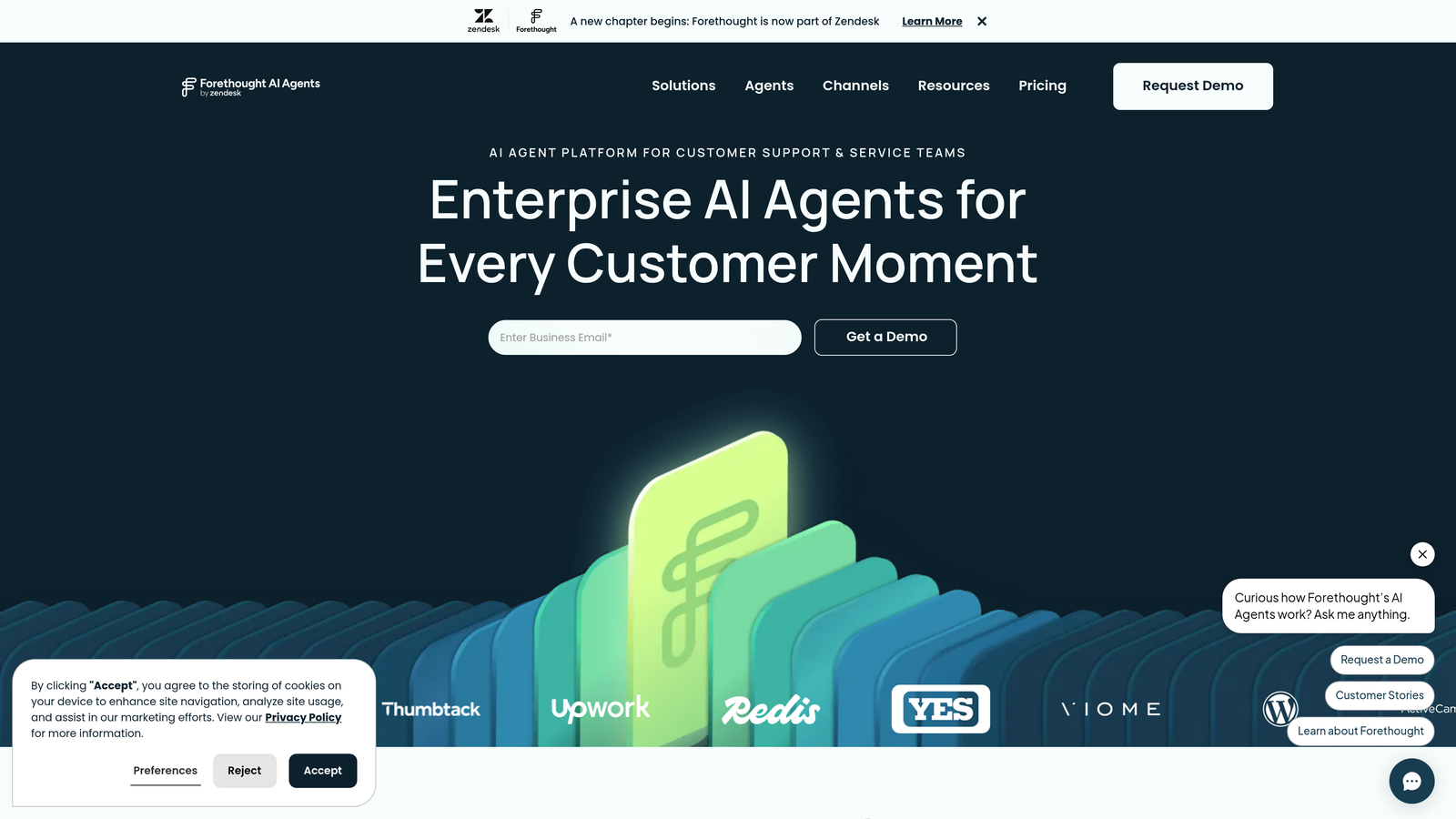
Forethought is an enterprise AI platform for customer support featuring SupportGPT for autonomous ticket handling, intelligent triage, and real-time agent assist.
Where This Tool Shines
Forethought's triage engine is particularly strong. Rather than routing tickets based on simple keyword matching, it uses predictive models to understand intent, urgency, and complexity before assigning tickets, which means agents spend less time re-routing and more time resolving.
The SupportGPT layer adds generative AI to the resolution workflow, enabling the system to compose contextual responses rather than surface static knowledge base articles. For enterprise teams handling nuanced, multi-part questions, this distinction matters.
Key Features
SupportGPT: Generative AI for autonomous ticket resolution with contextual, composed responses rather than pre-written answers.
Intelligent Triage: Predictive routing and prioritization based on intent, urgency, and complexity signals.
Agent Assist: Real-time knowledge suggestions surfaced to agents during live conversations.
Workflow Automation: Automated handling across support tiers to reduce manual handoffs and routing decisions.
Best For
Enterprise support organizations with complex, multi-tier support structures that need AI to handle both autonomous resolution and intelligent routing simultaneously.
Pricing
Custom enterprise pricing. Best suited for organizations with significant ticket volume where the ROI on autonomous resolution justifies the investment.
7. Tidio
Best for: Small businesses and e-commerce stores wanting accessible AI chat with live support
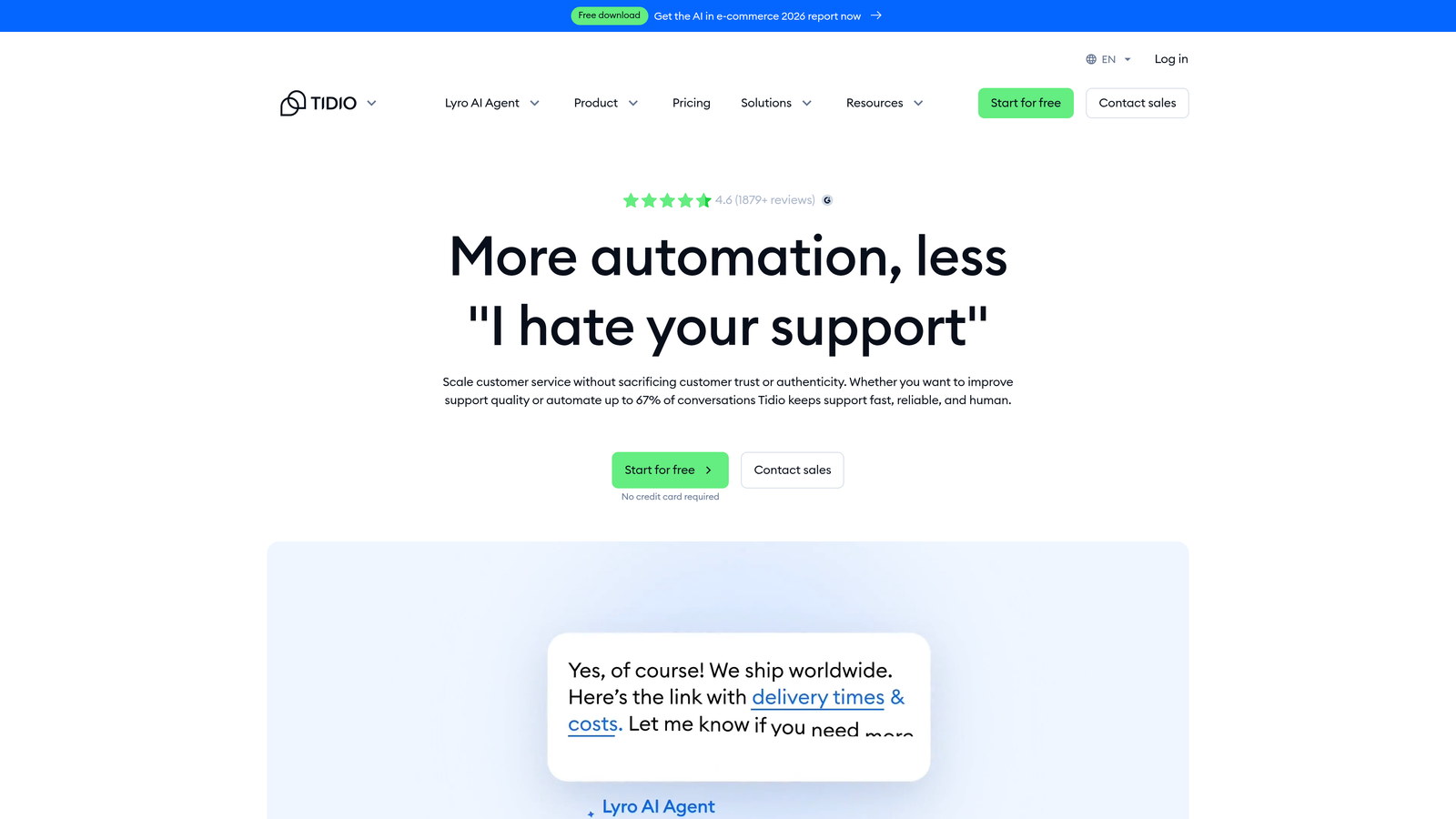
Tidio is an accessible AI chat and helpdesk platform combining the Lyro AI chatbot, live chat, and basic ticketing in a single widget designed for small businesses and online stores.
Where This Tool Shines
Tidio removes the complexity barrier that makes AI support feel out of reach for smaller teams. The Lyro AI chatbot handles common questions conversationally, and the visual flow builder lets non-technical users create custom chat automations without writing a line of code.
The e-commerce integrations are genuinely useful. Shopify and WordPress connections mean the AI can access order data, product information, and customer history to answer questions that would otherwise require a human to look things up manually.
Key Features
Lyro AI Chatbot: Conversational AI that handles common questions and learns from your support content.
Visual Flow Builder: No-code automation builder for creating custom chat flows and routing logic.
E-Commerce Integrations: Native connections to Shopify, WordPress, and other e-commerce platforms with order data access.
Combined Chat Widget: Live chat and AI chatbot in a single widget so customers get AI-first service with human backup.
Best For
Small businesses, e-commerce stores, and early-stage startups that want AI-assisted support without enterprise complexity or pricing, particularly those selling through Shopify or WordPress.
Pricing
Free plan available for basic live chat. AI features through Lyro start at $29/month, making it one of the more accessible entry points on this list.
8. Kustomer
Best for: Teams that need CRM-depth customer context embedded natively in support workflows
Kustomer is a CRM-centric helpdesk platform with AI-driven customer timelines, sentiment analysis, and an omnichannel inbox designed for context-rich, relationship-aware support.
Where This Tool Shines
Kustomer's unified customer timeline is its defining feature. Every interaction, across every channel, is assembled into a single chronological view of the customer relationship. When an agent or AI picks up a conversation, they're not starting from scratch; they have the full context of every previous interaction immediately available.
The AI layer builds on this foundation by classifying conversations, detecting sentiment, and suggesting responses based on what has worked in similar historical situations. It's support intelligence that improves with the richness of your customer data.
Key Features
Unified Customer Timeline: Full interaction history across all channels assembled into a single, chronological customer view.
AI Classification and Sentiment: Automatic conversation classification, sentiment detection, and AI-suggested responses.
Omnichannel Inbox: Email, chat, social, SMS, and voice managed from a single unified workspace.
Native CRM Data: Customer relationship data embedded directly in support workflows, not pulled from a separate system.
Best For
Customer-centric businesses where relationship context is critical to support quality: subscription services, high-touch B2C brands, and any team where knowing the customer's full history changes how you handle their issue.
Pricing
Enterprise pricing starting around $89/user/month. Positioned for teams where the depth of customer intelligence justifies the higher per-seat investment.
9. DevRev
Best for: Product-led companies bridging customer support and engineering workflows
DevRev is an AI-native platform that unifies customer support and product development, connecting customer conversations directly to engineering workflows and product decision-making.
Where This Tool Shines
DevRev solves a problem that most helpdesks ignore entirely: the gap between what customers are reporting and what product teams are building. By connecting support tickets directly to product development items, it closes the loop between customer pain and engineering action in a way that no traditional helpdesk can replicate.
The AI-powered clustering feature is particularly useful for product teams. Rather than manually reading through hundreds of tickets to identify patterns, DevRev groups customer issues into product themes automatically, surfacing the signal that should be driving roadmap decisions.
Key Features
Turing AI Bot: Automated resolution with simultaneous extraction of product insights from customer conversations.
Support-to-Engineering Connection: Direct linkage between customer tickets and product development items for closed-loop issue tracking.
Developer-Centric Workflows: Built for product-led growth organizations where engineering and support teams need to work from shared context.
AI Issue Clustering: Automatically groups customer-reported issues into product themes to surface roadmap-relevant patterns.
Best For
Product-led SaaS companies and developer-focused teams where customer support data should directly inform product development priorities, and where the traditional separation between support and engineering creates costly blind spots.
Pricing
Free tier available. Paid plans start at $19.99/user/month, making it one of the more accessible options for early-stage product teams.
Choosing the Right AI-First Helpdesk for Your Team
The platforms on this list aren't interchangeable. They reflect genuinely different philosophies about what AI-first support should look like, and the right choice depends heavily on what you're optimizing for.
If your priority is deep product integration and business intelligence beyond support metrics, Halo AI is built specifically for that use case. The page-aware context, continuous learning architecture, and connections to tools like Linear and Stripe make it the strongest fit for B2B SaaS teams where support data should feed back into product and revenue decisions.
If you're an enterprise team with an existing Zendesk or Freshdesk investment, adding AI capabilities through those platforms is a lower-disruption path. If you need to bridge the gap between support and product development, DevRev is purpose-built for that workflow. If you're a small e-commerce business getting started with AI chat, Tidio offers the lowest barrier to entry.
Here's a quick selection guide by use case:
B2B SaaS with product-aware AI needs: Halo AI
Conversational AI on existing help content: Intercom with Fin AI
Enterprise scale with mature infrastructure: Zendesk AI
Budget-friendly with full AI suite: Freshdesk with Freddy AI
Maximum autonomous resolution across channels: Ada
Enterprise triage and generative resolution: Forethought
Small business and e-commerce: Tidio
CRM-depth customer context in support: Kustomer
Connecting support to product development: DevRev
Your support team shouldn't scale linearly with your customer base. AI agents can handle routine tickets, guide users through your product in real time, and surface business intelligence that actually informs decisions, while your team focuses on the complex issues that genuinely need a human touch. See Halo in action and discover how continuous learning transforms every interaction into smarter, faster support.