9 Best AI-First Helpdesk Platforms in 2026
AI first helpdesk platforms are redefining customer support by making intelligence the core architecture rather than a bolted-on feature — enabling autonomous ticket resolution, continuous learning, and actionable business insights. This guide ranks the 9 best options available in 2026, evaluated on autonomy depth, integration breadth, and real-world fit for B2B and product-led teams.
 Grant CooperFounder13 min read
Traditional helpdesks were built for human agents. AI was bolted on later, tucked behind a premium tier, and often limited to suggested replies or basic chatbots. AI-first helpdesk platforms flip that model entirely: intelligence is the architecture, not the feature you unlock at a higher price point.
The result is support that resolves tickets autonomously, learns from every interaction, and surfaces business insights that legacy tools simply can't. Whether you're a SaaS team drowning in repetitive tickets or a scaling B2B company trying to grow support capacity without growing headcount, the right AI-first platform can fundamentally change how your team operates.
This list covers the top AI-first helpdesk platforms available in 2026, evaluated on autonomy depth, integration breadth, learning capability, and real-world fit for B2B and product-led teams. Halo AI appears at #1 because it's the platform behind this content, but every tool here is assessed on genuine merit.
1. Halo AI
Best for: B2B SaaS teams that want true AI-first autonomy with business intelligence built in
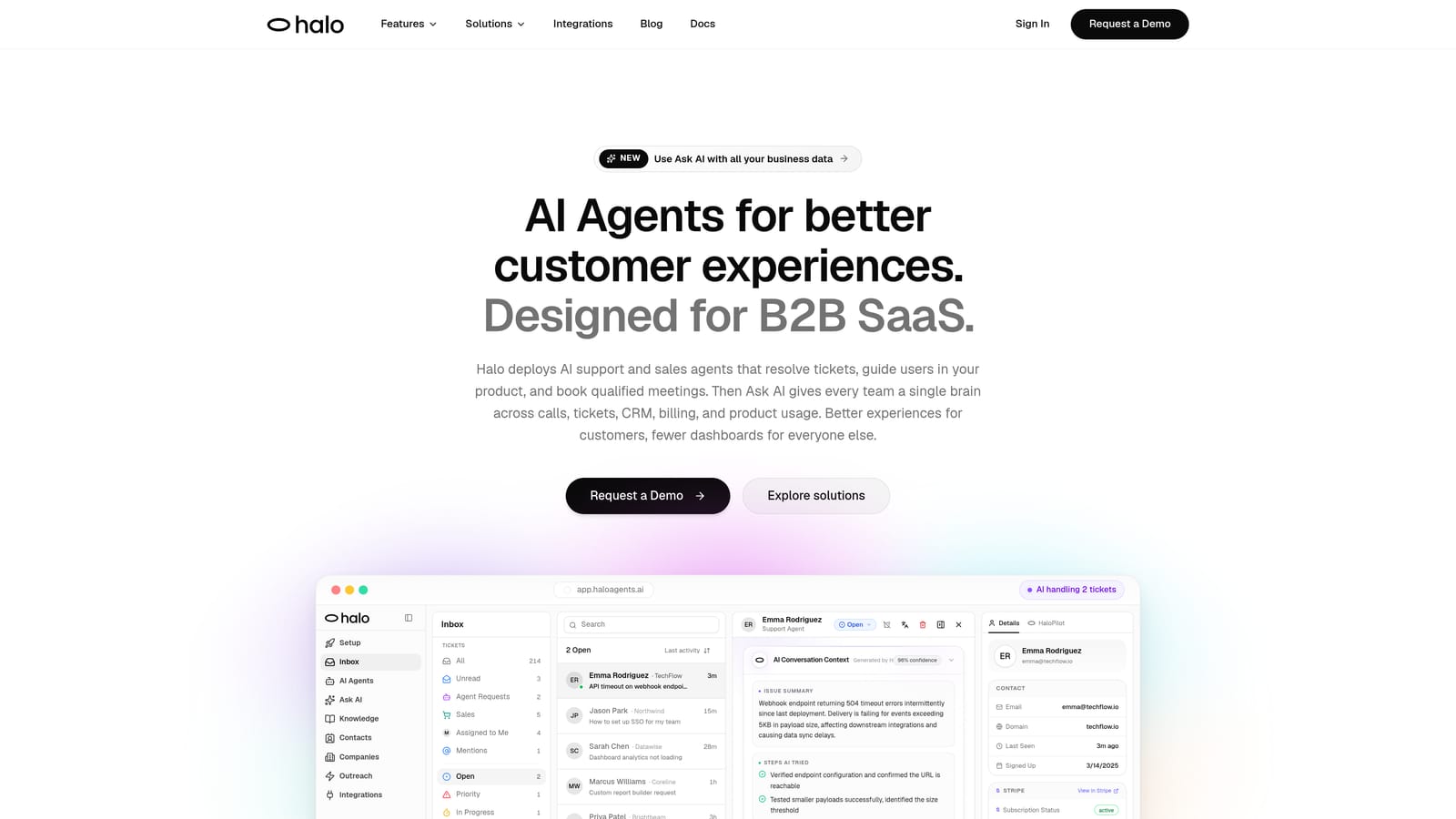
Halo AI is an AI-first customer support platform built without a legacy ticketing backbone underneath it.
Where This Tool Shines
Most platforms start as ticketing systems and add AI on top. Halo starts with intelligence as the foundation. That architectural difference shows up in how the platform actually behaves: the AI doesn't just suggest replies, it resolves tickets autonomously, learns from every closed interaction, and gets measurably better over time without manual retraining.
What makes Halo genuinely distinctive is page-aware context. The AI agent sees what the user sees inside your product, which means guidance is specific to where someone is stuck, not a generic FAQ response. Combined with a smart inbox that surfaces customer health signals, revenue anomalies, and churn indicators, Halo positions support as a business intelligence layer rather than a cost center.
Key Features
Page-Aware AI Agents: The AI understands which part of your product a user is viewing and provides contextually relevant guidance, not generic help articles.
Continuous Learning Loop: Every resolved interaction automatically improves the model, so the AI gets smarter without manual intervention.
Auto Bug Ticket Creation: Detected issues are automatically routed to Linear or other dev tools, closing the loop between support and engineering.
Smart Inbox with Business Intelligence: Surfaces customer health signals, revenue anomalies, and churn indicators directly within the support workflow.
Deep Integration Stack: Native connections to Linear, Slack, HubSpot, Intercom, Stripe, Zoom, PandaDoc, and Fathom.
Live Agent Handoff: Seamless escalation to human agents for complex or sensitive issues, with full conversation context preserved.
Best For
B2B SaaS teams and product-led growth companies that want support to do more than deflect tickets. If you're looking for a platform that connects support signals to revenue intelligence and scales without adding headcount, Halo is built for that use case specifically.
Pricing
Contact for pricing. Halo uses a demo-first onboarding model, so the starting point is a conversation about your team's specific needs rather than a self-serve signup.
2. Intercom (Fin AI)
Best for: Teams already using Intercom across sales, onboarding, and support
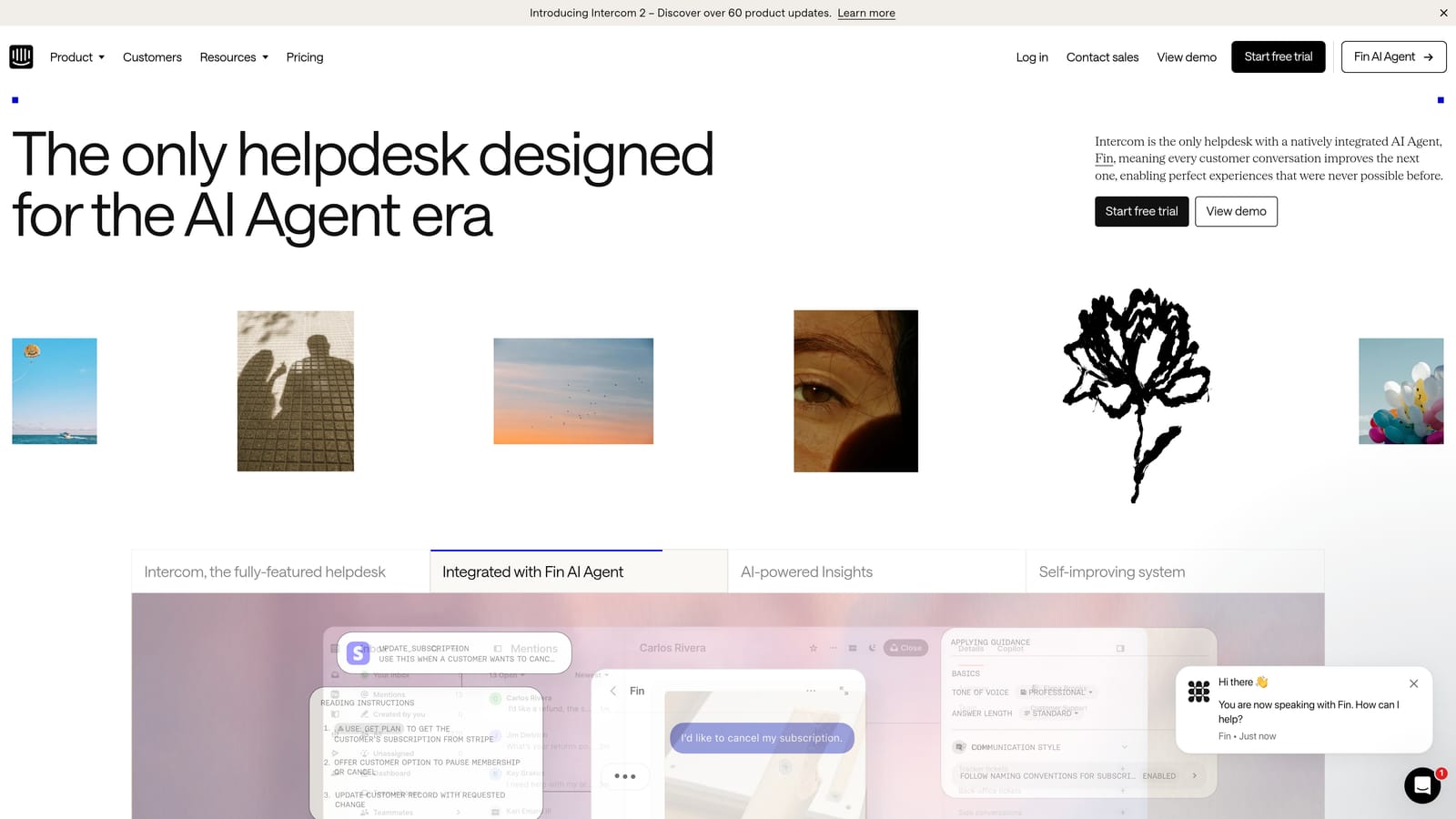
Intercom is a customer communications platform where Fin AI handles autonomous support resolution within the Intercom Messenger.
Where This Tool Shines
Fin AI is one of the most widely deployed AI support agents in the market, and its strength comes from how tightly it's woven into the broader Intercom platform. If your team already uses Intercom for sales conversations, product onboarding, and marketing messages, adding Fin for support resolution is a natural extension rather than a separate tool to manage.
The handoff experience is particularly well-executed. When Fin can't resolve something, it passes the conversation to a human agent with full context intact, which avoids the frustrating "please repeat your issue" moment that plagues many AI-to-human transitions.
Key Features
Fin AI Agent: Handles autonomous resolution on conversational queries out of the box, with strong performance on FAQ-style and procedural questions.
Unified Platform: Tight integration with Intercom's sales, marketing, and support tooling in a single workspace.
Multi-Channel Coverage: Chat, email, and in-product messaging all handled from one interface.
Contextual Handoff: Human agents receive full conversation history when Fin escalates, preserving continuity.
Usage-Based Fin Pricing: You pay per resolution rather than a flat fee, which aligns cost with actual AI output.
Best For
Teams already invested in the Intercom ecosystem who want AI resolution without adopting a separate platform. Also well-suited to product-led SaaS companies with high chat volume and conversational support patterns.
Pricing
Intercom seats start from approximately $39/seat/month. Fin AI is charged per resolution on top of seat costs, so total spend scales with volume. Verify current pricing at the Intercom website before budgeting.
3. Freshdesk (Freddy AI)
Best for: Budget-conscious mid-market teams wanting AI augmentation within a familiar helpdesk UI
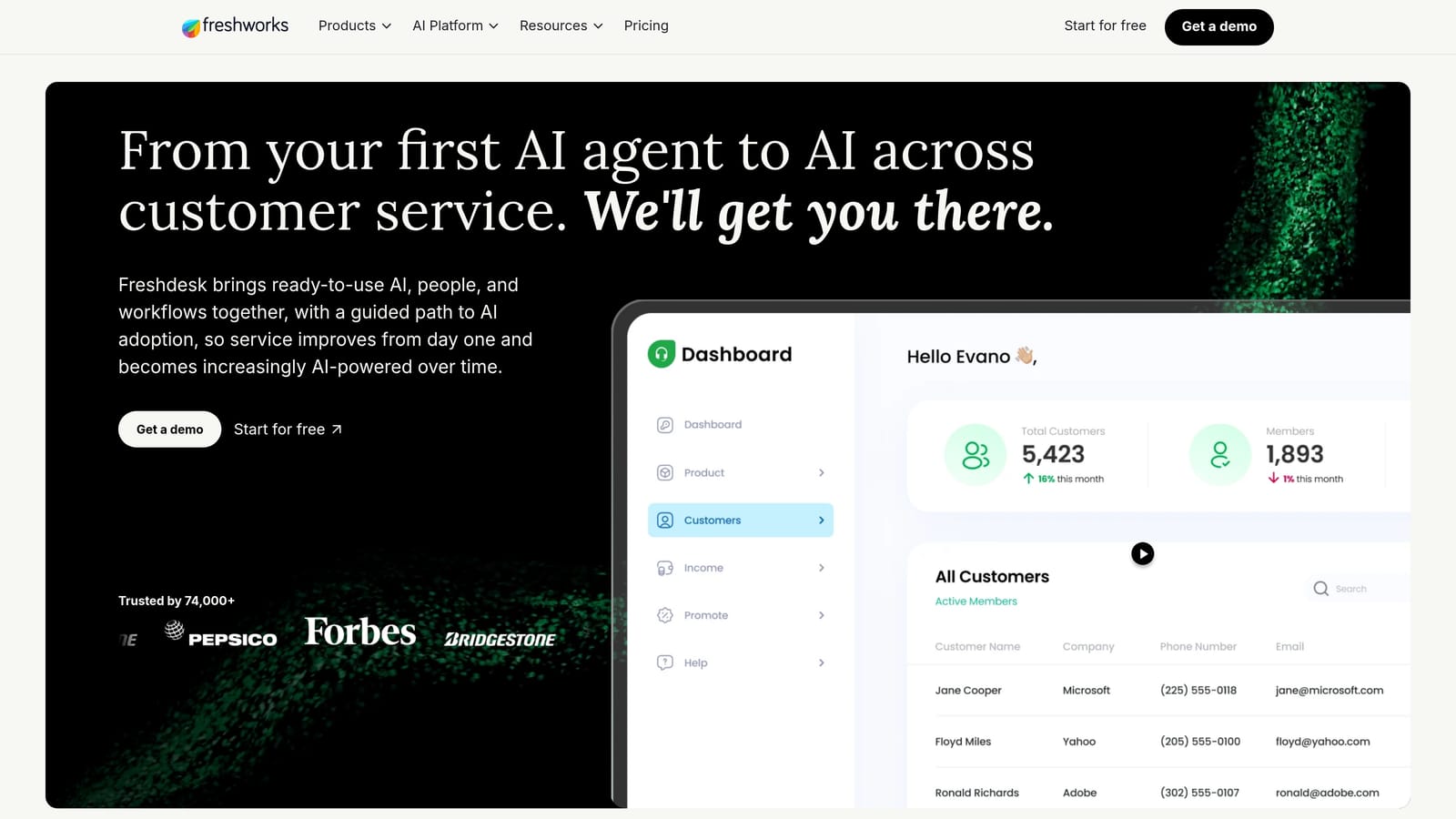
Freshdesk is a widely used helpdesk platform where Freddy AI adds triage, agent assist, suggested replies, and self-service deflection across its pricing tiers.
Where This Tool Shines
Freshdesk occupies a practical middle ground: it's not a fully AI-first platform, but it delivers meaningful AI capabilities at pricing that mid-market teams can actually work with. Freddy AI spans triage, suggested replies, and a self-service bot, which covers the most common AI use cases without requiring a platform migration or enterprise contract.
The broader Freshworks suite is also worth noting. If your team uses Freshsales for CRM or Freshservice for ITSM, Freddy AI creates a shared intelligence layer across those products, which reduces the fragmentation that often comes with multi-tool support stacks.
Key Features
Freddy AI Triage: Automatically categorizes and routes incoming tickets based on intent, reducing manual sorting for agents.
Suggested Replies: Freddy surfaces response suggestions based on ticket content and historical resolutions.
Freddy Self Service Bot: Deflects common queries before they become tickets, available across chat and messaging channels.
Omnichannel Coverage: Email, chat, phone, and social media handled within a single platform.
Freshworks Suite Integration: Connects natively with Freshsales and Freshservice for cross-product intelligence.
Best For
Mid-market teams that want to add AI capabilities to their support workflow without abandoning a familiar helpdesk structure. Also a strong option for teams that need omnichannel coverage at accessible price points.
Pricing
A free tier is available for small teams. Growth plans start from approximately $15/agent/month. Freddy AI features are available on Pro and Enterprise tiers. Verify current pricing at the Freshdesk website.
4. Zendesk AI
Best for: Enterprise support organizations needing AI within a mature, compliance-ready platform
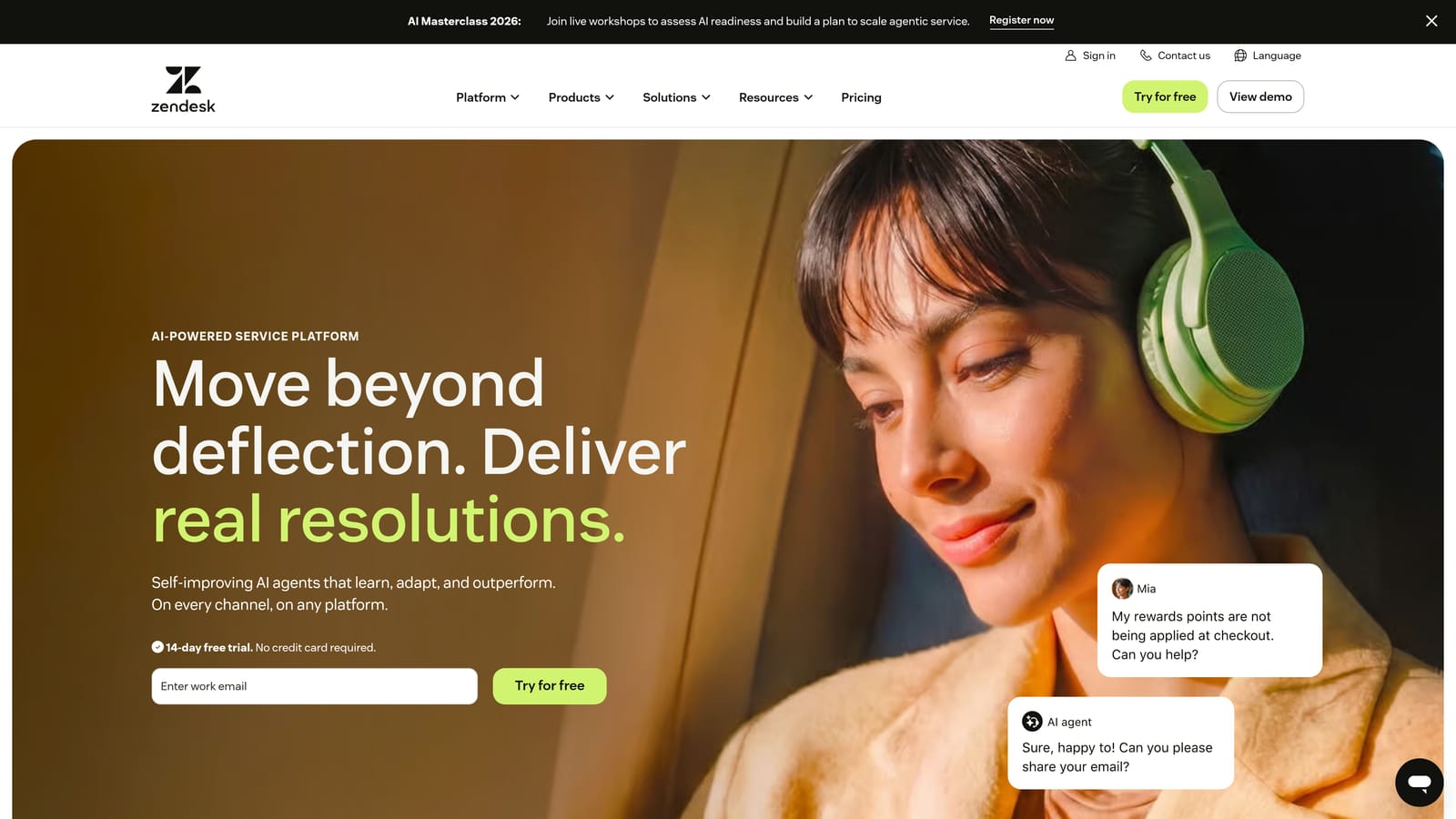
Zendesk is an enterprise-grade helpdesk platform that has built a comprehensive AI suite on top of its established ticketing infrastructure.
Where This Tool Shines
Zendesk's AI investment has accelerated significantly, and the current suite covers intelligent triage, AI agents for autonomous resolution, and an agent copilot that guides human agents through complex interactions. For enterprise teams, the depth of workflow customization and the breadth of the integration marketplace are hard to match.
The honest caveat is structural: Zendesk's AI sits on top of a ticketing architecture built before the AI era. That means some of the elegant, AI-native behaviors you'd get from a purpose-built platform require more configuration to achieve. For organizations with complex compliance requirements and established Zendesk workflows, that tradeoff often makes sense.
Key Features
AI Agents: Autonomous resolution for common ticket types, with configurable scope and escalation rules.
Agent Copilot: Suggests responses and next-best actions to human agents during live interactions.
Intelligent Triage: Routes tickets based on detected intent, sentiment, and priority signals.
Marketplace Integrations: Over 1,000 integrations available through the Zendesk marketplace.
Enterprise Compliance: SLA management, security controls, and compliance tooling built for large organizations.
Best For
Large support organizations with complex workflows, strict compliance requirements, and existing Zendesk infrastructure. Also suitable for teams that rely heavily on third-party integrations from the Zendesk marketplace.
Pricing
Suite plans start from approximately $55/agent/month. Advanced AI features are available on higher tiers. Verify current pricing at the Zendesk website before budgeting.
5. Tidio (Lyro AI)
Best for: SMBs and e-commerce teams wanting fast AI setup with minimal technical overhead
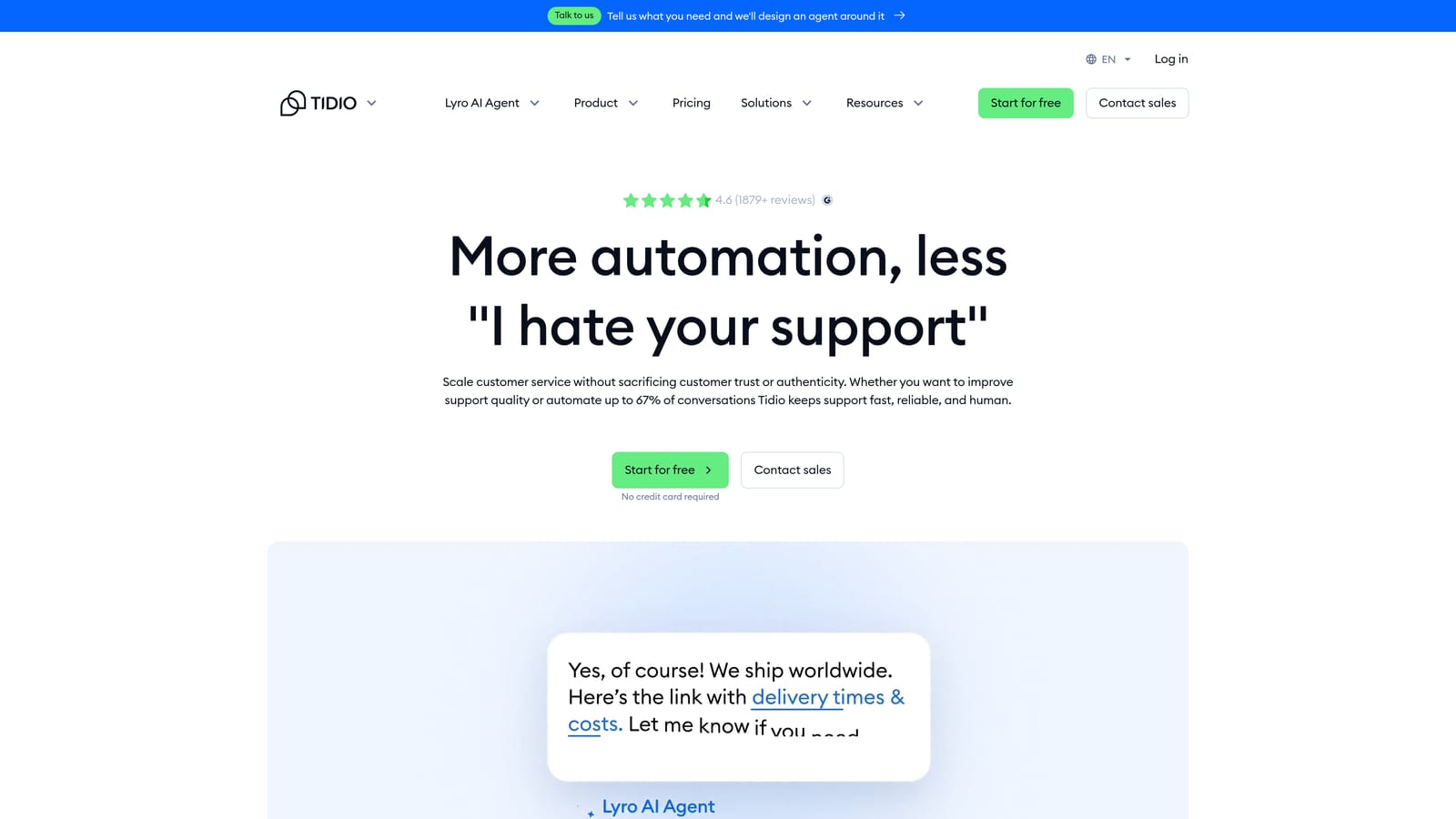
Tidio is a live chat and AI platform where Lyro AI handles conversational support autonomously, trained on your help content with minimal configuration required.
Where This Tool Shines
Tidio's biggest advantage is speed to value. Lyro AI can be live and handling real customer queries within hours, not weeks. It trains on your existing help content and knowledge base, which means you're not building a conversation model from scratch. For teams that need AI deflection running quickly without dedicated technical resources, that matters a lot.
The e-commerce integrations are also a genuine differentiator. Native connections to Shopify and WooCommerce mean Lyro can handle order status queries, return questions, and product information autonomously, which covers a large share of typical e-commerce support volume.
Key Features
Lyro AI Agent: Conversational AI trained on your knowledge base, handling common questions without human involvement.
Live Chat with Quick Takeover: Human agents can step into any conversation instantly when Lyro needs backup.
E-Commerce Integrations: Native connections to Shopify and WooCommerce for order and product queries.
Visual Chatbot Builder: Drag-and-drop builder for custom conversation flows beyond Lyro's AI scope.
Fast Deployment: Typically live within hours, not weeks, with no complex implementation required.
Best For
SMBs, e-commerce businesses, and teams with straightforward FAQ-style support volume. Less suited to complex B2B workflows with multi-step escalation logic or deep CRM integration requirements.
Pricing
A free tier is available. Lyro AI starts from approximately $29/month and scales by conversation volume. Verify current pricing at the Tidio website.
6. Help Scout
Best for: Teams that want AI to make human agents faster without removing humans from the loop
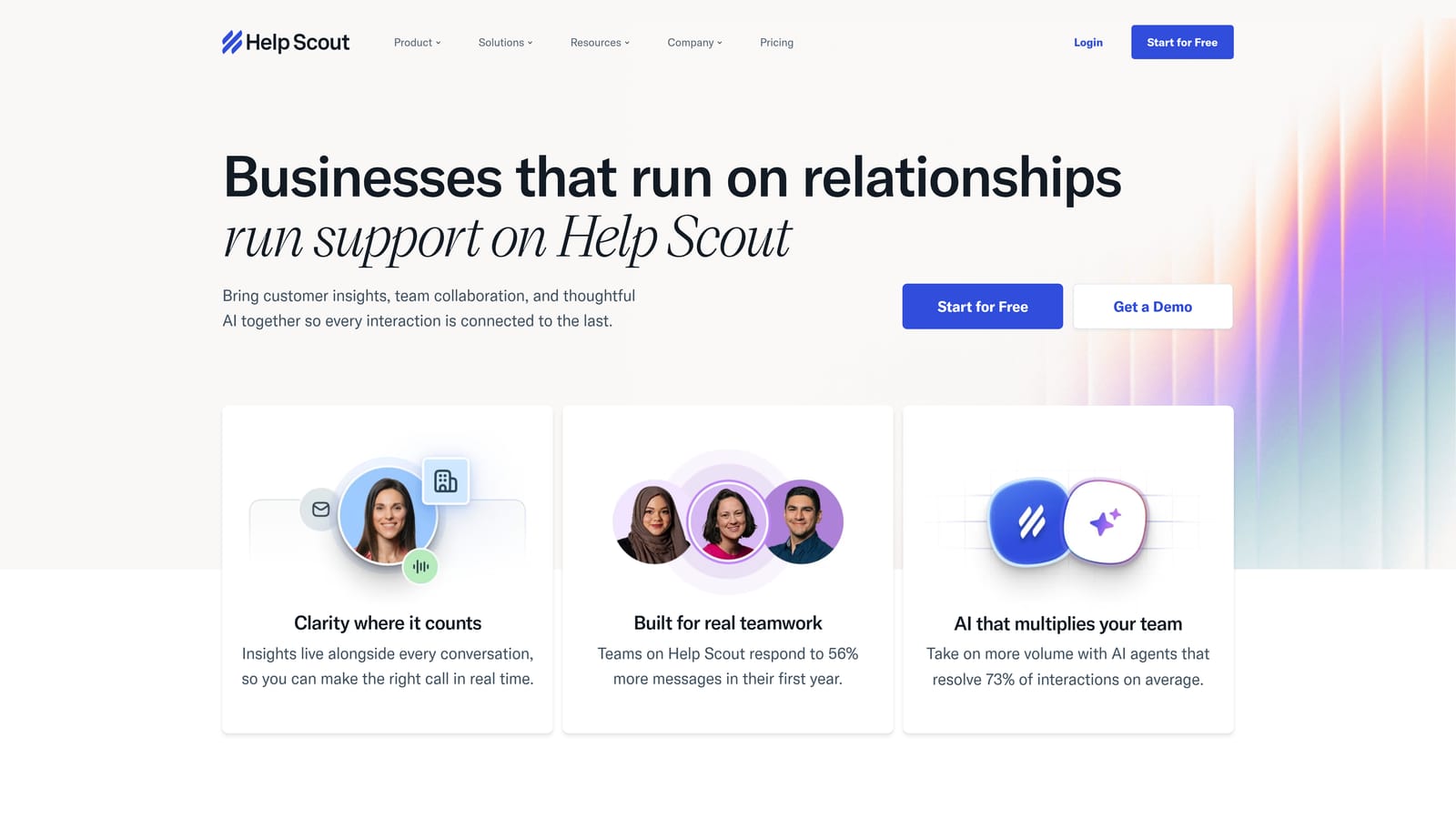
Help Scout is a shared inbox platform that has added practical AI assist features to help agents work more efficiently while keeping human judgment at the center of every interaction.
Where This Tool Shines
Help Scout's philosophy is explicitly human-first, and that's not a weakness — it's a deliberate positioning that resonates with teams where tone, relationship quality, and customer satisfaction scores matter more than raw deflection rates. The AI features are genuinely useful: drafts save agents significant time, and the summarize feature is particularly valuable for long, complex threads.
The platform also has one of the cleanest interfaces in the helpdesk space, which reduces training overhead and keeps agents focused on the conversation rather than the tool. If your support culture values quality over speed, Help Scout's approach fits that philosophy well.
Key Features
AI Drafts: Generates complete reply drafts for agents to review, edit, and send rather than composing from scratch.
AI Summarize: Condenses long conversation threads into a concise summary, saving agents time on context-gathering.
AI Assist: Adjusts tone, expands bullet points, and translates content within the compose window.
Docs with AI Search: Knowledge base with AI-powered search that surfaces relevant articles quickly.
Clean, Minimal UI: Intentionally simple interface designed to keep agents focused on customer conversations.
Best For
Customer-centric teams where relationship quality is the priority and full AI autonomy isn't the goal. Strong fit for companies with high-touch support models where agent judgment and tone are part of the brand experience.
Pricing
Standard plans start from approximately $22/user/month. Plus and Pro tiers are available with additional features. Verify current pricing at the Help Scout website.
7. Kustomer
Best for: CRM-native B2C and D2C brands with rich customer data and high interaction volume
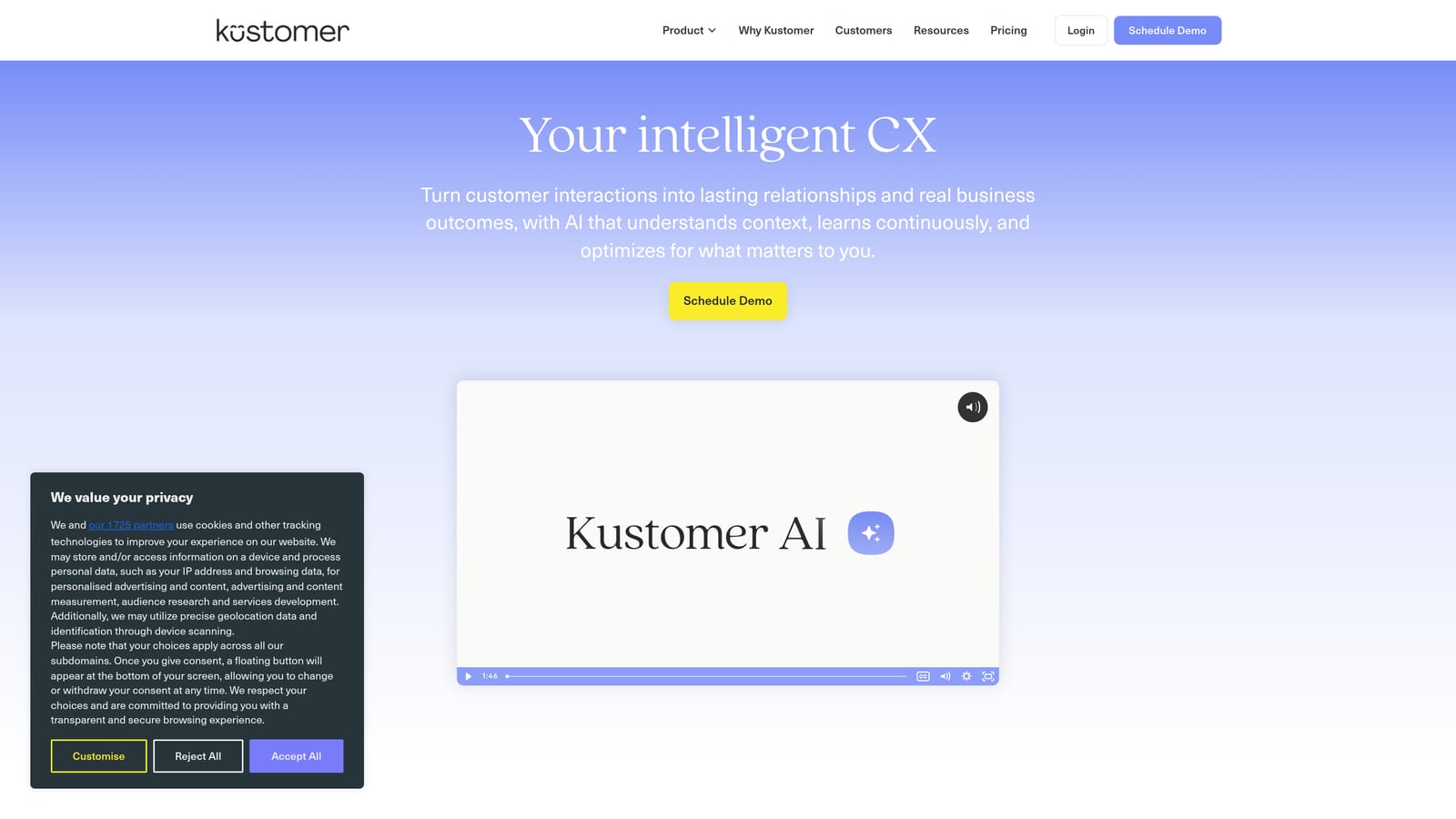
Kustomer is a CRM-native support platform, owned by Meta, that organizes all customer interactions on a single timeline with AI features layered across routing, suggestions, and conversational automation.
Where This Tool Shines
The single customer timeline is Kustomer's defining feature. Rather than managing separate tickets across channels, agents see every interaction a customer has ever had, across email, chat, SMS, social, and voice, in one continuous view. That context changes how agents can respond, and it gives AI features richer data to work with when making routing and suggestion decisions.
Meta's ownership has brought meaningful AI investment to the platform. For D2C and retail brands with large customer databases and high interaction volume, Kustomer's combination of CRM depth and AI capability is a compelling pairing. Teams with data privacy concerns should evaluate the Meta data relationship as part of their due diligence.
Key Features
Single Customer Timeline: All channels and all interactions consolidated in one view per customer, not per ticket.
AI-Powered Routing: Intelligent prioritization and routing based on customer data and interaction signals.
Conversational AI: Autonomous handling of common queries with escalation to agents when needed.
Deep CRM Data: Customer purchase history, lifetime value, and behavioral data surfaced during every support interaction.
Meta AI Investment: Ongoing model improvements backed by Meta's AI research and infrastructure.
Best For
D2C, retail, and consumer brands with rich customer data and complex multi-channel support needs. Less commonly used in B2B SaaS contexts where the CRM-centric model is less of a differentiator.
Pricing
Enterprise pricing. Contact Kustomer's sales team for a quote tailored to your team size and use case.
8. Forethought (Solve AI)
Best for: Enterprise teams that want AI-first resolution without migrating off their existing helpdesk
Forethought takes an overlay approach: its Solve AI sits on top of existing helpdesks like Zendesk, Salesforce Service Cloud, and ServiceNow, adding AI-first deflection and triage without requiring a platform migration.
Where This Tool Shines
Forethought solves a real organizational problem: many enterprise teams have years of workflow, training, and process investment in their existing helpdesk and can't justify a full migration. Forethought lets those teams add AI-first capabilities on top of what they already have, which dramatically lowers the switching cost of upgrading to AI-driven support.
The Discover analytics layer is particularly valuable for teams trying to understand where their support volume is coming from and where their knowledge base has gaps. That kind of diagnostic intelligence helps teams improve both their AI deflection rates and their underlying documentation quality over time.
Key Features
Solve: AI agent for autonomous deflection that intercepts common queries before they become tickets.
Triage: Intelligent routing and prioritization within existing helpdesk platforms based on intent and urgency.
Assist: Agent copilot providing suggested responses and knowledge retrieval during live interactions.
Discover: Analytics layer surfacing support trends, knowledge gaps, and deflection opportunities.
Helpdesk Compatibility: Works on top of Zendesk, Salesforce Service Cloud, ServiceNow, and others without replacing them.
Best For
Enterprise teams with significant investment in existing helpdesk infrastructure who want AI-first resolution capabilities without a full platform migration. Strong fit for complex knowledge bases and multi-team support organizations.
Pricing
Enterprise pricing. Contact Forethought's sales team for a quote based on your existing helpdesk environment and support volume.
9. Gladly
Best for: Premium consumer brands where relationship continuity and tone are part of the product experience
Gladly replaces the ticket model entirely with people-centric conversation threads, giving agents and AI a complete customer history across every channel in a single continuous view.
Where This Tool Shines
Gladly's core insight is that customers don't think in tickets. They think in relationships. When someone contacts a brand for the third time, they shouldn't have to re-explain their situation because the previous interactions were siloed into separate case numbers. Gladly eliminates that problem by organizing everything around the person, not the case.
For premium consumer brands where a single frustrating support interaction can damage a carefully built customer relationship, that continuity is meaningful. The Sidekick AI agent handles autonomous resolution within this people-centric model, and AI-powered routing ensures the right agent picks up complex conversations when Sidekick escalates.
Key Features
People-Centric Model: No tickets — every interaction is organized by customer, creating a continuous relationship thread rather than disconnected cases.
Unified Conversation Thread: Email, chat, SMS, voice, and social all appear in one view per customer.
Sidekick AI Agent: Autonomous self-service resolution for common queries within Gladly's people-centric framework.
AI-Powered Routing: Intelligent matching of customers to the right agents based on context and history.
Relationship Continuity: Agents always have full context, which eliminates the "please repeat yourself" experience for customers.
Best For
Premium, relationship-driven consumer brands where support quality is part of the brand identity. Less commonly used in B2B SaaS environments, but a standout choice for retail, hospitality, and luxury consumer categories.
Pricing
Gladly uses a Hero pricing model. Contact their sales team for pricing based on your team size and channel requirements.
Which Platform Is Right for Your Team?
The right AI-first helpdesk depends on where you're starting from and what you're trying to build. Here's a quick orientation by use case.
Halo AI is the strongest fit for B2B SaaS teams that want genuine AI-first autonomy, not AI features bolted onto a legacy system. The page-aware context, continuous learning loop, and business intelligence layer make it particularly well-suited to product-led teams where support and product insights should be connected.
Intercom Fin is the natural choice if your team already runs on Intercom across sales and support. The unified platform and strong handoff experience make the upgrade path straightforward.
Freshdesk Freddy is the practical mid-market option for teams that need AI capabilities at accessible pricing without a platform overhaul. Zendesk AI fits enterprise organizations with complex workflows and compliance requirements already anchored to the Zendesk ecosystem.
Tidio Lyro is the fastest path to AI deflection for SMBs and e-commerce teams with limited technical resources. Help Scout serves teams that want AI to accelerate human agents rather than replace them, where relationship quality is the primary metric.
Kustomer is built for D2C and retail brands with rich customer data across multiple channels. Forethought solves the migration problem for enterprise teams that want AI-first resolution without abandoning their existing helpdesk investment. And Gladly is the right choice for premium consumer brands where relationship continuity defines the support experience.
Your support team shouldn't scale linearly with your customer base. AI agents can handle routine tickets, guide users through your product, and surface business intelligence while your team focuses on complex issues that genuinely need a human touch. See Halo in action and discover how continuous learning transforms every interaction into smarter, faster support.