9 Best AI-First Helpdesk Software Platforms in 2026
This guide reviews the 9 best ai first helpdesk software platforms built with intelligence as their core architecture—not an afterthought—covering tools that offer autonomous ticket resolution, deep integrations, and continuous learning to help B2B SaaS teams scale support without adding headcount.
 Matt PattoliFounder13 min read
Most helpdesk software was built for human agents first, with AI bolted on later. That approach creates friction: clunky automation layers, limited context, and AI that needs constant hand-holding. AI-first helpdesk software flips this model entirely, treating intelligence as the foundation rather than an afterthought.
This list focuses specifically on platforms built with AI at the core of their architecture. Whether you're a SaaS company drowning in repetitive tickets, a product team that needs smarter triage, or a support leader trying to scale without adding headcount, these tools represent the current best options available.
Selection criteria: native AI architecture (not add-on), autonomous ticket resolution capabilities, integration depth, learning and improvement over time, and suitability for B2B SaaS teams. Pricing and ideal team size are noted for each.
1. Halo AI
Best for: B2B SaaS teams wanting a truly AI-native support platform with business intelligence built in
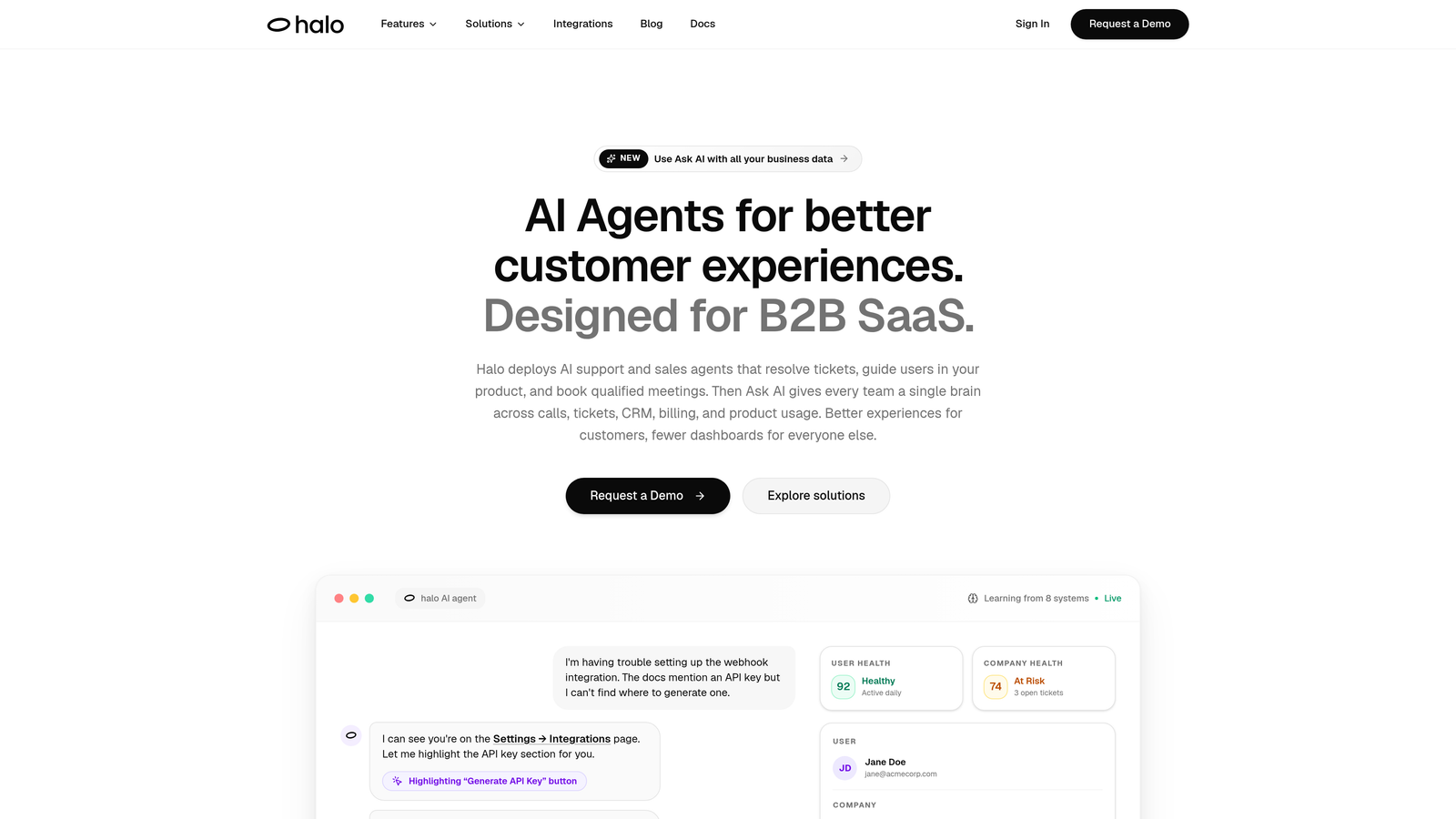
Halo AI is an AI-first customer support platform built specifically for B2B SaaS teams, deploying intelligent agents that resolve tickets, guide users through your product, and surface actionable business intelligence.
Where This Tool Shines
What separates Halo from most platforms on this list is its page-aware architecture. The chat widget doesn't just respond to what a user types; it understands where they are in your product and provides contextual, visual UI guidance based on what they're actually seeing. That level of context dramatically improves resolution quality for product-related questions.
Beyond ticket resolution, Halo's smart inbox surfaces business intelligence that most support tools ignore entirely: customer health signals, revenue intelligence, and anomaly detection. Support interactions become a source of strategic insight, not just a cost center to manage.
Key Features
Page-Aware Chat Widget: Sees what users see in your product and delivers visual UI guidance tied to their current context.
Intelligent AI Agents: Resolve tickets autonomously with continuous learning from every interaction, improving accuracy over time.
Smart Inbox with Business Intelligence: Surfaces customer health signals, revenue intelligence, and anomaly detection from support data.
Auto Bug Ticket Creation: Automatically generates and routes bug reports to engineering tools like Linear without manual intervention.
Live Agent Handoff: Seamlessly escalates complex issues to human agents with full context preserved.
Deep Integrations: Connects with Slack, HubSpot, Intercom, Stripe, Zoom, PandaDoc, and Fathom for a unified support and business stack.
Best For
Product-led SaaS companies and B2B teams that want support to do more than close tickets. Especially well-suited for teams that need their support layer to feed signals back into product, sales, and customer success workflows.
Pricing
Contact for pricing. Custom plans are available based on team size and use case. Visit haloagents.ai for details.
2. Intercom
Best for: Teams wanting conversational AI with strong in-app messaging and a mature integration ecosystem
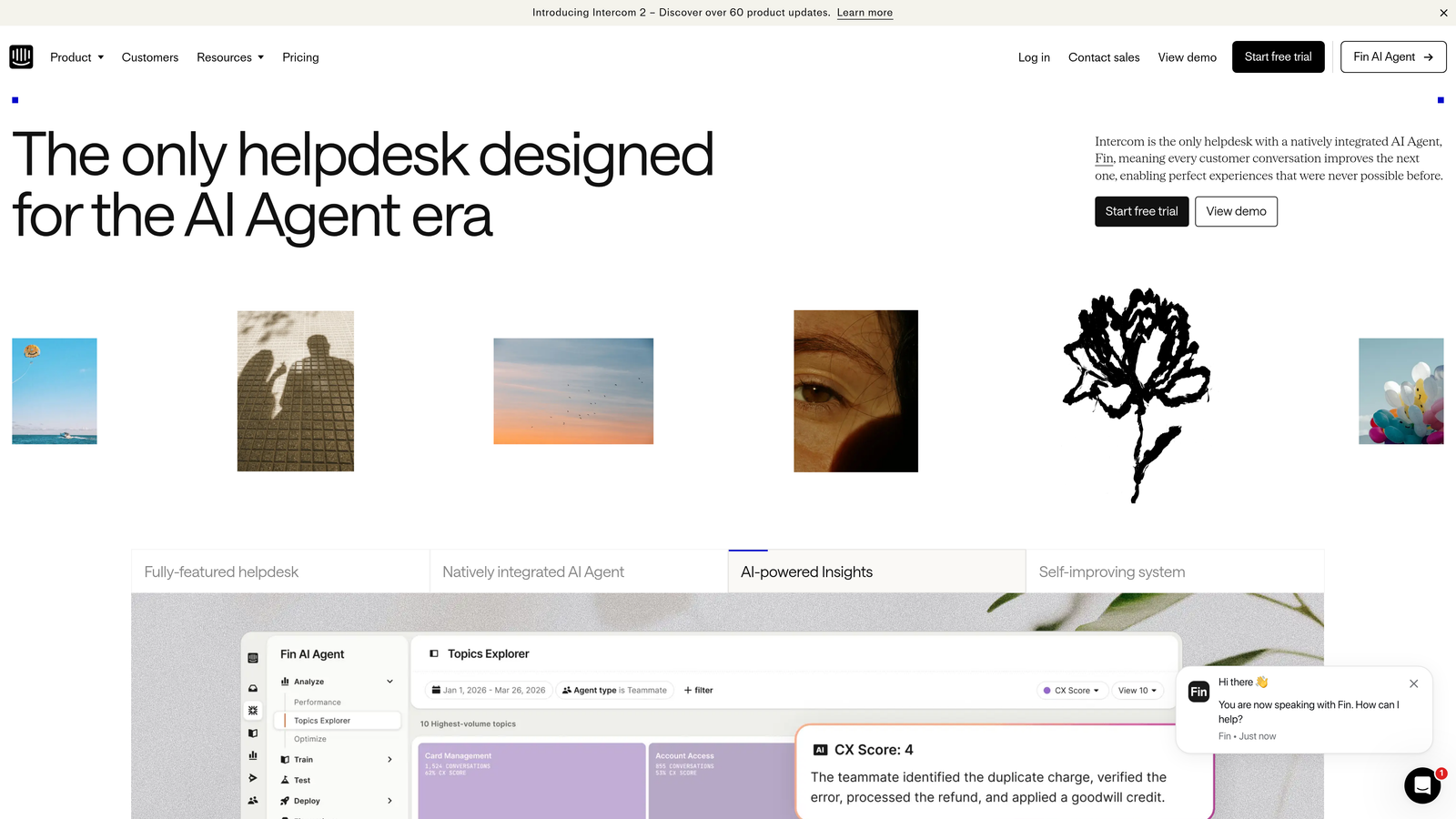
Intercom is a widely-used conversational support platform with Fin, an AI agent built on large language models that resolves customer queries directly from your help content.
Where This Tool Shines
Fin AI Agent has matured significantly since its initial launch, and Intercom's strength is the combination of autonomous resolution with a polished in-app messaging experience. For teams that already rely on Intercom for onboarding and product tours, keeping support in the same platform has real workflow advantages.
The omnichannel inbox handles chat, email, and social in one place, and the app marketplace is one of the largest in the category. The main consideration is cost: pricing can scale steeply as your team and resolution volume grow.
Key Features
Fin AI Agent: Resolves customer queries autonomously using your help content and large language model reasoning.
Omnichannel Inbox: Unifies chat, email, and social media conversations in a single workspace.
AI-Powered Summarization: Automatically summarizes conversations and generates suggested replies for human agents.
In-App Messaging and Product Tours: Native tools for onboarding and proactive engagement alongside support.
Extensive App Marketplace: Hundreds of integrations covering CRM, analytics, billing, and engineering tools.
Best For
Mid-market SaaS teams already invested in the Intercom ecosystem, or companies that want conversational AI combined with strong product engagement tooling in a single platform.
Pricing
Starts at approximately $39/seat/month; Fin AI is billed per resolution. Verify current pricing at intercom.com as costs can vary significantly based on usage.
3. Zendesk
Best for: Large enterprises with complex support operations needing robust AI across triage, routing, and agent assistance
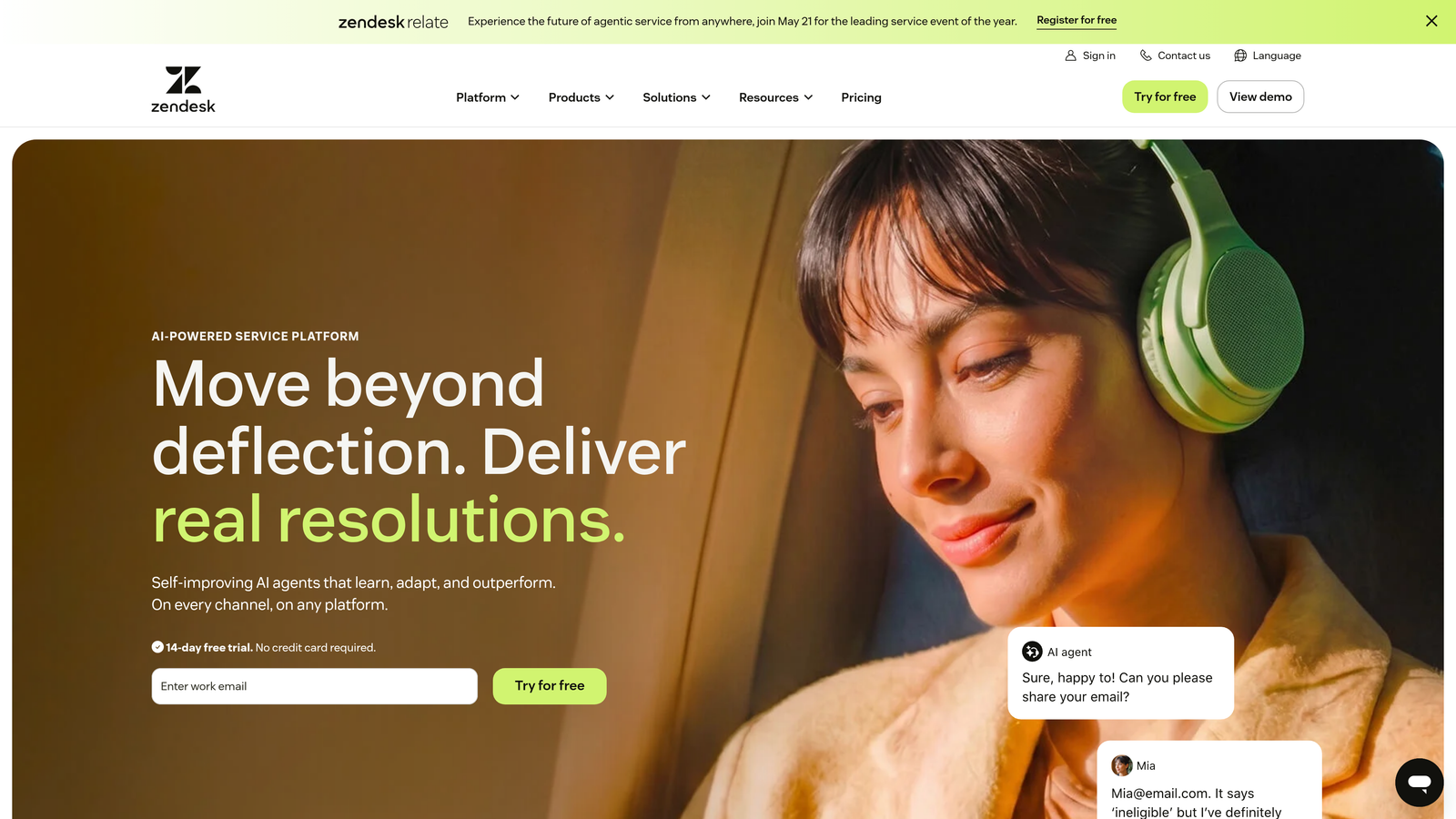
Zendesk is the enterprise helpdesk market leader, now with AI deeply embedded across triage, routing, agent assistance, and automated resolution.
Where This Tool Shines
Zendesk's AI investment has accelerated considerably, particularly following its acquisition of Ultimate.ai. The Agent Copilot provides real-time suggestions and next-best-action guidance during live conversations, while automated resolution bots handle common queries at scale. For large support organizations, the depth of analytics and reporting is hard to match.
The honest caveat: Zendesk's AI capabilities are layered onto a ticket-centric architecture that was built for human workflows. It's powerful, but you can feel the seams. Teams that need AI to be the primary resolution path rather than an assist layer may find the architecture less fluid than newer entrants.
Key Features
Intelligent Triage and Routing: AI-powered classification that automatically routes tickets to the right team or workflow.
Agent Copilot: Provides real-time suggestions, conversation summaries, and next-best-action recommendations during live support.
Automated Resolution Bots: Knowledge base-trained bots that handle common queries without agent involvement.
Advanced Analytics: Deep reporting on support performance, agent productivity, and customer satisfaction.
Massive Integration Ecosystem: Thousands of apps and integrations across virtually every business tool category.
Best For
Enterprise support teams with high ticket volumes, complex routing requirements, and existing investment in the Zendesk ecosystem. Less ideal for lean SaaS teams that want AI to be the primary resolution path from day one.
Pricing
Suite starts at approximately $55/agent/month billed annually. Verify current pricing at zendesk.com as enterprise plans vary widely.
4. Freshdesk (Freddy AI)
Best for: Growing teams wanting accessible AI-enhanced support with affordable tiered pricing and a free entry point
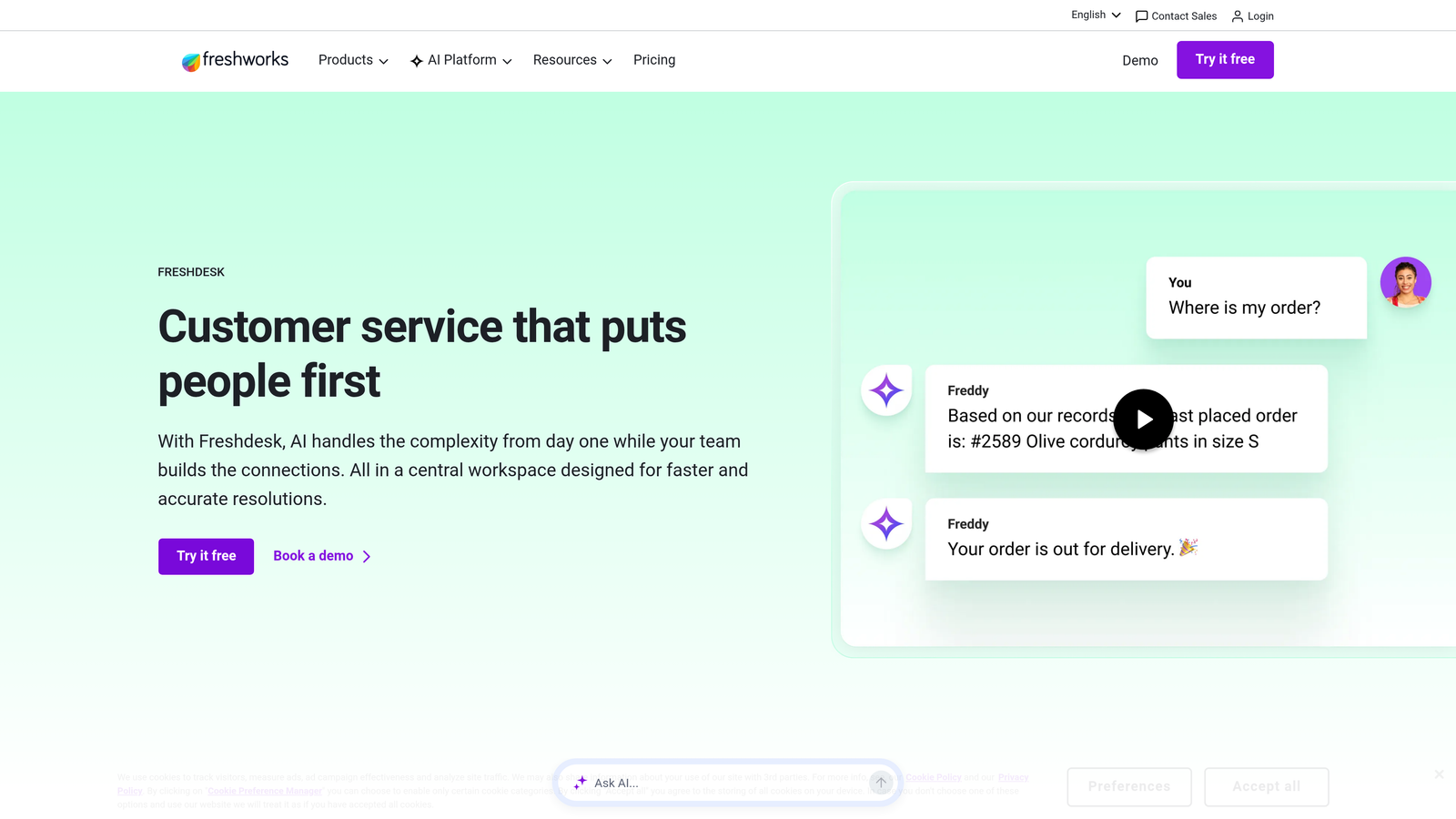
Freshdesk is Freshworks' helpdesk platform with Freddy AI embedded for auto-triage, suggested replies, self-service deflection, and support analytics.
Where This Tool Shines
Freshdesk's strongest advantage is accessibility. The pricing tiers make it realistic for smaller teams to get started, and Freddy AI covers the core use cases: ticket summarization, suggested responses, auto-triage, and a customer-facing self-service bot. Freddy Insights adds trend detection and analytics that help support leaders understand what's driving volume.
It's worth noting that Freddy AI is an enhancement layer on a traditional helpdesk architecture, similar to Zendesk's approach. For teams prioritizing cost-effectiveness and a familiar helpdesk workflow with AI assistance, it's a strong choice. For teams that want AI-native resolution as the default, the architecture has similar constraints.
Key Features
Freddy Copilot: Assists agents with conversation summaries, suggested replies, and contextual recommendations.
Freddy Self Service: Customer-facing autonomous resolution bot trained on your knowledge base and support content.
Freddy Insights: Analytics layer for support trend detection, volume forecasting, and performance reporting.
Omnichannel Support: Handles email, chat, phone, and social media in a unified agent workspace.
Affordable Tiered Pricing: Free plan available with paid tiers that scale gradually as team size grows.
Best For
Growing SMB and mid-market teams that need solid helpdesk fundamentals with AI assistance at a price point that doesn't require enterprise budget approval.
Pricing
Free tier available; paid plans start at approximately $15/agent/month. Verify current pricing at freshdesk.com as tiers and features change regularly.
5. Forethought
Best for: Enterprises with existing helpdesk investments wanting to add AI without a full platform migration
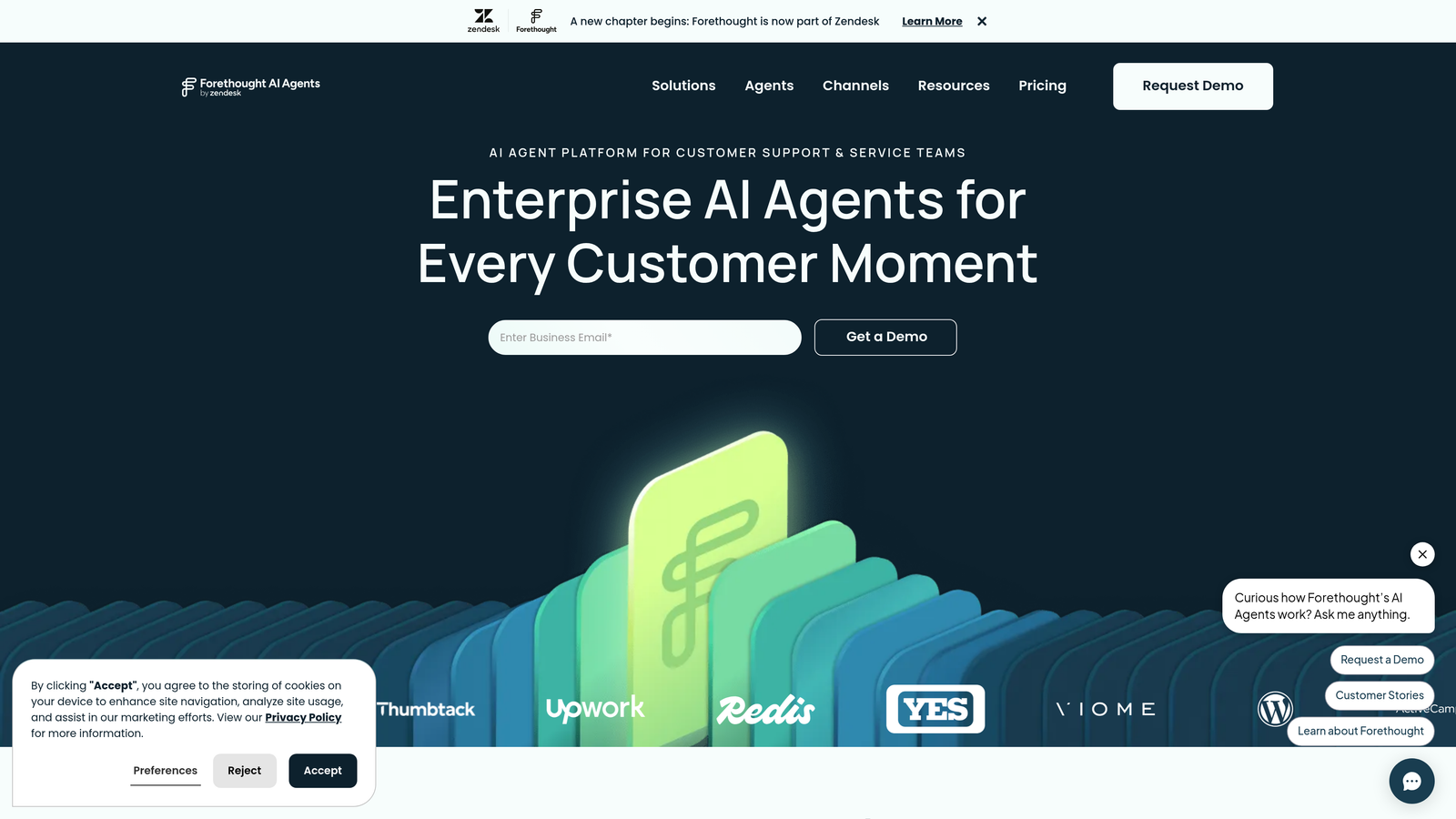
Forethought is an AI layer designed to sit on top of existing helpdesks like Zendesk and Salesforce, adding intelligent triage, agent assistance, and autonomous resolution without requiring teams to abandon their current infrastructure.
Where This Tool Shines
Forethought's core value proposition is additive intelligence. If your organization has years of ticket data in Zendesk or Salesforce Service Cloud and isn't ready for a platform migration, Forethought can apply AI to that existing infrastructure immediately. Its models are trained on your historical ticket data, which gives it contextual accuracy that generic AI layers often lack.
The three-product structure (Triage, Assist, Solve) lets teams adopt AI incrementally rather than committing to full autonomous resolution from day one. That's a meaningful advantage for large organizations where change management is a real constraint.
Key Features
Triage: AI-powered ticket routing and prioritization based on intent, urgency, and historical patterns.
Assist: Real-time agent suggestions surfaced from historical resolutions during live conversations.
Solve: Autonomous customer-facing resolution bot that handles common queries without agent involvement.
Historical Data Training: Models trained on your existing ticket history for contextual, accurate suggestions.
Native Integrations: Deep integrations with Zendesk, Salesforce Service Cloud, ServiceNow, and other enterprise helpdesks.
Best For
Enterprise teams with significant existing helpdesk infrastructure and historical ticket data who want to add AI capabilities without migrating to a new platform.
Pricing
Enterprise pricing model. Contact sales at forethought.ai for a custom quote based on your volume and existing stack.
6. Tidio
Best for: Small to mid-size teams wanting fast deployment and affordable conversational AI for common query resolution
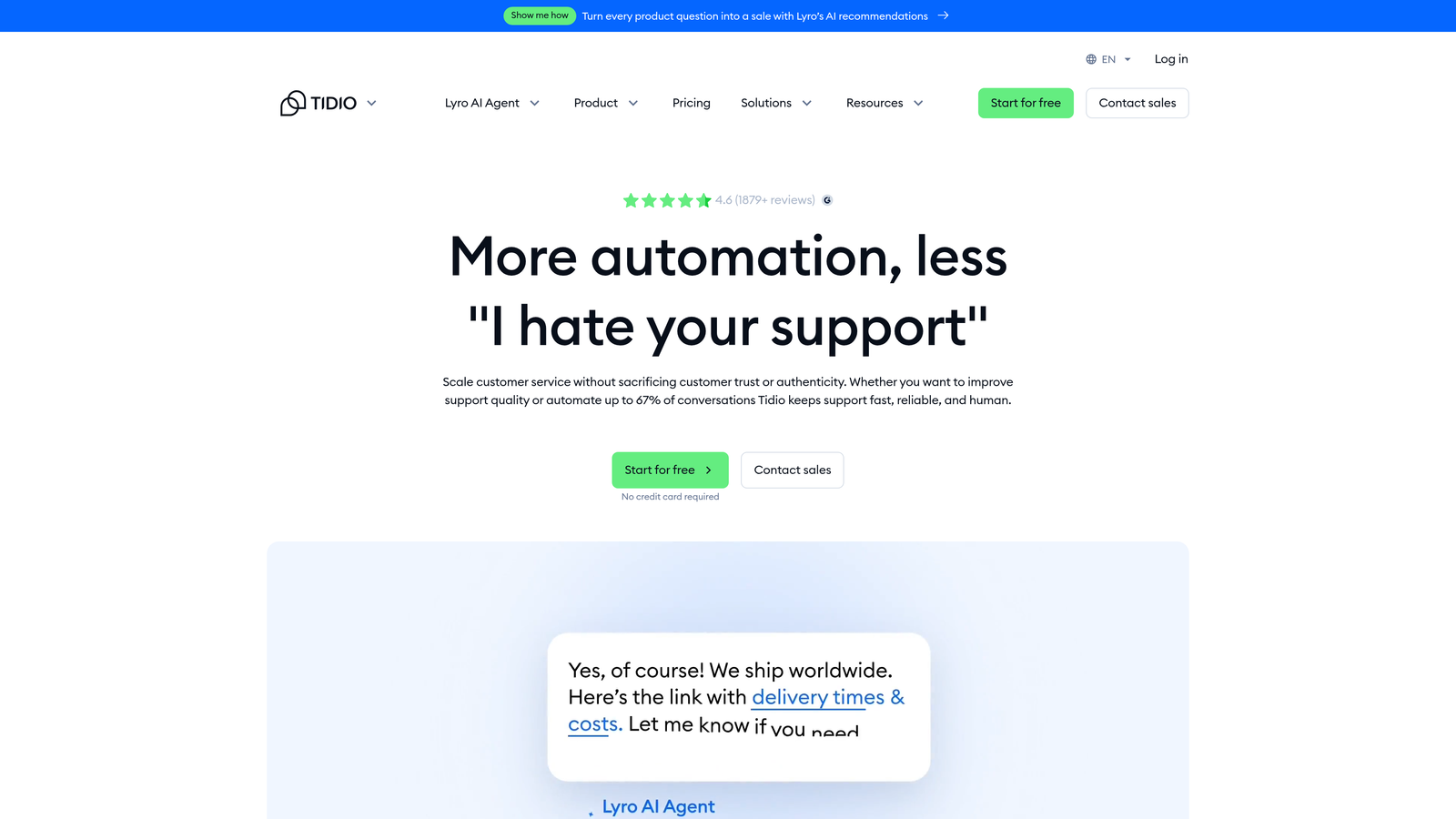
Tidio is a chat and helpdesk platform with Lyro AI, a conversational AI agent designed for fast deployment and autonomous resolution of common customer queries.
Where This Tool Shines
Tidio's standout quality is speed to value. Lyro AI can be trained on your existing support content quickly, and the no-code flow builder lets teams set up automation without engineering involvement. For lean teams that need AI coverage without a lengthy implementation project, that's a genuine differentiator.
The platform's e-commerce integrations, particularly with Shopify, make it a natural fit for consumer-facing businesses. It's less optimized for the complexity of B2B SaaS support environments where tickets often involve multi-step troubleshooting, API integrations, or account-specific context.
Key Features
Lyro AI: Conversational AI agent trained on your support content for autonomous resolution of common queries.
Quick Setup: Fast deployment with no-code configuration that doesn't require engineering resources.
Unified Inbox: Combines live chat, email, and Facebook Messenger in a single agent workspace.
Flow Builder: No-code automation builder for creating custom conversation flows and escalation paths.
E-commerce Integrations: Native Shopify integration and other e-commerce platform connections for order-related support.
Best For
Small businesses, e-commerce teams, and lean support operations that need affordable, fast-to-deploy conversational AI without the overhead of an enterprise platform.
Pricing
Free tier available; Lyro AI plans start at approximately $29/month. Verify current pricing at tidio.com as plan structures are updated regularly.
7. Kustomer
Best for: High-volume B2C and DTC brands needing AI that operates with full customer context and purchase history
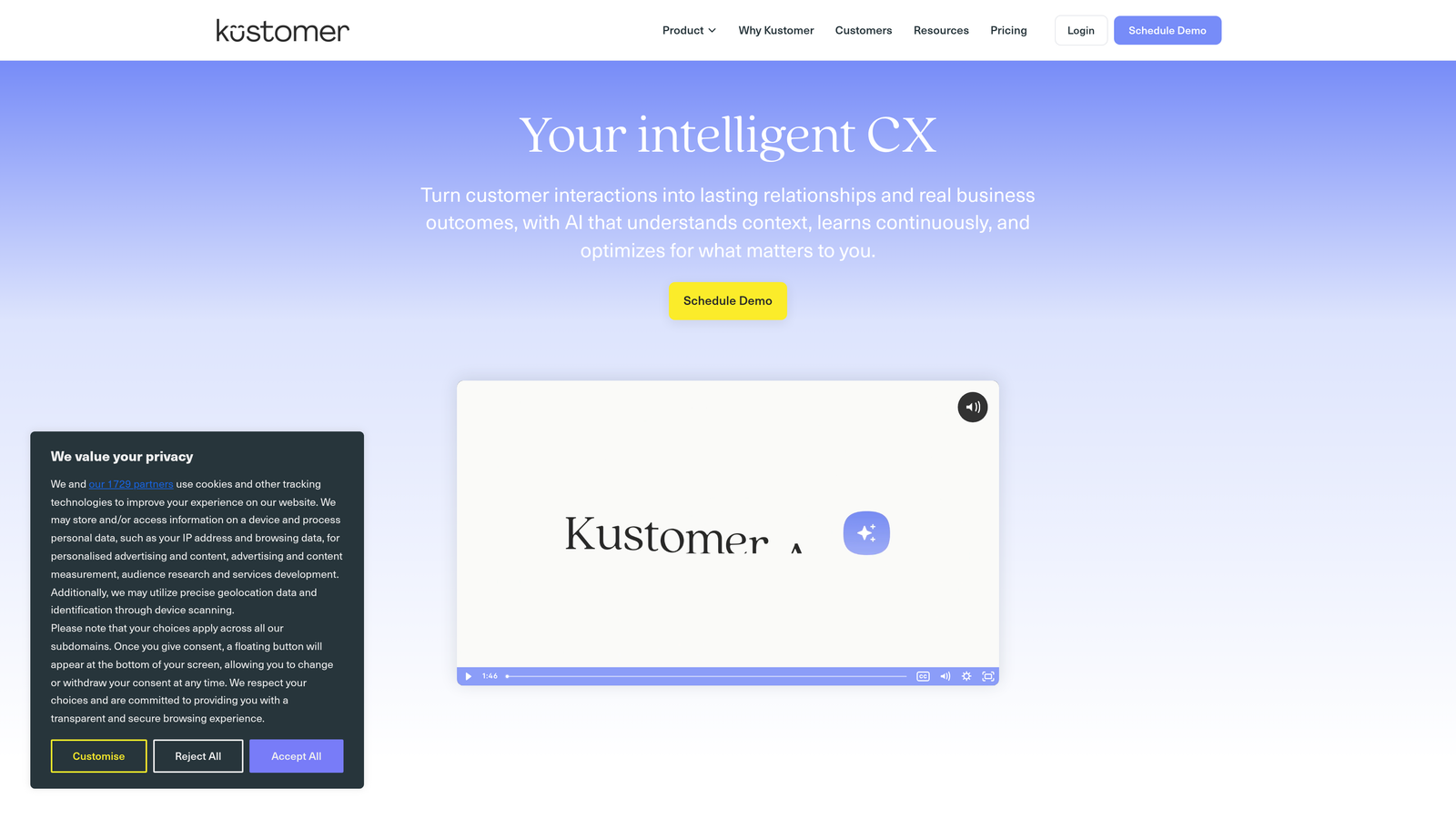
Kustomer is a CRM-native customer service platform where AI operates with full customer context, including purchase history, past interactions, and lifetime value, enabling more personalized and informed resolutions.
Where This Tool Shines
Kustomer's architectural difference is the unified customer timeline. Rather than treating each ticket as an isolated event, the platform combines CRM and support data so AI and agents always have the full customer picture. That context makes automated workflows and suggested responses significantly more relevant than platforms working from conversation data alone.
After being acquired by Meta and subsequently returning to independence, Kustomer has continued developing its AI capabilities. It's particularly well-suited for direct-to-consumer brands where order status, return history, and customer lifetime value are central to every support interaction.
Key Features
Unified Customer Timeline: Combines CRM data, purchase history, and support interactions in a single customer view.
AI Intent Detection: Identifies customer intent automatically to trigger appropriate workflows and routing.
Automated Workflows: AI-driven automation for common resolution paths based on customer context and intent.
Suggested Replies and Summaries: AI assistance for agents including contextual reply suggestions and conversation summaries.
Omnichannel Coverage: Handles email, chat, SMS, social media, and voice in a unified workspace.
Best For
High-volume B2C, DTC, and retail brands where customer history and purchase data are central to support quality. Less optimized for B2B SaaS environments with complex technical troubleshooting needs.
Pricing
Starts at approximately $89/agent/month. Verify current pricing at kustomer.com as plans and packaging evolve.
8. Gladly
Best for: Premium consumer brands prioritizing high-quality, personalized service experiences over ticket volume metrics
Gladly is a people-centric support platform that organizes all interactions by customer rather than ticket number, with AI features designed to support premium, relationship-driven service experiences.
Where This Tool Shines
Gladly's fundamental design decision, organizing support around people rather than ticket numbers, shapes everything about the experience. Agents see a complete, chronological conversation history across every channel for each customer, without needing to cross-reference multiple ticket threads. AI features like suggested replies and task automation are built to enhance that relationship-first model rather than replace it.
This positioning makes Gladly a strong fit for premium consumer brands where service quality is a brand differentiator. It's less focused on maximum deflection rates and more focused on delivering experiences that build loyalty. Teams optimizing purely for cost-per-ticket reduction may find other platforms more aligned with that goal.
Key Features
People-Based Conversation Model: Organizes all support around the individual customer, not ticket numbers, for complete interaction history.
AI-Powered Suggested Replies: Context-aware reply suggestions for agents based on full customer history.
Self-Service AI: Customer-facing deflection capabilities that preserve context for seamless escalation to agents.
Task Automation: AI-driven automation for routine tasks and workflows within the agent experience.
Full Omnichannel History: Complete conversation history across email, chat, SMS, social, and voice per customer.
Best For
Premium consumer brands and high-end retail companies where service quality and customer relationships are central to brand identity. Less suited for B2B SaaS or high-volume technical support environments.
Pricing
Hero pricing model based on customer volume rather than agent seats. Contact sales at gladly.com for a custom quote.
9. Capacity
Best for: Companies needing AI support automation across both customer-facing and internal teams (IT, HR, ops)
Capacity is an AI-powered support automation platform that handles both customer-facing and internal helpdesk use cases, with strong knowledge base AI and workflow automation across HR, IT, and operations.
Where This Tool Shines
Capacity's distinguishing feature is its breadth across use cases. Most helpdesks focus exclusively on external customer support. Capacity is built to serve internal teams (IT helpdesk, HR questions, ops workflows) alongside customer-facing support from the same platform. For companies that want to unify AI support automation across the entire organization, that's a meaningful efficiency gain.
The knowledge base AI uses natural language search to surface relevant answers automatically, and the chatbot builder allows teams to create custom flows without coding. It's a practical choice for mid-market companies that don't want to manage separate tools for internal and external support.
Key Features
AI Knowledge Base: Natural language search and auto-answer capabilities that surface relevant information from your documentation.
Chatbot Builder: No-code builder for creating AI-powered chatbots for both customer-facing and internal use cases.
Cross-Department Workflow Automation: Handles HR, IT, and customer support workflows from a single platform.
Escalation Paths: Structured handoff to live agents or external ticketing systems when AI cannot resolve the query.
Broad Integrations: Connects with Salesforce, Zendesk, Slack, and Microsoft Teams for a connected support stack.
Best For
Mid-market companies and enterprises that need AI support automation across both customer-facing and internal teams, particularly those looking to consolidate multiple helpdesk tools into one platform.
Pricing
Contact for pricing at capacity.com. Custom plans are available based on team size and the combination of use cases.
Which Platform Is Right for Your Team
The right AI-first helpdesk depends on three things: your current stack, your primary use case, and how AI-native you actually need the architecture to be.
Here's a quick orientation by scenario:
B2B SaaS teams wanting AI-native architecture with business intelligence: Halo AI is purpose-built for this use case, with page-aware context, continuous learning, and a smart inbox that surfaces customer health signals alongside ticket resolution.
Teams already deep in the Intercom ecosystem: Staying with Intercom and activating Fin AI is the path of least resistance, particularly if you rely on their in-app messaging and product tour features.
Large enterprise support orgs with complex routing needs: Zendesk's depth of analytics, integrations, and AI tooling makes it the natural fit, even if the architecture shows its age in places.
Growing teams on a budget: Freshdesk offers the most accessible entry point with a free tier and Freddy AI covering the core use cases at a price point that scales reasonably.
Enterprises not ready to migrate platforms: Forethought is the strongest option for adding AI intelligence on top of an existing Zendesk or Salesforce investment without disrupting established workflows.
Premium consumer brands focused on relationship quality: Gladly's people-centric model and Kustomer's CRM-native context both serve this segment well, depending on whether you prioritize conversation history or purchase data as the primary context layer.
Companies needing AI across internal and external support: Capacity's cross-department approach is the only platform on this list designed to unify IT, HR, and customer support automation in one place.
One final point worth making: there's a meaningful difference between AI that assists human agents and AI that resolves issues autonomously as the default path. Most platforms on this list offer both, but the architectural emphasis varies considerably. If your goal is to scale support without scaling headcount, that distinction matters more than any individual feature comparison.
Your support team shouldn't scale linearly with your customer base. Let AI agents handle routine tickets, guide users through your product, and surface business intelligence while your team focuses on complex issues that need a human touch. See Halo in action and discover how continuous learning transforms every interaction into smarter, faster support.