9 Best AI-First Support Software Platforms in 2026
Discover the 9 best AI-first support software platforms of 2026, purpose-built with AI as the core resolution engine rather than a bolted-on chatbot. This guide breaks down what distinguishes truly AI-native platforms from legacy helpdesks with AI wrappers, helping support teams find the right solution to reduce ticket volumes and scale efficiently without growing headcount.
 Matt PattoliFounder14 min read
Traditional helpdesks were built for humans managing queues. AI was bolted on later, usually as a chatbot layer sitting awkwardly on top of infrastructure designed for a different era. AI-first support software flips that model entirely: the AI is the primary responder, resolution engine, and intelligence layer, with humans stepping in only when genuinely needed.
The result is faster resolutions, lower ticket volumes, and support that scales without proportional headcount growth. But not every platform calling itself "AI-powered" is truly AI-first. Some are legacy helpdesks with a chatbot wrapper. Others are purpose-built from the ground up with AI at the core. The difference matters more than most vendors will admit.
This guide covers the genuinely AI-first support platforms worth evaluating in 2026 — what makes each one different, who it's best suited for, and honest pricing context. Whether you're replacing a legacy helpdesk, scaling a lean support team, or looking to extract business intelligence from your support conversations, there's a platform here for your situation.
1. Halo AI
Best for: B2B SaaS teams wanting a truly AI-native support architecture with business intelligence built in
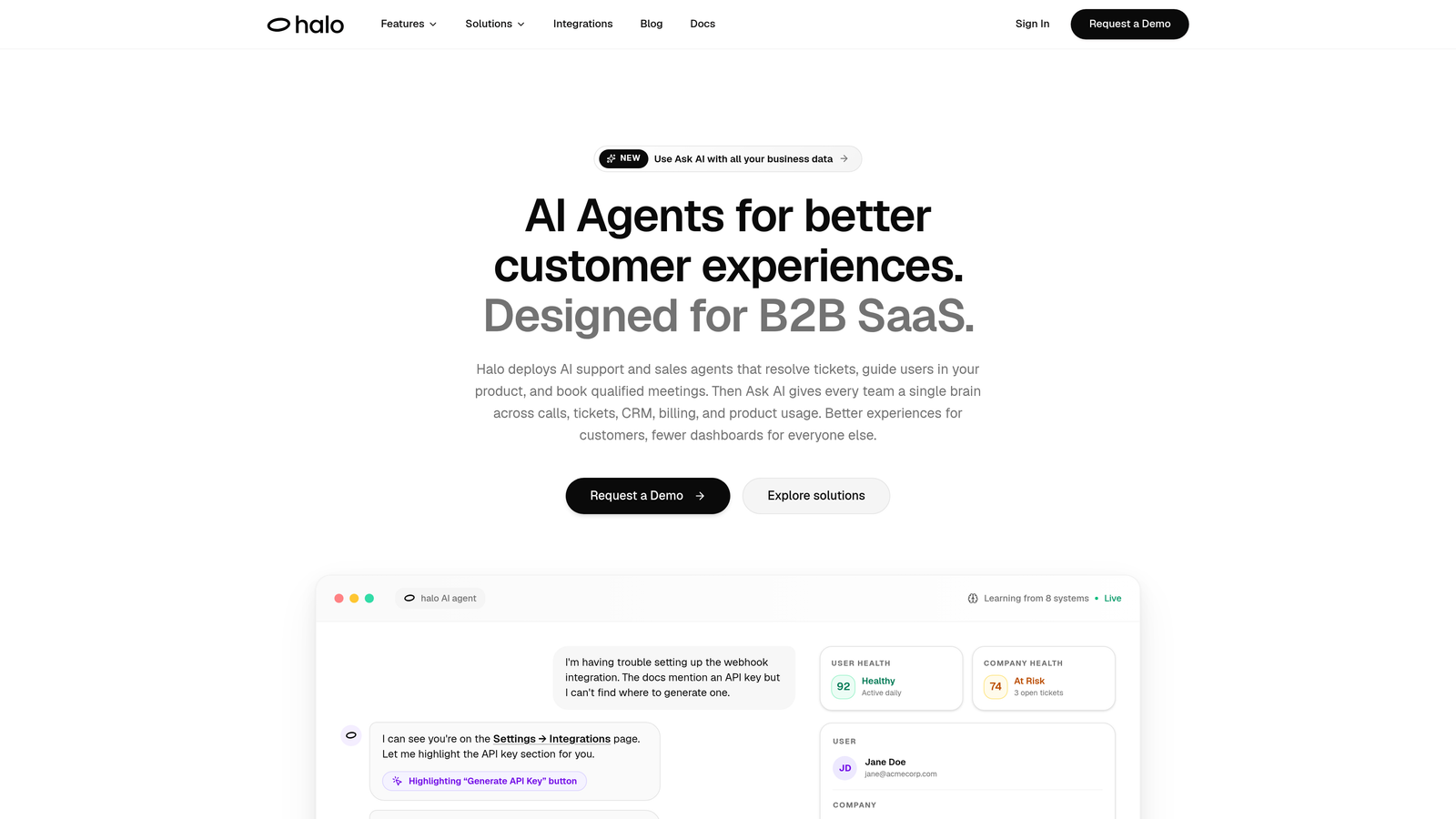
Halo AI is an AI-first customer support platform purpose-built for B2B SaaS teams, deploying autonomous agents that resolve tickets, guide users through your product, and surface business intelligence from every interaction.
Where This Tool Shines
What separates Halo from most platforms on this list is its page-aware context. The chat widget doesn't just know what a user typed — it sees which page they're on, what UI elements are visible, and uses that context to deliver precise, relevant guidance rather than generic answers pulled from a knowledge base. This is genuinely useful for SaaS products with complex interfaces where "I'm confused" means something different on the billing page versus the onboarding flow.
The other standout is the smart inbox. Rather than just routing tickets, Halo surfaces business intelligence from support conversations: customer health signals, revenue anomalies, and product usage patterns. Your support queue becomes a source of strategic insight, not just a cost center to manage down.
Key Features
Page-Aware Chat Widget: The AI sees the user's current screen context, enabling precise guidance that's relevant to exactly where they are in your product.
Autonomous Ticket Resolution: AI agents handle tickets end-to-end with a continuous learning loop, improving with every interaction rather than staying static.
Auto Bug Ticket Creation: When users report issues, Halo automatically creates structured bug tickets routed directly to Linear, keeping your engineering team in the loop without manual handoffs.
Smart Inbox with Business Intelligence: Customer health signals, revenue anomaly detection, and product insights surface automatically from support conversations.
Live Agent Handoff: Complex escalations transfer seamlessly to human agents without disrupting the conversation context.
Deep Integrations: Native connections to Linear, Slack, HubSpot, Intercom, Stripe, Zoom, PandaDoc, and Fathom make Halo a connective layer across your entire stack.
Best For
B2B SaaS product teams and support leaders who want AI as the primary resolution engine, not a suggestion layer. Particularly well-suited for teams already using Intercom or Zendesk who want to upgrade to a genuinely AI-native architecture without cobbling together multiple tools.
Pricing
Contact for pricing. Halo is built specifically for B2B SaaS teams, so pricing is tailored to your support volume and integration requirements.
2. Intercom (Fin AI Agent)
Best for: Teams already on Intercom's platform who want capable AI resolution without migrating infrastructure
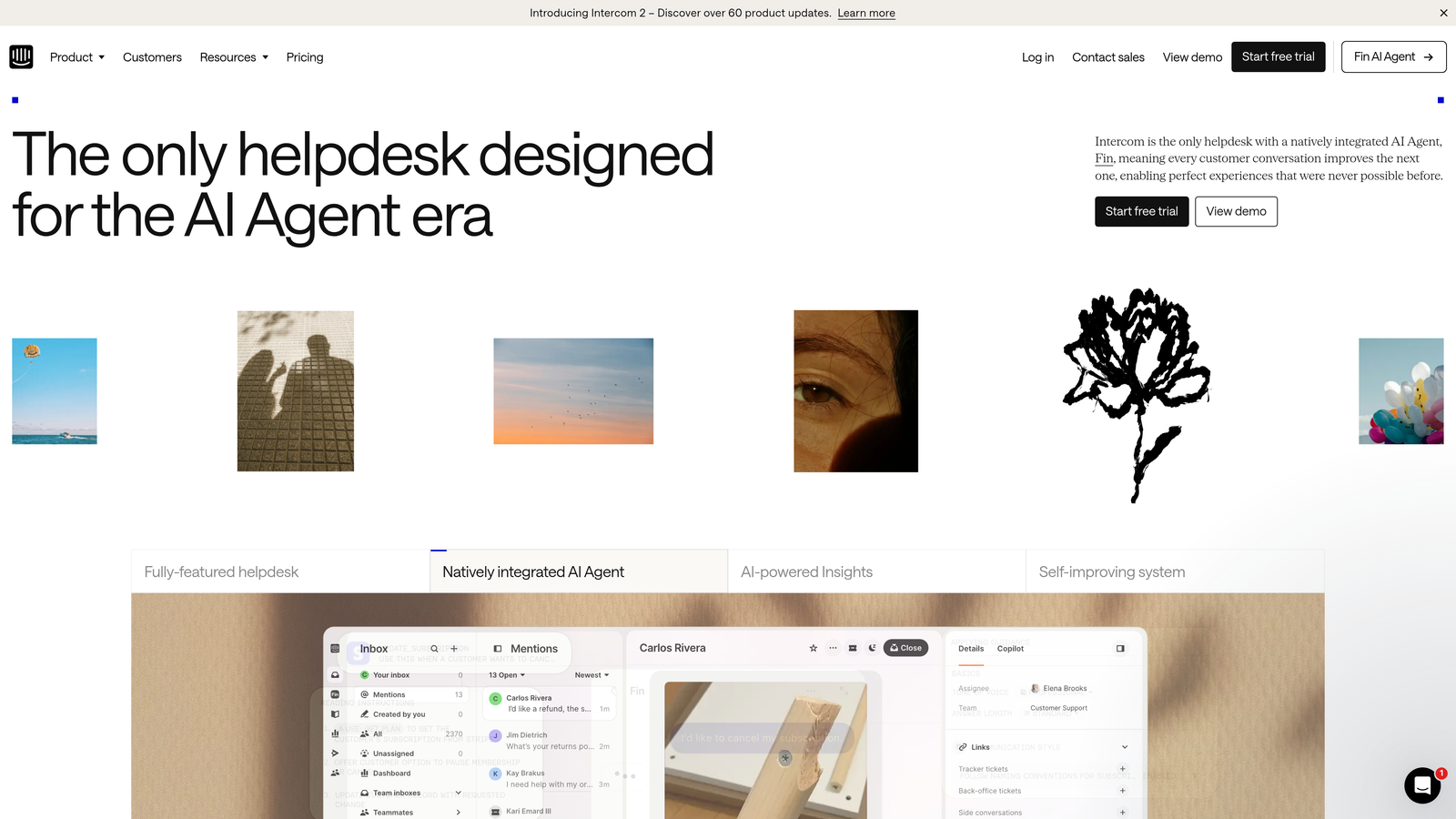
Intercom's Fin AI Agent is one of the more capable AI agents available today, trained on your help content to resolve common queries autonomously within Intercom's familiar messenger experience.
Where This Tool Shines
Fin benefits from Intercom's years of messaging infrastructure. The handoff between AI and human agent is genuinely smooth — context carries over, conversation history is preserved, and the experience doesn't feel disjointed. For teams already invested in Intercom's ecosystem, adding Fin is a natural extension rather than a platform change.
Resolution quality depends heavily on the quality of your help center content. Teams with well-maintained documentation get strong results. Teams with sparse or outdated content will find Fin's autonomous resolution rates disappointing until they invest in their knowledge base.
Key Features
Fin AI Agent: Resolves queries using your help center content and custom answers, with configurable confidence thresholds for when to escalate.
Seamless Human Handoff: Transfers to live agents within Intercom's messenger with full conversation context preserved.
Omnichannel Deployment: Available across web, mobile, and email within the Intercom ecosystem.
AI Resolution Analytics: Tracks resolution rates, deflection metrics, and identifies gaps in your help content.
App Ecosystem Integrations: Connects with a broad range of third-party tools through Intercom's marketplace.
Best For
Teams already using Intercom as their primary support and messaging platform. Less compelling as a standalone choice if you're starting fresh, since you're paying for the full Intercom platform plus Fin's per-resolution pricing.
Pricing
Fin AI Agent is priced per resolution as an add-on. Base Intercom plans start at approximately $29 per seat per month, with Fin costs layered on top depending on resolution volume.
3. Zendesk AI
Best for: Large enterprise support organizations already running Zendesk who need AI augmentation at scale
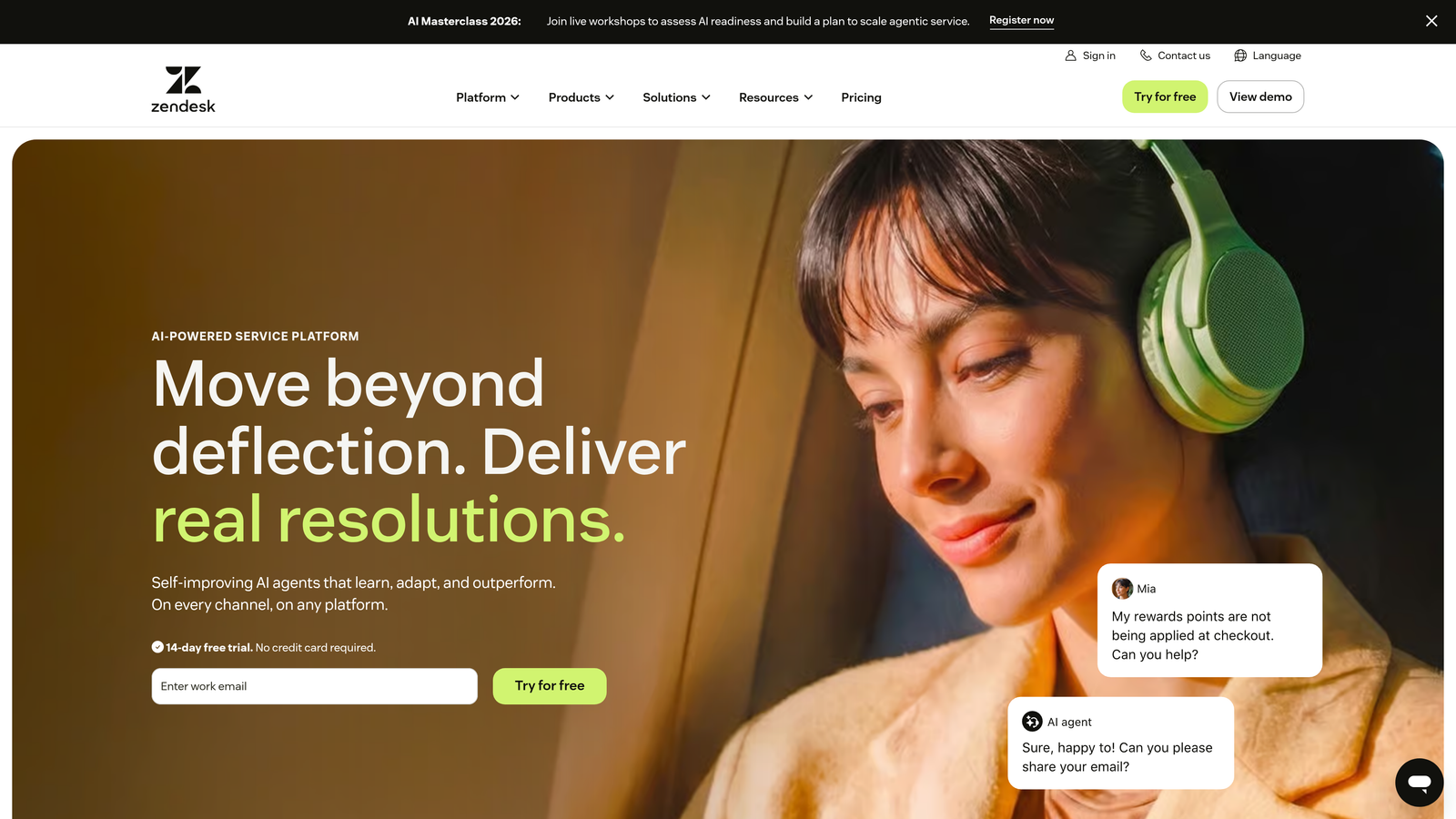
Zendesk's AI layer spans its entire support suite, from intelligent triage and routing to agent copilot features and self-service, designed for enterprise-scale operations with complex workflows.
Where This Tool Shines
Zendesk AI's strength is breadth. It touches every part of the support workflow: routing, triage, agent suggestions, knowledge surfacing, and self-service deflection. For enterprises with hundreds of agents handling diverse ticket types across multiple channels, that comprehensive coverage matters. You're not stitching together separate tools — AI assistance is woven throughout the platform you already operate.
It's worth being clear-eyed about what Zendesk AI is, though. It's an augmentation layer on top of a fundamentally human-agent ticketing system. The AI assists and accelerates human agents more than it replaces them. For teams whose primary goal is autonomous resolution rather than agent efficiency, that distinction matters.
Key Features
Intelligent Triage and Routing: AI classifies and routes incoming tickets based on intent, priority, and agent skill sets.
Agent Copilot: Suggests replies, surfaces relevant knowledge articles, and recommends next-best-action steps for agents in real time.
AI-Driven Self-Service: Surfaces relevant knowledge base content proactively to deflect tickets before they're submitted.
Advanced Analytics: Enterprise-grade reporting on support performance, workforce management, and AI effectiveness metrics.
Compliance and Security Controls: Extensive enterprise compliance features including data residency, audit logs, and access controls.
Best For
Enterprises with existing Zendesk infrastructure, large agent teams, and complex routing requirements. The switching costs from Zendesk are high, so this is primarily compelling for teams already committed to the platform.
Pricing
Suite plans start at approximately $55 per agent per month. AI features are available on higher tiers, which increases the effective per-seat cost meaningfully for larger teams.
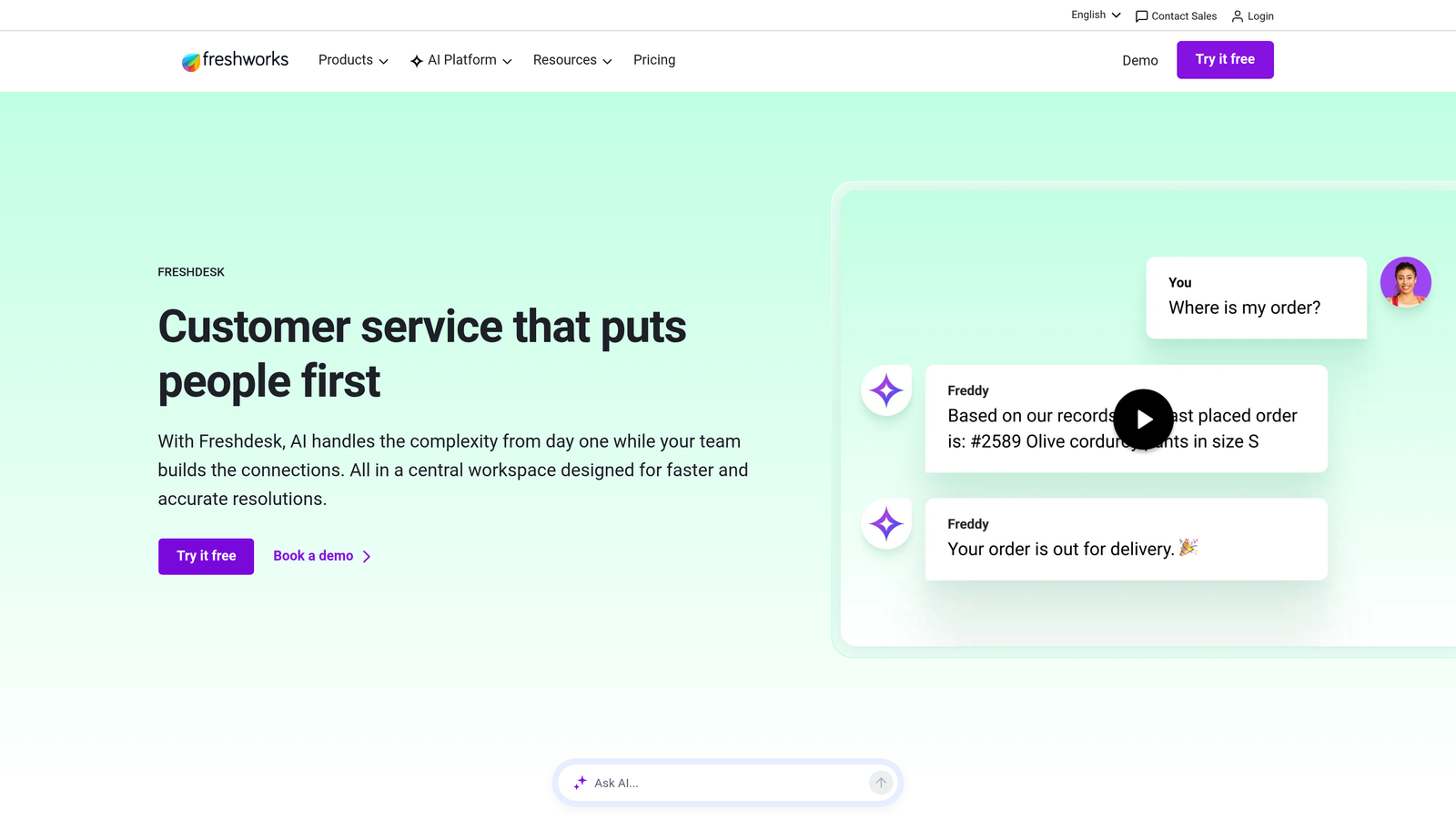
4. Freshdesk Freddy AI
Best for: SMB and mid-market teams wanting AI-assisted support at accessible pricing without enterprise complexity
Freshdesk's Freddy AI covers self-service, agent assist, and support insights, making AI-assisted support accessible to growing teams that can't justify enterprise-tier pricing.
Where This Tool Shines
Freshdesk's primary advantage is the combination of capable AI features and pricing that doesn't require a CFO sign-off. Freddy AI spans three distinct functions: self-service deflection, in-workflow agent assistance, and trend analysis. For a mid-market team managing a few hundred tickets per day, that's meaningful coverage without the overhead of an enterprise platform.
The tradeoff is depth. Freddy AI is positioned as agent-assist rather than autonomous resolution. It's helping your human agents work faster, not replacing them as the primary responder. Teams whose primary goal is reducing headcount dependency may find the autonomous resolution capabilities less mature than purpose-built AI-first platforms.
Key Features
Freddy Self Service: AI-powered deflection and chatbot flows that handle common queries before they become tickets.
Freddy Copilot: Suggests replies, summarizes long ticket threads, and surfaces relevant knowledge for agents mid-conversation.
Freddy Insights: Trend detection and CSAT analysis that surfaces patterns in support data.
Omnichannel Ticket Management: AI triage across email, chat, phone, and social channels.
Accessible Pricing Tiers: AI features available at price points that work for teams below enterprise scale.
Best For
SMB and mid-market support teams that want AI assistance without the complexity or cost of enterprise platforms. Also a strong choice for teams already using other Freshworks products like Freshsales or Freshservice.
Pricing
Free plan available for small teams. Paid plans start at approximately $15 per agent per month, with Freddy AI features unlocking on higher tiers.
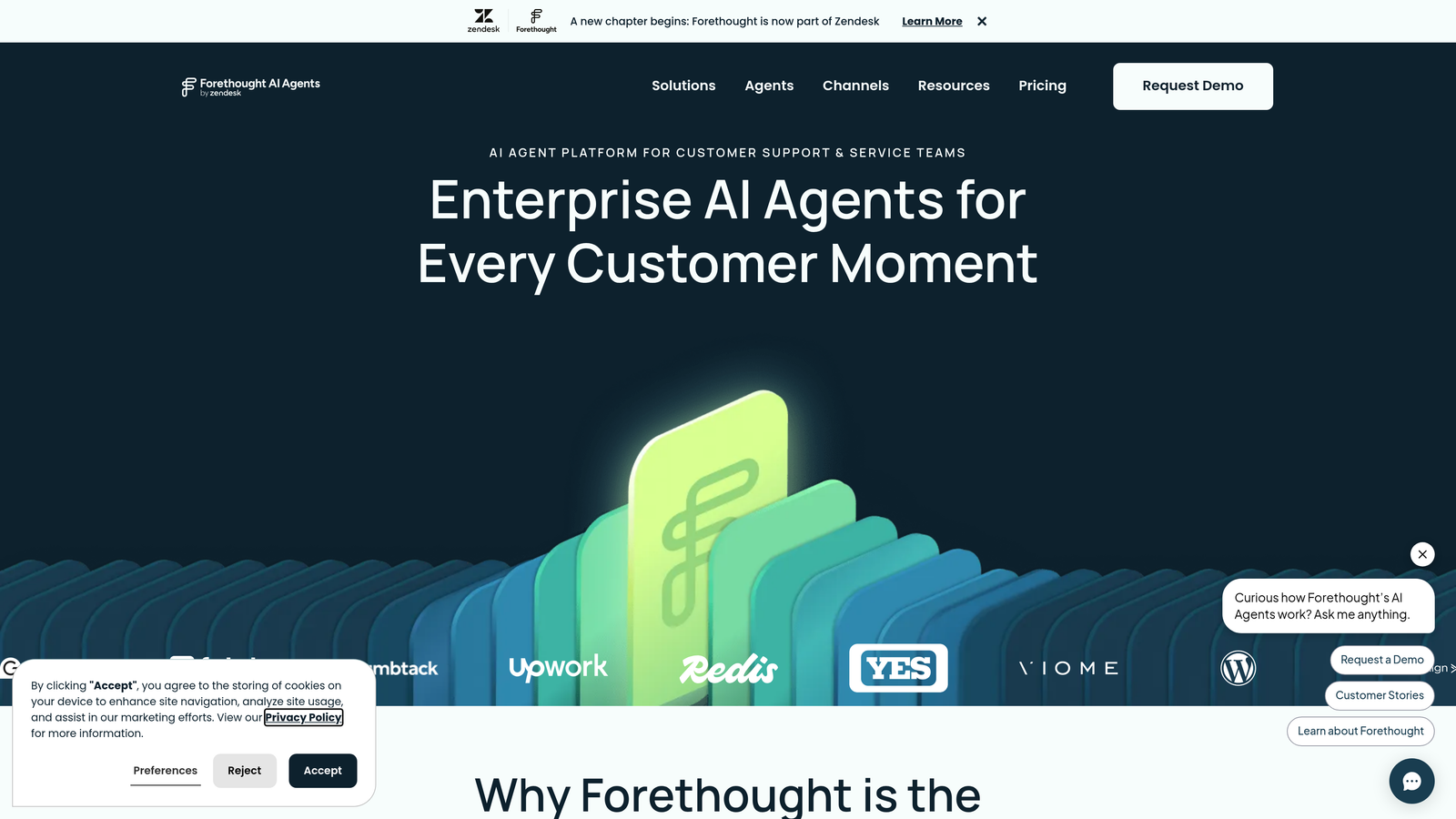
5. Forethought
Best for: Enterprises wanting AI augmentation without migrating away from their existing helpdesk
Forethought is an AI layer that sits on top of existing helpdesks, adding intelligent triage, deflection, and agent assist without requiring a platform migration or infrastructure change.
Where This Tool Shines
Forethought's core value proposition is additive AI. If your organization has significant investment in Zendesk, Salesforce Service Cloud, or Freshdesk and a migration is off the table, Forethought lets you layer meaningful AI capabilities on top without disrupting existing workflows. This is a real constraint for many enterprise teams, and Forethought addresses it directly.
The three-product structure (Solve for deflection, Triage for routing, Assist for agent suggestions) means you can adopt incrementally. Teams that start with just triage often expand to deflection once they see results, making it easier to build internal buy-in over time.
Key Features
Solve: AI-powered ticket deflection and self-service resolution that handles common queries before they reach an agent.
Triage: Intelligent routing based on intent, sentiment, and urgency signals extracted from incoming tickets.
Assist: In-workflow agent suggestions and knowledge surfacing that reduce handle time without disrupting existing processes.
Helpdesk Integrations: Connects with Zendesk, Salesforce Service Cloud, Freshdesk, and other major platforms.
No Migration Required: Augments existing infrastructure rather than replacing it.
Best For
Enterprise teams with entrenched helpdesk infrastructure who need AI improvements quickly without a platform change. Not a standalone support system — requires an existing helpdesk to function.
Pricing
Custom pricing based on volume and product combination. Contact Forethought directly for a quote.
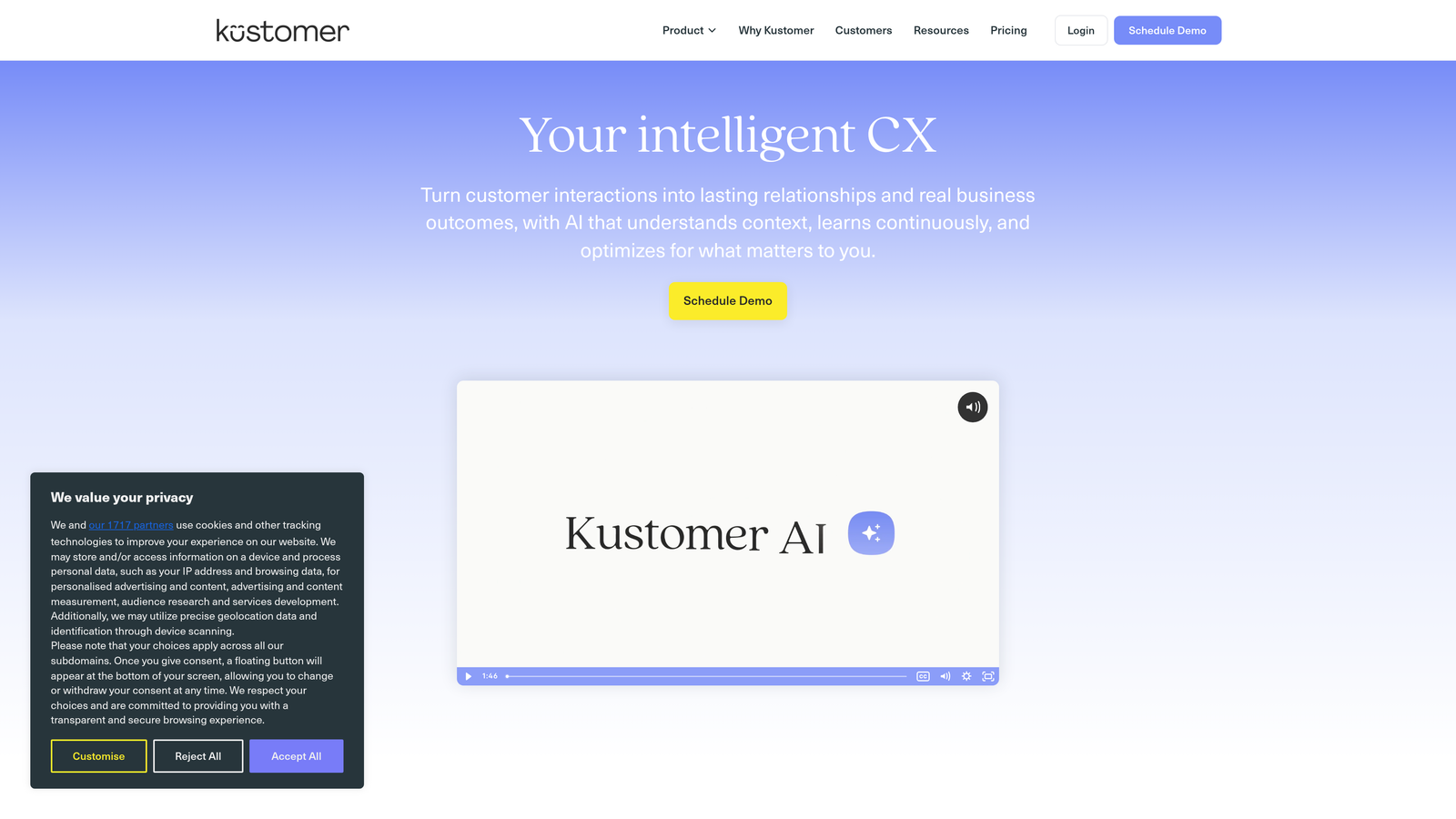
6. Kustomer
Best for: High-volume B2C support teams that need AI with rich customer history context
Kustomer is a CRM-native support platform that gives AI full customer timeline context — every order, interaction, and touchpoint — for more informed automated and human responses.
Where This Tool Shines
Kustomer's differentiator is the unified customer timeline. When a customer contacts support, the AI (and any human agent who takes over) sees the complete relationship history: past orders, previous conversations, returns, account status, and more. This context makes automated responses meaningfully more relevant than generic knowledge base lookups, particularly for consumer businesses where order history and account status are central to most support queries.
The platform is better suited to B2C than B2B SaaS. The CRM-native model shines when customer data is primarily transactional (orders, subscriptions, deliveries). For complex B2B accounts with multi-stakeholder relationships and product-specific technical issues, other platforms on this list will be a better fit.
Key Features
Unified Customer Timeline: Complete interaction, order, and account history in a single view for both AI and human agents.
Context-Rich AI Automation: AI responses informed by full CRM data rather than help content alone.
Omnichannel Support: Email, chat, voice, social, and SMS all managed within a single interface.
Workflow Automation: Routing, tagging, and escalation rules that leverage customer data for smarter decisions.
High-Volume B2C Optimization: Infrastructure designed for consumer support operations at significant scale.
Best For
High-volume B2C companies, particularly in e-commerce, retail, and subscription consumer products, where customer history context drives better support outcomes. Less compelling for B2B SaaS teams.
Pricing
Plans start at approximately $89 per agent per month. Enterprise pricing is available for larger deployments.
7. Ada
Best for: Global enterprise brands needing multilingual AI agents with no-code configuration and strong compliance controls
Ada is an enterprise AI agent builder with no-code configuration, strong multilingual capabilities, and omnichannel deployment designed for large organizations with complex automation requirements.
Where This Tool Shines
Ada's standout capability is multilingual support at enterprise scale. With coverage across 50+ languages and no-code agent configuration, it's a strong choice for global brands that need consistent AI-driven support across different markets without building separate automation flows for each language. The enterprise controls are mature, which matters for regulated industries or organizations with strict data governance requirements.
The tradeoff is setup complexity. Ada is not a plug-and-play solution. Getting meaningful results requires investment in configuration, content, and integration work. Teams expecting to be operational in days will be disappointed; teams willing to invest in setup will find a capable and flexible platform on the other side.
Key Features
No-Code Agent Builder: Enterprise-grade AI agent configuration without engineering resources required for ongoing maintenance.
Multilingual Support: AI agents operating across 50+ languages with consistent quality.
Omnichannel Deployment: Web, mobile, messaging apps, and voice covered from a single platform.
Deep Integrations: Connects with CRM, e-commerce, and support platforms to pull relevant customer context.
Containment Analytics: Detailed reporting on AI containment rates, escalation patterns, and agent performance.
Best For
Large global enterprises with multilingual support requirements, strong compliance needs, and the resources to invest in meaningful initial configuration. Not the right fit for teams that need fast deployment or have limited technical resources.
Pricing
Custom enterprise pricing. Contact Ada directly for a quote based on your deployment scope and volume.
8. Tidio
Best for: Small businesses and e-commerce stores wanting fast, affordable AI support without enterprise overhead
Tidio combines live chat with its Lyro AI agent to give small businesses and e-commerce stores accessible, fast-to-deploy AI support that's operational in hours rather than weeks.
Where This Tool Shines
Tidio's primary advantage is speed and simplicity. For a small e-commerce team that needs AI support running this week, not this quarter, Tidio delivers. The Lyro AI agent handles common queries autonomously, the live chat takeover is clean and quick, and the Shopify integration means product and order context flows into conversations without custom development work.
The ceiling is relatively low compared to enterprise platforms. Integration depth, analytics sophistication, and autonomous resolution capabilities don't match what you'll find in platforms designed for larger organizations. But for the SMB and e-commerce segment, those limitations rarely matter. Tidio solves the problem that segment actually has.
Key Features
Lyro AI Agent: Autonomous query resolution trained on your support content, handling common questions without human intervention.
Live Chat with Quick Takeover: Human agents can step in instantly when Lyro reaches its limits, with full conversation context visible.
E-Commerce Integrations: Native Shopify integration with support for other major e-commerce platforms.
Visual Chatbot Builder: Drag-and-drop flow builder for custom automation sequences without coding.
Fast Deployment: Setup measured in hours, not weeks, with minimal technical requirements.
Best For
Small businesses, e-commerce stores, and early-stage startups that need working AI support quickly and affordably. Not suited for B2B SaaS teams or organizations with complex integration requirements.
Pricing
Free plan available for very small teams. Lyro AI starts at approximately $29 per month, with paid plans scaling based on conversation volume and feature requirements.
9. Salesforce Einstein Service Cloud
Best for: Enterprises where Salesforce is already the system of record and native CRM context is non-negotiable
Salesforce Einstein Service Cloud embeds AI throughout the service experience, with the key advantage of native access to full Salesforce CRM data without any integration work required.
Where This Tool Shines
Einstein's core advantage is data proximity. When your entire account, order, contract, and relationship history lives in Salesforce, having AI that natively accesses all of that context is genuinely powerful. There's no integration to build, no data sync to maintain, and no context lost between systems. For enterprises where Salesforce is the system of record, that native connectivity is difficult to replicate with any other platform.
Outside of the Salesforce ecosystem, the value proposition weakens considerably. The platform is complex, expensive, and optimized for organizations already running Salesforce at scale. Teams evaluating Einstein who don't have existing Salesforce infrastructure will find better value elsewhere on this list.
Key Features
Einstein GPT for Service: AI-generated reply drafts, case summaries, and knowledge article recommendations built into the agent workflow.
Native CRM Data Access: Full Salesforce account, order, and relationship data available to AI without external integrations.
AI-Powered Knowledge Recommendations: Surfaces relevant knowledge articles based on case content and customer history.
Omni-Channel Routing: AI-assisted prioritization and routing across all support channels within the Salesforce environment.
Enterprise Compliance and Security: Salesforce's full compliance, audit, and data governance capabilities applied to service operations.
Best For
Large enterprises running Salesforce as their primary CRM and business platform, where native data access and ecosystem consistency outweigh the cost and complexity premium. Not a practical choice for organizations outside the Salesforce ecosystem.
Pricing
Service Cloud starts at approximately $75 per user per month. Einstein AI features are available on higher editions, making the effective cost meaningfully higher for teams that need the full AI capability set.
Which Platform Is Right for Your Team?
The right choice depends less on feature checklists and more on where you're starting from and what you actually need AI to do.
If you're a B2B SaaS team that wants AI as the primary resolution engine with page-aware context, business intelligence from support conversations, and deep integrations across your product stack, Halo AI is the most purpose-built option on this list. It's the only platform here designed specifically for that use case from the ground up.
If you're an enterprise team already on Zendesk or Salesforce, the switching costs are real. Zendesk AI and Einstein Service Cloud both offer meaningful AI augmentation within ecosystems you're already committed to. Forethought is worth evaluating if you want stronger AI capabilities without a platform migration.
For SMB and mid-market teams watching budget carefully, Freshdesk Freddy AI offers the best balance of capability and accessible pricing. Tidio is the fastest path to working AI support for small e-commerce businesses that need something operational this week.
For global enterprises with multilingual requirements and complex compliance needs, Ada's no-code configuration and 50+ language coverage make it the strongest fit, provided you have the resources for a thorough initial setup.
The broader point worth keeping in mind: AI-first isn't just a marketing label. It describes a fundamental architectural choice about whether AI is the primary agent or a helpful assistant to human agents. That distinction has real consequences for resolution rates, headcount requirements, and the intelligence you extract from support conversations over time.
Your support team shouldn't scale linearly with your customer base. Let AI agents handle routine tickets, guide users through your product, and surface business intelligence while your team focuses on complex issues that need a human touch. See Halo in action and discover how continuous learning transforms every interaction into smarter, faster support.