10 Best AI Tools for Customer Service Automation in 2026
This comprehensive guide evaluates the 10 best tools for AI for customer service automation in 2026, helping B2B support teams cut ticket volume, deliver instant responses, and scale efficiently without increasing headcount. Whether you're upgrading a legacy helpdesk or building an AI-first support operation, the breakdown covers autonomous resolution quality, integration depth, deployment ease, and pricing across today's leading platforms.
 Matt PattoliFounder15 min read
Customer service teams are under more pressure than ever. Ticket volumes climb, customers expect instant answers, and hiring at scale isn't sustainable for most businesses. AI-powered customer service automation has moved from "nice to have" to essential infrastructure for B2B companies that want to deliver fast, consistent support without burning out their teams.
But the market is crowded. From full-stack AI agent platforms to bolt-on chatbot widgets, the options vary wildly in capability, complexity, and cost. We evaluated tools across criteria that matter most to product and support teams: autonomous resolution quality, integration depth, learning capabilities, ease of deployment, and pricing transparency. Whether you're replacing a legacy helpdesk, augmenting your existing Zendesk or Intercom setup, or building an AI-first support operation from scratch, here are the top tools available right now.
1. Halo AI
Best for: B2B teams building an AI-first support operation with deep integrations and business intelligence
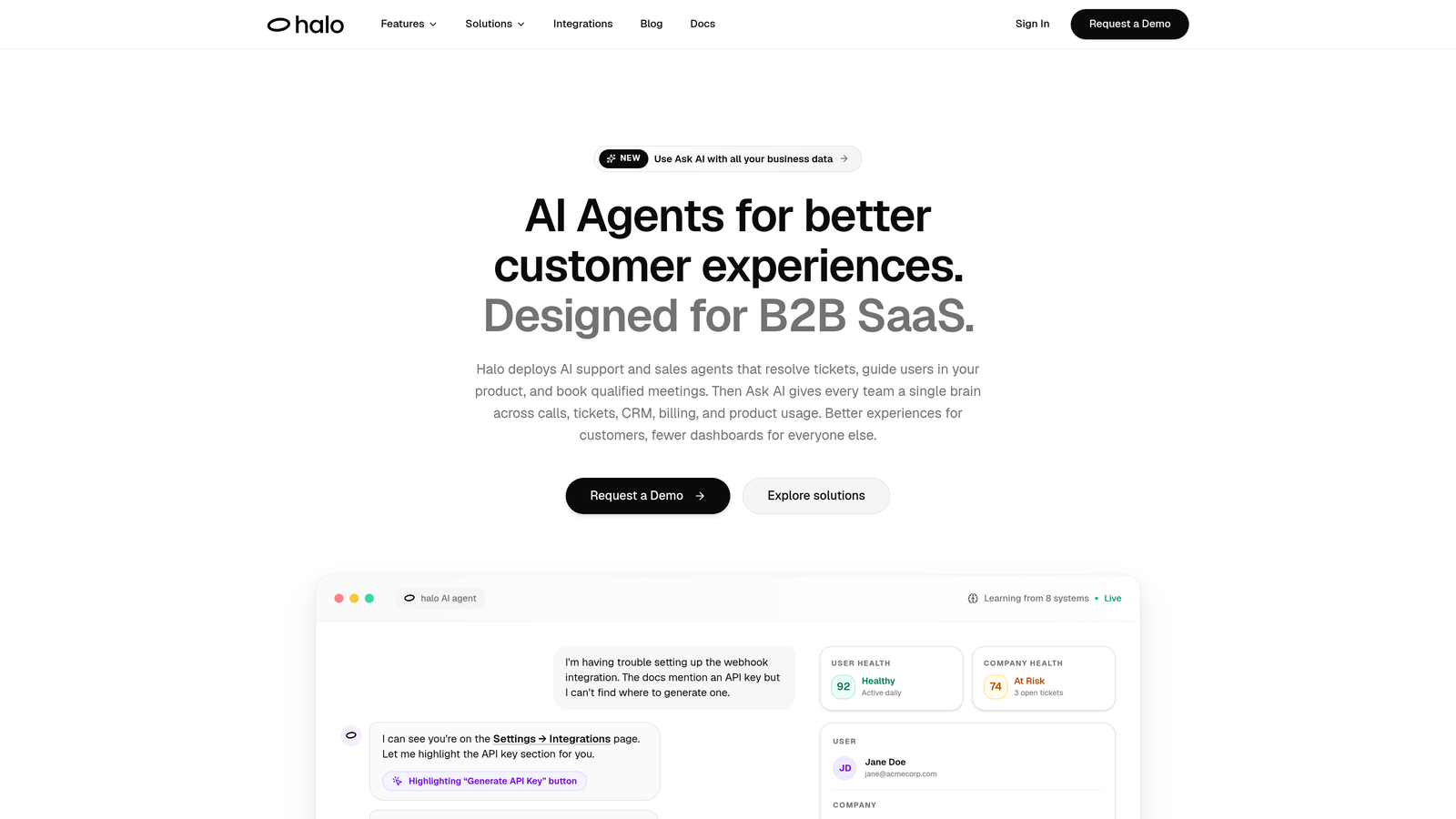
Halo AI is an AI-first customer support platform that deploys autonomous agents to resolve tickets, guide users with page-aware context, and surface business intelligence from every interaction.
Where This Tool Shines
Halo was built from the ground up around AI, not retrofitted onto a legacy helpdesk. That architecture difference shows up in the details: its AI agents don't just deflect tickets, they resolve them end-to-end, learning from every interaction to get smarter over time. The page-aware chat widget is a standout feature, giving the AI visibility into exactly what a user is looking at so it can provide contextual, visual guidance rather than generic answers.
Where Halo truly separates itself from the pack is the business intelligence layer. Support conversations are a goldmine of product signals, and Halo's smart inbox surfaces customer health data, anomaly detection, and churn risk indicators that most support tools simply ignore. You're not just resolving tickets; you're generating intelligence that feeds your product and revenue teams.
Key Features
Autonomous AI Agents: Resolve support tickets end-to-end without requiring human intervention, with continuous learning built into every resolved conversation.
Page-Aware Chat Widget: The AI sees what users see in real time, enabling visual UI guidance and context-specific answers rather than generic help center responses.
Smart Inbox with Business Intelligence: Surfaces customer health signals, anomaly detection, and revenue intelligence directly from support interaction data.
Auto Bug Ticket Creation: Automatically generates bug reports with full context and routes them directly to Linear, closing the loop between support and engineering.
Live Agent Handoff: Escalates complex issues to human agents with full conversation context preserved, so customers never have to repeat themselves.
Deep Integration Stack: Connects natively with Slack, HubSpot, Intercom, Stripe, Zoom, PandaDoc, and Fathom, enabling AI that acts across your entire business stack.
Best For
Halo is best suited for B2B SaaS companies and product-led growth teams that want AI to do more than answer FAQs. If your support team is also a source of product feedback, churn signals, and bug discovery, Halo's intelligence layer makes it a strong fit for teams that want support to inform the entire business.
Pricing
Contact for pricing; a free trial is available. Given the platform's depth of integrations and business intelligence capabilities, it's worth requesting a demo to see the full scope before comparing on price alone.
2. Intercom Fin
Best for: Teams already on Intercom who want a native AI agent with minimal setup
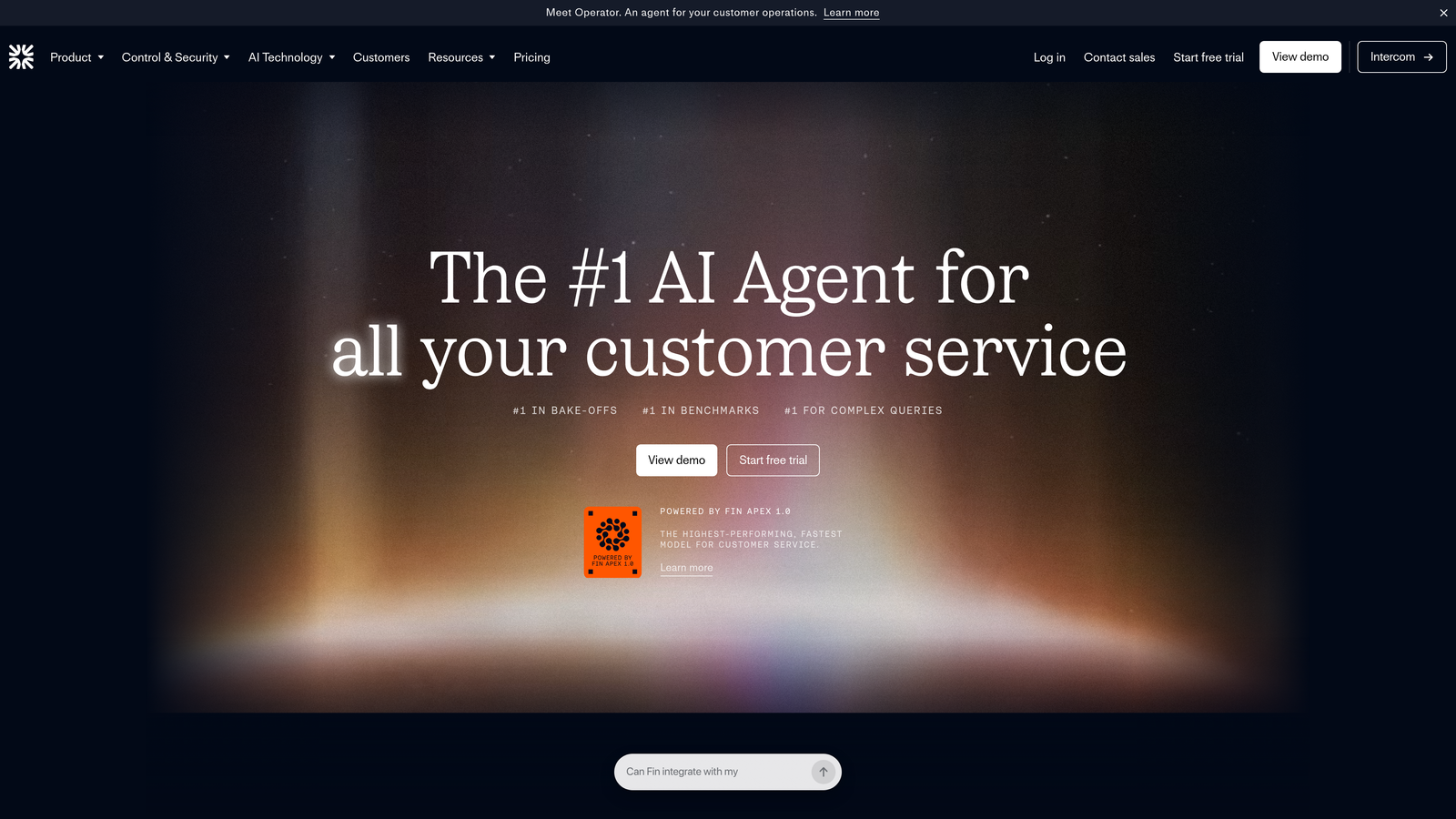
Intercom Fin is Intercom's native AI agent, trained on your existing help center content and conversation history to resolve customer questions within the Intercom ecosystem.
Where This Tool Shines
If your team is already invested in Intercom, Fin is a natural extension. It draws on your existing help center articles and past conversations to generate answers, which means the onboarding lift is lower than deploying a standalone AI platform. The handoff experience to human agents is seamless, maintaining the conversation thread without friction.
Fin's multilingual support and automatic language detection make it a solid choice for teams serving international customer bases. The built-in reporting on AI resolution rates also gives support managers a clear picture of what the AI is handling versus what's still reaching humans.
Key Features
Help Center-Trained AI: Learns from your existing articles, past conversations, and custom content without requiring manual rule-building.
Seamless Human Handoff: Escalates to live agents within the Intercom inbox with full context intact.
Multilingual Support: Detects customer language automatically and responds accordingly across supported languages.
Source Attribution: Cites the specific content source when generating answers, adding transparency to AI responses.
Resolution Rate Reporting: Built-in analytics track how effectively Fin is resolving conversations without agent involvement.
Best For
Teams already using Intercom as their primary support and messaging platform. Fin works best when you have a well-maintained help center to train on. If your documentation is sparse or outdated, you'll need to invest in content quality before Fin can perform at its best.
Pricing
Usage-based pricing per resolved conversation; requires an active Intercom subscription. Costs can scale quickly at high conversation volumes, so model your expected resolution rates before committing.
3. Zendesk AI
Best for: Enterprise support teams standardized on Zendesk Suite looking to add AI across existing workflows
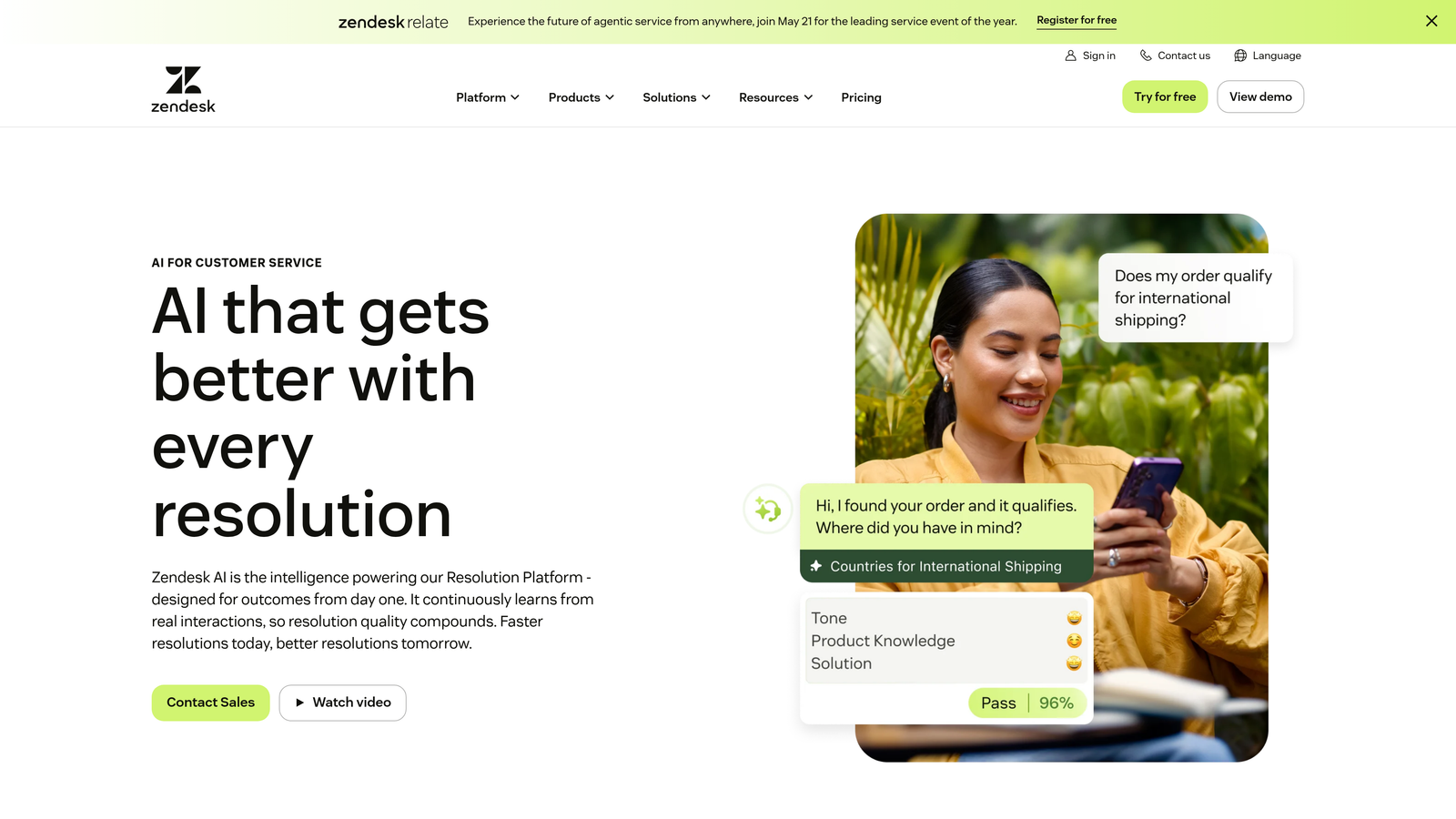
Zendesk AI is a suite of AI capabilities embedded across Zendesk's platform, including intelligent triage, suggested replies, and generative AI bots for self-service resolution.
Where This Tool Shines
Zendesk AI benefits from being deeply embedded in one of the most widely adopted helpdesk platforms in the world. For teams already running their support operations on Zendesk Suite, enabling AI features doesn't require a platform migration or significant re-training. Intelligent triage automatically categorizes incoming tickets by intent, language, and sentiment, which alone can save agents meaningful time on ticket management.
The generative AI bots handle self-service resolution for common questions, while the agent-assist features surface suggested replies and relevant knowledge base articles in real time. Zendesk's compliance-ready reporting is a genuine advantage for enterprise teams operating in regulated industries.
Key Features
Intelligent Triage: Automatically detects intent, language, and sentiment to route and prioritize tickets without manual sorting.
AI-Suggested Replies: Surfaces contextual reply suggestions for agents based on ticket content and knowledge base data.
Generative AI Bots: Handles self-service resolution for common questions before tickets reach the human queue.
Advanced Analytics: Compliance-ready reporting with detailed performance and resolution metrics.
Marketplace Integrations: Access to an extensive ecosystem of third-party apps and integrations.
Best For
Established enterprise support teams that are already on Zendesk Suite and want to layer AI capabilities onto existing workflows without switching platforms. Less ideal for teams looking for an AI-native architecture or deep product intelligence beyond the support queue.
Pricing
AI features are included in Suite plans starting around $55 per agent per month; advanced AI capabilities are available as an add-on. Pricing should be verified directly with Zendesk as tiers evolve.
4. Ada
Best for: High-volume enterprise support with omnichannel automation across chat, email, voice, and social
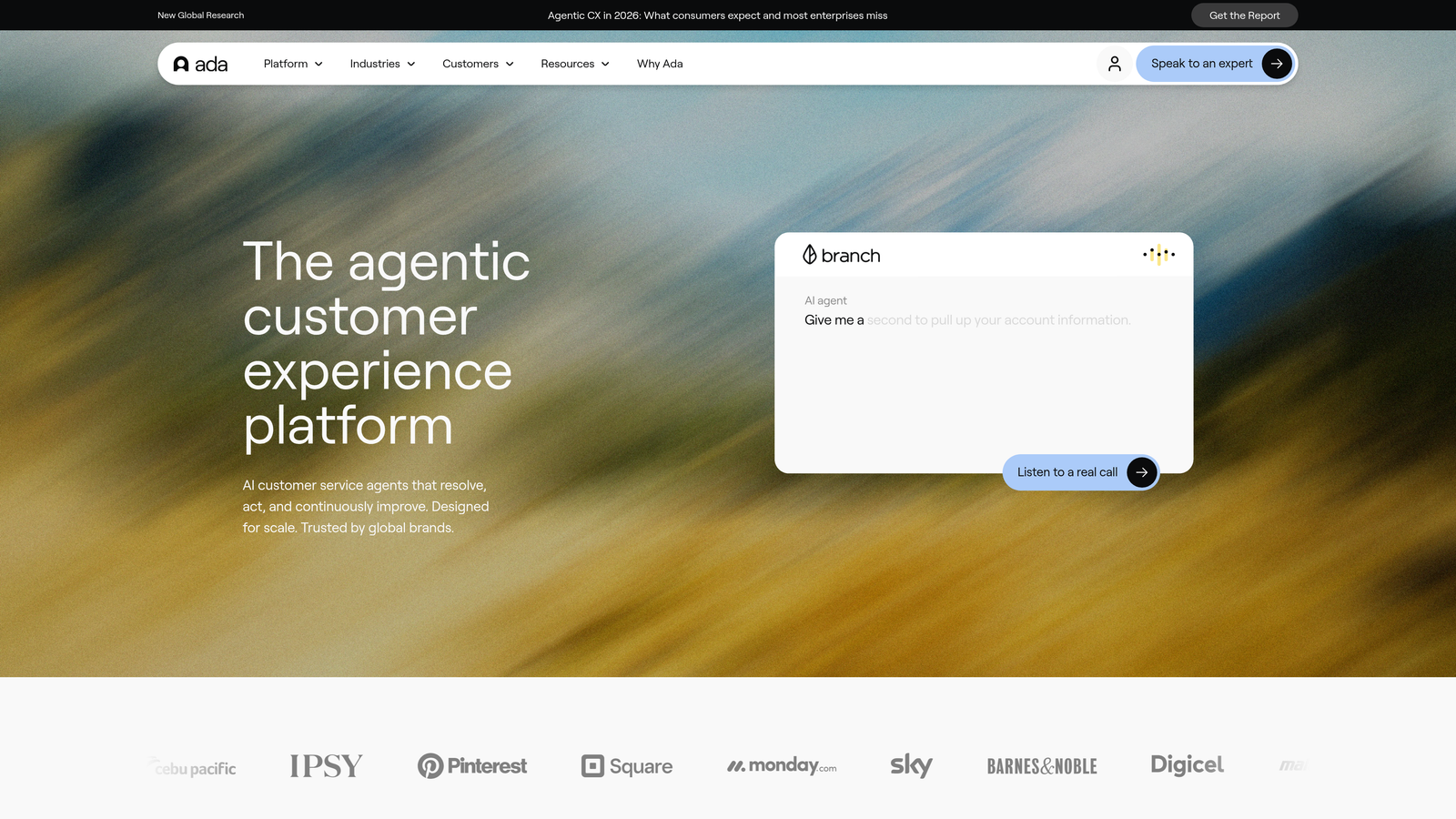
Ada is an enterprise-grade AI customer service platform focused on high-volume automated resolution across multiple channels and languages.
Where This Tool Shines
Ada has built its reputation on scale. For enterprise teams handling tens of thousands of interactions across multiple channels, Ada's no-code conversation builder combined with generative AI capabilities makes it possible to deploy sophisticated automation without heavy engineering involvement. Its multilingual support across 50-plus languages is one of the strongest in the market, making it a go-to for global support operations.
Ada also takes ROI measurement seriously. Built-in automated resolution tracking and ROI reporting give support leaders the data they need to justify AI investment to finance and executive stakeholders, which is often a real-world blocker for enterprise procurement.
Key Features
No-Code Conversation Builder: Build and deploy generative AI-powered conversations without requiring engineering resources.
Omnichannel Deployment: Covers web, mobile, social, SMS, and email from a single platform.
50-Plus Language Support: One of the broadest multilingual capabilities in the AI support category.
Automated Resolution Measurement: Tracks and reports on automation performance and ROI in a format suited for executive reporting.
Enterprise Security: Compliance certifications and enterprise-grade security controls for regulated industries.
Best For
Mid-market to enterprise teams managing high interaction volumes across multiple channels and geographies. Ada's pricing and complexity may be more than smaller teams need, but for global operations it's a strong contender.
Pricing
Custom pricing; typically positioned for mid-market to enterprise budgets. Expect a sales process before getting numbers.
5. Freshdesk Freddy AI
Best for: Growing teams on Freshworks looking for affordable AI-assisted support with CRM connectivity
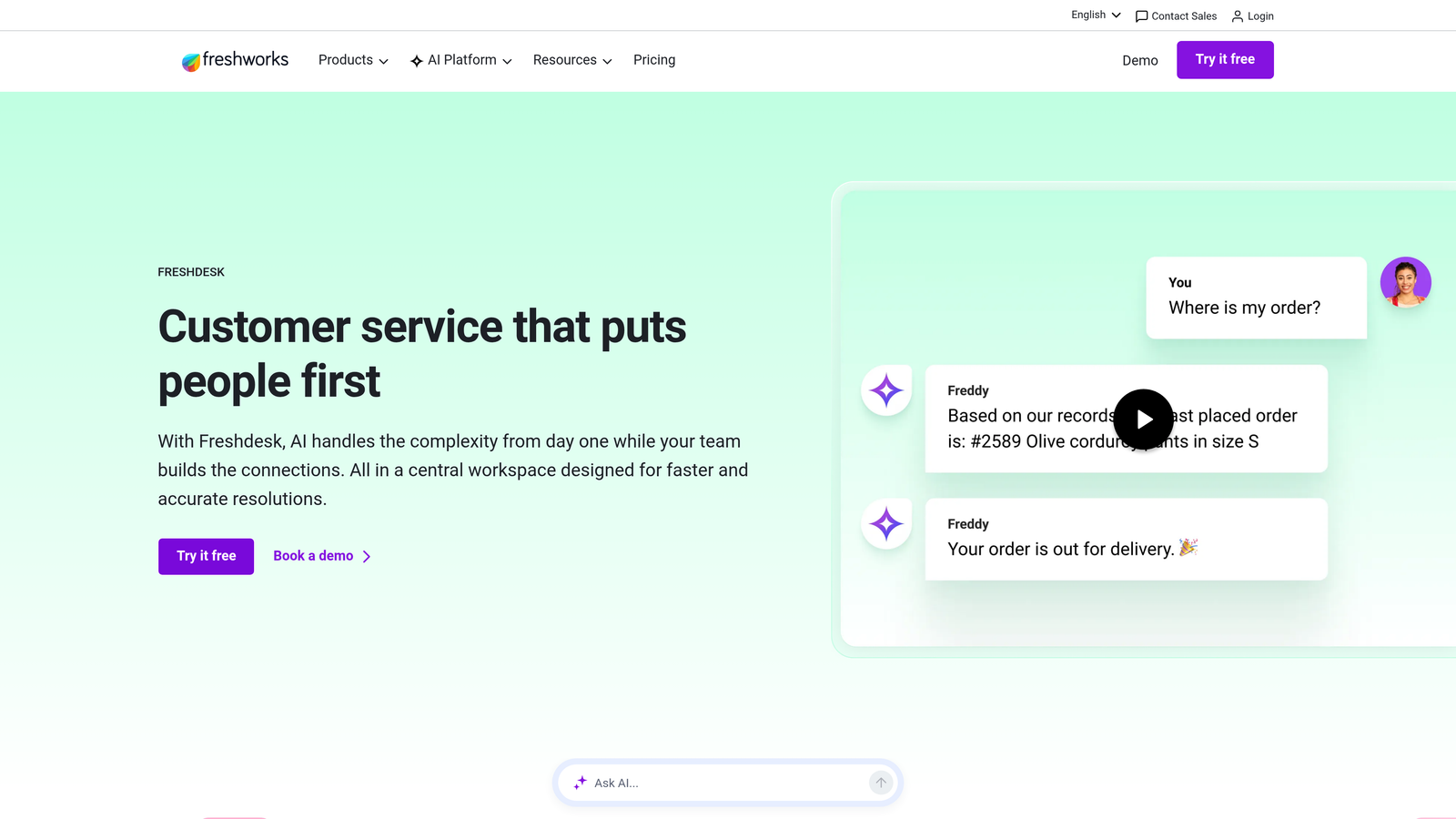
Freshdesk Freddy AI is an AI assistant built into the Freshworks ecosystem that helps support agents with auto-triage, response suggestions, and self-service chatbot capabilities.
Where This Tool Shines
Freddy AI stands out for its accessibility. The pricing tiers make AI-powered support realistic for growing teams that don't have enterprise budgets, and the integration with Freshworks CRM and sales tools creates a unified view of customer interactions across support and sales. For teams already in the Freshworks ecosystem, Freddy is a natural upgrade path rather than a separate procurement decision.
The auto-triage and ticket classification features reduce manual sorting work for agents, while the AI self-service agent handles common queries before they enter the human queue. It's not the most sophisticated AI platform on this list, but it delivers solid value at a price point that's hard to argue with for smaller teams.
Key Features
Freddy AI Agent: Automated self-service chatbot that handles common customer questions without agent involvement.
Auto-Triage: Classifies and routes incoming tickets automatically based on content and intent.
AI-Suggested Responses: Surfaces relevant reply suggestions for agents to speed up response times.
Freshworks Ecosystem Integration: Unified view connecting support data with CRM and sales tools in the Freshworks suite.
Affordable Pricing Tiers: Accessible entry points for teams that are earlier in their AI adoption journey.
Best For
Small to mid-size teams on Freshworks looking to add AI capabilities without a major platform change or budget increase. Also suitable for teams that want CRM and support data unified in a single, affordable platform.
Pricing
Free tier available; AI features become available in the Growth plan starting around $15 per agent per month. One of the more affordable entry points on this list.
6. Tidio
Best for: Small businesses and e-commerce teams that need fast deployment and a simple AI chat experience
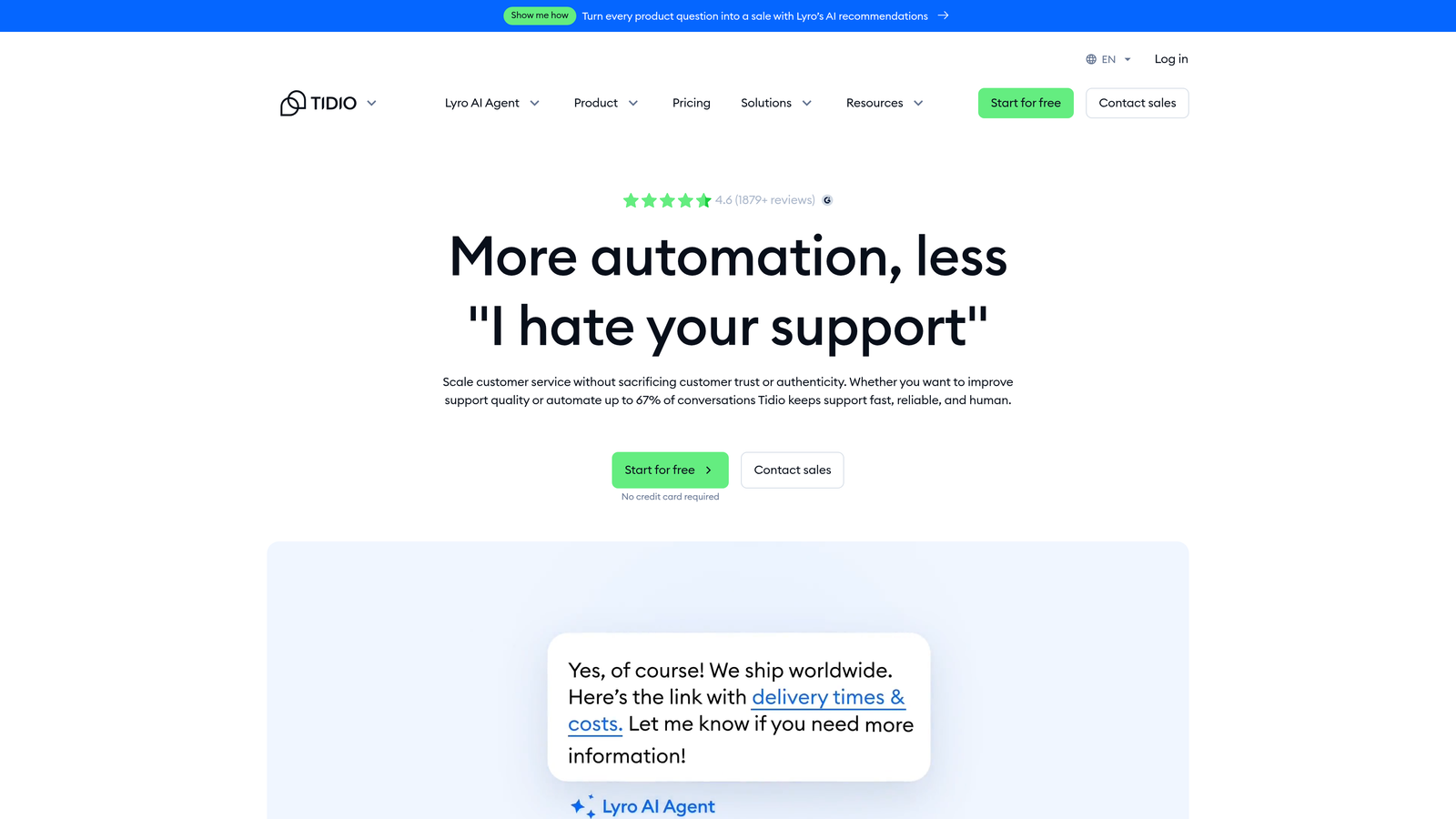
Tidio is a conversational AI platform combining live chat, chatbot automation, and its Lyro AI agent, designed for teams that need to get up and running quickly.
Where This Tool Shines
Tidio's biggest strength is speed to value. The visual chatbot builder with pre-built templates means teams without technical resources can deploy a functional AI chat experience in hours rather than weeks. Lyro, Tidio's AI agent, learns from your FAQ and help content to handle common questions automatically, reducing the volume that reaches live agents.
The e-commerce integrations with Shopify and WooCommerce make Tidio particularly well-suited for online retail teams. Visitor tracking and engagement analytics add a layer of insight that helps teams understand where customers are getting stuck and what questions keep surfacing.
Key Features
Lyro AI Agent: Learns from your FAQ and help content to automatically resolve common customer questions.
Visual Chatbot Builder: Drag-and-drop interface with pre-built templates for fast deployment without coding.
AI-Assisted Live Chat: Surfaces reply suggestions for live agents to speed up response times.
E-Commerce Integrations: Native connections with Shopify, WooCommerce, and other e-commerce platforms.
Visitor Tracking: Real-time analytics on visitor behavior and engagement patterns.
Best For
Small businesses, e-commerce teams, and early-stage companies that need an affordable, fast-to-deploy AI chat solution. Less suited for complex B2B support workflows or teams needing deep integrations with enterprise tooling.
Pricing
Free plan available; Lyro AI starts around $39 per month. One of the most accessible price points on this list for small teams.
7. Forethought
Best for: Enterprise support teams needing generative AI across ticket resolution, routing, and agent assist in one platform
Forethought is an AI platform for enterprise support teams that uses generative AI to automate ticket resolution, intelligent routing, and agent assist workflows.
Where This Tool Shines
Forethought's SupportGPT engine is built specifically for customer support use cases, which gives it an edge over general-purpose AI tools adapted for support. The combination of automated resolution, intelligent routing, and real-time agent assist in a single platform means support teams can apply AI across the entire ticket lifecycle rather than just at the front door.
The performance analytics suite is particularly strong, with deflection and resolution metrics that give support leaders clear visibility into where AI is working and where it needs improvement. Forethought also integrates across major helpdesk platforms, which is useful for enterprise teams that may have multiple tools in their stack.
Key Features
SupportGPT: Generative AI engine purpose-built for customer support ticket responses and resolution.
Intelligent Routing: Automatically prioritizes and routes tickets based on content, urgency, and customer context.
Agent Assist: Surfaces real-time knowledge suggestions to agents during live conversations.
Workflow Automation: Automates repetitive support workflows across connected helpdesk platforms.
Deflection Analytics: Detailed reporting on deflection rates, resolution performance, and AI effectiveness over time.
Best For
Enterprise support teams that want generative AI applied across the full ticket workflow, from initial resolution attempts through agent assist and routing. Best suited for teams with existing helpdesk infrastructure who want to add an intelligent AI layer on top.
Pricing
Custom pricing; enterprise-focused. Expect a consultative sales process and pricing that reflects the platform's enterprise positioning.
8. Cognigy
Best for: Large-scale contact centers needing voice and chat AI automation with on-premise deployment options
Cognigy is an enterprise conversational AI platform specializing in both voice and chat automation, designed for large-scale contact center operations.
Where This Tool Shines
Cognigy stands apart from most tools on this list because of its voice AI capabilities. While the majority of AI support tools focus on text-based chat, Cognigy's voice bots handle phone-based customer service automation at scale, making it one of the few platforms that can genuinely replace or augment a traditional call center operation. The advanced NLU engine with multi-intent recognition handles complex, nuanced conversations better than simpler rule-based systems.
For enterprises with strict data sovereignty requirements, Cognigy's on-premise deployment option is a significant differentiator. The contact center integrations with Genesys, NICE, and Avaya also make it a natural fit for organizations already running enterprise contact center infrastructure.
Key Features
Voice AI Bots: Automates phone-based customer service with natural language voice interactions at contact center scale.
Advanced NLU Engine: Multi-intent recognition handles complex, multi-step conversations with high accuracy.
Low-Code Flow Designer: Build and manage conversation flows without deep engineering involvement.
Contact Center Integrations: Native connections with Genesys, NICE, Avaya, and other enterprise contact center platforms.
On-Premise Deployment: Available for organizations with strict data residency or security requirements.
Best For
Large enterprises and contact centers that need voice AI alongside chat automation, particularly those in regulated industries or with on-premise data requirements. Likely overkill for teams without a significant phone support operation.
Pricing
Custom enterprise pricing. Cognigy is firmly in the enterprise tier, so budget conversations should happen early in the evaluation process.
9. Ultimate (Zendesk)
Best for: Global support teams needing advanced multilingual automation with deep customization
Ultimate is an AI-powered support automation platform now integrated into Zendesk, known for strong multilingual capabilities and deep customization for global support teams.
Where This Tool Shines
Ultimate built its reputation on multilingual automation, and that strength remains intact following its integration into the Zendesk ecosystem. Supporting automation across 100-plus languages with advanced intent recognition makes it one of the most capable platforms for truly global support operations where language diversity is a real operational challenge.
The backend integration capabilities for personalized, data-driven responses are a notable differentiator. Rather than giving every customer the same canned answer, Ultimate can pull in customer-specific data to generate responses that feel personalized at scale. The analytics dashboard gives support teams clear visibility into automation performance across languages and regions.
Key Features
100-Plus Language Support: One of the broadest multilingual automation capabilities available for enterprise support teams.
Advanced Intent Recognition: AI dialogue builder with sophisticated intent detection for nuanced customer queries.
Personalized Response Generation: Backend integrations enable data-driven, customer-specific responses rather than generic answers.
Automation Performance Analytics: Detailed dashboard tracking automation rates and performance across languages and channels.
Zendesk Integration: Now part of Zendesk's broader AI suite, available through Zendesk's platform and sales channels.
Best For
Global enterprise support teams managing high volumes across many languages, particularly those already in the Zendesk ecosystem. If multilingual accuracy and customization are top priorities, Ultimate is worth a close look.
Pricing
Custom pricing; now available through Zendesk's platform and sales team. Pricing should be evaluated alongside your existing Zendesk investment.
10. Drift (Salesloft)
Best for: Revenue-focused teams where support interactions overlap with sales qualification and pipeline generation
Drift is a conversational AI platform that blends customer support with sales engagement, now part of the Salesloft platform.
Where This Tool Shines
Drift occupies a unique position on this list: it's as much a revenue tool as a support tool. For companies where the line between support and sales is blurry, particularly in product-led growth motions or high-touch B2B sales cycles, Drift's ability to qualify leads, route buyers, and schedule meetings from within the same conversation that's resolving a support question is genuinely valuable.
The real-time buyer intent signals surfaced from support conversations give revenue teams visibility into which customers are showing purchase or expansion signals, turning the support chat into a pipeline intelligence source. The integration with CRMs and sales engagement tools ensures that signal flows to the right people automatically.
Key Features
AI Chatbots for Support and Sales: Handles both support deflection and lead qualification within the same conversation flow.
Conversational Playbooks: Pre-built and custom conversation flows for different buyer and customer segments.
Buyer Intent Signals: Surfaces revenue intelligence from support conversations to sales and customer success teams.
Meeting Scheduling: Built-in routing and scheduling so high-intent conversations convert directly to booked meetings.
CRM and Sales Tool Integration: Connects with CRMs and sales engagement platforms to route signals and data automatically.
Best For
B2B companies where support and sales functions overlap, particularly teams that want support conversations to feed pipeline intelligence. Less suited for teams looking for a pure support automation platform focused solely on ticket resolution efficiency.
Pricing
Custom pricing; bundled with the Salesloft platform. If your team isn't already evaluating Salesloft for sales engagement, the pricing model may feel like a mismatch for pure support use cases.
Which Tool Is Right for Your Team?
The right AI customer service tool depends heavily on where you're starting from and what you're trying to achieve. Here's a quick way to think through it.
If you're building an AI-first support operation and want autonomous resolution, business intelligence, and deep integrations across your entire tech stack, Halo AI is the strongest choice. Its page-aware context, continuous learning architecture, and smart inbox make it the most complete platform for B2B SaaS teams that want support to do more than deflect tickets.
If you're already on Intercom or Zendesk and want to add AI without switching platforms, Intercom Fin and Zendesk AI are the natural paths. They won't give you the same depth of intelligence as a purpose-built AI platform, but the friction to deploy is low and the ecosystem fit is strong.
For global enterprise teams with multilingual complexity, Ada and Ultimate are worth evaluating closely. For contact centers with a significant phone support operation, Cognigy is in a category of its own. And for teams where support and sales overlap, Drift's revenue intelligence layer is genuinely differentiated.
Smaller teams and e-commerce operations will find Tidio and Freshdesk Freddy AI offer the most accessible entry points without sacrificing meaningful AI capability.
The broader trend is clear: rule-based chatbots are giving way to generative AI agents capable of handling nuanced, multi-step conversations. Integration depth, continuous learning, and the ability to surface business intelligence from support interactions are becoming the real differentiators between tools that just deflect tickets and platforms that make your entire operation smarter.
Your support team shouldn't scale linearly with your customer base. Let AI agents handle routine tickets, guide users through your product, and surface business intelligence while your team focuses on complex issues that need a human touch. See Halo in action and discover how continuous learning transforms every interaction into smarter, faster support.