9 Best AI Helpdesk Automation Tools in 2026
This guide evaluates the 9 best AI helpdesk automation tools available in 2026, helping support teams move beyond basic chatbots to solutions that genuinely resolve tickets, intelligently route complex issues, and continuously improve through machine learning—whether you're a lean startup or a large enterprise operation.
 Grant CooperFounder13 min read
Support teams are caught in a frustrating loop: ticket volumes grow, customer expectations rise, and hiring more agents only delays the inevitable. The good news is that ai helpdesk software has evolved well past the era of clunky rule-based bots. Today's AI helpdesk automation tools can genuinely resolve tickets, not just deflect them, while routing complex issues intelligently, surfacing business intelligence from support data, and improving with every interaction.
But the market is crowded, and the wrong choice means wasted budget, frustrated customers, and a support team that's no better off than before. We evaluated these tools based on autonomous resolution capabilities, integration depth, learning and improvement mechanisms, analytics quality, and pricing transparency. Whether you're running a lean SaaS startup or a scaled enterprise support operation, here are the top automated customer support tools worth your attention right now.
1. Halo AI
Best for: B2B SaaS teams that want AI-first autonomous resolution with continuous learning and business intelligence built in.
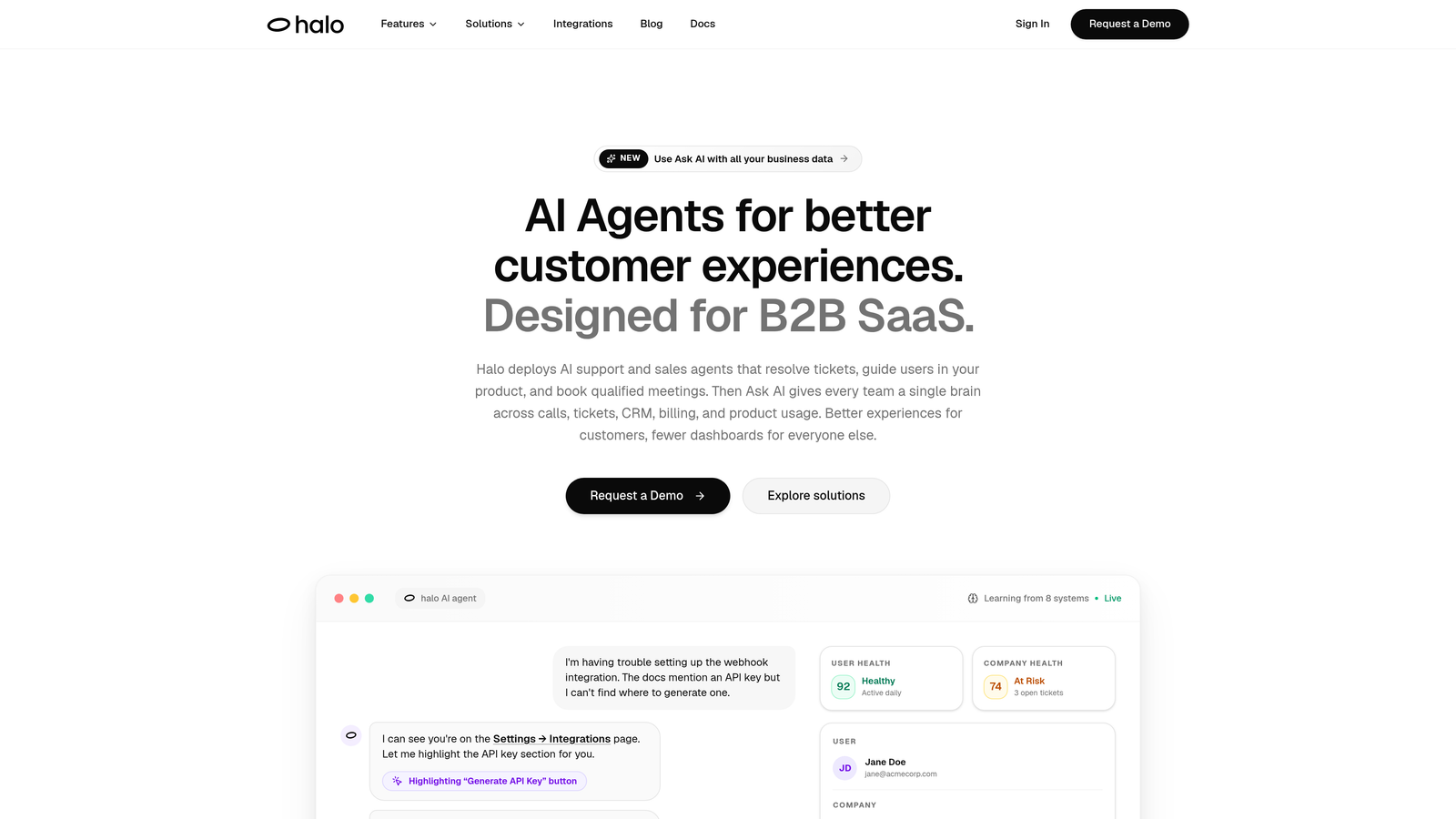
Halo AI is an AI-first customer support platform built from the ground up around autonomous ticket resolution, not retrofitted onto a traditional helpdesk.
Where This Tool Shines
Most AI helpdesk tools are bolt-ons: AI features layered onto a system that was designed for human agents. Halo AI takes the opposite approach. Its architecture is built around AI agents that resolve tickets autonomously, learn from every interaction, and get smarter over time without manual retraining. That continuous learning loop is what separates it from tools that require constant rule updates to stay effective.
What also stands out is the page-aware chat widget. Rather than offering generic responses, Halo's widget understands what page a user is on and what they're looking at, providing contextually relevant guidance and visual UI walkthroughs. For SaaS products with complex interfaces, this is a meaningful differentiator. Add in the smart inbox that surfaces customer health signals and revenue intelligence, and you're getting business value well beyond ticket deflection.
Key Features
Autonomous AI Agents: AI agents resolve support tickets end-to-end with continuous learning from every resolved interaction, improving accuracy over time without manual intervention.
Page-Aware Chat Widget: The widget sees what the user sees, enabling contextual responses and visual UI guidance based on the specific product page they're viewing.
Smart Inbox with Business Intelligence: Goes beyond support metrics to surface customer health signals, revenue intelligence, and anomaly detection from support interactions.
Auto Bug Ticket Creation: Automatically identifies and logs bug reports directly into Linear and engineering workflows, closing the loop between support and product teams.
Live Agent Handoff: Complex issues escalate to human agents with full conversation context preserved, so customers never have to repeat themselves.
Best For
B2B SaaS companies and product teams that want a standalone AI platform rather than a helpdesk add-on. Particularly strong for teams already using Linear, Slack, HubSpot, Intercom, Stripe, or Zoom who want their support data to feed into broader business workflows.
Pricing
Contact for pricing. Halo AI is designed for B2B SaaS teams scaling support operations, so pricing is tailored to team size and ticket volume.
2. Zendesk AI
Best for: Enterprise support teams already invested in the Zendesk ecosystem who want AI layered across their existing workflows.
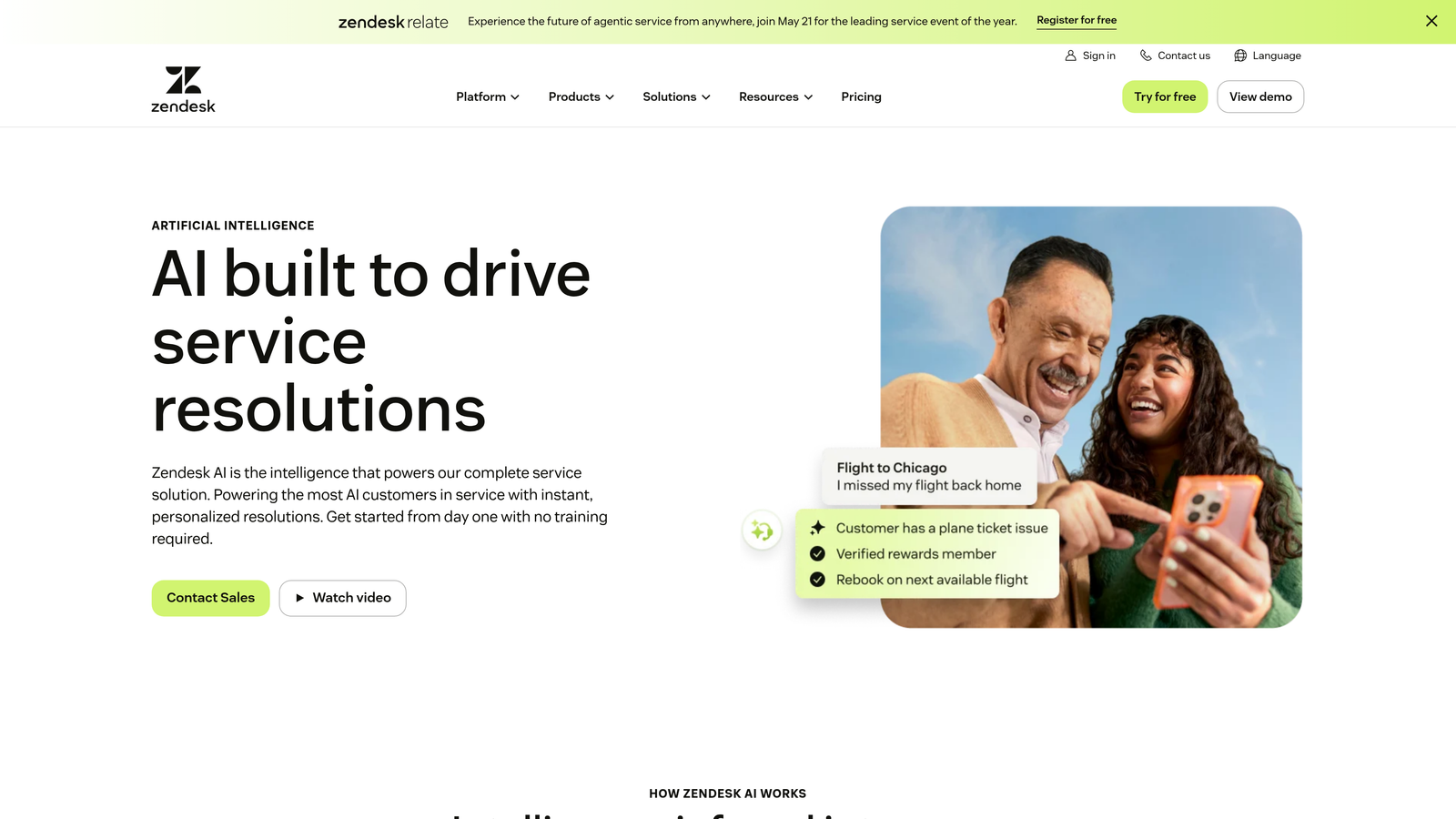
Zendesk AI is an AI-powered automation layer built natively into the Zendesk Suite, covering everything from self-service resolution to agent assist and intelligent triage.
Where This Tool Shines
If your team is already running Zendesk Support, Guide, Chat, and Talk, the AI layer integrates without friction. You're not adding a new system; you're activating intelligence across one you already know. The AI agents can handle self-service resolution across channels, while intelligent triage automatically classifies tickets by intent, sentiment, and language before they reach a human agent.
The agent assist features are particularly strong for enterprise teams. Suggested replies, knowledge base recommendations, and macro suggestions help agents work faster without sacrificing quality. The tradeoff is that Zendesk AI is an enhancement to an existing platform, not a standalone AI-first system, so its ceiling is tied to what Zendesk's architecture allows.
Key Features
AI Agents: Automated self-service resolution across channels, handling common queries without human involvement.
Intelligent Triage: Automatically detects intent, sentiment, and language to route and prioritize tickets before they hit the queue.
Agent Assist: Provides suggested replies and knowledge base recommendations to help agents respond faster and more accurately.
Native Suite Integration: Deep integration across Zendesk Support, Guide, Chat, and Talk with no third-party connectors required.
Best For
Mid-market and enterprise teams already using Zendesk who want to add AI capabilities without switching platforms. Less compelling for teams not already in the Zendesk ecosystem, given the platform dependency.
Pricing
AI features are available as an add-on on Suite plans; the Advanced AI add-on carries an additional per-agent cost on top of base Suite pricing.
3. Intercom Fin
Best for: Teams using Intercom's messaging platform who want a conversational AI agent that resolves questions using existing help center content.
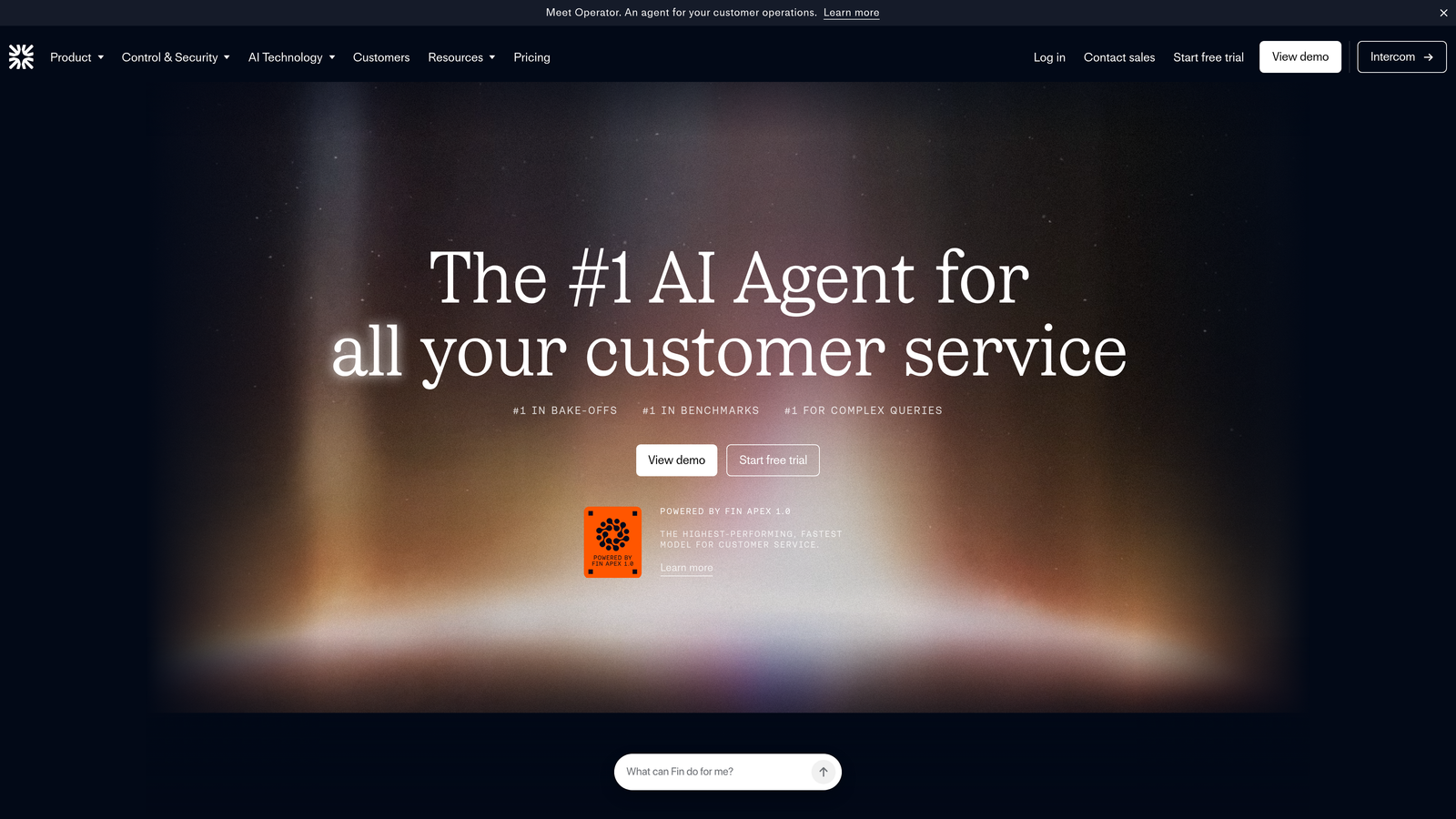
Intercom Fin is a conversational AI agent built into Intercom's platform, designed to answer customer questions using your help center content with source citations and smooth human handoff.
Where This Tool Shines
Fin's strength is its ability to ground answers in your actual documentation rather than generating responses from scratch. When it answers a question, it cites the specific help article it drew from, which builds customer trust and makes it easier to identify gaps in your knowledge base. The tone and behavior are also customizable, with guardrails to keep Fin on-topic and prevent off-brand responses.
The per-resolution pricing model is worth understanding before committing. It aligns costs with outcomes, which sounds appealing, but can become unpredictable as volume scales. Teams with high ticket volumes should model this carefully against seat-based alternatives.
Key Features
Fin AI Agent: Answers customer questions by drawing from your help center content, with source citations included in responses.
Customizable Guardrails: Configurable tone, behavior, and topic restrictions to keep Fin on-brand and on-topic.
Seamless Handoff: Escalates to human agents with full conversation context intact, eliminating the need for customers to repeat information.
Fin AI Copilot: Provides real-time suggestions and assist features for human agents handling escalated conversations.
Best For
Companies already using Intercom as their primary customer messaging platform. The per-resolution model works well for lower-volume teams; high-volume operations should evaluate total cost carefully.
Pricing
Fin charges per resolution. Intercom base plans start at $39 per seat per month, with Fin costs layered on top based on resolved conversations.
4. Freshdesk Freddy AI
Best for: Growing teams on the Freshworks ecosystem that need AI self-service, agent assist, and analytics without enterprise-level pricing.
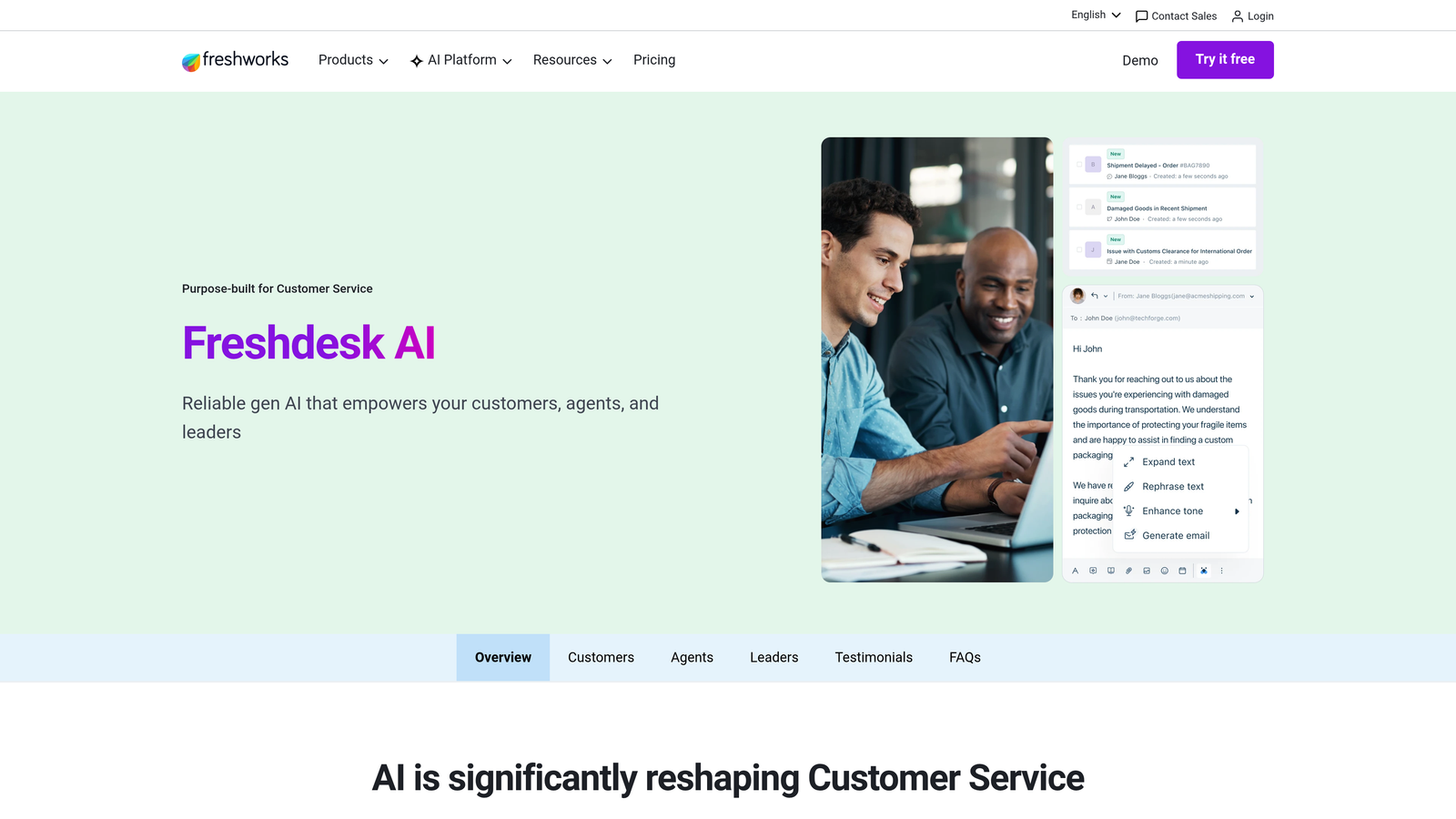
Freshdesk Freddy AI is a suite of AI capabilities spanning self-service bots, agent assist, and analytics across the Freshworks customer support platform.
Where This Tool Shines
Freddy AI covers three distinct layers: self-service automation through chatbots and knowledge base, agent productivity through reply suggestions and ticket summarization, and operational intelligence through AI-driven analytics. For teams that want AI across the entire support workflow without stitching together multiple tools, this breadth is genuinely useful.
The omnichannel coverage, including email, chat, phone, and social, means Freddy AI can operate consistently regardless of how customers reach out. The analytics layer, Freddy Insights, surfaces performance trends and flags areas where automation can be expanded, which helps teams continuously improve their AI coverage over time.
Key Features
Freddy Self Service: Automated resolution via chatbots and knowledge base deflection across customer-facing channels.
Freddy Copilot: Agent assist with reply suggestions, ticket summarization, and next-step recommendations for faster human responses.
Freddy Insights: AI-driven analytics and performance reporting that surfaces trends and automation opportunities.
Omnichannel Support: Consistent AI coverage across email, chat, phone, and social channels from a single platform.
Best For
Mid-market teams on Freshworks looking for a cost-effective way to add AI across self-service, agent assist, and analytics. Also a solid choice for teams migrating from basic helpdesks who want AI built in from the start.
Pricing
AI features are included in higher-tier Freshdesk plans; the Growth plan starts at $15 per agent per month, with AI capabilities unlocking at higher tiers.
5. Ada
Best for: Enterprise teams that need multilingual, omnichannel AI resolution at scale with action-taking capabilities in connected systems.
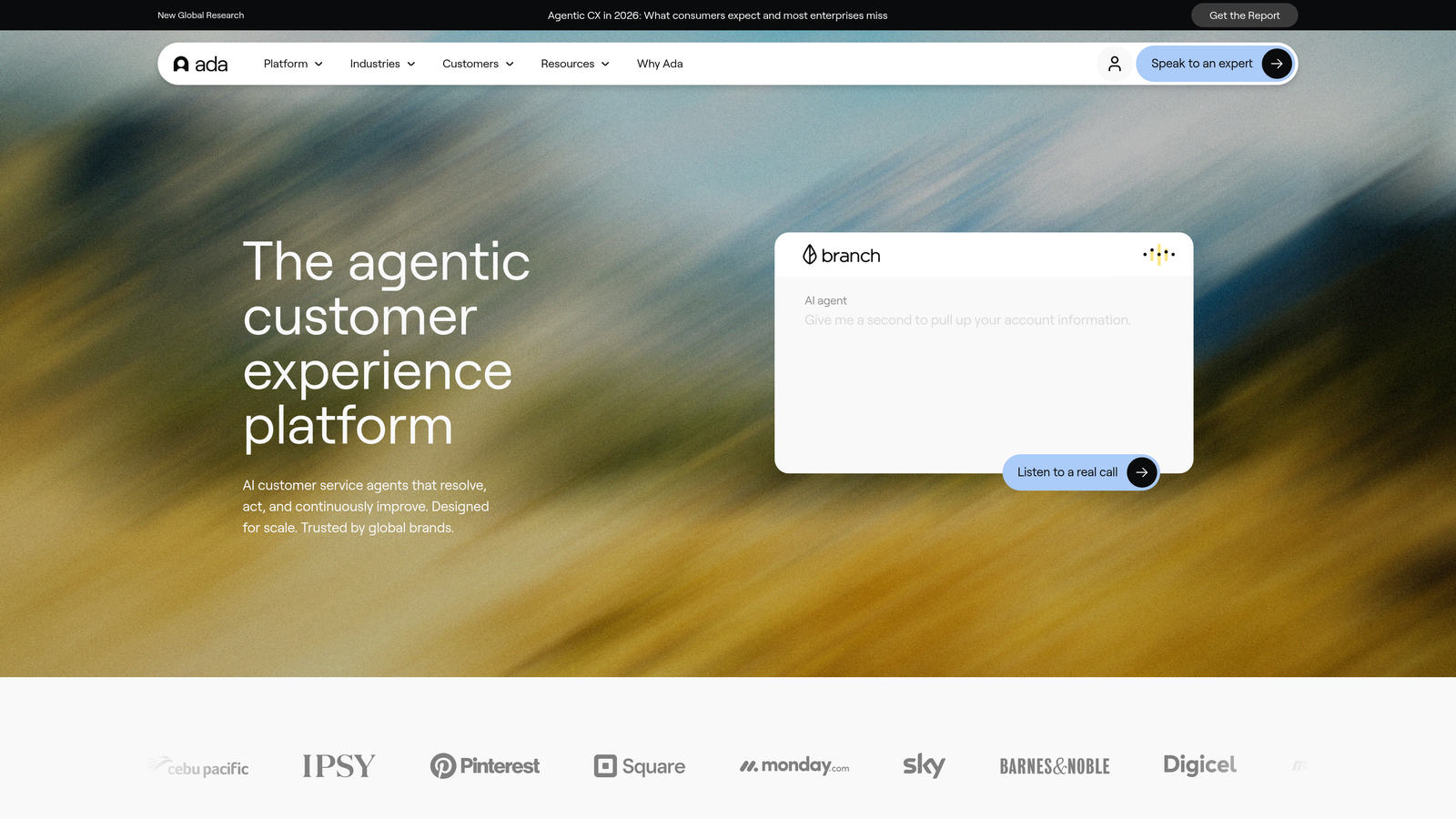
Ada is an enterprise AI agent platform purpose-built for automated customer resolution, supporting multilingual interactions and complex multi-step queries across channels.
Where This Tool Shines
Ada is positioned squarely around resolution, not deflection. The distinction matters: deflection tools push customers toward self-service and hope for the best, while Ada's AI agent is designed to actually take action in connected systems, updating orders, processing requests, and retrieving account data, rather than just providing information. This makes it particularly powerful for e-commerce, fintech, and subscription businesses where customers frequently need transactional support.
The multilingual capability across 50-plus languages without requiring manual translation is another standout. For global support operations, this eliminates the need to build and maintain separate bots for each market, which significantly reduces operational overhead.
Key Features
Action-Taking AI Agent: Goes beyond answering questions to take actions in connected systems, including CRMs, commerce platforms, and helpdesks.
Multilingual Support: Handles 50-plus languages without manual translation workflows, enabling consistent global coverage.
Omnichannel Deployment: Operates across web, mobile, social, and messaging apps from a single configuration.
Reasoning Engine: Handles multi-step queries that require synthesizing information from multiple sources before responding.
Best For
Enterprise organizations with high ticket volumes, global customer bases, or complex transactional support needs. Ada's pricing and implementation complexity make it less suited for smaller teams.
Pricing
Custom enterprise pricing; contact Ada directly for a quote based on volume and use case requirements.
6. Forethought
Best for: Teams with an existing helpdesk investment who want to add an intelligent AI layer without replacing their current platform.
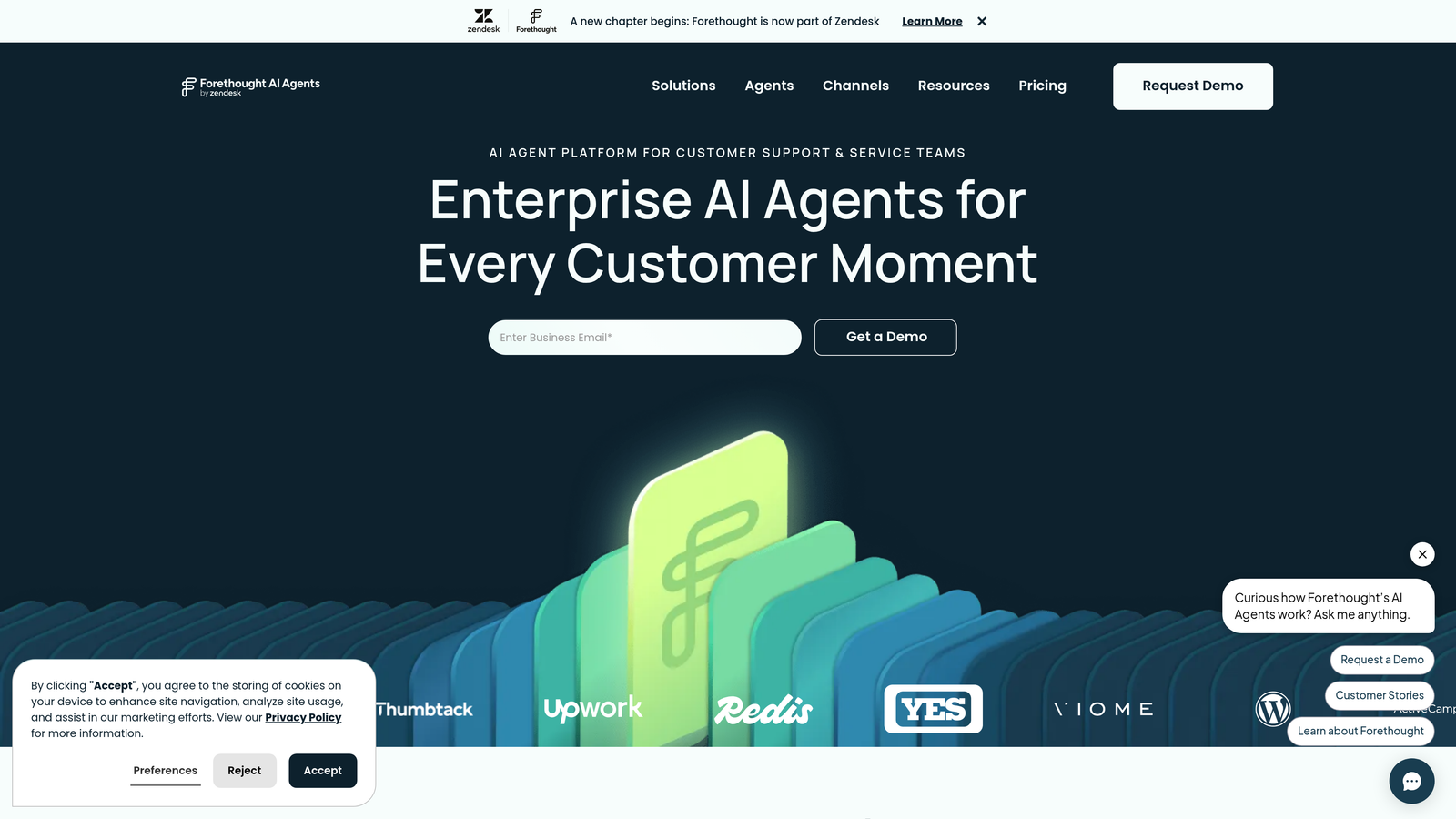
Forethought is an AI middleware platform that adds intelligent triage, autonomous resolution, and agent assist on top of existing helpdesks including Zendesk, Salesforce Service Cloud, and ServiceNow.
Where This Tool Shines
Forethought's core value proposition is that you don't have to rip and replace your existing helpdesk to get meaningful AI capabilities. It sits as a layer on top, handling triage, resolution, and agent assist while your underlying platform continues to manage tickets and data. For enterprise teams with significant existing helpdesk investments, this reduces switching costs considerably.
The modular structure is also worth noting. Teams can adopt Solve for autonomous resolution, Triage for intelligent classification, and Assist for agent productivity independently, scaling AI investment in stages rather than all at once.
Key Features
Solve: AI agent for autonomous ticket resolution across chat and email channels without human intervention.
Triage: Intelligent ticket classification, routing, and prioritization that ensures tickets reach the right agent or queue.
Assist: Real-time knowledge suggestions and reply drafts that help agents respond faster with higher accuracy.
Helpdesk Compatibility: Works as an intelligence layer on top of Zendesk, Salesforce Service Cloud, and ServiceNow.
Best For
Mid-market and enterprise teams with established Zendesk, Salesforce, or ServiceNow deployments who want AI capabilities without a full platform migration. The modular approach also suits teams that want to start with one AI use case and expand gradually.
Pricing
Custom pricing based on ticket volume and which modules are selected; contact Forethought for a tailored quote.
7. Tidio
Best for: Small businesses and e-commerce teams that need fast, affordable AI chat deployment without technical complexity.
Tidio is an AI chatbot and live chat platform with Lyro AI, designed for quick no-code deployment for small teams and online stores.
Where This Tool Shines
Tidio's appeal is its accessibility. Getting Lyro AI up and running requires no coding, no lengthy onboarding, and no dedicated implementation team. The chatbot learns from your existing FAQ and help content, which means most small businesses can go from signup to live AI support in hours rather than weeks. For e-commerce teams especially, the native integrations with Shopify, WooCommerce, and BigCommerce make it easy to connect product and order data to customer conversations.
The free plan is a genuine on-ramp for very small teams testing AI chat for the first time. As volume grows, the paid tiers add more Lyro AI conversations and additional automation capabilities.
Key Features
Lyro AI Chatbot: Learns from your FAQ and help content to answer common questions automatically without manual rule-building.
No-Code Bot Builder: Visual drag-and-drop interface for creating custom chatbot flows without developer involvement.
E-Commerce Integrations: Native connections to Shopify, WooCommerce, and BigCommerce for order and product context in conversations.
Live Chat with AI Assist: Blends automated responses with human agent availability and AI-assisted reply suggestions.
Best For
Small businesses, e-commerce stores, and early-stage startups that need affordable, easy-to-deploy AI chat. Less suitable for B2B SaaS teams needing deep integrations with engineering tools, CRMs, or complex escalation workflows.
Pricing
Free plan available; paid plans start at $29 per month; Lyro AI add-on starts at $39 per month based on conversation volume.
8. Kustomer
Best for: D2C brands and subscription businesses that need CRM-native support with AI-driven automation across unified customer timelines.
Kustomer is a CRM-powered helpdesk with AI automation, unified customer timelines, and intent-driven workflows built for high-volume consumer support.
Where This Tool Shines
Kustomer's architecture is fundamentally different from traditional helpdesks: it's built around the customer, not the ticket. Every interaction, across every channel, appears in a single unified timeline so agents always have complete context before they respond. The AI layer, KIQ, uses intent classification to trigger automated workflows, which means common requests like order status checks or subscription changes can be handled without agent involvement.
For D2C brands dealing with high volumes of transactional queries, this combination of CRM context and AI automation can meaningfully reduce handle times and improve first-contact resolution rates.
Key Features
Unified Customer Timeline: Every interaction across all channels displayed in a single view, giving agents complete context instantly.
AI Intent Classification: Automatically identifies customer intent and triggers appropriate automated workflows or routing rules.
CRM-Native Architecture: Built-in customer data management eliminates the need for separate CRM integrations in most cases.
KIQ AI Assistant: Handles automated responses and provides agent productivity features for escalated conversations.
Best For
D2C brands, subscription businesses, and high-volume consumer support operations that need CRM context baked into every support interaction. The per-user pricing reflects its enterprise positioning.
Pricing
Enterprise plan starts at $89 per user per month; contact Kustomer for AI add-on pricing details.
9. Help Scout
Best for: Small to mid-sized teams that prioritize clean, human-centric support with practical AI features that assist rather than replace agents.
Help Scout is a clean, human-focused helpdesk with emerging AI capabilities including AI drafts, conversation summaries, and a Beacon widget for docs-powered self-service.
Where This Tool Shines
Help Scout has built its reputation on simplicity and a philosophy that support should feel personal. Its AI features reflect that ethos: they assist agents rather than trying to replace them. AI drafts generate reply suggestions based on conversation context and your documentation, while AI summarization gives agents quick context when they pick up an existing conversation mid-thread. Neither feature is trying to resolve tickets autonomously; both are designed to make human agents faster and more effective.
The Beacon widget enables embedded self-service powered by your Docs knowledge base, providing customers with relevant article suggestions before they submit a ticket. It's a lighter-touch deflection mechanism that fits Help Scout's overall approach well.
Key Features
AI Drafts: Generates reply suggestions based on conversation context and knowledge base content to accelerate agent responses.
AI Summarization: Provides quick conversation summaries so agents have full context when picking up existing threads.
Beacon Widget: Embedded help center with AI-powered article recommendations for in-app self-service before ticket submission.
Docs Knowledge Base: Clean, integrated knowledge base that powers both the Beacon widget and AI draft suggestions.
Best For
Small to mid-sized teams, agencies, and companies where personal, human-feeling support is a brand priority. Teams looking for aggressive autonomous AI resolution will find Help Scout's capabilities limited compared to AI-first platforms.
Pricing
Standard plan starts at $25 per user per month; Plus plan at $50 per user per month includes AI features.
Which Tool Is Right for Your Team
The right choice depends on three things: your existing stack, your ticket volume, and whether you need a standalone AI platform or an enhancement to a helpdesk you're already running.
If autonomous resolution and continuous learning are your top priorities, Halo AI is the strongest option. Its AI-first architecture means it's not constrained by helpdesk design decisions made before AI was a serious consideration, and its smart inbox delivers business intelligence that goes well beyond standard support analytics. For B2B SaaS teams in particular, the integrations with Linear, Slack, HubSpot, and Stripe make it a natural fit.
For enterprise teams deeply invested in existing platforms, the ecosystem plays make sense. Zendesk AI and Intercom Fin add meaningful AI capabilities without requiring a platform change, and Forethought is the right call if you're on Salesforce or ServiceNow and want to avoid migration entirely.
Mid-market teams looking for value across the full support workflow will find Freshdesk Freddy AI covers a lot of ground at competitive price points. For global enterprise operations with multilingual needs, Ada is worth the investment. And for small businesses or e-commerce teams that need something live quickly, Tidio and Help Scout both offer accessible starting points.
The broader trend is clear: the market is moving away from simple chatbot deflection toward genuine ai support agent capabilities that resolve tickets, take action in connected systems, and improve over time. A chatbot for support that just deflects tickets is no longer enough.
Your support team shouldn't scale linearly with your customer base. Let AI agents handle routine tickets, guide users through your product, and surface business intelligence while your team focuses on complex issues that need a human touch. See Halo in action and discover how continuous learning transforms every interaction into smarter, faster support.