9 Best AI Helpdesks for Developer Tools Companies in 2026
Developer tools companies need support systems that match the technical depth of their engineer users — a standard helpdesk simply won't cut it. This guide ranks the 9 best AI helpdesk platforms for developer tools companies in 2026, evaluated on AI quality, dev-stack integrations (GitHub, Linear, Jira, Slack), and automation depth.
 Matt PattoliFounder14 min read
Developer tools companies face a support challenge unlike almost any other vertical. Your users are engineers. They arrive with precise error messages, stack traces, and zero patience for "have you tried clearing your cache?" They expect answers that match their technical depth, and when they don't get them, they churn fast or vent loudly on social media.
A standard helpdesk wasn't built for this. You need an AI-powered system that understands code-related queries, integrates with your engineering stack, routes bugs automatically, and scales without adding headcount every time you ship a new feature.
This list covers the best AI helpdesks built for, or well-suited to, developer tools companies. We evaluated each on AI quality, developer-stack integrations (Linear, GitHub, Slack, Jira), automation depth, and how well they handle the technical complexity your users bring. Whether you're a seed-stage dev tools startup or a scaling SaaS platform, there's a fit here for you.
1. Halo AI
Best for: Developer tools companies wanting an AI-first platform with deep engineering stack integration
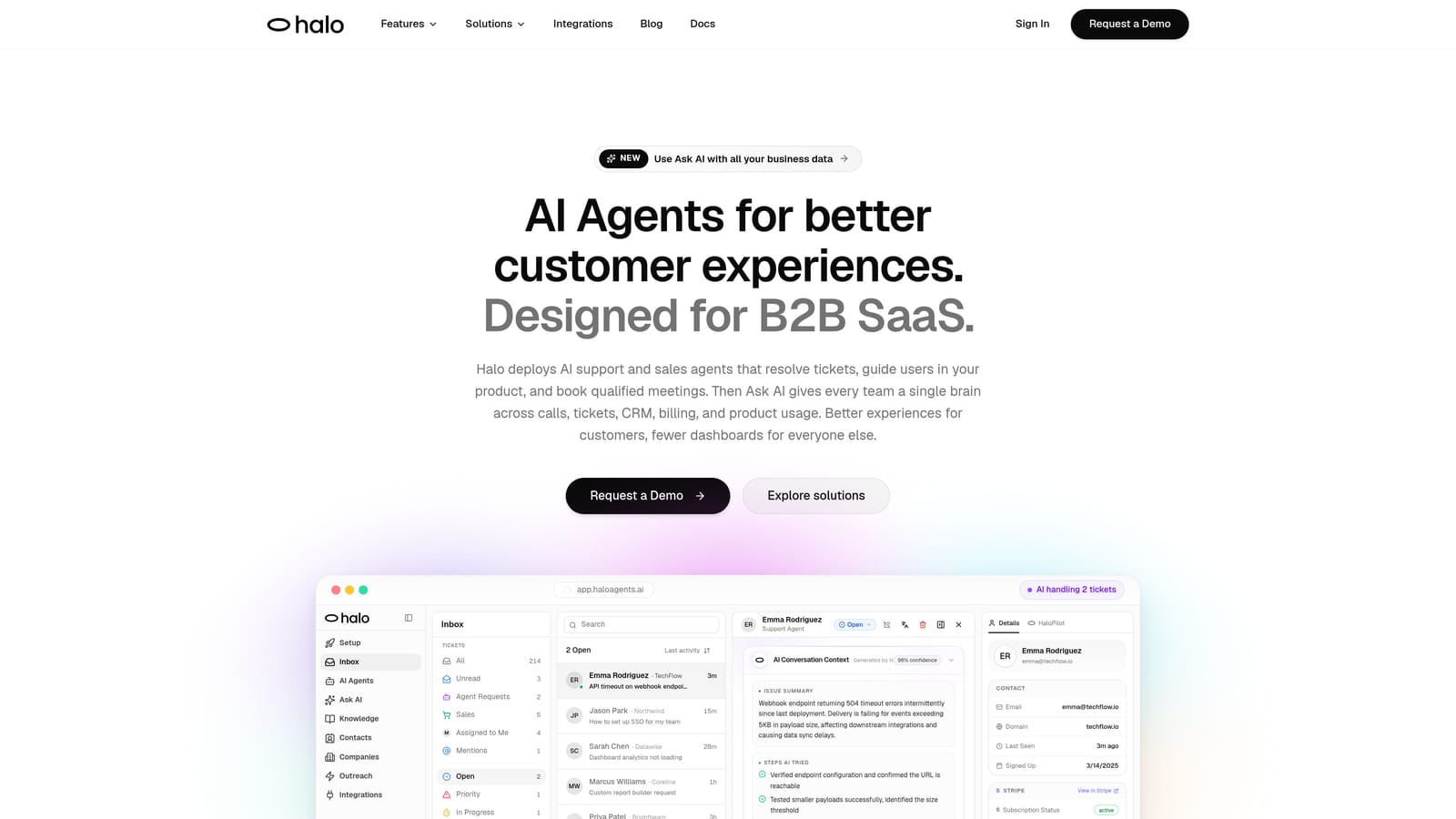
Halo AI is an AI-native customer support platform built specifically for B2B SaaS and developer tools companies, deploying intelligent agents that resolve tickets, guide users through your product UI, and surface business intelligence from every support interaction.
Where This Tool Shines
What sets Halo apart from most helpdesks is the page-aware context layer. The AI agent actually sees what the user sees inside your product, which means it can provide step-by-step UI guidance without the user needing to describe their screen. For developer tools companies, this is a meaningful upgrade over generic chatbots that rely entirely on knowledge base articles.
The Linear integration is equally compelling for engineering-led organizations. When a user reports a bug, Halo can automatically generate a structured bug ticket in Linear rather than relying on a support agent to manually translate the conversation into an engineering-ready format. That closed loop between support and engineering is rare, and it's exactly what developer tools companies need.
Key Features
Page-Aware AI Agents: The AI sees what users see in your product UI, enabling contextual guidance without requiring users to describe their screen state.
Auto Bug Ticket Creation: Automatically generates structured bug reports in Linear and other engineering tools directly from support conversations.
Smart Inbox with Business Intelligence: Surfaces customer health signals, anomaly detection, and revenue intelligence beyond basic support metrics.
Live Agent Handoff: Escalates gracefully to human agents when issues exceed the AI's confidence threshold, keeping complex tickets from falling through the cracks.
Continuous Learning: Improves from every resolved interaction, so the system gets smarter as your product and user base evolve.
Broad Integration Stack: Connects with Linear, Slack, HubSpot, Intercom, Stripe, Zoom, PandaDoc, and Fathom out of the box.
Best For
Developer tools companies that want an AI-first architecture rather than AI bolted onto a legacy helpdesk. Particularly strong for teams using Linear as their engineering backbone and for companies that need support to feed directly into product and bug workflows without manual handoffs.
Pricing
Contact for pricing. Halo runs a demo-first sales motion, so the best starting point is booking a call to see the platform in context of your specific stack.
2. Intercom
Best for: Teams wanting a mature conversational support platform with a strong developer API
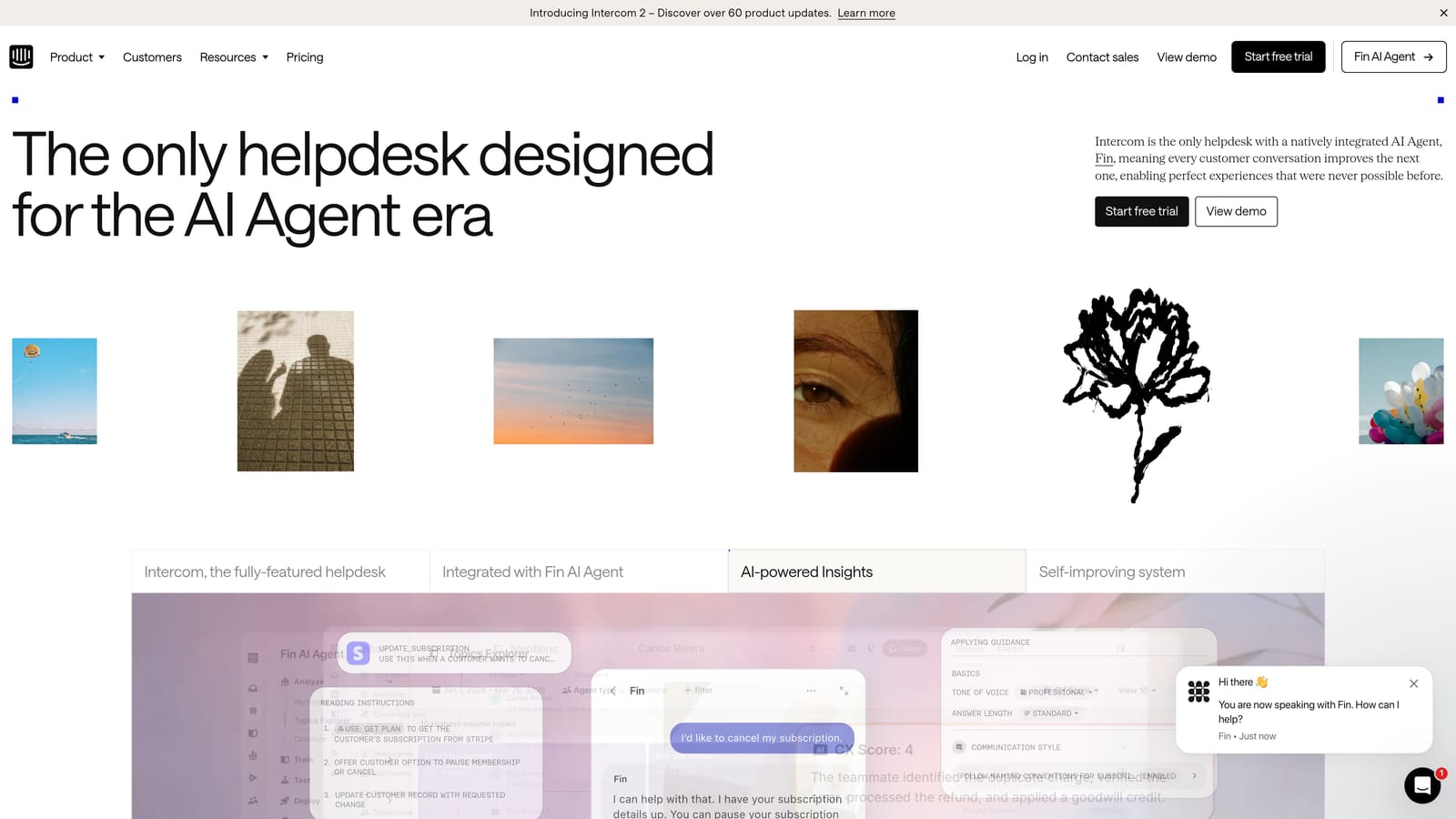
Intercom is one of the most established conversational support platforms, featuring the Fin AI agent for autonomous query resolution and a highly customizable messenger built with developers in mind.
Where This Tool Shines
Intercom's Fin AI agent ingests your knowledge base and handles a meaningful share of inbound queries autonomously. For developer tools companies with well-maintained documentation, this can significantly reduce ticket volume without requiring extensive configuration. The messenger itself is one of the most customizable on the market, with support for custom actions, webhooks, and a robust API that engineering teams can work with directly.
Intercom is also a mature platform with a large ecosystem. If your team is already using Salesforce, Slack, or other enterprise tools, the integrations are generally well-maintained. The trade-off is cost: Intercom can become expensive at scale, and some teams find themselves paying for features they don't use.
Key Features
Fin AI Agent: Ingests knowledge base content and handles inbound queries autonomously without requiring manual rule-building.
Customizable Messenger: Supports custom actions, webhooks, and developer-defined workflows for highly tailored support experiences.
Strong Developer API: Well-documented API allows engineering teams to build custom integrations and automations.
Third-Party Integrations: Connects with Slack, Salesforce, and GitHub and Jira via third-party connectors in the marketplace.
Best For
Mid-market to enterprise developer tools companies with dedicated support teams and the engineering resources to take advantage of Intercom's customization depth. Less ideal for early-stage startups watching their tooling budget closely.
Pricing
Tiered pricing that scales with usage and features. Verify current rates at intercom.com as pricing has evolved considerably in recent years.
3. Zendesk
Best for: Larger developer tools companies with dedicated support operations needing enterprise-grade ticketing
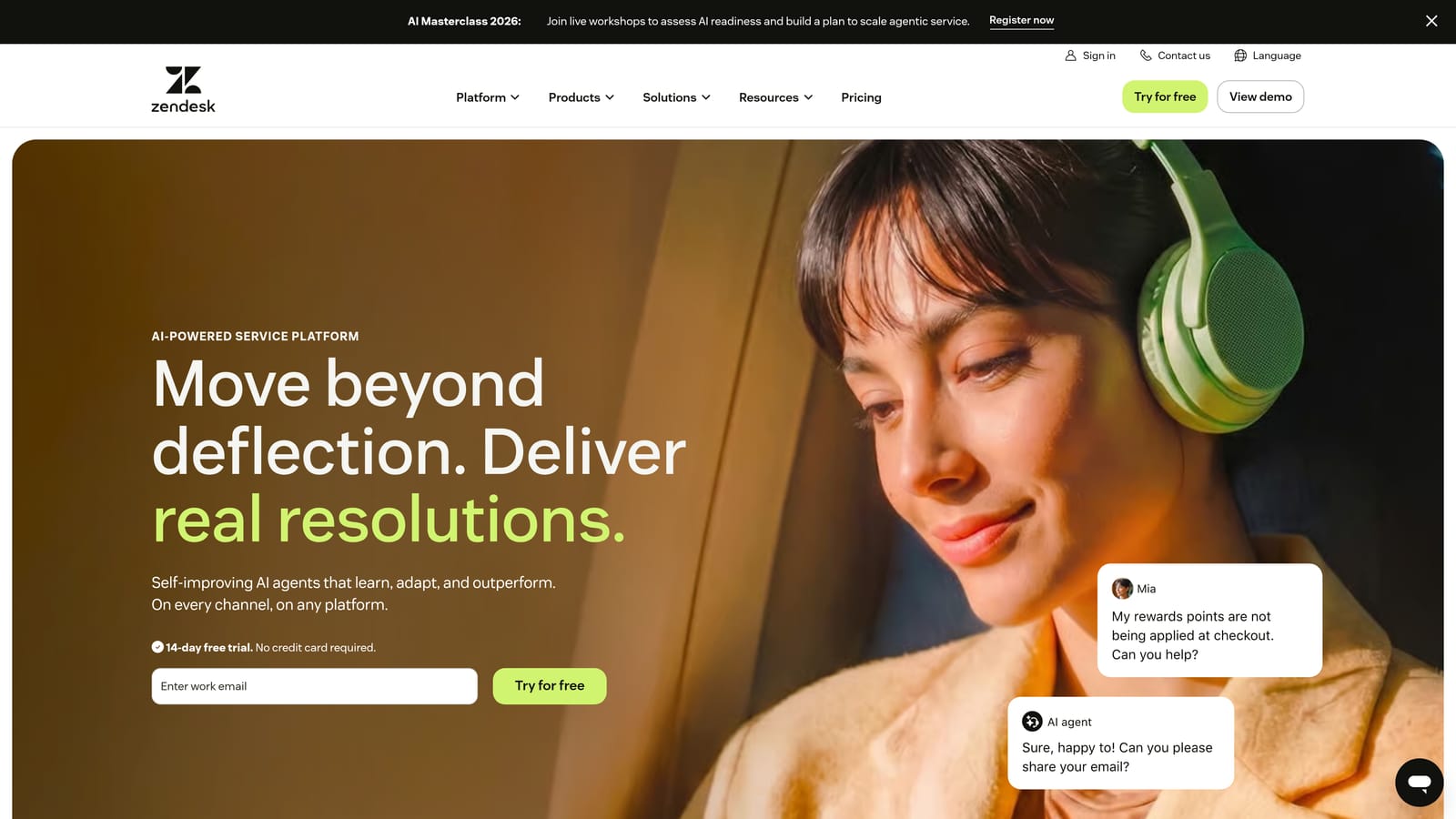
Zendesk is an enterprise-grade ticketing platform with AI triage, intent detection, and one of the largest integration marketplaces in the industry, including native connections to GitHub and Jira.
Where This Tool Shines
Zendesk's strength is scale and process. If you have a large support team with complex routing requirements, SLA management across multiple product lines, and a need for detailed reporting, Zendesk handles all of it reliably. The AI capabilities, including intent detection and macro suggestions, reduce repetitive work for agents handling high ticket volumes.
For developer tools companies specifically, the GitHub and Jira integrations in the marketplace are functional, though they require setup and don't always feel as native as purpose-built engineering-support bridges. Zendesk can also feel heavyweight for early-stage teams: the configuration overhead is real, and smaller organizations sometimes find themselves managing the tool more than using it.
Key Features
Zendesk AI Triage: Automatically detects intent and routes tickets to the right team or workflow without manual intervention.
Macro Suggestions: AI recommends response templates based on ticket content, speeding up agent resolution time.
Integration Marketplace: Extensive library including GitHub, Jira, and Slack connectors for engineering-adjacent workflows.
Advanced Routing and Automation: Sophisticated workflow automation built for large support teams with complex escalation paths.
Best For
Developer tools companies at scale with 10 or more support agents, complex SLA requirements, and dedicated support operations staff who can manage Zendesk's configuration depth. Less suitable for lean teams or early-stage startups.
Pricing
Per-agent seat pricing across multiple tiers. Verify current rates at zendesk.com as enterprise pricing varies significantly by feature set.
4. Plain
Best for: Developer-facing companies wanting a support tool that feels like it was built by engineers, for engineers
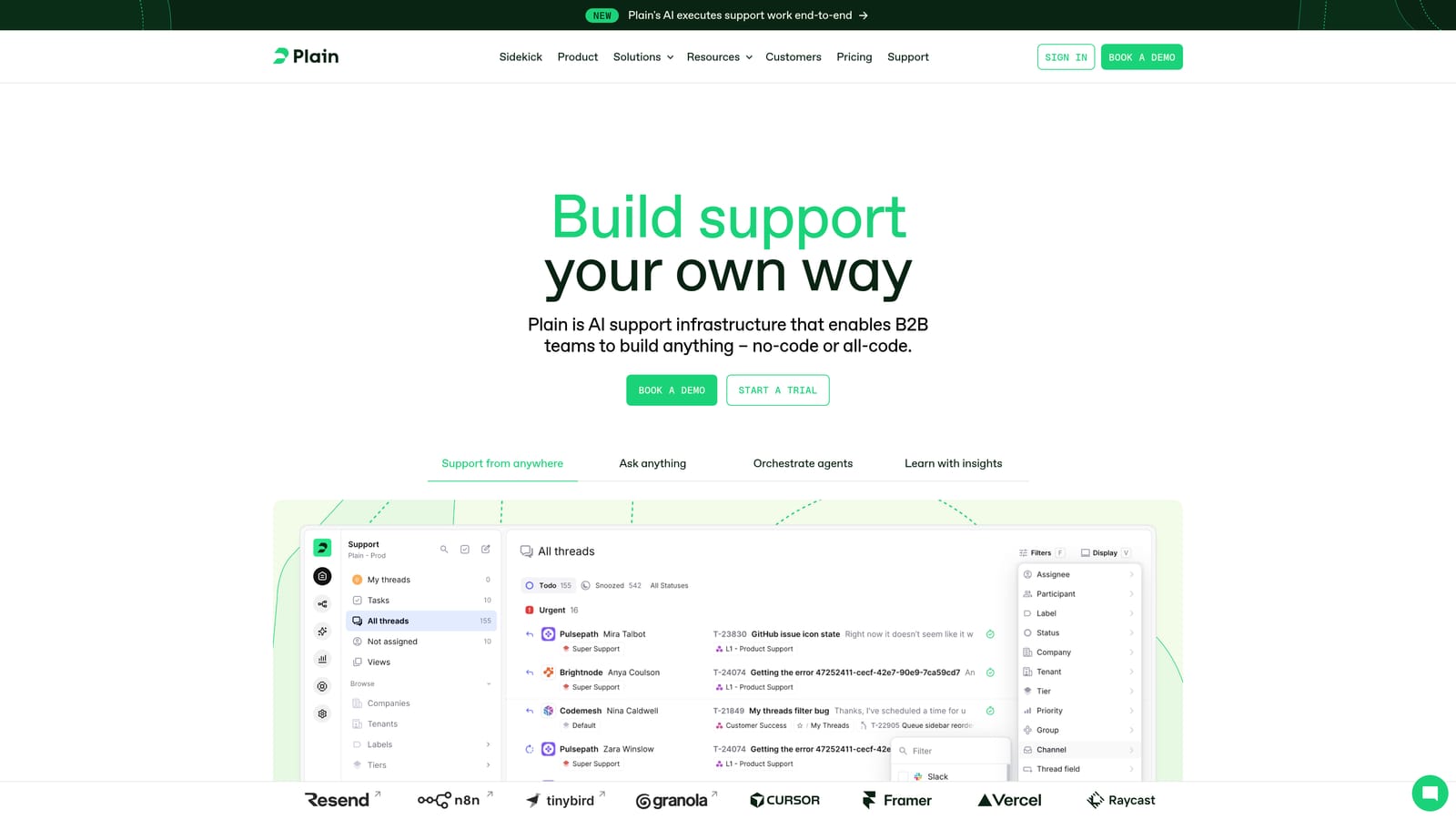
Plain is a modern, API-first support tool built specifically for developer-facing companies, with Slack-native workflows and an interface designed to feel like an engineering tool rather than a traditional helpdesk.
Where This Tool Shines
Plain's positioning is deliberate: it's a support tool built for companies whose customers are developers. The API-first architecture means your team can build custom support workflows without fighting against the platform's assumptions. If you want to trigger support actions from your own systems, pull in customer context from your database, or build a fully branded support experience, Plain gives you the primitives to do it.
The Slack-native workflow is a genuine differentiator for teams where support happens in Slack. Rather than forcing conversations into a separate ticketing interface, Plain lets agents handle threads directly in Slack while still maintaining structure and accountability. The platform is a newer entrant compared to Intercom or Zendesk, so some enterprise features are still maturing, but for the right team it feels refreshingly uncluttered.
Key Features
API-First Architecture: Build fully custom support workflows using Plain's API, without being constrained by the platform's default assumptions.
Slack-Native Workflows: Handle support conversations directly in Slack while maintaining thread structure and preventing conversations from getting lost.
AI Thread Summarization: Automatically summarizes long support threads so agents can get up to speed quickly.
AI Suggested Responses: Recommends replies based on thread context, reducing the time agents spend drafting responses.
Best For
Early to mid-stage developer tools companies with engineering-forward support teams who want a modern, API-first tool and are comfortable with a platform that's still building out its enterprise feature set.
Pricing
Check plain.com for current pricing tiers, as the platform has been actively evolving its plans.
5. Freshdesk
Best for: Small to mid-size dev tools teams looking for an accessible entry point with solid AI fundamentals
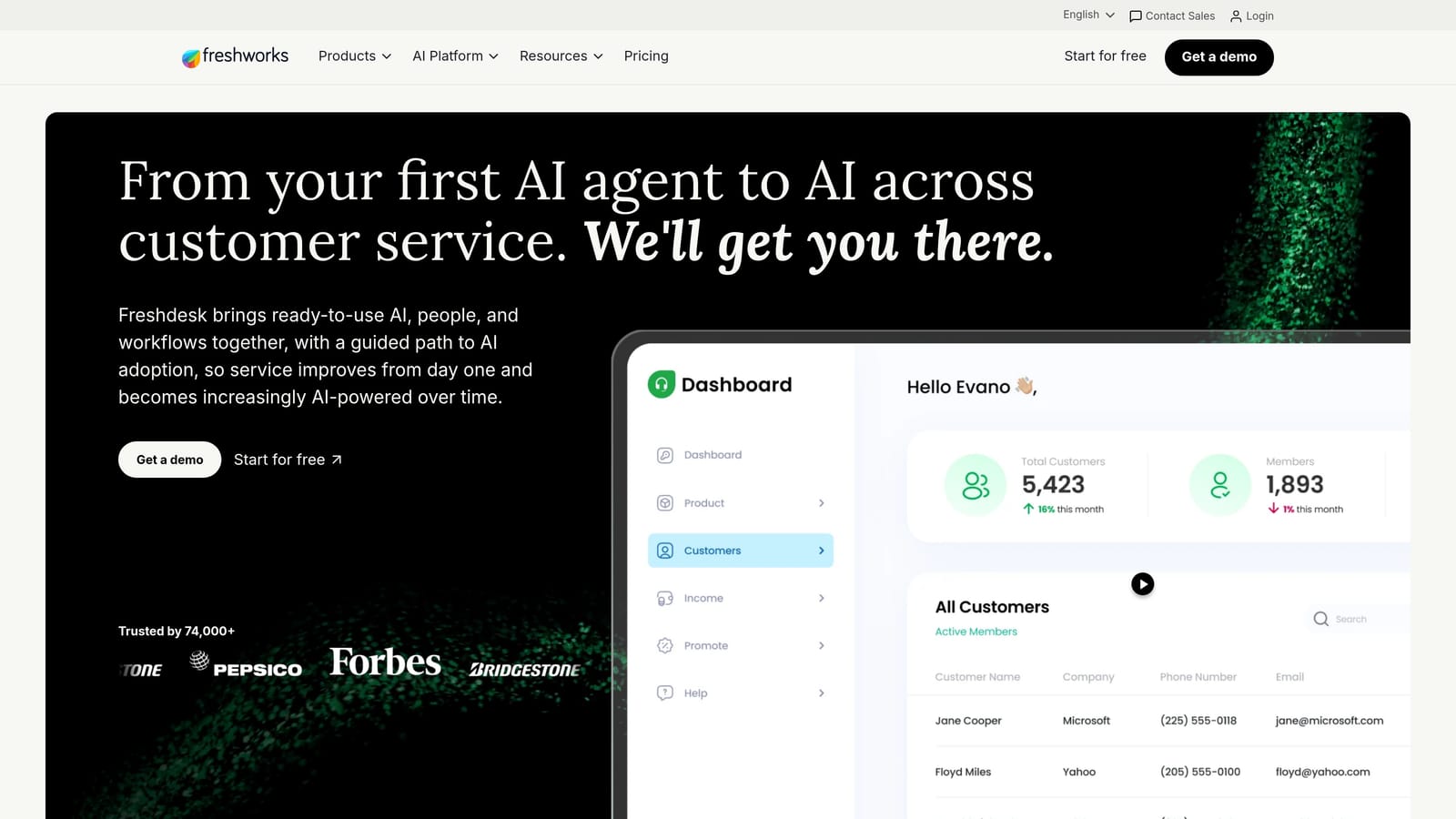
Freshdesk is a widely-used helpdesk platform with Freddy AI for ticket summarization and response suggestions, positioned as an accessible and cost-effective option for growing developer tools teams.
Where This Tool Shines
Freshdesk's value proposition is accessibility: a capable helpdesk with AI features at a price point that doesn't require a budget conversation with your CFO. Freddy AI handles ticket summarization and response suggestions reasonably well, and the integration library covers the essentials including Slack, Jira, and GitHub via the marketplace.
For developer tools startups graduating from email-only support, Freshdesk provides a structured ticketing environment without the configuration overhead of Zendesk. The trade-off is depth: Freshdesk's AI capabilities are solid for the price but don't match the sophistication of Intercom's Fin or AI-native platforms. Teams that grow quickly may find themselves outgrowing it sooner than expected.
Key Features
Freddy AI: Handles ticket summarization, response suggestions, and basic automation to reduce manual agent workload.
Integration Library: Marketplace connectors for Slack, Jira, and GitHub cover the core engineering tool integrations.
Free Tier: Allows small teams to get started without upfront cost, making it approachable for early-stage startups.
Automation Rules: Traditional helpdesk automation for routing, assignment, and SLA management.
Best For
Small developer tools teams with limited budgets that need structured ticketing and basic AI assistance. A good stepping stone before moving to a more AI-native platform as the team and ticket volume grow.
Pricing
Free tier available for small teams; paid plans scale by agent seat. Verify current rates at freshworks.com.
6. Linear
Best for: Engineering-led teams that want to bridge support conversations directly into their issue tracking workflow
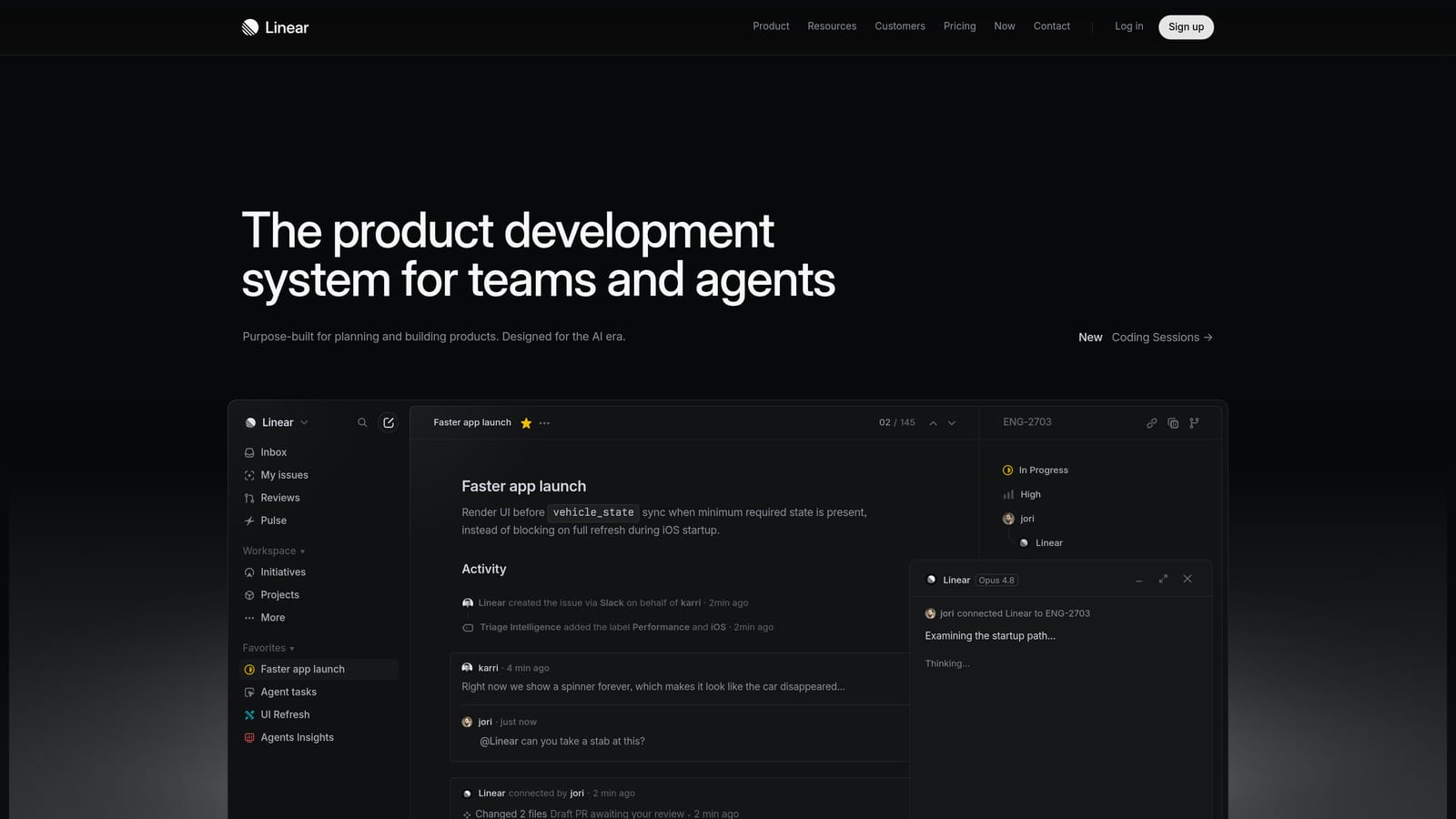
Linear is primarily an engineering issue tracker, but it plays an increasingly important role in support-to-bug workflows at developer tools companies, particularly as the back-end destination for structured bug reports generated from customer conversations.
Where This Tool Shines
Linear isn't a helpdesk, and it's worth being clear about that upfront. It belongs on this list because many developer tools companies already use Linear as their engineering backbone, and the question isn't whether to use Linear but how to connect it to the front-end support layer. Linear's AI features handle issue summarization and duplicate detection, which are genuinely useful when support issues are flowing into engineering queues.
The most powerful use case for Linear in a support context is pairing it with a front-end tool that can auto-generate structured bug tickets. Halo AI's native Linear integration does exactly this: when a user reports an issue, Halo creates a properly formatted Linear ticket without requiring a support agent to manually translate the conversation. That handoff is where a lot of dev tools teams lose time, and Linear plus the right front-end tool eliminates it.
Key Features
AI Issue Summarization: Automatically summarizes issues to help engineering teams quickly understand what was reported.
Duplicate Detection: Identifies when incoming issues match existing tickets, preventing redundant engineering work.
API and Webhooks: Enables routing from front-end support tools into Linear's engineering queues programmatically.
Engineering-Native Interface: Familiar to dev tools teams, reducing friction when support issues enter the engineering workflow.
Best For
Developer tools companies already using Linear for engineering that want to close the loop between customer-reported bugs and engineering resolution. Best used as a complement to a dedicated front-end support tool, not as a standalone helpdesk.
Pricing
Free for small teams; paid plans for larger organizations. Verify current rates at linear.app.
7. Unthread
Best for: B2B developer tools companies whose enterprise customers prefer Slack Connect over email or portal-based support
Unthread turns Slack channels into a structured support queue with AI-powered response suggestions, purpose-built for companies whose customers want to do support in Slack rather than through a traditional ticketing interface.
Where This Tool Shines
If you've ever lost a critical customer issue in a busy Slack Connect channel, you already understand Unthread's core value proposition. Developer tools companies often find that their best customers, typically engineering teams at other companies, strongly prefer Slack as a support channel. Unthread gives that preference structure: threads are tracked, nothing gets buried, and agents have a clear queue to work from.
The AI-powered response suggestions work within Slack itself, so agents don't need to context-switch between tools. For teams where the entire support workflow already lives in Slack, Unthread can feel like a natural extension rather than a new platform to learn. It's a focused tool that solves a specific problem exceptionally well.
Key Features
Slack-to-Queue Conversion: Transforms Slack channels into organized support queues with thread tracking and assignment.
AI Response Suggestions: Recommends replies within Slack, keeping agents in their existing workflow.
Thread Tracking: Ensures no customer conversation gets lost in channel noise, with clear visibility into open and resolved threads.
Slack Connect Native: Designed specifically for enterprise customers who prefer Slack Connect as their support channel of choice.
Best For
B2B developer tools companies with enterprise customers who insist on Slack Connect for support. Works best as either a primary support channel tool or alongside a ticketing system for teams managing multiple support channels simultaneously.
Pricing
Check unthread.io for current pricing tiers.
8. Kustomer
Best for: High-volume developer tools companies needing full customer context unified in a single support interface
Kustomer is a CRM-native helpdesk that unifies all customer interactions into a single timeline, with AI automation that draws on full customer history to provide more context-aware support responses.
Where This Tool Shines
Kustomer's differentiator is the unified timeline. Rather than treating each support ticket as an isolated event, Kustomer shows agents the complete customer history: every previous conversation, purchase, product usage event, and support interaction in one view. For developer tools companies with complex customer relationships and long sales cycles, this context can meaningfully improve the quality of support responses.
The AI automation layer draws on this full history, which means it can make smarter routing and response decisions than systems that only see the current ticket. Kustomer is worth noting that it has changed ownership in recent years, so it's worth verifying the current product roadmap and support commitments before making a long-term platform decision.
Key Features
Unified Customer Timeline: All interactions across every channel consolidated into a single view, giving agents complete context before responding.
History-Informed AI: Automation and response suggestions draw on full customer history rather than just the current ticket.
High-Volume Routing: Intelligent routing built for teams handling large ticket volumes across multiple channels.
Omnichannel Support: Handles email, chat, and social channels within a single interface.
Best For
Developer tools companies at scale with complex customer relationships, high ticket volumes, and a need for deep customer context in every support interaction. Enterprise-focused and priced accordingly.
Pricing
Enterprise-focused pricing. Verify current rates at kustomer.com, and confirm the current product roadmap given recent ownership changes.
9. Drift (Salesloft)
Best for: PLG developer tools companies where pre-sales technical questions and post-sale support overlap significantly
Drift, now part of Salesloft, is a conversational AI platform that bridges pre-sales technical conversations and post-sale support, making it relevant for product-led growth developer tools companies where the line between sales and support is intentionally blurry.
Where This Tool Shines
In a PLG motion, the first technical question a prospect asks often looks identical to the first support ticket a new customer submits. Drift handles both in the same conversational interface, routing based on context rather than forcing users into separate sales and support flows. For developer tools companies running a self-serve or product-led model, this can reduce friction at a critical moment in the user journey.
Drift is not a pure helpdesk, and it's important to be clear-eyed about that. It excels at top-of-funnel conversation handling and handoff, but teams with high support volume or complex ticket management needs will likely want to pair it with a dedicated helpdesk. Post-acquisition pricing and roadmap have also evolved, so verifying the current state of the product before committing is worthwhile.
Key Features
AI Chatbot for Technical Queries: Handles inbound technical pre-sales and support questions without requiring a live agent for every conversation.
Conversational Routing: Routes conversations between sales and support workflows based on context and user signals.
PLG Playbooks: Pre-built workflows for qualifying, routing, and supporting users in a product-led growth motion.
Salesloft Integration: Connects to the broader Salesloft revenue platform for teams that want sales and support data in the same system.
Best For
PLG-oriented developer tools companies where sales and support conversations naturally overlap and where a conversational interface at the top of the funnel is more important than deep ticketing capabilities.
Pricing
Verify current pricing at salesloft.com, as post-acquisition pricing may differ from legacy Drift plans.
Choosing the Right AI Helpdesk for Your Dev Tools Company
The right tool depends on where you are as a company and how your customers actually prefer to get support. Here's a quick way to think through the decision.
If you're an early-stage startup: Freshdesk's free tier gets you structured ticketing without upfront cost. If your customers are already in Slack, Unthread is worth evaluating alongside it. As your ticket volume grows and you need AI that actually learns from your product, Halo AI is the natural next step.
If you're scaling and engineering-integrated: Halo AI is purpose-built for this moment. The Linear integration, page-aware AI agents, and continuous learning architecture are designed for developer tools companies that need support and engineering to work as one system rather than two separate silos.
If your customers live in Slack: Unthread solves the Slack Connect chaos problem directly. For broader support needs beyond Slack, pair it with a ticketing-first platform.
If you're enterprise with complex operations: Zendesk or Kustomer handle the scale and process complexity, though both require more configuration investment and dedicated support operations staff to get the most out of them.
If your motion is product-led growth: Drift handles the pre-sales and early-support overlap well, but plan for a dedicated helpdesk as your post-sale support volume grows.
For most developer tools companies at the growth stage, the decision comes down to a simple question: do you want AI bolted onto a legacy helpdesk, or do you want an AI-first platform built for the way engineering-led teams actually work? The former gets you incremental improvement. The latter gets you a support operation that learns, scales, and feeds intelligence back into your product and revenue teams.
Your support team shouldn't scale linearly with your customer base. Let AI agents handle routine tickets, guide users through your product, and surface business intelligence while your team focuses on complex issues that need a human touch. See Halo in action and discover how continuous learning transforms every interaction into smarter, faster support.