9 Best AI Helpdesks for Enterprise Software Teams in 2026
Choosing the right AI helpdesk for enterprise software teams requires more than a basic chatbot—it demands autonomous ticket resolution, deep product integrations, and enterprise-grade security. This guide evaluates the nine best AI-native helpdesks purpose-built for complex technical environments, helping enterprise software teams scale support capacity and improve resolution accuracy without growing headcount.
 Grant CooperFounder13 min read
Enterprise software teams deal with a support challenge that most helpdesks weren't designed to handle. Your users are technical, your product is complex, ticket volumes are high, and the tolerance for slow or inaccurate resolutions is essentially zero. A generic helpdesk with a chatbot bolted on isn't going to cut it.
AI-native helpdesks are changing the equation: resolving tickets autonomously, surfacing product intelligence, and scaling support capacity without scaling headcount. But not every AI helpdesk is built for enterprise complexity. Some add AI as an afterthought to legacy infrastructure. Others lack the integrations, security controls, or contextual awareness that enterprise environments actually require.
This list covers the top AI helpdesks purpose-built or well-suited for enterprise software companies. We evaluated each on autonomous resolution capability, enterprise integrations, security posture, analytics depth, and how well the AI understands product context. Whether you're hitting the limits of your current stack or building from scratch, here's what deserves your evaluation time.
1. Halo AI
Best for: B2B SaaS teams that need AI-first support with deep product context and business intelligence.
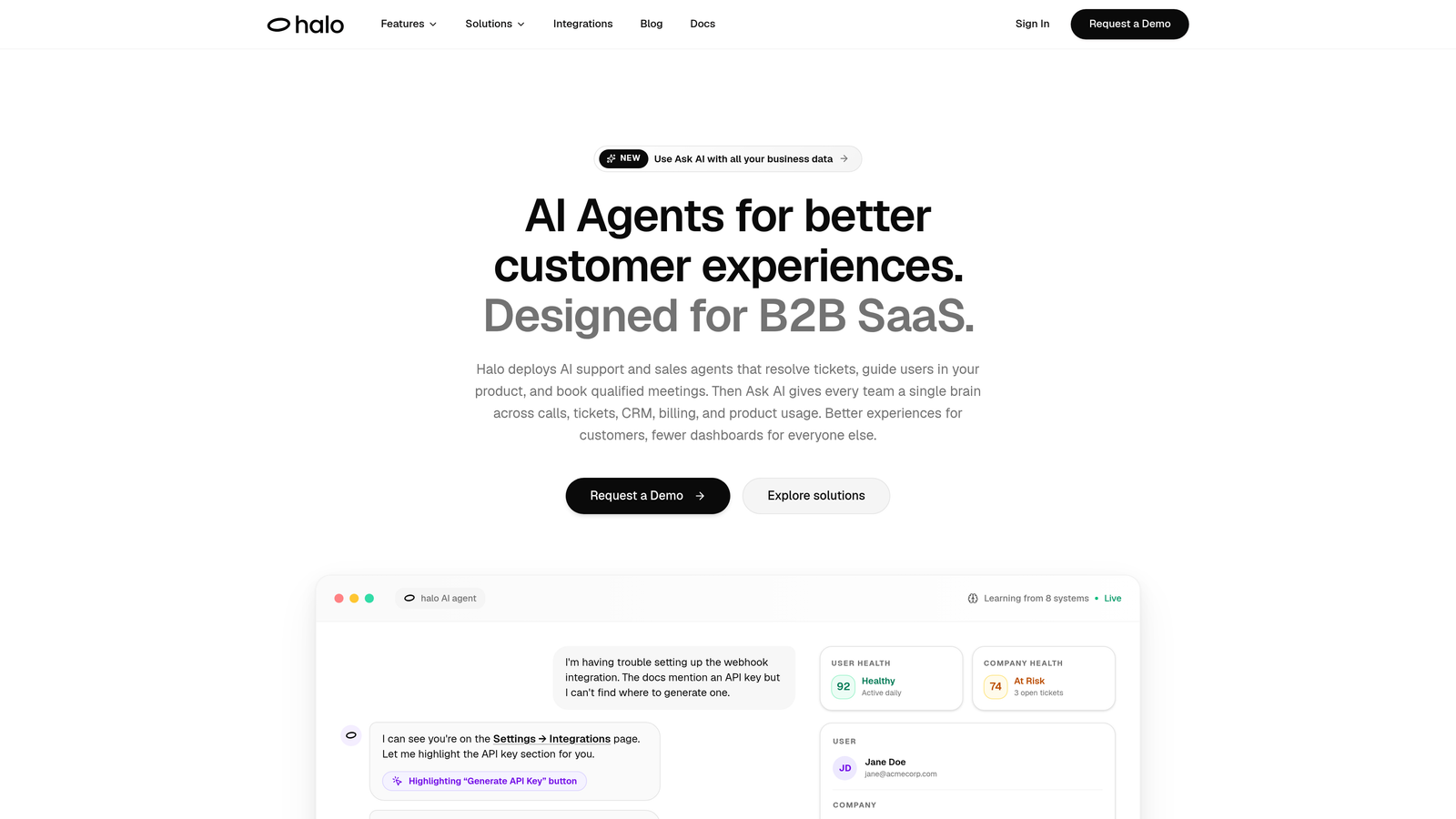
Halo AI is an AI-first customer support platform built specifically for B2B SaaS teams that need more than ticket deflection.
Where This Tool Shines
What separates Halo from most helpdesks on this list is the architecture. It wasn't built on a legacy ticketing system with AI features added later. The entire platform is designed around autonomous resolution, continuous learning, and surfacing intelligence from every support interaction.
The page-aware chat widget is a standout capability. The AI can see what screen or feature the user is currently viewing, which means it can provide guidance that's actually relevant to where someone is stuck rather than generic answers pulled from a knowledge base. For complex enterprise software, that context difference matters significantly.
Key Features
Page-Aware Context: The chat widget sees what the user sees, enabling contextually precise guidance without the user having to describe their screen.
Autonomous Ticket Resolution: AI agents handle tickets end-to-end with intelligent escalation to live agents when issues exceed their scope, preserving full context on handoff.
Auto Bug Ticket Creation: Reported issues are automatically converted into structured bug reports in Linear or your preferred tracker, eliminating manual triage work.
Smart Inbox with Business Intelligence: The inbox surfaces customer health signals, revenue anomaly detection, and product usage insights beyond standard support metrics.
Broad Integration Stack: Native connections to Linear, Slack, HubSpot, Intercom, Stripe, Zoom, PandaDoc, and Fathom mean Halo connects to your entire business stack.
Continuous Learning: The system improves resolution accuracy over time by learning from every interaction, not just from static knowledge base updates.
Best For
SaaS product teams and support leaders who want an AI-first platform rather than an AI-augmented legacy system. Particularly well-suited for companies with complex products, product-led growth motions, or teams that want support interactions to generate business intelligence alongside ticket resolution.
Pricing
Contact for enterprise pricing at haloagents.ai. Custom pricing based on team size and usage.
2. Zendesk AI
Best for: Large enterprises already invested in the Zendesk ecosystem needing AI-enhanced workflows.
Zendesk AI is the AI layer built into the industry's most widely deployed enterprise helpdesk platform.
Where This Tool Shines
Zendesk's strength is its maturity. The platform has enterprise security, compliance certifications, and an integration marketplace with over a thousand apps. For organizations that have invested heavily in Zendesk workflows, adding AI features through Intelligent Triage, AI agents, and Copilot is a natural evolution rather than a platform replacement.
The tradeoff is that AI feels like an addition to an existing system rather than a foundational capability. Configuration can be complex, and getting the AI to perform well typically requires dedicated helpdesk admin resources. For large enterprises with that capacity, it's a solid choice. For leaner teams, the overhead can be significant.
Key Features
AI Agents: Automated ticket deflection and self-service resolution for common queries before they reach human agents.
Intelligent Triage: Automatic ticket classification, intent detection, and routing based on content and priority signals.
Copilot for Agents: AI-suggested responses, conversation summaries, and next-best-action recommendations within the agent workspace.
Marketplace Integrations: Extensive third-party ecosystem covering CRMs, communication tools, and custom workflows.
Enterprise Security: SSO, role-based access controls, data residency options, and compliance certifications for regulated industries.
Best For
Large enterprise organizations with existing Zendesk infrastructure, dedicated helpdesk administrators, and support teams large enough to justify the per-agent pricing at enterprise tiers.
Pricing
Suite Enterprise starts around $169/agent/month. AI add-ons are priced separately, which can increase total cost meaningfully at scale.
3. Intercom Fin
Best for: Product-led growth SaaS companies prioritizing high autonomous resolution rates on product queries.
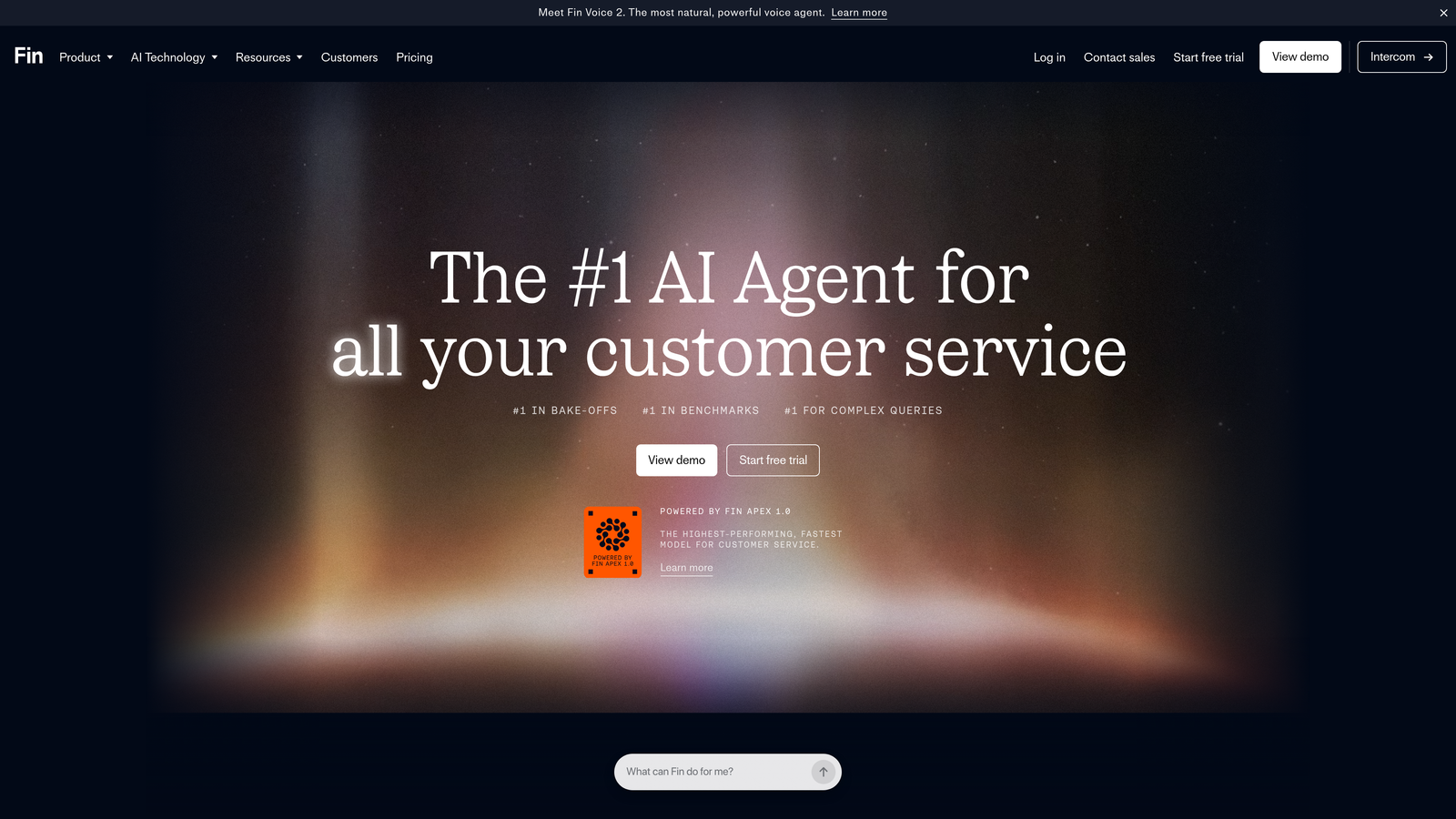
Intercom Fin is Intercom's LLM-powered AI agent designed to handle support conversations autonomously across chat and email.
Where This Tool Shines
Fin's autonomous resolution capability is one of the stronger offerings in this category, particularly for product-related queries. It draws answers from multiple knowledge sources simultaneously, including help documentation, PDFs, URLs, and custom answer sets, which gives it broad coverage without requiring a single perfectly organized knowledge base.
Intercom's in-product messaging capabilities also make Fin a natural fit for companies with proactive onboarding and engagement workflows. If you're already using Intercom for user communication, Fin extends that infrastructure into support resolution rather than requiring a separate tool.
Key Features
Fin AI Agent: Handles full conversations autonomously across chat and email channels using large language model reasoning.
Multi-Source Knowledge: Pulls answers from help docs, PDFs, external URLs, and custom answer sets in a single query.
Fin AI Copilot: Real-time answer suggestions and knowledge surfacing for human agents handling escalated conversations.
In-Product Messaging: Intercom's broader platform supports proactive messaging, onboarding flows, and user engagement alongside support.
Resolution-Based Pricing: Pay per resolved conversation rather than per seat, which aligns cost to outcomes.
Best For
PLG SaaS companies with well-maintained knowledge bases and high volumes of product-related support queries. Teams already using Intercom for user communication will see the most immediate value.
Pricing
Fin AI Agent is priced per resolution. Base Intercom plans start from approximately $74/month. High resolution volumes can make costs less predictable at scale.
4. Freshdesk Freddy AI
Best for: Enterprises seeking comprehensive AI capabilities at a more accessible price point than Zendesk.
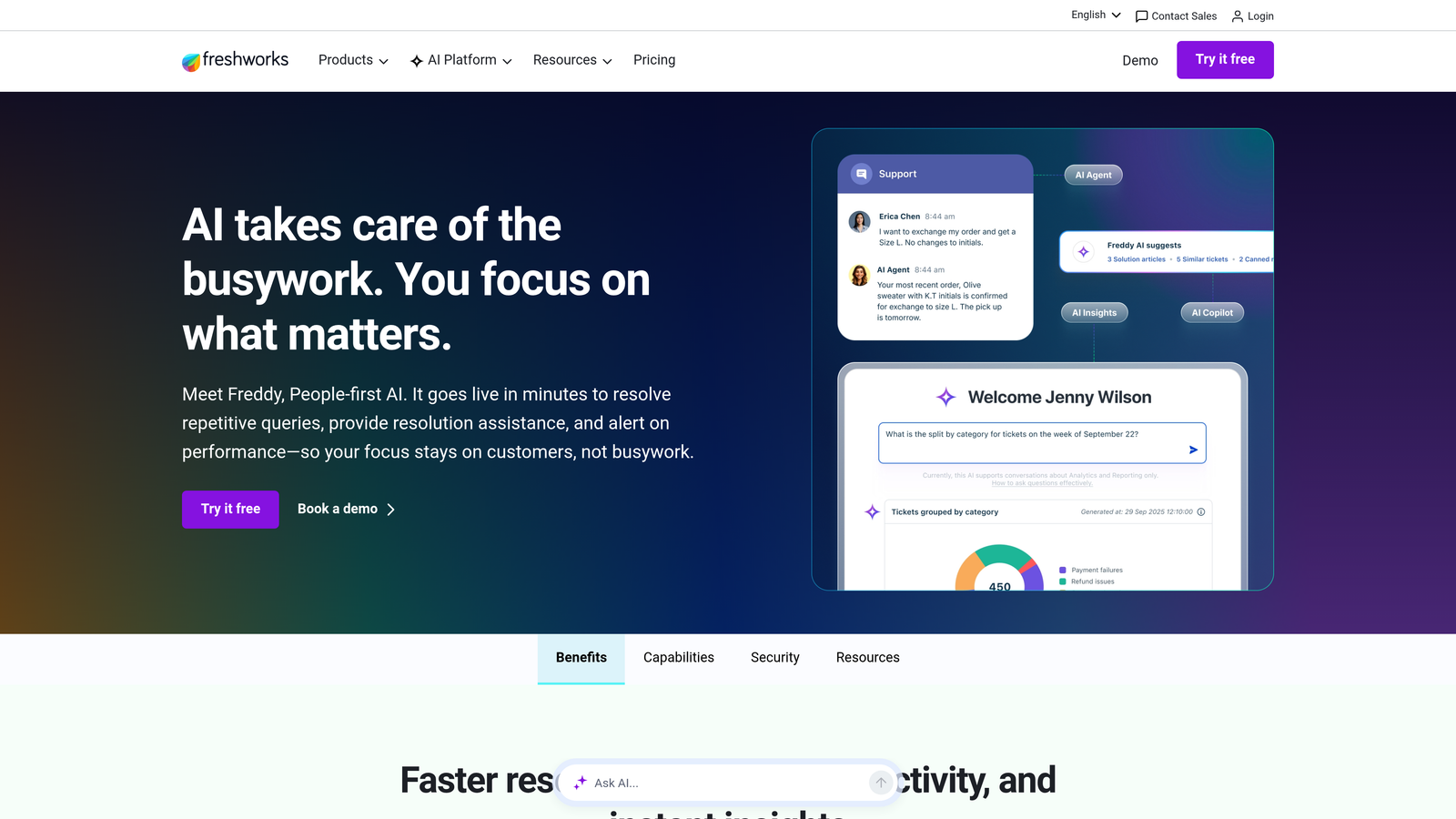
Freshdesk Freddy AI is Freshworks' AI suite covering self-service automation, agent assistance, and analytics within the Freshdesk helpdesk platform.
Where This Tool Shines
Freddy AI is structured across three distinct capabilities: Freddy Self Service handles automated deflection, Freddy Copilot provides real-time agent assistance, and Freddy Insights surfaces analytics and trend detection. This separation makes it easier to adopt incrementally rather than deploying everything at once.
The broader Freshworks ecosystem is also worth noting. If your organization uses Freshsales or Freshservice, consolidating on Freshworks gives you shared data and workflows across sales, IT, and customer support without complex integrations. For enterprises looking to simplify their vendor stack, that consolidation value is real.
Key Features
Freddy Self Service: AI bot for automated FAQ deflection and common request resolution before tickets are created.
Freddy Copilot: Real-time suggested responses, conversation summaries, and tone guidance for agents handling active tickets.
Freddy Insights: AI-driven analytics that surface support trends, anomalies, and areas for automation improvement.
Freshworks Ecosystem: Native integration across Freshsales and Freshservice for unified data across customer-facing teams.
Workflow Automation: Customizable business rules and AI-triggered automation for ticket routing and escalation.
Best For
Mid-market to enterprise software companies that want a full AI helpdesk suite without Zendesk-level pricing, particularly those open to consolidating on the Freshworks platform across multiple departments.
Pricing
Growth plan from $15/agent/month. Enterprise plans with full Freddy AI capabilities are available at higher tiers. Significantly more affordable than comparable Zendesk enterprise tiers.
5. Salesforce Service Cloud with Einstein AI
Best for: Enterprise organizations where Salesforce is already the primary system of record.
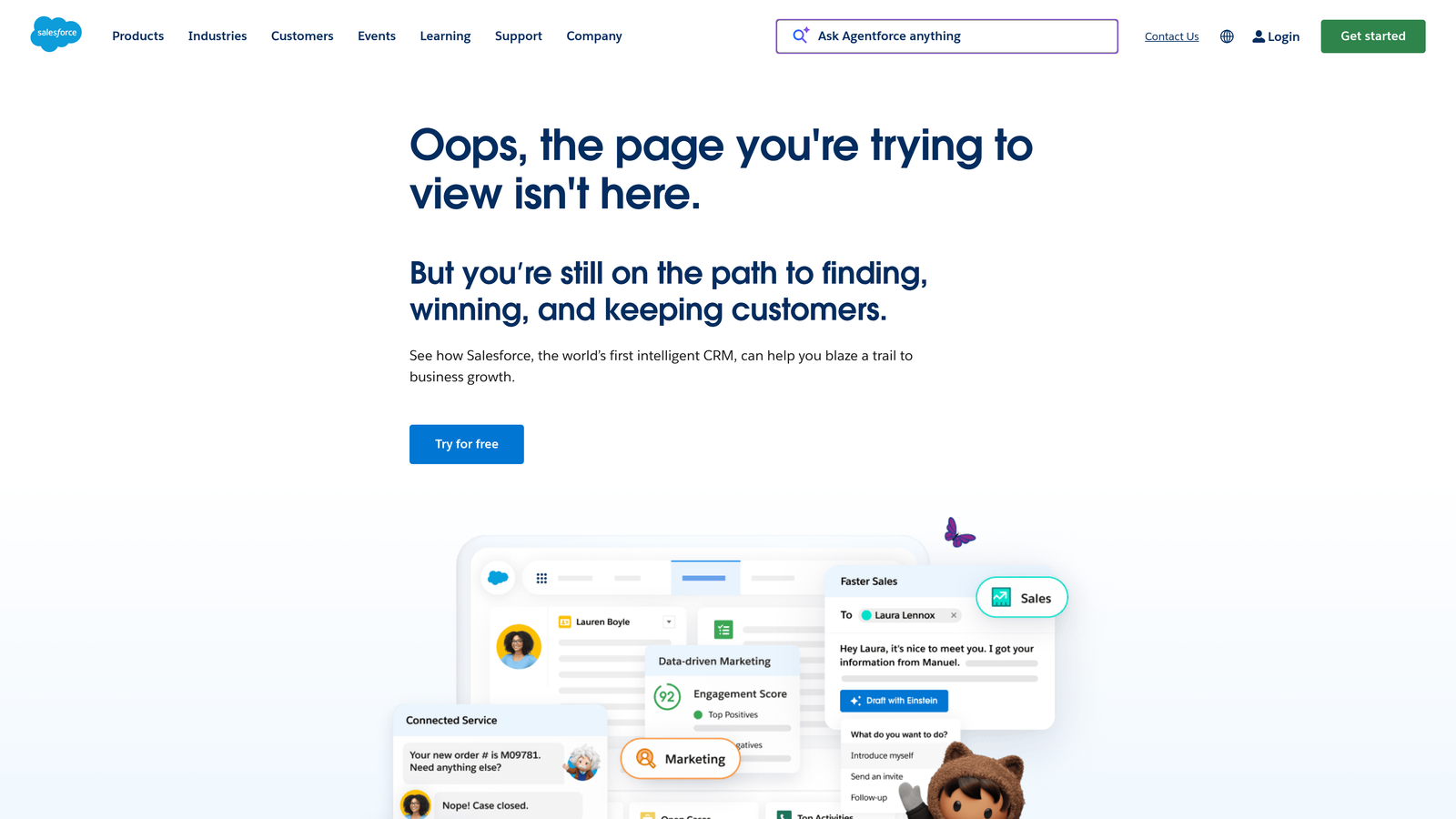
Salesforce Service Cloud is an enterprise support platform that leverages full CRM context through Einstein AI and autonomous agent capabilities via Agentforce.
Where This Tool Shines
The core advantage here is data depth. Because Service Cloud sits inside the Salesforce ecosystem, the AI has access to the complete customer record: sales history, account health, product usage, contract details, and prior support interactions. That context allows for significantly more intelligent case handling than a standalone helpdesk can provide.
Agentforce, Salesforce's newer autonomous AI agent capability, extends this further by enabling end-to-end case handling with full CRM context informing every decision. For enterprises where Salesforce is already the system of record, this integration is genuinely powerful. For everyone else, the implementation complexity and cost make it a harder sell.
Key Features
Einstein AI: Case classification, next best action recommendations, and article surfacing based on full customer history.
Agentforce: Autonomous AI agents that handle cases end-to-end using CRM context and configured business rules.
Native CRM Integration: Full customer timeline from first sales touch through every support interaction in a single unified view.
Omni-Channel Routing: AI-powered case prioritization and routing across email, chat, phone, and social channels.
Enterprise Governance: Salesforce-grade security, compliance certifications, and data governance controls.
Best For
Large enterprises already running Salesforce as their CRM and willing to invest in proper implementation. Typically requires a Salesforce implementation partner to deploy effectively.
Pricing
Enterprise edition from approximately $165/user/month. Einstein AI and Agentforce capabilities are priced as additional add-ons, making total cost substantial for large teams.
6. Kustomer
Best for: Enterprises with complex, multi-channel customer journeys who want a CRM-native support view.
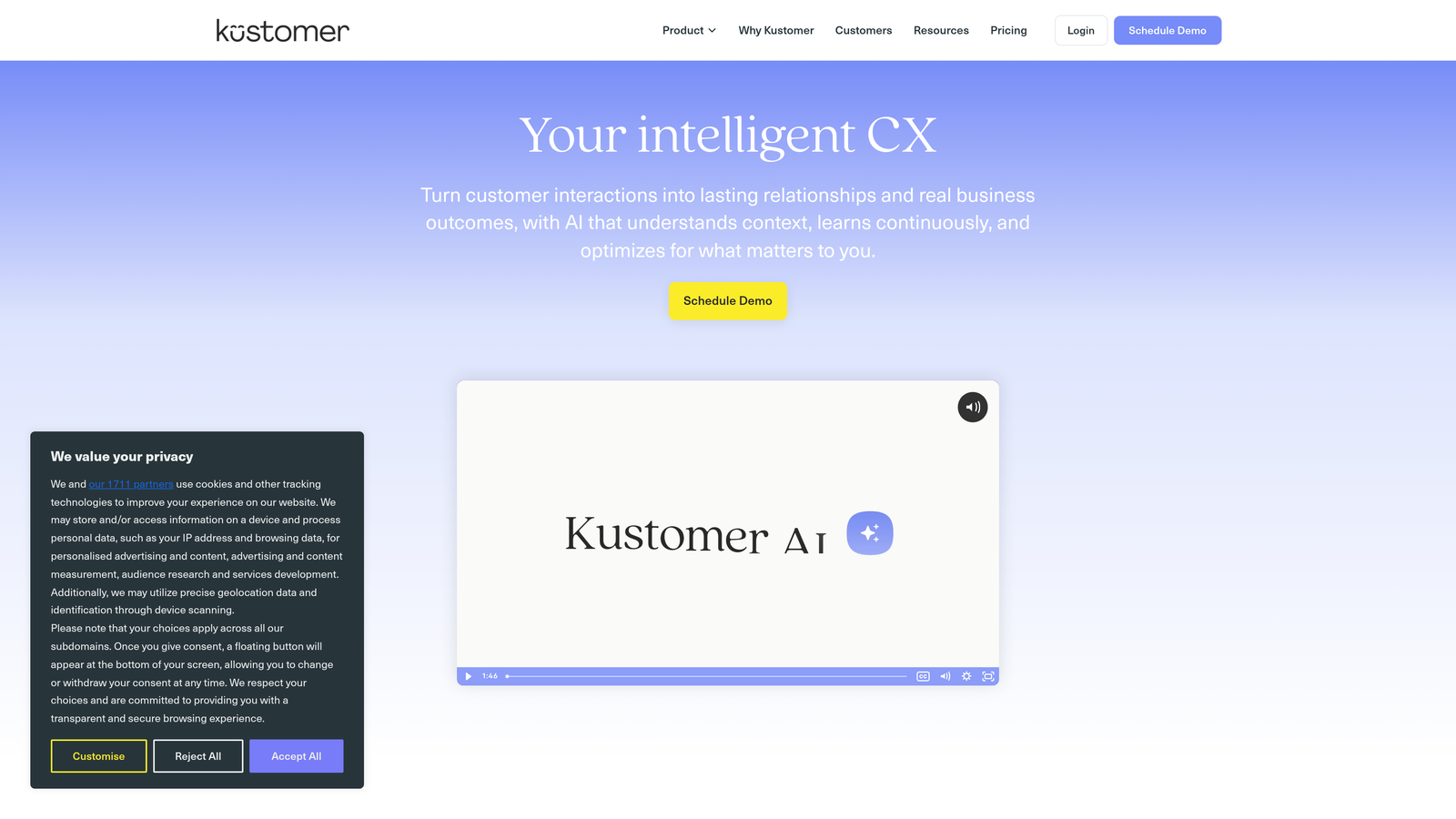
Kustomer is a CRM-native helpdesk that organizes support around a unified customer timeline rather than isolated ticket numbers.
Where This Tool Shines
Kustomer's architecture is fundamentally different from ticket-centric helpdesks. Every interaction, regardless of channel, is tied to a single customer timeline. Agents see the full relationship history at a glance, and the AI uses that context for intent detection, sentiment analysis, and routing decisions. For enterprises handling support across email, chat, voice, SMS, and social simultaneously, that unified view reduces the cognitive overhead significantly.
The AI capabilities in Kustomer IQ handle automated responses, suggested replies, and conversation summaries. These aren't as deep as some dedicated AI platforms, but they're well-integrated into the workflow and benefit from the rich customer data the platform accumulates over time.
Key Features
Unified Customer Timeline: Every interaction across all channels consolidated into a single chronological customer view.
AI Intent Detection: Automatic identification of customer intent and sentiment to inform routing and priority decisions.
Kustomer IQ: Automated responses, suggested replies, and conversation summaries for agent efficiency.
Omnichannel Coverage: Native support for email, chat, voice, SMS, and social channels in one platform.
Workflow Automation: Business rules and AI-triggered workflows for routing, escalation, and task assignment.
Best For
Enterprise companies with complex customer journeys across many touchpoints, particularly those where long-term relationship context should inform every support interaction. More common in B2C enterprise than pure B2B SaaS.
Pricing
Enterprise plan from approximately $89/user/month. Ultimate plan available with additional AI and reporting features.
7. Forethought
Best for: Enterprises that need AI capabilities but can't or won't replace their existing helpdesk.
Forethought is an AI layer designed to sit on top of existing helpdesks like Zendesk, Salesforce, and Freshdesk, adding intelligent deflection, triage, and agent assistance without platform migration.
Where This Tool Shines
The key differentiator is the no-migration approach. Forethought integrates directly into your existing helpdesk environment, which means you can add meaningful AI capabilities without disrupting workflows, retraining your team on a new platform, or migrating years of ticket history. For enterprises with significant investments in their current stack, this is a genuinely practical path to AI-enhanced support.
The three-module structure, Solve for deflection, Triage for classification, and Assist for agent recommendations, allows selective deployment. You can start with one capability and expand rather than committing to a full platform overhaul from day one.
Key Features
Solve: AI agent that deflects tickets before they reach human agents by resolving queries through self-service.
Triage: AI-powered ticket classification, tagging, and routing within your existing helpdesk environment.
Assist: In-workflow agent recommendations and knowledge surfacing without leaving the current helpdesk interface.
No Migration Required: Works natively within Zendesk, Salesforce, and Freshdesk without platform replacement.
Modular Deployment: Select and deploy only the capabilities you need, scaling adoption incrementally.
Best For
Enterprises with established Zendesk, Salesforce, or Freshdesk environments that want AI improvements without committing to a full platform change. Less suitable if you're looking for a unified platform experience with deep product context.
Pricing
Custom pricing based on ticket volume and the specific modules selected. Contact Forethought directly for a quote.
8. Help Scout
Best for: Scale-up software companies that prioritize agent usability and fast deployment over enterprise feature depth.
Help Scout is an agent-first helpdesk with AI assist features built in, known for its clean interface and accessible pricing.
Where This Tool Shines
Help Scout's strength is usability. The interface is genuinely intuitive, which means faster agent onboarding and less time spent navigating complex configurations. For growing software companies that don't have a dedicated helpdesk admin, that simplicity has real operational value.
The AI features, including AI Summarize and AI Assist, are practical rather than transformative. They help agents work faster through conversation summaries and reply drafting, but Help Scout isn't positioned as an autonomous resolution platform. If your primary goal is deflection and autonomous ticket closure at scale, you'll likely outgrow Help Scout's AI capabilities. If your goal is a well-run, efficient agent workflow with AI assistance, it delivers reliably.
Key Features
AI Summarize: Instant conversation summaries that give agents full context without reading entire thread histories.
AI Assist: Reply drafting, tone adjustment, and translation support within the agent compose window.
Beacon: Embeddable chat widget with proactive messaging and in-product help delivery.
Docs: Integrated knowledge base with AI-powered search for self-service resolution.
Shared Inbox: Clean collaborative inbox with collision detection and private notes for team coordination.
Best For
Scale-up software companies with small to mid-sized support teams that value simplicity and fast deployment. Less suited for large enterprises requiring deep customization, advanced AI autonomy, or complex compliance requirements.
Pricing
Plus plan from $40/user/month. Pro plan from $65/user/month. Transparent, predictable pricing with no significant AI add-on costs.
9. Gladly
Best for: Enterprises focused on long-term customer relationships where conversation continuity matters as much as resolution speed.
Gladly is a people-centric helpdesk that organizes support around the customer as a person rather than a ticket number, with AI features built around relationship context.
Where This Tool Shines
Gladly's architecture rejects the ticket model entirely. Every conversation a customer has ever had with your team, regardless of channel or time, lives in a single continuous thread. The AI agent, called Sidekick, and the routing engine both operate with that full relationship context, which creates meaningfully different interactions than systems that treat every new conversation as a blank slate.
People Match, Gladly's routing capability, goes beyond skill-based routing by connecting customers with agents who have a prior relationship with them. For enterprises where customer loyalty and relationship quality are strategic priorities, this philosophy produces measurably different support experiences. It's less common in pure B2B SaaS contexts but worth considering for enterprise software companies with high-value, long-term accounts.
Key Features
Sidekick AI Agent: Autonomous handling of common requests with full access to the customer's lifetime conversation history.
Conversation-Centric Architecture: Lifetime customer thread across all channels, replacing isolated tickets with continuous relationship records.
AI-Powered Routing: Routes based on customer history, sentiment, and agent relationship data rather than just ticket category.
People Match: Connects customers with agents who have existing relationships with them when available.
Knowledge Integration: Knowledge base connected to AI for answer generation within both Sidekick and agent workflows.
Best For
Enterprise companies where long-term customer relationships are central to the business model. Stronger fit for B2C enterprise or high-touch B2B accounts than high-volume, transactional support environments.
Pricing
Hero plan from approximately $150/agent/month. Custom enterprise pricing available for larger deployments.
Which AI Helpdesk Is Right for Your Team?
The right choice depends heavily on where you're starting from and what you actually need the AI to do.
If you're a B2B SaaS team that wants AI-first architecture with genuine product context awareness, Halo AI is the standout option. The page-aware context, autonomous resolution, auto bug ticket creation, and business intelligence capabilities are built for exactly the kind of complex, technical support environment that enterprise software teams operate in. It's not a legacy platform with AI features added. It's designed from the ground up for this use case.
For large enterprises with significant existing Zendesk investment and dedicated helpdesk admin resources, Zendesk AI is the natural evolution path. You get enterprise-grade security and compliance alongside AI features without a platform migration.
If your organization runs a product-led growth motion and Intercom is already central to your user communication, Intercom Fin extends that infrastructure into autonomous support resolution effectively. For Salesforce-native organizations where the CRM is the system of record, Service Cloud with Einstein and Agentforce leverages that data depth in ways no standalone helpdesk can match.
For teams that can't replace their current helpdesk but need meaningful AI improvements, Forethought offers a pragmatic path. And for growing software companies that prioritize usability over enterprise depth, Help Scout delivers reliable agent-assist AI without the configuration overhead.
Your support team shouldn't scale linearly with your customer base. Let AI agents handle routine tickets, guide users through your product, and surface business intelligence while your team focuses on complex issues that need a human touch. See Halo in action and discover how continuous learning transforms every interaction into smarter, faster support.