9 Best AI Helpdesks for Enterprises in 2026
This guide ranks the 9 best AI helpdesk for enterprises platforms in 2026, evaluating each on AI autonomy, enterprise integrations, escalation workflows, and analytics depth. Whether you're adopting your first AI-native support tool or replacing a legacy system, it covers what each platform does best, who it's built for, and what it costs.
 Matt PattoliFounder13 min read
Enterprise support teams are under a familiar kind of pressure: ticket volumes grow, customer expectations rise, and headcount budgets don't stretch to match. Traditional helpdesks were designed for human agents working through queues. AI-native platforms are designed for something different: autonomous resolution, continuous learning, and business intelligence that goes well beyond a resolved ticket count.
This list covers the top AI helpdesk platforms built, or meaningfully adapted, for enterprise needs. We're talking high ticket volumes, complex integrations, multi-team workflows, and the kind of analytical depth that actually informs product and revenue decisions. Whether you're evaluating your first AI-powered support platform or replacing a legacy system that's become too rigid to scale, here's what each tool does best, who it's built for, and what it costs.
Selection criteria: enterprise-grade integrations, AI autonomy and learning capability, escalation workflows, analytics depth, and overall fit for B2B SaaS and product-led teams.
1. Halo AI
Best for: B2B SaaS and product-led enterprises needing AI-first support with deep cross-stack integrations
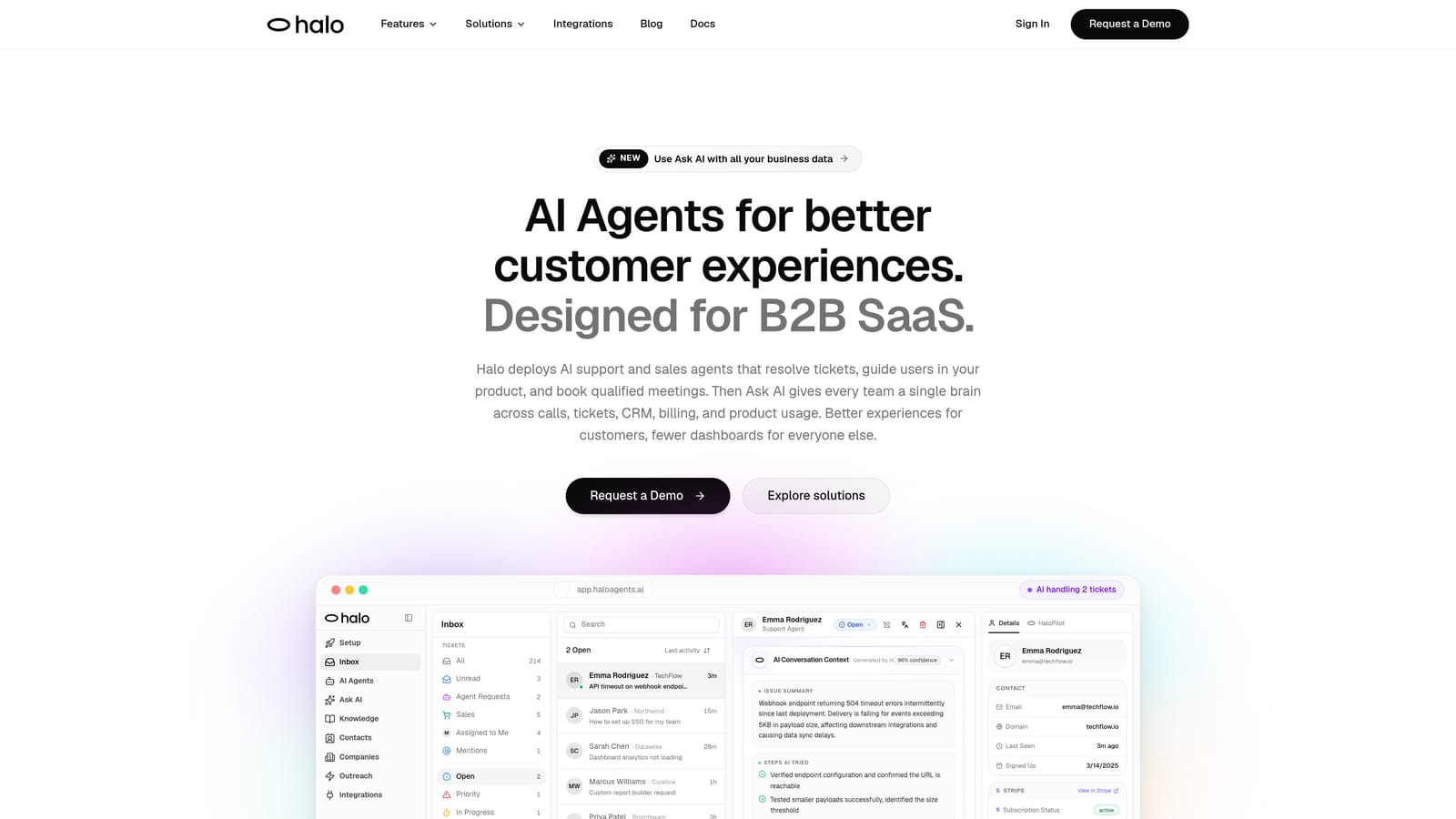
Halo AI is an AI-first customer support platform built around autonomous ticket resolution, page-aware contextual guidance, and business intelligence that extends well beyond the support queue.
Where This Tool Shines
Most AI helpdesks were built by adding AI features to existing ticketing infrastructure. Halo was designed the other way around: AI is the primary resolution layer, not an add-on. That architectural difference shows up in how it handles context. The page-aware chat widget sees what a user is currently viewing, which means agents and AI alike have real situational awareness rather than just a submitted ticket description.
The smart inbox goes further than most support platforms dare. Instead of surfacing ticket metrics, it surfaces business intelligence: customer health signals, revenue indicators, and anomaly detection that connects support patterns to product and commercial outcomes. For product-led teams, that's a meaningful step beyond "tickets resolved per day."
Key Features
Page-Aware Chat Widget: Sees the user's current page context, enabling resolution guidance that's specific to where they are in the product rather than generic knowledge base responses.
Autonomous AI Agents: Resolve tickets end-to-end without human intervention, and learn continuously from every interaction to improve future resolution accuracy.
Smart Inbox with Business Intelligence: Surfaces customer health signals, revenue intelligence, and anomaly detection alongside standard support metrics.
Auto Bug Ticket Creation: Automatically generates structured bug reports and routes them to engineering, bridging support and product teams without manual handoff.
Live Agent Handoff: Escalates to human agents with full conversation context preserved, so nothing gets repeated or lost in transition.
Cross-Stack Integrations: Connects natively with Linear, Slack, HubSpot, Intercom, Stripe, Zoom, PandaDoc, and Fathom for a unified support and business workflow.
Best For
B2B SaaS companies and product-led growth teams that want AI handling routine resolution while surfacing intelligence about customer health and product friction. Particularly strong for teams where support, product, and engineering need to operate as a connected system rather than separate silos.
Pricing
Contact for enterprise pricing. A demo is available at haloagents.ai.
2. Zendesk AI
Best for: Large enterprises already invested in the Zendesk ecosystem seeking AI-enhanced agent productivity
Zendesk AI is the AI capability layer built across Zendesk's mature enterprise helpdesk, covering intelligent triage, agent copilot, and automated self-service resolution.
Where This Tool Shines
Zendesk's core strength has always been its ecosystem maturity. Thousands of integrations, a deep marketplace, and years of enterprise deployment mean the platform handles complex organizational structures well. The AI layer adds meaningful capability on top of that foundation: intent-based routing, sentiment detection, and agent copilot features that reduce time-to-response.
For enterprises already running Zendesk, adopting the AI suite is a lower-friction upgrade path than migrating to a new platform. The tradeoff is that AI is layered onto existing infrastructure rather than architected as the primary resolution engine, which can create limitations in autonomy depth.
Key Features
Intelligent Triage: Routes tickets based on intent, sentiment, and detected language without manual categorization rules.
Agent Copilot: Suggests responses and next best actions in real time, reducing agent cognitive load during high-volume periods.
AI-Powered Self-Service: Surfaces relevant knowledge base content before tickets are submitted, deflecting routine questions automatically.
Advanced Analytics: Reporting dashboards across the full support organization with trend analysis and performance benchmarking.
Marketplace Integrations: Extensive third-party app ecosystem and open APIs for custom enterprise integrations.
Best For
Enterprises already committed to the Zendesk platform that want to extend existing investment with AI capabilities rather than replace their helpdesk infrastructure. Less suited for teams seeking AI-native architecture from the ground up.
Pricing
Enterprise plans start at $115 per agent per month. AI Suite pricing varies by configuration and is separate from base licensing.
3. Intercom Fin
Best for: Chat-heavy support workflows where autonomous conversation resolution is the primary goal
Intercom Fin is Intercom's LLM-powered AI agent, designed to autonomously resolve support conversations within Intercom's messenger infrastructure before routing to human agents.
Where This Tool Shines
Fin's design philosophy is straightforward: resolve as many conversations as possible before a human ever needs to get involved. It draws on knowledge bases, custom URLs, and configured content to answer questions, and its resolution accuracy has improved considerably in the current iteration. For teams where chat is the dominant support channel, Fin's autonomous-first approach aligns well with the workflow.
The escalation path is clean: when Fin can't resolve a conversation, it hands off to a human agent with full context intact. Omnichannel coverage across chat, email, and social adds flexibility for teams managing multiple inbound channels within Intercom.
Key Features
Autonomous Resolution: Handles conversations end-to-end using knowledge base content, URLs, and custom sources before involving human agents.
Seamless Escalation: Transfers to human agents with complete conversation history and context when resolution requires it.
Omnichannel Support: Covers chat, email, and social channels within the Intercom platform.
Resolution Analytics: Tracks AI resolution rates and conversation quality metrics to measure and improve performance over time.
Content Flexibility: Answers questions from knowledge base articles, custom URLs, and configured content sources.
Best For
Companies already using Intercom as their primary support and messaging platform that want to add autonomous AI resolution without switching infrastructure. Less compelling for teams not already in the Intercom ecosystem.
Pricing
Fin charges per resolution rather than per seat. Intercom plans start at $74 per seat per month, with Fin costs layered on top based on usage.
4. Freshdesk Freddy AI
Best for: Mid-to-large enterprises seeking cost-competitive AI across support, CRM, and ITSM in one suite
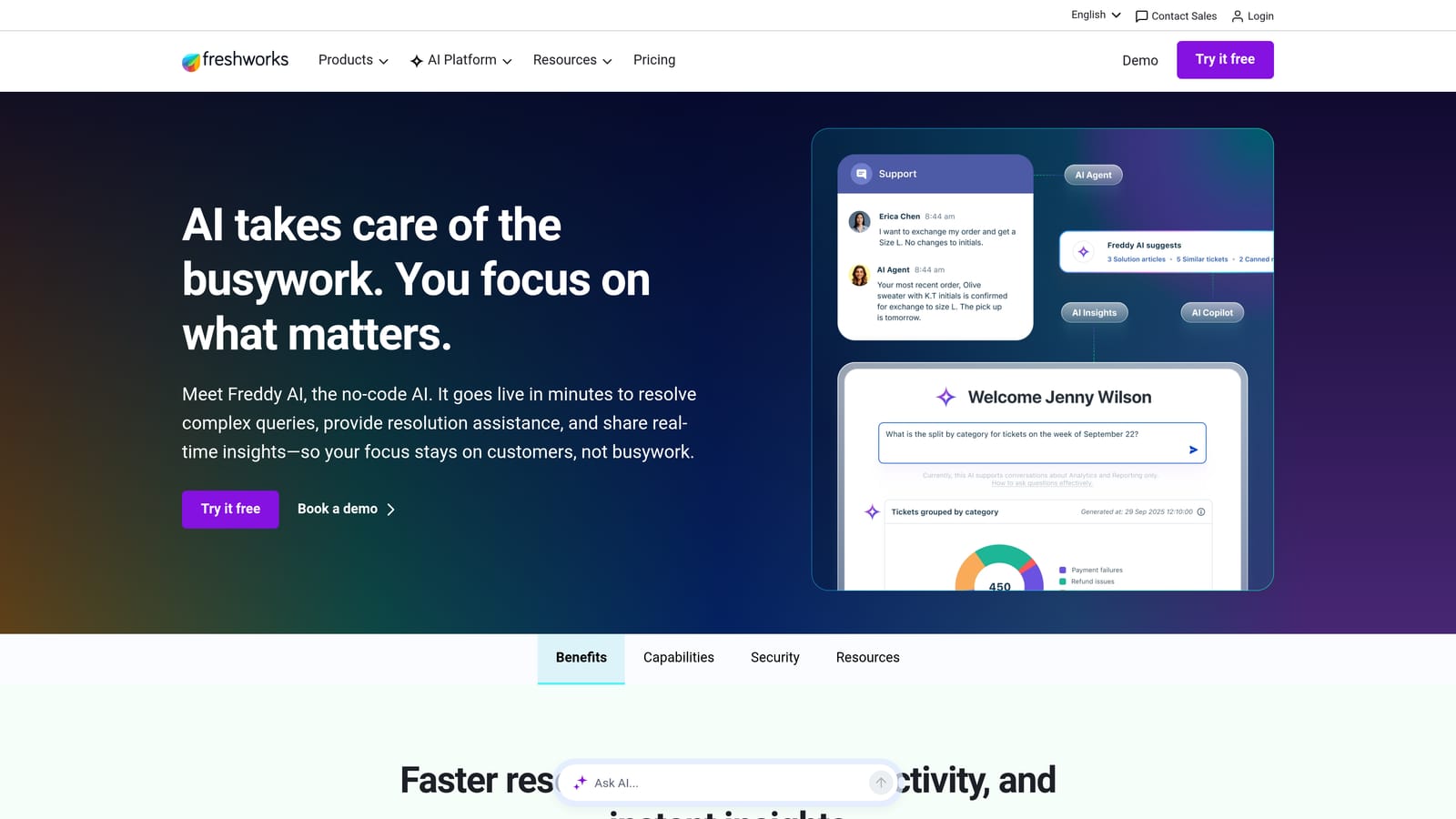
Freshdesk Freddy AI is Freshworks' AI layer spanning self-service deflection, agent assistance, and analytics across the Freshdesk helpdesk platform and the broader Freshworks suite.
Where This Tool Shines
Freddy AI is structured across three distinct functions: self-service (Freddy Self Service), agent productivity (Freddy Copilot), and analytics (Freddy Insights). That modular approach means enterprises can adopt the capabilities most relevant to their current maturity without overhauling everything at once. Freddy Insights in particular stands out for its anomaly detection and AI-driven analytics, which go beyond standard reporting dashboards.
Freshdesk's pricing is meaningfully more competitive than Zendesk at enterprise tier for comparable AI feature sets, which makes it worth serious evaluation for cost-conscious procurement teams. The integration across Freshsales and Freshservice also benefits enterprises that want a unified Freshworks stack.
Key Features
Freddy Self Service: AI-powered chatbot handling deflection and resolution before tickets reach human agents.
Freddy Copilot: Provides agents with response suggestions, summarization, and context during live interactions.
Freddy Insights: AI-driven analytics with anomaly detection, trend identification, and performance recommendations.
Intelligent Routing: Automatically classifies and prioritizes tickets based on content and urgency signals.
Freshworks Suite Integration: Connects natively with Freshsales (CRM) and Freshservice (ITSM) for cross-functional workflow continuity.
Best For
Enterprises looking for a cost-competitive alternative to Zendesk with AI capabilities spanning support, CRM, and IT service management. Strong fit for teams that want modular AI adoption rather than an all-or-nothing implementation.
Pricing
Growth plan starts at $15 per agent per month. Freddy AI add-ons are priced separately at enterprise tier; contact Freshworks for current AI suite pricing.
5. Salesforce Service Cloud Einstein
Best for: Enterprises where Salesforce is the system of record and AI needs full CRM context to be effective
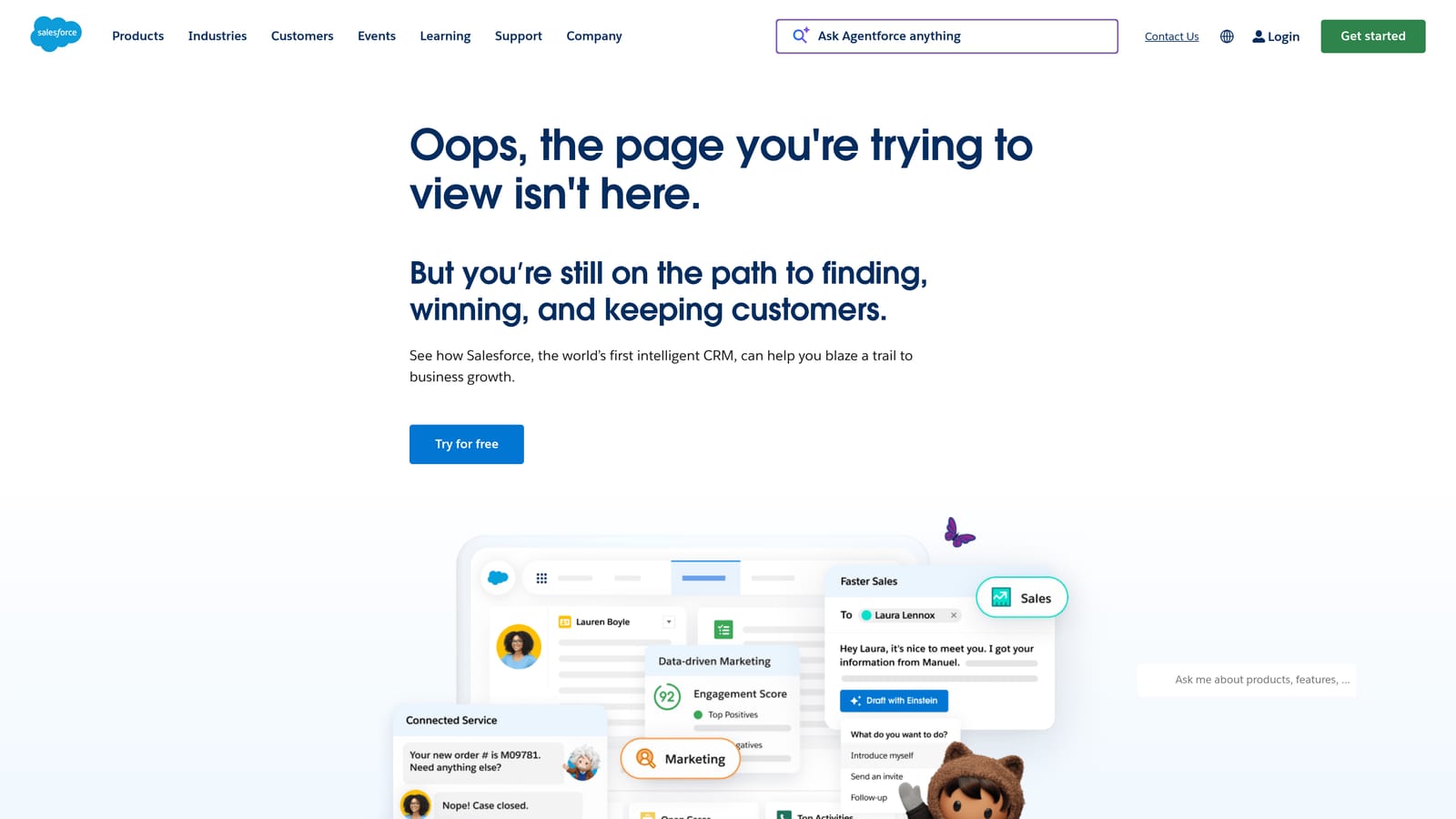
Salesforce Service Cloud Einstein embeds AI throughout Service Cloud, drawing on full CRM data for case classification, agent assistance, and predictive recommendations.
Where This Tool Shines
Einstein's core advantage is access to the full Salesforce data model. When AI can see a customer's purchase history, open opportunities, marketing engagement, and previous case history simultaneously, its recommendations and classifications are materially more accurate than AI working from support data alone. For enterprises where Salesforce is the central system of record, that context depth is genuinely difficult to replicate elsewhere.
Einstein Copilot for agents brings generative AI responses grounded in CRM data, which reduces hallucination risk and keeps agent guidance relevant to the specific customer relationship. The tradeoff is implementation complexity: getting Service Cloud Einstein fully configured requires significant technical investment.
Key Features
Einstein Case Classification: Automatically populates case fields and routes tickets based on content and historical patterns.
Einstein Copilot for Agents: Generative AI responses and guidance grounded in CRM data, not just knowledge base content.
Next Best Action: Recommends specific actions based on full customer history and current case context.
Einstein Article Recommendations: Surfaces relevant knowledge articles to agents and customers during case resolution.
Deep Salesforce Integration: Connects natively with Sales Cloud, Marketing Cloud, and the full Salesforce platform ecosystem.
Best For
Large enterprises where Salesforce is already the primary CRM and system of record. The AI is most powerful in that context; teams not on Salesforce will find the value proposition significantly reduced relative to implementation cost.
Pricing
Service Cloud Enterprise starts at $165 per user per month. Einstein AI features require additional licensing; contact Salesforce for current AI suite pricing.
6. ServiceNow Customer Service Management
Best for: Large enterprises where customer support and internal IT workflows need to operate on a unified platform
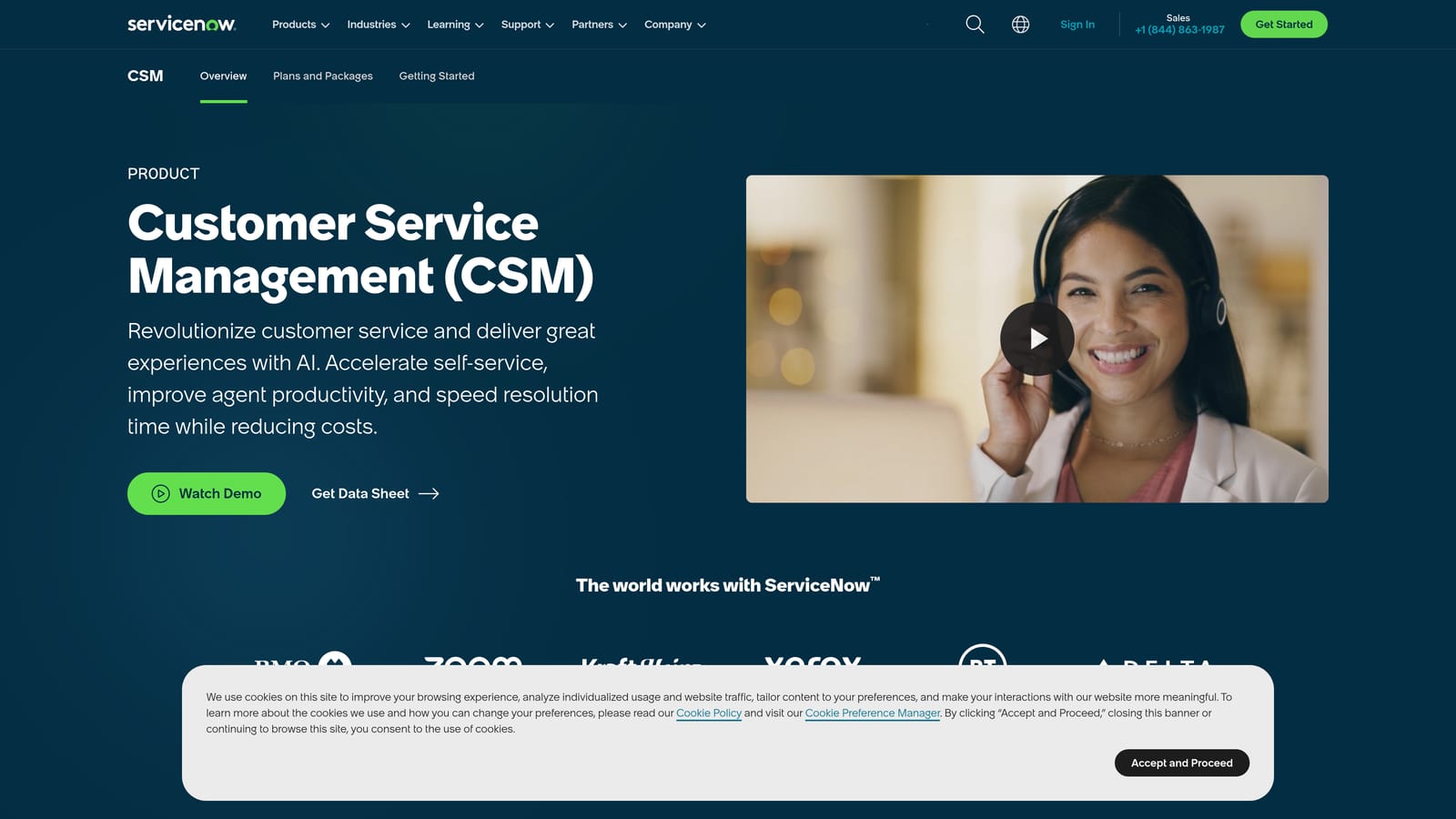
ServiceNow Customer Service Management connects customer-facing support with IT service management workflows, with generative AI capabilities via Now Assist across both domains.
Where This Tool Shines
ServiceNow occupies a specific and important enterprise niche: organizations where customer issues frequently require internal IT or operations teams to resolve. Telecom providers, financial services firms, and manufacturers often find that customer-facing support and internal service management are deeply intertwined. ServiceNow's unified platform handles both, which eliminates handoff friction that separate systems create.
Now Assist brings generative AI to case summarization, resolution notes, and agent guidance across the platform. The Virtual Agent handles self-service across channels, while Predictive Intelligence manages intelligent case routing and categorization. For enterprises already running ServiceNow for ITSM, extending it to customer support is a natural consolidation.
Key Features
Now Assist: Generative AI for case summarization, resolution notes, and real-time agent guidance across the platform.
Virtual Agent: AI-powered self-service handling customer inquiries across multiple channels before human escalation.
Predictive Intelligence: Intelligent case routing and categorization based on historical data and content analysis.
Unified ITSM and CSM: Single platform connecting customer support cases with internal IT service workflows and resolution teams.
Advanced Analytics Dashboards: Performance reporting across both customer service and IT service management operations.
Best For
Large enterprises in regulated or operationally complex industries where customer support resolution depends on internal IT or operations workflows. Less suited for pure SaaS companies where support and engineering operate independently.
Pricing
Enterprise pricing only; contact ServiceNow directly for custom quotes based on organizational scale and configuration.
7. Kustomer
Best for: Enterprises managing complex customer timelines across multiple channels who need CRM-native support
Kustomer is a CRM-native omnichannel helpdesk that organizes support around full customer timelines, with AI handling routing, deflection, and agent assistance throughout.
Where This Tool Shines
Kustomer's architecture is built around the customer, not the ticket. Every interaction, purchase, behavior, and prior support conversation is stored and surfaced in a unified timeline, visible to both AI and human agents. That context richness makes AI routing and recommendations meaningfully more relevant than platforms working from ticket data alone.
The omnichannel design covers email, chat, SMS, social, and voice natively, which reduces the integration complexity enterprises typically face when stitching together multiple channel tools. KustomerIQ handles deflection and self-service, while workflow automation manages repetitive case types without manual configuration each time.
Key Features
CRM-Native Architecture: Full customer history, purchases, and interactions visible to AI and agents in a unified timeline view.
Omnichannel Coverage: Native support across email, chat, SMS, social, and voice without requiring separate channel integrations.
AI-Powered Intelligent Routing: Routes cases based on full customer context, not just ticket content or category tags.
KustomerIQ Deflection: AI-powered self-service and deflection layer reducing inbound volume before human agents are involved.
Workflow Automation: Automates repetitive case types and standard processes to reduce manual handling at scale.
Best For
Enterprises with complex, multi-touchpoint customer relationships who need support AI grounded in rich customer history. Strong fit for companies managing high-value customer bases across multiple channels and interaction types.
Pricing
Enterprise plan starts at $89 per user per month. Contact Kustomer for volume-based enterprise pricing.
8. Gladly
Best for: Relationship-driven enterprises where customer continuity and lifetime value are central to support strategy
Gladly is a people-based enterprise support platform that organizes all customer interactions into a single lifetime conversation thread, with AI self-service via the Gladly Hero AI agent.
Where This Tool Shines
Gladly's defining differentiator is its rejection of the ticket model entirely. Rather than organizing support around case numbers, every interaction with a customer, regardless of channel or time, lives in one continuous thread. Agents and AI see the complete relationship history without hunting through separate tickets. For brands where customer relationships are long-term and high-value, that continuity changes the quality of every interaction.
The Gladly Hero AI agent handles self-service resolution, and AI-powered routing considers both agent skills and customer history when escalating. The platform is particularly well-regarded in retail and consumer brands, though its people-based model translates to any enterprise where relationship continuity is a support priority.
Key Features
People-Based Model: All customer interactions across every channel unified in a single lifetime conversation thread, not separate tickets.
Gladly Hero AI Agent: Handles self-service resolution with access to full customer context before escalating to human agents.
Unified Customer Timeline: Complete interaction history visible across channels, enabling context-aware resolution at every touchpoint.
AI-Powered Routing: Considers both agent skills and individual customer history when routing escalations.
Omnichannel Support: Native coverage across chat, email, voice, SMS, and social within the unified customer view.
Best For
Enterprises in retail, consumer brands, or any high-LTV customer context where relationship continuity and long-term customer history are central to support quality. Less common in pure B2B SaaS environments but worth evaluating for relationship-intensive enterprise accounts.
Pricing
Hero (AI) plan and Hero + Agent plans available; contact Gladly for enterprise pricing based on volume and configuration.
9. Forethought
Best for: Enterprises that want AI triage, deflection, and agent assist without migrating away from their existing helpdesk
Forethought is an AI layer that sits on top of existing helpdesks including Zendesk, Salesforce, and ServiceNow, adding intelligent triage, deflection, and agent assistance without requiring platform migration.
Where This Tool Shines
Forethought's value proposition is deliberately positioned around the migration problem. Many enterprises have years of investment in Zendesk, Salesforce, or ServiceNow, and replacing those platforms is a multi-year project with significant organizational risk. Forethought adds meaningful AI capability on top of what already exists, which means faster time-to-value and no disruption to existing workflows.
The four-module structure covers the full support lifecycle: Solve handles self-service deflection, Triage classifies and routes tickets intelligently, Assist supports agents with relevant knowledge during live interactions, and Discover provides analytics on what's driving ticket volume. That last module is particularly useful for teams trying to understand where to invest in product improvements or documentation.
Key Features
Solve: AI agent handling self-service deflection across chat and email before tickets reach human agents.
Triage: Intelligent ticket classification and priority routing applied before human handling begins.
Assist: Agent copilot surfacing relevant knowledge articles and suggested responses during live ticket handling.
Discover: Analytics identifying top ticket drivers and automation opportunities to guide continuous improvement.
Helpdesk-Agnostic Architecture: Works alongside existing Zendesk, Salesforce, ServiceNow, and other platforms without requiring migration.
Best For
Enterprises with significant investment in existing helpdesk platforms that want to add AI capability incrementally. Also useful for organizations evaluating AI before committing to a full platform migration.
Pricing
Contact Forethought for enterprise pricing. No self-serve plans; pricing is custom based on volume and modules selected.
Which AI Helpdesk Is Right for Your Enterprise?
The right choice depends heavily on where your enterprise is starting from and what you're optimizing for.
If you're building on an AI-first architecture and want support that connects to your full business stack, including product, engineering, billing, and CRM, Halo AI is the strongest fit for B2B SaaS and product-led teams. The page-aware context, continuous learning, and business intelligence layer make it genuinely differentiated from platforms that added AI to existing helpdesk infrastructure.
If you're already deeply invested in an existing platform, the path of least resistance is to extend it: Zendesk AI for Zendesk shops, Intercom Fin for Intercom-native teams, Einstein for Salesforce-centric enterprises, and Forethought for anyone who wants AI capability without platform migration.
For enterprises where customer relationships span long timelines and multiple channels, Kustomer and Gladly offer CRM-native and people-based models respectively that most traditional helpdesks can't replicate. And for large organizations where customer support and internal IT operations are deeply intertwined, ServiceNow CSM remains the natural consolidation platform.
The common thread across all of them: AI autonomy rates, integration depth, and escalation quality are now the primary evaluation criteria, not seat counts or ticket limits.
Your support team shouldn't scale linearly with your customer base. Let AI agents handle routine tickets, guide users through your product, and surface business intelligence while your team focuses on complex issues that need a human touch. See Halo in action and discover how continuous learning transforms every interaction into smarter, faster support.