9 Best AI Helpdesk Tools for Tech Companies in 2026
Discover the 9 best AI helpdesk tools for tech companies in 2026, evaluated on autonomous ticket resolution, technical integrations, and developer-friendly features. This guide helps engineering-driven support teams move beyond generic ticketing systems to platforms that understand product context, route bugs intelligently, and scale with complex technical workflows.
 Matt PattoliFounder13 min read
Tech companies face a support challenge that most helpdesk vendors weren't built to solve. Your users are developers, product managers, and technical buyers who expect precise answers instantly. Your tickets involve API errors, integration failures, and edge cases that require actual product context. And when a bug slips through, you need it routed to your dev team before it becomes a churn event.
A generic ticketing system with a chatbot bolted on won't get you there. The platforms worth your attention in 2026 resolve tickets autonomously, understand what's happening in your product, surface patterns across your support data, and connect natively to the tools your engineering and success teams already live in.
Here are the top AI helpdesk tools for tech companies, evaluated on AI capability, technical integrations, developer-friendliness, and real-world scalability.
1. Halo AI
Best for: SaaS and tech companies that want an AI-first support architecture, not an AI add-on.
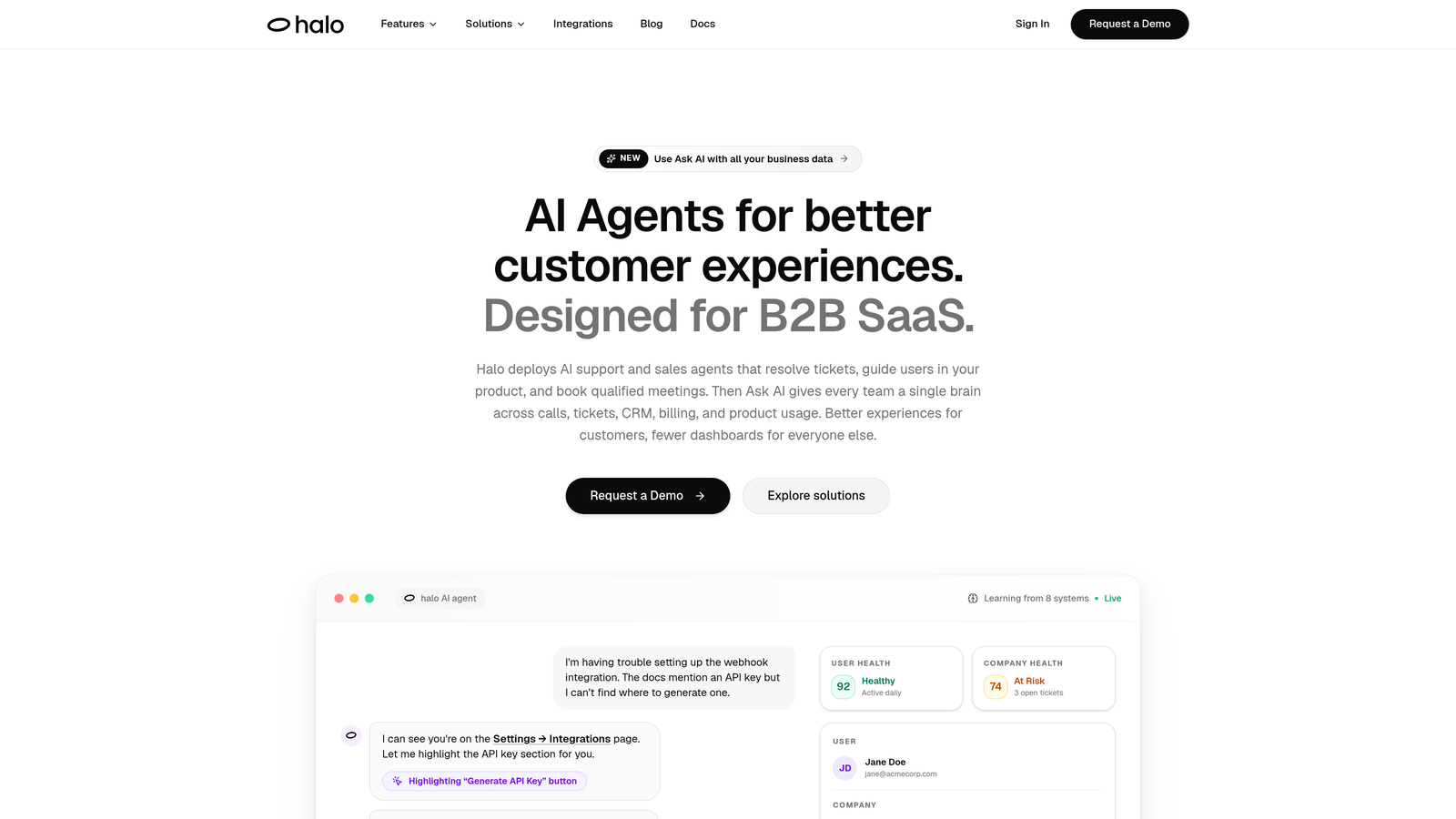
Halo AI is an AI-native customer support platform built specifically for SaaS and tech companies that need intelligent agents, not just smarter ticket routing.
Where This Tool Shines
What separates Halo from legacy helpdesks with AI layers is the architecture. It was built AI-first, meaning the intelligence isn't a feature you toggle on — it's the foundation everything runs on. The platform's page-aware chat widget is a standout: it sees exactly what your user sees in the product and can provide visual UI guidance in context, which is genuinely useful when your users are stuck mid-workflow at midnight.
Beyond resolution, Halo's smart inbox surfaces business intelligence from your support data: customer health signals, revenue anomalies, and usage patterns that would otherwise stay buried in ticket queues. This turns your support operation into a strategic signal layer, not just a cost center.
Key Features
Page-Aware Chat Widget: Sees the user's current product context and delivers visual UI guidance tailored to exactly where they are in your app.
Autonomous Ticket Resolution with Intelligent Handoff: AI agents handle routine and semi-complex tickets, then escalate to live agents when the situation genuinely requires it.
Auto Bug Ticket Creation: Automatically generates and routes bug reports to Linear, Jira, or your existing dev workflow without requiring manual intervention from support staff.
Smart Inbox with Business Intelligence: Surfaces customer health signals, revenue risk indicators, and product usage anomalies from within your support data.
Deep Integration Stack: Connects to Slack, HubSpot, Intercom, Stripe, Zoom, PandaDoc, Fathom, and Linear — covering your entire go-to-market and engineering toolchain.
Best For
SaaS startups scaling past their support team's capacity, and B2B tech companies that want support data to feed into product, revenue, and engineering workflows rather than sitting in a silo. Particularly strong for teams where bug detection and developer tool integrations are non-negotiable.
Pricing
Visit haloagents.ai for current pricing details. Plans are designed for tech companies at various growth stages.
2. Intercom
Best for: Product-led growth companies already embedded in the Intercom messaging ecosystem.
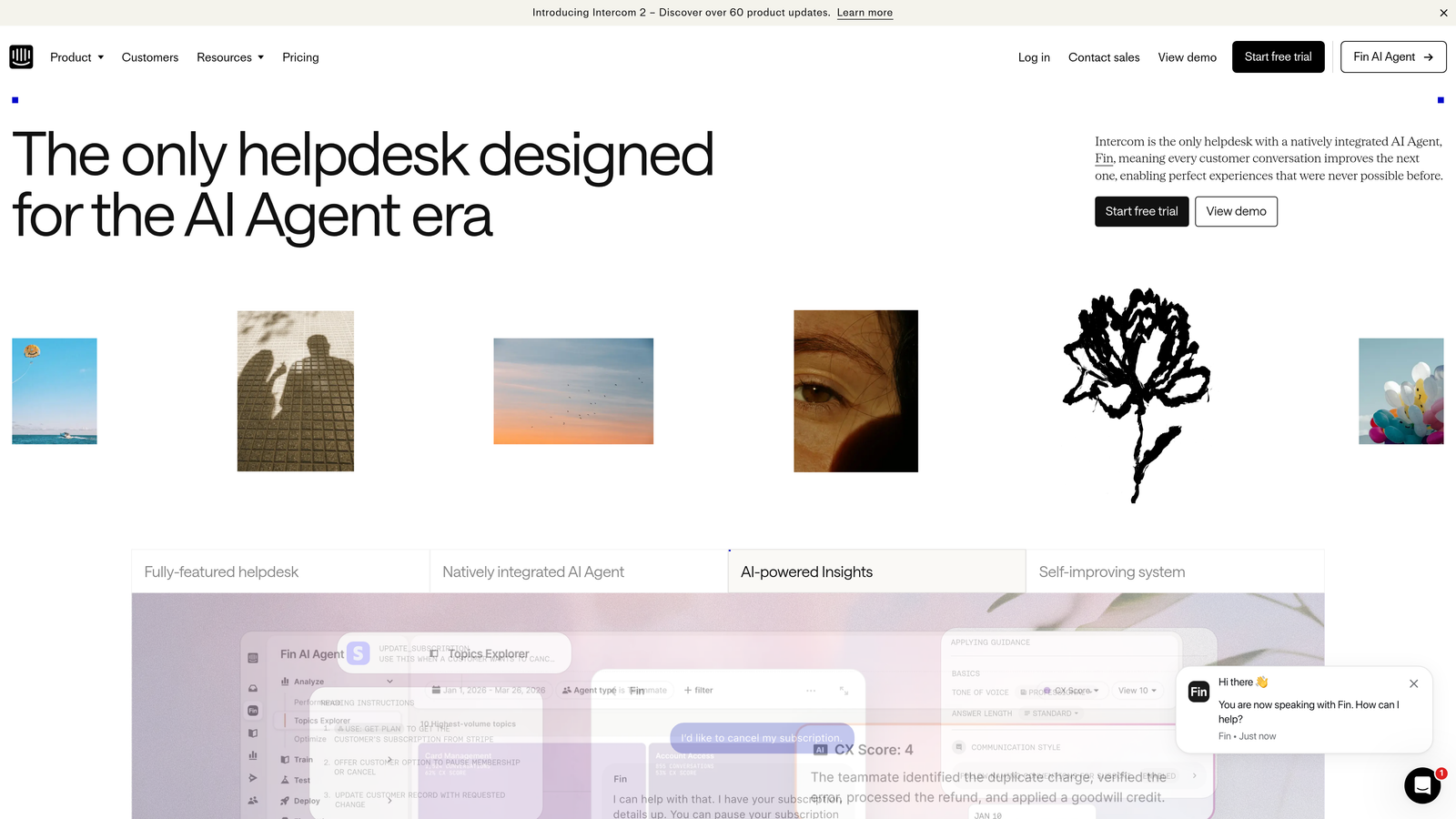
Intercom is a mature customer messaging and support platform with Fin, an AI agent that resolves queries using your help center content and product data.
Where This Tool Shines
Intercom's strength is its depth of customer messaging history. Fin, the AI agent, draws on that context alongside your help center content to resolve queries with reasonable accuracy for common questions. If your team has already built out Intercom's product tours, in-app messages, and conversation flows, Fin slots naturally into that existing architecture.
The proactive support capabilities are genuinely useful for tech companies: you can trigger contextual messages based on user behavior, reducing inbound tickets before they're created. The trade-off is pricing, which can escalate quickly at scale when Fin's usage-based fees are layered on top of seat costs.
Key Features
Fin AI Agent: Trained on your help center content for autonomous resolution of common support queries.
Rich Messaging Context: Full conversation history provides AI agents with customer context for more relevant responses.
Proactive Support: In-product messaging and behavior-triggered outreach to deflect tickets before they're submitted.
SaaS-Friendly Integrations: Connects with Salesforce, Stripe, GitHub, and most major SaaS tools.
AI Resolution Reporting: Detailed analytics on Fin's resolution rate and CSAT scores for continuous optimization.
Best For
Tech companies with a strong existing Intercom footprint and product-led growth motions. Less ideal for teams starting fresh who want a purpose-built AI resolution engine without the full Intercom messaging suite overhead.
Pricing
Starts at approximately $39/seat/month; Fin AI usage-based pricing applies on top. Verify current pricing at intercom.com.
3. Zendesk AI
Best for: Large enterprise tech teams with existing Zendesk infrastructure and complex compliance requirements.
Zendesk AI is an enterprise helpdesk platform with AI triage, intelligent routing, and agent copilot capabilities layered on top of one of the most established ticketing systems in the market.
Where This Tool Shines
Zendesk's core advantage is enterprise-grade infrastructure: SLA management, advanced reporting, compliance controls, and an app marketplace with over 1,500 integrations. For large tech organizations with strict security requirements and complex support workflows, that foundation is hard to replicate quickly.
The AI capabilities, including intelligent triage and agent copilot with suggested replies, are solid additions. However, they're best understood as enhancements to the existing ticketing engine rather than a reimagined AI-first experience. Teams that have built significant workflow automation and macros in Zendesk will find the AI layer meaningfully useful.
Key Features
AI-Powered Triage and Routing: Automatically categorizes and routes incoming tickets based on intent, priority, and team availability.
Agent Copilot: Provides suggested replies, macro recommendations, and response drafts to speed up agent resolution.
Advanced Reporting and SLA Management: Comprehensive analytics and compliance-friendly workflow controls.
1,500+ App Marketplace: Extensive integration options covering virtually every enterprise toolchain.
Enterprise Security: Role-based access controls, data residency options, and compliance certifications for regulated industries.
Best For
Large enterprise tech companies with existing Zendesk investments, significant compliance requirements, and support teams that need robust workflow automation rather than primarily autonomous AI resolution.
Pricing
Suite plans start at approximately $55/agent/month; AI features are available on higher tiers. Verify at zendesk.com.
4. Freshdesk Freddy AI
Best for: Growing tech companies that need omnichannel AI support at a more accessible price point than enterprise alternatives.
Freshdesk Freddy AI is Freshworks' AI layer across the Freshdesk platform, covering ticket deflection, agent assist, and omnichannel automation.
Where This Tool Shines
Freddy AI's value proposition is breadth at an accessible price. You get autonomous ticket deflection, agent assist with suggested replies and tone adjustment, auto-triage, and omnichannel coverage across email, chat, phone, and social — without the enterprise price tag of Zendesk or Intercom.
For tech companies in the growth phase that need solid AI coverage across multiple channels before they can justify a larger investment, Freshdesk Freddy represents a practical middle ground. The free tier also makes it genuinely approachable for early-stage teams testing AI deflection for the first time.
Key Features
Freddy AI Agent: Autonomous ticket deflection across chat and email channels using your knowledge base content.
Freddy Copilot: Agent assist with suggested replies, conversation summarization, and tone adjustment tools.
Omnichannel Coverage: Unified inbox across email, chat, phone, and social media channels.
Auto-Triage: Intelligent routing based on detected intent and sentiment analysis.
Free Tier Available: Entry-level access for small teams to test AI deflection without upfront commitment.
Best For
Mid-size tech companies and SaaS startups that need omnichannel AI support without enterprise pricing. Also a strong option for teams migrating from basic helpdesks who want AI features included in the platform rather than purchased separately.
Pricing
Free tier available; paid plans start at approximately $15/agent/month. Verify current tiers at freshworks.com.
5. Guru
Best for: Tech companies whose support quality suffers from fragmented knowledge spread across Slack, Confluence, Notion, and Google Drive.
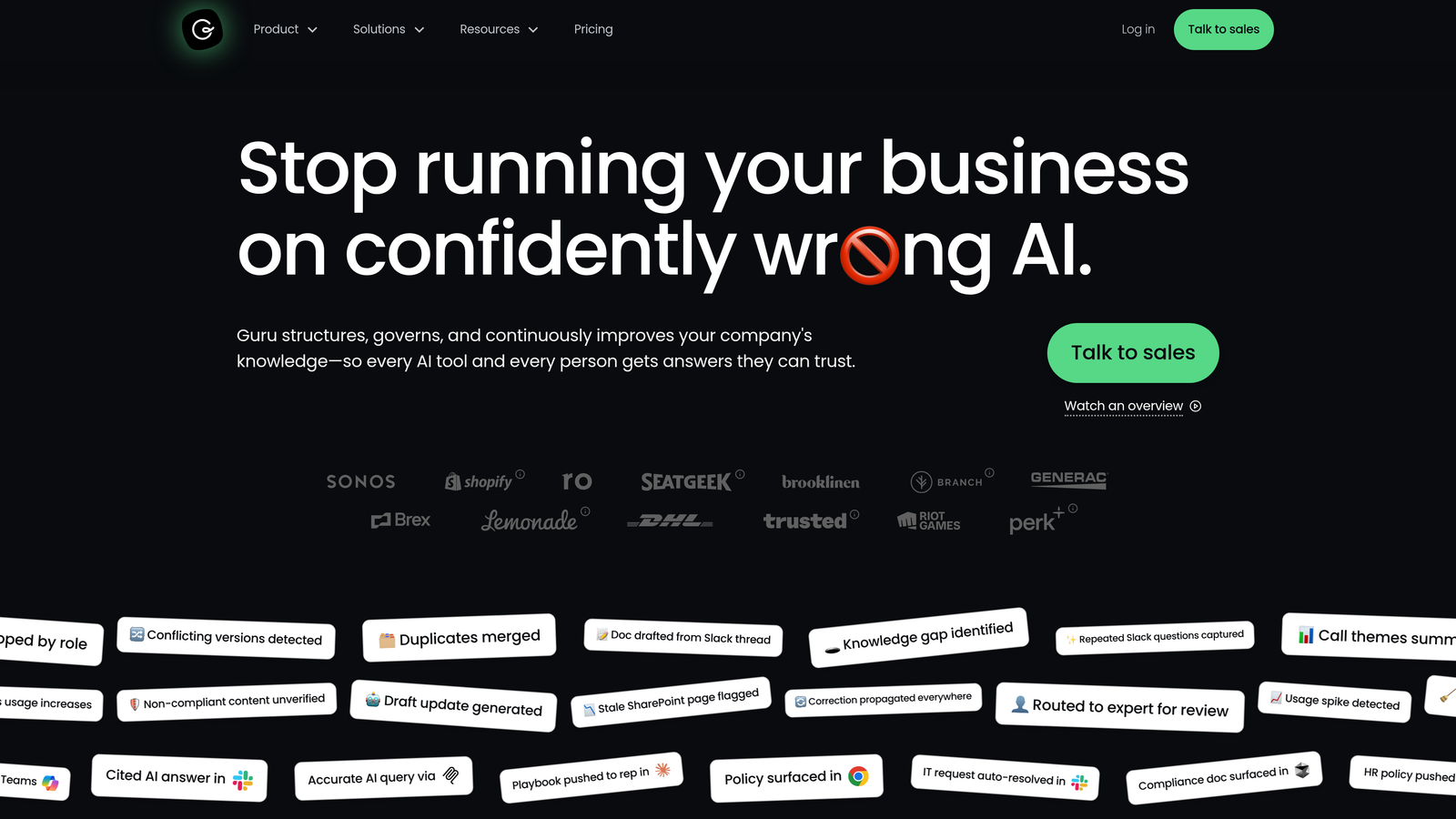
Guru is an AI-powered knowledge management platform that surfaces answers from across your entire tool stack in real time for support agents and AI systems.
Where This Tool Shines
Guru isn't a helpdesk in the traditional sense — it's the knowledge infrastructure that makes AI helpdesks actually work. Tech companies often have product knowledge scattered across a dozen tools, and when support agents or AI agents can't find accurate answers quickly, resolution quality suffers. Guru connects to 100+ apps and surfaces relevant answers in Slack and Chrome without requiring a context switch.
The knowledge verification workflows are particularly valuable for tech companies where product information changes frequently. Content owners get prompted to review and update articles, keeping the knowledge base accurate rather than gradually stale.
Key Features
AI Search Across 100+ Apps: Connects to Slack, Confluence, Notion, Google Drive, and other sources to surface answers in real time.
In-Context Answer Surfacing: Delivers relevant knowledge directly in Slack and Chrome without requiring agents to switch tools.
Knowledge Verification Workflows: Automated prompts to content owners to review and update articles on a regular cadence.
Search Analytics: Identifies which topics agents search for most, revealing gaps in your knowledge base.
AI Agent Foundation: Can serve as the knowledge layer powering AI agent deployments across other platforms.
Best For
Tech companies with distributed knowledge that want to improve both human agent efficiency and AI agent accuracy. Often used as a foundational layer before or alongside deploying a dedicated AI helpdesk.
Pricing
Free tier available; paid plans start at approximately $10/user/month. Verify at getguru.com.
6. Forethought
Best for: Mid-market and enterprise tech teams that want AI capabilities layered on top of their existing Zendesk, Salesforce, or ServiceNow investment.
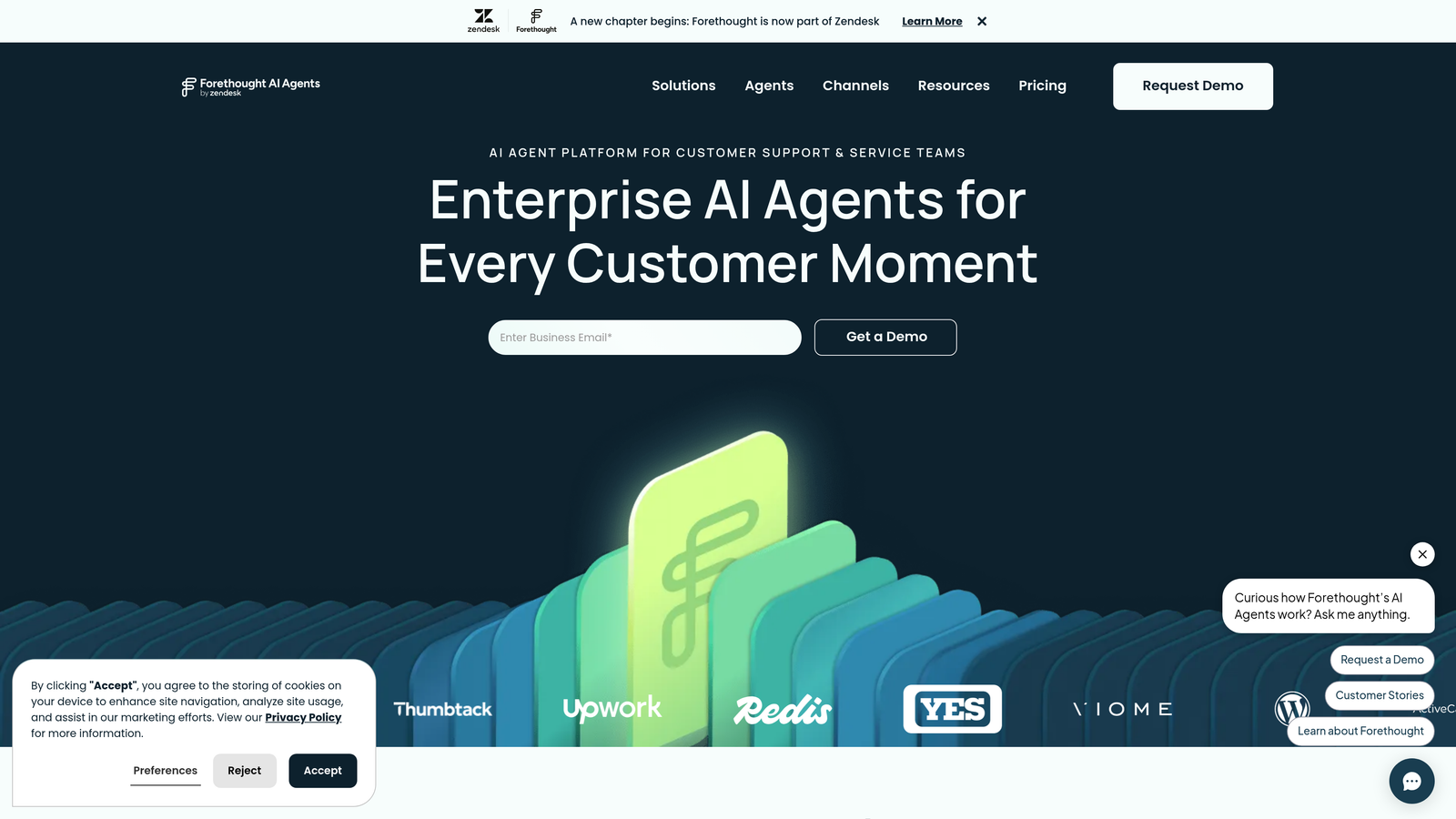
Forethought is an AI platform that sits on top of existing helpdesks, using historical ticket data to predict, triage, and resolve support requests.
Where This Tool Shines
Forethought's core insight is that your historical ticket data is a training asset. If you've been running Zendesk or Salesforce Service Cloud for years, you have thousands of resolved tickets that can teach an AI model how to handle new ones. Forethought mines that history to build predictive triage and resolution models specific to your support patterns.
The Discover analytics module is a standout for tech teams: it identifies the top drivers of inbound tickets, helping product and support leaders understand where to invest in documentation, in-app guidance, or product fixes to reduce ticket volume at the source.
Key Features
Predictive Triage: Routes tickets based on models trained on your historical ticket data, not generic intent categories.
Solve AI Agent: Autonomous resolution of common queries using your knowledge base and ticket history.
Assist Copilot: AI-suggested responses and context surfaced within your existing helpdesk UI.
Discover Analytics: Identifies top ticket drivers and quantifies automation opportunities across your support volume.
Native Helpdesk Integrations: Works directly within Zendesk, Salesforce Service Cloud, and ServiceNow workflows.
Best For
Mid-market and enterprise tech companies with significant ticket history in an established helpdesk who want AI enhancement without migrating their entire support stack.
Pricing
Custom pricing; typically positioned for mid-market and above. Contact Forethought directly at forethought.ai for a quote.
7. Tidio
Best for: Early-stage tech companies and developer tools startups that need fast AI chat deployment at an accessible price.
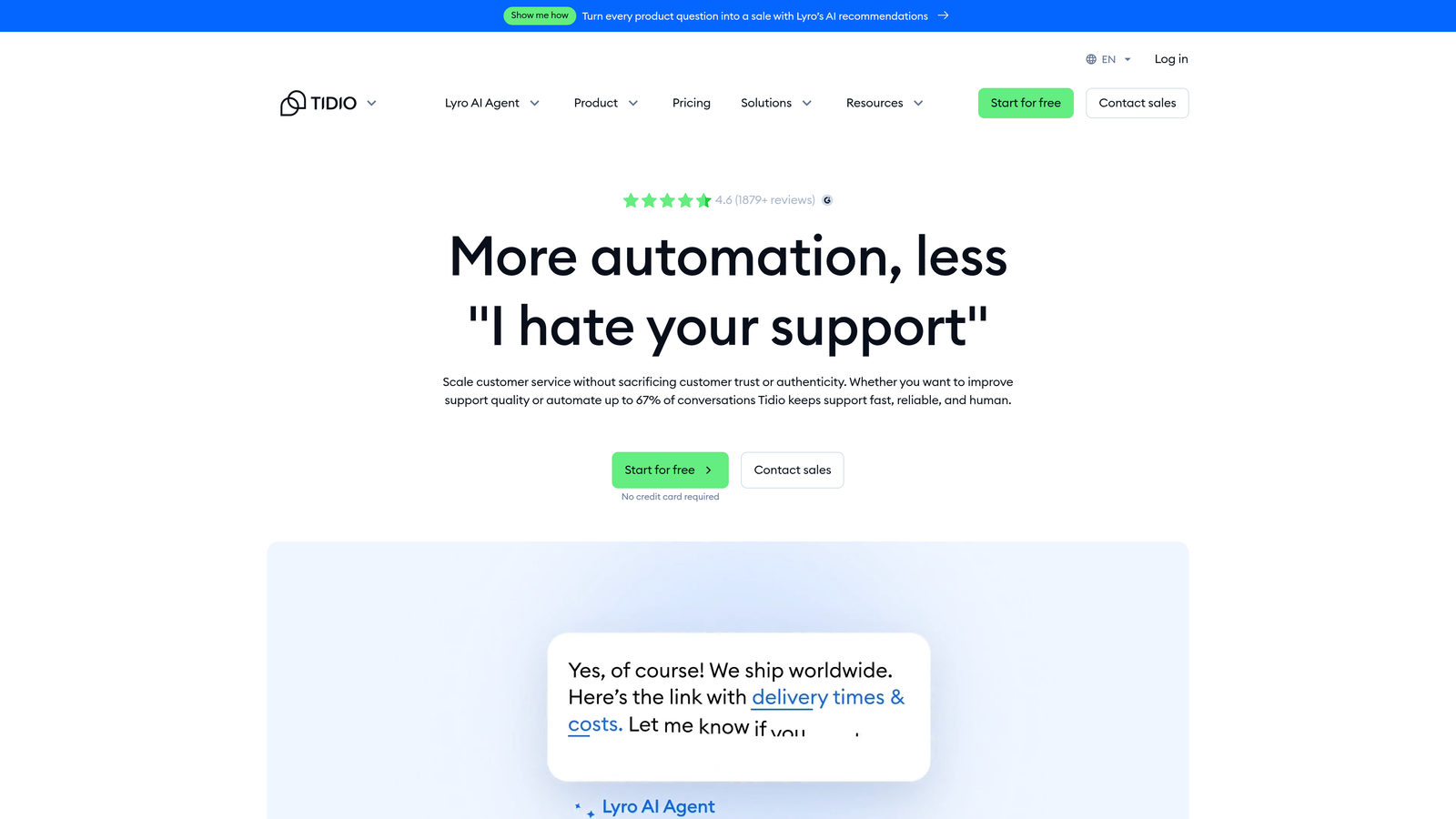
Tidio is an accessible AI chat platform with Lyro AI agent, designed for fast deployment and affordable pricing.
Where This Tool Shines
Tidio's primary advantage is speed to value. You can have Lyro AI handling chat conversations within hours, not weeks. For early-stage SaaS teams that need basic AI chat coverage before they've built out a full support infrastructure, that deployment speed is genuinely useful.
The platform consolidates live chat, email, and Messenger into a single inbox, which simplifies operations for small support teams. Proactive chat triggers based on visitor behavior can also help tech companies engage users who are showing signs of confusion before they submit a ticket or churn silently.
Key Features
Lyro AI Agent: Autonomous chat resolution trained on your FAQ and knowledge base content with no-code setup.
Fast No-Code Configuration: Deploy and configure AI chat without developer involvement in most cases.
Unified Inbox: Live chat, email, and Messenger managed in a single interface.
Proactive Chat Triggers: Behavior-based triggers that initiate conversations with users showing engagement signals.
Free Tier: Entry-level access with paid plans scaling by conversation volume as you grow.
Best For
Early-stage tech companies and developer tools startups that need quick AI chat coverage without a large support budget. Less suited for complex technical support environments where deep integrations and autonomous resolution of multi-step issues are required.
Pricing
Free tier available; paid plans start at approximately $19/month. Verify current pricing at tidio.com.
8. Kustomer
Best for: B2C tech companies and consumer apps where full customer history — purchases, usage, prior tickets — is essential support context.
Kustomer is a CRM-first support platform that unifies customer history, product usage, and transaction data into a single timeline for AI-assisted resolution.
Where This Tool Shines
Kustomer's unified customer timeline is the differentiator. Rather than treating each support ticket in isolation, Kustomer gives agents and AI models a complete view of the customer: every prior conversation, purchase event, product usage signal, and transaction record in one place. For tech companies where support context requires understanding the full customer relationship, that data depth produces meaningfully better resolution quality.
The workflow automation capabilities are robust, allowing teams to build resolution paths for common scenarios that trigger automatically based on customer attributes or event data — reducing manual handling without requiring AI to make judgment calls on complex cases.
Key Features
Unified Customer Timeline: Combines support history, purchase data, and product usage into a single view for every customer.
Context-Aware AI Routing: Routes and suggests responses based on full customer context, not just the current ticket.
Omnichannel Coverage: Chat, email, SMS, social, and voice managed in a unified platform.
Workflow Automation: Builds automated resolution paths triggered by customer attributes and behavioral events.
Deep Integrations: Shopify, Salesforce, and custom API connections for flexible data ingestion.
Best For
B2C tech companies and consumer apps where customer lifetime value and purchase history are core support context. Less optimized for pure B2B SaaS environments where technical ticket complexity and developer tool integrations are the primary requirements.
Pricing
Starts at approximately $89/agent/month. Verify current pricing at kustomer.com.
9. Glean
Best for: Large engineering organizations with knowledge distributed across Confluence, Notion, GitHub, Slack, and Google Drive.
Glean is an enterprise AI search and answer generation platform that connects to 100+ apps and generates accurate answers from your entire organizational knowledge graph.
Where This Tool Shines
Glean was built for the enterprise knowledge problem: large organizations where critical information is fragmented across dozens of tools and finding the right answer requires searching in five different places. For large tech companies, this means engineering docs in Confluence, product specs in Notion, customer conversations in Slack, and code context in GitHub — all searchable through a single AI layer that respects existing access permissions.
Glean Agents can handle autonomous task completion and answer generation, making it increasingly viable as a foundation for both internal IT helpdesk use cases and external customer-facing support at scale. The permissions-aware architecture is a meaningful enterprise differentiator: answers are scoped to what each user is actually authorized to see.
Key Features
AI Search Across 100+ Apps: Unified search covering Confluence, Notion, Google Drive, GitHub, Slack, and most enterprise tooling.
Glean Agents: Autonomous agents for task completion and answer generation across connected knowledge sources.
Permissions-Aware Answers: Respects existing access controls so users only see information they're authorized to access.
Dual Use Case: Powers both internal IT helpdesk and external customer-facing support from the same knowledge layer.
Engineering Org Fit: Strong alignment with large technical teams that have deep, distributed documentation.
Best For
Large enterprise tech companies and engineering organizations with significant, distributed internal knowledge that want a unified AI search layer across their entire tool stack. Less suited for smaller teams that need a standalone customer-facing helpdesk out of the box.
Pricing
Custom enterprise pricing. Contact Glean directly at glean.com for details.
Which Tool Is Right for Your Team?
The right choice depends on where your company is, what your tickets look like, and how deeply you need AI to integrate with your existing stack.
If you want an AI-first architecture built for SaaS: Halo AI is the strongest fit. The page-aware context, auto bug ticket creation, and business intelligence layer make it genuinely differentiated from platforms that have added AI to an existing ticketing engine. It's built for the way tech companies actually operate.
If you're already invested in Intercom's messaging ecosystem: Fin AI extends naturally from what you've already built. Just model the total cost carefully as usage scales.
If you're a large enterprise with Zendesk infrastructure: Zendesk AI enhances what you already have without requiring migration. The compliance and workflow depth is hard to match.
If you're mid-market and cost-sensitive: Freshdesk Freddy AI delivers solid omnichannel AI coverage at a price point that doesn't require executive sign-off.
If your biggest problem is fragmented knowledge: Guru solves the knowledge layer problem that undermines AI accuracy everywhere else. It's often the right first investment before deploying an AI agent.
If you want AI layered on an existing enterprise helpdesk: Forethought is purpose-built for that use case and leverages your historical ticket data as a training advantage.
If you're early-stage and need something running this week: Tidio's speed and free tier make it the practical starting point.
One thing is consistent across all of these platforms: your support team shouldn't scale linearly with your customer base. AI agents can handle routine tickets, guide users through your product, and surface business intelligence while your team focuses on complex issues that genuinely need a human touch. See Halo in action and discover how continuous learning transforms every interaction into smarter, faster support.