9 Best AI Helpdesk Integration Services for B2B Teams in 2026
This guide reviews the 9 best AI helpdesk integration services purpose-built for B2B teams, evaluating each on depth of integration, autonomous ticket resolution, and long-term learning capability. Whether your stack runs on Zendesk, Freshdesk, Intercom, or a custom setup, these platforms go far beyond bolt-on chatbots to deliver genuine AI-powered support automation.
 Grant CooperFounder13 min read
Most helpdesk tools weren't built for AI. They were built for ticket queues, and AI was bolted on later. That gap creates real problems: fragmented workflows, shallow automation, and support teams still drowning in repetitive tickets despite paying for "AI features."
AI helpdesk integration services take a different approach. Instead of adding a chatbot to an existing inbox, they connect AI intelligence directly into your support stack, resolving tickets autonomously, surfacing business signals, and handing off to humans only when it actually matters.
This list covers tools built for B2B teams that need more than a FAQ bot. Whether you're running support on Zendesk, Freshdesk, Intercom, or a custom stack, these platforms offer genuine AI-powered integration. We evaluated each on depth of integration, automation capability, learning over time, and fit for product-led or support-heavy SaaS teams.
1. Halo AI
Best for: B2B SaaS teams wanting an AI-first support platform with business intelligence built in
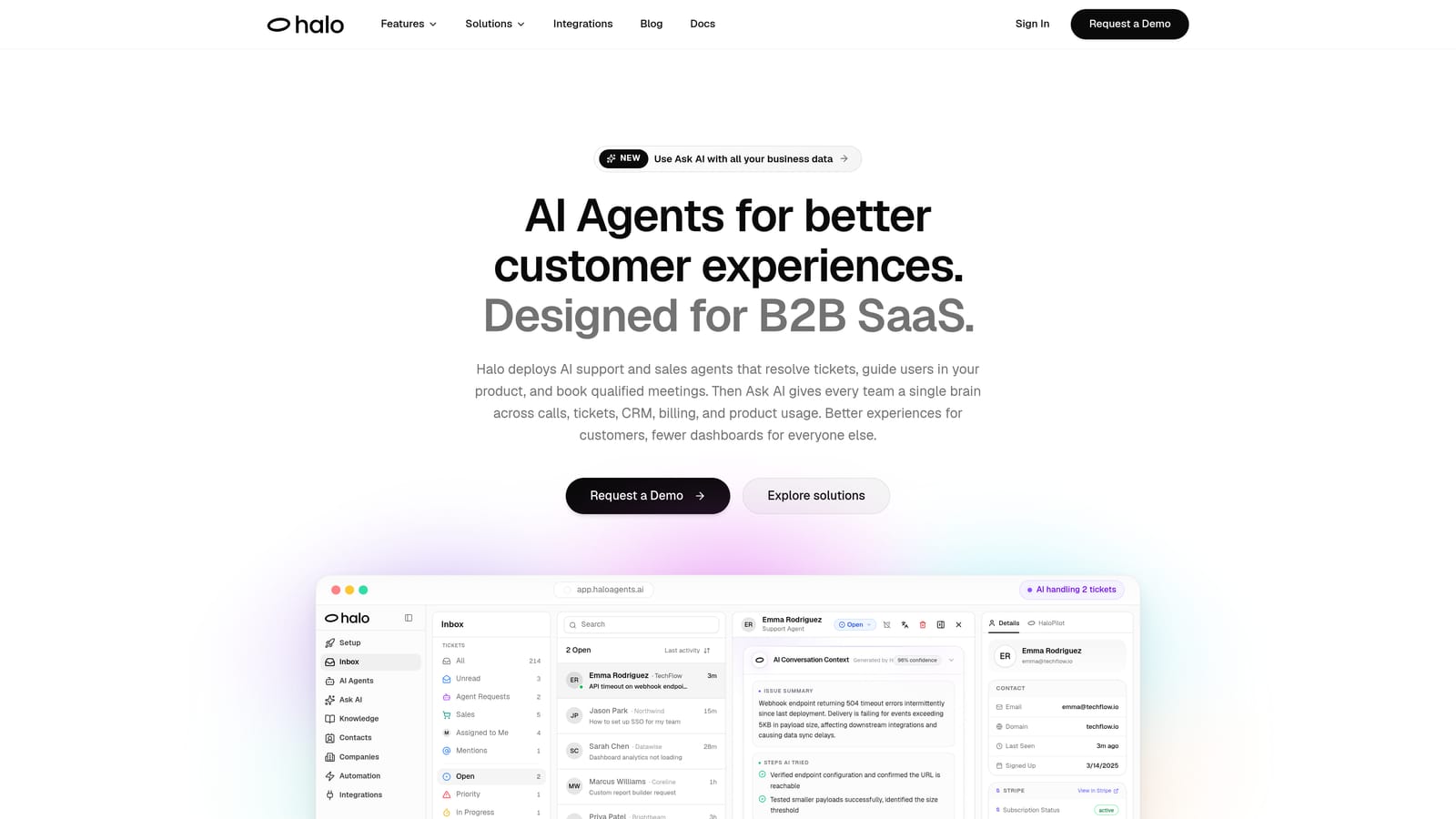
Halo AI is an AI-first customer support platform that deploys intelligent agents to resolve tickets, guide users through your product, and surface business intelligence signals from every interaction.
Where This Tool Shines
Most tools on this list are AI layers added on top of existing helpdesk infrastructure. Halo is structurally different: it was built from the ground up as an AI support platform, not retrofitted from a ticketing system. That distinction matters when you're evaluating how deeply AI can actually operate in your support workflow.
The standout capability is page-aware context. Halo's AI agents can see what the user sees, delivering guidance that's specific to the exact product screen someone is on. Combined with continuous learning from every resolved interaction, the system improves without requiring manual retraining or knowledge base updates after every product change.
Key Features
Page-Aware AI Agents: The AI understands which page a user is on and delivers contextual, visual guidance relevant to that specific moment in the product.
Autonomous Ticket Resolution: Handles routine support tickets end-to-end, with smart handoff to live agents for issues that genuinely require human judgment.
Auto Bug Ticket Creation: Automatically identifies and routes bug reports directly to Linear or your dev tooling, removing a manual step from the support-to-engineering pipeline.
Smart Inbox with Business Intelligence: Surfaces customer health signals, revenue anomalies, and trend detection beyond standard ticket metrics, turning support data into strategic insight.
Broad Integration Stack: Connects to Linear, Slack, HubSpot, Intercom, Stripe, Zoom, PandaDoc, and Fathom, so it fits into how B2B SaaS teams already operate.
Best For
B2B SaaS companies scaling support without scaling headcount. Particularly strong for product-led teams where in-product guidance matters, and for ops teams who want support data to feed into revenue and product intelligence workflows.
Pricing
Contact for pricing. Designed for B2B SaaS teams scaling support operations rather than small-volume or transactional use cases.
2. Intercom Fin
Best for: Teams already using Intercom who want AI resolution without adding new middleware
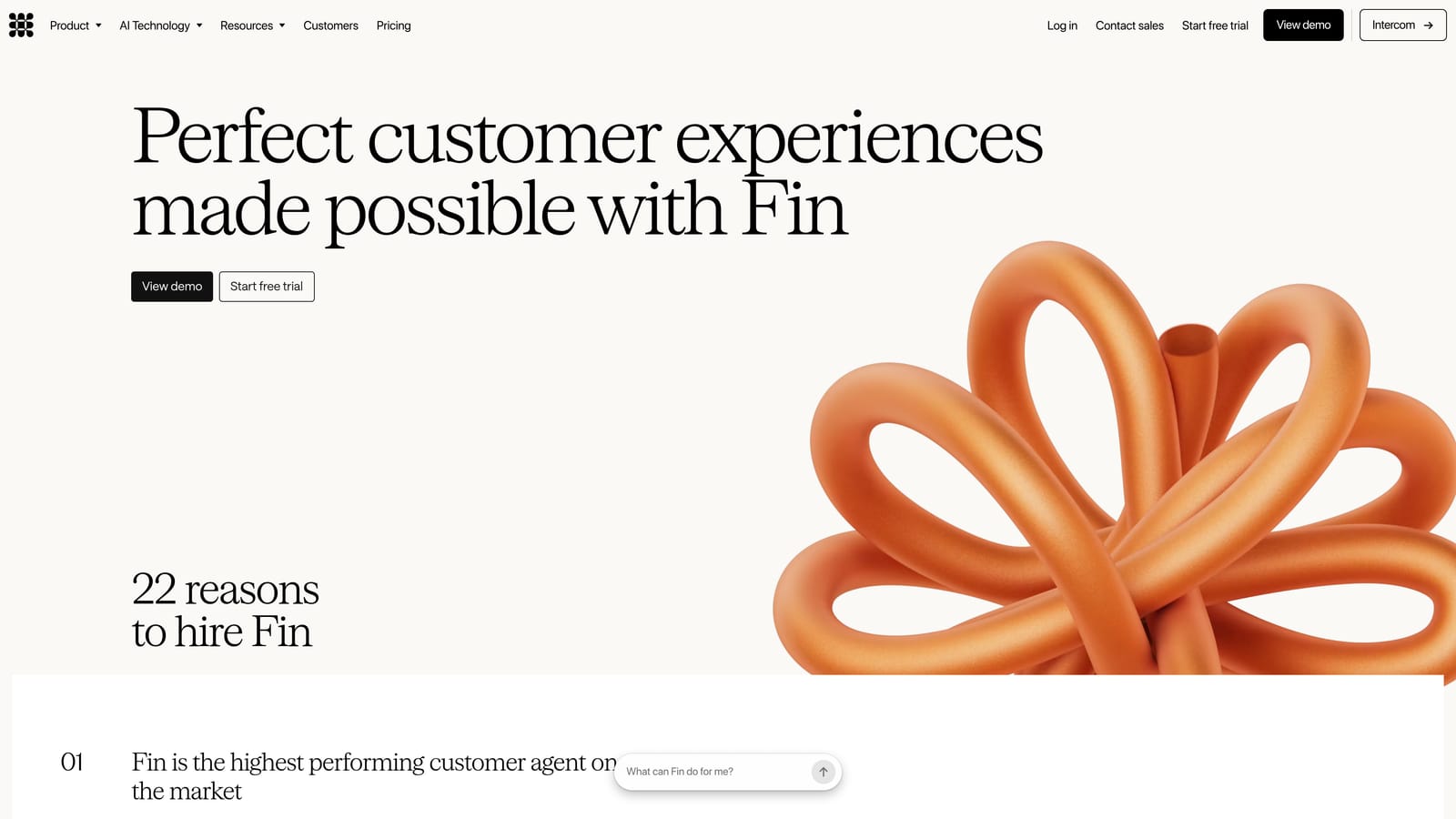
Intercom Fin is Intercom's native LLM-powered AI agent that resolves customer conversations using your existing help center content and custom answers.
Where This Tool Shines
Fin's biggest advantage is how seamlessly it fits into the Intercom ecosystem. If your team already lives in Intercom, there's no separate setup, no middleware to manage, and no context lost between the AI and your human agents. The handoff happens within the same conversation thread.
The consumption-based pricing model is also worth noting. Rather than paying flat seat fees regardless of AI usage, you pay per resolution, which can be a more predictable cost structure for teams with variable support volume.
Key Features
LLM-Powered Resolution: Uses large language models to generate accurate, contextual responses from your help center articles and custom answer sets.
Native Intercom Integration: No separate platform or API configuration required, Fin operates directly within your existing Intercom workspace.
Seamless Human Handoff: Escalates to human agents within the same conversation thread, preserving full context without asking customers to repeat themselves.
Multilingual Support: Handles conversations across major languages without requiring separate configurations per language.
Per-Resolution Pricing: Consumption-based model means costs scale with actual AI usage rather than seat count.
Best For
Support teams already committed to the Intercom platform who want to add AI resolution without introducing a separate vendor or integration layer. Less suited for teams running multi-platform support stacks.
Pricing
Charged per resolution. Requires an active Intercom subscription; pricing scales with resolution volume.
3. Zendesk AI
Best for: Enterprise support teams with established Zendesk infrastructure wanting native AI across triage, agents, and analytics
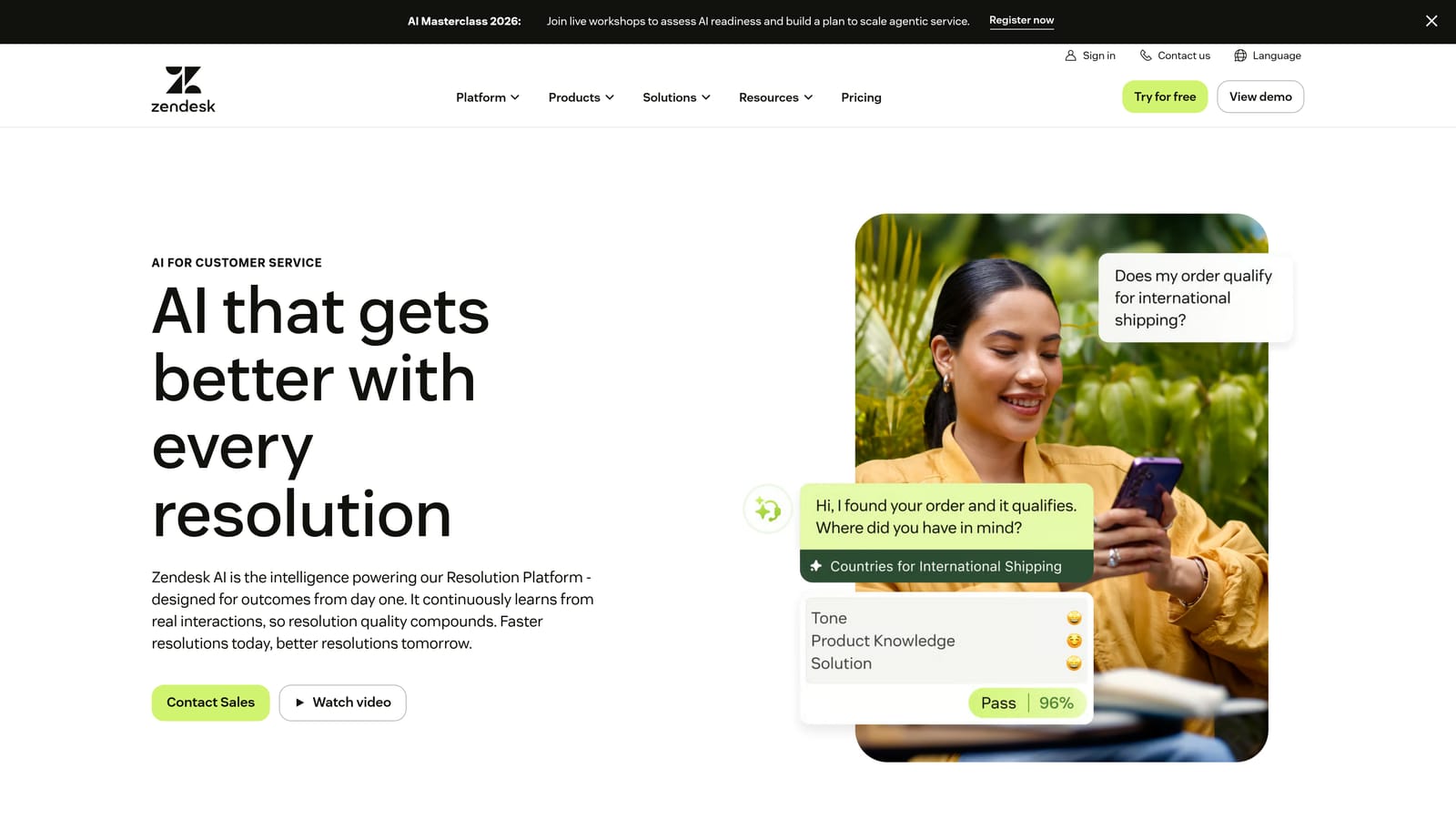
Zendesk AI is Zendesk's native AI suite layered directly into Zendesk Suite, covering intelligent triage, agent copilot, automated bots, and AI-powered quality assurance.
Where This Tool Shines
For teams with deep Zendesk infrastructure, the native integration is genuinely valuable. There's no third-party connection to manage, and AI features operate across the same data and workflows your team already uses. The Agent Copilot in particular helps experienced agents move faster by surfacing macro suggestions and next-best-action recommendations mid-ticket.
The CSAT prediction and quality assurance scoring features are useful for support operations leaders who need to monitor quality at scale without manually reviewing every interaction.
Key Features
Intelligent Triage: Automatically categorizes, routes, and prioritizes incoming tickets based on content and intent.
Agent Copilot: Surfaces macro suggestions and next-best-action recommendations to help agents resolve tickets faster.
Zendesk Bots: Self-service resolution layer that handles common queries before a ticket is ever created.
AI-Generated CSAT Predictions: Predicts customer satisfaction scores and flags at-risk interactions for proactive quality management.
Native Suite Integration: All AI features operate within Zendesk Suite, no external middleware or API connections required.
Best For
Enterprise support teams already running Zendesk Suite at scale. The value is highest when Zendesk is the primary system of record for support, and diminishes for teams running hybrid or multi-platform stacks.
Pricing
Included in select Zendesk Suite plans; advanced AI features are gated to higher-tier subscriptions.
4. Freshdesk Freddy AI
Best for: Freshworks customers wanting a unified AI layer across self-service, agent assist, and support analytics
Freshdesk Freddy AI is Freshworks' three-layer AI suite covering customer-facing automation, agent assistance, and operational analytics within the Freshdesk platform.
Where This Tool Shines
Freddy AI's strength is its layered approach. Rather than a single AI feature, it spans three distinct functions: customer-facing deflection, in-ticket agent assistance, and post-interaction analytics. Teams get coverage across the full support lifecycle without needing separate tools for each layer.
For organizations already using other Freshworks products like their CRM or ITSM tools, Freddy's native integration across the Freshworks ecosystem creates a unified data environment that standalone AI tools can't replicate.
Key Features
Freddy Self Service: Customer-facing AI bot that deflects common queries before they reach the agent queue.
Freddy Copilot: Assists agents mid-ticket with reply suggestions, ticket summaries, and recommended next steps.
Freddy Insights: AI-generated analytics and trend reporting across support operations, surfacing patterns in ticket volume and agent performance.
Freshworks Ecosystem Integration: Natively connected across Freshworks CRM, ITSM, and support products for unified data flow.
Tiered Availability: Core Freddy features available across Freshdesk plans, with advanced capabilities gated to higher tiers.
Best For
Freshworks customers who want AI across their support workflow without adding a third-party tool. Teams running Freshdesk alongside other Freshworks products will see the most value from the ecosystem integration.
Pricing
Freddy features are included in Freshdesk plans; the full suite with advanced capabilities requires higher-tier subscriptions.
5. Forethought
Best for: Support operations teams managing complex multi-platform environments who need a helpdesk-agnostic AI layer
Forethought is a helpdesk-agnostic AI platform that adds intelligent triage, autonomous resolution, and agent assist capabilities on top of existing helpdesk tools including Zendesk, Salesforce, and ServiceNow.
Where This Tool Shines
Forethought's platform-agnostic design is its core differentiator. If your support stack spans multiple tools, or if you're locked into a helpdesk that doesn't offer strong native AI, Forethought can add a meaningful AI layer without requiring a platform migration. It works across Zendesk, Salesforce Service Cloud, ServiceNow, and other major helpdesks.
The Discover module is particularly useful for support ops leaders. It identifies automation opportunities and knowledge gaps across your ticket history, turning raw support data into a roadmap for reducing ticket volume over time.
Key Features
Solve: AI agent that handles ticket resolution autonomously for eligible request types without human intervention.
Triage: Routes and prioritizes tickets based on detected intent, sentiment, and urgency signals.
Assist: Surfaces relevant knowledge articles and suggested replies for agents while they're actively working a ticket.
Discover: Analytics layer that identifies where automation would have the most impact and where knowledge base gaps are costing resolution time.
Multi-Platform Compatibility: Works across Zendesk, Salesforce Service Cloud, ServiceNow, and other major enterprise helpdesks.
Best For
Support operations teams running enterprise-scale environments across multiple platforms, or teams that want AI capabilities without switching helpdesks. Less suited for smaller teams looking for a simple, low-configuration option.
Pricing
Custom pricing; contact Forethought directly for a quote based on your environment and volume.
6. Tidio Lyro
Best for: Smaller B2B and e-commerce teams wanting accessible conversational AI with live chat escalation
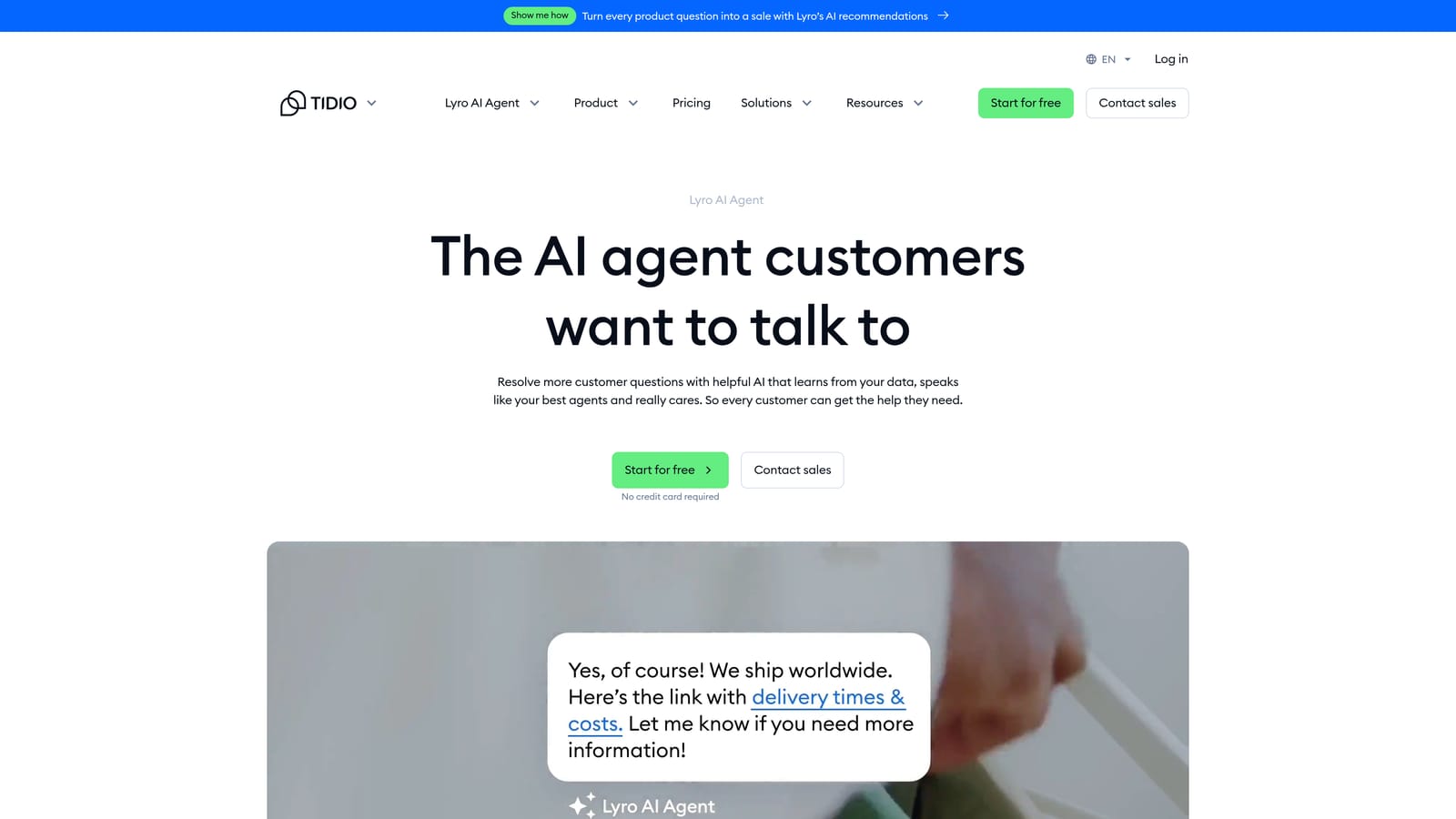
Tidio Lyro is Tidio's conversational AI agent designed for smaller teams, handling common support queries with seamless escalation to live chat agents when needed.
Where This Tool Shines
Lyro lowers the barrier to entry for AI-powered support. The setup requires no technical expertise, and it's trained on your existing support content to handle FAQ-style queries without a lengthy implementation process. For teams without a dedicated support engineer, that matters.
The live chat escalation path is smooth, and Tidio's integrations with Shopify and WordPress make it a natural fit for teams running e-commerce or content-driven businesses alongside their B2B support operations.
Key Features
Conversational AI Resolution: Trained on your support content to handle common queries in a natural, conversational format.
Live Chat Escalation: Smoothly hands off to live agents when queries exceed the AI's capability, without losing conversation context.
E-Commerce and CMS Integrations: Connects with Shopify, WordPress, and select helpdesk tools for teams running mixed support environments.
No-Code Setup: Designed for non-technical users, with configuration accessible through a visual interface rather than API documentation.
Accessible Pricing: Entry-level pricing significantly lower than enterprise-tier alternatives, making AI support accessible to smaller teams.
Best For
Smaller B2B teams, e-commerce businesses, and companies new to AI-powered support who need a low-friction starting point. Teams with complex, multi-step support workflows or enterprise-scale volume will likely outgrow Lyro's capabilities.
Pricing
Lyro is available from approximately $29/month, scaling with conversation volume. Pricing is significantly more accessible than enterprise alternatives.
7. Salesforce Einstein for Service
Best for: Enterprise teams where Salesforce is the primary system of record and CRM context is central to support quality
Salesforce Einstein for Service is AI embedded natively in Salesforce Service Cloud, providing case classification, knowledge suggestions, agent copilot capabilities, and next-best-action recommendations tied to full CRM data.
Where This Tool Shines
Einstein's core advantage is CRM depth. Because it operates within Salesforce, every AI recommendation is informed by the complete customer record: purchase history, open opportunities, previous cases, and account health. That context produces more relevant suggestions than AI tools working with support data alone.
Einstein Copilot's generative AI capabilities for drafting replies and summarizing cases are particularly strong when agents are handling complex, account-specific issues where customer history matters as much as the current ticket content.
Key Features
Case Classification and Routing: Automatically categorizes incoming cases and routes them based on content, history, and agent availability.
Knowledge Article Suggestions: Surfaces relevant knowledge base articles automatically while agents are actively working a case.
Einstein Copilot: Generative AI assistant that drafts replies and summarizes cases using full CRM and case context.
Next-Best-Action Recommendations: Suggests actions informed by the customer's full Salesforce record, not just the current interaction.
Deep CRM Integration: All AI features draw on the complete Salesforce data environment, making recommendations more contextually accurate for account-based support.
Best For
Enterprise organizations where Salesforce is the system of record and support is tightly connected to account management and revenue operations. Value drops significantly for teams not running Salesforce as their primary CRM.
Pricing
Included in select Salesforce Service Cloud plans; Einstein add-ons are available separately for teams needing advanced AI capabilities.
8. HubSpot AI Help Desk
Best for: Revenue-focused teams running marketing, sales, and support within the HubSpot ecosystem
HubSpot AI Help Desk is HubSpot's Service Hub help desk with AI-powered ticket summarization, reply drafting, and conversation intelligence connected directly to HubSpot CRM contact and deal data.
Where This Tool Shines
HubSpot's help desk shines when support is part of a broader revenue motion. Because tickets are linked to CRM contacts, companies, and deals, agents can see the full customer relationship in context: what they've purchased, where they are in a renewal cycle, and what the account is worth. That visibility changes how support conversations get handled.
For teams already using HubSpot for marketing and sales, consolidating support into the same platform removes the data silos that often make cross-functional reporting painful.
Key Features
AI Ticket Summarization: Instantly summarizes ticket history so agents can get up to speed without reading through long conversation threads.
AI-Suggested Replies: Drafts response suggestions based on conversation context and knowledge base content.
CRM-Linked Tickets: Every ticket is connected to HubSpot CRM contact, company, and deal records for full relationship context.
Conversation Intelligence: Reporting and analytics built within the HubSpot ecosystem, accessible alongside marketing and sales data.
Unified Platform: Marketing, sales, and support teams operate within a single platform, reducing handoff friction and data fragmentation.
Best For
B2B SaaS and services teams already invested in HubSpot who want support integrated with their revenue data. Teams running dedicated enterprise helpdesks will find HubSpot's support features less mature than purpose-built alternatives.
Pricing
Service Hub starts at $15/seat/month on the Starter plan; AI features are available on Professional and Enterprise tiers.
9. Aisera
Best for: Large enterprises needing unified AI automation across both customer support and internal IT helpdesk
Aisera is an enterprise AI platform that unifies customer support and IT service management automation, using generative AI to resolve requests autonomously across both external and internal support channels.
Where This Tool Shines
Aisera addresses a gap that most tools on this list don't touch: the overlap between customer-facing support and internal IT helpdesk. For large enterprises running both functions, having a single AI platform that handles employee IT requests and customer service queries reduces vendor complexity and creates a consistent automation layer.
The enterprise-grade security, compliance, and audit logging capabilities make Aisera relevant for regulated industries where data governance is a procurement requirement, not just a nice-to-have.
Key Features
Unified CX and ITSM Automation: Handles both customer support and internal IT service requests within a single generative AI platform.
Multi-Platform Integration: Connects with ServiceNow, Zendesk, Salesforce, Jira, and other major enterprise platforms.
AI-Powered Knowledge Management: Intelligent search and knowledge surfacing across enterprise content sources and documentation repositories.
Autonomous Workflow Automation: Handles multi-step service requests end-to-end without requiring human involvement for eligible request types.
Enterprise Security and Compliance: Built-in audit logging, compliance controls, and enterprise-grade security for regulated environments.
Best For
Large enterprises with both customer support and IT helpdesk needs, particularly those in regulated industries or complex multi-platform environments. Aisera is overbuilt for smaller teams and most mid-market SaaS companies.
Pricing
Enterprise pricing; contact Aisera directly for a custom quote based on deployment scope and volume.
Choosing the Right Tool for Your Team
The right AI helpdesk integration depends less on feature lists and more on where your team actually lives and what you're trying to accomplish.
If you're a B2B SaaS team scaling support without scaling headcount: Halo AI is purpose-built for this. The AI-first architecture, page-aware guidance, and business intelligence outputs go well beyond what retrofitted AI features on traditional helpdesks can offer.
If you're already committed to Intercom: Fin is the path of least resistance. Native integration, no middleware, and per-resolution pricing that scales cleanly with usage.
If Zendesk or Freshdesk is your primary platform: Zendesk AI and Freddy AI respectively offer solid native capabilities without adding a new vendor. The trade-off is that you're working within the constraints of what those platforms have prioritized.
If you're running a multi-platform enterprise environment: Forethought's helpdesk-agnostic approach gives you AI capabilities without requiring a platform migration. Aisera is the right conversation if you're also managing internal IT helpdesk at enterprise scale.
If Salesforce is your system of record: Einstein for Service will deliver the most contextually accurate AI recommendations because it draws on your complete CRM data.
If you're a smaller team or just getting started: Tidio Lyro offers the lowest barrier to entry. HubSpot Service Hub is worth exploring if you're already on HubSpot and want support connected to your revenue data.
Your support team shouldn't scale linearly with your customer base. Let AI agents handle routine tickets, guide users through your product, and surface business intelligence while your team focuses on complex issues that need a human touch. See Halo in action and discover how continuous learning transforms every interaction into smarter, faster support.