9 Best AI Helpdesk Platforms Compared for 2026
This ai helpdesk platform comparison evaluates nine leading solutions for 2026, helping B2B SaaS and product-led teams distinguish genuinely AI-native platforms from legacy tools with surface-level chatbot features. Each platform is assessed across five criteria—AI architecture, integration depth, automation capability, analytics quality, and pricing transparency—so support leaders can make a confident, informed decision.
 Matt PattoliFounder13 min read
Traditional helpdesks were built for a different era of customer support: linear ticket queues, manual routing, and agents working through backlogs one by one. That model struggles to keep pace with modern B2B SaaS teams, where customers expect instant, contextual answers and support teams are expected to do more with less.
The good news is that AI helpdesk platforms have matured significantly entering 2026. The harder part is figuring out which ones represent genuine AI-first architecture versus legacy tools with a chatbot layer glued on top. That distinction matters more than any feature checklist.
This guide is written for B2B SaaS teams, product-led companies, and support leaders evaluating their options. We evaluated each platform across five criteria: AI architecture (native vs. bolt-on), integration depth, automation capability, analytics quality, and pricing transparency. Whether you're exploring AI-powered support agents for the first time or comparing your current helpdesk against newer alternatives, this breakdown gives you a clear picture of what each platform actually does well.
1. Halo AI
Best for: AI-first B2B SaaS teams that want autonomous ticket resolution and business intelligence from support data.
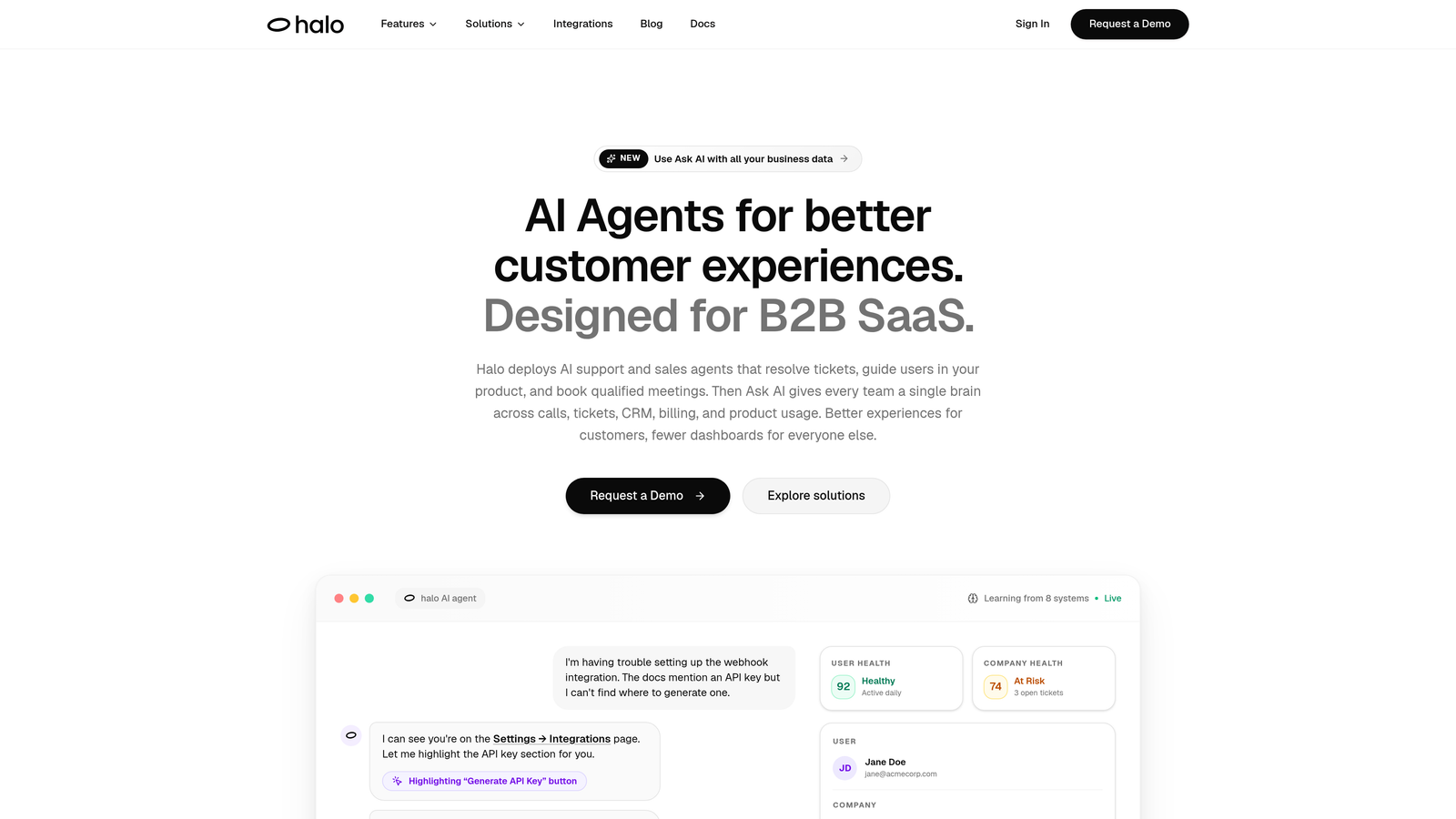
Halo AI is an AI-native customer support platform built from the ground up to resolve tickets, guide users through products with page-aware context, and surface business intelligence across your entire customer base.
Where This Tool Shines
The core differentiator here is architecture. Halo wasn't built by adding AI features to an existing helpdesk. It was designed from the start around autonomous AI agents that learn from every resolved interaction, which means the system gets meaningfully smarter over time rather than staying static.
The page-aware chat widget is particularly notable: the AI sees what the user sees on screen, enabling it to provide visual UI guidance rather than generic help center links. Combine that with a smart inbox that surfaces customer health signals, revenue anomalies, and product feedback patterns, and you have a support platform that generates business intelligence, not just resolved tickets.
Key Features
Page-Aware Chat Widget: The AI understands which page a user is on and what they're looking at, enabling contextual visual guidance rather than generic responses.
Intelligent AI Agents: Autonomous ticket resolution with continuous learning built in, so every interaction improves future performance.
Smart Inbox with Business Intelligence: Surfaces customer health signals, revenue anomalies, and product feedback trends directly from support data.
Auto Bug Ticket Creation: Automatically identifies and routes bug reports to Linear or connected dev tools without agent intervention.
Live Agent Handoff: Escalates to human agents with full conversation context preserved, so nothing gets repeated or lost.
Deep Integration Stack: Connects with Linear, Slack, HubSpot, Intercom, Stripe, Zoom, PandaDoc, and Fathom out of the box.
Best For
B2B SaaS companies and product-led teams that want support to scale without scaling headcount. Particularly well-suited for teams that need their support data to feed back into product, revenue, and engineering workflows rather than sitting in an isolated helpdesk silo.
Pricing
Contact for pricing. See haloagents.ai for details and to request a demo.
2. Zendesk
Best for: Large enterprises with complex support operations and dedicated admin resources to manage configuration.
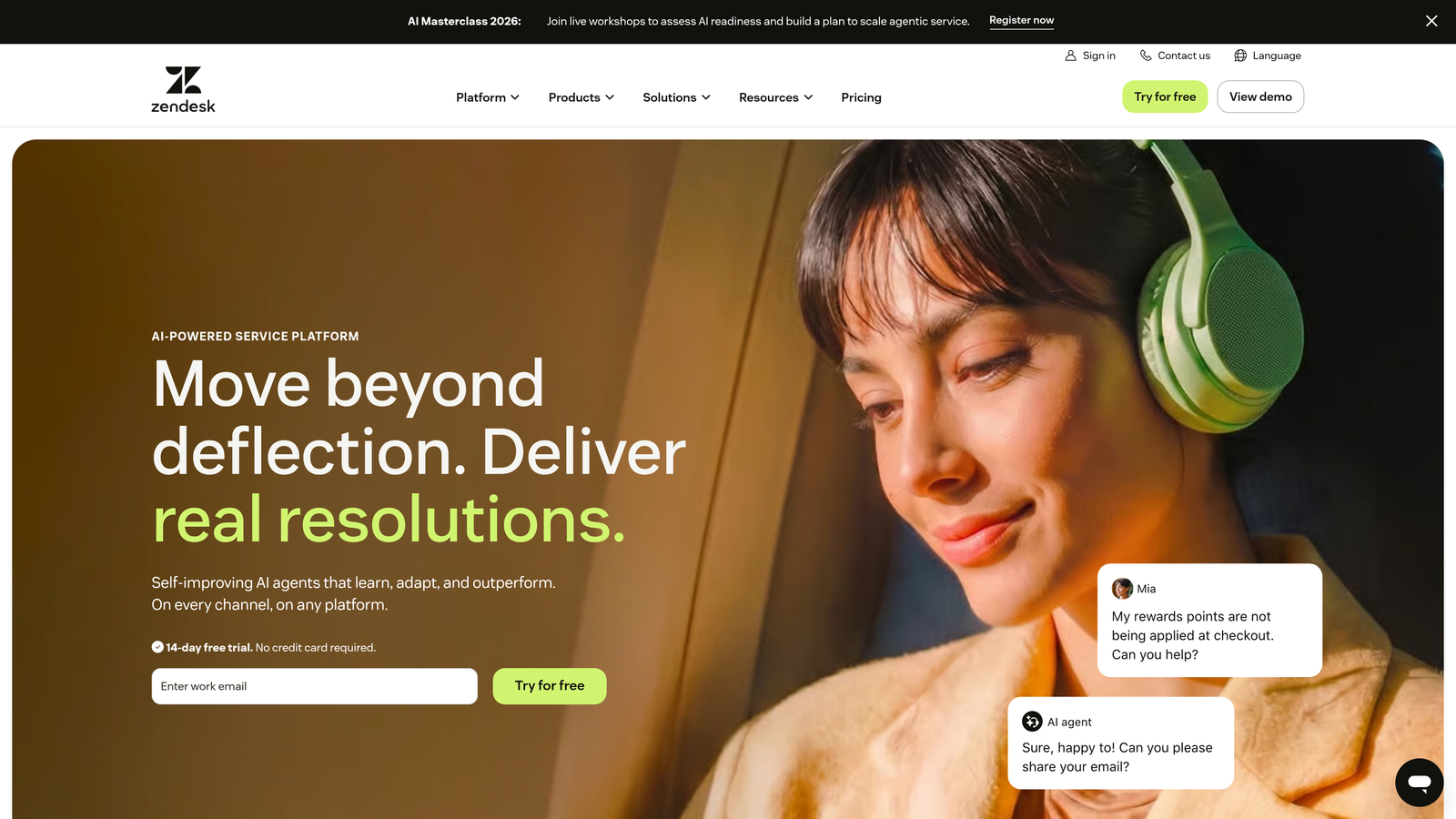
Zendesk is a mature enterprise helpdesk platform with AI capabilities layered on via the Zendesk AI suite, covering intelligent triage, agent copilot functionality, and automated resolutions across a large integration ecosystem.
Where This Tool Shines
Zendesk's primary strength is breadth. It has been the default enterprise helpdesk for years, and that longevity shows in its marketplace of integrations, its robust reporting suite, and its ability to handle complex multi-team support operations at scale.
The Zendesk AI suite adds meaningful capability on top of that foundation, including intelligent triage, suggested macros, and an agent copilot that surfaces next-best-action guidance. The honest caveat: these are AI-assisted features layered onto legacy infrastructure, not a ground-up AI architecture. For large organizations already invested in the Zendesk ecosystem, the AI additions are genuinely useful. For teams starting fresh, it's worth weighing that distinction carefully.
Key Features
Intelligent Triage and Routing: Automatically classifies and routes incoming tickets based on intent, sentiment, and topic.
Agent Copilot: Provides suggested replies, next-best-action guidance, and macro recommendations to speed up agent responses.
Automated Resolutions: Handles common queries without agent involvement using trained AI models.
App Marketplace: Hundreds of integrations covering CRM, ecommerce, analytics, and communication tools.
Advanced Reporting: Comprehensive analytics suite for tracking SLAs, CSAT, ticket trends, and team performance.
Best For
Large enterprise teams with dedicated Zendesk administrators, complex multi-channel support requirements, and existing investment in the Zendesk ecosystem. Less ideal for lean SaaS teams that want quick deployment and minimal configuration overhead.
Pricing
Suite plans from approximately $55 per agent per month billed annually; enterprise pricing on request. Verify current rates at zendesk.com.
3. Intercom
Best for: Teams already using Intercom's in-app messaging who want to extend it with autonomous AI resolution.
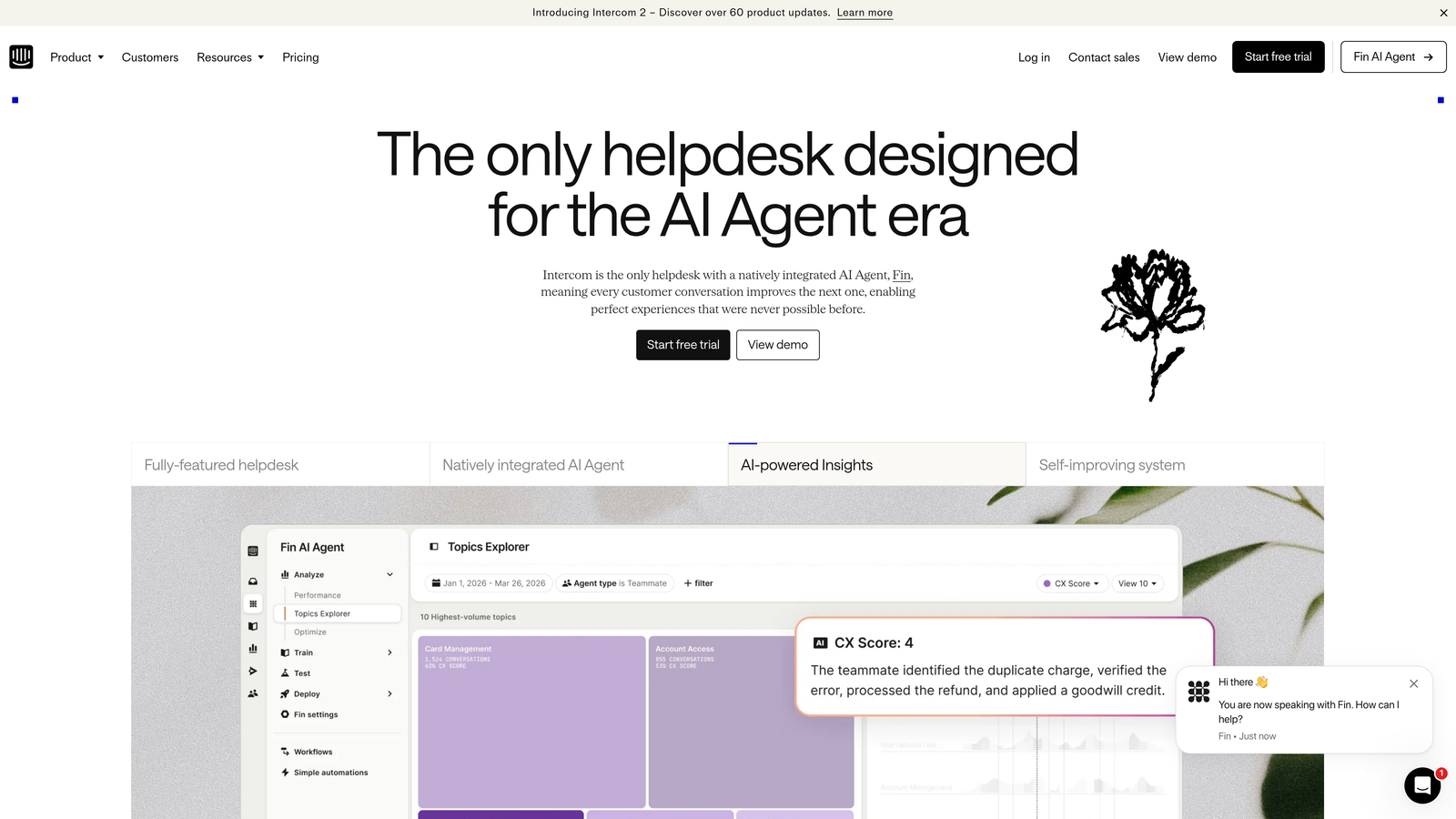
Intercom is a conversational support platform with Fin AI Agent at its core, designed to handle customer questions autonomously using help center content and custom answers within Intercom's established messaging infrastructure.
Where This Tool Shines
Fin AI Agent is one of the more capable AI resolution products in the market, particularly for teams whose help center content is already well-structured. It draws on that content to answer questions conversationally, and the integration with Intercom's broader product suite (in-app messages, product tours, onboarding flows) creates a cohesive customer experience layer.
The main consideration is ecosystem lock-in. Intercom works best when you're already using it as your primary customer communication tool. Teams coming in from outside that ecosystem may find the setup investment significant before Fin AI Agent reaches its full potential.
Key Features
Fin AI Agent: Autonomous conversation resolution powered by large language models, drawing from your help center and custom answer library.
In-App Messaging and Product Tours: Contextual in-product communication for onboarding, feature announcements, and proactive support.
AI-Powered Inbox: Conversation summaries and AI-assisted agent tools to speed up human response time.
Help Center with AI Suggestions: AI-assisted content recommendations to improve knowledge base coverage.
Flexible Pricing Options: Both usage-based and seat-based pricing structures available depending on team size and volume.
Best For
SaaS teams already embedded in the Intercom ecosystem, particularly those with strong in-app messaging needs and a well-maintained help center that Fin AI Agent can draw from effectively.
Pricing
Essential plan from approximately $29 per seat per month; Fin AI Agent priced per resolution. Verify current rates at intercom.com.
4. Freshdesk
Best for: Mid-market and SMB teams that need solid multi-channel helpdesk coverage with AI assist at a competitive price point.
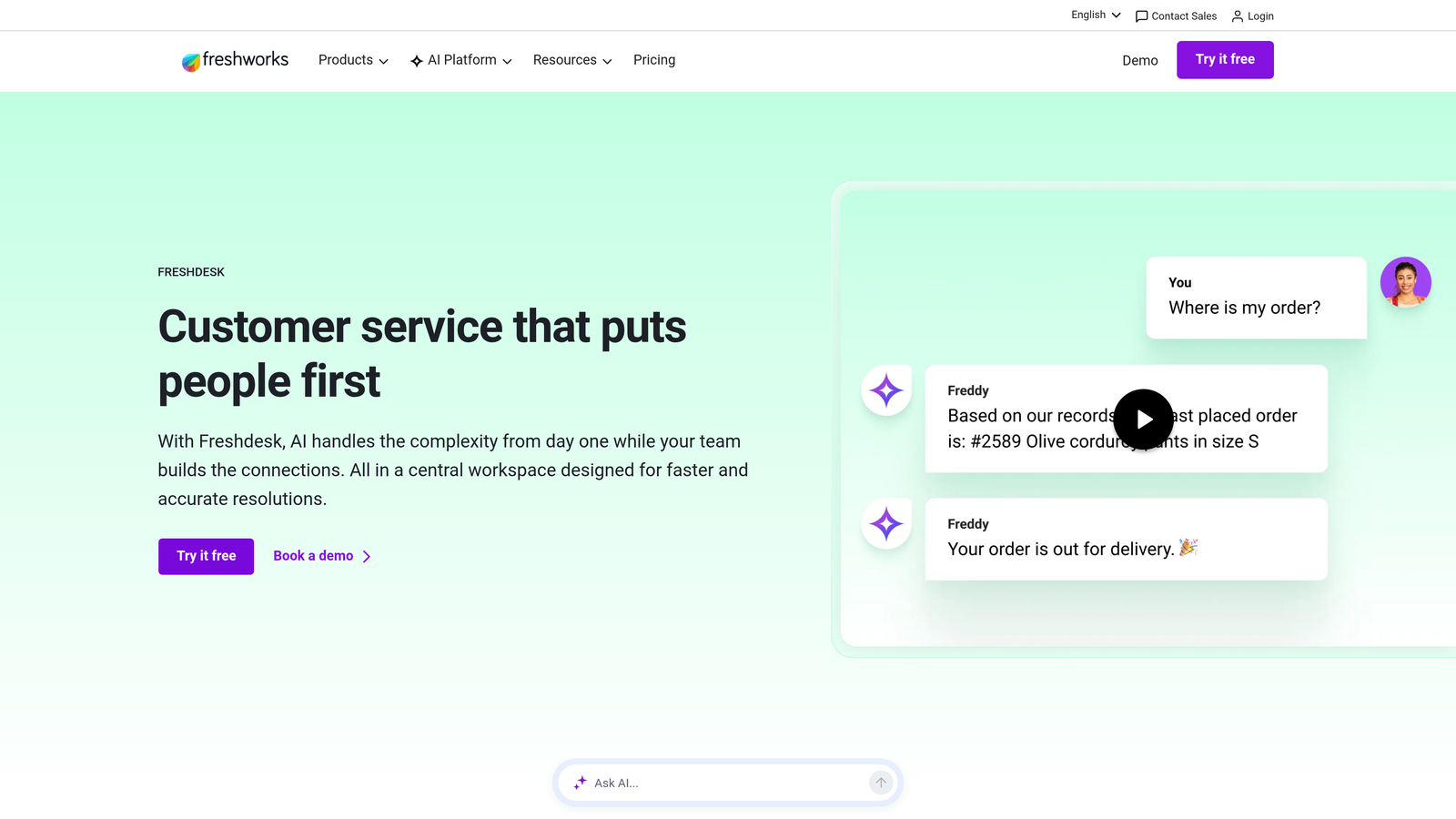
Freshdesk is a mid-market and SMB-friendly helpdesk featuring the Freddy AI suite for self-service, agent assist, and support analytics across multiple customer channels.
Where This Tool Shines
Freshdesk's value proposition is strong multi-channel coverage without the complexity and cost of enterprise-tier platforms. Freddy AI spans self-service resolution, agent copilot functionality, and analytics in a reasonably integrated package that doesn't require significant technical overhead to configure.
For teams comparing Freshdesk to Zendesk at similar feature levels, the pricing difference is often meaningful. The tradeoff is that Freddy AI is positioned as agent-assist rather than autonomous resolution. It helps agents work faster; it doesn't replace the agent queue entirely.
Key Features
Freddy Self Service: AI-powered customer-facing resolution that deflects common questions before they reach an agent.
Freddy Copilot: Agent-assist features including suggested replies, ticket summaries, and response drafting.
Freddy Insights: Support analytics and trend identification to help managers understand volume patterns and team performance.
Multi-Channel Coverage: Handles email, chat, phone, and social media from a unified inbox.
Free Tier: A functional free plan makes it accessible for small teams evaluating the platform before committing.
Best For
SMB and mid-market teams that need reliable multi-channel helpdesk functionality with AI assist built in, particularly those who find Zendesk's pricing difficult to justify at their current scale.
Pricing
Free plan available; paid plans from approximately $15 per agent per month. Verify current rates at freshdesk.com.
5. Help Scout
Best for: Small support teams that prioritize clean UX and agent productivity over autonomous AI resolution.
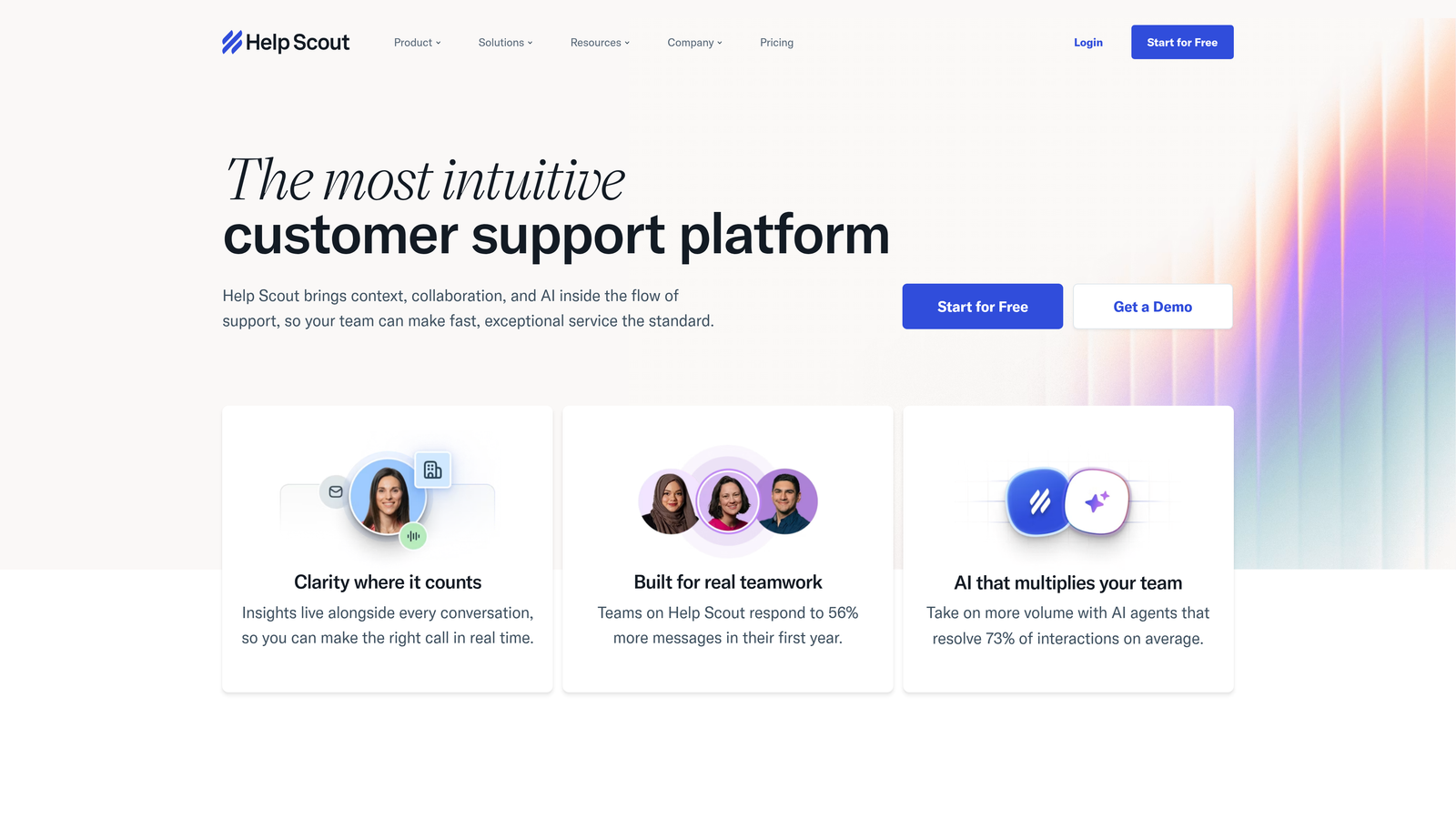
Help Scout is a human-centered helpdesk designed for simplicity, with AI Assist, AI Summarize, and AI Drafts features that enhance agent productivity without repositioning the platform around autonomous resolution.
Where This Tool Shines
Help Scout's strongest quality is restraint. It doesn't try to be everything. The interface is clean, the workflows are intuitive, and the AI features are genuinely useful without being intrusive. AI Summarize gives agents quick context on long conversations; AI Drafts speeds up reply writing without removing the human voice from the response.
If your team values a low-configuration, high-usability experience and you're not looking for full autonomous resolution, Help Scout delivers that reliably. It's a particularly good fit for teams where the human support experience is a deliberate brand choice, not a cost constraint.
Key Features
AI Summarize: Condenses long conversation threads so agents can get up to speed instantly without reading every message.
AI Assist and AI Drafts: Helps agents write faster, more consistent replies without fully automating the response process.
Shared Inbox: Clean, minimal UX designed for team collaboration without the overhead of complex ticket management systems.
Docs Knowledge Base: Integrated knowledge base that connects directly with support workflows and the Beacon chat widget.
Beacon Chat Widget: In-app support widget that surfaces relevant Docs content proactively before a customer submits a request.
Best For
Small to mid-sized teams that want a polished, easy-to-use helpdesk with AI productivity features. Not the right fit for teams seeking autonomous ticket resolution or deep business intelligence from support data.
Pricing
Standard plan from approximately $20 per user per month. Verify current rates at helpscout.com.
6. Tidio
Best for: SMBs and e-commerce teams that want quick-to-deploy AI chat with a low barrier to entry.
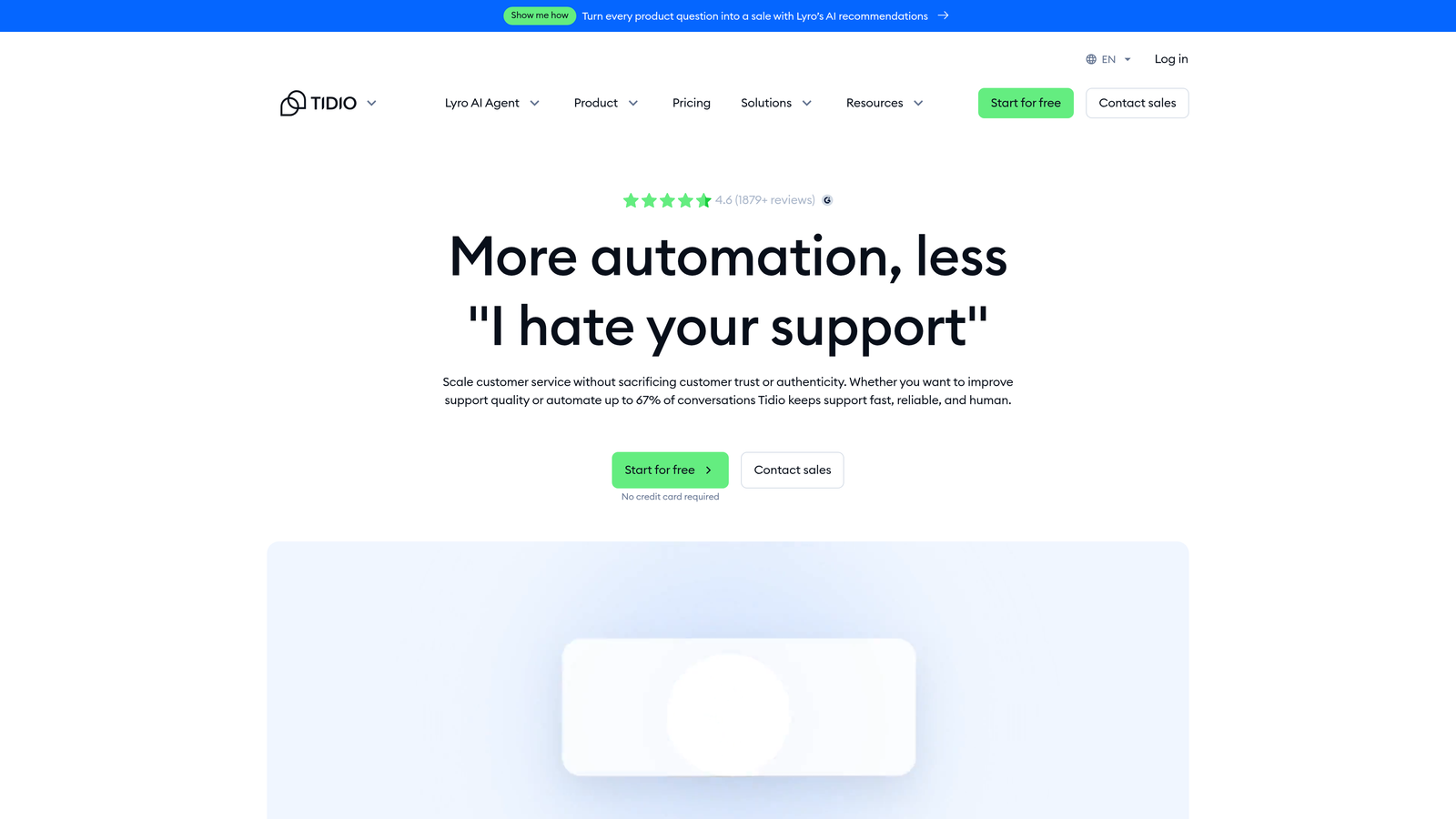
Tidio is an accessible AI chat and helpdesk platform featuring Lyro AI for autonomous customer conversations, designed for fast deployment with minimal technical setup.
Where This Tool Shines
Tidio's differentiator is accessibility. Getting Lyro AI up and running doesn't require a long implementation project or a dedicated admin. For small businesses and e-commerce teams that need AI-powered chat without significant technical investment, that low setup barrier is genuinely valuable.
The platform consolidates live chat, chatbot, and email into one interface, which reduces context-switching for small support teams. Lyro handles a meaningful portion of common customer questions autonomously, routing to a human agent when it reaches the limits of its training.
Key Features
Lyro AI Chatbot: Autonomous conversation handling for common customer questions, with human handoff when needed.
Unified Platform: Live chat, chatbot, and email support managed from a single interface.
Quick Deployment: Minimal technical setup required, making it accessible for non-technical teams.
E-Commerce Integrations: Native connections with Shopify and WooCommerce for order-related support queries.
Freemium Entry Point: A free plan lets small teams get started before committing to a paid tier.
Best For
Small businesses and e-commerce teams that want AI-powered chat without heavy implementation overhead. Less suited for B2B SaaS teams that need deep integrations with dev tools, CRMs, and revenue platforms.
Pricing
Free plan available; Lyro AI add-on from approximately $39 per month. Verify current rates at tidio.com.
7. Kustomer
Best for: High-volume B2C support operations that need a unified customer timeline with AI-powered workflow automation.
Kustomer is a CRM-native helpdesk that unifies all customer interactions into a single timeline view, with AI automation handling routing, tagging, and repetitive workflows at scale.
Where This Tool Shines
The unified customer timeline is Kustomer's signature feature. Rather than treating each support interaction as an isolated ticket, Kustomer presents agents with a complete view of every conversation, purchase, and touchpoint a customer has had across all channels. That context makes agents significantly more effective on complex, multi-touch issues.
AI automation handles the repetitive operational work: routing tickets to the right queue, tagging by topic and sentiment, and executing workflow rules that would otherwise require manual intervention. This makes it particularly effective for high-volume B2C operations where consistent routing and SLA management are critical.
Key Features
Unified Customer Timeline: Every interaction across all channels displayed in a single chronological view for full customer context.
AI-Powered Routing and Tagging: Automated classification and routing that reduces manual triage work at scale.
Omnichannel Coverage: Email, chat, voice, social, and SMS all managed from one platform.
CRM Data in Every Interaction: Customer data embedded directly in the support view, eliminating the need to switch between systems.
Reporting and SLA Management: Robust tools for tracking performance against service level agreements across teams and channels.
Best For
High-volume B2C support teams, particularly in retail, subscription services, and consumer apps where customer history context is critical to effective support. Less suited for B2B SaaS teams looking for product-integrated AI or business intelligence from support data.
Pricing
Enterprise-focused; pricing available on request. Verify current rates at kustomer.com.
8. Gorgias
Best for: E-commerce brands on Shopify, BigCommerce, or Magento that need AI to take autonomous order actions.
Gorgias is a purpose-built helpdesk for e-commerce brands with deep native integrations that enable AI to handle order-related actions like refunds and cancellations without agent involvement.
Where This Tool Shines
Gorgias solves a specific problem extremely well: e-commerce support at volume. When a customer asks "where's my order?" or "can I get a refund?", Gorgias can look up the order, process the action, and close the conversation without a human ever touching it. That level of autonomous action is genuinely differentiated for e-commerce use cases.
The per-ticket pricing model is unusual in this market and can work in favor of lower-volume merchants who want predictable costs without per-seat fees. The important caveat is that Gorgias is built specifically for e-commerce workflows. B2B SaaS teams will find it a poor fit.
Key Features
Native E-Commerce Integrations: Deep connections with Shopify, BigCommerce, and Magento for real-time order data access.
Automate for Order Actions: AI handles refunds, cancellations, and tracking lookups autonomously without agent involvement.
AI-Powered Flows: Automated resolution paths for repetitive e-commerce queries like shipping questions and return requests.
Per-Ticket Pricing: A unique pricing model that scales with ticket volume rather than agent seats.
Revenue Statistics: Ties support interactions to revenue impact, showing which conversations convert or retain customers.
Best For
E-commerce brands with high volumes of order-related support queries, particularly those operating on Shopify or BigCommerce. Not a fit for B2B SaaS, professional services, or teams without an e-commerce transaction layer.
Pricing
Starter from approximately $10 per month for 50 tickets, scaling with ticket volume. Verify current rates at gorgias.com.
9. Drift (Salesloft)
Best for: B2B revenue teams where sales conversations and support queries overlap significantly.
Drift, now part of Salesloft, is a conversational AI platform oriented around revenue engagement: qualifying leads, booking meetings, and handling FAQs for B2B teams where the line between support and sales is deliberately blurred.
Where This Tool Shines
Drift's strength is at the intersection of support and pipeline. If a prospect visits your pricing page at 11pm and has a question, Drift's AI chatbot can qualify the intent, answer common questions, and book a meeting for the next morning. That's a genuinely different use case from traditional ticket-based support.
The integration with Salesloft's broader revenue platform means buyer intent signals, conversation history, and lead data flow into the same system your sales team is already using. For B2B companies where support and sales conversations frequently overlap, that unified view has real operational value. Teams looking for a pure support platform, however, will find Drift's focus on revenue engagement misaligned with their needs.
Key Features
AI Chatbot for Lead Qualification: Engages website visitors, qualifies intent, and routes to the right sales or support resource automatically.
Meeting Booking: Books calendar meetings with the right rep directly within the conversation flow.
Conversational Landing Pages: AI-powered pages that engage buyers in dialogue rather than presenting static content.
Real-Time Buyer Intent Signals: Identifies which accounts are actively researching and surfaces them for sales follow-up.
Salesloft Platform Integration: Full integration with Salesloft's revenue engagement suite for unified pipeline and conversation data.
Best For
B2B companies where marketing, sales, and support conversations happen on the same channels, and where lead qualification and meeting booking are as important as ticket resolution. Not suited for teams that need a dedicated support-first platform.
Pricing
Enterprise-focused; contact sales for pricing. Verify current rates at salesloft.com.
Which Platform Is Right for Your Team?
The right AI helpdesk platform depends heavily on where you sit in the market and what you actually need AI to do. There's a meaningful difference between AI that assists agents and AI that resolves tickets autonomously. Knowing which you need should drive the decision more than any feature comparison.
Here's a quick orientation by use case:
AI-first B2B SaaS teams: Halo AI is the strongest fit. It's the only platform here built AI-native from the ground up, with page-aware context, business intelligence from support data, and integrations that connect support to your entire business stack.
Enterprise teams with existing Zendesk investment: Zendesk remains a defensible choice if you have the admin resources to manage it. The AI suite adds meaningful capability on top of a mature foundation.
In-app messaging as the primary channel: Intercom's Fin AI Agent is well-integrated with its messenger infrastructure and works best for teams already in that ecosystem.
SMBs on a budget: Freshdesk offers the best combination of multi-channel coverage and competitive pricing. Tidio is the right call if you need AI chat with minimal setup and a freemium entry point.
E-commerce brands: Gorgias is purpose-built for this use case and genuinely differentiated on autonomous order actions. Nothing else on this list comes close for Shopify-native workflows.
Your support team shouldn't scale linearly with your customer base. Let AI agents handle routine tickets, guide users through your product, and surface business intelligence while your team focuses on complex issues that need a human touch. See Halo in action and discover how continuous learning transforms every interaction into smarter, faster support.