9 Best AI Helpdesk Software Options by Cost in 2026
This guide compares nine AI helpdesk software options by cost, evaluating each platform on pricing transparency, AI capabilities, and total cost of ownership to help SaaS startups and scaling B2B teams find the right fit. Rather than focusing solely on seat license pricing, it examines the real value delivered—from automated tier-1 resolution rates to agent productivity gains—so teams can make smarter AI helpdesk software cost decisions.
 Grant CooperFounder13 min read
When evaluating AI helpdesk software, cost is rarely straightforward. You're not just paying for a seat license. You're investing in resolution rates, agent productivity, and the business intelligence that comes from every support interaction. The real question isn't "what does it cost?" but "what do you get for that cost?"
This guide breaks down nine AI helpdesk platforms by pricing model, value delivered, and who each one is actually built for. Whether you're a lean SaaS startup looking to automate tier-1 support without hiring, or a scaling B2B team drowning in tickets, there's a meaningful difference between bolting AI onto a legacy helpdesk and deploying a purpose-built AI support agent from day one.
We've evaluated each platform on pricing transparency, AI capabilities, integration depth, and total cost of ownership—not just the number on the pricing page.
1. Halo AI
Best for: B2B SaaS teams that want AI-first support with deep product and business context
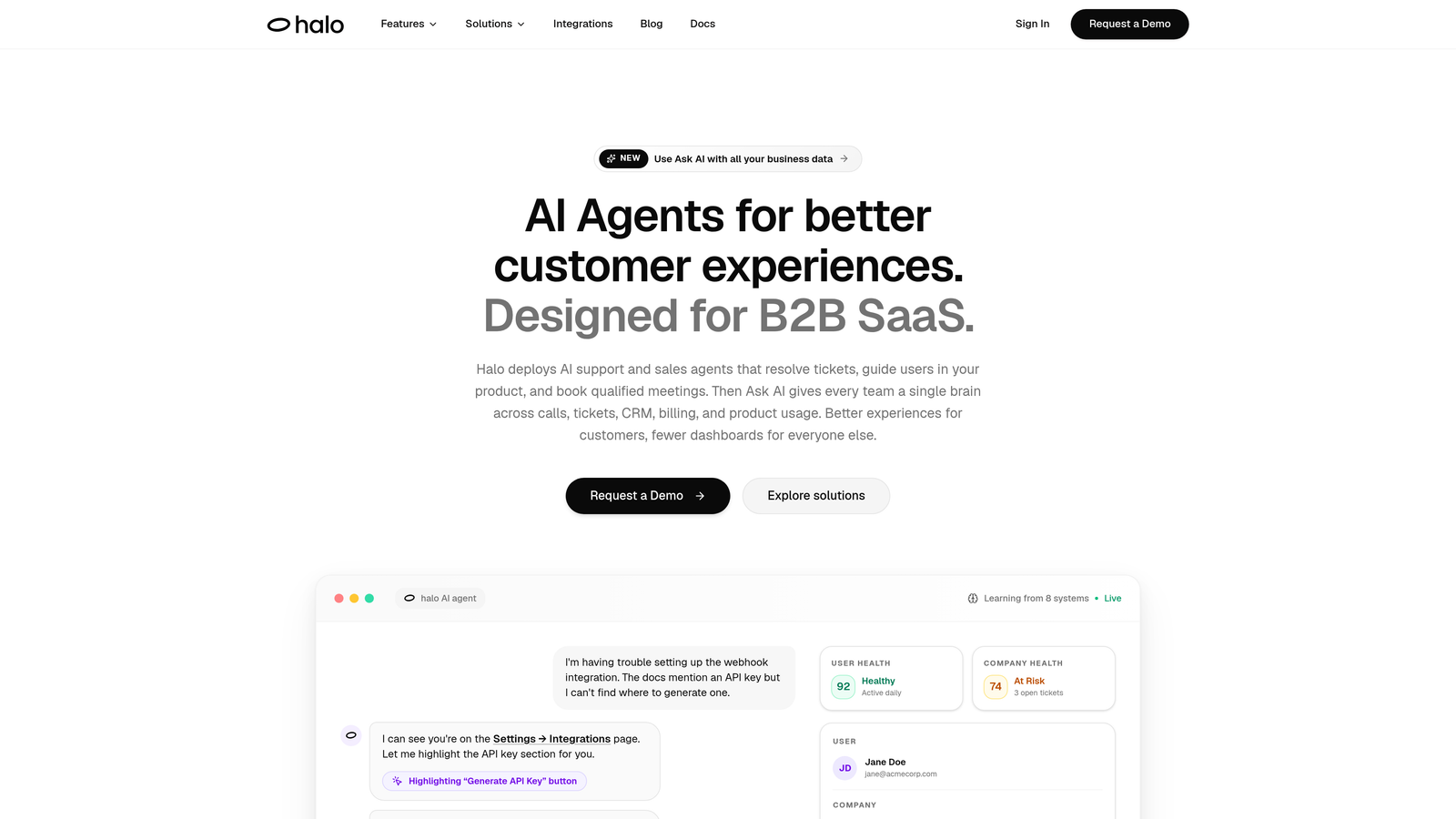
Halo AI is a purpose-built AI customer support platform that deploys intelligent agents to resolve tickets, guide users through your product, and surface business intelligence signals across every interaction.
Where This Tool Shines
Most AI helpdesk tools are traditional ticketing systems with AI features added on top. Halo is architected the other way around: AI is the foundation, not the feature. That distinction matters more than it sounds, especially when you're trying to resolve support tickets without growing headcount.
The standout capability here is page-aware context. Halo's chat widget actually sees what the user sees on screen, which means its guidance is situational rather than generic. Combined with a smart inbox that surfaces customer health signals, revenue anomalies, and churn indicators, Halo turns your support channel into a business intelligence layer.
Key Features
Autonomous AI Agents: AI agents resolve support tickets independently and continuously learn from every interaction to improve over time.
Page-Aware Chat Widget: The widget understands the user's current page context, enabling step-by-step visual guidance rather than generic help articles.
Smart Inbox with Business Intelligence: Surfaces customer health signals, revenue anomalies, and churn indicators directly within the support workflow.
Auto Bug Ticket Creation: Automatically creates and routes bug reports to Linear, Jira, or Slack without manual intervention from support agents.
Live Agent Handoff: Escalates complex conversations to human agents with full conversation context preserved, so nothing gets repeated.
Deep Integration Stack: Connects natively with HubSpot, Stripe, Zoom, PandaDoc, Fathom, Intercom, Slack, and more.
Best For
Halo is built for B2B SaaS companies and product-led growth teams that want support to operate as a strategic function, not just a cost center. If your team is scaling and you need AI that learns your product rather than just searching a knowledge base, this is worth a close look.
Pricing
Custom pricing based on your team's needs. Contact Halo AI directly at haloagents.ai for details.
2. Zendesk AI
Best for: Enterprise teams that need a mature, battle-tested helpdesk with AI layered on top
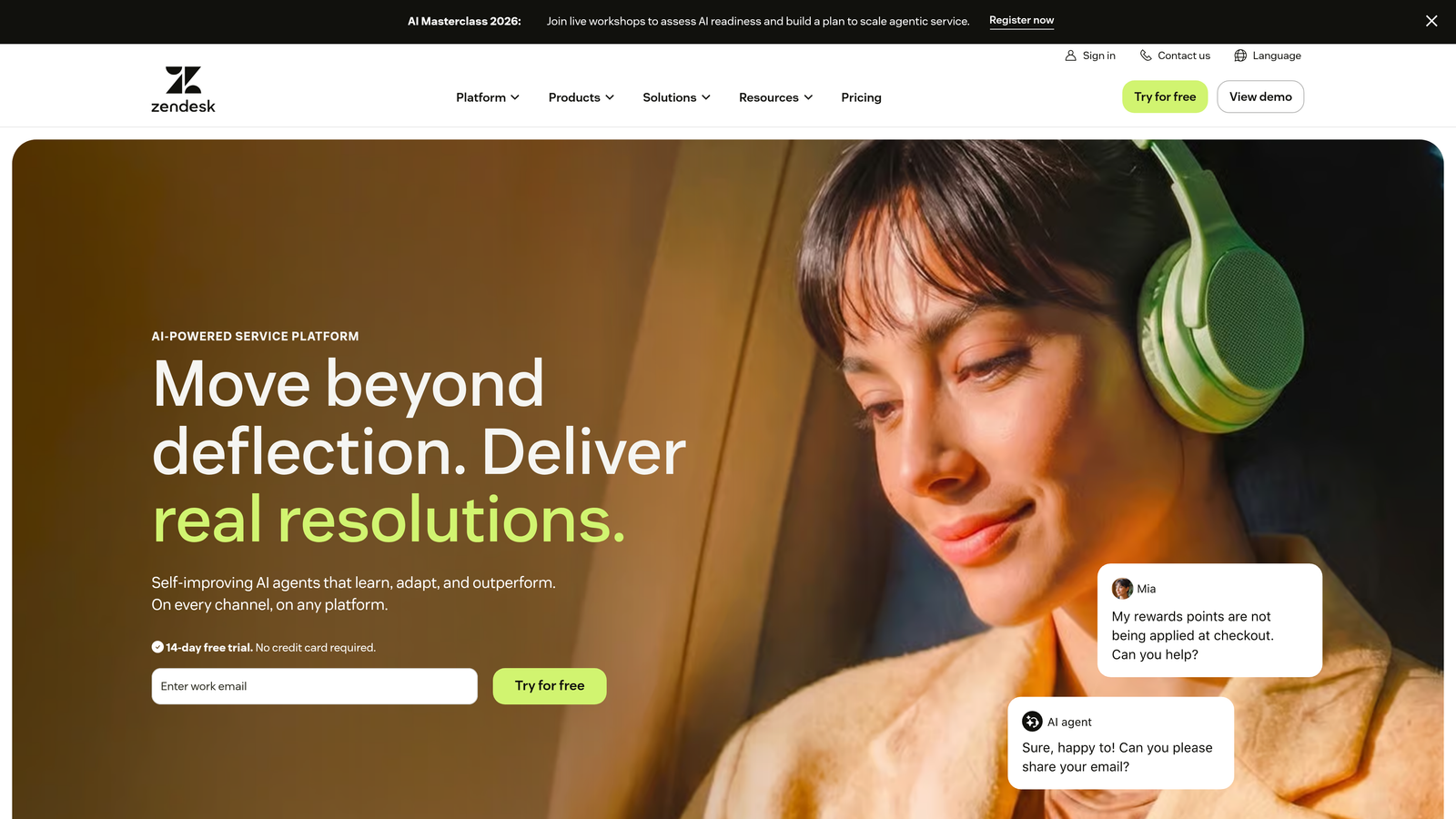
Zendesk is the enterprise standard in helpdesk software, now with AI agents and a copilot feature built onto its established ticketing and workflow engine.
Where This Tool Shines
Zendesk's strength is its maturity. If you need complex SLA management, multi-channel routing, and access to a marketplace of over 1,000 integrations, it delivers. The platform's AI additions handle automated ticket resolution across email, chat, and social, while the AI copilot gives human agents suggested replies and next-best-action guidance in real time.
The trade-off is cost complexity. AI features are often available at higher tiers or as separate add-ons, which means your actual monthly spend can look quite different from the base seat price. For large teams with predictable ticket volumes, the total cost of ownership can be justified. For smaller teams, it can escalate quickly.
Key Features
AI Agents: Automated ticket resolution across email, chat, and social channels.
AI Copilot: Provides human agents with suggested replies and next-best-action prompts during live interactions.
Advanced Routing and SLA Management: AI-powered triage assigns tickets to the right team with priority scoring.
1,000+ Marketplace Integrations: Extensive ecosystem covering CRM, e-commerce, analytics, and more.
Robust Reporting Suite: Detailed analytics on ticket volume, resolution times, and agent performance.
Best For
Enterprise and mid-market teams with complex support operations, multiple channels, and the budget to support a platform at scale. Less ideal for lean SaaS startups where AI add-on costs can outpace value delivered.
Pricing
Suite Team from approximately $55/agent/month; AI features available at higher tiers or as add-ons. Verify current pricing at zendesk.com/pricing.
3. Intercom
Best for: SaaS teams that want AI-powered in-app messaging with per-resolution pricing
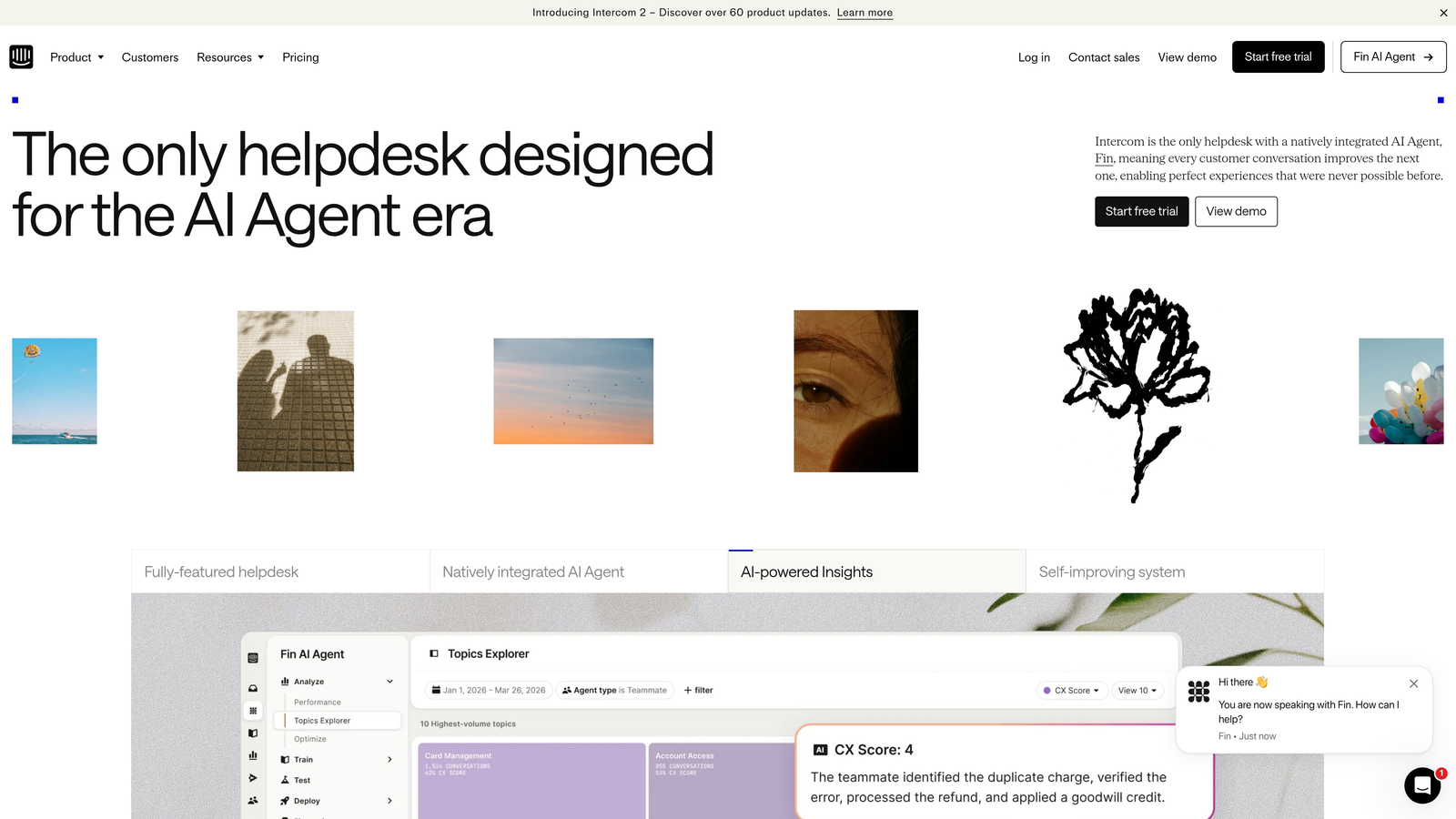
Intercom is a customer messaging platform with Fin, its GPT-powered AI agent, designed to handle support conversations across in-app chat, email, and web.
Where This Tool Shines
Fin is one of the more capable AI agents in this category, and Intercom's per-resolution pricing model is genuinely interesting: you only pay when Fin actually resolves a conversation. For teams with high deflection rates, this can make the economics work well. The catch is that "resolution" needs to be monitored carefully to ensure quality isn't sacrificed for cost savings.
Beyond support, Intercom's product tour and onboarding flow capabilities make it a natural fit for SaaS companies that want to use the same platform for both user engagement and customer support. The overlap between these two functions is where Intercom earns its keep.
Key Features
Fin AI Agent: Resolves conversations autonomously, drawing on your help content and knowledge base.
Per-Resolution Pricing: Fin charges approximately $0.99 per resolved conversation, aligning cost with actual value delivered.
In-App Messaging and Product Tours: Proactive support flows and onboarding sequences built into the same platform.
AI Copilot for Human Agents: Instant answer suggestions during live conversations.
Omnichannel Inbox: Unified inbox for chat, email, social, and SMS.
Best For
SaaS companies that want to combine support and user engagement in one platform, particularly those with high ticket volumes where per-resolution pricing creates favorable unit economics.
Pricing
Base plans from approximately $39/seat/month; Fin AI Agent approximately $0.99/resolution. Verify current pricing at intercom.com/pricing.
4. Freshdesk
Best for: SMBs and growing teams that want AI-assisted support at accessible price points
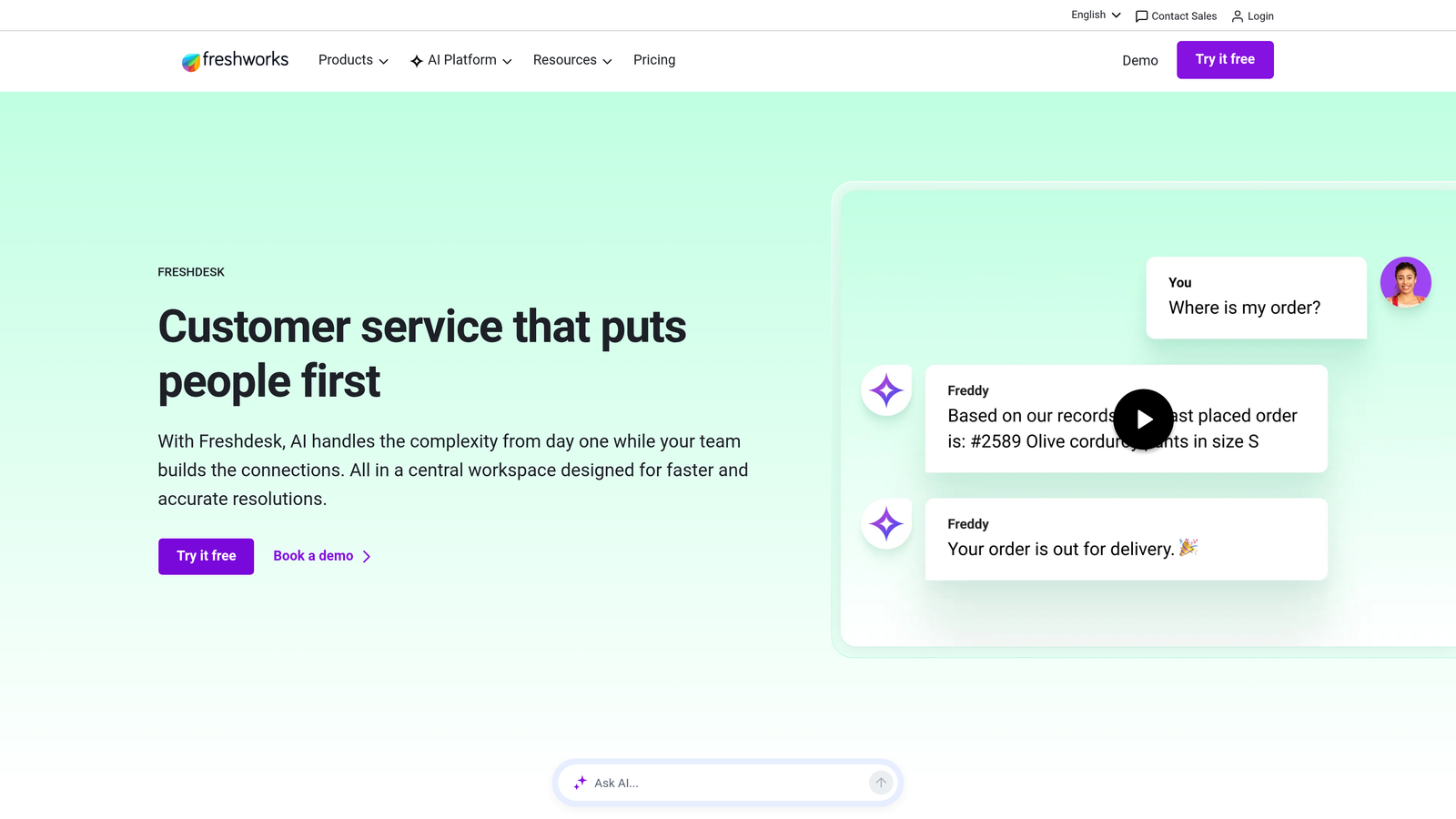
Freshdesk is a cloud-based helpdesk from Freshworks, with Freddy AI providing automation, self-service, and agent assistance across its pricing tiers.
Where This Tool Shines
Freshdesk's biggest advantage is accessibility. The free tier gives small teams a genuine starting point, and the paid plans scale incrementally without the steep jumps you see in enterprise platforms. Freddy AI handles ticket categorization, routing, and suggested replies, while Freddy Self Service powers a customer-facing chatbot for deflection.
For teams already using Freshworks products like Freshsales or Freshservice, the native integrations create a coherent ecosystem without extra middleware. That said, Freddy's AI capabilities are more assistive than autonomous, meaning human agents are still doing the heavy lifting on complex tickets.
Key Features
Freddy AI: Automates ticket categorization, routing, and generates suggested replies for agents.
Freddy Self Service: Customer-facing AI chatbot for deflecting common questions before they become tickets.
Free Plan: Available for small teams with limited features, including email and knowledge base.
Omnichannel Support: Email, chat, phone, and social in one platform.
Freshworks Ecosystem: Native integration with Freshsales CRM and Freshservice ITSM.
Best For
SMBs and early-stage teams that need a full-featured helpdesk without enterprise pricing. Also a strong choice for teams already invested in the Freshworks product suite.
Pricing
Free tier available; Growth from approximately $15/agent/month; Pro approximately $49; Enterprise approximately $79. Verify at freshdesk.com/pricing.
5. Help Scout
Best for: Small to mid-sized teams that want clean, human-centric support with AI writing tools included
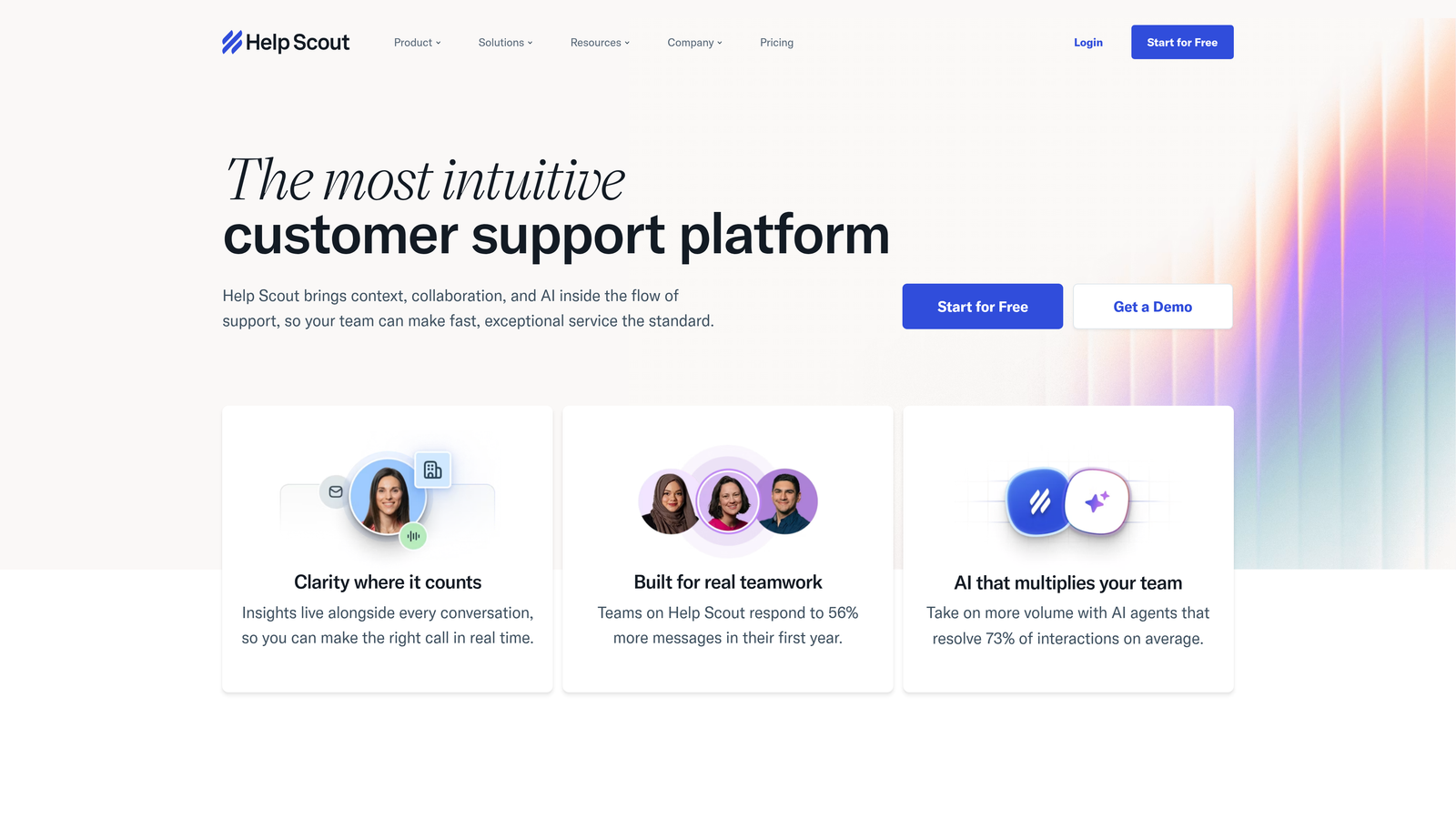
Help Scout is a simple, shared inbox platform with AI writing and summarization tools built into its paid plans, designed for teams that prioritize clarity and ease of use over feature density.
Where This Tool Shines
Help Scout's appeal is its transparency. The per-seat pricing is straightforward, AI features are included in paid plans rather than sold as add-ons, and the interface is genuinely easy to use. For teams that have been burned by hidden fees or complex configuration, this simplicity is a real selling point.
AI Summarize, AI Assist, and AI Drafts reduce the time agents spend writing and reviewing tickets without requiring a major workflow overhaul. It's AI as a writing partner rather than an autonomous agent, which suits teams that want to keep humans in the loop.
Key Features
AI Summarize, Assist, and Drafts: AI writing tools included in paid plans to speed up agent responses and reduce cognitive load.
Shared Inbox: Collision detection and private notes prevent duplicate responses and internal miscommunication.
Beacon Widget: In-app help center and chat widget for proactive self-service.
Transparent Pricing: No hidden AI add-on fees; what you see on the pricing page is what you pay.
Knowledge Base Integration: Built-in docs and help center that feeds into AI suggestions.
Best For
Small to mid-sized teams that want a clean, reliable helpdesk with AI writing assistance included. Not the right fit for teams that need autonomous AI resolution or complex workflow automation.
Pricing
Standard from approximately $22/user/month; Plus approximately $44/user/month. Verify at helpscout.com/pricing.
6. Tidio
Best for: Small businesses and e-commerce stores that want affordable AI chat automation with a low barrier to entry
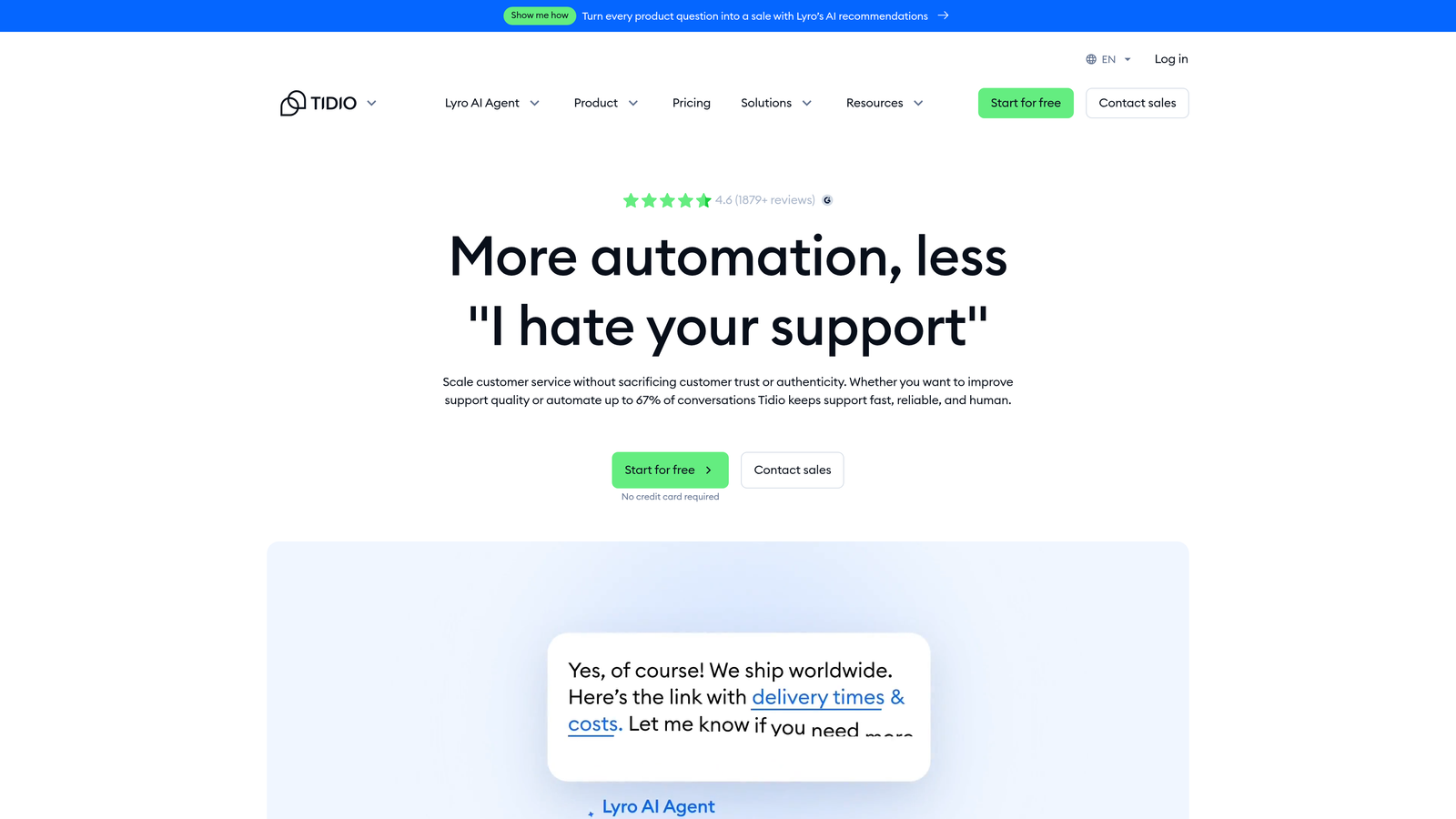
Tidio is a live chat and AI chatbot platform featuring Lyro, its AI agent, built for smaller businesses that need automation without a large upfront investment.
Where This Tool Shines
Tidio's free plan is one of the most accessible entry points in this category. Lyro handles customer questions using your existing support content, and the visual chatbot flow builder lets non-technical users create custom automation without writing a single line of code. For e-commerce stores with repetitive queries around orders, shipping, and returns, Lyro can deflect a meaningful portion of incoming volume.
The platform's Shopify and WooCommerce integrations make it a natural fit for product-focused small businesses. It's not built for complex B2B SaaS workflows, but for its target audience, the cost-to-value ratio is hard to argue with.
Key Features
Lyro AI Chatbot: Handles customer questions using your support content, with per-conversation pricing on AI responses.
Free Plan: Limited conversations included at no cost, making it one of the lowest-risk entry points in this list.
Visual Flow Builder: Drag-and-drop chatbot builder for creating custom automation without technical expertise.
Unified Inbox: Live chat, email, and Messenger managed from one place.
E-Commerce Integrations: Native connections to Shopify and WooCommerce for order-aware support.
Best For
Small businesses and e-commerce teams that want affordable AI chat automation. Less suited for B2B SaaS teams with complex support workflows or enterprise-grade integration requirements.
Pricing
Free plan available; paid plans from approximately $29/month; Lyro AI priced per conversation. Verify at tidio.com/pricing.
7. Zoho Desk
Best for: Teams already in the Zoho ecosystem that want AI-assisted support with strong CRM context
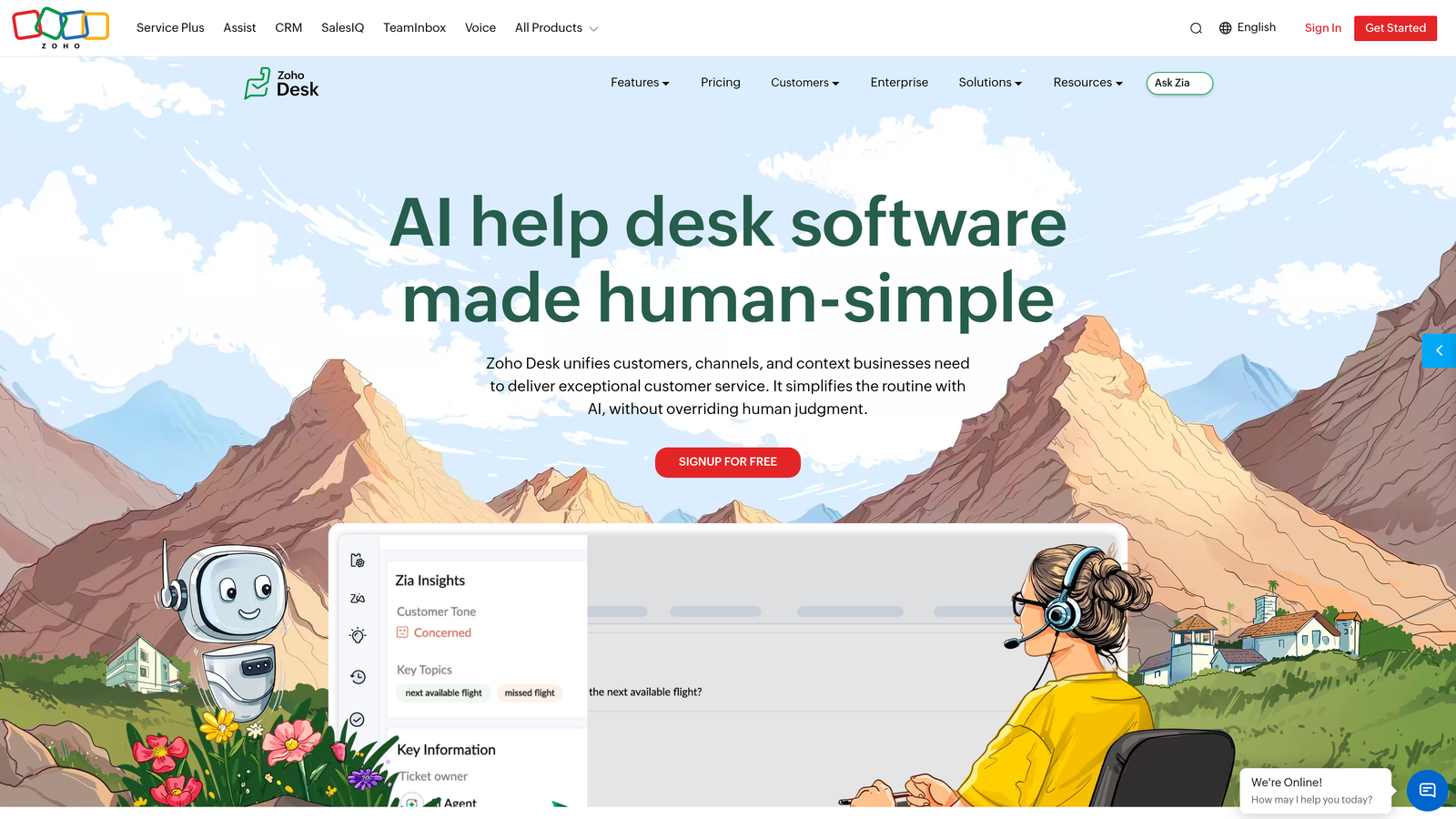
Zoho Desk is a context-aware helpdesk with Zia AI, part of the broader Zoho suite, offering solid value for teams that are already using Zoho CRM or other Zoho products.
Where This Tool Shines
Zia AI brings sentiment analysis, automatic ticket tagging, and anomaly detection to Zoho Desk's mid-tier plans. Combined with deep Zoho CRM integration, agents get full customer context without switching tabs. For teams that live inside the Zoho ecosystem, this unified view of the customer is genuinely useful and eliminates a common pain point in support workflows.
Blueprint workflow automation is another standout, allowing teams to map out complex ticket processes with conditional logic. It's more powerful than the simple rule-based routing you find in many SMB-focused tools.
Key Features
Zia AI: Provides sentiment analysis, automatic ticket tagging, and anomaly detection across incoming tickets.
Zoho CRM Integration: Unified customer timeline combining support history and CRM data in one view.
Blueprint Automation: Visual workflow builder for complex, multi-step ticket processes with conditional logic.
Multi-Brand Support: Manage multiple brands and departments from a single Zoho Desk instance.
Competitive AI Pricing: Zia features available at mid-tier plans without a significant price jump.
Best For
Teams already using Zoho CRM or other Zoho products who want a cohesive support platform without integrating a third-party tool. Less compelling for teams outside the Zoho ecosystem.
Pricing
Standard from approximately $14/agent/month; Professional approximately $23; Enterprise approximately $40. Verify at zoho.com/desk/pricing.
8. Kustomer
Best for: High-volume customer service teams that want conversation-based pricing to reward automation
Kustomer is a CRM-native customer service platform with AI automation and a conversation-based pricing model that can reduce effective cost per interaction at scale.
Where This Tool Shines
Kustomer's pricing model is its most distinctive feature. Rather than charging strictly per seat, it ties pricing to conversation volume, which means the more your AI deflects, the more favorable your unit economics become. For high-volume consumer support teams, this creates a genuine incentive to invest in automation quality.
The unified customer timeline is also worth noting. Kustomer pulls together support history, order data, and CRM records into a single view, giving agents the context they need to resolve issues faster. The omnichannel coverage across chat, email, SMS, social, and voice rounds out a comprehensive feature set.
Key Features
Unified Customer Timeline: Combines support history, order data, and CRM records in a single agent view.
Conversation-Based Pricing: Pricing model that rewards automation by reducing effective cost as AI deflection increases.
AI Deflection and Routing: Automated conversation handling and intelligent routing to the right agent or team.
Omnichannel Coverage: Chat, email, SMS, social, and voice in one platform.
Proactive Outreach: Campaign capabilities for reaching customers before they submit a ticket.
Best For
High-volume consumer support operations where conversation-based pricing creates favorable economics at scale. Less ideal for smaller B2B teams where the per-user cost can be harder to justify.
Pricing
Plans typically in the $89 to $139/user/month range. Verify current pricing at kustomer.com/pricing.
9. Gorgias
Best for: E-commerce brands on Shopify, BigCommerce, or Magento that want ticket-volume pricing tied to revenue impact
Gorgias is an e-commerce-focused helpdesk with deep Shopify integration and ticket-volume-based pricing, built to position support as a revenue driver rather than a cost center.
Where This Tool Shines
Gorgias is purpose-built for e-commerce, and that focus shows. Order data, return status, and customer purchase history appear directly inside the ticket view, so agents never need to leave the helpdesk to answer common questions. AI automation handles high-frequency queries like order status, tracking, and return requests, which are the bread and butter of e-commerce support queues.
The ticket-volume pricing model scales with your business activity rather than your headcount, which suits seasonal e-commerce brands with fluctuating support demand. The revenue statistics feature, which ties support interactions to sales outcomes, is a useful tool for demonstrating the ROI of your support operation.
Key Features
Deep E-Commerce Integrations: Native connections to Shopify, BigCommerce, and Magento with order data surfaced directly in the ticket view.
AI Automation for E-Commerce Queries: Handles order status, return requests, and tracking inquiries automatically.
Ticket-Volume Pricing: Pricing scales with ticket volume rather than agent seats, rewarding efficient support teams.
Revenue Statistics: Tracks the revenue impact of support interactions to quantify support's contribution to sales.
Automate Add-On: Intent-based self-service flows for deflecting common queries before they reach an agent.
Best For
E-commerce brands with high ticket volumes and a need for deep platform integration. Not a fit for B2B SaaS companies or teams with complex, multi-step support workflows outside the e-commerce context.
Pricing
Starter approximately $10/month (50 tickets); Basic approximately $60/month (300 tickets); Pro approximately $360/month (2,000 tickets). Verify at gorgias.com/pricing.
Which AI Helpdesk Is Right for Your Team?
The right platform depends less on the price tag and more on the architecture underneath it. Here's a quick way to think through the decision.
For B2B SaaS teams that want AI-first support: Halo AI is the standout choice. Its page-aware context, continuous learning, and business intelligence signals are built for product-led companies where support and product experience are deeply connected.
For enterprise teams with complex operations: Zendesk offers the most mature feature set and integration ecosystem, though the total cost of ownership requires careful planning as AI add-ons layer on top of base seat pricing.
For SaaS teams that want messaging plus support: Intercom's Fin and per-resolution pricing model make sense if your team is already using Intercom for onboarding and user engagement.
For SMBs on a tight budget: Freshdesk's free tier and incremental pricing make it the most accessible full-featured option. Help Scout is the cleaner choice if your team values simplicity and transparent pricing over AI depth.
For e-commerce brands: Gorgias is the category leader if you're on Shopify or BigCommerce. Tidio is a lower-cost starting point for smaller stores just beginning to automate.
For Zoho users: Zoho Desk delivers strong value without requiring a new ecosystem investment.
Your support team shouldn't scale linearly with your customer base. AI agents should handle routine tickets, guide users through your product, and surface business intelligence while your team focuses on complex issues that need a human touch. See Halo in action and discover how continuous learning transforms every interaction into smarter, faster support.