9 Best AI Helpdesk Software Free Trials to Test in 2026
Explore the top AI helpdesk software trial options for 2026, ranked by how much value you can extract before committing to a purchase. This guide evaluates nine platforms on trial generosity, AI resolution quality, integration depth, and fit for B2B SaaS teams—helping you make a confident decision whether you're migrating from a legacy system or building your support stack from scratch.
 Matt PattoliFounder14 min read
Choosing AI helpdesk software is a significant investment, and the best way to evaluate it is to actually use it. Free trials let you stress-test AI resolution quality, integration depth, and escalation logic before signing a contract. But not all trials are created equal: some give you a sandboxed demo, others hand you full platform access with real ticket data.
This guide covers the best AI helpdesk platforms offering meaningful trials in 2026, ranked by how much value you can extract before committing. Whether you're migrating from a legacy helpdesk or building your support stack from scratch, these trials give you enough runway to make a confident decision. We've evaluated each platform on trial generosity, AI capabilities, integration breadth, and fit for B2B SaaS teams. For additional context, see our guides on automated customer support and AI helpdesk software.
1. Halo AI
Best for: B2B SaaS teams that want an AI-first platform with page-aware context and business intelligence.
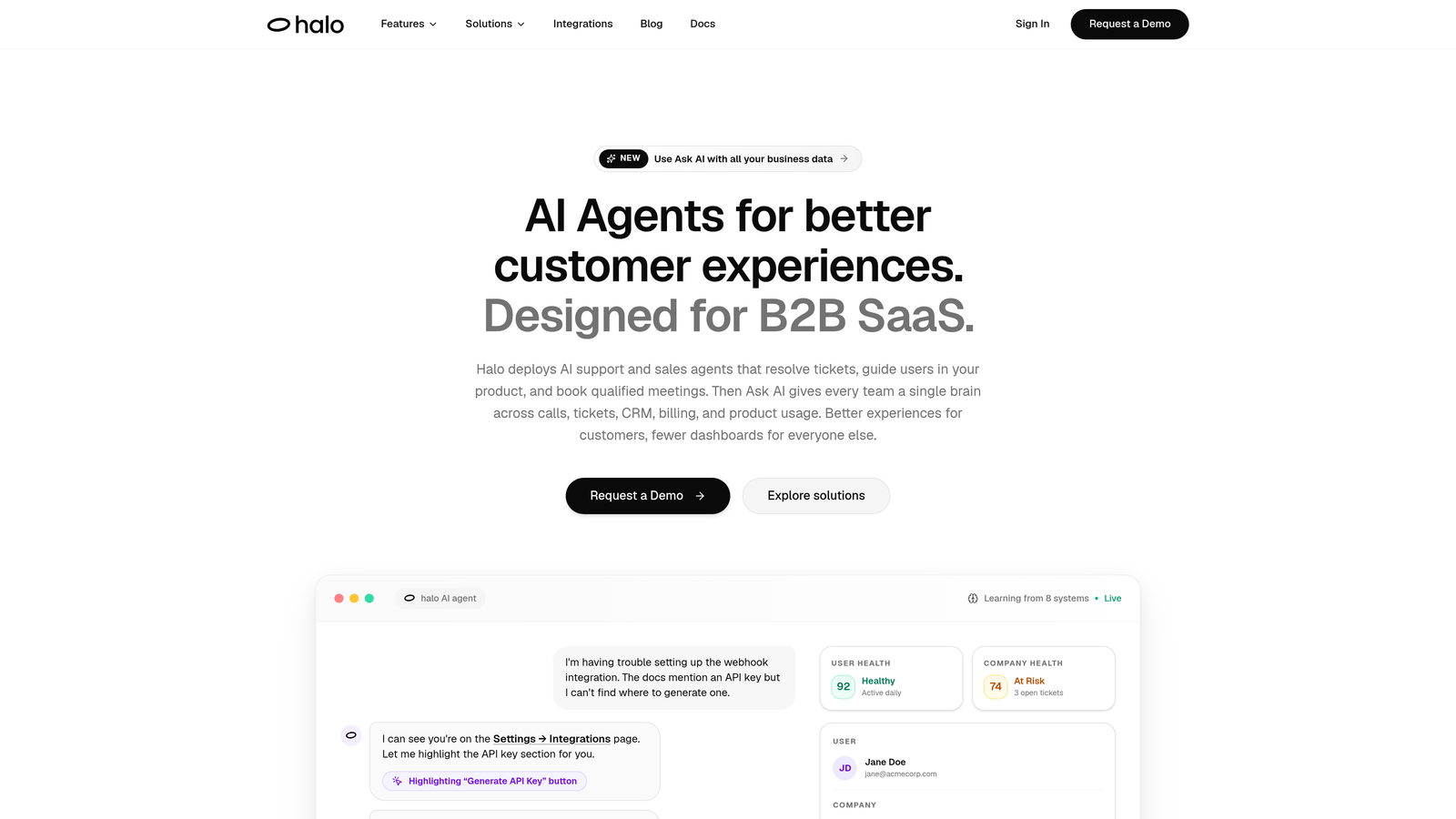
Halo AI is an AI-first customer support platform that deploys intelligent agents to resolve tickets, guide users through your product, and surface actionable business intelligence — all while learning from every interaction.
Where This Tool Shines
What separates Halo from most AI helpdesk tools is the architecture. Rather than bolting AI onto an existing ticketing system, Halo is built AI-first from the ground up. The page-aware context engine is particularly compelling: Halo's agents can see what a user is looking at in real time and provide visual UI guidance, not just generic text answers.
The business intelligence layer is another genuine differentiator. Beyond resolving tickets, Halo's smart inbox surfaces customer health signals, revenue anomalies, and churn indicators — turning your support queue into a strategic data source. For a Head of Support or VP of Customer Success, that's a meaningful upgrade from a traditional inbox.
Key Features
Page-Aware AI Agents: Agents understand the exact page a user is on and deliver contextually relevant UI guidance, not one-size-fits-all answers.
Autonomous Ticket Resolution with Smart Escalation: Halo handles routine tickets end-to-end and routes complex issues to live agents with full conversation context preserved.
Auto Bug Ticket Creation: When users report product issues, Halo automatically creates and routes bug tickets to Linear or your preferred PM system, closing the loop between support and engineering.
Smart Inbox with Business Intelligence: The inbox goes beyond ticket management, flagging customer health signals, churn indicators, and revenue anomalies across your customer base.
Native Integrations: Connects with Slack, HubSpot, Intercom, Stripe, Zoom, PandaDoc, and Fathom — meaning Halo plugs into your existing stack rather than replacing it.
Best For
B2B SaaS companies with 50 to 500 employees that want AI to do more than deflect tickets. Particularly strong for product-led growth teams where support context overlaps with product usage and revenue signals. If you're currently on Zendesk or Freshdesk and wondering whether to add an AI layer or switch entirely, Halo is worth putting through its paces first.
Pricing
Pricing and trial details are available directly on the Halo AI website. Given the platform's depth, it's worth reaching out to confirm the trial scope before starting.
2. Zendesk
Best for: Enterprise and mid-market teams that need a proven platform with deep compliance and a massive app ecosystem.
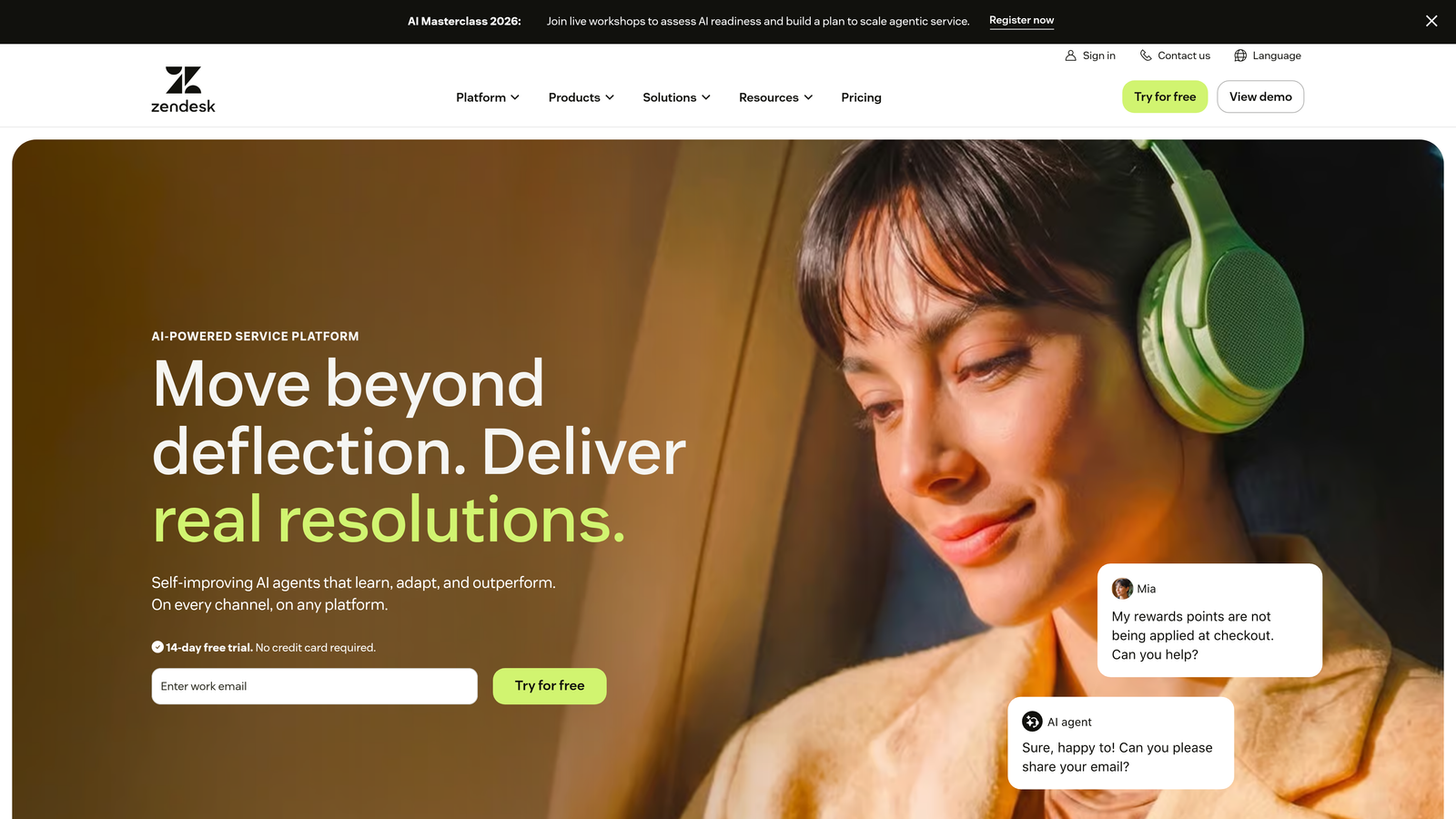
Zendesk is one of the most established names in helpdesk software, now with AI Copilot and intelligent triage built into its Suite plans.
Where This Tool Shines
Zendesk's strength is its maturity. The platform has been refined over many years, and it shows in areas like SLA management, reporting depth, and the breadth of its app marketplace. For teams that need to integrate with dozens of tools, Zendesk's 1,000+ integration library is hard to beat.
The AI Copilot is positioned as an agent-assist tool rather than a fully autonomous resolver. It suggests responses and next steps for human agents, which suits teams that aren't ready to hand full resolution authority to AI but still want to accelerate agent productivity.
Key Features
AI Copilot: Surfaces suggested responses, next steps, and relevant knowledge base articles for human agents in real time.
Intelligent Triage and Routing: Automatically categorizes and routes tickets based on intent, sentiment, and ticket content.
1,000+ App Integrations: One of the largest integration marketplaces in the helpdesk category, covering CRMs, billing tools, and communication platforms.
Advanced Reporting and SLA Management: Granular analytics and configurable SLA policies suited to complex support operations.
Compliance and Data Residency: Strong enterprise-grade compliance options, including GDPR and data residency controls for regulated industries.
Best For
Mid-market to enterprise teams with complex support operations, multiple channels, and strict compliance requirements. Also a natural choice for teams already embedded in the Zendesk ecosystem who want to layer in AI without migrating platforms.
Pricing
Suite Team starts at approximately $55 per agent per month. A 14-day free trial is available with full feature access.
3. Freshdesk
Best for: SMBs and growing teams that want accessible AI features without a large upfront investment.
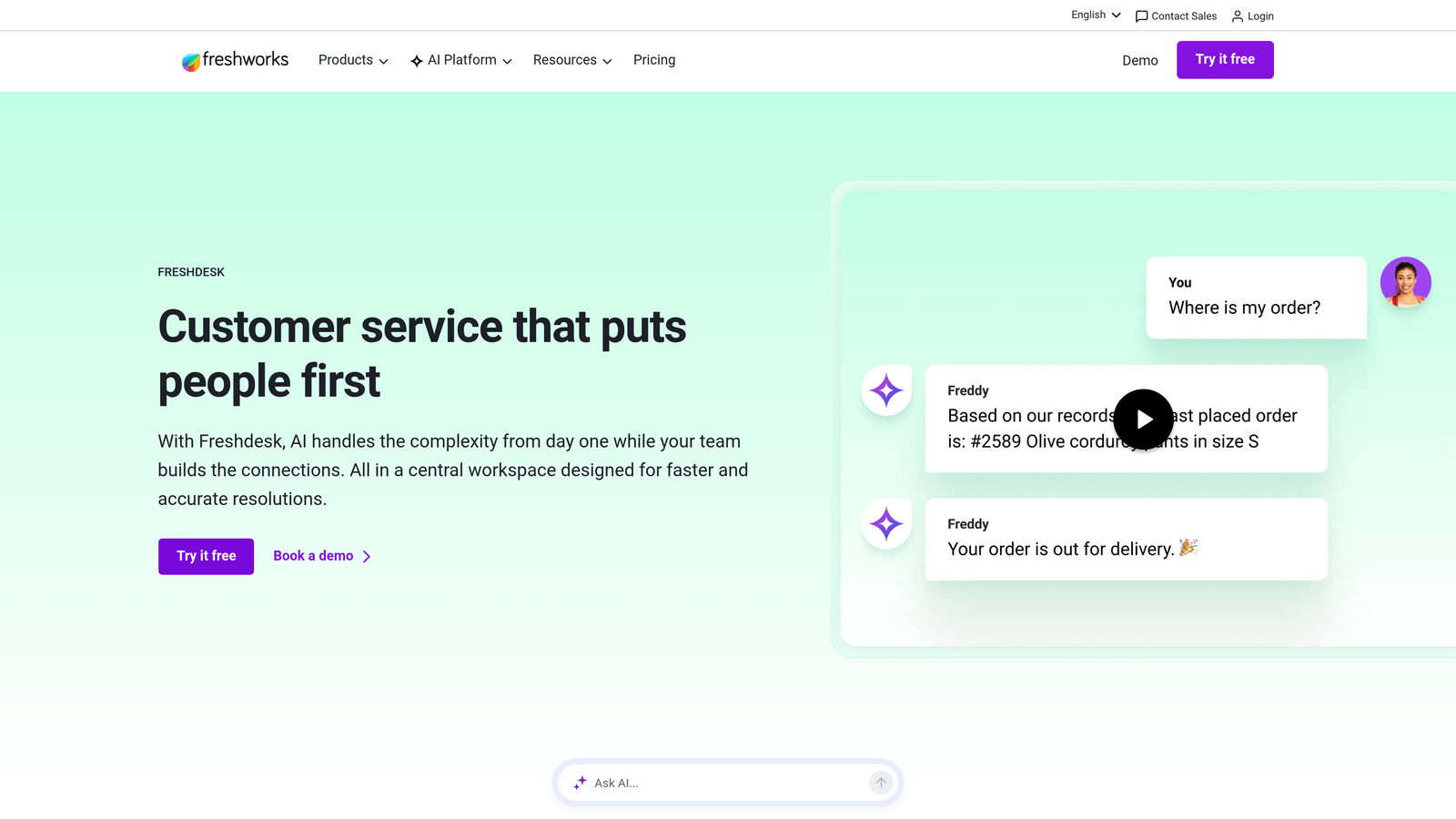
Freshdesk is a widely-used helpdesk from Freshworks with Freddy AI embedded across its ticketing, automation, and self-service layers.
Where This Tool Shines
Freshdesk earns its place on this list largely because of its accessibility. The free plan is genuinely functional for small teams, and the 21-day trial on paid plans is one of the more generous in the category. Freddy AI handles categorization, routing, and suggested replies without requiring significant configuration out of the box.
The Freddy Self Service layer lets you build AI-powered knowledge base bots that can deflect common questions before they become tickets. For teams with a well-maintained knowledge base, this can meaningfully reduce inbound volume from day one of the trial.
Key Features
Freddy AI for Ticketing: Automates ticket categorization, routing, and surfaces suggested replies to speed up agent response times.
Freddy Self Service: Enables AI-powered bots built on your knowledge base to handle common queries autonomously.
Free Plan for Small Teams: A functional free tier with limited agents, making it easy to evaluate core functionality at no cost.
Omnichannel Support: Covers email, live chat, phone, and social channels from a single interface.
Collision Detection: Prevents two agents from responding to the same ticket simultaneously, reducing duplicate work and customer confusion.
Best For
SMBs, early-stage SaaS teams, and companies that want a proven helpdesk with AI features at a reasonable price point. Also a strong option for teams already using other Freshworks products like Freshsales or Freshservice.
Pricing
Free plan available for small teams. Growth plan starts at approximately $15 per agent per month. A 21-day free trial is available on paid plans, which is among the longest in this category.
4. Intercom
Best for: Product-led SaaS companies that want conversational AI tightly integrated with in-app messaging.
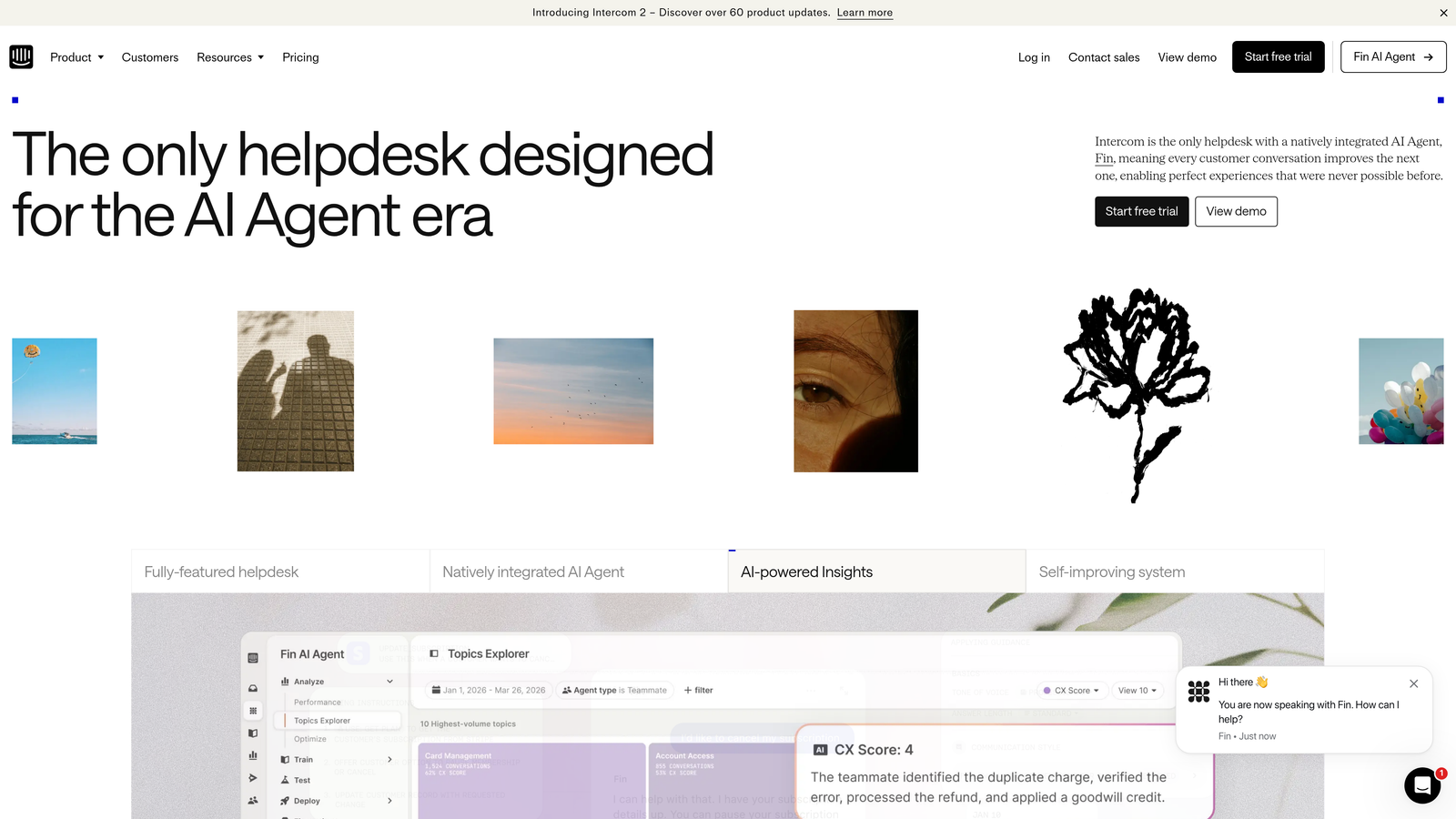
Intercom is a conversational support platform best known for in-app messaging, now featuring Fin — an AI agent built on large language models for autonomous ticket resolution.
Where This Tool Shines
Fin is genuinely impressive for conversational support. It handles open-ended customer questions using your knowledge base and product documentation, and it does so in a way that feels more natural than traditional chatbot flows. For SaaS products with strong documentation, Fin can autonomously resolve a meaningful share of inbound queries.
Intercom's deeper strength is the tight integration between support and product engagement. Proactive support triggers, product tours, and in-app messaging all live in the same platform, making it particularly well-suited to product-led growth companies where the line between onboarding and support is blurry.
Key Features
Fin AI Agent: Autonomous resolution of conversational support queries using large language models trained on your content.
In-App Messaging and Product Tours: Tightly integrated with support, enabling proactive outreach based on user behavior and product usage.
AI-Powered Inbox: Surfaces conversation summaries and suggested actions to speed up human agent responses.
Proactive Support Triggers: Automatically reaches out to users showing patterns associated with confusion or churn risk.
Extensive Integration Library: Connects with Salesforce, Stripe, GitHub, and many other tools commonly used in SaaS stacks.
Best For
B2B SaaS companies with strong product documentation and a conversational support model. Particularly effective for teams that want to unify support, onboarding, and proactive engagement in a single platform.
Pricing
Essential plan starts at approximately $29 per seat per month. Fin AI is billed per resolution on top of the base plan. A 14-day trial is available; Fin AI agent access may vary by plan tier, so confirm at signup.
5. Help Scout
Best for: Teams that want AI assistance without losing the human, email-like feel of their support workflow.
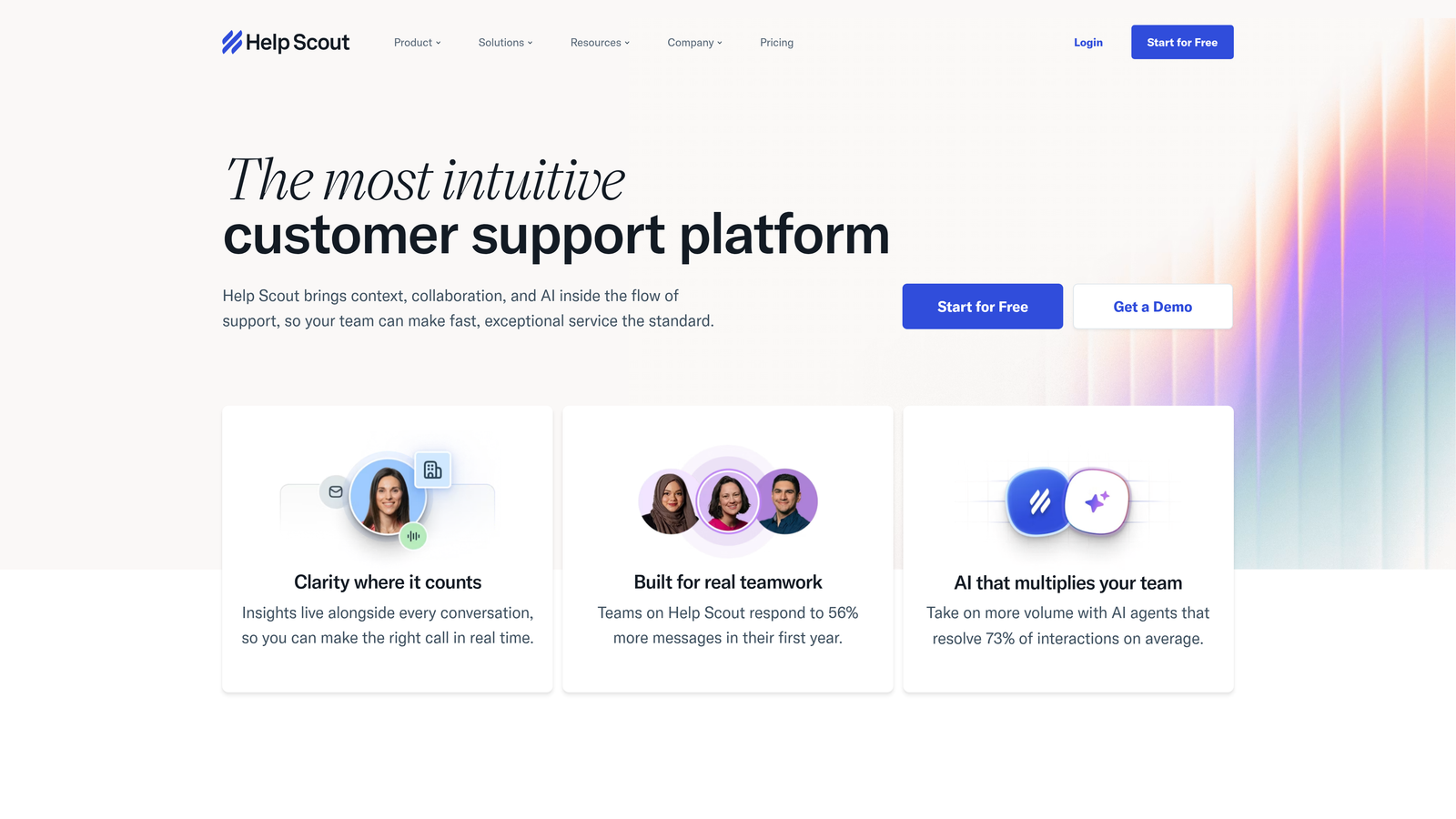
Help Scout is a shared inbox and helpdesk platform with AI Assist and AI Summarize tools, designed to feel like email rather than a traditional ticketing system.
Where This Tool Shines
Help Scout occupies a distinct position in this list: it's not trying to replace human agents with AI. Instead, it makes human agents dramatically faster. AI Summarize gives agents instant context when they pick up a conversation mid-thread, and AI Assist helps with drafting, rephrasing, and translating replies without the agent needing to leave the inbox.
The interface is intentionally simple. If your team struggles with adoption of complex ticketing systems, Help Scout's email-like UX significantly reduces training time and resistance. That simplicity is a genuine product decision, not a limitation.
Key Features
AI Summarize: Instantly summarizes long conversation threads so agents can get up to speed without reading every message.
AI Assist: Helps agents draft, rephrase, adjust tone, and translate replies directly in the inbox.
Docs Knowledge Base: Built-in knowledge base with AI-powered article suggestions surfaced during ticket handling.
Email-Like Interface: Clean, familiar design that minimizes agent training time and reduces friction for non-technical support staff.
Customer Profiles: Full conversation history and customer data surfaced alongside every ticket.
Best For
Small to mid-sized teams that prioritize agent experience and want AI to enhance human work rather than replace it. Strong fit for companies where support quality and tone are central to brand identity.
Pricing
Standard plan starts at approximately $22 per user per month. A 15-day free trial is available with full feature access.
6. Zoho Desk
Best for: Teams already in the Zoho ecosystem that want AI-powered support without adding another vendor.
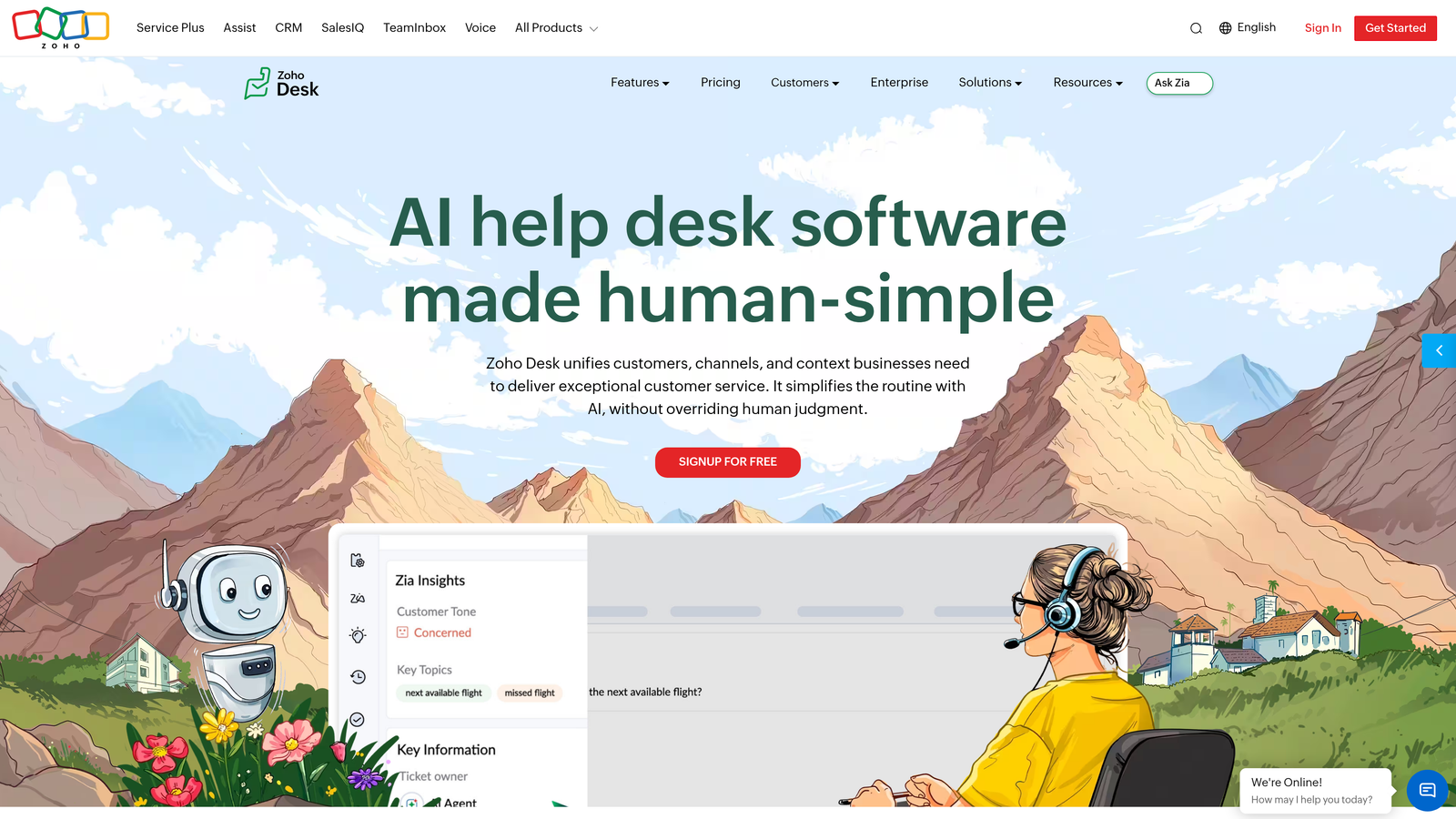
Zoho Desk is a feature-rich helpdesk from Zoho with Zia, an AI assistant that handles sentiment analysis, anomaly detection, and auto-tagging across your ticket queue.
Where This Tool Shines
Zia stands out for its anomaly detection capability. When ticket volume spikes unexpectedly, Zia flags it in real time, allowing support managers to respond before SLAs are breached. Combined with sentiment analysis on incoming tickets, this gives teams a layer of operational intelligence that goes beyond basic AI routing.
Zoho Desk's value proposition strengthens considerably if you're already using Zoho CRM, Zoho Analytics, or other products in the Zoho suite. The native integration between these tools means customer data flows across your stack without custom connectors or middleware.
Key Features
Zia AI: Handles ticket tagging, sentiment analysis, and response suggestions across the support queue.
Anomaly Detection: Flags unusual spikes in ticket volume so teams can respond proactively before service levels degrade.
Zoho Ecosystem Integration: Deep native connectivity with Zoho CRM, Zoho Analytics, and the broader Zoho product suite.
Blueprint Workflow Automation: Structured, visual workflow builder for complex ticket processes with conditional logic and approvals.
Free Plan for Small Teams: Functional free tier supporting up to three agents, useful for initial evaluation.
Best For
Teams already invested in the Zoho ecosystem, as well as SMBs looking for strong AI features at a competitive price point. The free tier makes it accessible for very small teams that aren't ready to commit to a paid plan.
Pricing
Free plan available for up to three agents. Standard plan starts at approximately $14 per agent per month. A 15-day trial is available on paid plans.
7. Tidio
Best for: SMBs and e-commerce teams that need a fast-deploying AI chat agent with minimal setup overhead.
Tidio is a lightweight AI chat and helpdesk platform built for fast deployment, featuring Lyro — an AI agent that can be live within hours of setup.
Where This Tool Shines
Tidio's primary advantage is speed to value. Lyro can be deployed and handling conversations in a matter of hours, not days or weeks. For teams that want to test AI-driven support quickly without a lengthy implementation project, this is a meaningful differentiator.
The visual flow builder makes it easy to create automated conversation paths without writing a single line of code. This puts customization in the hands of support managers rather than developers, which matters for smaller teams without dedicated technical resources.
Key Features
Lyro AI Agent: Autonomous chat-based support agent that handles common queries and hands off to live agents when needed.
Visual Flow Builder: No-code builder for creating automated conversation paths and decision trees.
Live Chat with Agent Takeover: Seamless handoff from Lyro to a human agent when queries exceed the AI's scope.
E-Commerce Integrations: Native integrations with Shopify and WooCommerce, making it particularly useful for online retail support.
Free Plan with Lyro Conversations: A free tier that includes a limited number of Lyro AI conversations, useful for initial testing.
Best For
SMBs, e-commerce brands, and teams that want to get AI support running quickly without a complex implementation. Less suited to enterprise B2B SaaS teams with complex escalation logic or deep integration requirements.
Pricing
Free plan available with limited Lyro conversations. Lyro AI paid plans start at approximately $29 per month. A paid trial is available.
8. Kustomer
Best for: High-volume B2C support teams that need a unified customer timeline and CRM-native workflow automation.
Kustomer is a CRM-native helpdesk designed for high-volume B2C support, offering a unified customer timeline and AI-driven workflow automation built around the full customer record.
Where This Tool Shines
Kustomer's core insight is that support quality improves when agents have complete customer context, not just the current ticket. The unified timeline aggregates every interaction a customer has had across every channel, giving agents a 360-degree view before they type a single word.
The built-in CRM eliminates the need for a separate customer data tool, which reduces both cost and the friction of syncing data between systems. For high-volume B2C operations where agents handle dozens of conversations per shift, this consolidated view can meaningfully improve both speed and quality.
Key Features
Unified Customer Timeline: Aggregates all customer interactions across channels into a single chronological view for every agent.
AI-Powered Routing and Intent Detection: Automatically classifies and routes incoming conversations based on detected intent and urgency.
Kustomers Workflow Automation: Handles complex, multi-step support processes with conditional logic and automated actions.
Built-In CRM: Customer data lives natively in the platform, eliminating the need for a separate CRM integration for most use cases.
Omnichannel Coverage: Handles email, chat, SMS, social, and voice from a single unified interface.
Best For
High-volume B2C companies, particularly in retail, subscription services, and consumer apps, where support agents need full customer context and omnichannel coverage. Less optimized for B2B SaaS teams with lower ticket volumes and more complex product-specific queries.
Pricing
Enterprise plan starts at approximately $89 per user per month. Kustomer primarily offers demo-led trials; self-serve trial availability should be confirmed directly on their website before planning your evaluation.
9. Gorgias
Best for: Direct-to-consumer e-commerce brands that need AI agents capable of taking direct action on orders.
Gorgias is an e-commerce helpdesk with deep Shopify integration, allowing AI agents to take direct actions like processing refunds and editing orders from within tickets.
Where This Tool Shines
Gorgias is the only platform on this list built specifically around e-commerce support workflows. The Shopify integration isn't just a data sync: agents and AI can pull order details, process refunds, edit shipping addresses, and cancel orders directly from the support interface. This eliminates the tab-switching that slows down high-volume e-commerce support teams.
The revenue statistics feature is also worth noting. Gorgias tracks which support interactions lead to conversions, giving support managers data to demonstrate the revenue impact of their team, not just cost reduction. That's a useful framing shift for teams trying to position support as a growth function.
Key Features
Native Shopify, BigCommerce, and Magento Integrations: Full order action capabilities including refunds, edits, and cancellations directly from the support interface.
AI Agent for E-Commerce Actions: Autonomously handles order status inquiries, return requests, and refund processing without human involvement.
Revenue Statistics: Links support interactions to conversion data, quantifying the revenue impact of support activity.
Macros and Rules: High-volume automation for repetitive ticket types, keeping response times fast during peak periods.
Omnichannel Coverage: Handles email, chat, social DMs, and SMS from a single interface.
Best For
DTC brands, Shopify-native businesses, and e-commerce companies with high volumes of order-related support queries. Not the right fit for B2B SaaS teams with product-specific technical support needs.
Pricing
Starter plan from approximately $10 per month, billed on a ticket-based pricing model rather than per agent. A 7-day free trial is available.
Which Platform Should You Choose?
The right choice depends heavily on your support model, your existing stack, and how much autonomy you're ready to hand to AI. Here's a quick orientation by team type.
B2B SaaS teams wanting AI-first architecture: Halo AI is the strongest fit here. The page-aware context, business intelligence layer, and native integrations with tools like Linear, HubSpot, and Stripe are built specifically for this use case. If you want AI that learns from every interaction and surfaces revenue signals, not just ticket deflection, start your evaluation here.
Teams migrating from a legacy helpdesk: Zendesk and Freshdesk offer the most proven migration paths, with extensive documentation, professional services, and integration libraries. Freshdesk's 21-day trial gives you more runway to test a full migration scenario.
Conversational-first SaaS products: Intercom's Fin agent and in-app messaging integration make it the natural choice for product-led growth companies where support and onboarding overlap.
E-commerce and DTC brands: Gorgias wins on Shopify depth and order-action capability. Tidio is a strong lightweight alternative for smaller stores that need fast deployment over deep functionality.
Teams prioritizing agent experience: Help Scout's email-like interface and AI Assist tools are purpose-built for teams where agent adoption and support tone are the top priorities.
Your support team shouldn't scale linearly with your customer base. Let AI agents handle routine tickets, guide users through your product, and surface business intelligence while your team focuses on complex issues that need a human touch. See Halo in action and discover how continuous learning transforms every interaction into smarter, faster support.