9 Best AI-Native Support Software Platforms in 2026
Discover the 9 best AI-native support software platforms built from the ground up for autonomous decision-making, not retrofitted with AI afterthoughts. This guide evaluates each platform on autonomy depth, learning capabilities, and integration breadth to help B2B SaaS teams resolve tickets faster, scale support without adding headcount, and continuously improve with every customer interaction.
 Grant CooperFounder12 min read
Your helpdesk isn't slow because your team is slow. It's slow because the underlying architecture was never designed to think. Traditional support platforms were built around rules, queues, and human routing — and then AI was layered on top like a coat of paint. The result is a system that still requires humans to touch most interactions, just with better autocomplete.
AI-native support software takes a different approach entirely. These platforms are built from the ground up around autonomous decision-making, continuous learning, and contextual reasoning. They don't just suggest responses; they resolve tickets, detect patterns, escalate intelligently, and get smarter with every interaction.
This list focuses specifically on platforms that are AI-native at their core. We evaluated each on autonomy depth, integration breadth, learning capabilities, and how well they serve B2B SaaS teams. Whether you're replacing an aging helpdesk, scaling without adding headcount, or trying to turn your support queue into a strategic asset, these platforms are worth a serious look.
1. Halo AI
Best for: B2B SaaS teams wanting a fully AI-native support platform with deep business intelligence
Halo AI is an AI-first customer support platform built from the ground up — not a legacy helpdesk with a chatbot bolted on.
Where This Tool Shines
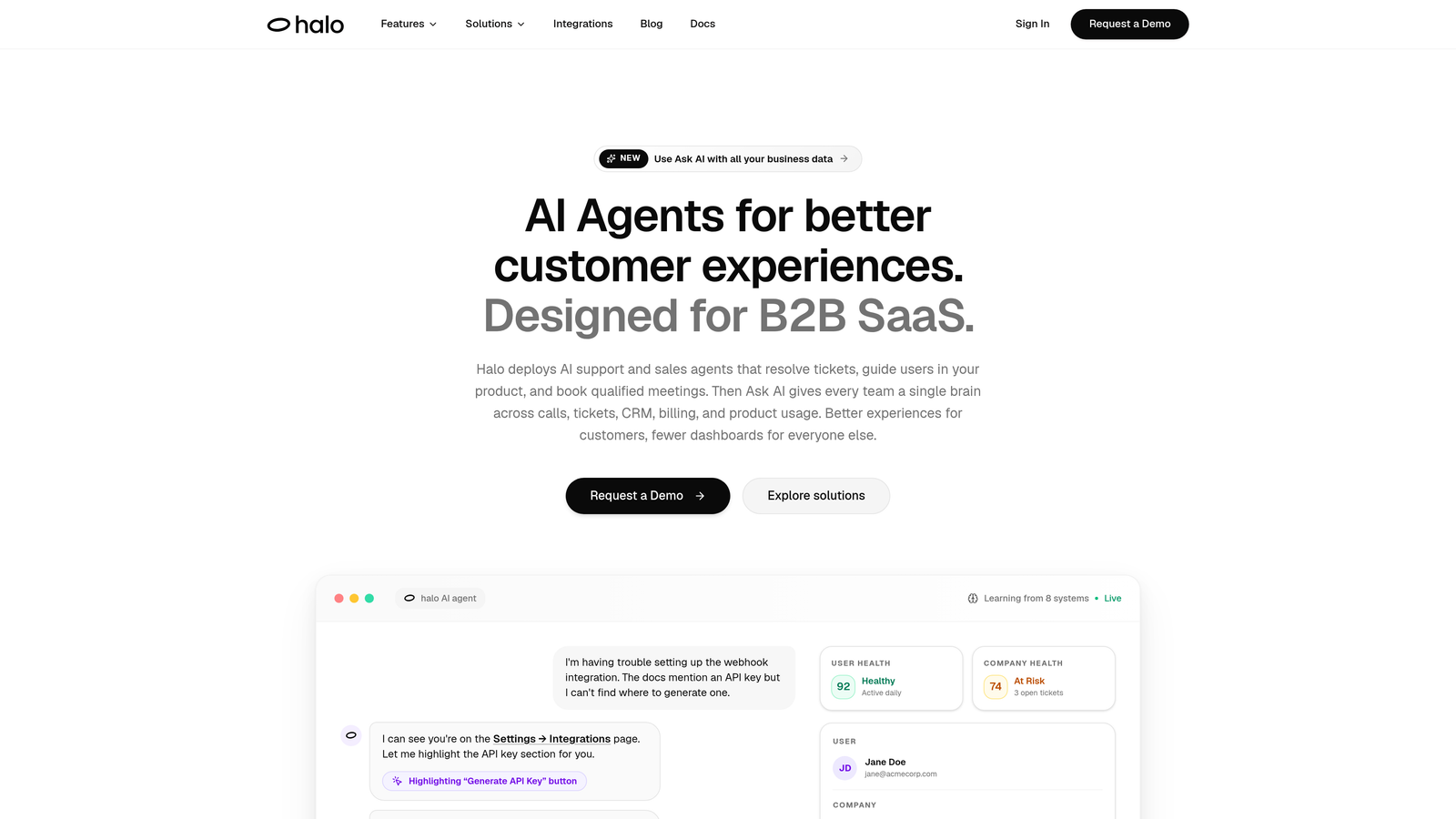
Halo's most distinctive capability is its page-aware context engine. The AI agent doesn't just read what a user types; it sees what the user is looking at, understanding their current product state to deliver guidance that's actually relevant. This is a meaningful step beyond keyword-matching chatbots that respond to text without any awareness of where in your product the user is stuck.
Beyond ticket resolution, Halo's smart inbox surfaces business intelligence that most support tools never capture: customer health signals, revenue anomalies, and trend detection drawn from support interaction patterns. Your support queue becomes a source of strategic insight, not just a cost center to manage down.
Key Features
Page-Aware Chat Widget: The AI sees the user's current page and product state, delivering contextual UI guidance rather than generic answers.
Intelligent AI Agents: Autonomous ticket resolution with continuous learning from every interaction, improving accuracy over time without manual retraining.
Smart Inbox with Business Intelligence: Surfaces customer health signals, revenue intelligence, and anomaly detection beyond standard support metrics.
Auto Bug Ticket Creation: Detects issues and automatically logs them to Linear or equivalent tools without requiring human intervention.
Live Agent Handoff: Intelligent escalation with full context preserved, so human agents never start from scratch.
Deep Integrations: Connects to Linear, Slack, HubSpot, Intercom, Stripe, Zoom, PandaDoc, and Fathom across the full business stack.
Best For
Product-led SaaS companies and B2B teams that want AI-native support without stitching together multiple tools. Particularly strong for teams that need their support layer to connect meaningfully with engineering, sales, and customer success workflows rather than operating in isolation.
Pricing
Visit haloagents.ai for current pricing details. Plans are designed to scale with your support volume and team size.
2. Intercom (Fin AI)
Best for: Teams already invested in the Intercom ecosystem who want autonomous resolution layered in
Intercom is one of the most established customer messaging platforms available, and its Fin AI agent brings genuine autonomous resolution capabilities to that foundation.
Where This Tool Shines
Fin's strength is the infrastructure it sits on. Intercom has spent years building out messenger, inbox, and omnichannel tooling, and Fin plugs into all of it natively. If your team already lives in Intercom, adding Fin doesn't require a migration or a parallel system — it extends what you already have.
The handoff experience is particularly polished. When Fin reaches the edge of its confidence, the transition to a human agent happens within the same interface, with full conversation context intact. For teams where hybrid AI-human support is the operating model, this continuity matters.
Key Features
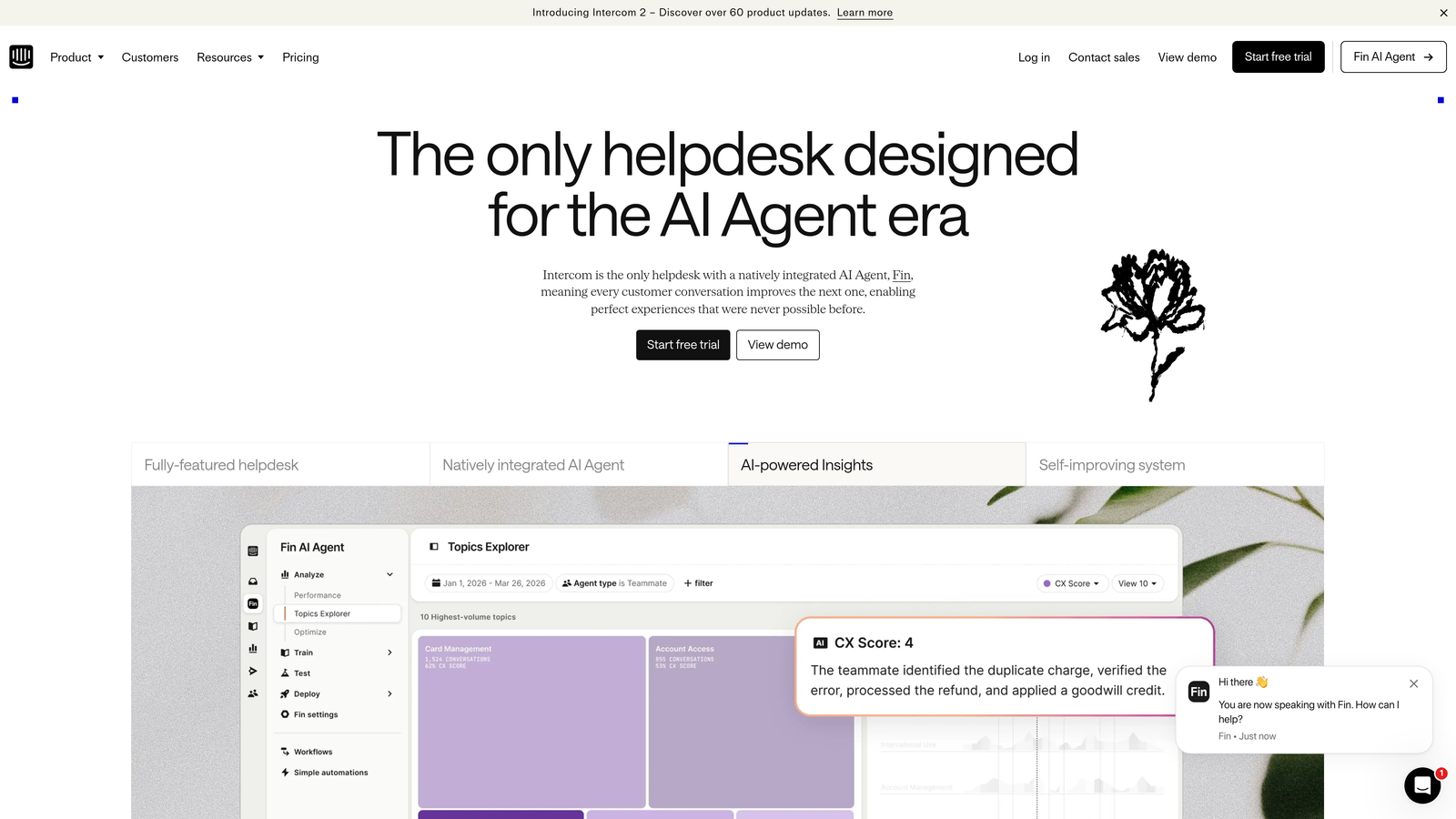
Fin AI Agent: Autonomous query resolution built on large language models, capable of handling a meaningful portion of inbound volume without human involvement.
Mature Messenger Infrastructure: Built on Intercom's established in-app, email, and web messaging foundation.
Seamless Human Handoff: Escalation stays within the same interface, preserving conversation context for the receiving agent.
Omnichannel Coverage: Works across email, chat, and in-app messaging channels from a single platform.
Best For
Companies already running Intercom as their primary support and messaging layer. The ROI is strongest when Fin augments an existing Intercom investment rather than justifying the platform from scratch.
Pricing
AI features are included or available as add-ons depending on plan tier. Verify current pricing at intercom.com.
3. Zendesk AI
Best for: Enterprise teams needing AI-powered triage and agent assistance across complex omnichannel operations
Zendesk has embedded AI deeply across its Suite platform, making it a serious option for large organizations with high-volume, multi-channel support needs.
Where This Tool Shines
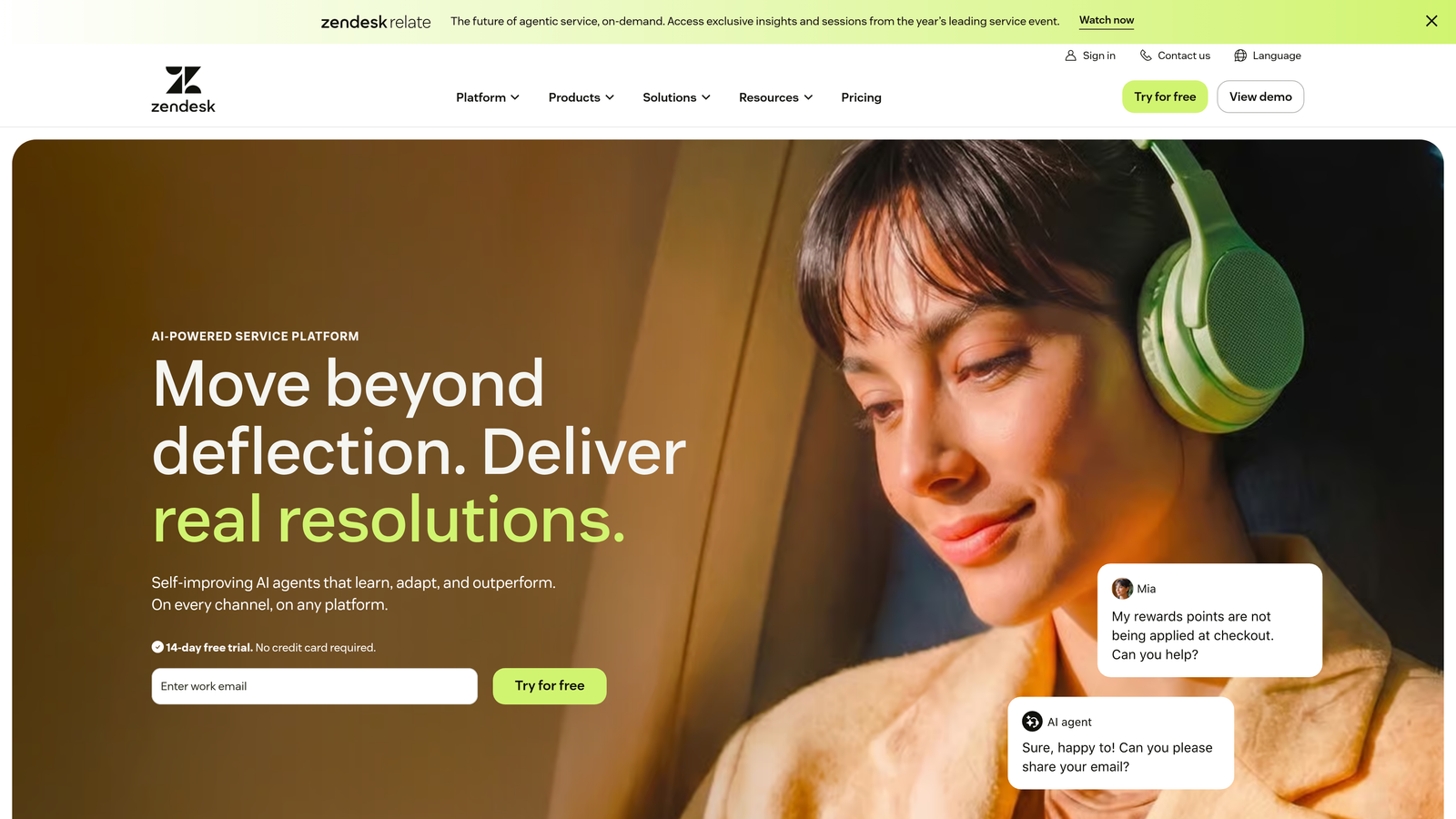
Zendesk's AI capabilities are broad rather than narrow. Intent detection, sentiment analysis, automated routing, and agent copilot features work together across a platform that many enterprise support teams already know well. The acquisition of Ultimate.ai strengthened Zendesk's AI foundation considerably, adding more sophisticated automation capabilities to the existing Suite.
Agent Copilot is one of the more practical features for teams that aren't ready to go fully autonomous: it surfaces suggested responses and next-best-action recommendations in real time, helping human agents resolve tickets faster without removing them from the loop entirely.
Key Features
AI Triage: Automatic intent and sentiment detection that routes tickets to the right queue or agent without manual intervention.
Agent Copilot: Real-time suggested responses and next-best-action guidance for human agents handling complex queries.
Automated Workflow Triggers: Rule and AI-driven automation for ticket routing, tagging, and escalation.
Omnichannel Coverage: Unified management across email, chat, voice, and social channels.
Best For
Enterprise organizations with established Zendesk investments, complex multi-channel support operations, and teams that need AI assistance rather than full AI autonomy. Less ideal for lean SaaS teams looking for a clean AI-native starting point.
Pricing
AI features are available on higher-tier Suite plans. Verify current plan details at zendesk.com.
4. Freshdesk (Freddy AI)
Best for: SMB and mid-market teams wanting accessible AI-powered support without enterprise-level pricing
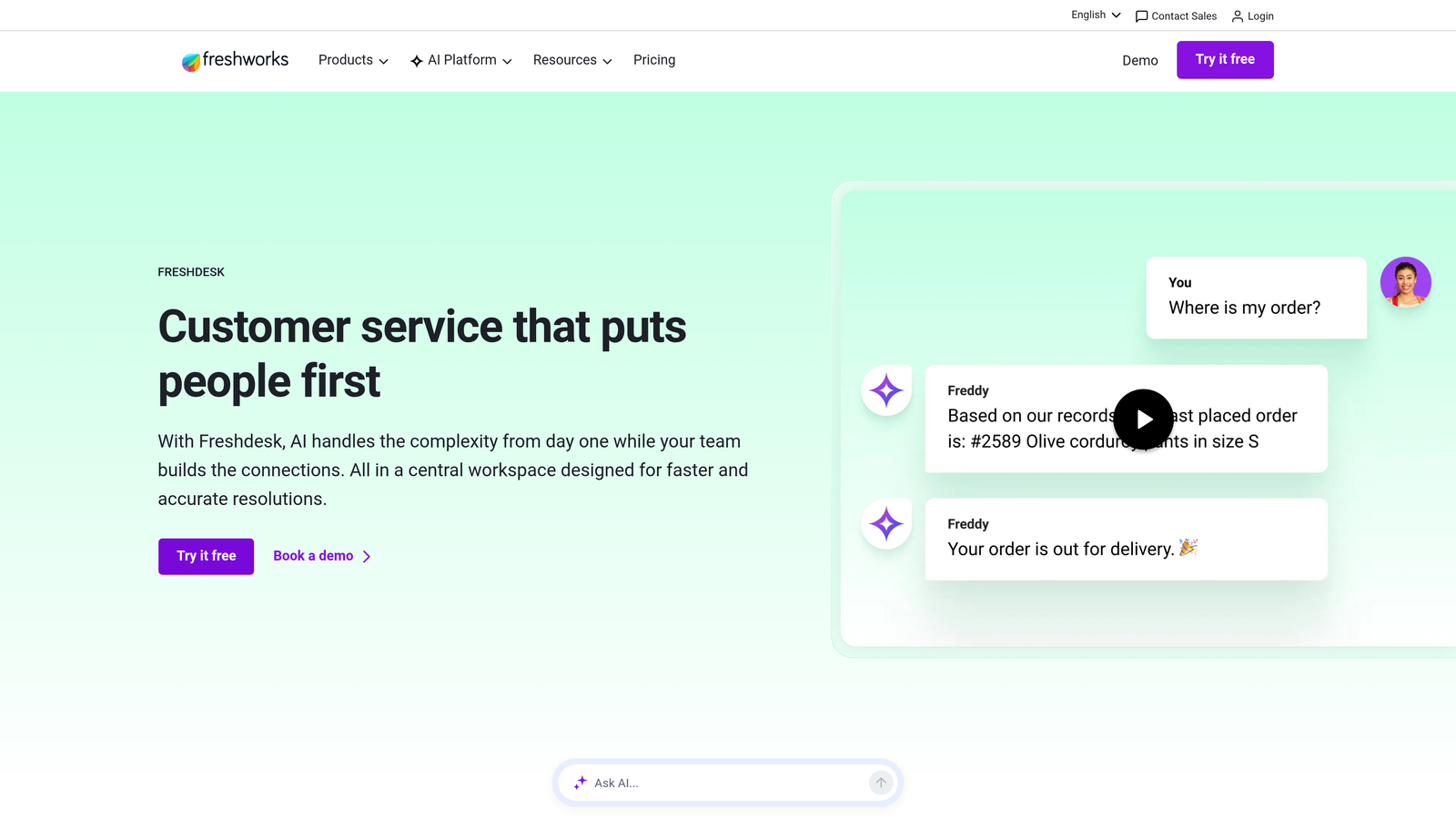
Freshdesk offers Freddy AI as its intelligence layer, spanning self-service, agent assistance, and analytics in a package that's typically more cost-accessible than comparable enterprise alternatives.
Where This Tool Shines
Freddy AI is structured as three distinct components, which gives teams flexibility in how deeply they adopt AI. You can start with self-service deflection, layer in agent assist as your team grows comfortable, and eventually use Freddy Insights to identify where automation can go further. It's a graduated adoption path that suits teams moving from traditional support to AI-augmented workflows.
The pricing accessibility is a genuine differentiator for growing companies. Teams that find Zendesk's AI tiers cost-prohibitive often land on Freshdesk as a capable middle ground.
Key Features
Freddy Self Service: AI chatbot that deflects common queries before they reach the human queue.
Freddy Copilot: Real-time agent suggestions, auto-summarization, and response drafting for human agents.
Freddy Insights: AI-driven analytics with anomaly alerts and performance trend identification.
Accessible Pricing: Competitive cost structure relative to enterprise AI support platforms.
Best For
SMB and mid-market support teams looking for a practical, cost-effective entry into AI-assisted support. Also a strong fit for teams already running Freshdesk who want to activate AI without a platform migration.
Pricing
Tiered pricing across Freshdesk plans. Verify current plan details at freshworks.com.
5. Forethought
Best for: Teams wanting to add autonomous AI capabilities on top of an existing helpdesk without replacing it
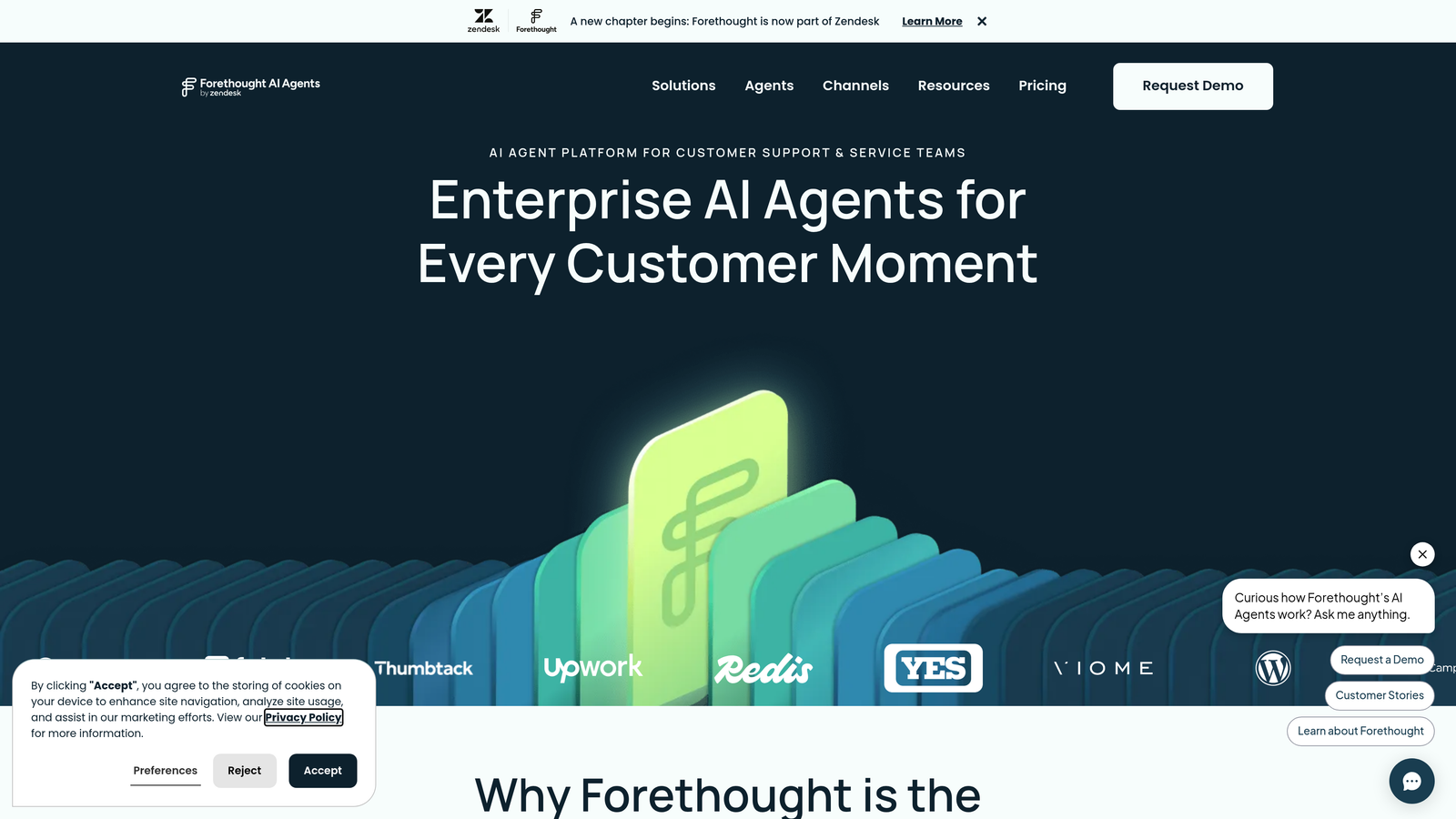
Forethought is an AI layer designed to augment existing helpdesk infrastructure, adding autonomous triage, resolution, and agent assistance without requiring teams to migrate away from their current platform.
Where This Tool Shines
Forethought's key value proposition is additive rather than replacement. If your team has significant Zendesk or Salesforce Service Cloud configuration built up over years, ripping it out to adopt a new platform carries real operational risk. Forethought sits on top of those systems, adding AI intelligence without disrupting existing workflows.
The Discover component is worth highlighting specifically: it analyzes your ticket data to identify which workflows have the highest automation potential, giving you a data-informed roadmap for where to focus AI deployment next.
Key Features
Triage: AI-powered auto-routing and prioritization that reduces manual ticket handling.
Solve: Autonomous resolution for common, repeatable query types.
Assist: In-context suggestions for human agents handling tickets that require personal attention.
Discover: Workflow analytics that surface automation opportunities within your existing ticket data.
Helpdesk Integrations: Works with Zendesk, Salesforce Service Cloud, and other established platforms.
Best For
Enterprise teams with substantial existing helpdesk investments who want AI capabilities without a platform migration. Strong fit for Zendesk and Salesforce shops looking to meaningfully increase automation rates.
Pricing
Enterprise pricing model. Contact Forethought directly for a quote at forethought.ai.
6. Kustomer
Best for: High-volume consumer brands where customer context from order and account history drives support quality
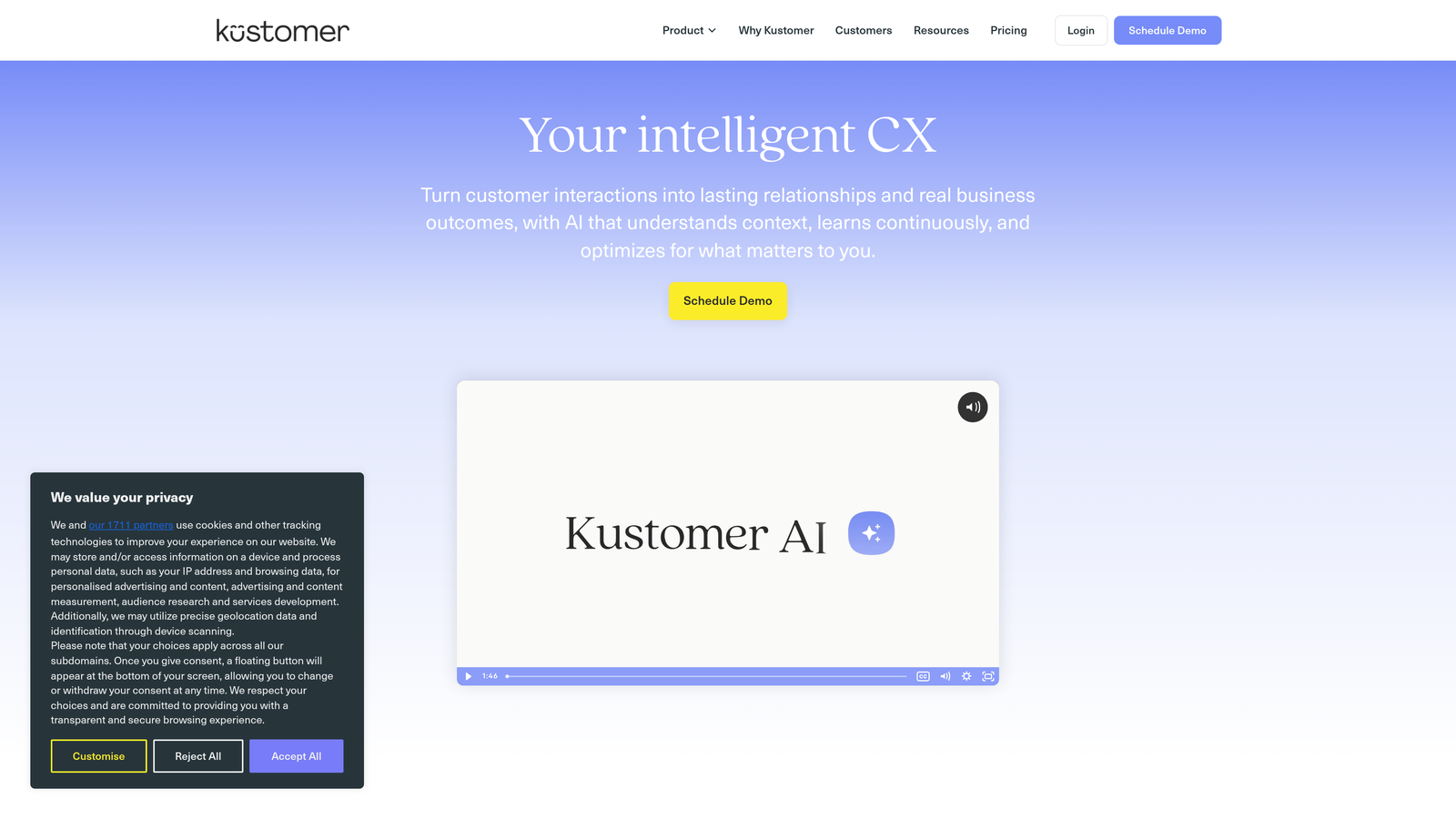
Kustomer is a CRM-first service platform where AI automation is built around a unified customer timeline, combining support history, order data, and account activity in a single view.
Where This Tool Shines
The unified timeline is Kustomer's defining architectural choice. When a customer contacts support, the agent (or AI) sees the complete picture: previous conversations, purchase history, returns, account status, and any prior resolutions. This context-richness enables AI automation that's far more nuanced than systems working only from the current ticket.
For consumer brands handling high volumes of order-related queries — shipping status, returns, account changes — Kustomer's CRM-native approach means the AI has the data it needs to resolve those queries autonomously without escalating for basic account lookups.
Key Features
Unified Customer Timeline: Full history of support interactions, orders, and account data in a single view accessible to both AI and human agents.
Context-Driven AI Automation: Automation triggered by customer history and account state, not just the current message.
Omnichannel Inbox: AI-assisted routing across email, chat, social, and voice channels.
Proactive Workflow Automation: Outreach and workflow triggers based on customer events and account changes.
Best For
High-volume consumer brands and DTC companies where order history and account context are central to support quality. Less optimized for pure B2B SaaS environments where CRM-depth is less critical than product-context awareness.
Pricing
Verify current plan pricing at kustomer.com.
7. Tidio
Best for: Small businesses and early-stage SaaS teams deploying AI-powered support for the first time
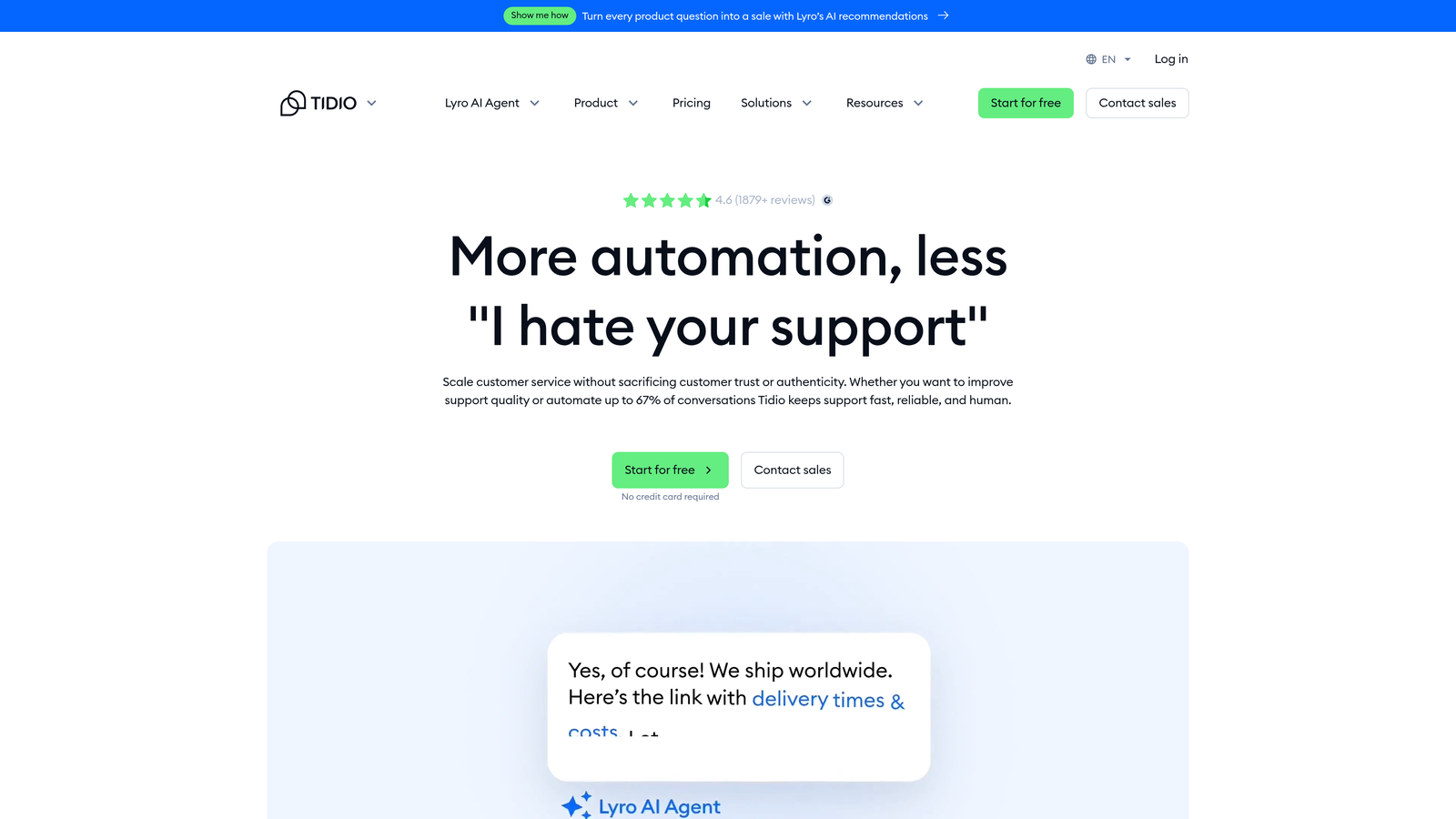
Tidio combines live chat with its Lyro AI agent in a package built specifically for ease of deployment and accessible pricing, making it a practical entry point for teams new to AI support automation.
Where This Tool Shines
Tidio's setup experience is genuinely fast compared to enterprise alternatives. Teams can have Lyro handling conversations within hours rather than weeks, without needing dedicated technical resources or a lengthy onboarding process. For small teams where speed to value matters more than deep customization, that simplicity is a real advantage.
The Shopify and e-commerce integrations are also notably strong, making Tidio a natural fit for product-based businesses where order and inventory queries make up a large share of inbound support volume.
Key Features
Lyro AI Agent: Conversational AI for autonomous support handling, designed for natural dialogue rather than rigid decision trees.
E-Commerce Integrations: Strong native connectivity with Shopify and other e-commerce platforms for order-context support.
Unified Live Chat and AI: Human and AI support managed from a single interface without switching tools.
Free Tier: Available for low-volume use cases, lowering the barrier to initial deployment.
Best For
Small businesses, early-stage SaaS teams, and e-commerce brands that want AI-powered support without enterprise complexity or pricing. Best suited for teams handling lower support volumes who need a fast, simple deployment.
Pricing
Free tier available for low-volume use. Paid plans scale with usage. Verify current plan details at tidio.com.
8. Ada
Best for: Enterprise teams needing action-oriented AI that can execute transactions, not just answer questions
Ada is an enterprise-grade, no-code AI agent builder distinguished by its ability to take action within connected systems — processing refunds, updating account records, and executing workflows autonomously.
Where This Tool Shines
Most AI support tools answer questions. Ada's agents can do things. That distinction matters significantly for consumer-facing businesses where a large portion of support volume involves transactional requests: cancellations, refunds, account updates, plan changes. When the AI can execute those actions rather than just explain how to do them, resolution rates climb and customer frustration drops.
The no-code builder is genuinely accessible for non-technical teams, allowing customer experience and support operations managers to build and modify agent workflows without engineering involvement. For large organizations where engineering bandwidth is a constraint, this autonomy over the tool matters.
Key Features
Action-Oriented AI: Agents can process refunds, update records, and execute workflows — not just retrieve and relay information.
No-Code Agent Builder: Visual workflow builder accessible to non-technical support and CX teams.
Multilingual Support: Native support for multiple languages, enabling consistent global customer experiences.
Enterprise Integrations: Deep connectivity with enterprise CRM, commerce, and back-office platforms.
Best For
Large consumer brands and enterprise teams handling high volumes of transactional support requests where execution capability — not just information retrieval — is the primary requirement. Multilingual needs also make Ada a strong fit for global operations.
Pricing
Enterprise pricing model. Contact Ada directly for a quote at ada.cx.
9. Capacity
Best for: Companies wanting a single AI platform spanning both customer-facing support and internal IT or HR helpdesk
Capacity bridges customer-facing support automation and internal helpdesk use cases, making it a practical choice for organizations that want to consolidate AI tooling across both functions.
Where This Tool Shines
Most support AI tools are built exclusively for external customer interactions. Capacity's architecture spans both directions: it can handle inbound customer queries and internal employee requests within the same platform. For companies running separate tools for customer support and internal IT or HR helpdesks, consolidation here carries real operational and cost benefits.
The knowledge base component is central to how Capacity works. By building a structured, AI-searchable knowledge layer, Capacity enables both customers and employees to self-serve effectively before a ticket is ever created.
Key Features
AI-Powered Knowledge Base: Centralized, searchable knowledge layer that powers self-service for both customers and internal teams.
Dual-Use Automation: Handles customer support and internal IT or HR workflows from a single platform.
Conversational Chatbot Builder: Tools for building and deploying AI chat experiences without deep technical requirements.
Helpdesk Integrations: Connects with common business tools and existing helpdesk platforms.
Best For
Mid-market and enterprise companies that want to consolidate external and internal support automation under one AI platform. Particularly strong for organizations where IT and HR helpdesk volume is high enough to justify the investment alongside customer support.
Pricing
Verify current pricing and plan details at capacity.com.
Which Platform Is Right for Your Team?
The right choice here depends less on feature checklists and more on where your team sits today and where you're trying to go.
If you're an enterprise organization with years of Zendesk or Salesforce configuration you're not ready to abandon, Forethought or Zendesk AI are the logical starting points. They add meaningful AI intelligence without requiring a platform migration.
For high-volume consumer brands where order history and transactional execution matter most, Kustomer and Ada are purpose-built for that context. Ada in particular stands out when your support volume is dominated by requests that require action, not just answers.
SMB and early-stage teams that need fast deployment and accessible pricing will find Tidio and Freshdesk's Freddy AI both capable and practical. Neither requires significant technical investment to get running.
For B2B SaaS teams specifically — product-led companies where support quality connects directly to retention and expansion — the calculus is different. You need an AI layer that understands product context, surfaces business intelligence, and connects meaningfully to your engineering and go-to-market stack. That's where Halo AI is purpose-built for your situation.
Your support team shouldn't scale linearly with your customer base. Let AI agents handle routine tickets, guide users through your product, and surface business intelligence while your team focuses on complex issues that need a human touch. See Halo in action and discover how continuous learning transforms every interaction into smarter, faster support.