9 Best AI-Powered Customer Experience Platforms in 2026
Choosing the right AI powered customer experience platform can transform customer support from a cost center into a retention and revenue driver. This guide evaluates nine leading platforms across automation depth, integration breadth, and human handoff quality to help B2B SaaS teams—from lean startups to enterprise operations—find the best fit for resolving tickets autonomously and surfacing early churn signals.
 Matt PattoliFounder13 min read
Customer support is no longer just a cost center — for B2B SaaS teams, it's a direct signal of product health, customer retention, and revenue risk. The right AI-powered customer experience platform can resolve tickets autonomously, surface early churn signals, and guide users through your product without adding headcount. The wrong one adds complexity without meaningful automation.
To build this list, we evaluated platforms across six criteria: automation depth, learning capability, integration breadth, context awareness, pricing accessibility, and quality of human handoff. The tools below span three categories: AI-first platforms built around autonomous agents, helpdesk-plus-AI solutions for teams with existing infrastructure, and messaging or CRM-native platforms where support intersects with sales data.
Whether you're a lean startup looking to deflect tickets at scale or an enterprise team managing thousands of inbound queries daily, there's a platform here built for your situation. Let's get into it.
1. Halo AI
Best for: B2B SaaS teams that want AI-first ticket resolution with deep product and business context.
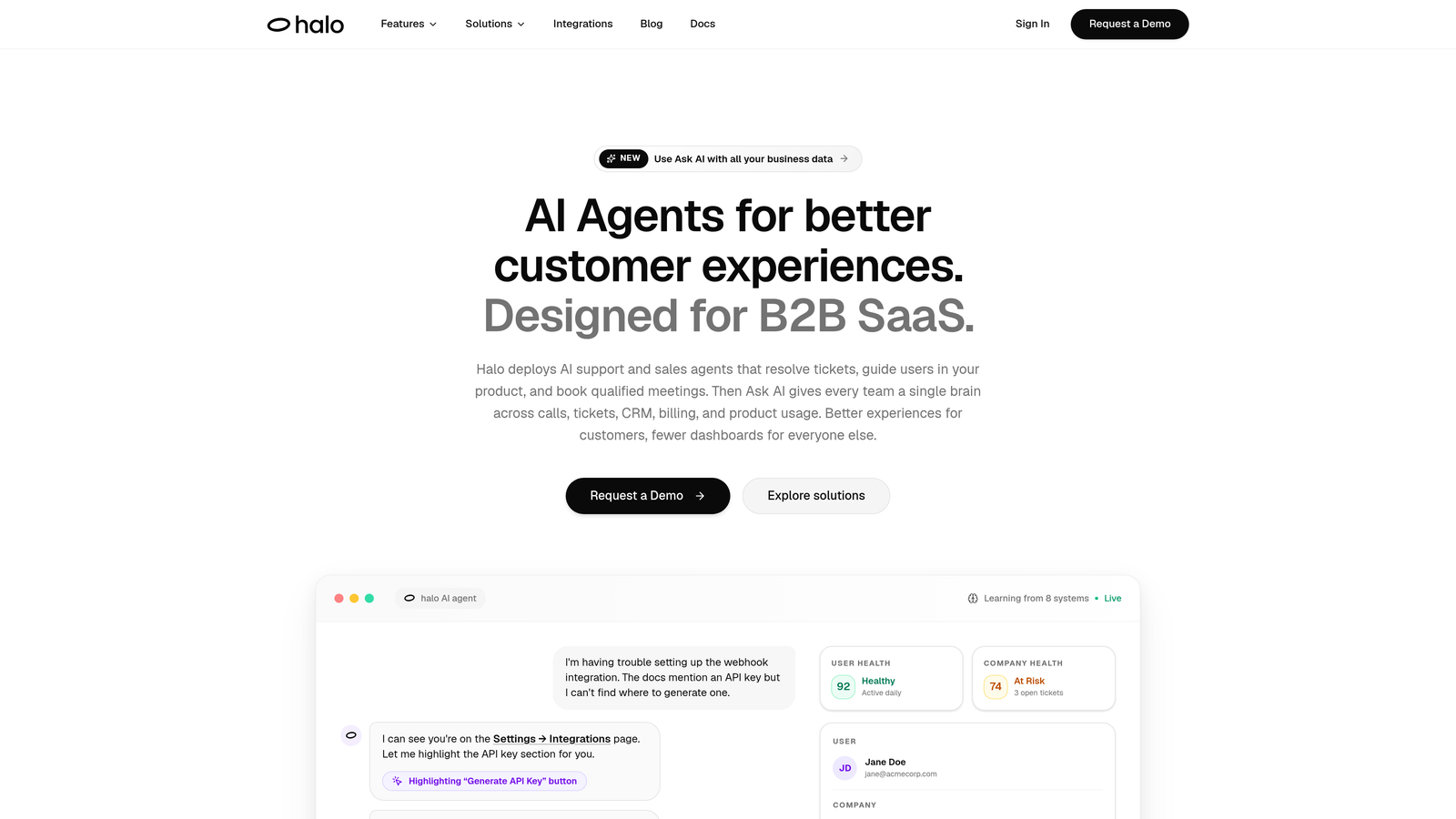
Halo AI is an AI-first customer support platform built specifically for B2B SaaS and product-led growth teams.
Where This Tool Shines
What separates Halo from most platforms on this list is its architecture. Rather than layering AI onto an existing helpdesk, Halo was built from the ground up around autonomous AI agents. That distinction matters: the AI isn't suggesting responses for a human to approve, it's resolving tickets, creating bug reports, and guiding users through your product on its own.
The page-aware chat widget is a genuinely distinctive capability. The AI understands what page a user is on and what they're seeing, which means it can deliver contextual, visual UI guidance rather than generic help center links. Combined with a smart inbox that surfaces customer health signals and revenue anomalies, Halo functions less like a support tool and more like an intelligent layer across your entire customer relationship.
Key Features
Page-Aware Chat Widget: The AI sees what the user sees on screen and delivers contextual guidance tied to their current location in the product.
Autonomous Ticket Resolution: AI agents resolve support tickets end-to-end, with continuous learning from every interaction to improve over time.
Auto Bug Ticket Creation: Automatically generates and routes bug tickets directly to Linear, removing manual triage from your engineering workflow.
Smart Inbox with Business Intelligence: Surfaces customer health signals, revenue anomalies, and churn indicators so support data becomes strategic intelligence.
Live Agent Handoff: Escalates to human agents with full conversation context preserved, so customers never have to repeat themselves.
Deep Integrations: Connects to Linear, Slack, HubSpot, Intercom, Stripe, Zoom, PandaDoc, and Fathom for a unified view across your business stack.
Best For
B2B SaaS companies and product teams that want more than ticket deflection. Halo is particularly well-suited to product-led growth businesses where support, product feedback, and customer health signals need to flow together. If your team is manually triaging bugs, chasing churn signals, or losing context during agent handoffs, Halo addresses all three.
Pricing
Visit haloagents.ai for current pricing details. Plans are designed for B2B SaaS teams at various stages of growth.
2. Intercom
Best for: Teams wanting a mature omnichannel messaging platform with a capable AI agent built in.
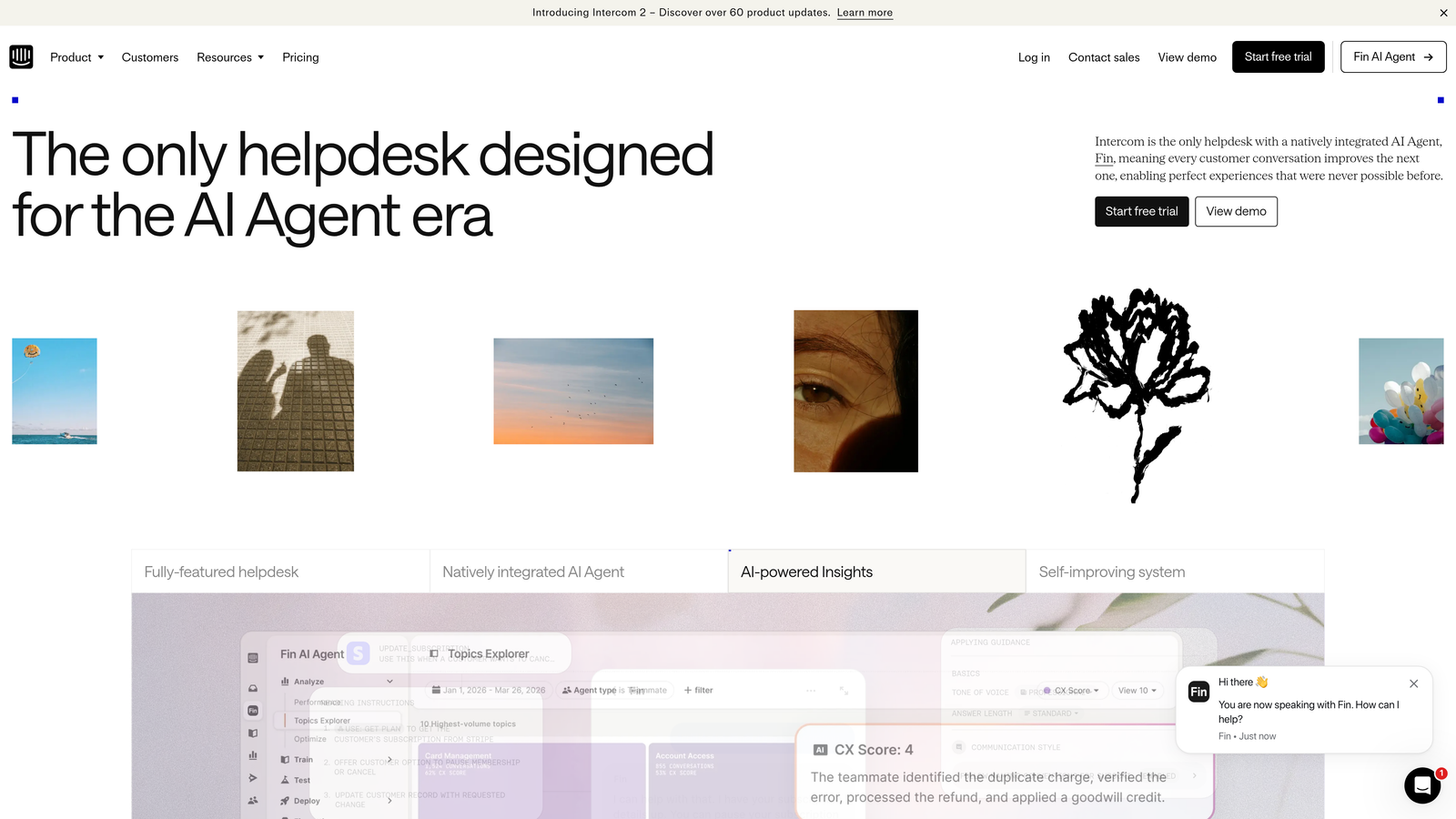
Intercom is one of the most established customer messaging platforms, now featuring Fin, its AI agent built on large language models for autonomous query resolution.
Where This Tool Shines
Intercom's longevity in the market means it comes with a polished, well-documented product and an extensive integration marketplace. Fin, the AI agent, can handle a meaningful share of inbound queries without human involvement, drawing on your existing help center content to generate accurate responses.
The platform's strength is its breadth. In-app messaging, live chat, email, and AI-driven inbox management all live in one place. For teams that need omnichannel coverage alongside AI deflection, Intercom delivers without requiring multiple tools.
Key Features
Fin AI Agent: Resolves inbound queries autonomously using large language models trained on your support content.
Omnichannel Inbox: Manages in-app messaging, live chat, and email conversations from a single workspace.
AI-Powered Inbox: Provides suggested replies and intelligent triage to speed up agent response times.
Conversation Analytics: Tracks CSAT, resolution rates, and conversation trends with detailed reporting.
Integration Marketplace: Connects to hundreds of third-party tools across CRM, billing, and product categories.
Best For
Product and support teams that want a proven, all-in-one messaging platform with solid AI deflection. Intercom works well for SaaS companies at growth stage and beyond. Teams with high inbound volume across multiple channels will get the most value from the platform's breadth.
Pricing
Starts at $39 per seat per month; Fin AI usage is billed per resolution. Costs can scale significantly with volume and seat count. See intercom.com for current rates.
3. Zendesk AI
Best for: Teams already operating within Zendesk's ticketing infrastructure who want to add AI capabilities without switching platforms.
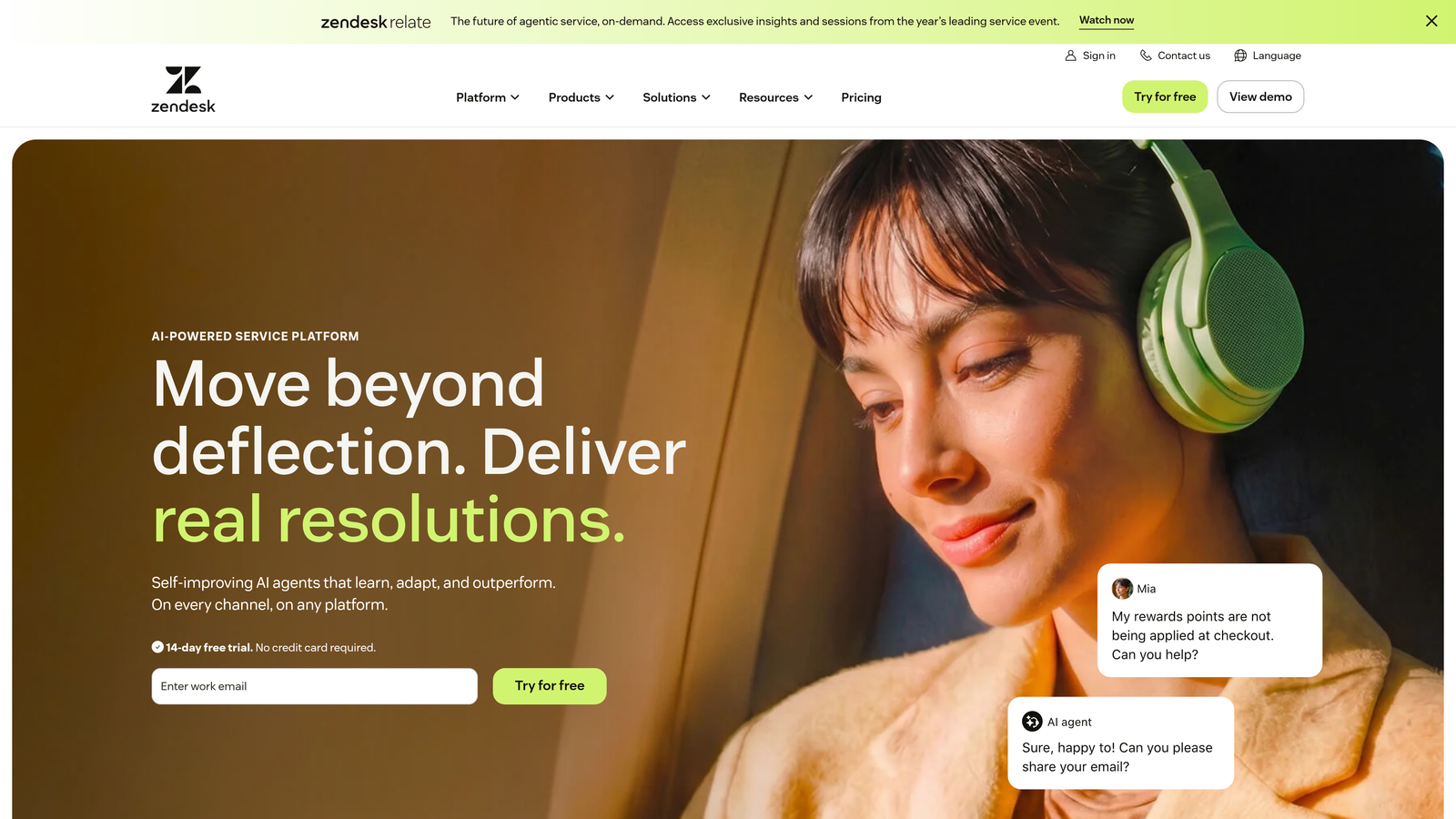
Zendesk AI is the intelligent layer built into Zendesk Suite, offering triage, routing, macro suggestions, and an AI agent for automated deflection.
Where This Tool Shines
If your team already lives in Zendesk, the AI layer integrates without disruption. Intelligent routing and triage reduce the manual sorting burden on agents, while macro suggestions speed up response drafting. For organizations with large, established Zendesk deployments, adding AI doesn't require a migration.
Zendesk acquired Ultimate to power its AI agent capabilities, which means the deflection technology has a solid foundation. Sentiment analysis and intent detection add useful context for prioritization, particularly for high-volume support operations.
Key Features
AI-Powered Triage and Routing: Automatically classifies and routes incoming tickets based on intent and content.
Macro and Response Suggestions: Recommends relevant macros and reply drafts to reduce agent effort on common queries.
AI Agent for Deflection: Handles routine queries autonomously before they reach a human agent.
Sentiment Analysis and Intent Detection: Surfaces emotional context and customer intent to help agents prioritize effectively.
Knowledge Base Optimization: Identifies gaps in help content based on unresolved query patterns.
Best For
Organizations with existing Zendesk deployments that want to improve efficiency without switching platforms. Also a strong fit for mid-market and enterprise teams with complex ticketing workflows already built around Zendesk's infrastructure.
Pricing
AI features are included at higher Suite tiers or available as add-ons on lower plans. See zendesk.com for current pricing and tier details.
4. Freshdesk Freddy AI
Best for: SMB and mid-market teams wanting affordable AI-enhanced helpdesk capabilities within the Freshworks ecosystem.
Freshdesk Freddy AI combines a self-service bot, agent copilot, and analytics insights into Freshworks' helpdesk platform at competitive price points.
Where This Tool Shines
Freddy AI is Freshworks' answer to enterprise-grade AI at a price point accessible to smaller teams. The three-layer approach — self-service bot for deflection, copilot for agent assistance, and Insights for analytics — covers the main AI use cases without requiring separate tools for each function.
For teams already using Freshworks products, the native integration across CRM, ITSM, and helpdesk creates a coherent ecosystem. Freddy Insights in particular adds useful trend detection and support analytics without needing a separate BI tool.
Key Features
Freddy Self Service: Automated bot that deflects routine queries before they reach an agent queue.
Freddy Copilot: Assists agents with reply suggestions, conversation summarization, and next-step recommendations.
Freddy Insights: Provides support analytics, trend detection, and performance reporting across the team.
Freshworks Suite Integration: Native connectivity with Freshworks CRM and ITSM products for a unified customer view.
Competitive Pricing: Positioned as a more accessible alternative to enterprise platforms like Zendesk and Salesforce.
Best For
SMB and mid-market support teams looking for a well-rounded AI helpdesk without enterprise pricing. Teams already invested in the Freshworks ecosystem will benefit most from the native integrations across products.
Pricing
Freddy AI is available as an add-on across Freshdesk plans. See freshworks.com for current plan and add-on pricing.
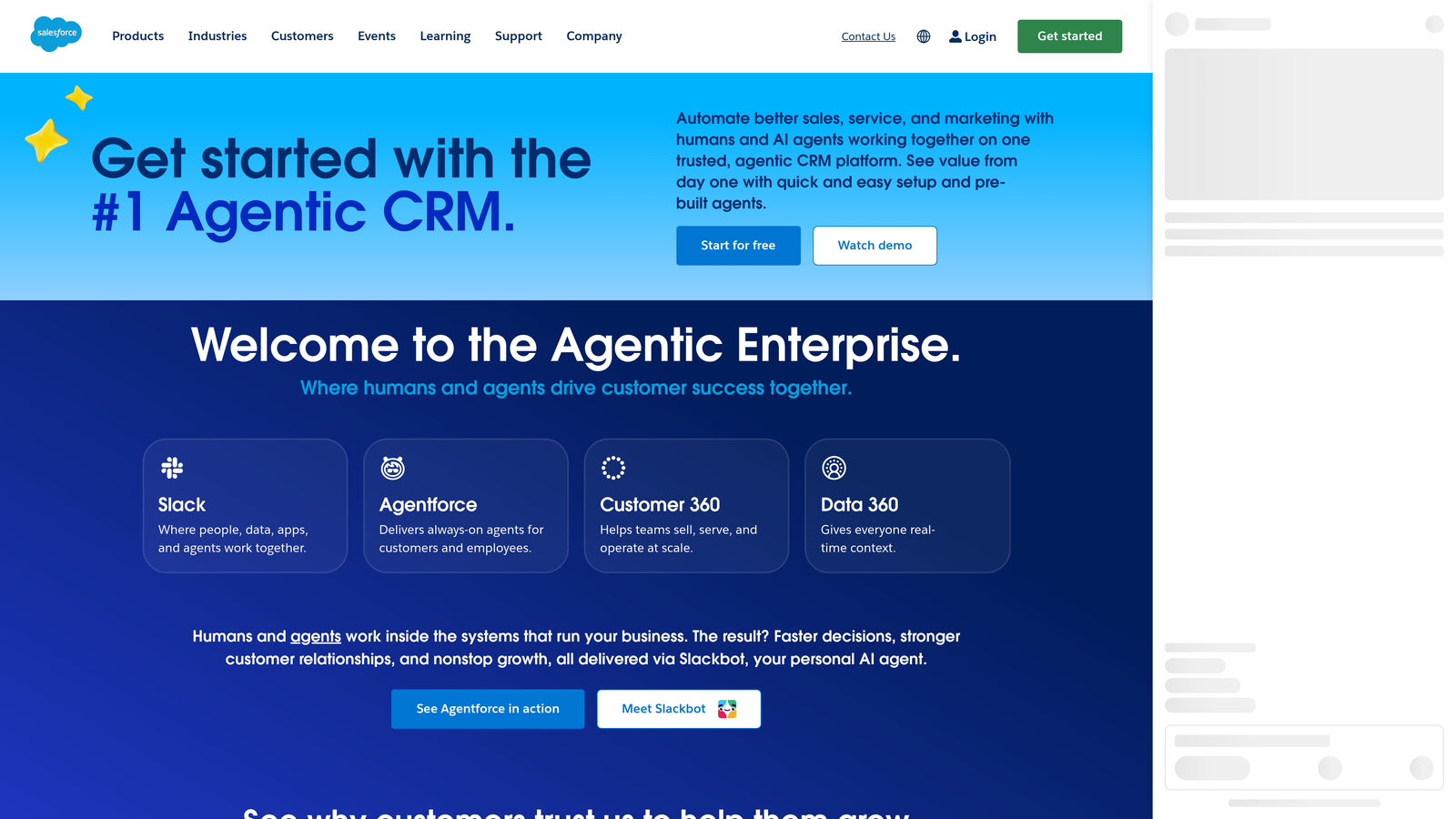
5. Salesforce Einstein Service Cloud
Best for: Enterprise teams whose entire customer record lives in Salesforce and who need AI grounded in full CRM data.
Salesforce Einstein Service Cloud weaves Einstein GPT capabilities into case management, giving large organizations AI-driven support built on complete customer context.
Where This Tool Shines
The core advantage here is data depth. When your entire customer relationship — purchase history, sales interactions, support history, account health — lives in Salesforce, Einstein can draw on all of it to inform case handling. Case summarization, reply drafting, and next-best-action recommendations all benefit from that full-context foundation.
Knowledge article generation from resolved cases is a particularly useful capability for teams with large, evolving help content libraries. Over time, the AI helps keep documentation current without requiring dedicated content work.
Key Features
Einstein GPT for Case Management: Generates case summaries and drafts agent replies using full CRM context.
AI-Powered Classification and Routing: Automatically categorizes and routes cases based on content and customer data.
Next-Best-Action Recommendations: Suggests optimal agent responses based on case history and customer profile.
Knowledge Article Generation: Creates help content from resolved cases to continuously improve self-service resources.
Deep Salesforce Integration: Fully connected to Sales Cloud, CRM data, and the broader Salesforce platform.
Best For
Enterprise organizations already standardized on Salesforce. The implementation complexity and cost make it less accessible for smaller teams, but for large organizations where Salesforce is the system of record, the AI capabilities are deeply contextual in ways that standalone tools cannot replicate.
Pricing
Enterprise pricing with Service Cloud editions and Einstein add-on costs. See salesforce.com for current pricing and edition details.
6. Drift (Salesloft)
Best for: B2B companies where website chat serves both sales qualification and support routing simultaneously.
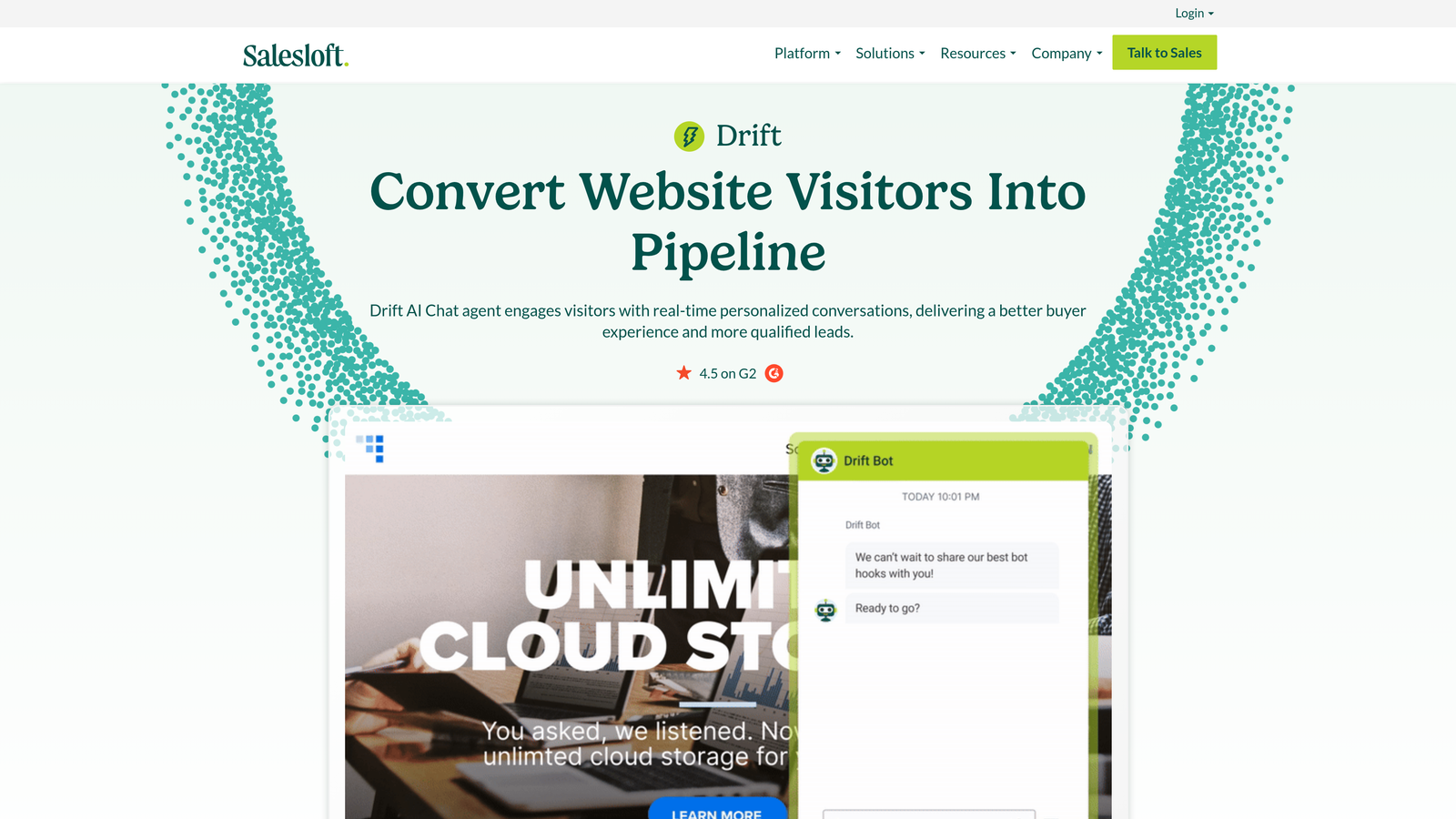
Drift, now part of Salesloft, uses AI-powered chat to qualify leads and handle support queries in a single conversation flow on B2B websites.
Where This Tool Shines
Drift's original insight was that website visitors shouldn't have to fill out a form and wait. The AI chatbot engages visitors in real time, qualifies intent, routes to the right team, and can book meetings directly from the conversation. For B2B companies where marketing, sales, and support all touch the same website visitor, that unified flow reduces friction significantly.
Following the Salesloft acquisition, Drift's positioning has shifted toward revenue teams. The real-time visitor intelligence and intent signals make it particularly useful for teams that want to connect chat activity to pipeline outcomes.
Key Features
AI Chatbot for Qualification and Routing: Engages visitors, qualifies intent, and routes to sales or support based on conversation signals.
Real-Time Visitor Intelligence: Identifies visitor company, intent signals, and engagement patterns as conversations happen.
In-Chat Meeting Booking: Allows prospects to schedule meetings with sales reps directly within the chat window.
CRM and Marketing Automation Integration: Syncs conversation data to CRM and marketing tools for follow-up workflows.
Revenue-Focused Reporting: Connects chat activity to pipeline and revenue outcomes for sales-aligned teams.
Best For
B2B companies where the line between sales and support is intentionally blurred on the website. Particularly strong for demand generation teams that want chat to serve as both a qualification tool and a support channel. Less suited for pure support-focused deployments.
Pricing
Contact Salesloft or Drift directly for current pricing. See drift.com for more information.
7. Tidio
Best for: Small businesses and e-commerce stores that need quick AI deployment at an accessible price point.
Tidio is an accessible AI customer service platform featuring Lyro, its AI agent, designed for fast setup and affordable pricing without requiring technical resources.
Where This Tool Shines
Tidio's primary strength is simplicity. Lyro can be deployed quickly, the no-code chatbot builder requires no engineering involvement, and the platform consolidates live chat, email, and social media into a single inbox. For small teams that need AI support coverage without a lengthy implementation, Tidio removes most of the barriers.
The Shopify and WooCommerce integrations make it a natural fit for e-commerce businesses. The availability of a free plan also makes it one of the few tools on this list where a team can start without a budget commitment.
Key Features
Lyro AI Agent: Handles automated query resolution using your existing support content as its knowledge base.
Unified Inbox: Combines live chat, email, and social media messages into a single agent workspace.
No-Code Chatbot Builder: Lets non-technical team members build and customize chat flows without engineering support.
E-Commerce Integrations: Native connectivity with Shopify and WooCommerce for order and product context.
Free Plan: Available for small teams getting started with AI customer service at no cost.
Best For
Small businesses, e-commerce teams, and early-stage startups that need fast AI deployment at low cost. Tidio is less well-suited for complex B2B SaaS support workflows that require deep integrations, business intelligence, or sophisticated escalation logic.
Pricing
Free plan available; paid plans start at accessible rates for small teams. See tidio.com for current pricing tiers.
8. Kustomer
Best for: High-volume consumer support operations that need every conversation tied to a full customer timeline.
Kustomer is a CRM-native customer service platform that connects every support interaction to a unified customer history, using AI for routing, sentiment analysis, and suggested responses.
Where This Tool Shines
Kustomer's architecture is built around the customer record rather than the ticket. Every conversation — regardless of channel — is appended to a single customer timeline that includes purchase history, previous interactions, and behavioral data. For support teams handling high volumes where customer context is critical to resolution quality, this approach reduces the time agents spend piecing together background information.
The AI capabilities layer on top of that CRM foundation, enabling smarter routing based on customer value, sentiment-aware prioritization, and automated workflows triggered by specific customer behaviors or milestones.
Key Features
Unified Customer Timeline: Aggregates all conversations, purchases, and interactions into a single customer view across every channel.
AI Routing and Sentiment Analysis: Routes tickets based on customer value and urgency signals detected through sentiment analysis.
Behavioral Workflow Automation: Triggers automated actions based on specific customer behaviors, events, or lifecycle stages.
Omnichannel Coverage: Manages chat, email, SMS, social media, and voice from one platform.
Customer Lifetime Value Reporting: Connects support metrics to revenue and retention data for strategic decision-making.
Best For
High-volume consumer support teams and businesses where customer lifetime value data needs to inform support prioritization. Less commonly deployed in pure B2B SaaS environments, but well-suited to consumer brands, subscription businesses, and retail operations with complex customer histories.
Pricing
Enterprise pricing model. See kustomer.com for current plan details and pricing information.
9. Ada
Best for: Enterprise brands that need a no-code AI agent builder with multilingual capabilities and strict security compliance.
Ada is an enterprise-grade AI customer service automation platform built for organizations that need control over AI behavior without requiring engineering resources to configure it.
Where This Tool Shines
Ada's no-code agent builder is genuinely accessible to non-technical teams. Brand, support, and operations teams can build, adjust, and deploy AI agents without pulling engineering resources — which matters at enterprise scale where iteration speed is often bottlenecked by development queues.
The multilingual capabilities make Ada a strong option for global support operations. Combined with SOC 2 Type II and GDPR compliance, it's one of the more enterprise-ready platforms on this list for organizations with strict security and data residency requirements.
Key Features
No-Code Agent Builder: Enables non-technical teams to build and customize AI agents without engineering involvement.
Multilingual Support: Handles customer queries across a wide range of languages for global support operations.
Enterprise Security Compliance: SOC 2 Type II and GDPR certified for organizations with strict data and security requirements.
CRM and Helpdesk Integrations: Connects to major platforms to pull customer context into automated conversations.
Containment and Deflection Analytics: Tracks how effectively the AI resolves queries without human escalation.
Best For
Large enterprises and global brands that need multilingual AI coverage, enterprise security compliance, and the ability to manage AI behavior without ongoing engineering dependency. Typically positioned for organizations with significant inbound volume and complex compliance requirements.
Pricing
Enterprise pricing. See ada.cx for current rates and package details.
Which Platform Is Right for Your Team?
The right choice depends less on feature lists and more on where your team sits today and where your support operation needs to go.
If you're a B2B SaaS team that wants AI-first architecture: Halo AI is the most purpose-built option on this list. The page-aware context, auto bug ticket creation, and business intelligence signals are capabilities designed specifically for product-led growth companies, not retrofitted from a generic helpdesk. For teams where support, product feedback, and customer health signals need to work together, it's the strongest fit.
If you're already invested in Zendesk or Freshdesk: Adding the AI layer within your existing platform is the path of least resistance. Zendesk AI and Freshdesk Freddy AI both offer meaningful automation without requiring a migration. Freshdesk tends to be more accessible on price; Zendesk offers deeper customization at higher tiers.
If support and sales share the same website conversation: Drift is built for exactly that overlap. It's not a pure support tool, but for B2B companies where qualification and support routing happen in the same chat window, the revenue-focused architecture makes sense.
If you're an enterprise standardized on Salesforce: Einstein Service Cloud is the natural choice. The AI is only as good as the data it draws from, and if that data lives in Salesforce, no other platform can match the contextual depth.
If you're a small business or e-commerce store: Tidio gets you started quickly and affordably. For global enterprise operations with compliance requirements, Ada offers the security and multilingual coverage that smaller platforms don't prioritize.
Your support team shouldn't scale linearly with your customer base. Let AI agents handle routine tickets, guide users through your product, and surface business intelligence while your team focuses on complex issues that need a human touch. See Halo in action and discover how continuous learning transforms every interaction into smarter, faster support.