9 Best AI-Powered Customer Service Tools in 2026
This guide evaluates the 9 best AI-powered customer service tools available in 2026, comparing purpose-built AI-first platforms against legacy helpdesk add-ons across key criteria including autonomous ticket resolution, integration depth, and scalability—helping SaaS teams, product teams, and enterprise operations find the right solution for their specific support needs.
 Matt PattoliFounder14 min read
AI-powered customer service tools have moved well beyond simple chatbots. Today's platforms resolve tickets autonomously, detect customer health signals, route complex issues to the right human, and even generate bug reports—all without adding headcount. But the market is crowded, and not every tool is built for the same use case.
Some are bolt-on AI layers added to legacy helpdesks. Others are purpose-built AI-first platforms designed to learn and improve with every interaction. This guide covers the top AI-powered customer service tools available in 2026, evaluated on autonomous resolution capability, integration depth, ease of deployment, and how well they scale with growing support volumes.
Whether you're a SaaS team looking to deflect repetitive tickets, a product team that needs page-aware guidance, or an enterprise operation standardizing on a single support stack—there's a right tool for your situation. Let's get into it.
1. Halo AI
Best for: B2B SaaS and product teams wanting an AI-first support platform with page-aware context and business intelligence
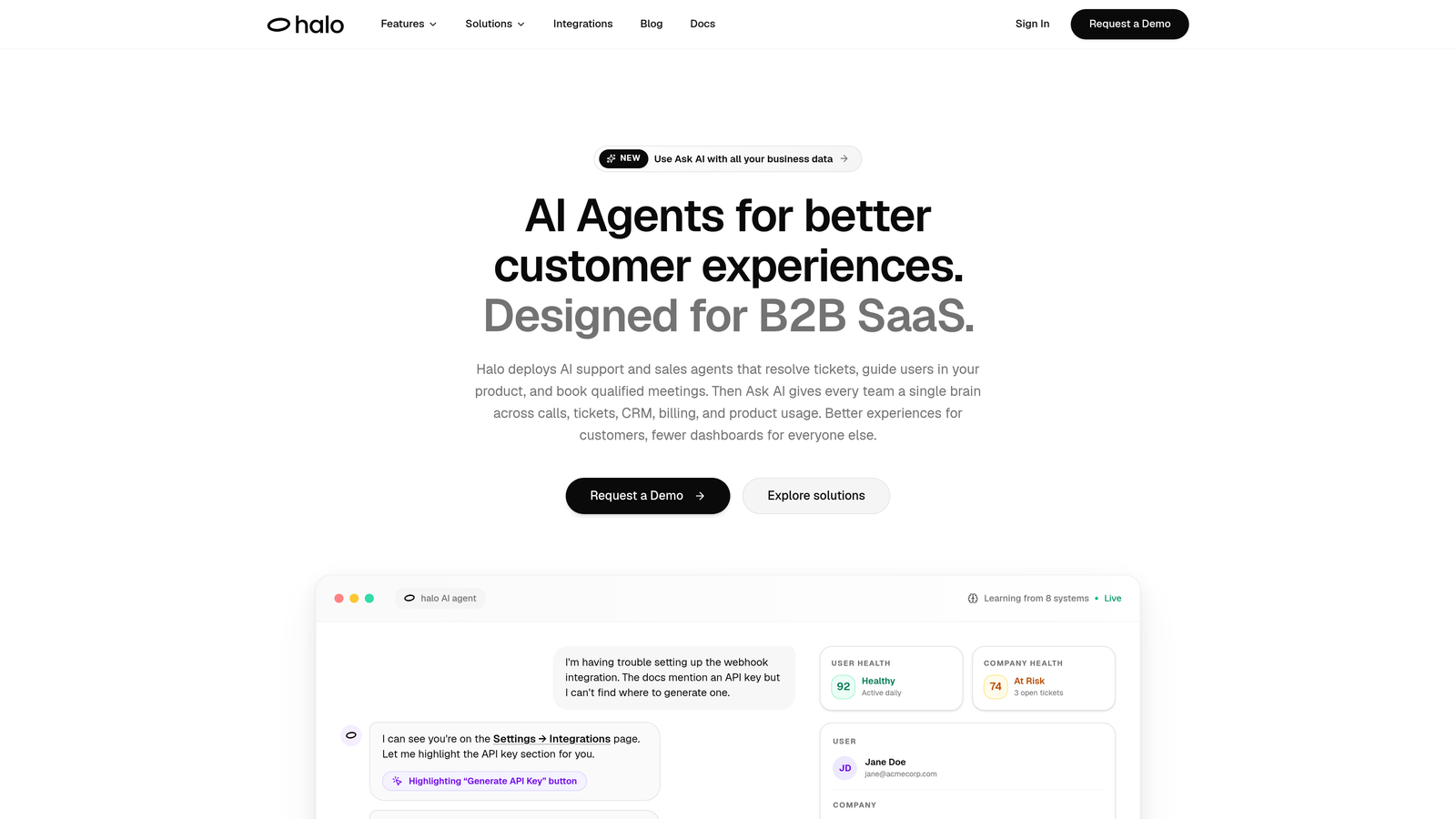
Halo AI is an AI-first customer support platform that deploys autonomous agents to resolve tickets, guide users through your product with page-aware context, and surface business intelligence signals—all while continuously learning from every interaction.
Where This Tool Shines
What separates Halo from most tools on this list is its architecture. Rather than layering AI onto an existing helpdesk, Halo is built from the ground up around autonomous resolution. That means the entire system—from how tickets are triaged to how agents learn—is optimized for AI-first operation, not retrofitted to fit legacy workflows.
The page-aware context is a genuine differentiator for product teams. Halo's chat widget understands what page a user is on and what they're looking at, which means AI agents can provide visual UI guidance specific to the user's current situation rather than generic help center responses. Combine that with auto bug ticket creation routed directly to Linear, and you have a support layer that connects directly to your product development cycle.
Key Features
Page-Aware AI Agents: Agents understand the user's current product context, enabling precise in-app guidance rather than generic responses.
Autonomous Ticket Resolution: Handles routine tickets end-to-end with smart escalation to human agents for complex issues that genuinely need one.
Auto Bug Ticket Creation: Detects and routes bug reports directly to Linear, closing the loop between support and engineering automatically.
Smart Inbox with Business Intelligence: Surfaces customer health signals, revenue anomalies, and CSAT trends—turning support data into strategic insight.
Deep Integration Stack: Connects natively with Slack, HubSpot, Intercom, Stripe, Zoom, PandaDoc, and Fathom for a unified view across your business.
Best For
B2B SaaS companies and product teams that want more than ticket deflection. Halo is particularly well-suited to teams that need their support layer to connect to engineering (via Linear), sales (via HubSpot), and billing (via Stripe)—and want continuous learning baked into the architecture, not bolted on later.
Pricing
Contact sales for pricing. Halo is positioned as an enterprise-grade platform, so pricing is customized based on team size and integration requirements.
2. Intercom (Fin AI Agent)
Best for: Teams already using Intercom who want AI resolution layered natively into their existing inbox
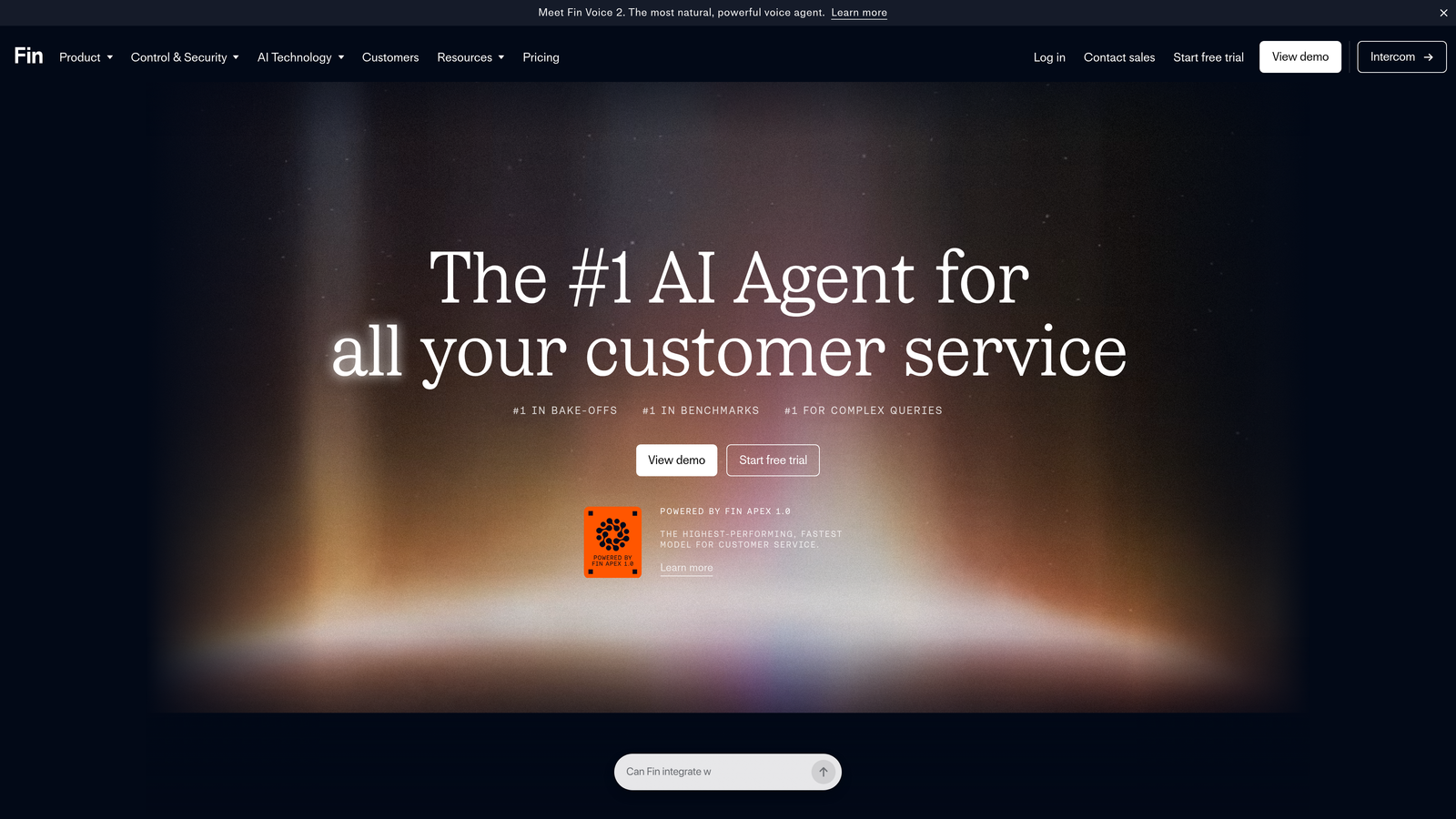
Intercom's Fin AI Agent is a large language model-powered support agent that answers customer questions using connected knowledge sources, operating natively inside the Intercom inbox.
Where This Tool Shines
Fin's biggest strength is how seamlessly it fits into the Intercom ecosystem. If your team already lives in Intercom, Fin doesn't require a workflow overhaul—it reads your existing help center content and starts resolving common questions almost immediately. The human handoff experience is smooth, which matters when customers need to escalate.
The consumption-based pricing model (per resolution) is worth understanding carefully before committing. At low volumes it's attractive, but at scale the costs can grow in ways that are harder to predict than a flat per-seat model. Teams with a well-maintained, comprehensive help center will get more value from Fin than those with sparse documentation.
Key Features
LLM-Powered Resolution: Answers questions by referencing connected knowledge bases and help center content with strong natural language understanding.
Native Inbox Integration: Operates within the Intercom inbox with seamless handoff to human agents when needed.
Consumption-Based Pricing: Charged per resolution, which aligns cost directly with value delivered.
Multi-Channel Support: Handles conversations across chat, email, and social channels.
Resolution Analytics: Dashboard tracking resolution rates, CSAT, and deflection metrics.
Best For
Teams already invested in the Intercom ecosystem with a well-maintained help center. Less compelling for teams that want AI capabilities independent of a specific helpdesk platform, or those with complex multi-system integration requirements beyond Intercom's native stack.
Pricing
Consumption-based; per-resolution pricing layered on top of your existing Intercom plan. Total cost depends heavily on resolution volume—review your ticket data before projecting costs.
3. Zendesk AI
Best for: Large enterprise support teams with complex routing logic already running on Zendesk
Zendesk AI adds intelligent triage, agent copilot suggestions, generative reply drafting, and automated routing on top of the Zendesk Support platform.
Where This Tool Shines
Zendesk AI's depth of integration with Zendesk's existing trigger and macro system is a genuine advantage for teams with sophisticated routing logic already built in Zendesk. Intent detection, sentiment analysis, and language identification happen automatically, meaning tickets reach the right team faster without manual intervention.
The agent copilot is particularly useful for teams managing high ticket volumes with varying agent experience levels. Real-time reply suggestions and ticket summarization reduce the cognitive load on agents and help newer team members respond with consistency. The trade-off is cost: AI features are add-ons to existing Zendesk plans, so total cost of ownership can climb quickly at scale.
Key Features
Intelligent Triage: Automatically detects intent, sentiment, and language to route tickets to the right team or agent.
Agent Copilot: Provides real-time reply suggestions and macro recommendations directly in the agent workspace.
Generative AI: Drafts replies and summarizes long ticket threads to reduce agent effort on complex conversations.
AI-Powered Routing: Integrates with Zendesk's existing triggers and workflows for seamless automation.
Advanced QA Scoring: Automated quality assurance scoring across agent interactions for coaching and compliance.
Best For
Enterprise support organizations already operating on Zendesk with established workflows, large agent teams, and complex routing requirements. Less compelling for teams evaluating their helpdesk stack from scratch or those looking for AI-first architecture rather than AI augmentation of an existing system.
Pricing
AI features are add-ons to base Zendesk plans. Pricing varies significantly by tier and feature set—contact Zendesk directly for enterprise quotes.
4. Freshdesk Freddy AI
Best for: SMBs and growing teams using the Freshworks ecosystem who want accessible AI without enterprise pricing
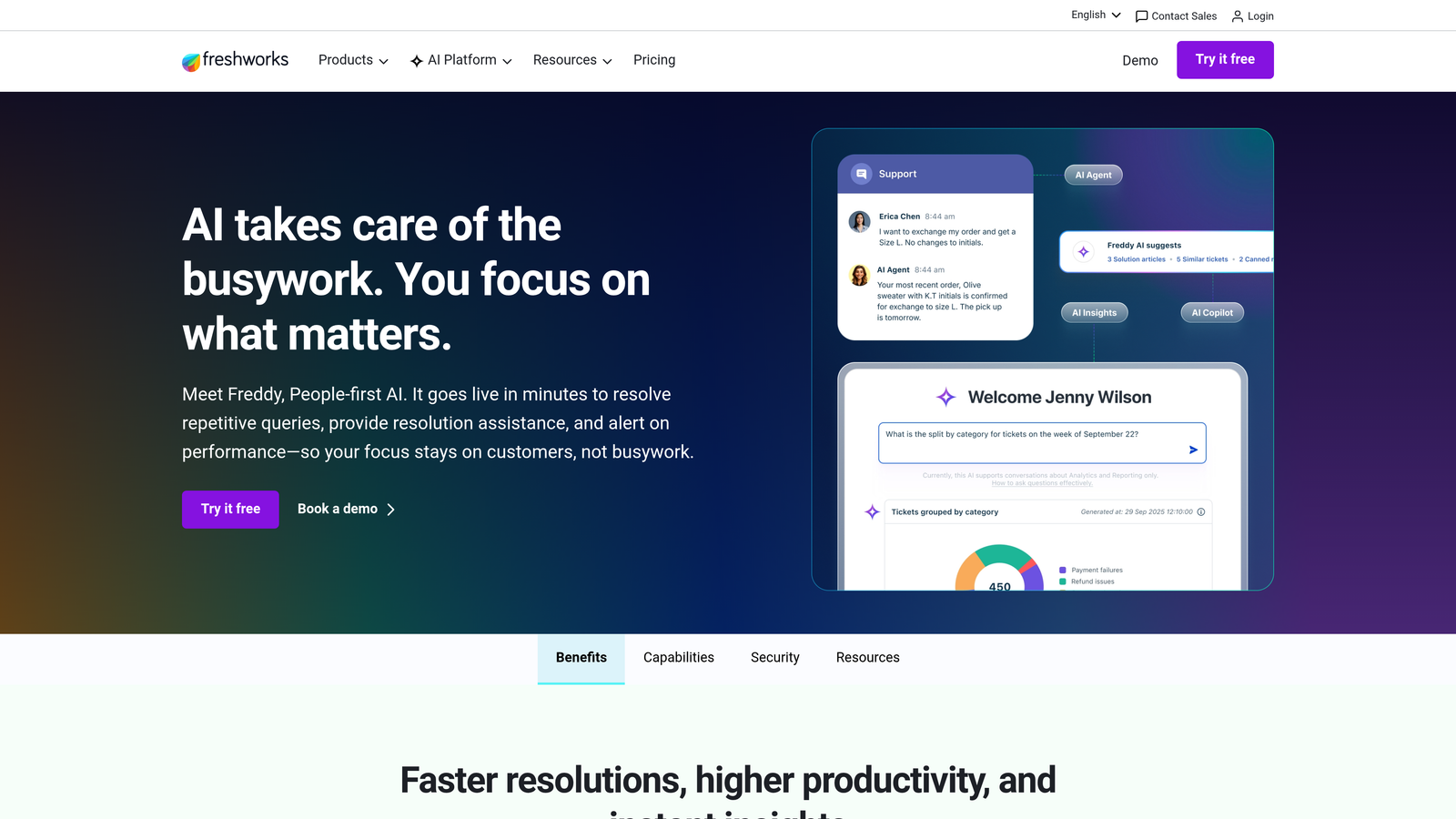
Freddy AI is Freshworks' AI layer across its product suite, bringing self-service bots, agent assist, and predictive analytics to Freshdesk support teams.
Where This Tool Shines
Freddy's appeal is accessibility. For teams that find Zendesk AI's pricing prohibitive or Intercom's per-resolution model unpredictable, Freshdesk Freddy offers a more budget-friendly entry point into AI-augmented support. The breadth of the Freshworks ecosystem also helps: Freddy spans Freshdesk, Freshchat, and Freshsales, so teams using multiple Freshworks products get a more unified AI experience.
The trade-off compared to dedicated AI-first platforms is depth. Freddy is competent across self-service deflection, agent suggestions, and analytics, but teams with complex autonomous resolution requirements may find the capabilities shallower than purpose-built alternatives.
Key Features
Freddy Self Service: Customer-facing AI bot for deflecting common questions before they reach an agent.
Freddy Copilot: Real-time agent suggestions and generative reply drafting inside the Freshdesk workspace.
Freddy Insights: Predictive analytics and CSAT forecasting to help managers identify trends before they become problems.
Cross-Suite Coverage: AI capabilities span Freshdesk, Freshchat, and Freshsales for teams using multiple Freshworks products.
Accessible Pricing: More SMB-friendly pricing structure compared to enterprise-tier competitors on this list.
Best For
SMBs and mid-market teams already on the Freshworks stack, or those evaluating a combined support and CRM solution at a lower price point than Zendesk or Salesforce. Teams with enterprise-scale autonomous resolution needs may outgrow Freddy's capabilities.
Pricing
Freddy Copilot starts around $29/agent/month; Freddy Self Service is priced by conversation sessions. Verify current rates directly with Freshworks, as pricing is updated regularly.
5. Tidio (Lyro AI)
Best for: Small businesses and e-commerce teams needing affordable AI chat without technical complexity
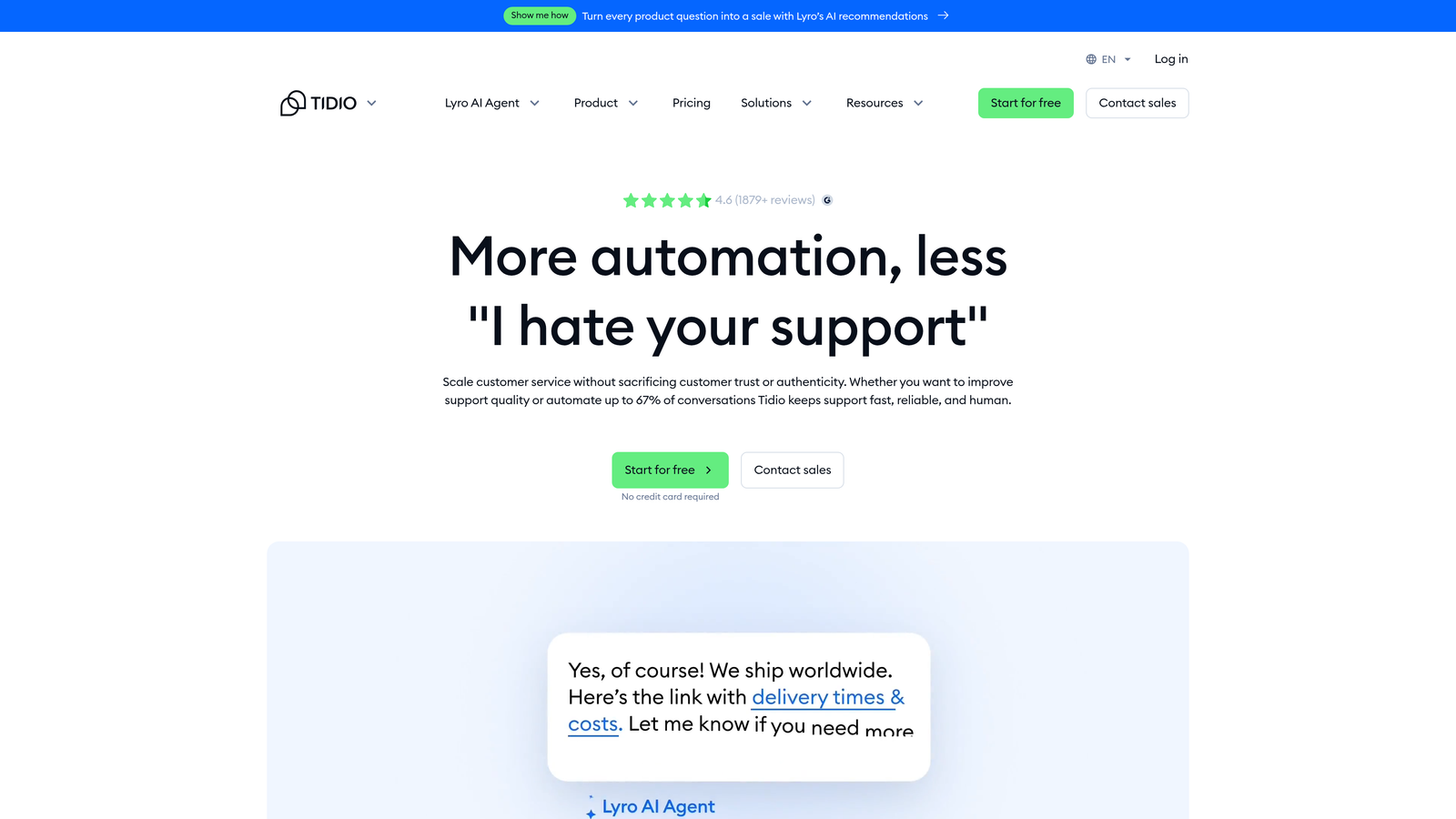
Tidio is a live chat and AI chatbot platform built for small businesses and e-commerce, with its Lyro AI agent handling common customer questions using existing FAQ content.
Where This Tool Shines
Tidio's strength is approachability. The visual flow builder requires no developer involvement, and Lyro AI trains itself on your existing FAQ content, meaning setup time is minimal. For e-commerce teams running on Shopify or WooCommerce, the native integrations mean Lyro can access order data and answer common "where's my order?" questions without any custom development.
It's worth being clear about the ceiling here: Tidio is excellent for small business use cases and straightforward e-commerce queries. It's not designed for complex B2B SaaS support scenarios, multi-step troubleshooting, or enterprise-scale routing logic. But for its target audience, it delivers strong value at a price point that's hard to argue with.
Key Features
Lyro AI Chatbot: Trains on existing FAQ and help content to resolve common questions without agent involvement.
Visual Flow Builder: No-code automation builder that non-technical teams can manage independently.
E-Commerce Integrations: Native Shopify and WooCommerce integrations for order-aware conversations.
Live Chat with AI Handoff: Smooth escalation from Lyro AI to a live agent when questions exceed the bot's capability.
Accessible Entry Pricing: Free plan available with paid tiers that scale based on conversation volume.
Best For
Small businesses, DTC brands, and e-commerce teams on Shopify or WooCommerce that need affordable AI chat without developer resources. Not recommended for B2B SaaS teams with complex support workflows or enterprise-scale requirements.
Pricing
Free plan available. Lyro AI starts from $29/month, with paid plans scaling by conversation volume. One of the most accessible price points on this list.
6. Drift (Salesloft)
Best for: Revenue teams that need AI to bridge sales engagement and support conversations in one platform
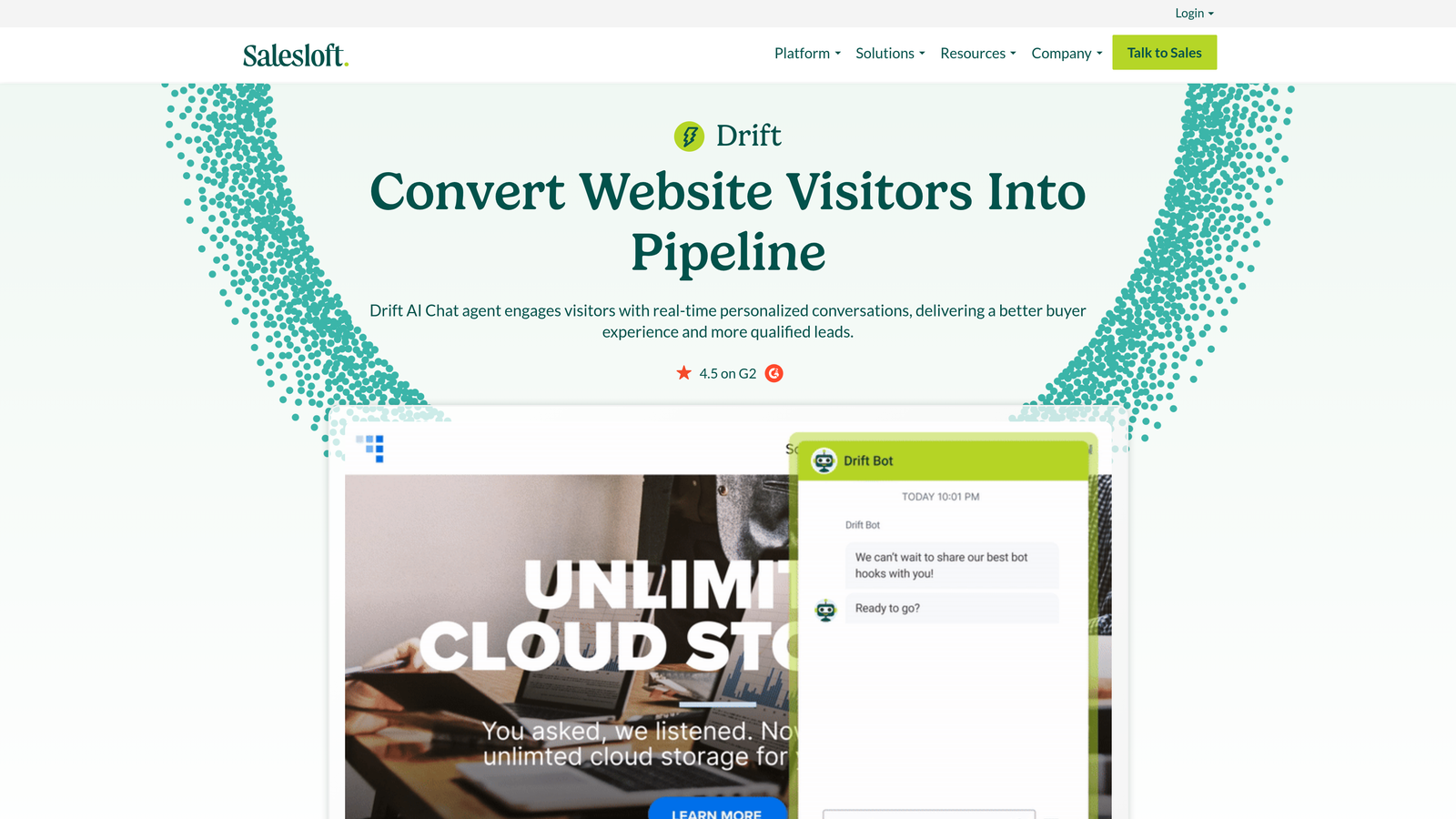
Drift is a conversational AI platform now part of Salesloft, blending sales engagement and support conversations with AI routing, qualification, and personalization.
Where This Tool Shines
Drift's positioning has always been at the intersection of sales and support, and the Salesloft acquisition deepens that angle. If your team needs a platform that handles inbound conversations from both prospective customers and existing users—and routes them intelligently based on account tier and intent data—Drift is genuinely differentiated here.
The ABM integration is worth noting for B2B teams: Drift can personalize the conversation experience based on which account a visitor is from, which is valuable when enterprise prospects and SMB customers need very different handling. That said, if pure support resolution is the primary goal rather than pipeline influence, there are more focused tools on this list.
Key Features
AI Conversation Routing: Routes conversations based on account data, intent signals, and visitor behavior rather than simple keyword matching.
ABM Personalization: Tailors conversation experiences by account tier, segment, or named account for enterprise B2B use cases.
Bionic Chatbots: Combines AI automation with human-authored playbooks for nuanced conversation handling.
Salesloft Integration: Native pipeline influence tracking connecting support conversations to revenue outcomes.
High-Intent Alerts: Real-time notifications when high-value accounts engage, enabling immediate human intervention.
Best For
B2B revenue teams that want a single platform for both sales engagement and customer support conversations. Less suited to teams focused purely on support efficiency or those without a strong ABM motion to leverage.
Pricing
Enterprise pricing; contact Drift or Salesloft directly for current quotes. Pricing is not publicly listed.
7. Ada
Best for: Enterprise CX teams needing multilingual AI agents with strong governance and compliance controls
Ada is a no-code AI agent platform designed for enterprise CX teams, with strong multilingual capabilities, governance controls, and integrations across major helpdesks and CRMs.
Where This Tool Shines
Ada's enterprise governance features are its clearest differentiator. For global organizations that need approval workflows, audit trails, and strict controls over what the AI can and cannot say, Ada provides that infrastructure out of the box. The no-code builder means CX teams can manage and update AI agents without routing every change through engineering.
The multilingual support across 40+ languages makes Ada a practical choice for companies operating across multiple regions where maintaining separate support teams per language isn't feasible. The reasoning engine handles multi-step queries reasonably well for complex questions that require more than a single knowledge base lookup.
Key Features
No-Code Agent Builder: Visual interface that lets non-technical CX teams build and manage AI agents independently.
Multilingual Support: Handles conversations across 40+ languages for global support operations.
Enterprise Governance: Approval workflows, audit controls, and content guardrails for regulated industries and risk-sensitive organizations.
Helpdesk and CRM Integrations: Connects with Zendesk, Salesforce, Freshdesk, and major CRM platforms.
Multi-Step Reasoning: Reasoning engine for resolving complex queries that require chaining multiple pieces of information.
Best For
Global enterprise CX teams that prioritize multilingual coverage, compliance controls, and non-technical manageability. Teams that need deep product-context awareness or tight integration with engineering workflows may find other platforms better suited.
Pricing
Enterprise pricing; contact Ada for custom quotes. Not publicly listed.
8. Kustomer
Best for: High-volume consumer brands and D2C companies needing a CRM-first omnichannel support platform
Kustomer (owned by Meta) is a CRM-first omnichannel support platform with AI automation layered on a unified customer timeline, purpose-built for high-volume consumer brands.
Where This Tool Shines
Kustomer's unified customer timeline is genuinely useful for consumer-facing support teams. Rather than toggling between a CRM, an order management system, and a helpdesk, agents see every interaction, order, and customer history in a single view. That context makes AI-powered suggestions and automated workflows significantly more accurate because the system has more complete data to work with.
The omnichannel coverage—chat, email, SMS, social, and voice—is comprehensive for brands managing support across many consumer touchpoints. Kustomer is less of a fit for B2B SaaS teams; its strengths are most evident in high-volume D2C environments where order history and consumer behavior data drive support interactions.
Key Features
Unified Customer Timeline: Aggregates all interactions, orders, and customer history into a single agent view for richer context.
AI Workflow Automation: Intent detection and automated routing based on customer data and conversation signals.
Omnichannel Coverage: Handles chat, email, SMS, social, and voice from a single platform.
KustomerIQ: Suggested replies and automated routing powered by the customer's full history and intent signals.
E-Commerce and D2C Integrations: Deep integrations with e-commerce platforms for order-aware support at scale.
Best For
High-volume consumer brands, D2C companies, and retail businesses where unified order history and omnichannel coverage are critical. Not the natural fit for B2B SaaS teams where product-context awareness and engineering integrations matter more than order data.
Pricing
Enterprise pricing starting around $89/user/month; contact Kustomer for current rates and volume discounts.
9. Forethought
Best for: Teams wanting AI augmentation on top of their existing helpdesk without replacing it
Forethought is a helpdesk-agnostic AI layer that plugs into existing support stacks—Zendesk, Salesforce Service Cloud, Freshdesk—to add intelligent triage, deflection, agent assist, and support analytics.
Where This Tool Shines
Forethought's core value proposition is additive: it makes your existing helpdesk smarter without requiring you to migrate off it. For teams that have years of workflow configuration and institutional knowledge built into Zendesk or Salesforce, that's a meaningful advantage. The AI layer handles triage, routing, and deflection while leaving the underlying system intact.
The Discover module is worth highlighting for support leaders: topic clustering and CSAT prediction analytics surface which issues are driving dissatisfaction before it shows up in survey scores. That kind of proactive insight is valuable for teams that want to move from reactive support to continuous improvement.
Key Features
Solve: AI auto-responses for common tickets, handling resolution without any human involvement for qualifying queries.
Triage: Intent and sentiment-based routing that gets tickets to the right team or agent faster.
Assist: Real-time agent suggestions pulled from the knowledge base during live conversations.
Discover: Topic clustering and CSAT prediction analytics for proactive support quality management.
Helpdesk-Agnostic: Works across Zendesk, Salesforce Service Cloud, Freshdesk, and other major platforms without requiring migration.
Best For
Enterprise support teams with significant investment in an existing helpdesk who want AI augmentation rather than replacement. Particularly useful for teams that need cross-platform analytics or are running multiple helpdesk systems across different business units.
Which Tool Is Right for Your Team?
The right AI-powered customer service tool depends less on feature checklists and more on where your team sits architecturally. Here's a direct breakdown by use case.
For B2B SaaS and product teams: Halo AI is the strongest fit. Page-aware context, autonomous resolution, auto bug ticket creation routed to Linear, and business intelligence signals make it the most complete platform for teams where support connects directly to product development and revenue.
For teams already on Intercom or Zendesk: Fin AI Agent and Zendesk AI are the natural choices if you want to stay within your existing ecosystem. Just model the cost carefully—per-resolution pricing and add-on fees can compound quickly at scale.
For SMBs and growing teams on a budget: Freshdesk Freddy AI offers the best balance of capability and accessibility. Tidio is the right call for small e-commerce businesses that need simple, affordable AI chat without developer resources.
For global enterprise CX teams: Ada's multilingual support and governance controls make it the strongest choice for organizations operating across multiple regions with compliance requirements.
For high-volume D2C and consumer brands: Kustomer's unified customer timeline and omnichannel coverage are built for this exact scenario.
For revenue-focused B2B teams: Drift within the Salesloft ecosystem bridges sales engagement and support in a way no other tool on this list does.
For teams that want AI without a helpdesk migration: Forethought's helpdesk-agnostic approach lets you layer AI intelligence onto your existing Zendesk, Salesforce, or Freshdesk setup without disrupting established workflows.
If you're evaluating from scratch and want an AI-first architecture rather than a bolt-on, Halo AI is worth a close look. Your support team shouldn't scale linearly with your customer base. Let AI agents handle routine tickets, guide users through your product, and surface business intelligence while your team focuses on complex issues that need a human touch. See Halo in action and discover how continuous learning transforms every interaction into smarter, faster support.