9 Best AI-Powered Customer Support Tools for Small Business in 2026
This guide reviews nine AI powered customer support tools for small business, evaluating each on ease of setup, automation depth, integration breadth, and cost-effectiveness. Whether you're running a two-person support desk or scaling past your first thousand customers, it identifies the right platform to help your team resolve issues faster without adding headcount.
 Matt PattoliFounder13 min read
Small business support teams face a real tension: customers expect fast, personalized responses, but hiring more agents isn't always feasible. The good news is that AI-powered customer support tools have matured significantly. They no longer just route tickets or surface FAQs. Today's best platforms resolve issues autonomously, learn from every interaction, and hand off seamlessly to humans when needed.
This list covers nine tools genuinely worth considering if you run a small business support operation. We evaluated each on ease of setup, automation depth, integration breadth, and value for smaller teams that can't afford enterprise-level complexity or cost. Whether you're running a lean two-person support desk or scaling past your first 1,000 customers, there's a fit here for you. Halo AI is listed first because it's built specifically for this use case, but every tool on this list earns its place.
1. Halo AI
Best for: B2B SaaS and product teams that want AI-native support with business intelligence built in
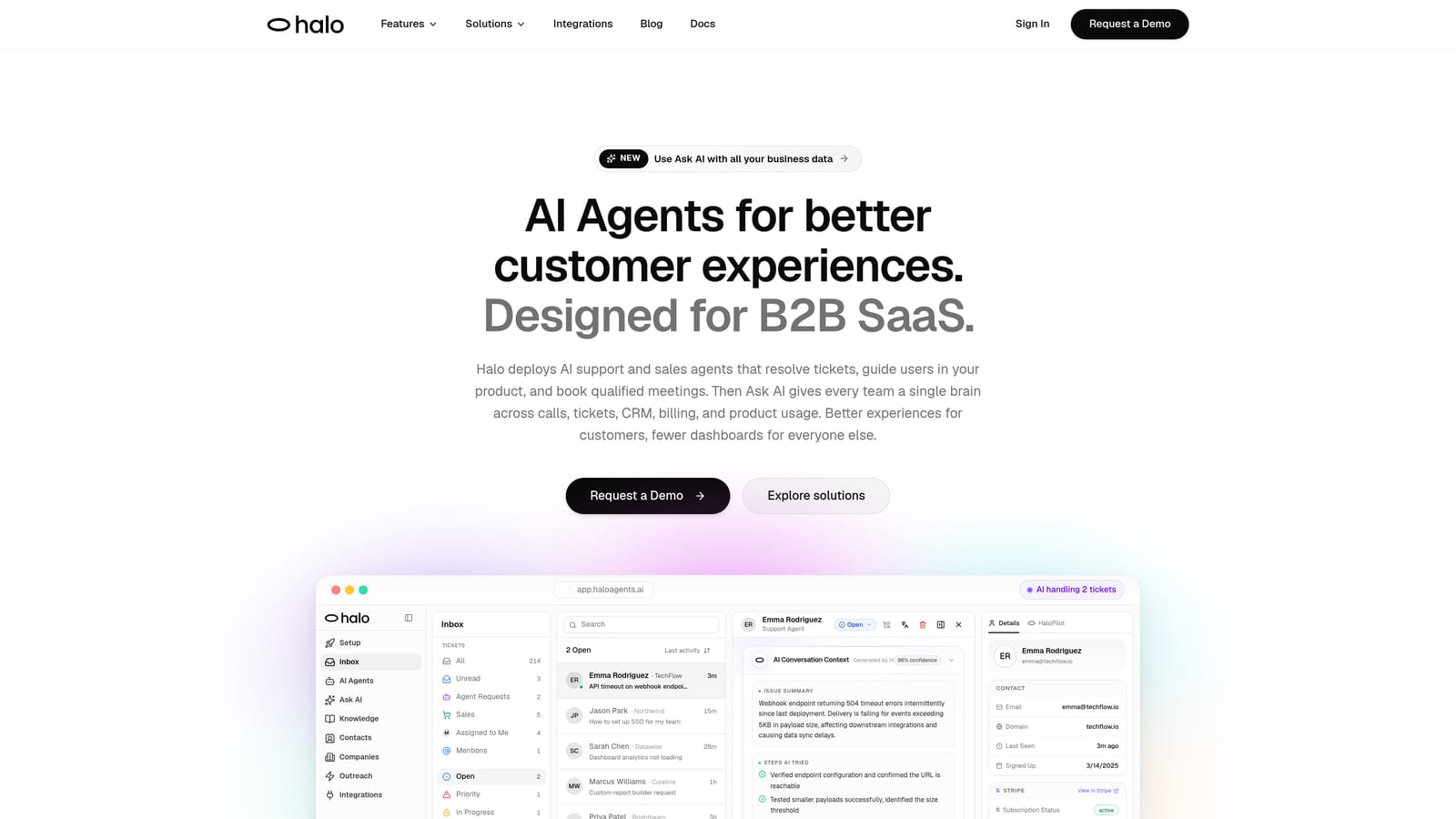
Halo AI is an AI-first customer support platform that resolves tickets autonomously, guides users through your product with page-aware visual assistance, and surfaces business intelligence signals while learning from every interaction.
Where This Tool Shines
What separates Halo from most tools on this list is its architecture. It wasn't built as a helpdesk with AI bolted on afterward. The AI is the foundation, which means it operates with a different level of autonomy. It can resolve tickets end-to-end, create bug reports automatically in Linear, and hand off to a live agent with full context when a situation genuinely requires a human.
The page-aware chat widget is a standout feature. The AI actually sees what the user sees inside your product and can provide in-context UI guidance, not just generic FAQ answers. That's a meaningful difference for SaaS companies where support often means walking someone through a specific workflow.
Key Features
Page-Aware Chat Widget: The AI understands where users are in your product and delivers contextual, visual guidance rather than generic responses.
Autonomous Ticket Resolution: Handles tickets end-to-end with intelligent escalation to live agents for complex issues, preserving full context throughout the handoff.
Smart Inbox with Business Intelligence: Surfaces customer health signals, revenue anomalies, and product feedback patterns, going well beyond standard support metrics.
Auto Bug Ticket Creation: Automatically creates and routes bug tickets in Linear based on user-reported issues, removing manual triage from your workflow.
Continuous Learning Architecture: Improves with every resolved interaction, so the AI gets meaningfully smarter over time rather than staying static.
Broad Integration Stack: Connects to Linear, Slack, HubSpot, Intercom, Stripe, Zoom, PandaDoc, and Fathom, giving the AI the context it needs to act autonomously.
Best For
Small B2B SaaS teams that want support AI to do more than answer questions. If you want your support layer to feed intelligence back into product, revenue, and engineering teams, Halo's business intelligence features make it a strong fit. It's particularly well-suited for teams already using tools like Linear, HubSpot, or Slack as part of their core stack.
Pricing
Check haloagents.ai for current pricing plans. Pricing details are best confirmed directly given how frequently AI tool pricing evolves.
2. Intercom
Best for: SaaS companies that want a polished, full-featured messaging platform with strong AI capabilities
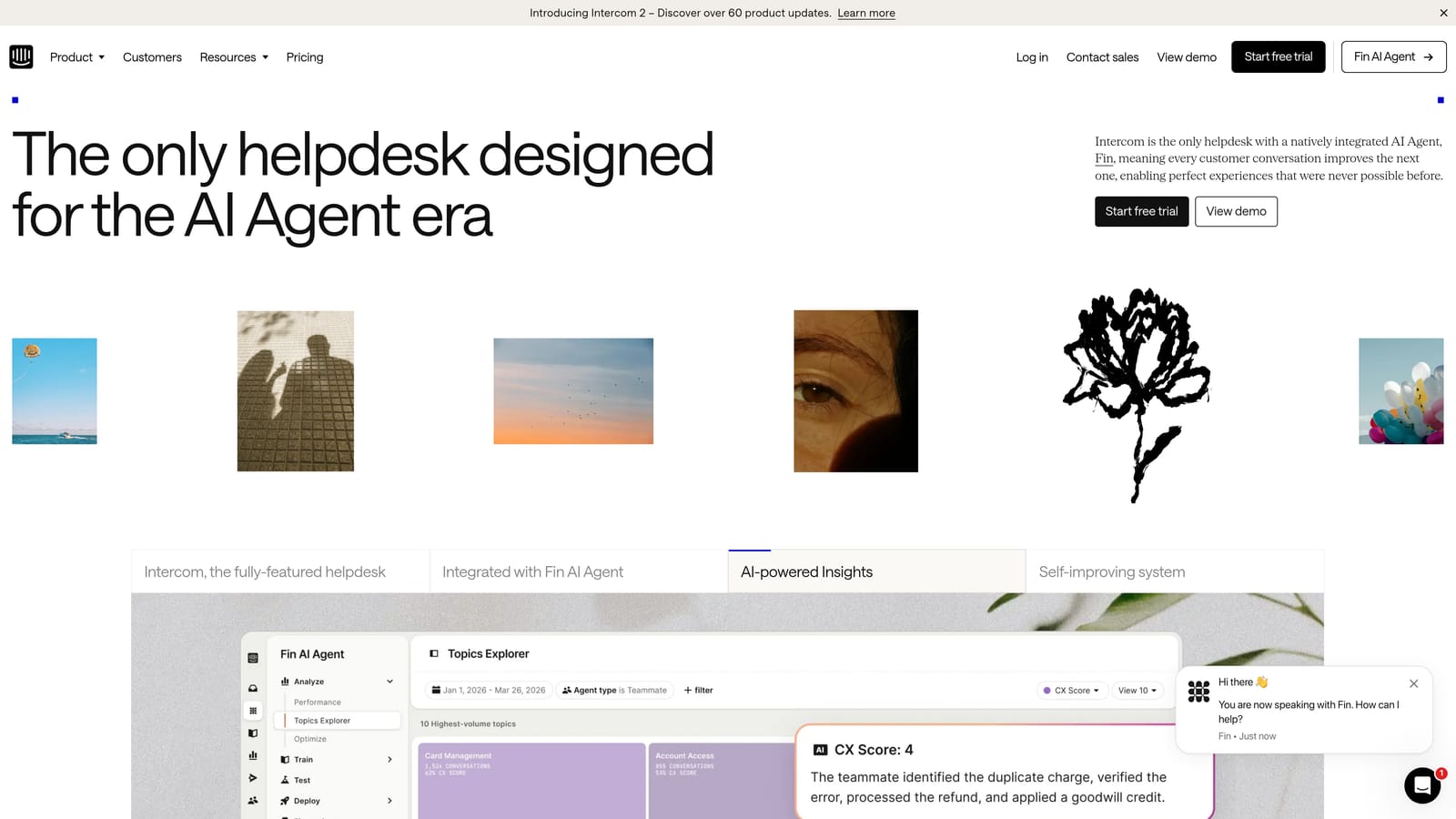
Intercom is a leading customer messaging platform with Fin, an AI agent built on large language models that handles chat and email support autonomously.
Where This Tool Shines
Intercom has long been the gold standard for in-product messaging, and Fin extends that reputation into AI-driven resolution. Fin is trained on your help center content and can handle a wide range of queries without human involvement, escalating with full context when it hits the edges of what it knows.
The messenger UI is genuinely polished. For SaaS products where the in-app experience matters, Intercom's widget feels native rather than bolted on. The app marketplace is extensive, making it easy to connect to most tools your team already uses.
Key Features
Fin AI Agent: Handles chat and email queries autonomously using large language model reasoning trained on your support content.
Polished In-Product Messenger: One of the best-looking and most UX-refined chat widgets available, designed to feel native inside modern SaaS products.
Full Context Handoff: When Fin escalates to a human agent, the entire conversation history and context transfers cleanly.
Broad App Marketplace: Hundreds of integrations covering CRM, billing, analytics, and more.
Omnichannel Coverage: Handles chat, email, and in-app messaging from a single platform.
Best For
SaaS companies that prioritize a premium, polished support experience and have the budget to match. Worth noting: Fin AI is priced per resolution on some plans, which can make costs harder to predict as volume grows. Ideal for teams already invested in the Intercom ecosystem.
Pricing
Tiered plans available; Fin AI is priced per resolution on some plan configurations. Verify current pricing and plan details at intercom.com.
3. Freshdesk
Best for: Small teams transitioning from email-only support to a structured helpdesk with AI assistance
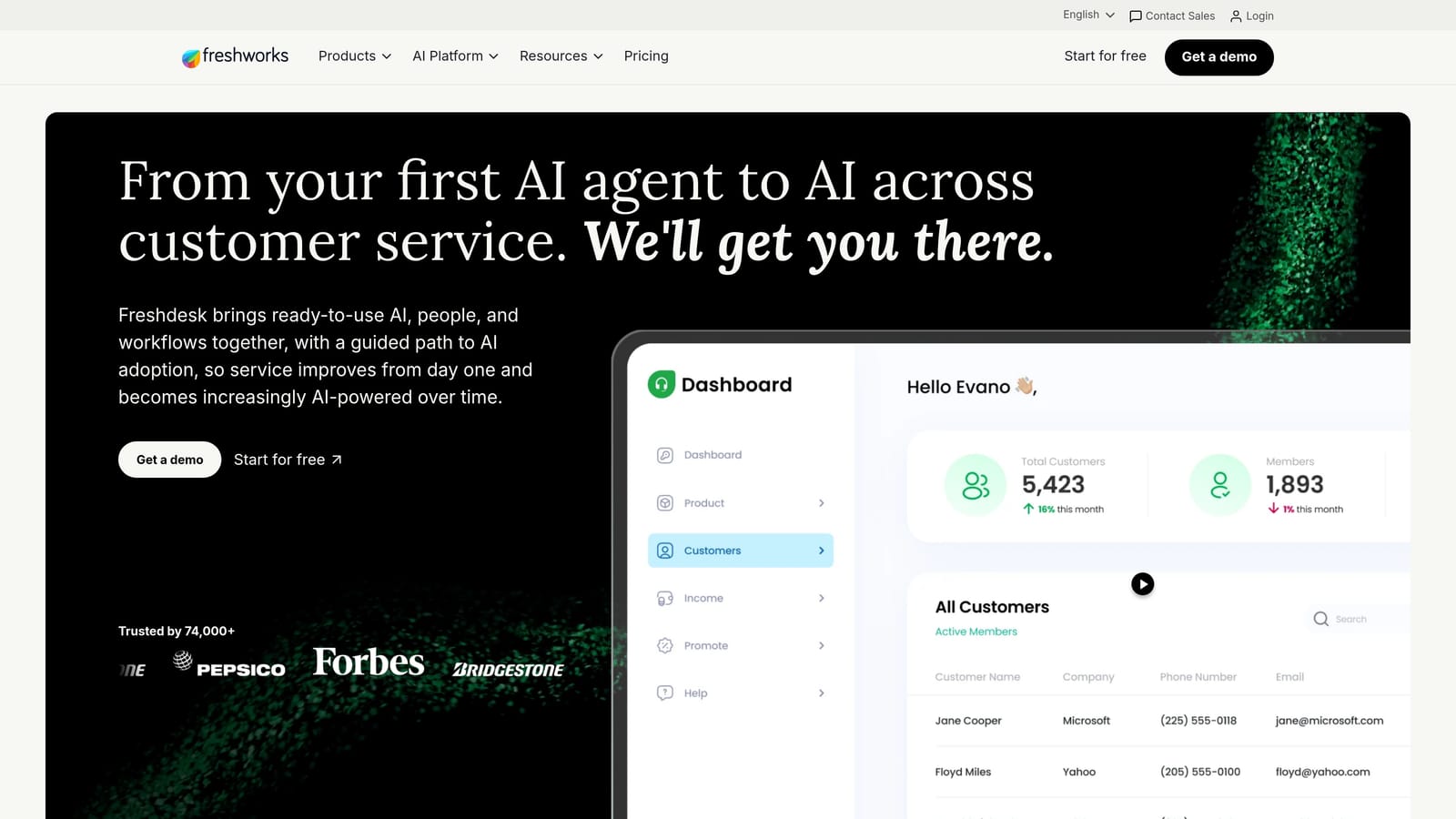
Freshdesk is a full-featured helpdesk with Freddy AI providing ticket summarization, suggested responses, and auto-categorization at accessible price points.
Where This Tool Shines
Freshdesk's biggest advantage for small businesses is accessibility. The free tier makes it a genuine option for very early-stage teams, and Freddy AI adds meaningful efficiency gains even at lower paid tiers. It's a solid choice for teams that are outgrowing shared inboxes and need structure without a steep learning curve.
The omnichannel coverage is broad: email, chat, phone, and social all feed into a single queue. That breadth is rare at Freshdesk's price point.
Key Features
Freddy AI: Provides ticket summarization, suggested replies, and auto-categorization to help agents work faster without requiring full autonomous resolution.
Auto-Categorization and Priority Assignment: Incoming tickets are automatically sorted and prioritized, reducing manual triage time.
Omnichannel Support: Handles email, chat, phone, and social from a unified interface.
Free Tier: A functional free plan makes Freshdesk accessible for very small teams or those just getting started.
Scalable Architecture: Grows with your team, with more advanced AI and automation features available at higher tiers.
Best For
Teams moving from email-only support to a proper helpdesk for the first time. Freddy AI functions more as a co-pilot than a fully autonomous agent at lower tiers, so teams expecting hands-off ticket resolution at the entry level should set expectations accordingly.
Pricing
Free tier available; paid plans scale with features and team size. Verify current plan details at freshdesk.com.
4. Tidio
Best for: E-commerce small businesses that want fast AI chat deployment with native Shopify integration
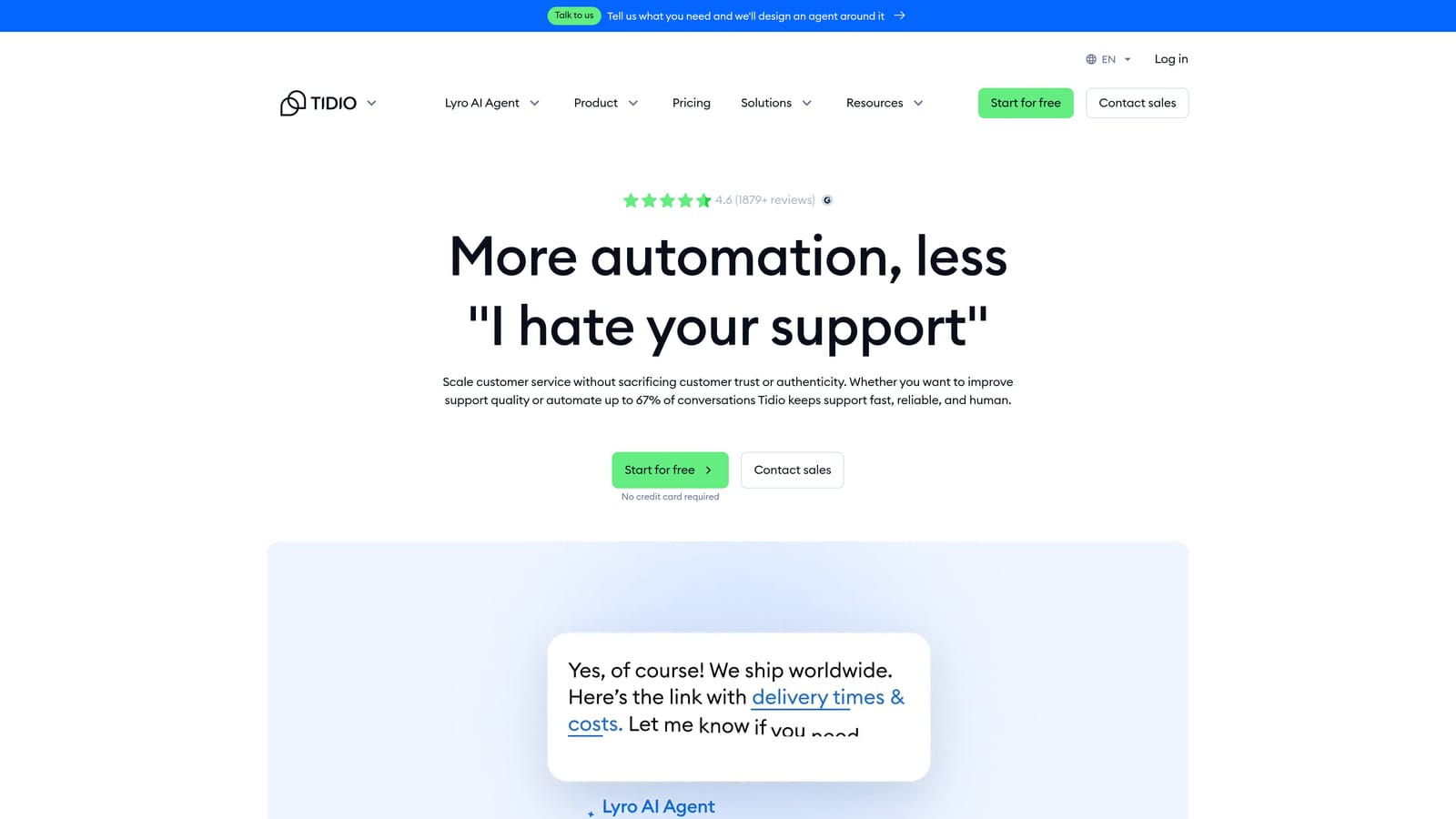
Tidio is a fast-to-deploy AI chat platform with Lyro, a conversational AI chatbot trained on your content, built for e-commerce small businesses.
Where This Tool Shines
Speed of setup is Tidio's headline strength. Many teams report being live within hours, which matters when you're a small operation without a dedicated IT team to manage implementation. Lyro is trained on your help content and website, so it can handle conversational queries without extensive configuration.
The native integrations with Shopify, WooCommerce, and WordPress make it a natural fit for product-based businesses. If your support volume is dominated by order questions, shipping queries, and basic product help, Tidio handles that territory well.
Key Features
Lyro AI Chatbot: Trained on your help content and website to handle conversational customer queries without manual scripting.
Native E-commerce Integrations: Direct connections to Shopify, WooCommerce, and WordPress out of the box.
Fast Setup: Designed for quick deployment, often live within hours rather than days or weeks.
Live Chat Fallback: Smoothly transitions to a human agent when Lyro reaches the edges of its knowledge.
Visual Chatbot Builder: Drag-and-drop builder for creating custom conversation flows without coding.
Best For
E-commerce and B2C small businesses with high chat volume and straightforward query types. Less suited to complex B2B SaaS support where queries require deep product knowledge or multi-step troubleshooting.
Pricing
Free tier available; Lyro AI conversations are priced separately at higher volumes. Verify current pricing at tidio.com.
5. Zendesk
Best for: Small businesses planning to scale significantly and wanting enterprise-grade infrastructure from the start
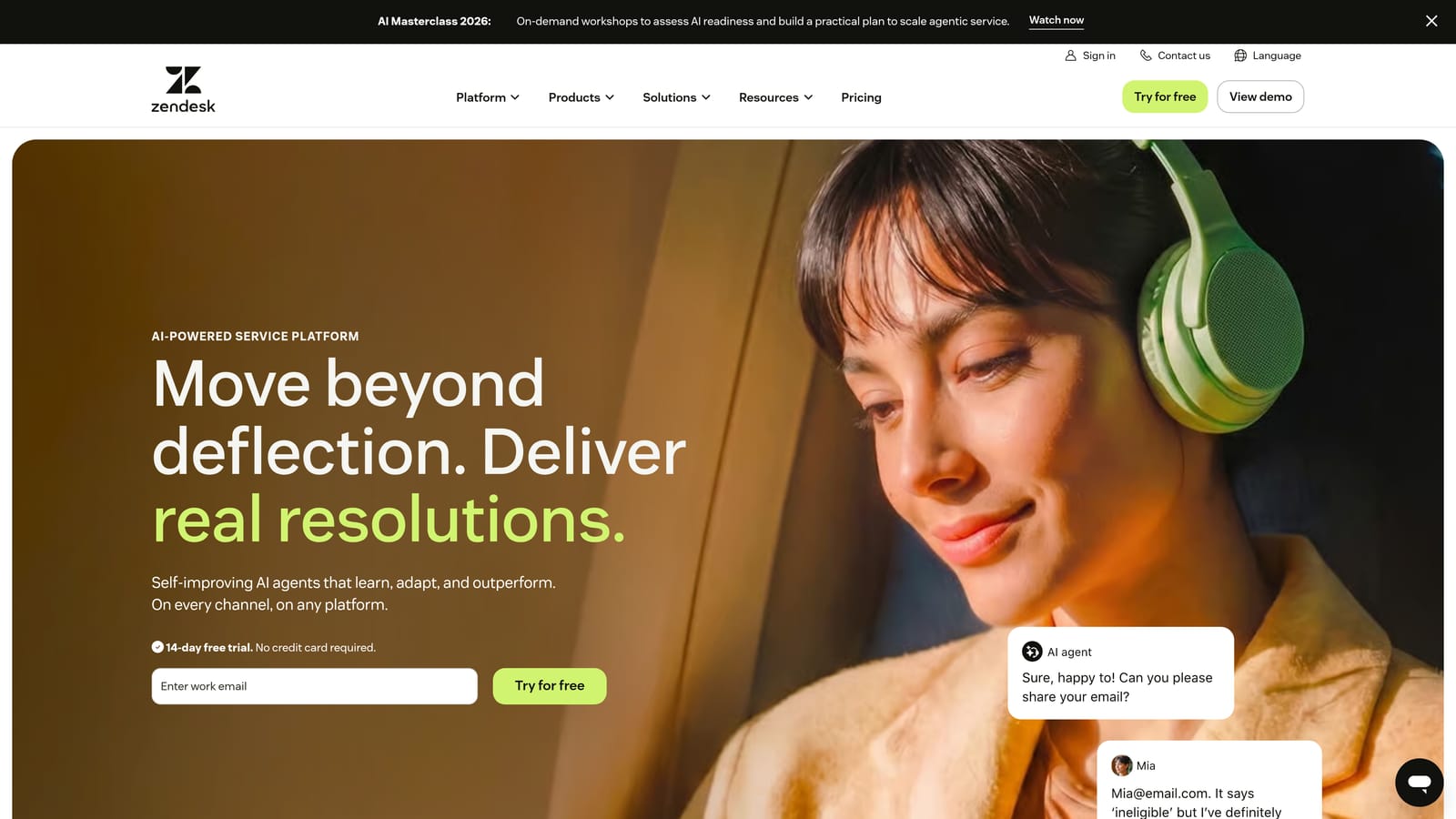
Zendesk is the industry-standard helpdesk platform with AI triage, intent detection, and intelligent automation available through its AI add-on suite.
Where This Tool Shines
Zendesk's depth is its defining characteristic. The reporting capabilities, multi-channel support, and integration marketplace are among the most mature in the industry. For small businesses that expect rapid growth and want to avoid migrating platforms later, starting on Zendesk provides a ceiling that's hard to outgrow.
The AI features, including intent detection, intelligent triage, and macro suggestions, are genuinely useful for reducing manual work. The tradeoff is configuration complexity. Smaller teams without a dedicated admin may find the setup process demanding.
Key Features
AI Triage and Intent Detection: Automatically categorizes and routes incoming tickets based on detected intent and priority signals.
Intelligent Macro Suggestions: Recommends pre-written response templates to agents based on ticket content.
Robust Multi-Channel Support: Handles email, chat, voice, and social from a single unified platform.
Extensive Reporting and Analytics: Deep analytics across all support channels with customizable dashboards.
Large Integration Marketplace: Hundreds of apps and integrations covering virtually every business tool category.
Best For
Small businesses with growth ambitions that want to invest in infrastructure that won't need replacing. Teams without dedicated admin resources may find the configuration overhead significant at the start.
Pricing
Suite plans available; AI features may require higher tiers or add-ons. Verify current plan details at zendesk.com.
6. Gorgias
Best for: E-commerce businesses running on Shopify, Magento, or BigCommerce with high order-related support volume
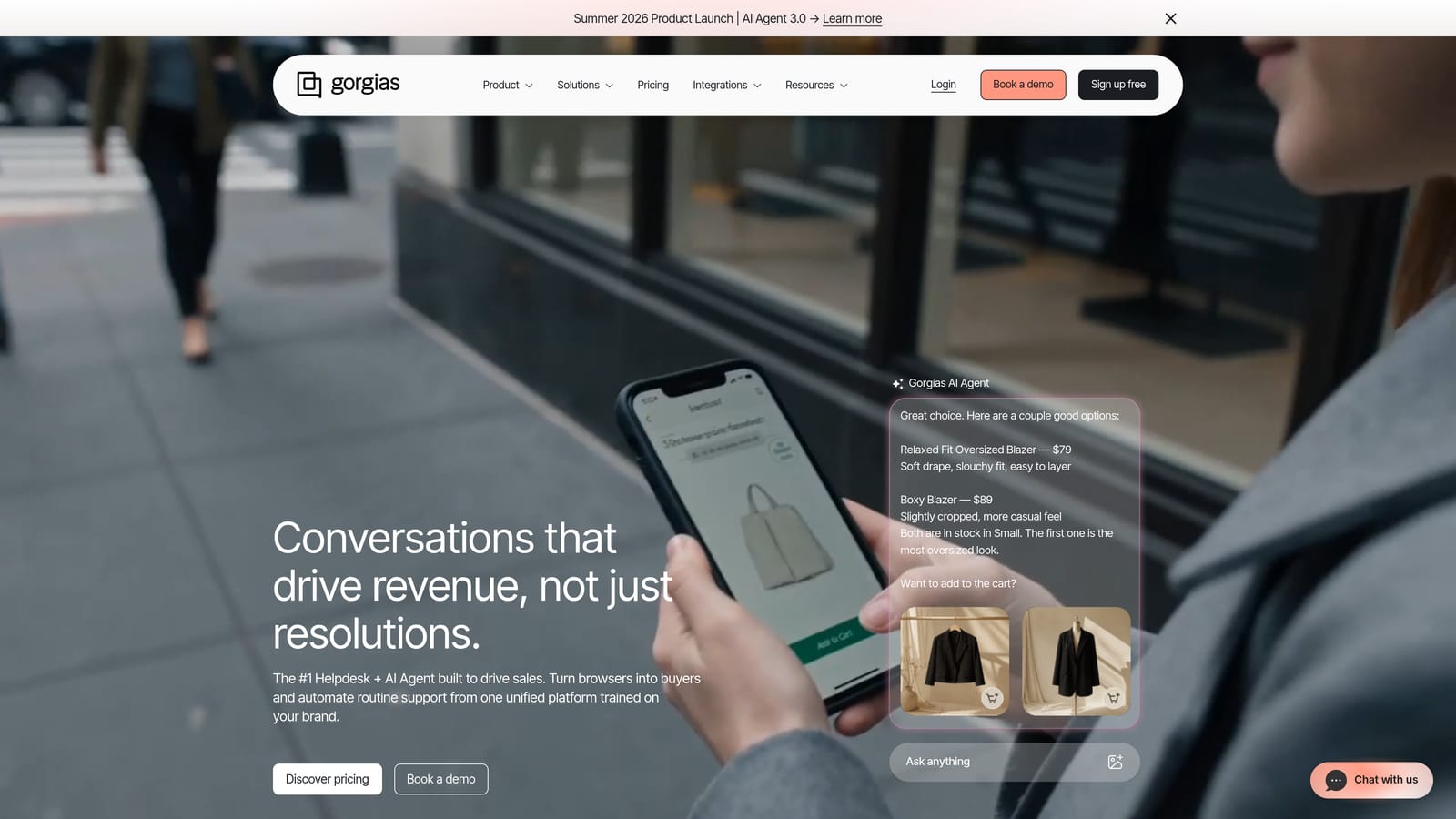
Gorgias is a helpdesk built specifically for e-commerce, with deep Shopify integration that lets AI resolve order, shipping, and return queries without agent involvement.
Where This Tool Shines
Gorgias does one thing exceptionally well: it connects your support queue directly to your e-commerce data. When a customer asks "Where is my order?" the AI doesn't need to ask an agent to look it up. It pulls the order status, shipping information, and return eligibility directly from Shopify and responds autonomously.
For e-commerce businesses where a large portion of support volume consists of order status and return queries, this level of integration translates to meaningful reduction in tickets that require human attention.
Key Features
Deep E-commerce Data Integration: Pulls order, shipping, and return data directly from Shopify, Magento, and BigCommerce to resolve queries without agent involvement.
Autonomous Order Query Resolution: Handles common e-commerce questions like order status, shipping tracking, and return eligibility without escalation.
Automation Rules Based on Order Data: Triggers automated responses and actions based on specific order conditions and customer data.
Omnichannel Coverage: Manages email, chat, SMS, and social from a single inbox.
Revenue Statistics: Ties support interactions to revenue impact, helping you understand the commercial value of your support operation.
Best For
E-commerce small businesses with Shopify as their primary platform. If your business is B2B, service-based, or SaaS, Gorgias's core strengths won't translate as directly to your use case.
Pricing
Volume-based pricing by ticket count. Verify current plan details at gorgias.com.
7. Zoho Desk
Best for: Small businesses already using the Zoho ecosystem that want competitive pricing with solid AI features
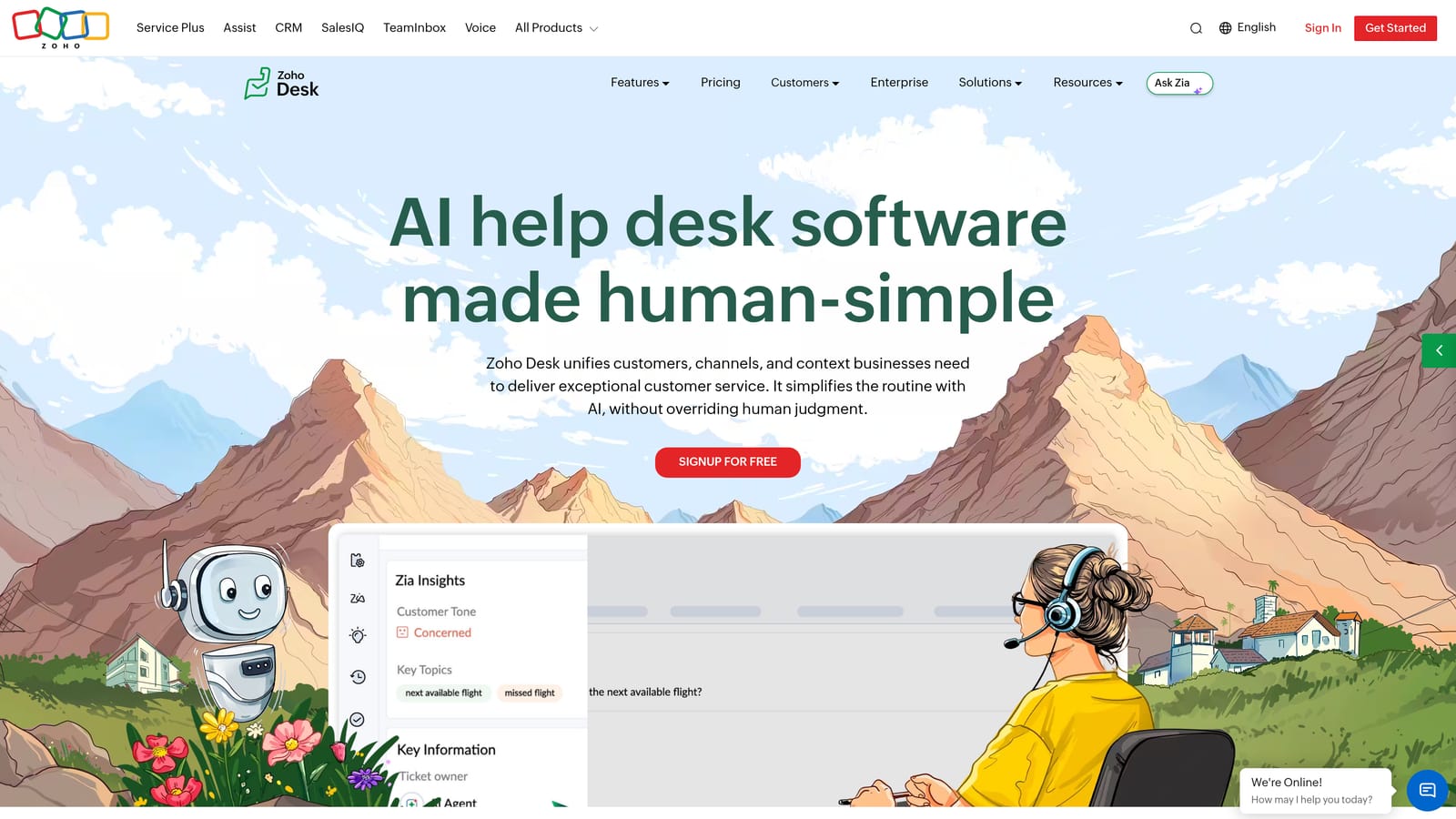
Zoho Desk is a helpdesk with Zia AI for sentiment analysis, anomaly detection, and response suggestions, tightly integrated with the Zoho CRM ecosystem.
Where This Tool Shines
For teams already using Zoho CRM or Zoho One, Desk is a natural extension. The tight integration means your support agents have full customer context from the CRM without any manual data syncing. Zia AI adds sentiment analysis and anomaly detection that go beyond basic ticket routing.
Pricing is competitive, particularly for teams on the Zoho One bundle. If you're comparing per-feature value at similar price points, Zoho Desk holds up well against more heavily marketed alternatives.
Key Features
Zia AI: Provides sentiment analysis, ticket tagging, anomaly detection for unusual volume spikes, and response suggestions for agents.
Anomaly Detection: Flags unusual patterns in ticket volume, helping you catch product issues or service disruptions early.
Tight Zoho CRM Integration: Customer data flows automatically between CRM and support, giving agents full context on every interaction.
Auto-Tagging and Response Suggestions: Reduces manual classification work and speeds up agent response times.
Competitive Pricing: Strong value proposition, especially for teams already on Zoho One.
Best For
Small businesses already invested in the Zoho ecosystem, or budget-conscious teams looking for solid AI features without premium pricing. Teams looking for fully autonomous AI resolution may find Zia's capabilities more co-pilot-oriented than fully autonomous.
Pricing
Tiered plans; competitive pricing for small teams, especially within Zoho One. Verify current details at zoho.com/desk.
8. Help Scout
Best for: Service businesses, agencies, and teams where relationship tone and human-feeling support matter most
Help Scout is a shared inbox platform with AI Summarize and AI Assist features that improve agent efficiency while maintaining a human, relationship-first support feel.
Where This Tool Shines
Help Scout made a deliberate product choice: no heavy chatbot interface, no aggressive automation that makes customers feel like they're talking to a machine. Instead, AI works behind the scenes to make your agents faster and more effective. AI Summarize condenses long email threads so agents can get up to speed instantly. AI Assist drafts and refines replies, reducing the time it takes to write a thoughtful response.
For businesses where the relationship is the product, that philosophy matters. Agencies, nonprofits, and service businesses often find that heavy automation erodes the trust they've built with clients.
Key Features
AI Summarize: Condenses long email threads into concise summaries so agents can quickly understand context before responding.
AI Assist: Drafts and improves agent replies, reducing writing time while maintaining a human tone.
Beacon Widget: In-app help widget that surfaces relevant documentation and enables chat without a heavy chatbot interface.
Shared Inbox with Collision Detection: Prevents two agents from responding to the same ticket simultaneously with real-time collision alerts.
Internal Notes: Enables team collaboration on tickets without the customer seeing the discussion.
Best For
Service businesses, agencies, consultancies, and nonprofits where maintaining a human, relationship-driven support tone is non-negotiable. Less suited to teams that want fully autonomous AI resolution with minimal agent involvement.
Pricing
Per-user pricing model. Verify current plan details at helpscout.com.
9. Kustomer
Best for: Growing small businesses with complex, multi-touchpoint customer relationships that need CRM and support in one platform
Kustomer is a CRM-native support platform where AI works across the entire customer timeline, not just the current ticket, enabling more contextual and intelligent resolution.
Where This Tool Shines
Most helpdesks treat each ticket as an isolated event. Kustomer treats it as one moment in an ongoing customer relationship. Every interaction, order, and touchpoint lives in a unified timeline, and the AI uses that complete history when resolving current issues. That context produces noticeably more relevant responses, especially for customers with complex or recurring issues.
For businesses that have outgrown basic helpdesks but don't want to manage a separate CRM alongside their support platform, Kustomer's built-in CRM eliminates that overhead entirely.
Key Features
Full Customer Timeline: Every interaction, order, and touchpoint consolidated in a single view per customer, accessible during every support interaction.
History-Aware AI Resolution: AI draws on complete customer history, not just the current ticket, to provide more contextually accurate responses.
Omnichannel Coverage: Handles email, chat, SMS, social, and voice from a unified platform.
Workflow Automation: Automates processes across the entire customer lifecycle, not just within individual tickets.
Built-In CRM: Eliminates the need for a separate customer relationship management system for most small business use cases.
Best For
Growing small businesses with complex, multi-touchpoint customer relationships, particularly those in retail, subscription services, or any model where customer history significantly affects how support should be handled.
Pricing
Per-user pricing; positioned for growing small businesses. Verify current plan details at kustomer.com.
Which Tool Is Right for Your Business?
The right choice depends heavily on your business model, existing stack, and what you actually need AI to do.
Best for B2B SaaS and product teams: Halo AI's page-aware intelligence, business intelligence signals, and continuous learning architecture make it the strongest fit for SaaS companies that want support AI to do more than answer questions. It feeds intelligence back into your product and revenue teams in ways other tools on this list don't.
Best for e-commerce: Gorgias is the clear pick if you're running on Shopify and your support volume is dominated by order and return queries. Tidio is a strong alternative if you want faster setup and a lighter footprint.
Best budget pick: Freshdesk's free tier makes it genuinely accessible for early-stage teams. Zoho Desk is the better value play if you're already in the Zoho ecosystem or comparing paid plans side by side.
Best for growing into enterprise: Zendesk's infrastructure depth means you won't outgrow it. The configuration overhead is real, but the ceiling is high.
Best for relationship-driven support: Help Scout is the right call for agencies, service businesses, and teams where maintaining a human tone is part of the product experience.
Your support team shouldn't scale linearly with your customer base. Let AI agents handle routine tickets, guide users through your product, and surface business intelligence while your team focuses on complex issues that need a human touch. See Halo in action and discover how continuous learning transforms every interaction into smarter, faster support.