9 Best AI-Powered Help Center Software Tools in 2026
This guide evaluates the 9 best AI-powered help center software tools available in 2026, comparing platforms across AI resolution quality, integration depth, and scalability to help B2B SaaS teams automate ticket triage, eliminate repetitive responses, and handle growing support volume without expanding headcount.
 Matt PattoliFounder13 min read
If your support team is still manually triaging tickets, writing the same answers repeatedly, and struggling to scale without hiring, AI-powered help center software changes the equation entirely. These platforms go beyond static knowledge bases: they resolve tickets autonomously, guide users through your product in real time, and surface business intelligence that traditional helpdesks miss entirely.
This list covers the strongest options available in 2026, evaluated across five criteria: AI resolution quality, integration depth, ease of deployment, scalability for B2B SaaS teams, and value relative to cost. Whether you're running a lean startup support team or managing enterprise-scale ticket volume, there's a tool here built for your situation.
For more context on how these tools fit into a broader strategy, see our guides on top AI support automation tools and best automated helpdesk solutions.
1. Halo AI
Best for: B2B SaaS teams wanting AI-first architecture with deep business stack integrations
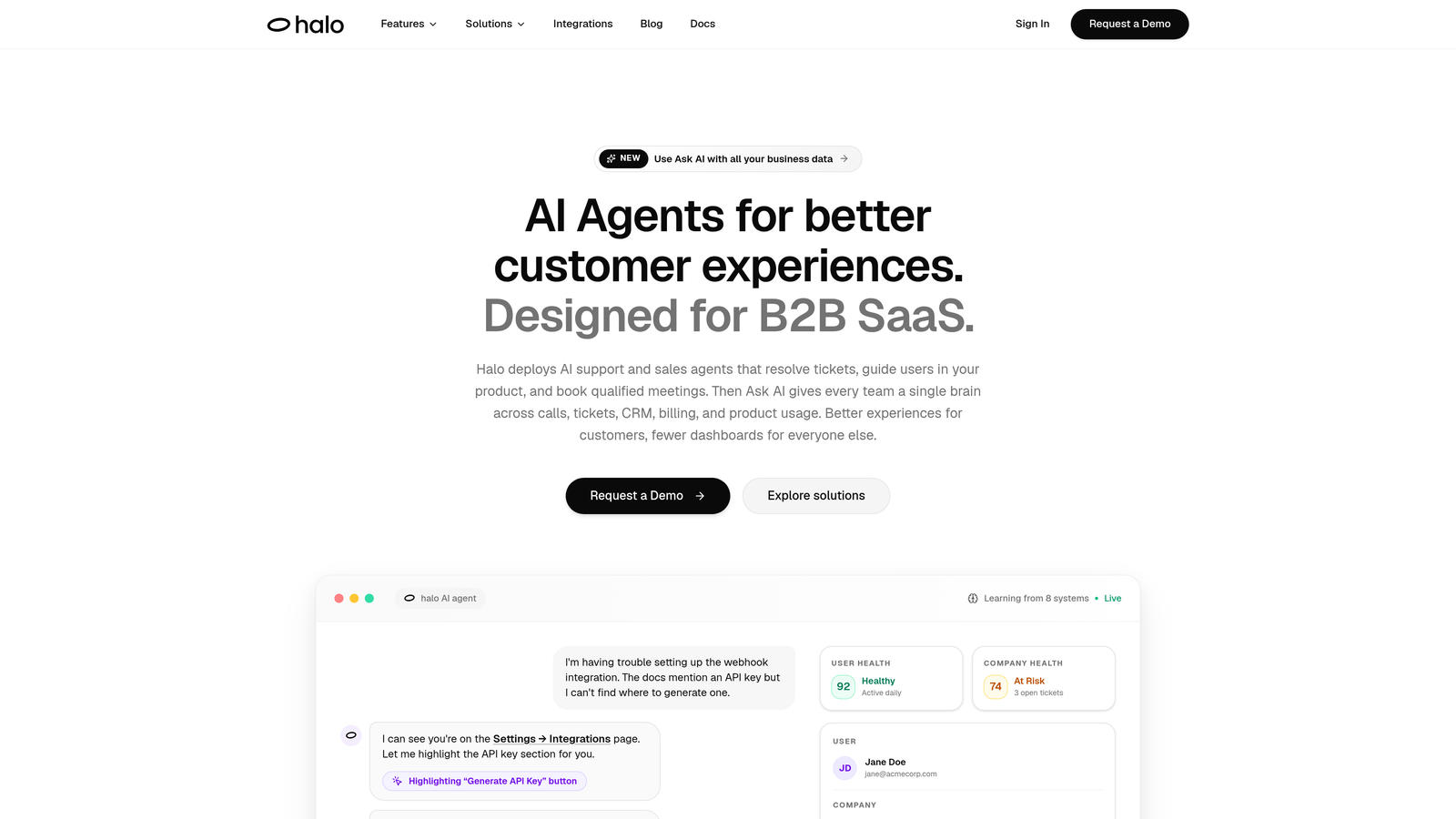
Halo AI is an AI-native customer support platform built specifically for B2B SaaS teams who need more than a chatbot bolted onto an existing helpdesk.
Where This Tool Shines
What separates Halo from most tools on this list is its architecture. It was built as AI-first from the ground up, not retrofitted with AI features after the fact. That distinction matters: the AI has full context about what users are doing inside your product, not just what they type into a chat window.
The page-aware chat widget is particularly compelling for SaaS teams. The AI can see exactly which page a user is on and deliver visual, contextual UI guidance rather than generic knowledge base links. Combined with continuous learning from every interaction, the system gets smarter over time rather than staying static.
Key Features
Page-Aware Chat Widget: Sees what users see in real time, delivering contextual guidance tied to the specific product page they're on.
Intelligent AI Agents: Resolve tickets end-to-end autonomously, not just suggest replies for agents to approve.
Auto Bug Ticket Creation: Detects issues and routes bug reports directly to Linear or your preferred bug tracker without manual intervention.
Smart Inbox with Business Intelligence: Surfaces customer health signals, revenue intelligence, and anomaly detection from support interactions — turning your helpdesk into a strategic data source.
Live Agent Handoff: Escalates to human agents with full conversation context preserved, so customers never have to repeat themselves.
Deep Integrations: Connects across Linear, Slack, HubSpot, Intercom, Stripe, Zoom, PandaDoc, and Fathom — the full business stack, not just the support stack.
Best For
Product-led SaaS companies that want AI handling the full support lifecycle, not just deflection. Particularly strong for teams who want support data feeding into product, revenue, and customer success workflows rather than sitting siloed in a helpdesk.
Pricing
Contact for pricing. A free trial is available to explore the platform before committing.
2. Zendesk AI
Best for: Enterprise teams already invested in the Zendesk ecosystem
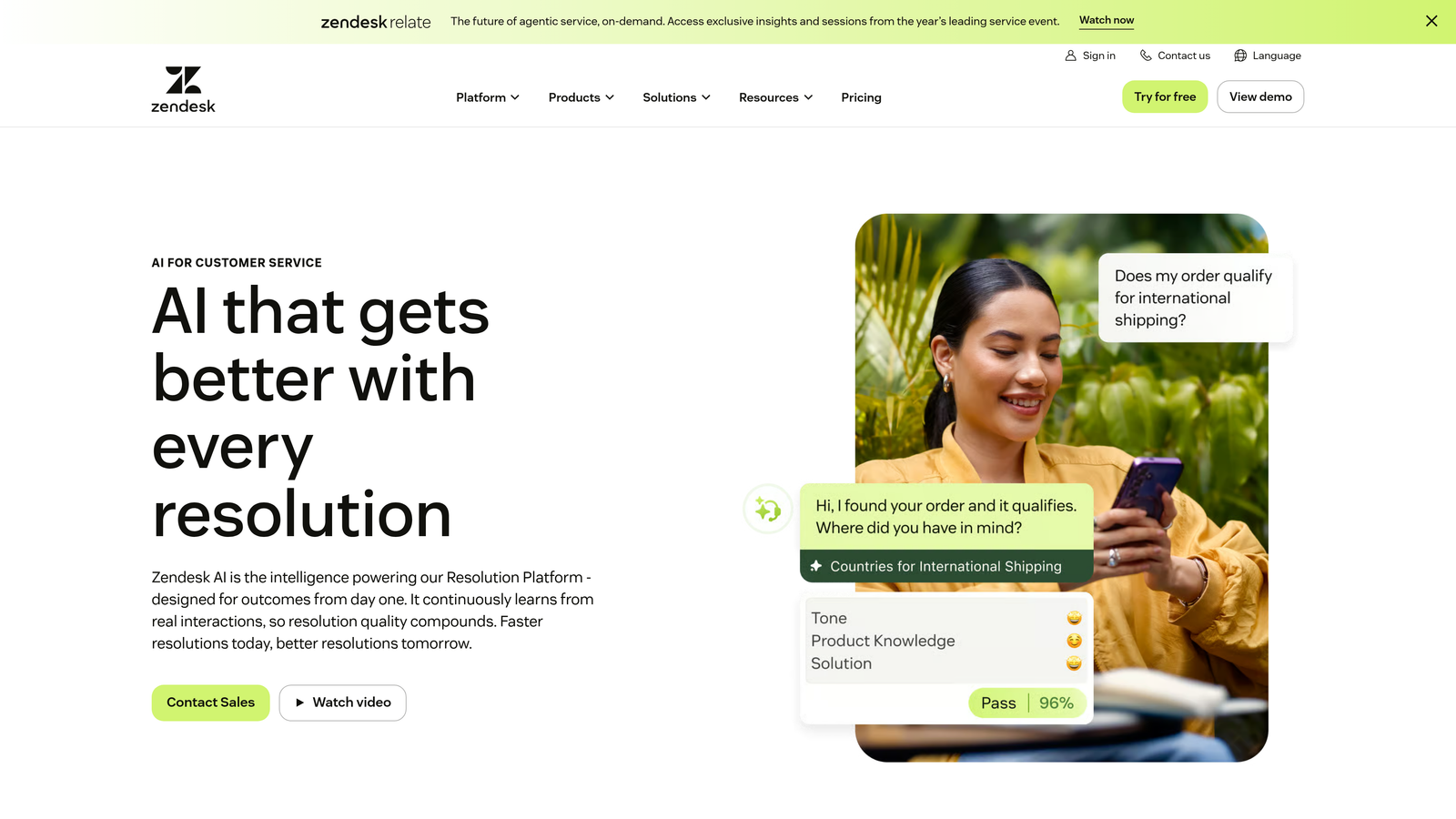
Zendesk AI is the AI layer built into Zendesk's established enterprise helpdesk, adding intelligent triage, automated responses, and agent assist across email, chat, and voice.
Where This Tool Shines
If your team is already running on Zendesk, adding Zendesk AI is the path of least resistance. The AI features integrate directly into existing workflows without requiring a platform migration. Ticket triage, routing, and the Agent Copilot features work well for high-volume teams managing diverse query types.
The breadth of Zendesk's ecosystem is genuinely hard to match. With over 1,500 marketplace integrations, virtually any tool your team uses already has a Zendesk connector. For enterprise teams with complex, multi-channel support operations, that ecosystem depth is a real advantage.
Key Features
AI-Powered Triage and Routing: Classifies and routes incoming tickets intelligently based on intent, sentiment, and priority.
Zendesk Bots: Automated bot resolution for common queries before they reach an agent.
Agent Copilot: Suggests replies, next-best actions, and relevant knowledge base content to speed up agent responses.
Advanced Analytics: Workforce management integrations and reporting dashboards for support leaders tracking team performance.
Marketplace Ecosystem: 1,500+ integrations covering virtually every tool in a modern support stack.
Best For
Enterprise support teams and organizations already using Zendesk who want to add AI capabilities without switching platforms. Less ideal for teams starting fresh who want AI-native architecture rather than AI layered onto legacy infrastructure.
Pricing
Suite plans start at $55/agent/month. AI add-ons are priced separately, so total cost scales depending on which features you enable.
3. Intercom Fin
Best for: Chat-first teams wanting autonomous resolution from existing help content
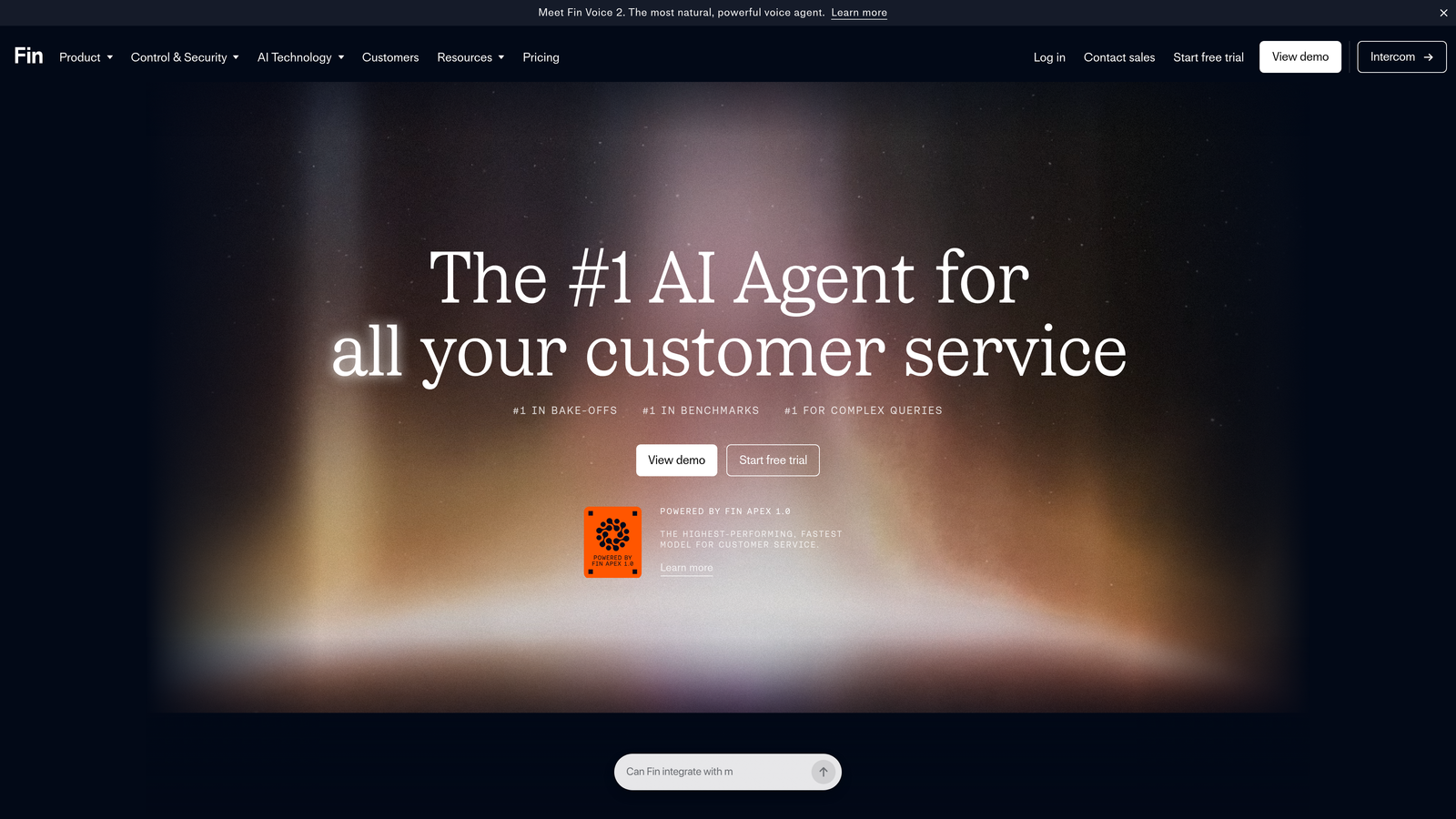
Intercom Fin is Intercom's LLM-powered AI agent, designed to resolve customer queries autonomously using your existing knowledge base with minimal setup required.
Where This Tool Shines
Fin's core strength is how quickly it gets to autonomous resolution. You point it at your existing help content, and it starts handling conversations. It handles multi-turn conversations rather than just matching keywords to FAQ answers, which means it can work through more complex queries without immediately escalating.
The Fin Insights dashboard gives support leaders visibility into what Fin is resolving, where it's failing, and which topics are driving the most volume. That feedback loop makes it easier to improve both your AI coverage and your underlying content over time.
Key Features
LLM-Powered Resolution Engine: Trained on your knowledge base and support content to deliver contextually relevant answers.
Multi-Turn Conversation Handling: Manages complex, back-and-forth conversations rather than just answering single questions.
Seamless Human Handoff: Escalates to live agents when resolution fails, with context carried through.
Omnichannel Deployment: Available across chat, email, and social channels from a single configuration.
Fin Insights Dashboard: Shows resolution rates, topic trends, and gaps in your coverage to guide content improvements.
Best For
Teams already using Intercom for customer communication who want to add autonomous resolution without switching platforms. Also a strong choice for companies with well-developed knowledge bases looking for fast time-to-value.
Pricing
Fin is priced per resolution rather than per seat. Intercom base plans start at $39/month, with Fin costs scaling based on usage volume.
4. Freshdesk Freddy AI
Best for: Teams running on Freshdesk wanting native AI across self-service, agent assist, and analytics
Freshdesk Freddy AI is Freshworks' suite of AI capabilities spanning self-service bots, agent assistance, and predictive analytics, all natively integrated into the Freshdesk platform.
Where This Tool Shines
Freddy covers the full support workflow rather than focusing on a single AI use case. You get bot deflection for customers, AI drafts and summaries for agents, and predictive analytics for support leaders, all within the same platform. That breadth makes it a practical choice for teams who want AI assistance at every stage without stitching together multiple tools.
Multilingual support is a genuine differentiator for teams serving global customer bases. Freddy handles major languages natively, which removes a significant barrier for companies that would otherwise need separate localization solutions.
Key Features
Freddy Self Service: AI bot that deflects tickets by surfacing knowledge base answers before customers submit a request.
Freddy Copilot: Drafts replies, summarizes conversations, and suggests responses to speed up agent work.
Freddy Insights: Predictive analytics and anomaly detection giving support leaders early warning on emerging issues.
Native Freshworks Integration: Works across Freshdesk ticketing, Freshdesk CRM, and ITSM products without additional configuration.
Multilingual Support: Handles customer interactions across major languages without separate localization tools.
Best For
Support teams already in the Freshworks ecosystem, particularly those managing multilingual customer bases or wanting AI features across the full support workflow without a separate AI platform.
Pricing
Core Freddy AI features are included in the Growth plan at $15/agent/month. The Copilot add-on is available separately for teams wanting advanced agent assist capabilities.
5. Help Scout AI
Best for: Smaller teams wanting AI efficiency without losing their conversational, human tone
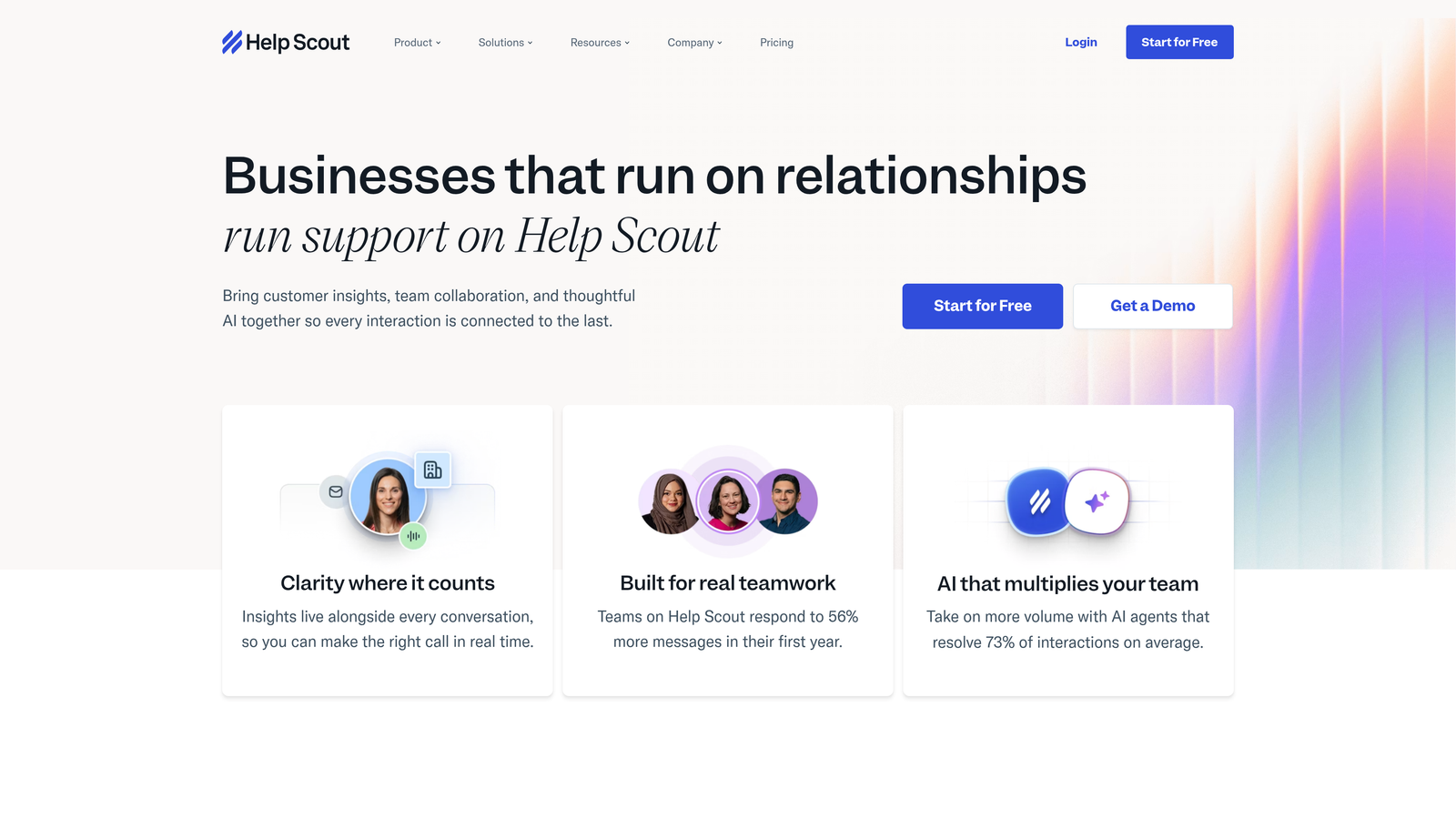
Help Scout is an email-first support platform that has added AI features including AI Drafts, Summarize, and AI Answers to help lean teams move faster without sacrificing the personal feel their customers expect.
Where This Tool Shines
Help Scout has always prioritized the quality of human-to-human support communication. Its AI additions follow that same philosophy: they're designed to assist agents rather than replace them. AI Drafts generates reply suggestions that agents can edit and send, preserving their voice rather than producing robotic outputs.
For smaller teams managing high email volume, the AI Summarize feature is particularly practical. Long, complex threads get condensed into key points, which dramatically reduces the time agents spend getting up to speed on a conversation before responding.
Key Features
AI Drafts: Generates reply drafts based on conversation context and your existing knowledge base content.
AI Summarize: Condenses long email threads into key points for faster agent handoff and context switching.
AI Answers: Surfaces relevant knowledge base articles automatically in chat before customers need to ask.
Docs Knowledge Base: Built-in knowledge base with AI-enhanced search that improves self-service findability.
Inbox-Style UI: Clean, email-native interface that keeps human agents central to the workflow rather than treating them as a fallback.
Best For
Startups and SMBs with strong brand voices who want AI to speed up their team without making support feel automated. Less suited for teams wanting fully autonomous ticket resolution at scale.
Pricing
Plans start at $22/user/month on the Standard tier. AI features are included on the Plus plan at $44/user/month.
6. Guru
Best for: Teams wanting AI-powered knowledge management that surfaces answers inside existing workflows
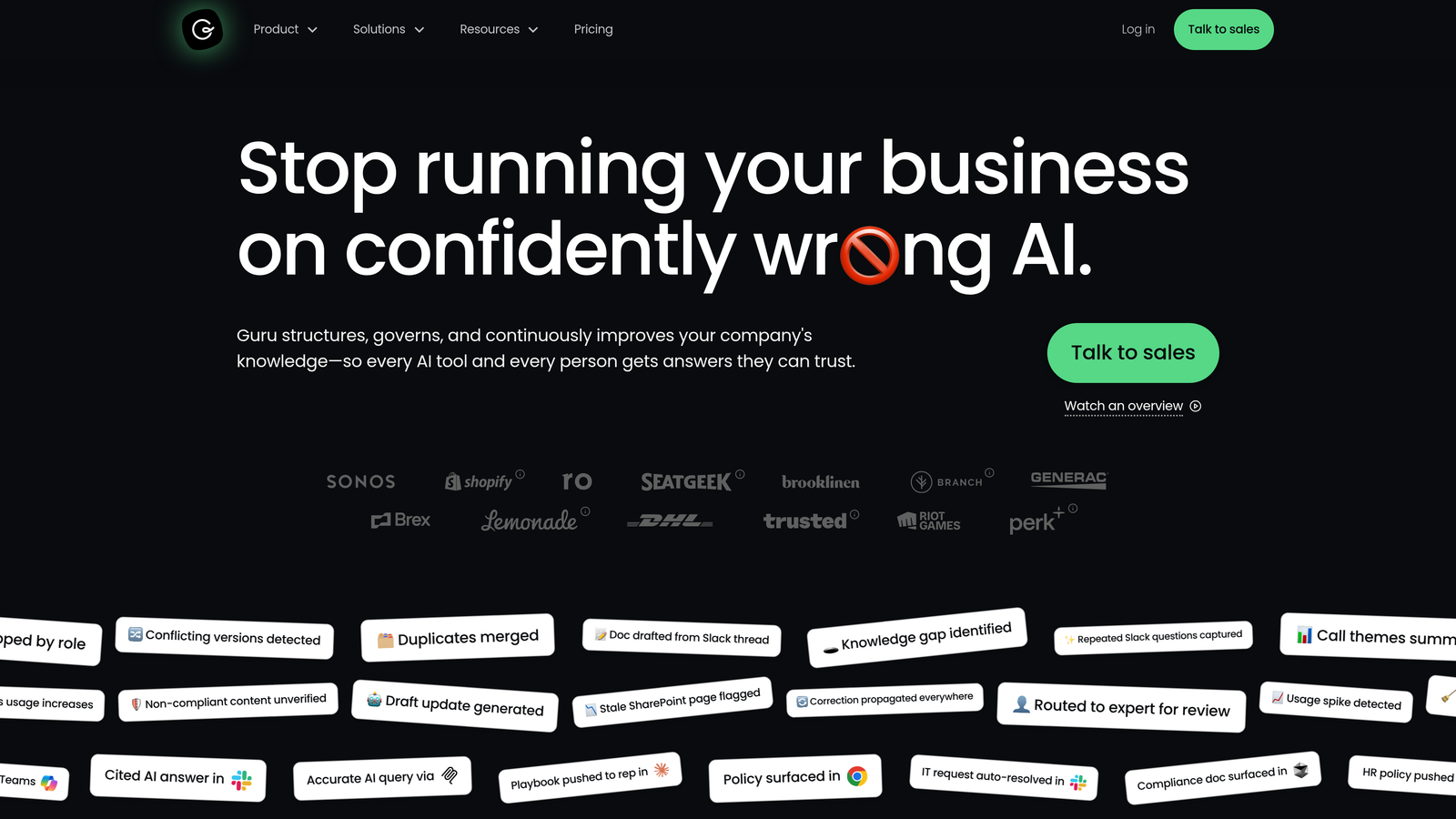
Guru is an AI-powered knowledge management platform that delivers the right information to agents and customers at the right moment, integrating directly into tools like Slack, Chrome, and your helpdesk.
Where This Tool Shines
Guru's approach is different from most tools on this list. Rather than being a standalone support platform, it acts as an intelligent knowledge layer that sits on top of your existing stack. Agents get contextual answers surfaced inside the tools they're already using, without switching tabs or searching through documentation manually.
The AI-suggested knowledge gap feature is particularly useful for content teams. Guru tracks what agents search for but can't find, then flags those gaps so you can proactively fill them. Over time, this creates a tighter feedback loop between support activity and knowledge base quality.
Key Features
AI Enterprise Search: Searches across internal knowledge, wikis, and connected tools to surface relevant answers quickly.
Knowledge Cards: Surfaces contextual answers directly inside Slack, Chrome, and connected helpdesks without leaving the workflow.
AI Knowledge Gap Detection: Identifies what agents search for but can't find, flagging content opportunities automatically.
Customer-Facing Knowledge Base: Publishable knowledge base with AI-powered search for external self-service.
Helpdesk Integrations: Connects with Zendesk, Salesforce, Slack, and Google Workspace for in-context knowledge delivery.
Best For
Support teams and customer success organizations that want to improve knowledge accessibility across both agents and customers. Particularly strong when paired with an existing helpdesk rather than used as a standalone support platform.
Pricing
A free plan is available for small teams. Paid plans start at $10/user/month, making it one of the more accessible options on this list.
7. Tidio Lyro
Best for: SMBs and e-commerce teams wanting fast AI setup with minimal technical overhead
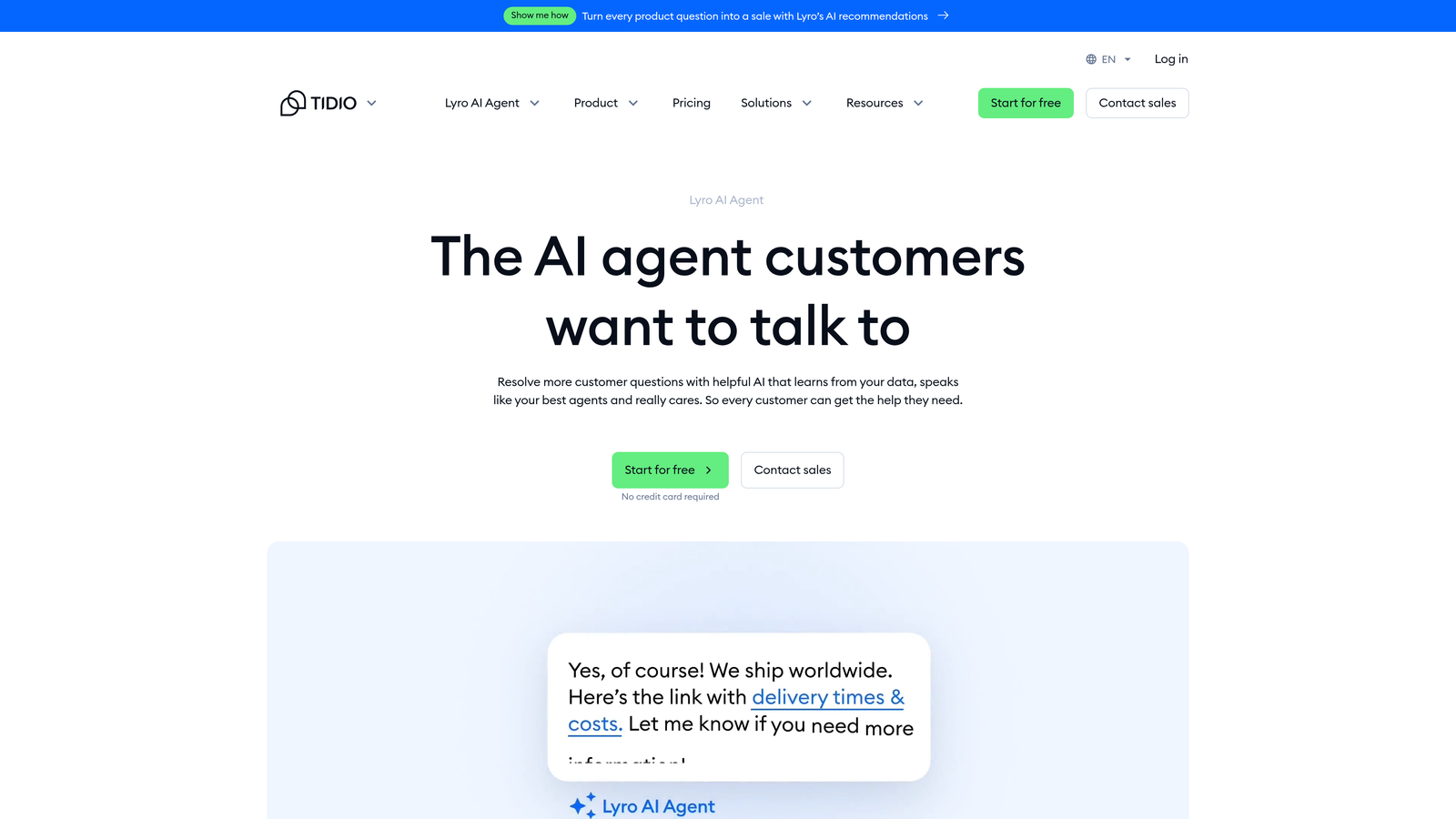
Tidio Lyro is Tidio's conversational AI agent designed for smaller teams, capable of handling customer questions autonomously using your existing FAQ and help content with a quick setup process.
Where This Tool Shines
Lyro is built for teams that don't have a dedicated technical resource to manage AI configuration. You connect it to your existing support content, and it starts handling conversations. The setup timeline is measured in minutes rather than weeks, which matters for small teams who need immediate value without a lengthy implementation project.
The Shopify and WooCommerce integrations make Lyro a natural fit for e-commerce businesses handling order status, returns, and product questions. These query types are high-volume and highly repetitive, making them ideal candidates for autonomous AI handling.
Key Features
Autonomous AI Conversations: Trained on your support content quickly, handling customer questions without manual scripting.
Multi-Step Conversation Handling: Manages follow-up questions and proactive clarifications rather than stopping at single answers.
Live Chat Fallback: Escalates to human agents smoothly when the AI reaches the edge of its capabilities.
E-Commerce Integrations: Native connections to Shopify and WooCommerce for order and product query handling.
No-Code Setup: Deployable without technical expertise, making it accessible for non-technical team owners.
Best For
SMBs, e-commerce businesses, and early-stage teams who want meaningful AI deflection without enterprise pricing or complex implementation. Less suited for B2B SaaS teams needing deep integrations with product and engineering tools.
Pricing
Lyro starts at $29/month for 50 AI conversations. Higher tiers are available for teams with greater monthly volume needs.
8. Kustomer
Best for: High-volume B2C and subscription businesses wanting AI with full customer timeline context
Kustomer is a CRM-native customer service platform that uses AI to automate conversations and workflows, with the full customer history powering every interaction rather than just the current ticket.
Where This Tool Shines
Kustomer's CRM-native architecture is its defining characteristic. Most support platforms work from ticket data alone. Kustomer's AI has access to the complete customer timeline: purchase history, previous interactions, subscription status, and behavioral data. That context produces meaningfully more personalized and accurate responses.
The intelligent routing engine takes this further by factoring in customer value and history when assigning tickets, not just issue type. High-value customers or those with recurring issues can be automatically prioritized and routed to specialized agents without manual intervention.
Key Features
CRM-Native Architecture: AI operates with full customer history and attributes, not just the current conversation.
AI-Powered Chatbots: Deep personalization driven by customer data rather than generic scripted responses.
Intelligent Routing: Routes tickets based on customer value, history, and issue type simultaneously.
Omnichannel Inbox: Consolidates email, chat, SMS, social, and voice into a single unified view.
Workflow Automation Engine: Handles complex, multi-step support processes with conditional logic and automated actions.
Best For
B2C companies, subscription businesses, and high-volume consumer brands where customer history and personalization drive support quality. The CRM-native approach is less critical for pure B2B SaaS teams where ticket context is often more relevant than purchase history.
Pricing
Enterprise plans start at $89/agent/month. Contact Kustomer for volume pricing on larger team deployments.
9. Document360
Best for: Teams wanting to deflect tickets through a best-in-class self-service knowledge base
Document360 is an AI-powered knowledge base platform focused on helping teams build, maintain, and optimize self-service content that deflects support tickets before they're ever submitted.
Where This Tool Shines
Document360's philosophy is deflection at the source. Rather than resolving tickets after they arrive, it invests in the quality of self-service content so customers find answers before reaching out. The AI-powered search understands intent rather than matching keywords, which makes a real difference in whether customers actually find what they need.
The article performance analytics are particularly valuable for content teams. You can see which articles successfully deflect tickets, which ones create confusion and generate more contacts, and where content gaps exist. That data-driven approach to knowledge base management is more sophisticated than most platforms offer.
Key Features
Intent-Based AI Search: Understands what customers are looking for rather than relying on exact keyword matches.
Eddy AI: Answers customer questions directly from knowledge base content without requiring a separate chatbot configuration.
Article Performance Analytics: Shows which content deflects tickets and which creates confusion, guiding ongoing optimization.
AI-Assisted Article Writing: Helps teams create and improve content faster, including automated content gap detection.
Embeddable In-App Widget: Delivers self-service directly inside your product so customers can find answers without leaving their workflow.
Best For
Product teams and support leaders who believe the best ticket is the one that never gets submitted. Ideal as a primary self-service layer or as a complement to a conversational AI platform. Less suited for teams needing real-time agent assist or autonomous ticket resolution.
Pricing
A free plan is available for small projects. Paid plans start at $149/project/month, positioning it as a more substantial investment than general-purpose tools.
Which Tool Is Right for Your Team?
The right choice depends less on feature checklists and more on where your support operation sits today and where you need it to go.
If you're building on AI-first architecture for a B2B SaaS product, Halo AI is the strongest option. The combination of page-aware context, autonomous resolution, business intelligence from support signals, and deep integrations across your full business stack makes it purpose-built for product-led companies that want support to feed into product, revenue, and customer success workflows.
For teams already embedded in established ecosystems, the calculus is straightforward. Zendesk AI makes sense if you're running enterprise-scale operations on Zendesk and want AI without a migration. Freddy AI is the natural choice if you're in the Freshworks ecosystem. Intercom Fin is the strongest option if chat-first, autonomous deflection is your primary goal and you're already using Intercom.
For knowledge-base-first deflection, Document360 is the most sophisticated option available. If budget is the primary constraint and you're serving e-commerce or SMB customers, Tidio Lyro delivers genuine AI capabilities at an accessible price point. Help Scout fits teams that want AI efficiency while preserving a personal, human tone in every reply. Guru works best as a knowledge layer on top of an existing helpdesk rather than a standalone platform. Kustomer is the right call for B2C and subscription businesses where full customer history powers better AI personalization.
Your support team shouldn't scale linearly with your customer base. Let AI agents handle routine tickets, guide users through your product, and surface business intelligence while your team focuses on complex issues that need a human touch. See Halo in action and discover how continuous learning transforms every interaction into smarter, faster support.