9 Best AI-Powered Helpdesk Solutions for B2B Teams in 2026
Discover the 9 best AI-powered helpdesk solutions for B2B SaaS teams in 2026, evaluated on automation depth, integration ecosystems, and analytics capabilities. This guide helps support teams handling rising ticket volumes choose between AI-first platforms and legacy systems with AI add-ons, covering everything from autonomous ticket resolution to seamless human handoffs.
 Grant CooperFounder14 min read
Customer support teams are under more pressure than ever. Ticket volumes keep climbing, headcounts stay flat, and customers expect instant, accurate answers regardless of how complex their question is. AI-powered helpdesk solutions have moved well beyond basic chatbots: today's platforms can resolve tickets autonomously, detect bugs, surface revenue signals, and hand off complex issues to human agents without missing a beat.
But not all AI helpdesks are built the same. Some bolt AI onto legacy ticketing systems. Others are built AI-first from the ground up. The difference shows up in resolution rates, integration depth, and how well the system learns over time.
This list covers the best AI-powered helpdesk solutions available in 2026, evaluated on automation depth, integration ecosystem, analytics capabilities, and fit for B2B SaaS teams. Whether you're replacing Zendesk, augmenting Intercom, or starting fresh, there's an option here for your team.
1. Halo AI
Best for: B2B SaaS teams that want AI-first autonomous support with deep product and business context.
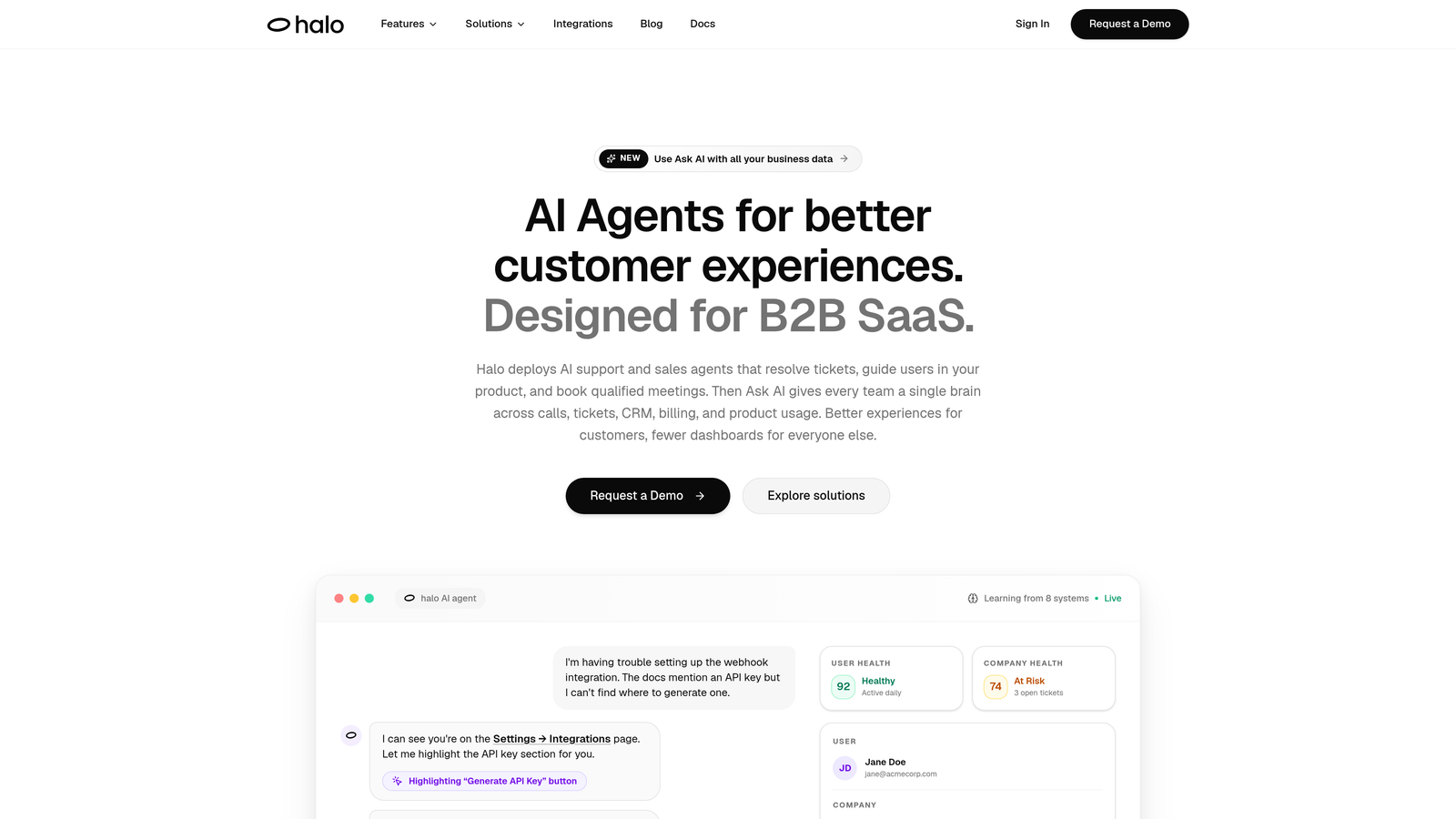
Halo AI is an AI-first customer support platform built specifically for B2B SaaS teams who need more than deflection.
Where This Tool Shines
Most AI helpdesks treat support as an isolated function. Halo treats it as a source of business intelligence. Its page-aware chat widget actually sees what your user sees, providing contextual guidance and visual UI walkthroughs rather than generic answers. That context-awareness makes a real difference when your product is complex and users need specific, step-by-step help.
What separates Halo from bolt-on AI tools is its architecture. It's built for autonomous resolution from the ground up, with continuous learning baked in from day one. Every resolved ticket, every escalation, every user interaction feeds back into the system, making it progressively smarter about your product and your customers over time.
Key Features
Page-Aware Chat Widget: Sees exactly what users see on screen and delivers contextual guidance with visual UI walkthroughs, not just text responses.
Intelligent AI Agents: Autonomously resolve support tickets with continuous learning, improving resolution accuracy with every interaction.
Smart Inbox with Business Intelligence: Surfaces customer health signals, anomaly detection, and revenue intelligence directly from support data, giving teams visibility beyond ticket counts.
Auto Bug Ticket Creation: Automatically creates bug reports and connects them to Linear, so engineering stays in the loop without manual handoffs.
Live Agent Handoff: Escalates complex issues to human agents smoothly, with full conversation context preserved.
Deep Integration Ecosystem: Connects to Linear, Slack, HubSpot, Intercom, Stripe, Zoom, PandaDoc, and Fathom, giving support agents and AI alike full business context on every interaction.
Best For
Halo is the strongest fit for B2B SaaS companies that want support to do more than close tickets. If your team needs integration with engineering workflows, revenue systems, and CRM data, and you want AI that learns from your specific product rather than generic training data, Halo is built for exactly that use case.
Pricing
Visit haloagents.ai for current pricing plans. Plans are tailored to team size and usage.
2. Zendesk AI
Best for: Enterprise support teams already invested in the Zendesk ecosystem who want AI layered onto a mature platform.
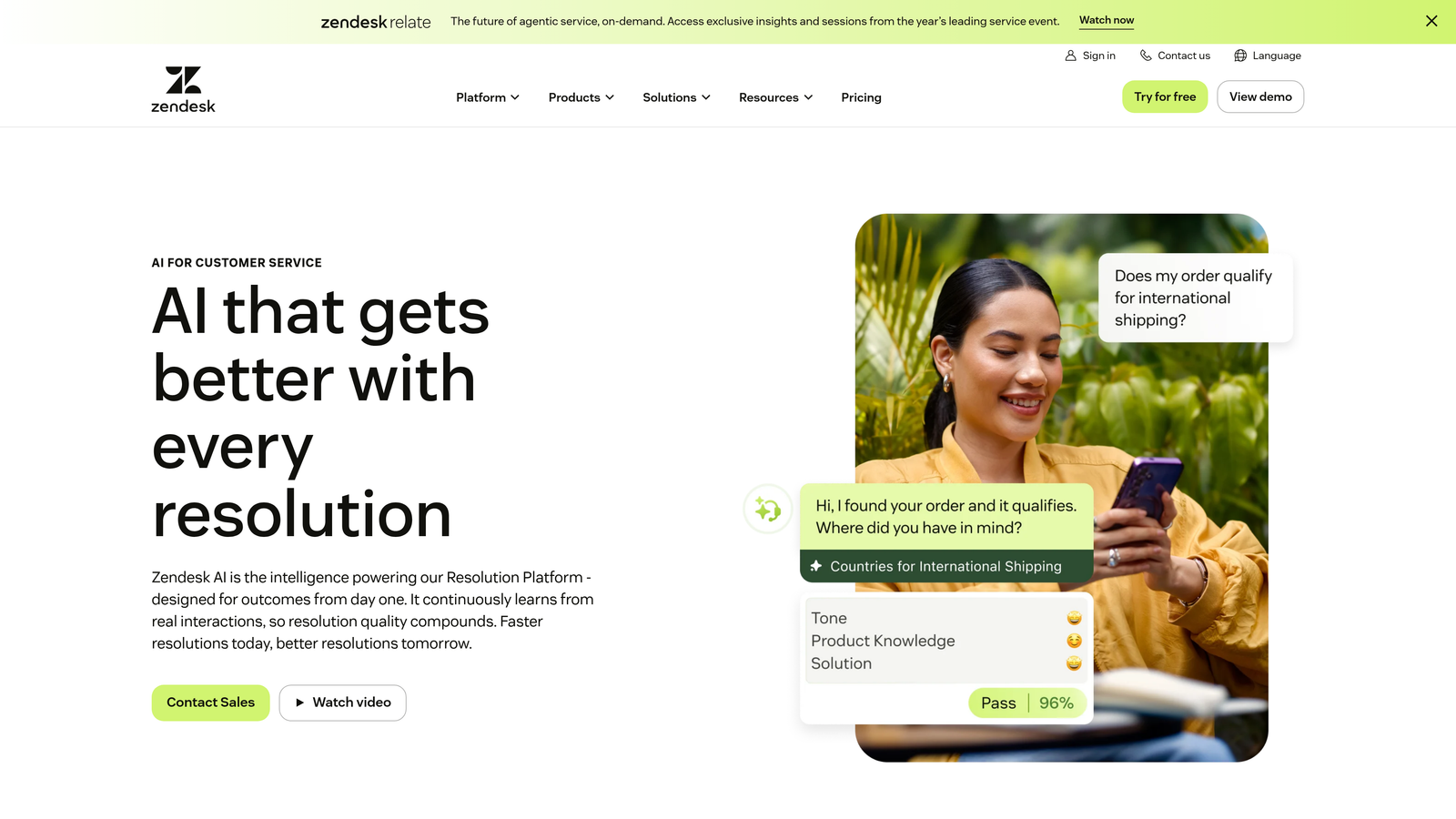
Zendesk AI is the AI layer built into Zendesk's industry-leading support platform, bringing intelligent triage, agent copilot features, and macro automation to large-scale support operations.
Where This Tool Shines
Zendesk's biggest advantage is its maturity. The platform has decades of enterprise support infrastructure behind it, and the AI features sit on top of that foundation. Intelligent triage automatically detects intent, sentiment, and language, routing tickets before a human ever touches them. Agent Copilot provides real-time response suggestions that help agents work faster without sacrificing quality.
For teams already running Zendesk, the AI upgrade path is straightforward. The integration ecosystem is one of the largest in the industry, meaning you can connect to almost any tool your team uses without custom development work.
Key Features
Intelligent Triage: Automatically detects intent, sentiment, and language to route tickets accurately from the moment they arrive.
Agent Copilot: Provides real-time response suggestions and contextual recommendations to help agents resolve issues faster.
AI-Powered Macro and Workflow Automation: Suggests and applies macros automatically, reducing repetitive manual steps for agents.
Extensive Integration Ecosystem: Connects to hundreds of third-party tools across CRM, engineering, and business operations.
Multi-Channel Support: Covers email, chat, voice, and social in a single unified platform.
Best For
Enterprise teams with established Zendesk workflows who want AI capabilities without migrating to a new platform. Less ideal for teams starting fresh who want an AI-native architecture rather than AI bolted onto a legacy ticketing system.
Pricing
AI features are included in Suite plans, with pricing that scales based on agent count and tier. Costs can escalate quickly at enterprise scale, so evaluate total cost carefully against your team size.
3. Intercom Fin
Best for: Teams that want fast deployment of an LLM-powered resolution agent with minimal setup overhead.
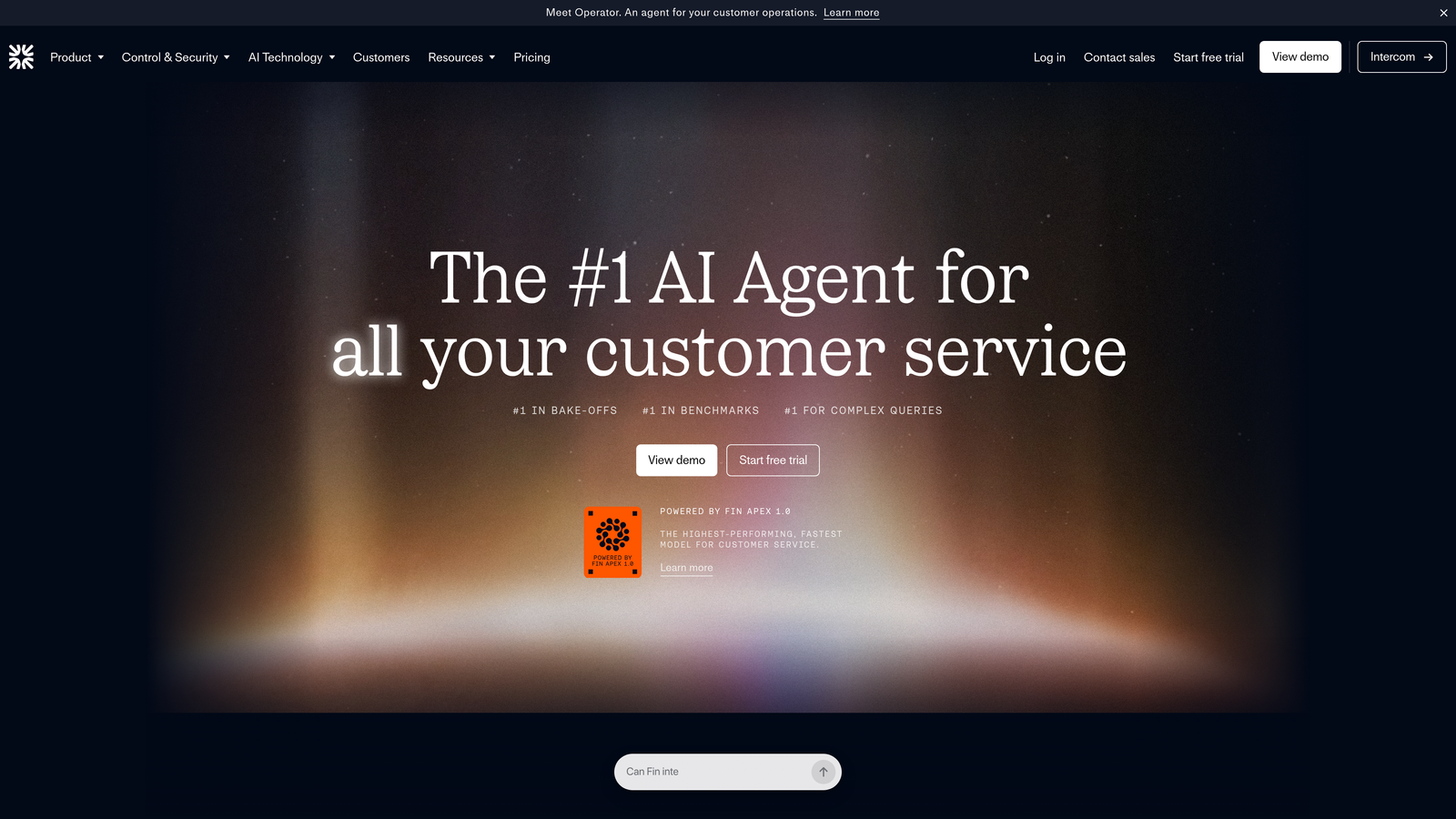
Intercom Fin is Intercom's LLM-powered AI resolution agent that autonomously handles customer queries using your existing help content, with clean handoff to human agents when needed.
Where This Tool Shines
Fin's standout quality is its speed to value. It trains on your existing help center content and begins resolving queries autonomously without extensive configuration. For teams with solid documentation already in place, this means meaningful automation in days rather than weeks. The handoff experience to human agents is notably smooth, preserving conversation context so customers don't have to repeat themselves.
The usage-based pricing model is a double-edged sword. It keeps initial costs low and aligns spending directly with value delivered, but it can make budgeting unpredictable at higher volumes. Teams should model their expected resolution volume carefully before committing.
Key Features
LLM-Powered Resolution: Trained on your help center content to answer common queries accurately and autonomously.
Minimal Setup: Learns from existing documentation without requiring extensive custom training or configuration.
Smooth Human Handoff: Escalates complex issues with full conversation context intact, so agents pick up without friction.
Conversation Summaries: AI-generated summaries give agents instant context when they take over a conversation.
Usage-Based Pricing: Charges per resolution, aligning cost directly with outcomes rather than seats.
Best For
Teams already on Intercom, or those with strong help center documentation who want fast autonomous resolution without complex implementation. Less suited to teams with intricate B2B workflows requiring deep integrations across engineering and revenue systems.
Pricing
Usage-based pricing per resolution, layered on top of an Intercom base plan. Check intercom.com for current resolution rates.
4. Freshdesk Freddy AI
Best for: SMBs and mid-market teams that want solid AI-powered support capabilities at accessible price points.
Freshdesk Freddy AI is Freshworks' AI suite spanning self-service bots, agent copilot assistance, and AI-driven analytics, built into the Freshdesk platform at pricing that growing teams can actually afford.
Where This Tool Shines
Freddy AI is structured across three distinct layers: self-service, agent assistance, and analytics. That modularity means teams can adopt the pieces that matter most for their current maturity level. Freddy Self Service handles autonomous query resolution. Freddy Copilot provides real-time suggestions and auto-complete for agents. Freddy Insights surfaces AI-driven analytics and CSAT predictions.
Freshdesk's omnichannel coverage is strong for the price tier, handling email, chat, phone, and social in one platform. For teams that are growing into AI support capabilities rather than overhauling mature enterprise infrastructure, Freddy offers a practical, lower-risk entry point.
Key Features
Freddy Self Service: AI bot that resolves common queries autonomously without agent involvement.
Freddy Copilot: Real-time agent suggestions, auto-complete, and response drafting to accelerate resolution times.
Freddy Insights: AI-driven analytics with CSAT predictions and support trend identification.
Omnichannel Coverage: Unified handling across email, chat, phone, and social channels.
Accessible Pricing Tiers: AI features available at price points designed for teams that aren't enterprise-scale yet.
Best For
SMBs and mid-market teams looking for a well-rounded AI helpdesk without enterprise-level investment. Teams with complex B2B integration needs or those requiring deep business intelligence from support data may find Freddy's AI capabilities less sophisticated than purpose-built AI-first platforms.
Pricing
Freddy features are available across Growth and higher plans. Freddy Copilot is offered as an add-on. Check Freshworks' pricing page for current tier details.
5. HubSpot Service Hub AI
Best for: Teams already in the HubSpot ecosystem who want support deeply integrated with CRM and revenue data.
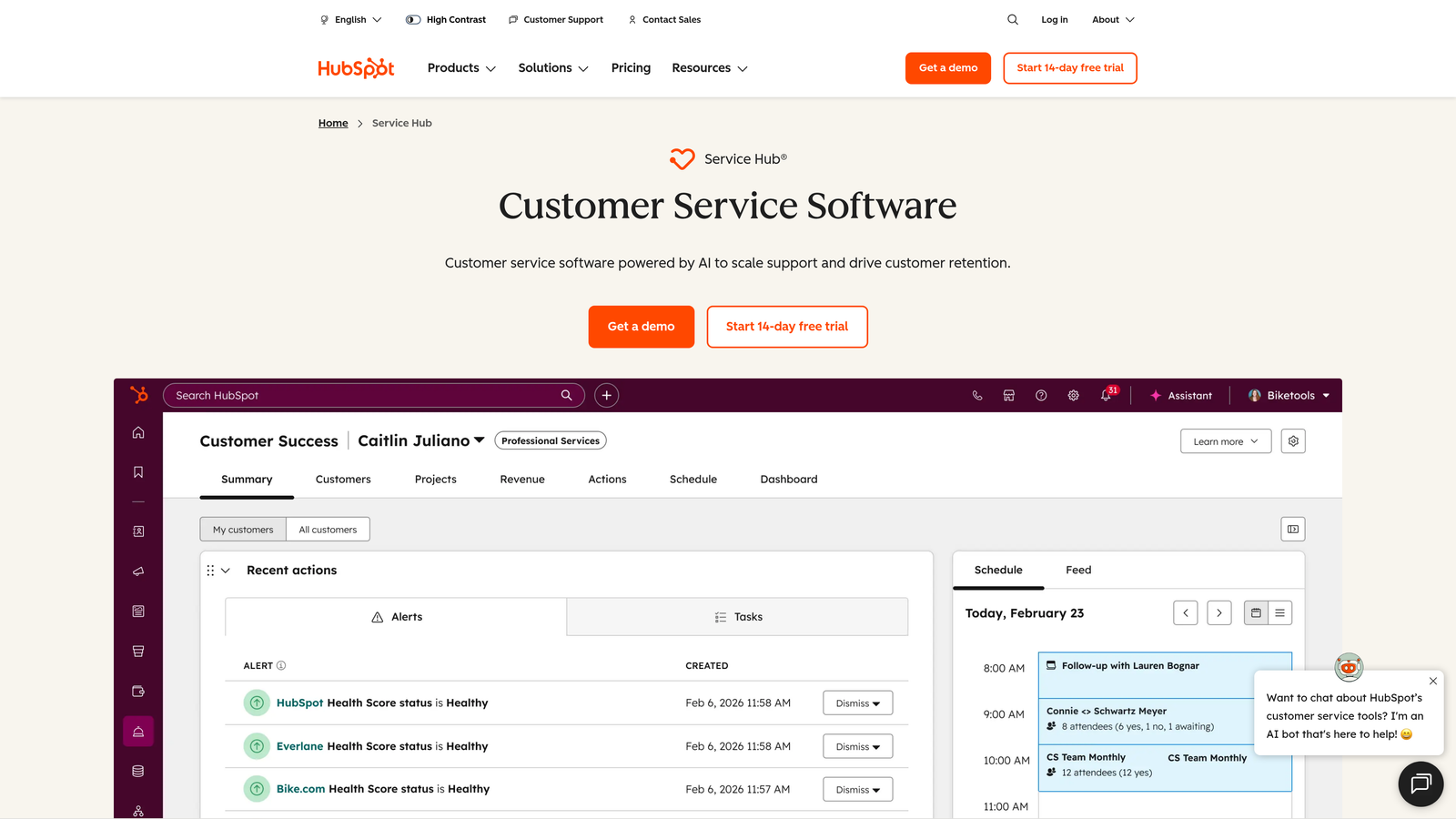
HubSpot Service Hub is HubSpot's customer service platform with AI features woven directly into its CRM, giving support agents full customer and deal context on every single interaction.
Where This Tool Shines
HubSpot's core advantage here isn't AI depth, it's context. When a support agent opens a ticket, they see the customer's full CRM history: deal stage, recent marketing interactions, sales notes, and contact details, all in one view. AI-suggested replies are informed by that full history, not just the current conversation. For revenue-aligned support teams, that context changes how agents prioritize and respond.
The native integration with Marketing Hub and Sales Hub also means support data flows directly into pipeline reporting, making it easier to connect support quality to retention and expansion outcomes. If your team is already running HubSpot across sales and marketing, Service Hub is the natural extension.
Key Features
AI-Suggested Replies: Response suggestions informed by the customer's full CRM history, not just the current ticket.
Conversation Summaries and AI Chatbot Builder: Automated summaries and a no-code chatbot builder for self-service flows.
Native HubSpot CRM Integration: Full visibility into contact, deal, and pipeline data directly within the support view.
Knowledge Base with AI Search: Customer-facing knowledge base with intelligent search to reduce inbound volume.
Revenue-Tied Reporting: Support metrics connected to pipeline and retention data for revenue-aligned teams.
Best For
Teams already using HubSpot for CRM, sales, or marketing who want support to plug into that ecosystem naturally. Teams evaluating standalone AI support platforms may find the AI capabilities more moderate compared to purpose-built solutions.
Pricing
Free tier available. AI features are included in Professional ($90/seat/month) and Enterprise plans. Check HubSpot's pricing page for current details.
6. Salesforce Service Cloud Einstein
Best for: Large enterprises already on Salesforce who need AI-powered support at scale with deep CRM data integration.
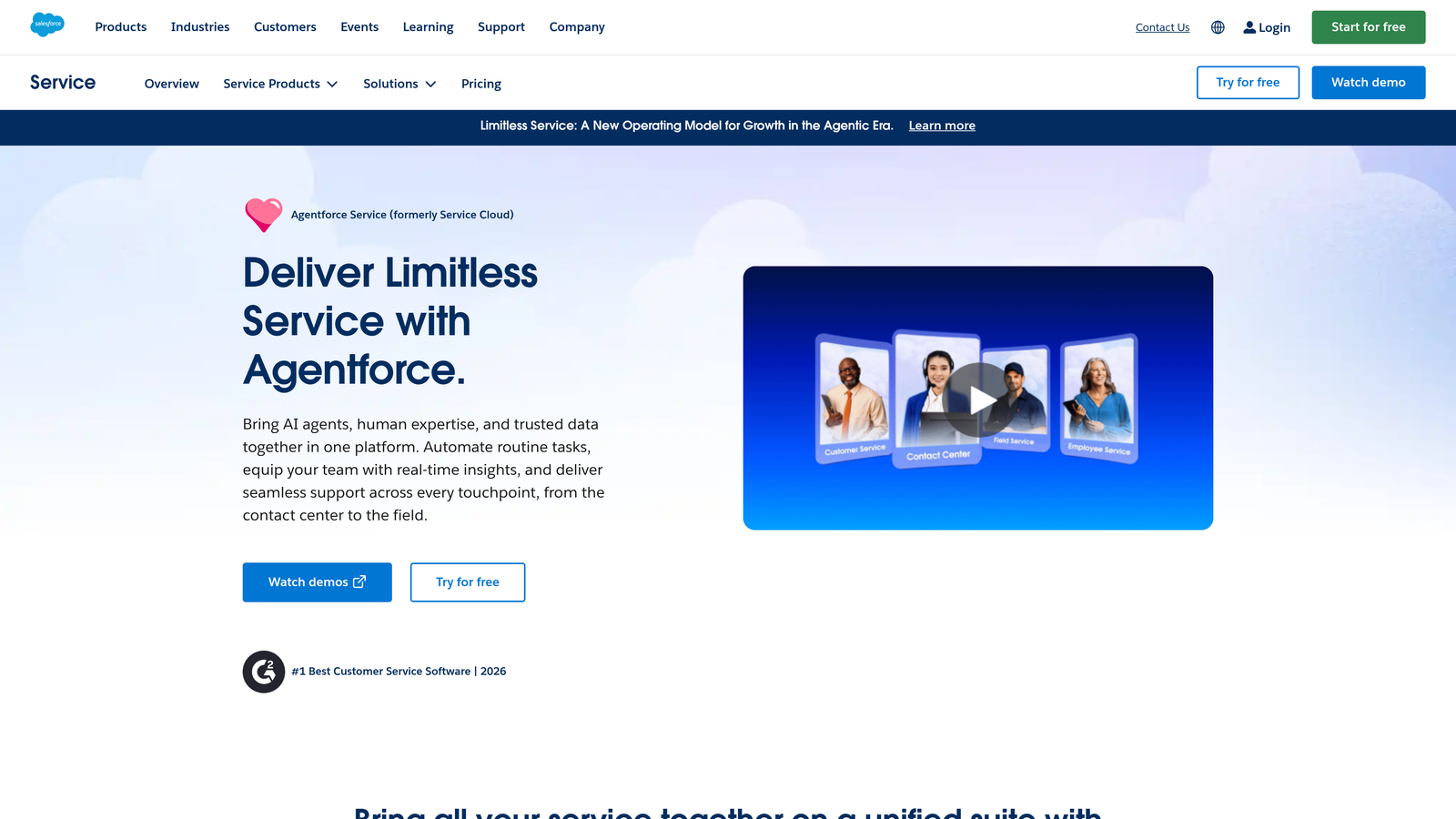
Salesforce Service Cloud Einstein is Salesforce's enterprise-grade AI for customer service, featuring case classification, next-best-action recommendations, and Einstein Copilot for agents, all built on the world's largest CRM data foundation.
Where This Tool Shines
For enterprises already running Salesforce, Einstein is the most data-rich AI support option available. Case classification automatically routes and prioritizes incoming cases using historical data patterns. Next-best-action recommendations guide agents toward the most effective resolution path based on customer history and predictive models. Predictive CSAT scoring lets teams identify at-risk interactions before they escalate.
The honest caveat is that this power comes with significant implementation complexity. Einstein is not a tool you deploy in a week. Teams typically need Salesforce implementation expertise and meaningful configuration time before realizing the full value. For smaller teams or those outside the Salesforce ecosystem, the investment rarely makes sense.
Key Features
Einstein Case Classification: Automatic routing and prioritization based on historical case data and machine learning patterns.
Einstein Copilot: AI assistant for agents with contextual recommendations drawn from Salesforce CRM data.
Next-Best-Action: Guides agents toward the highest-probability resolution path for each case.
Predictive CSAT Scoring: Identifies interactions at risk of poor outcomes before they close.
Deep Salesforce and Data Cloud Integration: Connects support data to the full Salesforce platform, including sales, marketing, and commerce data.
Best For
Large enterprises with existing Salesforce infrastructure and the implementation resources to configure Einstein properly. Not recommended for teams outside the Salesforce ecosystem or those needing fast time-to-value.
Pricing
Enterprise-level pricing. Einstein AI features require higher-tier Service Cloud licenses. Contact Salesforce directly for a quote based on your team size and requirements.
7. Gladly
Best for: High-touch customer service teams that prioritize relationship continuity over ticket-based workflows.
Gladly is a people-based support platform that replaces ticket numbers with continuous conversation threads per customer, with AI features for routing, summarization, and suggested replies layered on top.
Where This Tool Shines
Gladly's fundamental model is different from every other platform on this list. Instead of tickets, every customer has a single, continuous conversation thread that spans all channels over their entire lifetime with your brand. Agents see the full history, regardless of whether previous interactions happened via email, chat, voice, or SMS. That continuity changes the nature of support from reactive ticket-closing to genuine relationship management.
The AI features support that model: intelligent routing assigns conversations to the right agent based on history and expertise, while AI summarization gives agents instant context when picking up a conversation mid-thread. It's a strong fit for teams where customer relationships are genuinely long-term and high-value.
Key Features
People-Based Model: Single lifetime conversation thread per customer across all channels, replacing ticket numbers entirely.
AI Routing and Queue Management: Intelligently assigns conversations based on agent expertise and customer history.
AI Conversation Summarization: Gives agents instant context when joining or resuming a conversation.
Omnichannel in One View: Voice, email, chat, SMS, and social all visible in a single unified interface.
Relationship Continuity Focus: Platform design prioritizes long-term customer relationship quality over throughput metrics.
Best For
Teams where relationship continuity is a core service differentiator, particularly in high-touch B2C or premium B2B environments. Teams that need deep native integrations with engineering and revenue tooling may find Gladly's ecosystem more limited than alternatives.
Pricing
Premium pricing reflects the platform's positioning. Contact Gladly directly for a quote based on your team size and requirements.
8. Kustomer
Best for: High-volume, multi-channel support operations that need a unified customer timeline and strong automation capabilities.
Kustomer is a CRM-native support platform with a unified customer timeline view, AI-powered routing, and flexible automation tools built for teams handling large volumes across multiple channels simultaneously.
Where This Tool Shines
Kustomer's unified timeline is its defining feature: every customer interaction across every channel, from all time, in a single scrollable view. Agents never need to switch tabs or search across systems to understand a customer's history. Combined with AI-powered routing and intelligent auto-resolution, this creates a platform that handles high volume without sacrificing context quality.
The workflow automation builder is notably flexible, allowing teams to build custom automation logic without heavy developer involvement. Proactive service triggers let teams reach out to customers based on behavioral signals before issues become tickets, shifting support from reactive to proactive.
Key Features
Unified Customer Timeline: Complete interaction history across all channels in a single view, regardless of when or how previous contacts occurred.
AI-Powered Routing and Auto-Resolution: Intelligent routing and autonomous resolution for common query types.
Proactive Service Triggers: Automated outreach based on customer behavior signals, enabling proactive support before issues escalate.
Flexible Workflow Automation Builder: Customizable automation logic without requiring significant developer resources.
Multi-Channel Coverage: Email, chat, voice, social, and SMS managed in one platform.
Best For
Larger teams managing high ticket volumes across multiple channels who need strong automation and a complete customer history view. Implementation can be complex, making Kustomer better suited to teams with the resources to configure it properly.
Pricing
Per-user pricing model. Contact Kustomer for enterprise pricing based on team size and channel requirements.
9. Tidio
Best for: Smaller teams that need fast-to-deploy AI resolution with minimal setup and an accessible price point.
Tidio is an accessible AI-powered support platform featuring Lyro AI, which autonomously resolves common queries from your existing content with minimal training required.
Where This Tool Shines
Tidio's strongest selling point is speed to deployment. Lyro AI learns from your existing help content and starts resolving queries autonomously without requiring extensive setup or custom training. For small teams that need to move fast and don't have dedicated support operations resources, that low-friction onboarding is genuinely valuable.
The platform combines live chat, AI chatbot, and email ticketing in a single interface, keeping things simple for teams that don't need enterprise complexity. Integrations with e-commerce platforms like Shopify and WordPress make Tidio a practical choice for product-led growth companies with mixed customer bases.
Key Features
Lyro AI: Autonomous resolution of common queries trained on your existing help content with minimal configuration needed.
Unified Platform: Live chat, AI chatbot, and email ticketing in one interface, reducing tool sprawl for small teams.
Fast Setup: Lyro learns from existing documentation, enabling meaningful automation within days of deployment.
E-Commerce and SaaS Integrations: Native connections to Shopify, WordPress, and other common platforms.
Accessible Pricing: Free plan available, with Lyro AI included in paid plans at entry-level price points.
Best For
Small teams and early-stage companies that need AI-powered support without enterprise-level investment or implementation complexity. Teams with complex B2B workflows, deep integration requirements, or needs for business intelligence from support data will likely outgrow Tidio as they scale.
Pricing
Free plan available. Lyro AI is included in paid plans starting at accessible price points. Check tidio.com for current rates.
Which Tool Is Right for Your Team?
The right AI-powered helpdesk depends on where your team sits today and what you need support to do beyond closing tickets.
If you're a B2B SaaS team that wants AI-first architecture, deep product context, and business intelligence from support data, Halo AI is the strongest fit. It's built from the ground up for autonomous resolution, continuous learning, and integration across your entire business stack, not just your helpdesk.
For enterprise teams already invested in Salesforce or Zendesk, Einstein and Zendesk AI offer the deepest integration with existing infrastructure, though both come with meaningful implementation complexity and cost. Teams already running HubSpot across sales and marketing will find Service Hub the natural extension for revenue-aligned support.
If speed to deployment is the priority and your team is smaller or earlier-stage, Intercom Fin and Tidio both offer fast onboarding with solid autonomous resolution capabilities. Freshdesk Freddy sits in the middle: more capable than Tidio at scale, more accessible than enterprise platforms on price.
Gladly and Kustomer serve more specific needs. Gladly is the right call when relationship continuity is a genuine differentiator for your service model. Kustomer shines when high-volume, multi-channel operations need a unified customer timeline and flexible automation.
Your support team shouldn't scale linearly with your customer base. Let AI agents handle routine tickets, guide users through your product, and surface business intelligence while your team focuses on complex issues that need a human touch. See Halo in action and discover how continuous learning transforms every interaction into smarter, faster support.