9 Best AI-Powered Helpdesk Systems for Smarter Support in 2026
Choosing the right AI powered helpdesk system is critical for B2B companies looking to scale support without increasing headcount. This guide evaluates nine leading platforms across genuine AI capabilities, integration depth, scalability, and pricing transparency to help support teams move beyond basic automation and invest in systems that truly resolve, route, and learn autonomously.
 Grant CooperFounder13 min read
AI-powered helpdesk systems have quietly crossed a threshold. They're no longer a differentiator for forward-thinking support teams; they're the baseline expectation for any B2B company serious about scaling support without scaling headcount. The shift from traditional ticket queues to intelligent systems that resolve, route, and learn autonomously has happened faster than most anticipated.
But not all "AI-powered" helpdesks are created equal. Some bolt AI onto legacy ticketing infrastructure. Others build from the ground up with autonomous resolution as the core design principle. Choosing the wrong one means paying for AI theater instead of actual intelligence.
To help you cut through the noise, we evaluated these platforms on five criteria: genuine AI capabilities (not just automation rules), integration depth with your existing stack, scalability for B2B teams, analytics and business intelligence features, and pricing transparency. Whether you're exploring a customer support automation strategy or benchmarking against AI support platform features you actually need, this list gives you a clear starting point.
Here are the top AI-powered helpdesk systems worth your attention in 2026.
1. Halo AI
Best for: B2B SaaS teams that want AI-first support with business intelligence built in
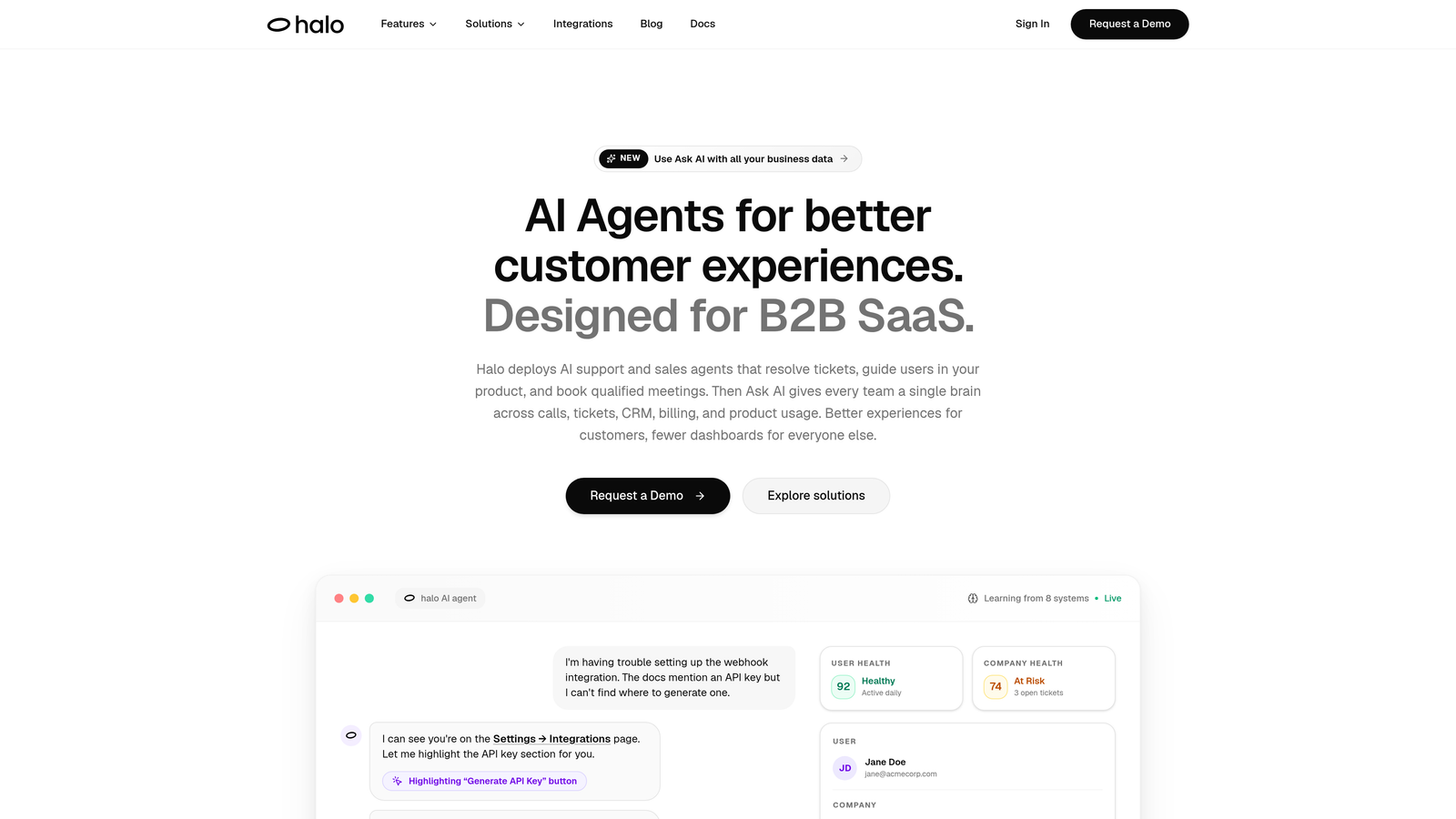
Halo AI is an AI-first customer support platform built around autonomous ticket resolution, page-aware contextual guidance, and business intelligence that goes well beyond traditional helpdesk metrics.
Where This Tool Shines
Most helpdesks treat AI as a layer on top of a ticketing system. Halo inverts that model. The AI agent is the primary interface, and the entire platform is architected around continuous learning from every interaction. That means resolution quality improves over time rather than staying static.
The page-aware capability is genuinely differentiated. Halo's agents can see what the user is looking at within your product, enabling contextual guidance that goes beyond keyword-matched knowledge base articles. Add auto bug ticket creation from support conversations and a smart inbox that surfaces customer health signals and revenue intelligence, and you have a platform that informs your product and revenue teams, not just your support team.
Key Features
Page-Aware AI Agents: Agents detect which page or feature a user is on and deliver contextually relevant guidance rather than generic answers.
Continuous Learning: Every resolved interaction feeds back into the model, improving accuracy and resolution rates over time without manual retraining.
Auto Bug Ticket Creation: When support conversations reveal product issues, Halo automatically creates bug tickets, closing the loop between support and engineering.
Smart Inbox with Business Intelligence: Goes beyond CSAT scores to surface customer health signals, anomaly detection, and revenue-relevant insights from support data.
Deep Integration Stack: Connects natively with Linear, Slack, HubSpot, Intercom, Stripe, Zoom, PandaDoc, Fathom, and more, making it a connective layer across your entire business stack.
Best For
B2B SaaS product teams and support leaders who want AI that understands product context, not just knowledge base content. Particularly strong for teams that need support intelligence to feed product decisions and customer success workflows.
Pricing
Contact for pricing. Designed specifically for B2B SaaS teams; pricing is scoped to your team size and usage needs.
2. Zendesk AI
Best for: Enterprise teams that need proven scale, compliance, and a mature ecosystem
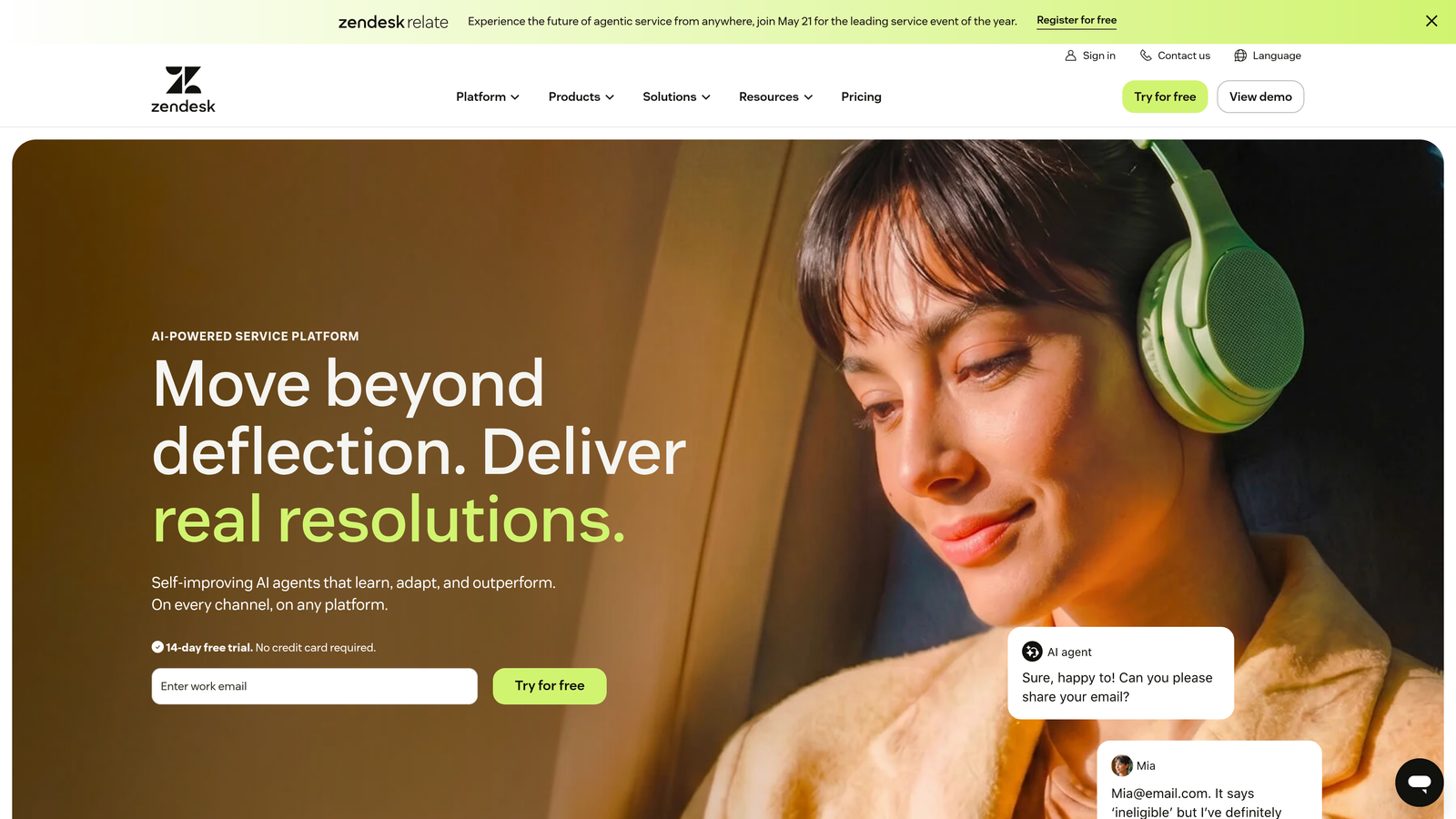
Zendesk AI is an enterprise-grade helpdesk platform with AI capabilities layered across its mature ticketing system, including intelligent triage, agent assist, and generative AI-powered responses.
Where This Tool Shines
Zendesk's biggest strength is its install base and ecosystem maturity. If your team is already operating on Zendesk, the AI add-ons integrate directly into existing workflows without a platform migration. Intelligent triage handles automatic classification and routing at scale, and the generative AI tools help agents draft responses and maintain knowledge base content without starting from scratch.
For enterprise buyers with strict compliance requirements, Zendesk's security certifications and administrative controls are well-established. The tradeoff is that the AI capabilities feel additive rather than foundational. You're enhancing an existing system rather than working with one designed around AI from the start.
Key Features
Intelligent Triage: Automatically classifies, tags, and routes incoming tickets based on intent and sentiment detection.
Generative AI Responses: Suggests agent replies and helps generate and maintain knowledge base articles using generative AI.
Advanced Analytics: AI-driven reporting surfaces trends, bottlenecks, and performance insights across the support operation.
Marketplace Ecosystem: Thousands of integrations and apps available through the Zendesk marketplace.
Enterprise Security: Comprehensive compliance certifications and security controls for regulated industries.
Best For
Large enterprise support teams already invested in the Zendesk ecosystem, or organizations that need a proven, compliant platform with broad integration support and don't mind AI being an add-on layer.
Pricing
Suite plans start at $55/agent/month. Advanced AI capabilities are available as a paid add-on on top of base plan pricing.
3. Intercom Fin
Best for: Product-led growth companies with strong in-app messaging needs
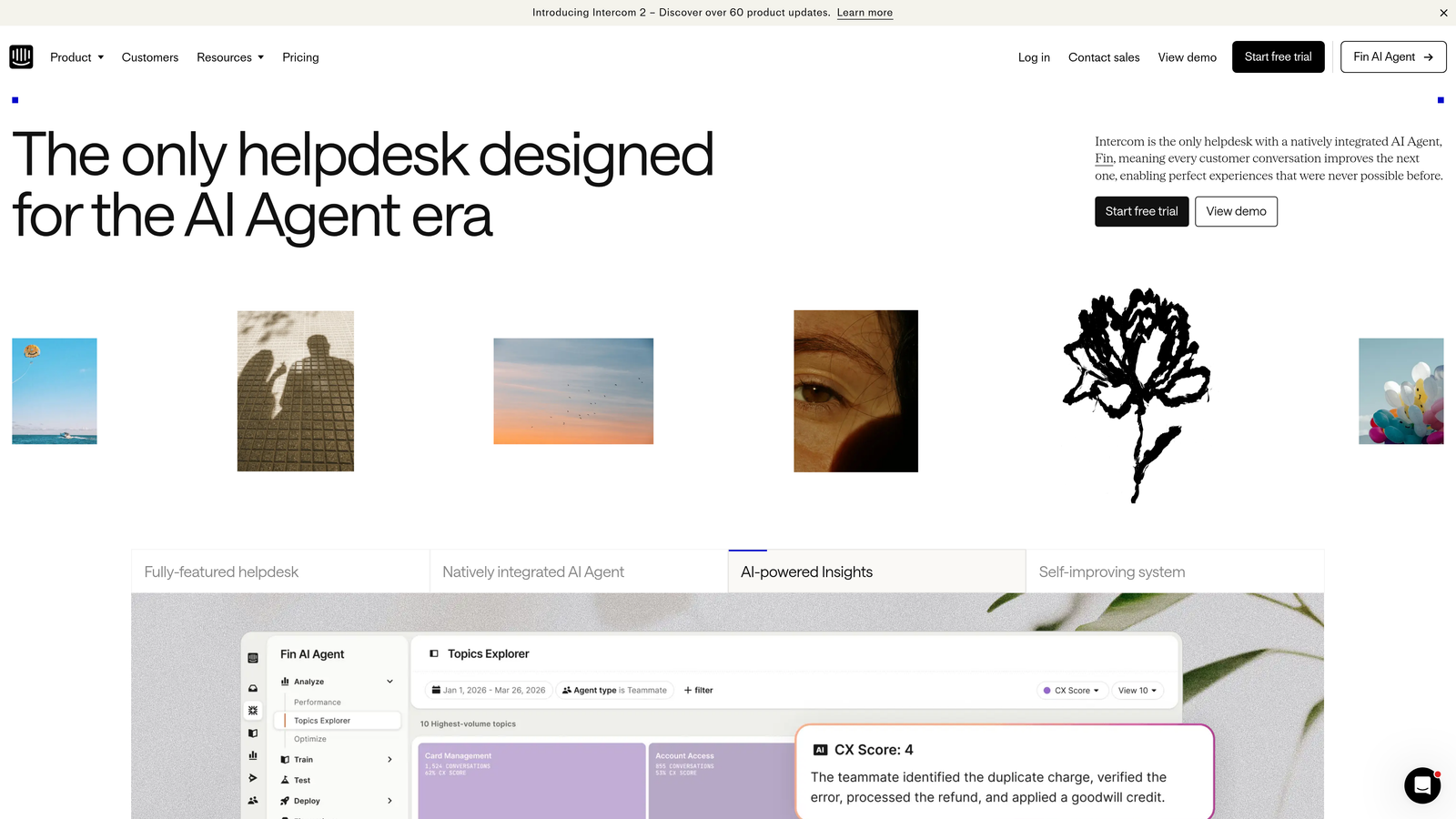
Intercom Fin is a conversational AI agent built into Intercom's messaging-first platform, resolving customer questions from help center content and custom data sources with strong in-app support capabilities.
Where This Tool Shines
Fin is purpose-built for conversational resolution. It pulls from your existing knowledge base and custom data sources to answer questions in a natural, dialogue-based format rather than serving up article links. For product-led growth companies where in-app support is critical, the combination of Fin's AI resolution with Intercom's product tours and contextual messaging creates a cohesive user experience.
The per-resolution pricing model is worth noting. It aligns Intercom's incentive with yours: you pay when Fin actually resolves something, not just when it attempts to. That said, at scale, per-resolution pricing can become expensive compared to seat-based models.
Key Features
Fin AI Agent: Resolves customer questions conversationally using your knowledge base and custom data sources without requiring manual flow building.
In-App Messenger: Product tours, contextual messages, and proactive support triggered by user behavior inside your product.
Custom AI Workflows: Build complex resolution paths and actions for scenarios that go beyond simple Q&A.
AI-Powered Routing: Conversation prioritization and routing based on intent and customer context.
Per-Resolution Pricing for Fin: Outcome-aligned pricing model that charges based on successful resolutions.
Best For
SaaS companies with a strong in-app support model and existing Intercom investment, particularly those in product-led growth motions where the messenger is already part of the user experience.
Pricing
Essential plan starts at $29/seat/month. Fin AI is charged separately per resolution, making total cost dependent on your resolution volume.
4. Freshdesk Freddy AI
Best for: Growing teams that need omnichannel AI support at a competitive price point
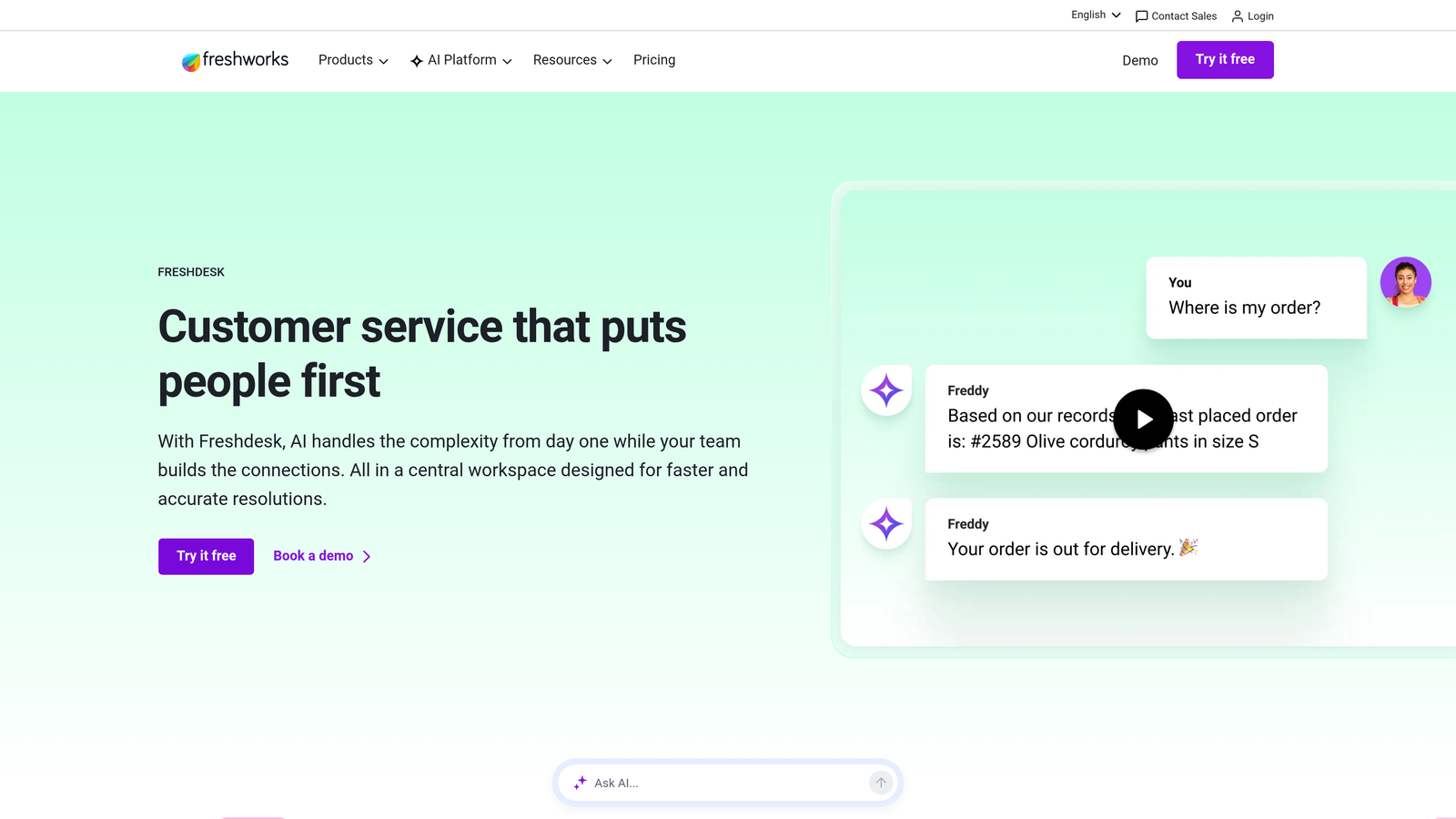
Freshdesk is an AI-powered helpdesk within the Freshworks ecosystem, offering Freddy AI across email, chat, phone, and social channels with strong self-service and agent assistance capabilities.
Where This Tool Shines
Freshdesk's competitive advantage is breadth at an accessible price. Freddy AI handles auto-triage, suggested responses, and canned reply recommendations across a genuinely omnichannel setup. For teams managing support across email, chat, social, and phone simultaneously, having a unified AI layer across all channels reduces operational complexity.
The free tier and competitive Pro pricing make Freshdesk particularly attractive for teams that need to demonstrate AI ROI before committing to enterprise-level spend. The Freshworks ecosystem also provides a natural upgrade path to CRM, sales, and IT service management tools as the business grows.
Key Features
Freddy AI Triage: Automatically routes, tags, and suggests responses for incoming tickets across all channels.
Omnichannel Support: Unified inbox covering email, chat, phone, social media, and messaging apps.
AI-Powered Chatbots: Self-service deflection bots that handle common questions before they reach an agent.
SLA Management: Built-in SLA tracking and escalation rules with collaboration tools for team-based resolution.
Competitive Pricing: Free tier available with meaningful functionality; paid plans priced accessibly relative to enterprise alternatives.
Best For
Mid-market teams that need omnichannel AI support without enterprise pricing, and companies already using or considering other Freshworks products for a unified ecosystem approach.
Pricing
Free tier available. Pro plan starts at $49/agent/month with AI features included. Enterprise pricing available for larger teams.
5. Ada
Best for: Teams laser-focused on maximizing autonomous resolution rates at scale
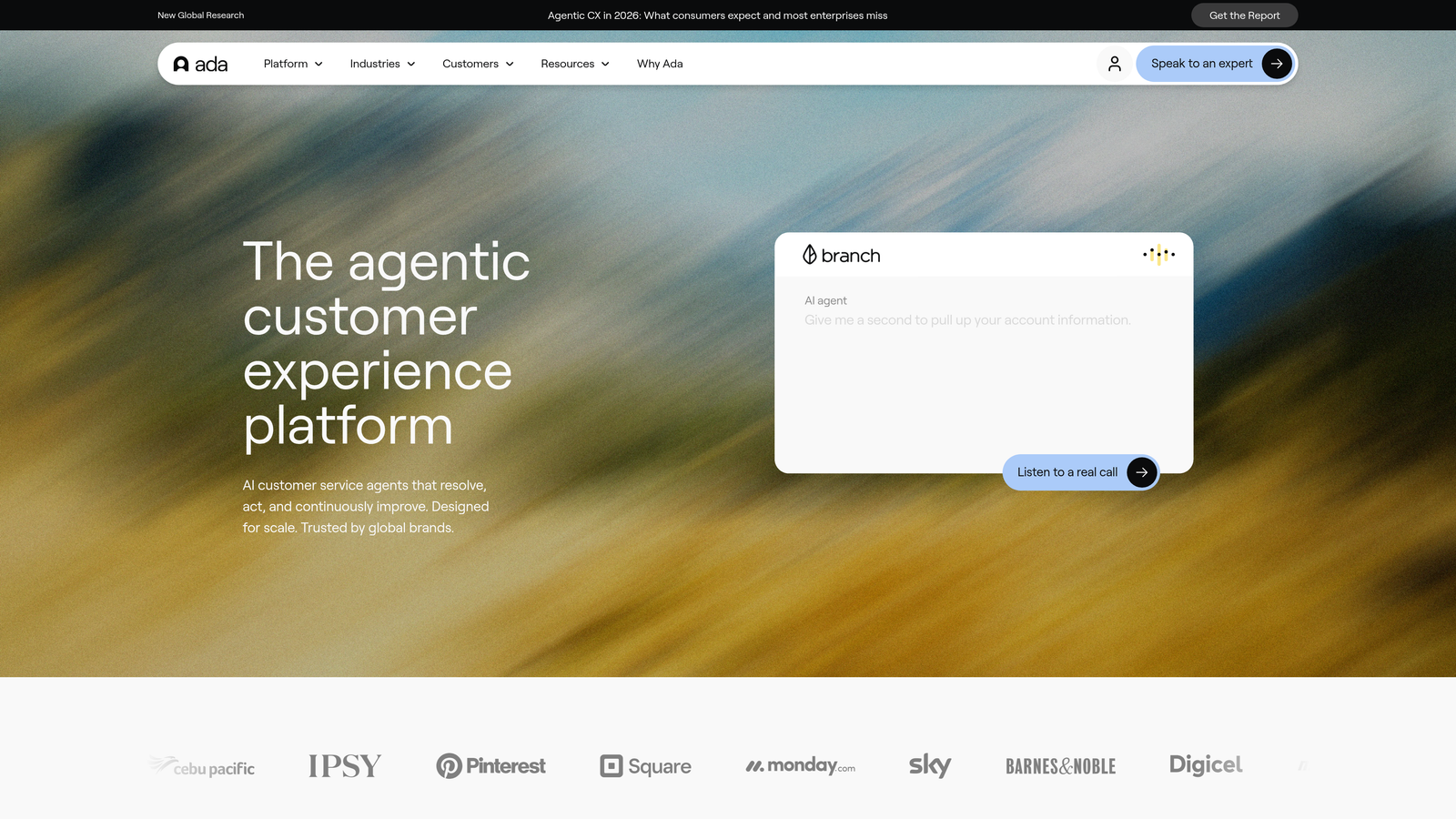
Ada is a purpose-built AI agent platform designed to maximize automated resolution across chat, email, voice, and social channels, with strong multilingual capabilities and action-oriented AI.
Where This Tool Shines
Ada is built around one metric: automated resolution rate. The platform is designed to resolve as much as possible without human intervention, and it's engineered for teams that want to treat that number as a primary KPI. Unlike AI tools that focus on helping agents respond faster, Ada's orientation is toward eliminating the need for human response on routine issues entirely.
The multilingual support is a genuine differentiator for companies with global customer bases. Ada handles many languages without requiring manual translation workflows, and its action-oriented AI can actually perform tasks within connected systems rather than just answering questions.
Key Features
Autonomous Resolution Engine: AI agent designed to resolve inquiries end-to-end without requiring human handoff for routine issues.
Multilingual Support: Handles customer conversations across many languages without manual translation workflows.
Action-Oriented AI: Can perform tasks within connected systems (lookups, updates, transactions) rather than only providing information.
Helpdesk Integrations: Connects with existing helpdesks including Zendesk, Salesforce Service Cloud, and others to layer on top of existing infrastructure.
Resolution-Based Pricing: Pricing aligned to outcomes rather than seats, which scales with demonstrated value.
Best For
Enterprise and mid-market companies with high ticket volumes and a clear mandate to maximize automation rates, particularly those with multilingual support needs or global customer bases.
Pricing
Custom pricing based on resolution volume. Contact Ada's sales team for a quote tailored to your expected resolution volume and channel mix.
6. Tidio
Best for: Small-to-mid-size teams that need fast deployment with minimal technical overhead
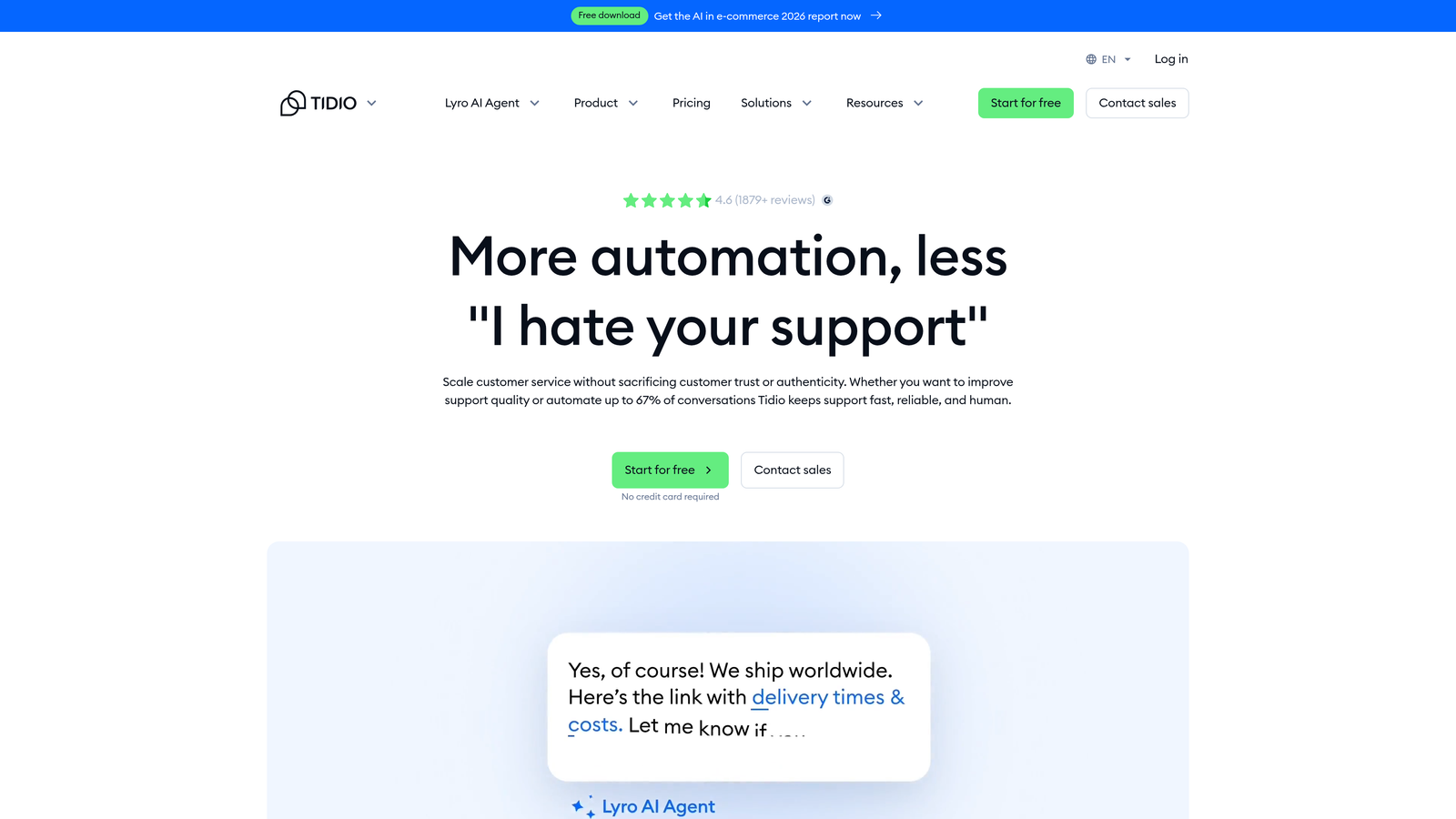
Tidio is an accessible AI helpdesk combining live chat, a visual chatbot builder, and the Lyro AI conversational agent, designed for quick deployment without extensive technical setup.
Where This Tool Shines
Tidio's strength is approachability. The visual drag-and-drop chatbot builder means non-technical team members can build and modify conversation flows without developer involvement. Lyro AI handles conversational support automatically, and the live chat component gives agents real-time visibility into visitor behavior and active conversations.
For teams that need something running quickly, Tidio's integrations with Shopify, WordPress, and other common platforms reduce setup friction significantly. It's not the most powerful AI engine on this list, but for smaller teams, the deployment speed and ease of use often matter more than raw AI sophistication.
Key Features
Lyro AI Chatbot: Conversational AI agent that handles customer questions automatically using your content and FAQs.
Visual Flow Builder: Drag-and-drop interface for building chatbot conversation flows without coding.
Live Chat with Visitor Tracking: Real-time monitoring of active visitors with agent chat capabilities and behavioral triggers.
AI-Suggested Responses: Helpdesk ticketing with AI-generated reply suggestions to speed up agent response times.
Platform Integrations: Native integrations with Shopify, WordPress, Wix, and other common website and e-commerce platforms.
Best For
Small-to-mid-size businesses, e-commerce teams, and early-stage SaaS companies that need a fast-to-deploy AI chat and helpdesk solution without heavy IT involvement or enterprise-level budget.
Pricing
Free plan available. Paid plans start around $29/month. Lyro AI conversations are priced separately based on volume, so factor that into total cost projections.
7. HubSpot Service Hub
Best for: Teams that need full customer lifecycle context woven into every support interaction
HubSpot Service Hub is an AI-powered service platform deeply integrated with HubSpot's CRM, giving support teams complete customer context spanning marketing, sales, and service history.
Where This Tool Shines
Service Hub's defining advantage is context. Because it sits inside HubSpot's CRM, every support interaction is automatically enriched with the customer's full history: marketing touchpoints, sales conversations, deal status, and previous support tickets. For B2B teams where support quality directly affects retention and expansion revenue, that context changes how agents prioritize and respond.
The AI tools in Service Hub handle conversation intelligence, ticket summarization, and chatbot interactions. The feedback and health scoring features connect support outcomes directly to CRM records, which is valuable for customer success teams trying to identify churn risk or expansion opportunities.
Key Features
CRM-Contextual AI Chatbot: Chatbot and knowledge base powered by AI with access to full CRM customer data for personalized support.
Unified Customer Timeline: Single view of all marketing, sales, and service interactions for every customer record.
Conversation Intelligence: AI-generated ticket summaries and conversation insights that reduce agent ramp-up time on complex issues.
Customer Feedback and Health Scoring: CSAT and NPS surveys tied directly to CRM records for customer health tracking.
Cross-Team Handoffs: Seamless escalation and context sharing between marketing, sales, and support teams within one platform.
Best For
B2B companies already using HubSpot CRM that want to unify support with customer success and revenue workflows. Particularly valuable for teams where support interactions influence renewal and expansion conversations.
Pricing
Free tools available with HubSpot account. Professional plan starts at $100/seat/month with full AI and automation features included.
8. Zoho Desk with Zia
Best for: Budget-conscious teams in the Zoho ecosystem that need AI without enterprise pricing
Zoho Desk is a budget-friendly AI helpdesk featuring Zia, an AI assistant that handles sentiment analysis, ticket tagging, anomaly detection, and response suggestions across a multi-department support setup.
Where This Tool Shines
Zoho Desk punches above its price point. Zia's anomaly detection is a feature you'd expect in more expensive platforms: it flags unusual spikes in ticket volume and surfaces patterns that might indicate a product issue or service disruption before it becomes a crisis. Sentiment analysis on incoming tickets helps agents prioritize emotionally charged conversations before they escalate.
For organizations already using Zoho CRM, Zoho Projects, or other Zoho applications, Desk integrates natively across the ecosystem. Multi-department and multi-brand support from a single platform also makes it a practical choice for companies managing support across multiple product lines.
Key Features
Zia AI Assistant: Handles sentiment analysis, auto-tagging, field predictions, and suggested responses for agents.
Anomaly Detection: Flags unusual ticket volume spikes and patterns that may indicate broader product or service issues.
AI-Suggested Knowledge Articles: Recommends relevant knowledge base content to both agents and customers during interactions.
Multi-Department and Multi-Brand Support: Manage support for multiple products, brands, or business units from a single Zoho Desk instance.
Zoho Ecosystem Integration: Deep native integration with Zoho CRM, Zoho Projects, Zoho Analytics, and other Zoho applications.
Best For
Small-to-mid-market teams on a budget, particularly those already in the Zoho ecosystem. Also a strong choice for companies managing multi-brand or multi-department support from one platform.
Pricing
Free plan for up to 3 agents. Enterprise plan at $40/agent/month includes Zia AI features. Competitive pricing relative to most alternatives on this list.
9. Kustomer
Best for: B2B teams that want a conversation-centric CRM with AI classification and proactive support
Kustomer is a conversation-centric CRM and helpdesk platform that organizes support around complete customer timelines rather than individual tickets, with AI classification, workflow automation, and proactive support capabilities.
Where This Tool Shines
Kustomer's fundamental design choice sets it apart: it treats the customer as the unit of organization, not the ticket. Every interaction across email, chat, social, SMS, and voice appears in a unified timeline for each customer. Agents see the full picture immediately rather than hunting across channels for context. For B2B support where customers have complex, multi-thread relationships with your product, that timeline view changes the quality of every interaction.
The custom objects and data modeling capability is worth highlighting for enterprise B2B use cases. Teams can model their specific business data inside Kustomer, making the platform adaptable to complex support workflows that generic helpdesks struggle to accommodate.
Key Features
Timeline-Based Customer View: All interactions across every channel consolidated into a single chronological customer timeline.
AI Classification and Routing: Automatic intent classification, ticket routing, and suggested responses powered by AI.
Proactive Support Triggers: Initiate support conversations based on customer behavior signals before issues escalate.
Omnichannel Coverage: Email, chat, social, SMS, and voice all managed from a unified agent workspace.
Custom Objects and Data Modeling: Build custom data structures inside Kustomer to reflect your specific business logic and support workflows.
Best For
Mid-market and enterprise B2B teams with complex customer relationships and multi-channel support needs, particularly those that find traditional ticket-centric helpdesks too rigid for their workflows.
Pricing
Enterprise plan starts at $89/user/month. AI add-on pricing is available; contact Kustomer's sales team for a full quote based on your team size and feature requirements.
How to Choose the Right AI-Powered Helpdesk for Your Team
The right choice depends less on feature lists and more on how your team thinks about AI's role in support. There's a meaningful difference between AI that assists agents and AI that resolves independently. Getting clear on which model fits your operation is the most important decision you'll make before evaluating vendors.
If autonomous resolution is your primary goal, Halo AI and Ada are the strongest options. Both are designed around AI-first resolution rather than AI-assisted agents, with the distinction that Halo adds page-aware context, continuous learning, and business intelligence features that extend value beyond the support team itself.
If you're already deep in an existing ecosystem, platform fit often matters more than AI sophistication. Zendesk AI for large enterprise teams, HubSpot Service Hub for CRM-centric organizations, and Zoho Desk for Zoho ecosystem users all offer meaningful AI capabilities without requiring a platform migration.
For teams that prioritize conversational in-app support, Intercom Fin remains a strong choice. For budget-conscious teams that need fast deployment, Tidio and Freshdesk offer accessible entry points without sacrificing core AI functionality.
One question worth asking every vendor: does the AI get smarter over time with your specific data, or does it stay static until you manually update it? That distinction separates tools that compound in value from those that plateau.
Your support team shouldn't scale linearly with your customer base. Let AI agents handle routine tickets, guide users through your product, and surface business intelligence while your team focuses on complex issues that need a human touch. See Halo in action and discover how continuous learning transforms every interaction into smarter, faster support.