9 Best AI Support Agent Software Tools Reviewed for 2026
This guide delivers hands-on AI support agent software reviews of nine leading platforms evaluated on ticket resolution quality, helpdesk compatibility, integration depth, business intelligence, and pricing transparency. Whether you're upgrading a legacy helpdesk or building a fully autonomous support operation, these reviews help B2B teams shortlist the right tool without sitting through endless demos.
 Matt PattoliFounder13 min read
Buying an AI support agent platform in 2026 is harder than it looks. Every vendor promises autonomous resolution, seamless escalation, and instant ROI, but the real differences only surface once you dig into how each tool handles context, integrations, and continuous learning.
This review cuts through the noise. We evaluated nine platforms on the criteria that actually matter to B2B teams: ticket resolution quality, helpdesk compatibility, depth of integrations, business intelligence capabilities, and pricing transparency. Whether you're replacing a legacy helpdesk, layering AI onto Zendesk or Freshdesk, or building a fully autonomous support operation from scratch, this list gives you a clear picture of where each tool excels and where it falls short.
Each entry covers key features, ideal use cases, and pricing so you can shortlist the right platform without sitting through nine demo calls first.
1. Halo AI
Best for: B2B SaaS teams wanting AI-native autonomous support with business intelligence built in.
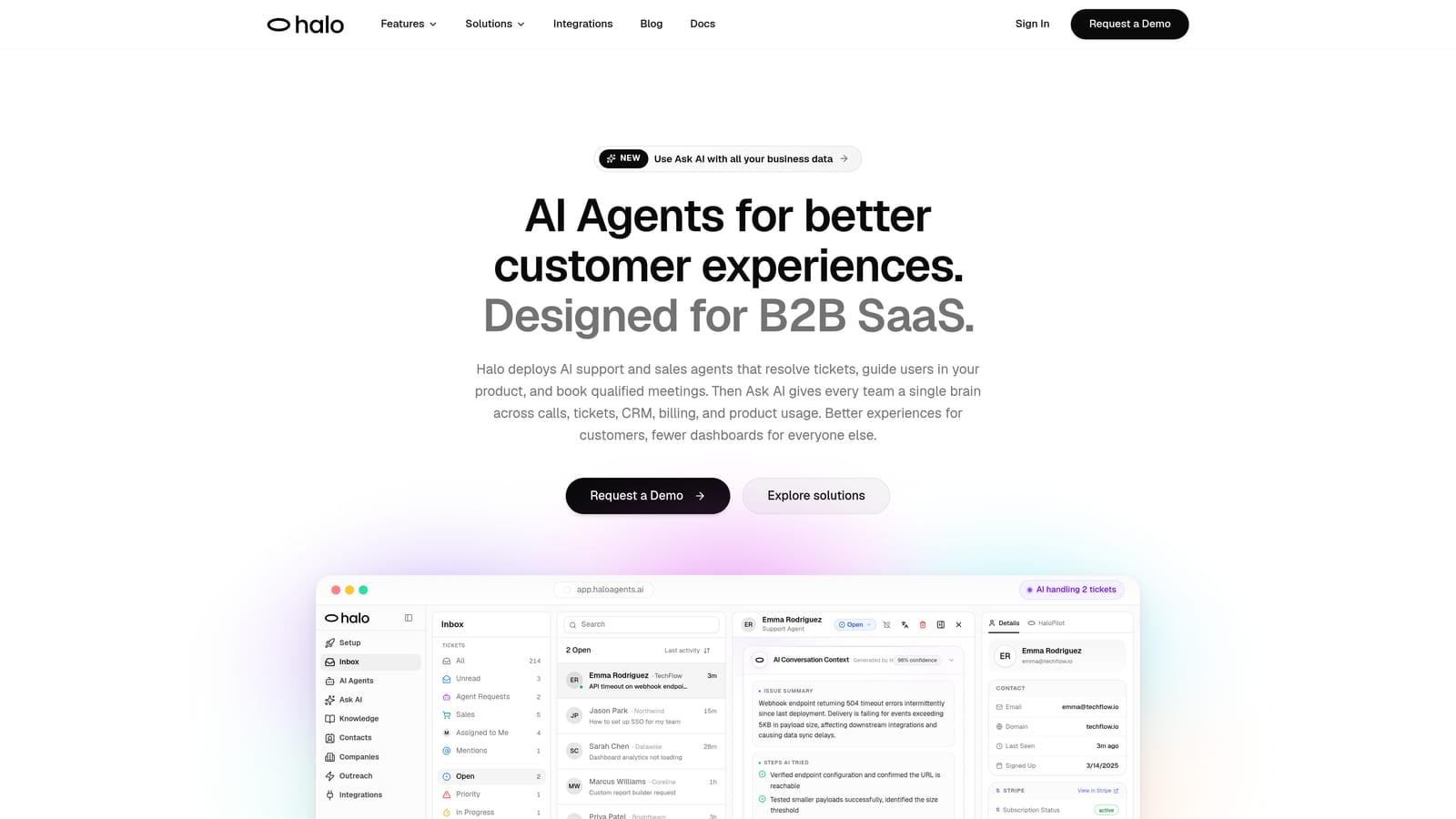
Halo AI is an AI-native customer support platform built from the ground up for autonomous ticket resolution, not as a bolt-on to an existing helpdesk.
Where This Tool Shines
Most AI support tools stop at deflection. Halo goes further. Its page-aware chat widget actually sees what the user sees, meaning the AI understands which feature, screen, or workflow triggered the support request before the conversation even starts. That context alone changes the quality of every response.
The business intelligence layer is what genuinely sets Halo apart from the rest of this list. The smart inbox surfaces customer health signals, revenue anomalies, and churn indicators drawn from support interactions. Your support data stops being a cost center metric and starts functioning as a real-time signal about your business.
Key Features
Page-Aware Chat Widget: The AI sees the user's current page and UI state, enabling contextually accurate guidance without the user having to explain where they are.
Autonomous Ticket Resolution: AI agents resolve tickets end-to-end with continuous learning from every interaction, improving accuracy over time without manual retraining.
Auto Bug Ticket Creation: When an issue looks like a bug, Halo automatically creates and routes a ticket to Linear or your connected project management tool.
Smart Inbox with Business Intelligence: Surfaces customer health signals, revenue intelligence, and anomaly detection directly from support data.
Live Agent Handoff: Complex issues escalate to human agents with full conversation context preserved, so agents never start cold.
Deep Integrations: Connects to Linear, Slack, HubSpot, Intercom, Stripe, Zoom, PandaDoc, and Fathom across the full business stack.
Best For
B2B SaaS product teams and customer success organizations that want AI-first support architecture rather than AI features added onto a traditional helpdesk. Particularly strong for teams that want support data to feed into broader revenue and product intelligence workflows.
Pricing
Contact for pricing. A demo is available at haloagents.ai.
2. Intercom Fin
Best for: Teams already running Intercom who want AI resolution without switching platforms.
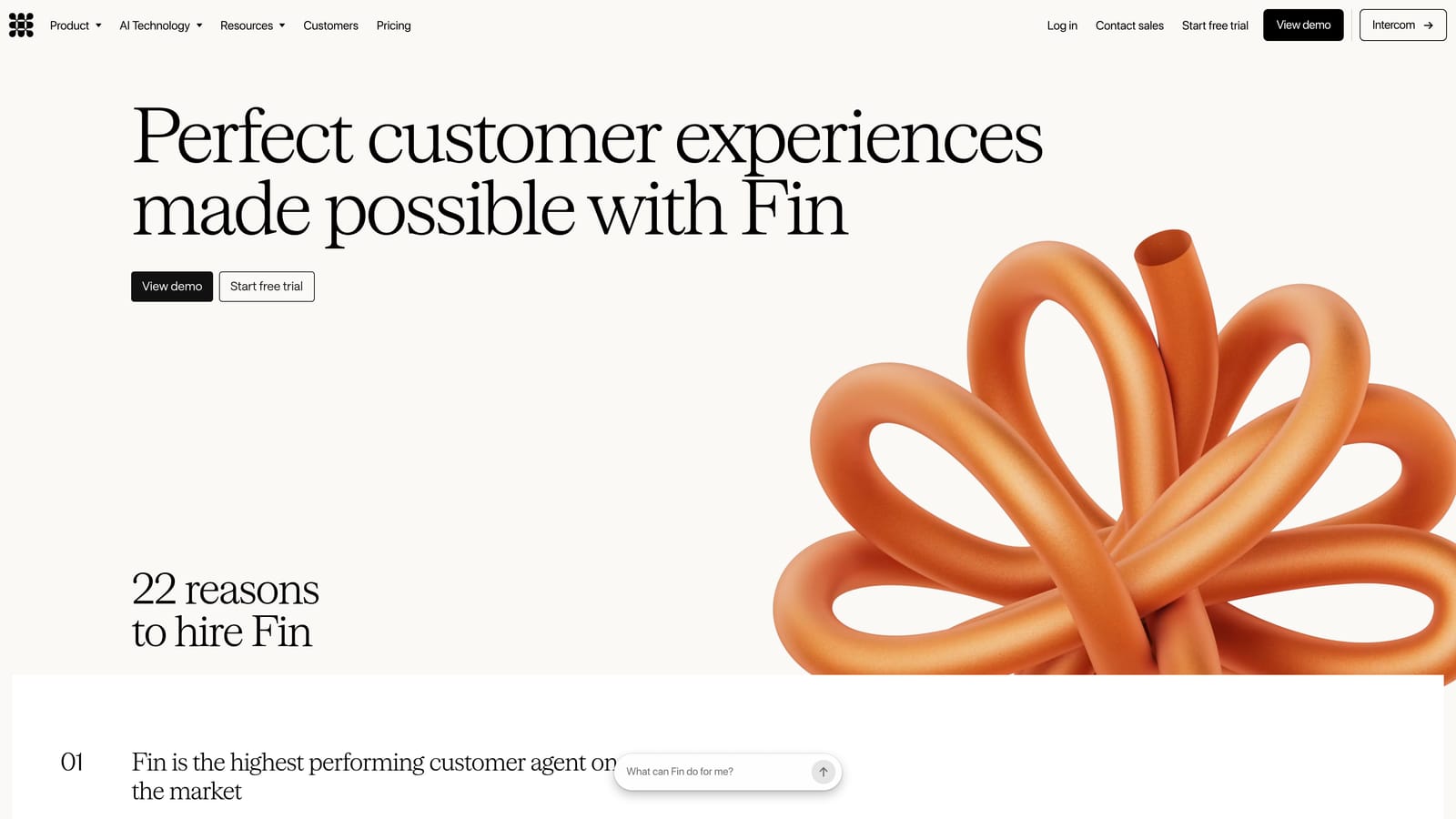
Intercom Fin is a GPT-powered AI agent built natively into the Intercom platform, designed to resolve support conversations using your existing knowledge base and inbox.
Where This Tool Shines
If your team is already living inside Intercom, Fin is the path of least resistance. It plugs directly into your existing knowledge base, conversation history, and inbox without any migration or re-platforming. Resolution quality is generally strong for questions your knowledge base already answers well.
The handoff experience is a genuine strength. When Fin reaches its limits, the transition to a human agent inside the same Intercom inbox is smooth and familiar for both agents and customers.
Key Features
Native Intercom Integration: Works directly within your existing Intercom inbox, CRM, and conversation history without additional setup.
Knowledge Base Resolution: Resolves questions using your existing articles and custom answers, with no separate training pipeline required.
Seamless Human Handoff: Escalates to live agents within the same inbox interface, preserving conversation context throughout.
Multilingual Support: Handles conversations across major languages without additional configuration.
Resolution-Based Pricing: You pay per resolved conversation rather than per seat, which can align costs with outcomes.
Best For
Support teams already standardized on Intercom who want to add AI resolution without introducing a new vendor. Less compelling for teams not already on the Intercom platform, where the switching cost may not justify the fit.
Pricing
Charged per resolution on top of an existing Intercom plan. Intercom plans start at approximately $39/month, though pricing is subject to change. Contact Intercom for current resolution fees.
3. Zendesk AI
Best for: Large enterprise teams already standardized on Zendesk Suite who need AI augmentation at scale.
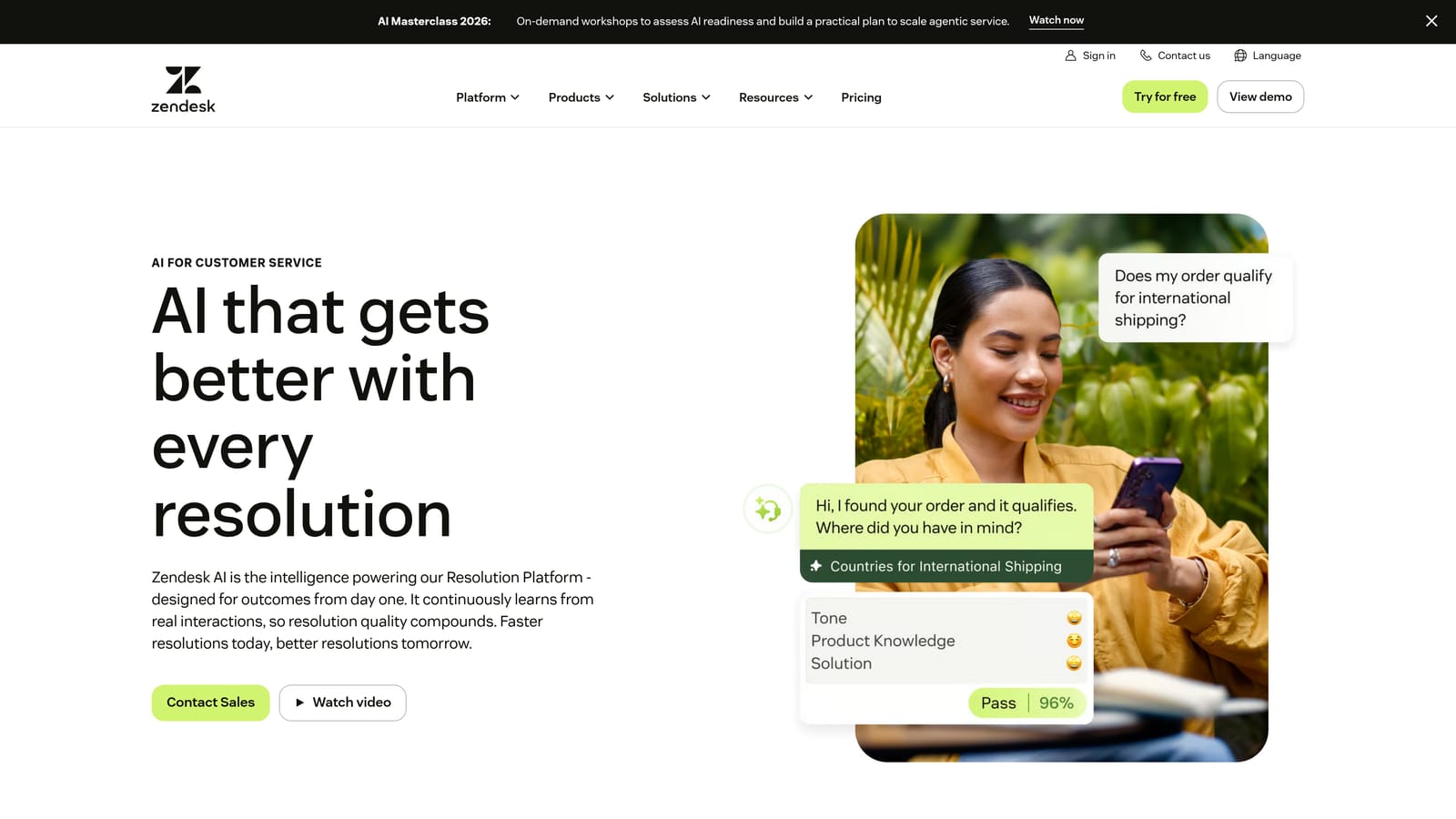
Zendesk AI embeds AI capabilities across the Zendesk Suite, including intelligent triage, agent copilot, macro suggestions, and self-service automation.
Where This Tool Shines
Zendesk AI's strength is scale. For enterprise support operations processing thousands of tickets daily, intelligent triage and automatic classification can meaningfully reduce the manual sorting burden. The agent copilot layer surfaces suggested responses and next-best-action recommendations inside the workflow agents already use.
It's worth being clear about the architecture: Zendesk AI is primarily augmentation-focused, designed to make human agents faster and more consistent rather than to operate autonomously. Teams looking for full autonomous resolution will find the platform more assistant than agent.
Key Features
Intelligent Triage: Automatically classifies and prioritizes incoming tickets at scale based on content and historical patterns.
Agent Copilot: Suggests responses, next-best-actions, and relevant knowledge articles to agents in real time.
AI Self-Service Bots: Integrated with Zendesk Help Center to deflect common questions before they reach the queue.
Macro and Workflow Suggestions: Recommends automation improvements based on historical ticket data patterns.
Enterprise Security and Compliance: Built to meet enterprise-grade security, compliance, and data residency requirements.
Best For
Enterprise support organizations already running Zendesk Suite that want to improve agent efficiency and deflect repetitive tickets without replacing their existing infrastructure.
Pricing
Requires an active Zendesk Suite subscription. AI features are available as an add-on at pricing available on request from Zendesk's sales team.
4. Freshdesk Freddy AI
Best for: SMB and mid-market teams on Freshdesk looking for accessible AI without a separate vendor relationship.
Freshdesk Freddy AI is Freshworks' AI layer built into Freshdesk, covering auto-triage, suggested responses, self-service chatbot, and support analytics.
Where This Tool Shines
Freddy AI's main appeal is simplicity. If your team is already on Freshdesk, you get meaningful AI capabilities without signing a separate contract, managing a new vendor, or running a migration. The self-service chatbot deflects common questions, and Freddy Copilot helps agents respond faster with AI-generated suggestions and conversation summaries.
For teams at the SMB and lower mid-market tier, this is often the most practical path to AI-assisted support. The trade-off is that Freddy AI is less powerful than standalone AI-native platforms when support scenarios require multi-system context or complex resolution logic.
Key Features
Freddy Self Service: Chatbot that deflects common questions using your knowledge base before tickets enter the queue.
Auto-Triage: Automatically categorizes, prioritizes, and routes incoming tickets based on content analysis.
Freddy Copilot: Provides agents with AI-generated response suggestions and conversation summarization.
Freddy Insights: Analytics layer that identifies support trends and flags areas for process improvement.
Bundled Availability: Included within the Freshdesk ecosystem, removing the need for a separate AI vendor.
Best For
SMB and mid-market support teams already using Freshdesk who want to add AI capabilities incrementally without additional vendor complexity or significant budget increases.
Pricing
Freddy AI add-ons are available on Freshdesk Growth plans and above. Base Freshdesk plans start at approximately $15/agent/month, though pricing is subject to change.
5. Tidio Lyro
Best for: SMBs and e-commerce brands needing fast deployment for high-volume repetitive questions.
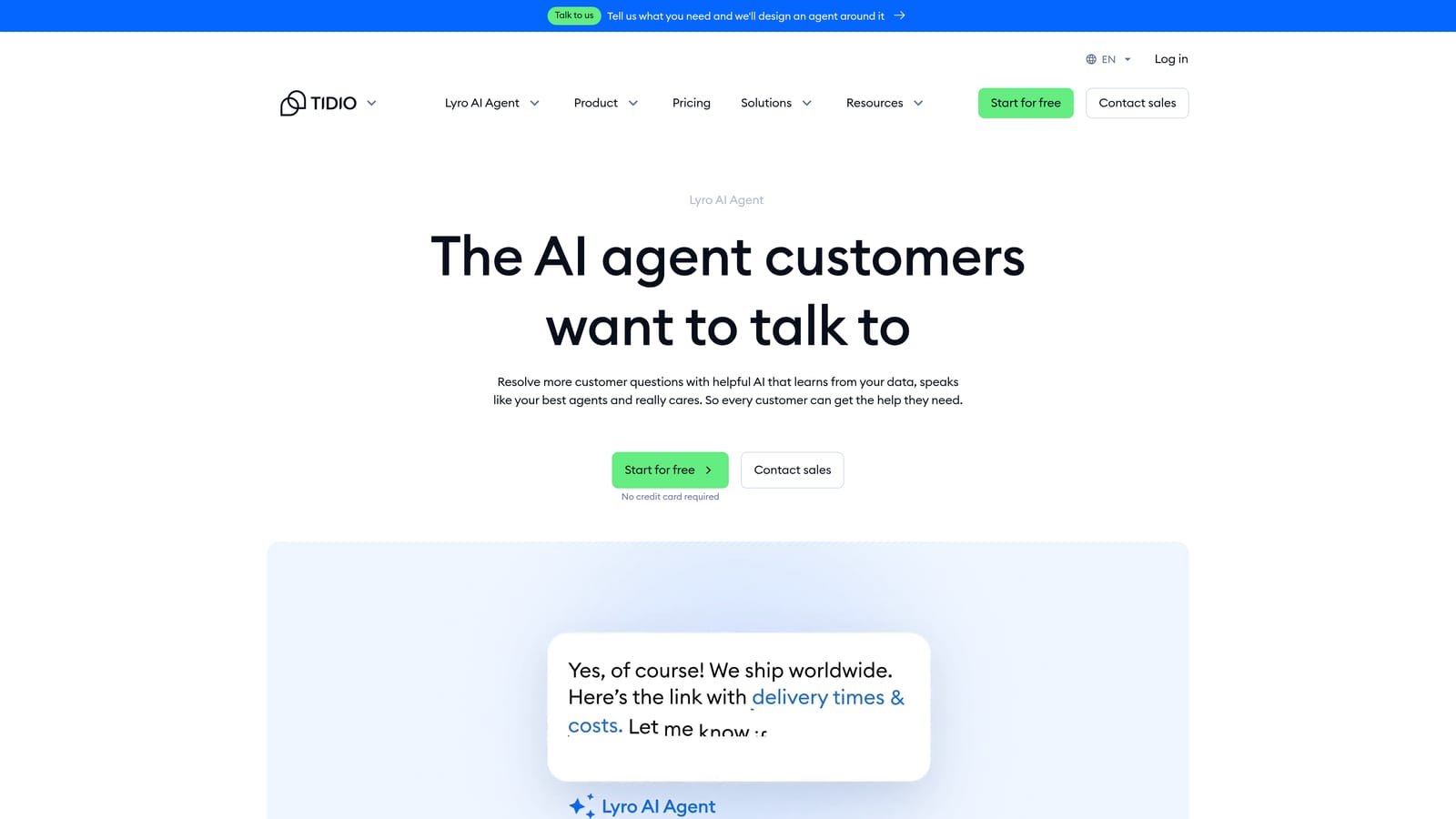
Tidio Lyro is a conversational AI agent trained on your knowledge base, designed for quick deployment and autonomous handling of FAQ-style customer conversations.
Where This Tool Shines
Lyro's standout quality is speed to value. You connect your knowledge base, and Lyro starts handling conversations with minimal configuration. For e-commerce and SMB teams drowning in repetitive questions about orders, shipping, and returns, that fast deployment path is genuinely useful.
The platform integrates well with Shopify and WooCommerce, making it a natural fit for direct-to-consumer brands. When Lyro reaches the limits of what it can resolve, it falls back to live chat without friction.
Key Features
Knowledge Base Training: AI trains directly on your existing content with minimal setup time required.
Autonomous FAQ Handling: Manages repetitive, high-volume conversations without human intervention.
Live Chat Fallback: Smoothly transitions to human agents when conversations exceed Lyro's resolution capability.
E-Commerce Integrations: Native integration with Shopify, WooCommerce, and other major e-commerce platforms.
Usage-Based Scaling: Free tier available with paid plans scaling based on conversation volume.
Best For
SMBs, e-commerce brands, and consumer-facing businesses with high volumes of repetitive support questions. Less suited for complex B2B SaaS support environments that require multi-system context and deep integration across business tools.
Pricing
A free tier is available. Lyro AI conversations are billed per usage, with paid plans starting at approximately $29/month. Pricing is subject to change.
6. Forethought Solve
Best for: Mid-market and enterprise teams focused on reducing agent handle time through intelligent triage and routing.
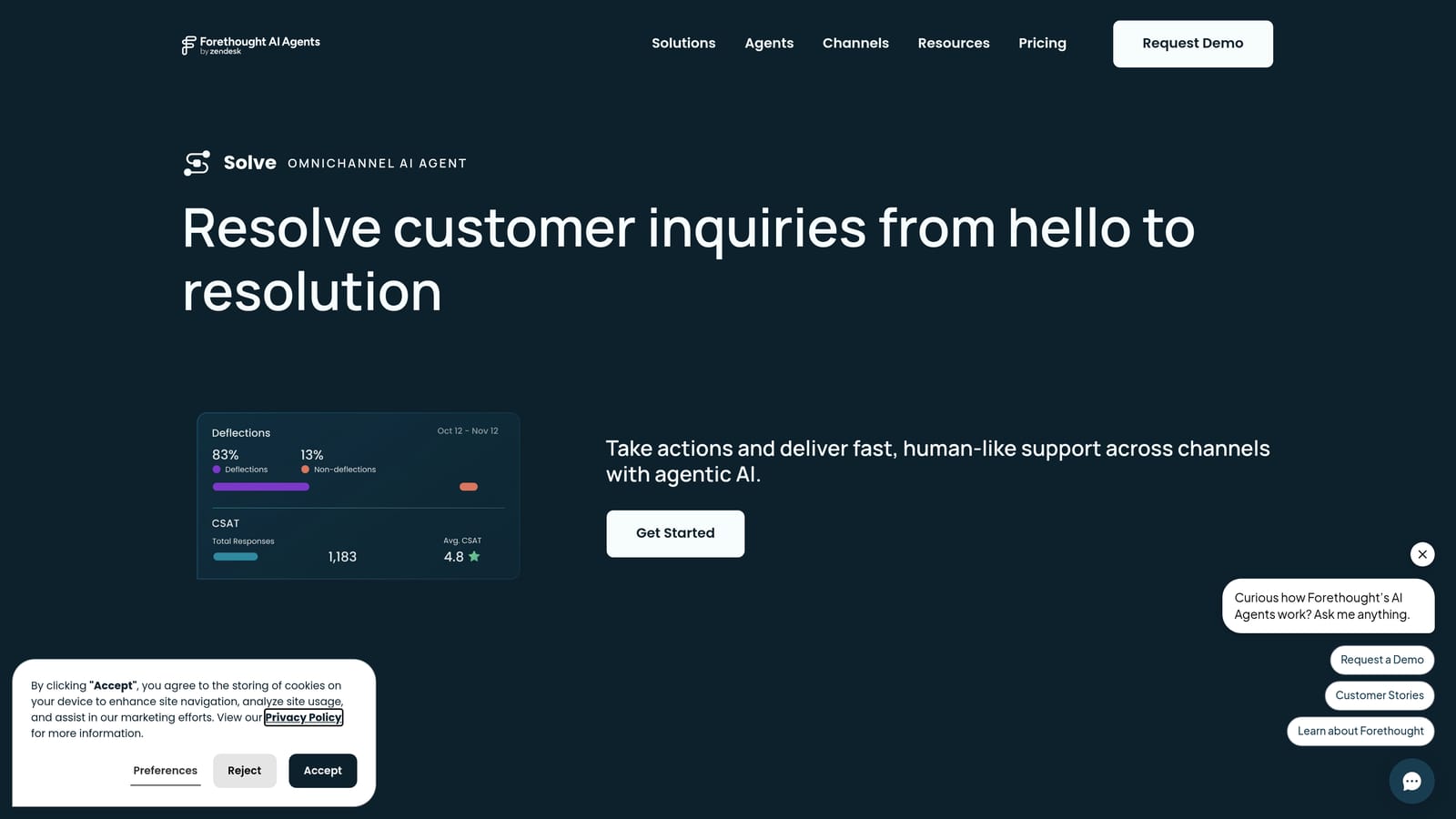
Forethought Solve is an AI platform specializing in intent detection, intelligent ticket triage, and predictive routing before tickets ever reach a human agent.
Where This Tool Shines
Forethought's focus is the pre-agent layer. Rather than replacing agents, it makes sure tickets arrive at the right agent, in the right queue, with the right context already attached. Intent detection classifies tickets by topic, urgency, and sentiment so that routing decisions are made intelligently rather than by keyword matching or manual rules.
The Agent Assist mode extends this into live conversations, surfacing relevant knowledge articles at the moment agents need them. For organizations where routing complexity and handle time are the primary pain points, Forethought addresses those specifically.
Key Features
Intent Detection: Classifies incoming tickets by topic, urgency, and sentiment to inform downstream routing decisions.
Predictive Routing: Automatically sends tickets to the right team or queue based on classification results.
Knowledge Surfacing: Presents relevant articles to agents at the exact moment they're needed during a conversation.
Agent Assist Mode: Provides in-conversation AI support to help agents respond faster and more accurately.
Enterprise Integrations: Connects with Salesforce, Zendesk, ServiceNow, and other enterprise support and CRM systems.
Best For
Mid-market and enterprise support operations where routing complexity, misclassification, and agent handle time are the primary inefficiencies to solve. Works well as a layer on top of existing enterprise helpdesk infrastructure.
Pricing
Enterprise pricing model. Contact Forethought directly for a quote based on volume and deployment requirements.
7. Kustomer AI
Best for: Subscription and retail businesses where complete customer history should inform every support interaction.
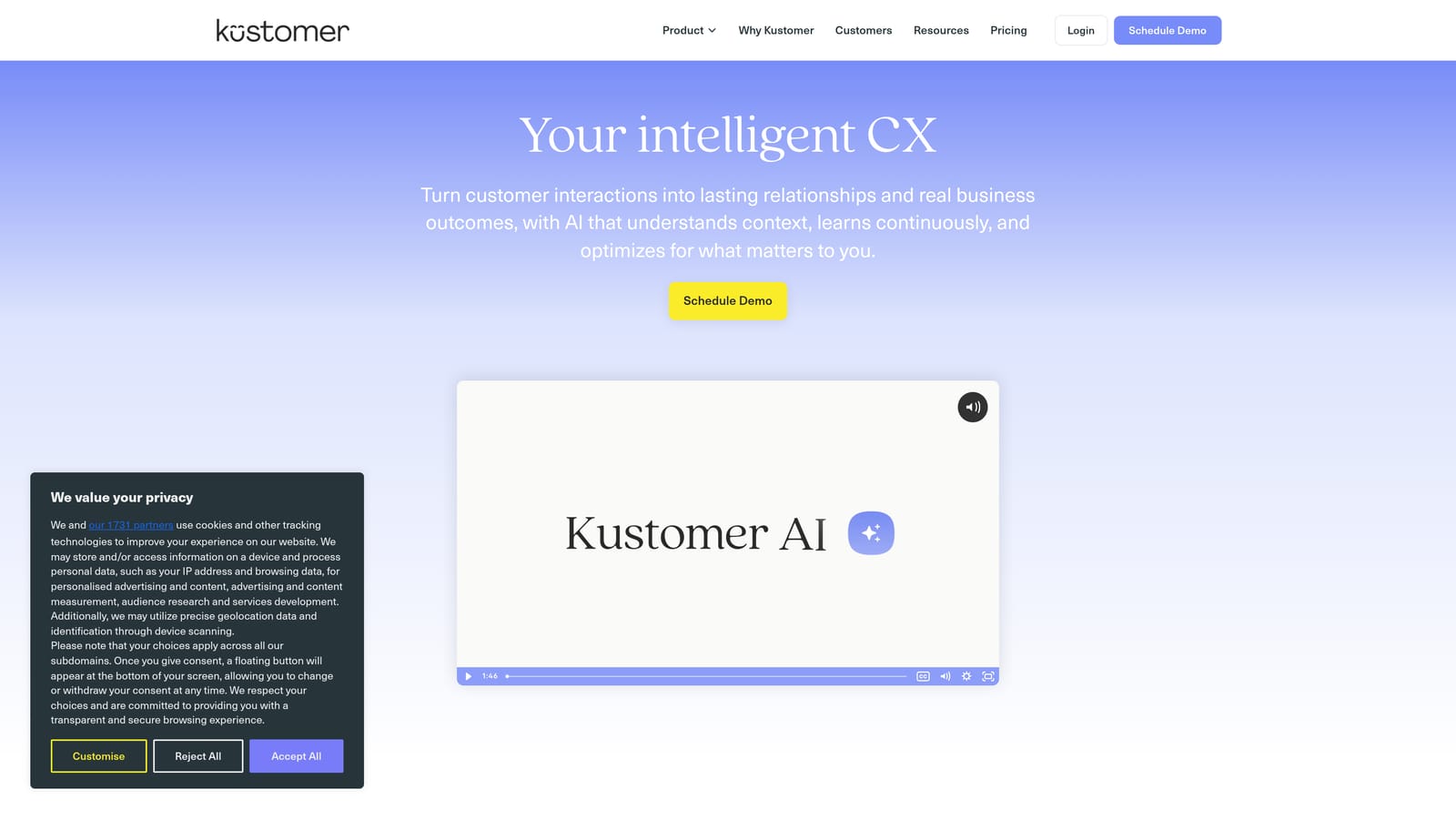
Kustomer AI is a CRM-native support platform where AI responses are informed by a unified customer timeline covering purchase history, past interactions, and behavioral signals.
Where This Tool Shines
The core differentiator here is context depth. Most AI support tools work from knowledge base content. Kustomer's AI works from the full customer record: what they bought, when they contacted support before, how they've behaved, and what their current order status is. That context produces meaningfully more personalized responses for businesses where customer history matters.
It's worth noting for enterprise buyers that Kustomer has had a notable ownership history, having been acquired by Meta and subsequently sold. Teams evaluating long-term vendor stability should factor that in during due diligence.
Key Features
History-Informed AI: AI responses draw on complete purchase, interaction, and behavioral data rather than knowledge base content alone.
Unified Customer Timeline: Every channel and interaction consolidated into a single customer view accessible to both AI and human agents.
AI-Powered Suggested Replies: Generates contextually relevant response suggestions informed by the full customer record.
Omnichannel Support: Covers email, chat, SMS, social media, and voice within a single platform.
Workflow Automation: Automates repetitive support processes and routing based on customer data triggers.
Best For
Subscription businesses, retailers, and direct-to-consumer brands where customer purchase history, order data, and behavioral signals should actively shape support responses. Less optimized for B2B SaaS teams whose support needs are more product and feature-centric.
Pricing
Starts at approximately $89/agent/month, with enterprise plans available. Pricing is subject to change.
8. Helpshift
Best for: Gaming studios, consumer app companies, and mobile-first businesses needing in-app support automation.
Helpshift is a mobile-first support platform that delivers AI automation via SDK directly inside mobile applications, purpose-built for gaming and consumer app environments.
Where This Tool Shines
Helpshift occupies a genuinely distinct niche. By deploying support through an SDK embedded in the app itself, it eliminates the friction of redirecting users to a separate support channel. Players and app users get help without ever leaving the experience, which matters enormously in high-engagement mobile contexts like gaming.
The AI bots handle common in-app support flows, smart FAQ surfacing is informed by in-app context, and the analytics focus on engagement and resolution metrics specific to mobile support operations.
Key Features
SDK-Based In-App Messaging: Support is embedded directly inside your mobile app rather than redirecting users to an external channel.
In-App AI Bots: Automated bots handle common support flows without requiring users to leave the application.
Smart FAQ Surfacing: Surfaces relevant help content based on the user's in-app context and current screen.
High-Volume Agent Tools: Agent interface optimized for the volume and pace of mobile support operations.
Mobile-Specific Analytics: Reporting focused on in-app support engagement, resolution rates, and bot performance.
Best For
Gaming studios, consumer app developers, and mobile-first businesses where in-app support experience is a product quality concern. Not well-suited for web-based B2B SaaS teams whose support needs are browser and product-feature-centric.
Pricing
Contact Helpshift for pricing. Costs are tailored to deployment volume and SDK integration requirements.
9. Ada
Best for: Enterprise teams in regulated industries that need governance, audit trails, and compliance controls alongside AI automation.
Ada is a no-code AI agent builder designed for enterprise scale, with strong governance features, role-based access controls, and multilingual capabilities.
Where This Tool Shines
Ada's differentiator is control. Non-technical teams can build, test, and deploy AI agents through a no-code interface, which removes the bottleneck of engineering involvement for every update or new conversation flow. For enterprises in financial services, healthcare, or other regulated sectors, the audit trails and role-based access controls address compliance requirements that most AI support tools don't prioritize.
The proactive messaging capability is worth noting: Ada can initiate outbound conversations based on triggers, not just respond to inbound requests. That expands its use beyond reactive support into proactive customer engagement.
Key Features
No-Code Agent Builder: Non-technical teams can create and manage AI agents without engineering support for routine updates.
Enterprise Governance: Audit trails, role-based access controls, and compliance features designed for regulated industry requirements.
Multilingual AI: Supports conversations across dozens of languages without requiring separate agent configurations.
Broad Integrations: Connects with major CRMs, helpdesks, and enterprise data systems.
Proactive Messaging: Initiates outbound conversations based on customer behavior or system triggers, extending beyond reactive support.
Best For
Large enterprises, particularly in regulated industries, where governance, compliance, and the ability for non-technical teams to manage AI agents independently are as important as resolution quality. Ada is typically positioned at enterprise scale with pricing to match.
Pricing
Enterprise pricing model. Contact Ada directly for a quote based on your organization's scale and requirements.
Which Tool Is Right for Your Team?
The right platform depends entirely on where you're starting from and what problem you're actually trying to solve.
If you're already deep in the Intercom, Zendesk, or Freshdesk ecosystem, the native AI layers from those vendors offer the lowest-friction path to AI-assisted support. They won't give you AI-first architecture, but they'll improve what you already have without a rip-and-replace.
For e-commerce and mobile-first businesses, Tidio Lyro and Helpshift serve genuinely distinct needs that most enterprise platforms don't address well. If your support lives inside a mobile app or revolves around order and shipping questions, those tools are purpose-fit in ways that general platforms aren't.
Forethought and Ada serve enterprise teams with specific needs: Forethought for organizations where routing complexity and handle time are the primary bottleneck, and Ada for regulated industries where governance and no-code management are non-negotiable.
For B2B SaaS teams that want to move beyond AI-assisted support toward genuinely autonomous resolution with business intelligence built in, Halo AI stands apart. The page-aware context, continuous learning architecture, smart inbox with revenue and churn signals, and deep integrations across the business stack make it the strongest fit for product-led and SaaS organizations that want support data to do more than measure deflection rates.
Your support team shouldn't scale linearly with your customer base. Let AI agents handle routine tickets, guide users through your product, and surface business intelligence while your team focuses on complex issues that need a human touch. See Halo in action and discover how continuous learning transforms every interaction into smarter, faster support.