9 Best AI Support Automation Tools for Enterprises in 2026
Enterprise support teams face unique challenges — thousands of tickets, global customers, and strict compliance demands — that basic chatbots simply can't handle. This guide compares the 9 best AI support automation platforms built for enterprise complexity, evaluating each on AI depth, integration ecosystem, scalability, analytics, and seamless human-AI collaboration.
 Matt PattoliFounder13 min read
Enterprise support teams aren't dealing with the same problems as a five-person startup. You're managing thousands of tickets across multiple products, serving customers in different time zones and languages, navigating compliance requirements, and trying to keep agents focused on work that actually requires human judgment. Basic chatbots and keyword-routing rules were never designed for this environment.
The good news is that AI support automation has matured considerably. The platforms available today can reason through complex queries, execute multi-step actions, integrate deeply with your existing stack, and hand off to humans without losing context. The challenge is finding the right fit for your specific operation.
Here are the top AI support automation platforms built for enterprise complexity, evaluated on AI depth, integration ecosystem, scalability, analytics quality, and human-AI collaboration. A quick note: Halo AI is featured first because it's the platform behind this content, but we've aimed to give you an honest, useful comparison of the full field.
1. Halo AI
Best for: B2B SaaS product teams wanting AI-first support with business intelligence built in.
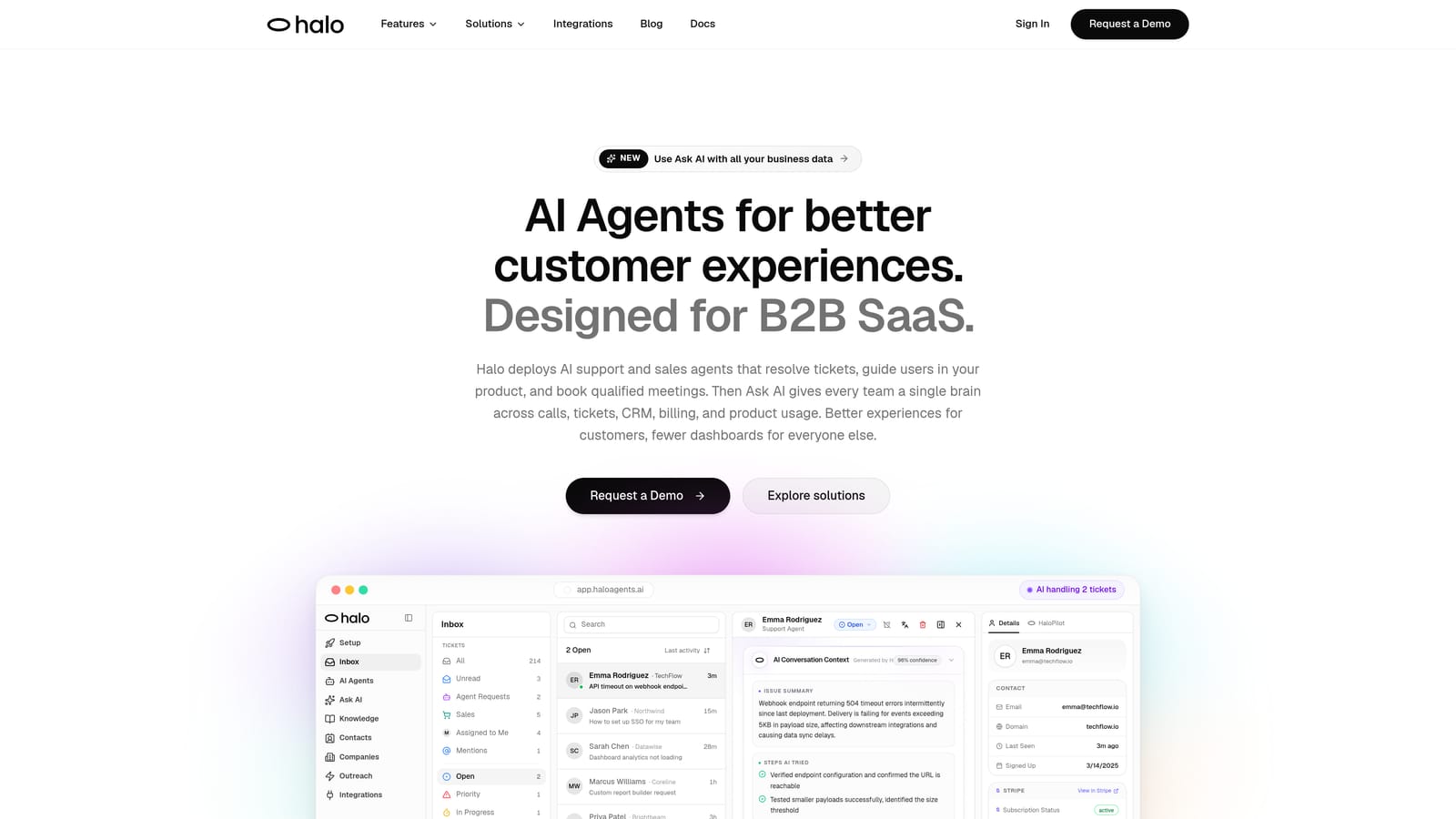
Halo AI is an AI-first customer support platform that deploys intelligent agents to resolve tickets, guide users visually through your product, and surface business intelligence — all while learning from every interaction.
Where This Tool Shines
Most enterprise support tools were built on top of legacy helpdesk infrastructure and had AI added later. Halo was designed from the ground up with AI at the center, and that architectural difference shows up in ways that matter. The page-aware chat widget is a standout example: the AI actually sees the page context the user is on, enabling it to provide visual UI guidance rather than generic text responses. That's a meaningful step beyond what most platforms offer.
The other differentiator worth calling out is the smart inbox's business intelligence layer. Beyond tracking ticket volumes and resolution times, Halo surfaces customer health signals, revenue intelligence, and anomaly detection. For B2B SaaS teams, that means support data becomes a source of insight about churn risk and product friction, not just an operational metric.
Key Features
Page-Aware Chat Widget: The AI sees the page context the user is on and delivers visual UI guidance, not just text answers.
Intelligent AI Agents: Autonomous ticket resolution with continuous learning from every interaction, improving accuracy over time without manual retraining.
Smart Inbox with Business Intelligence: Customer health signals, revenue intelligence, and anomaly detection surface insights that go well beyond standard support analytics.
Auto Bug Ticket Creation: Automatically creates tickets in Linear from recurring support patterns, bridging the gap between support and engineering.
Live Agent Handoff: Escalations include full context transfer so agents aren't starting from scratch.
Multi-System Integrations: Connects with Linear, Slack, HubSpot, Intercom, Stripe, Zoom, PandaDoc, and Fathom.
Best For
B2B SaaS companies and product teams that want AI-first support without migrating to a traditional helpdesk. Particularly strong for teams that want support data to inform product decisions and customer health monitoring, not just measure agent productivity.
Pricing
Enterprise pricing available on request. Visit haloagents.ai for current plan details and to book a demo.
2. Zendesk AI
Best for: Enterprises already on Zendesk Suite looking to activate AI without platform migration.
Zendesk AI is native AI capability built directly into the Zendesk Suite, covering autonomous resolution, agent assist, and intelligent triage.
Where This Tool Shines
The biggest practical advantage of Zendesk AI is that it activates on your existing ticket data and workflows. There's no migration, no parallel system to maintain, and no retraining your team on a new interface. For enterprises with years of Zendesk history, that continuity has real value.
The Agent Copilot functionality is well-developed, offering suggested replies, conversation summarization, and next-best-action guidance that helps agents work faster without removing them from the loop. Zendesk Explore integration means analytics stay unified rather than fragmented across systems.
Key Features
AI Agents: Autonomous ticket resolution built on existing Zendesk ticket infrastructure, handling full resolution flows without agent involvement.
Agent Copilot: Suggested replies, conversation summarization, and next-best-action guidance for human agents.
Intelligent Triage and Routing: Intent and sentiment-based routing that directs tickets to the right queue or agent automatically.
Zendesk Explore Integration: Unified analytics across AI and human-handled interactions without leaving the Zendesk ecosystem.
No Migration Required: AI activates on existing Zendesk data, workflows, and configurations.
Best For
Enterprises already invested in Zendesk Suite who want meaningful AI capabilities without a platform change. Less compelling for teams not already on Zendesk, since the value proposition is largely tied to existing infrastructure.
Pricing
AI features are available on Suite Professional and Enterprise plans; AI add-on pricing varies. Verify current rates at zendesk.com.
3. Intercom Fin
Best for: Product-led growth companies and B2B SaaS teams wanting fast AI deployment with strong out-of-the-box accuracy.
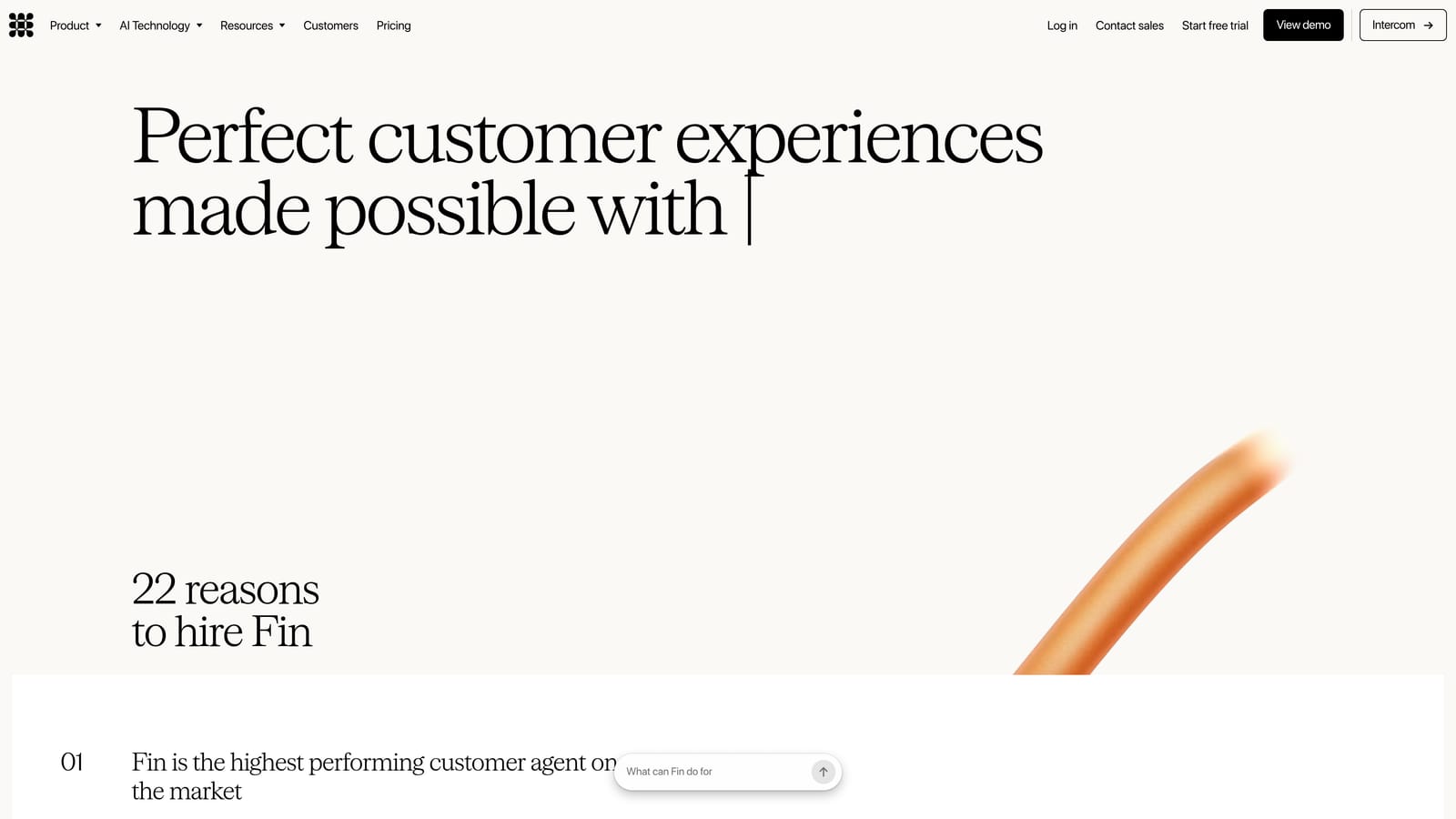
Intercom Fin is Intercom's LLM-powered AI agent that resolves customer questions autonomously using your help content, with an outcome-based pricing model that aligns cost with actual value delivered.
Where This Tool Shines
Fin's reputation is built on strong resolution accuracy with minimal configuration. It trains on your existing help center content and handles multi-step reasoning for more complex queries, which means teams with well-documented products can deploy quickly and see results without extensive tuning.
The outcome-based pricing model is worth noting as a structural differentiator. Paying per resolution rather than per seat or per conversation changes the incentive alignment between vendor and customer in a way that many enterprise buyers find appealing.
Key Features
Multi-Step Reasoning: Handles complex resolution flows rather than just single-turn question answering.
Help Content Training: Trained on your existing help center with minimal configuration required to get started.
Outcome-Based Pricing: Per-resolution pricing model aligns vendor incentives with actual value delivered to your team.
Omnichannel Coverage: Works across chat, email, and messaging channels.
Smooth Human Handoff: Escalates to Intercom's human inbox with context intact when resolution isn't possible.
Best For
B2B SaaS and product-led growth companies already using Intercom, or teams wanting fast time-to-value from AI resolution without heavy configuration. Strong for organizations with thorough, well-maintained help documentation.
Pricing
Per-resolution pricing on top of the Intercom base plan; Enterprise plan available with SSO, advanced permissions, and SLA management. Check current rates at intercom.com.
4. Salesforce Agentforce
Best for: Enterprises where Salesforce is the primary system of record across sales, service, and operations.
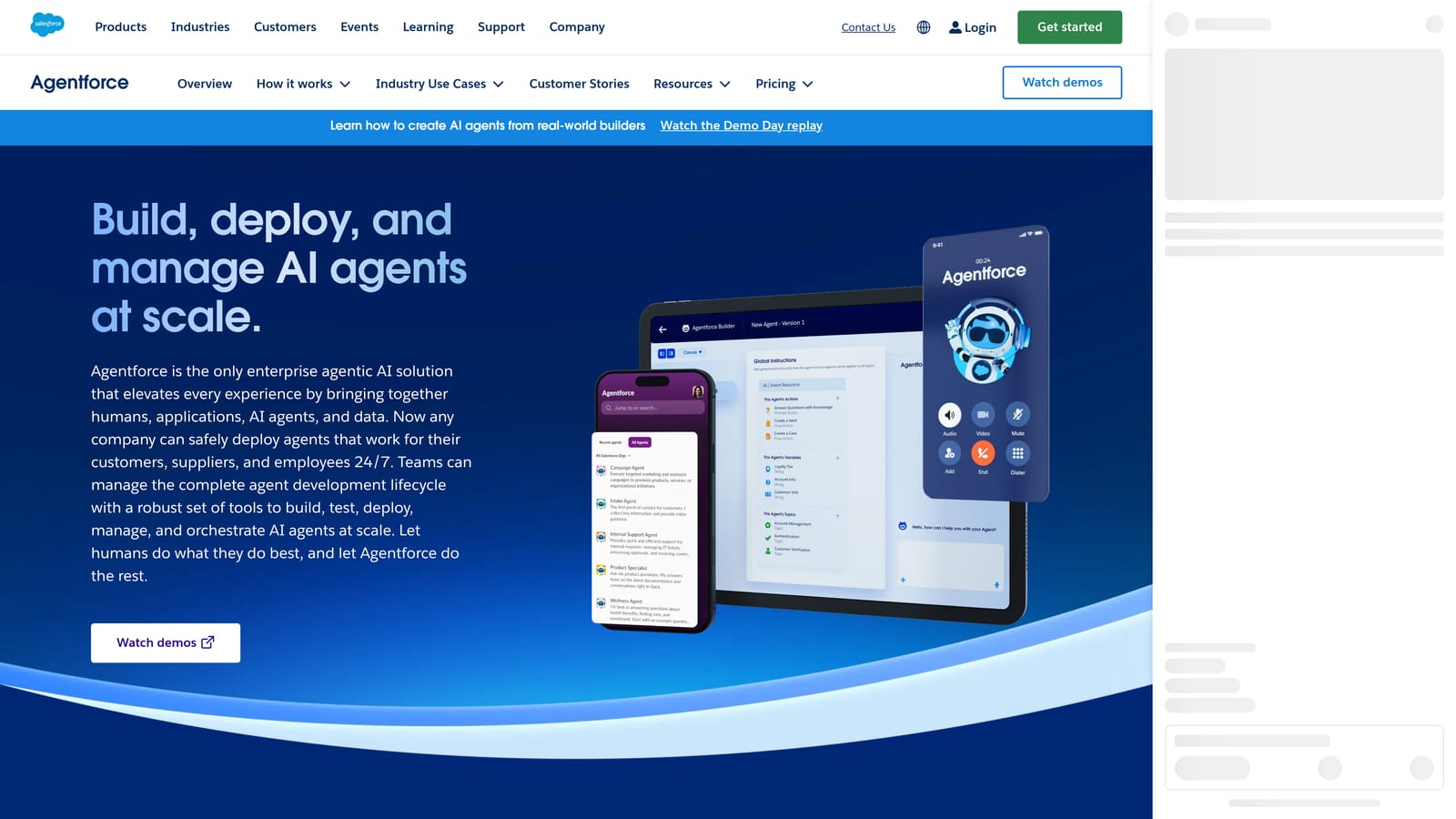
Salesforce Agentforce is Salesforce's autonomous AI agent layer embedded across Service Cloud, giving support teams AI resolution powered by full CRM context.
Where This Tool Shines
The core advantage of Agentforce is access to Salesforce's complete CRM data layer. When an AI agent handles a support interaction, it has visibility into order history, case history, customer tier, contract details, and anything else stored in Salesforce. That context depth enables more personalized and accurate resolution than AI systems operating on support data alone.
For regulated industries, Salesforce's compliance and data governance controls are mature and well-documented. Healthcare, financial services, and other compliance-heavy sectors often find that Agentforce fits their requirements more naturally than newer AI-first platforms still building out their governance capabilities.
Key Features
Full CRM Context: AI agents access order history, case history, and customer tier data to inform every response.
Low-Code Configuration: Configurable via Salesforce Flow and low-code tools, reducing engineering dependency for customization.
Compliance and Governance: Strong data governance controls suited for regulated industries including healthcare and financial services.
Cross-Cloud AI: Works across Sales, Service, and Marketing Cloud for AI that spans the full customer lifecycle.
Consumption-Based Pricing: Pay-per-conversation model rather than fixed seat licensing.
Best For
Large enterprises already running Salesforce as their system of record, particularly those in regulated industries where compliance controls are a purchasing requirement. Less compelling for organizations not already in the Salesforce ecosystem.
Pricing
Consumption-based pricing model; verify current rates at salesforce.com as pricing has evolved since general availability.
5. Freshdesk Freddy AI
Best for: Mid-market to enterprise teams on Freshworks looking for AI across support, CRM, and ITSM in one layer.
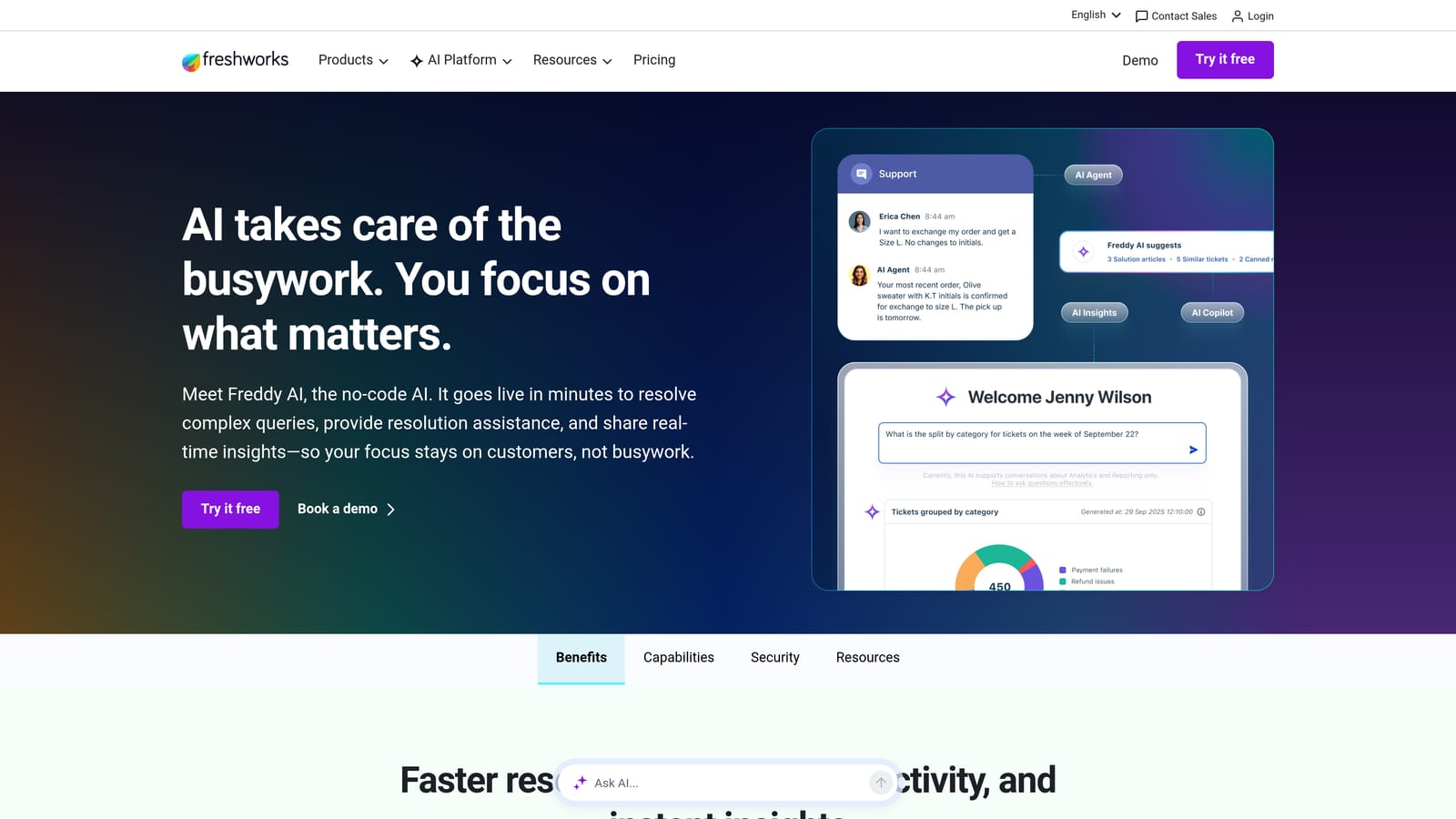
Freshdesk Freddy AI is Freshworks' AI layer spanning Freshdesk, Freshsales, and Freshservice, covering self-service resolution, agent assist, and cross-suite analytics.
Where This Tool Shines
Freddy's cross-suite coverage is genuinely useful for organizations running multiple Freshworks products. Support agents, sales teams, and IT staff can all operate within an AI layer that shares context across functions, reducing the siloed data problem that plagues many enterprise support operations.
From a cost perspective, Freshworks tends to come in at a lower total cost of ownership compared to Zendesk or Salesforce for comparable AI functionality. For enterprises that don't need the deep ecosystem of those larger platforms, Freddy offers a competitive feature set without the premium pricing.
Key Features
Freddy Self Service: AI-powered autonomous resolution for customer-facing interactions before tickets reach agents.
Freddy Copilot: Agent assist with suggested replies, conversation summarization, and next-best-action recommendations.
Freddy Insights: Analytics and anomaly detection across support data to surface trends and operational issues.
Cross-Suite Visibility: Unified AI layer across support, CRM, and ITSM data for full customer context.
Competitive Pricing: Generally lower total cost of ownership versus Zendesk or Salesforce for comparable capabilities.
Best For
Organizations already on Freshworks products, or teams evaluating a full-suite alternative to Zendesk or Salesforce. Strong for companies that want AI across support, sales, and IT without managing multiple AI vendors.
Pricing
Available on Growth and higher plans; Freddy Copilot and Self Service carry add-on pricing. Check current rates at freshdesk.com.
6. Kustomer AI
Best for: High-volume B2C enterprises in retail, subscription, and e-commerce needing deep customer timeline context.
Kustomer AI is built on a customer-centric data model rather than a ticket-centric one, giving AI full timeline context across purchases, interactions, and behaviors for personalized, high-volume resolution.
Where This Tool Shines
The data model distinction here is significant. Most support platforms organize data around tickets. Kustomer organizes data around customers, which means the AI has access to a complete interaction and purchase timeline rather than isolated ticket records. For high-volume consumer businesses where customer history drives resolution quality, that difference translates directly into better AI responses.
Kustomer handles omnichannel coverage across chat, email, SMS, social, and voice, which matters for B2C enterprises serving customers across many touchpoints. It's worth noting that Kustomer was acquired by Meta and has since returned to independence, so enterprise buyers should factor platform stability into their evaluation.
Key Features
Customer Timeline Data Model: AI accesses full purchase, interaction, and behavior history rather than isolated ticket records.
AI Deflection: Autonomous resolution before interactions reach a human agent.
AI Assist: Contextual suggestions for human agents based on full customer history.
Omnichannel Coverage: Chat, email, SMS, social, and voice in a unified platform.
High-Volume B2C Fit: Architecture and pricing designed for the scale and interaction patterns of consumer businesses.
Best For
High-volume B2C enterprises in retail, subscription commerce, and e-commerce. Less commonly deployed in pure B2B SaaS environments where ticket-centric models are often sufficient.
Pricing
Enterprise pricing available on request. Contact kustomer.com for current rates.
7. ServiceNow Now Assist
Best for: Large enterprises running both internal IT/HR support and external customer support on the ServiceNow platform.
ServiceNow Now Assist is generative AI embedded across the Now Platform, spanning customer service management and IT service management on a unified enterprise system.
Where This Tool Shines
ServiceNow's unique position is that it handles both internal operations (IT, HR) and external customer support within a single platform. Now Assist brings generative AI to all of those workflows simultaneously. For large enterprises running unified operations on ServiceNow, that means AI capabilities across the entire service organization without managing separate tools for different departments.
Enterprise governance is a genuine strength here. Data residency controls, compliance frameworks, and security capabilities are mature, which matters significantly for regulated industries and global enterprises with data sovereignty requirements.
Key Features
AI Case Summarization and Resolution Recommendations: Generative AI surfaces resolution suggestions and summarizes cases to reduce agent handling time.
Virtual Agent for Customer Support: AI-powered self-service resolution for external customer interactions.
Unified ITSM and Customer Service AI: Spans internal IT/HR and external customer support simultaneously on one platform.
Enterprise Governance Controls: Mature compliance, data residency, and security capabilities for regulated industries.
Embedded in Existing Workflows: No separate AI platform to manage — Now Assist activates within existing ServiceNow configurations.
Best For
Large enterprises already running ServiceNow across IT and customer service operations. Particularly strong for organizations in regulated industries with strict compliance and data residency requirements.
Pricing
Now Assist is an add-on to ServiceNow platform licenses. Contact servicenow.com for current enterprise pricing.
8. Forethought AI
Best for: Enterprises with significant helpdesk investment wanting AI gains without platform migration.
Forethought AI is an AI layer that sits on top of existing helpdesks, adding intelligent triage, autonomous resolution, agent assist, and analytics without requiring teams to abandon their current platform.
Where This Tool Shines
Forethought's positioning is deliberately different from the other tools on this list: it enhances rather than replaces. For enterprises that have invested heavily in Zendesk, Salesforce Service Cloud, or Freshdesk configurations, ripping out the helpdesk isn't realistic. Forethought plugs in on top and adds a meaningful AI layer to whatever is already there.
The product suite covers the full workflow: Solve handles autonomous deflection, Triage handles intelligent routing, Assist supports agents during live interactions, and Discover provides analytics across support data. That breadth means teams can deploy selectively or across the entire funnel.
Key Features
Solve: Autonomous AI resolution that deflects tickets before they reach agents.
Triage: Intelligent routing based on intent, sentiment, and priority to get tickets to the right place faster.
Assist: Agent copilot with suggested replies and knowledge retrieval during live interactions.
Discover: Analytics and insights layer that surfaces patterns across support data.
Helpdesk Agnostic: Integrates with major platforms including Zendesk, Salesforce, and Freshdesk without requiring migration.
Best For
Enterprises with sunk costs in existing helpdesk platforms who want AI capabilities without the disruption of a full platform migration. Also strong for teams that want to add AI selectively to specific parts of their workflow rather than committing to a full-platform switch.
Pricing
Enterprise pricing available on request. Contact forethought.ai for current rates.
9. Ada CX
Best for: Global enterprises needing no-code AI agent building, multilingual support, and action-based resolution across channels.
Ada CX is an enterprise AI customer service platform known for no-code agent building, action-based resolution that goes beyond Q&A, strong multilingual coverage, and proven deployment at scale in telecom, fintech, and retail.
Where This Tool Shines
Ada's action-based AI is a genuine differentiator. Rather than just answering questions, Ada can execute transactions: processing refunds, updating account details, checking order status, and completing other actions via integrations. That moves AI resolution from informational to operational, which is where real deflection value comes from.
For global enterprises, Ada's multilingual support is a practical strength rather than a marketing claim. Deploying a single AI platform that handles customer interactions across multiple languages and regions simplifies operations considerably compared to building separate regional solutions.
Key Features
Action-Based AI: Executes transactions including refunds, account updates, and order status checks via integrations, not just answering questions.
No-Code Agent Builder: Enterprise teams can build and modify AI agents without heavy engineering resources.
Multilingual Support: Strong coverage for global enterprise deployments serving customers across multiple languages.
Omnichannel: Web, mobile, messaging, and voice coverage in a unified platform.
Proven Enterprise Scale: Deployed across major telecom, fintech, and retail enterprises with high-volume requirements.
Best For
Global enterprises in telecom, fintech, and retail that need multilingual, omnichannel AI with action execution capabilities. Strong for organizations with limited engineering resources who need non-technical teams to manage AI agent configuration.
Pricing
Enterprise pricing available on request. Contact ada.cx for current rates.
Which Tool Is Right for Your Enterprise?
The right platform depends heavily on where your data lives, what you're willing to migrate, and how much you want AI to own versus assist.
Already on Zendesk? Zendesk AI is the lowest-friction path to meaningful AI capabilities. Forethought AI is worth evaluating if you want to layer on additional intelligence without changing your core configuration.
Salesforce is your system of record? Agentforce is the natural fit. The CRM context depth is hard to replicate with an external AI tool, and the compliance controls matter if you're in a regulated industry.
Running Freshworks products? Freddy AI gives you cross-suite AI across support, sales, and ITSM at a competitive price point. The unified data layer is a real operational advantage.
Large enterprise on ServiceNow? Now Assist is the logical choice if you're already running IT and customer service on the Now Platform. The unified internal and external support coverage is difficult to match.
High-volume B2C? Kustomer's customer-timeline model and Ada's action-based resolution are both strong options depending on whether your priority is context depth or transaction execution.
B2B SaaS product team ready to move beyond bolt-on AI? Halo AI's purpose-built architecture, page-aware guidance, and business intelligence layer make it worth a close look. You're not just adding AI to an existing helpdesk; you're getting a platform where support data actively informs product decisions and customer health monitoring.
Your support team shouldn't scale linearly with your customer base. Let AI agents handle routine tickets, guide users through your product, and surface business intelligence while your team focuses on complex issues that need a human touch. See Halo in action and discover how continuous learning transforms every interaction into smarter, faster support.