9 Best AI Support Automation Tools Compared for 2026
This guide delivers a comprehensive AI support automation tools comparison of the 9 best platforms available in 2026, evaluating each on intelligence depth, integration breadth, ease of deployment, and genuine ticket resolution — not just deflection. Rather than crowning a single winner, it matches each tool to the team type most likely to benefit, helping SaaS startups and scaling B2B companies make a confident, informed choice.
 Grant CooperFounder13 min read
The era of routing tickets manually and hoping agents keep up is over. AI support automation tools now handle everything from first-response triage to full ticket resolution, and the market has matured enough that the differences between platforms really matter.
Whether you're a lean SaaS team drowning in repetitive tickets or a scaling B2B company looking to deliver enterprise-grade support without enterprise headcount, the right tool changes everything. This guide compares the best AI support automation platforms available in 2026, evaluating them on intelligence depth, integration breadth, ease of deployment, and how well they actually resolve tickets rather than just deflect them.
Each tool has a distinct strength, so instead of declaring one winner, we'll match each platform to the teams most likely to benefit from it. Let's get into it.
1. Halo AI
Best for: B2B SaaS and product-led teams wanting AI-first autonomous ticket resolution with business intelligence
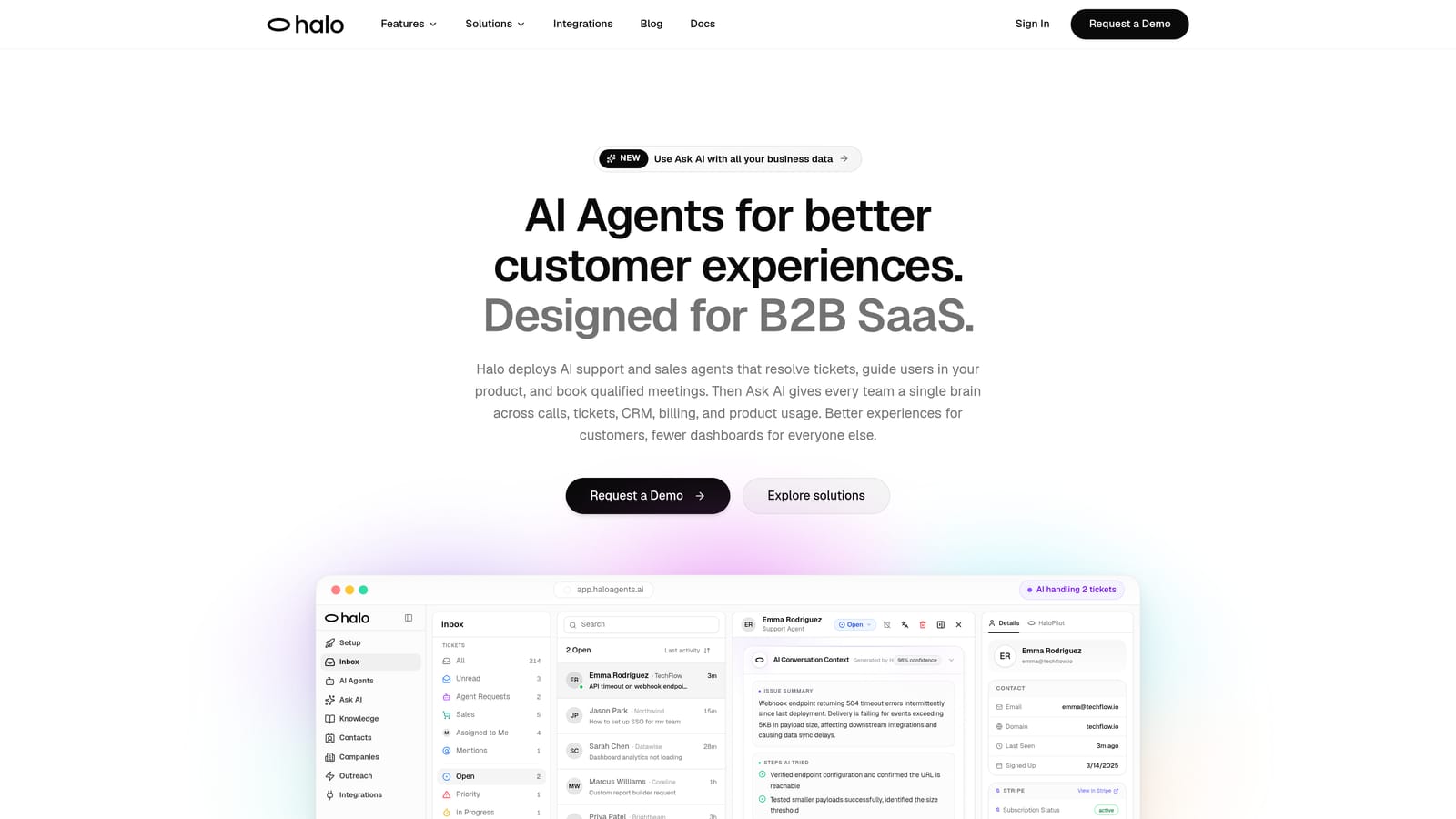
Halo AI is an AI-first customer support platform built from the ground up for B2B SaaS teams, deploying intelligent agents that resolve tickets autonomously, guide users through your product with page-aware context, and surface business intelligence from every support interaction.
Where This Tool Shines
The standout capability here is page-awareness. Halo's AI agents can see the user's current state inside your product, which means guidance is contextual rather than generic. Instead of pointing someone to a help article, the AI understands exactly where they are and what they're trying to do.
Beyond resolution, Halo treats every support interaction as a data signal. The smart inbox surfaces customer health trends, revenue anomalies, and engagement patterns that would otherwise stay buried in ticket queues. For product-led teams, this is support infrastructure that doubles as business intelligence.
Key Features
Page-Aware AI Agents: The AI sees the user's current product state, enabling contextually accurate guidance rather than one-size-fits-all responses.
Continuous Learning Loop: Every resolved interaction feeds back into the model, so the AI gets measurably smarter over time without manual retraining.
Smart Inbox with Business Intelligence: Surfaces customer health signals, revenue anomalies, and support trend detection directly from ticket data.
Auto Bug Ticket Creation: Automatically generates and routes bug reports to Linear or your engineering workflow when issues are detected.
Live Agent Handoff: Escalates complex issues to human agents with full conversation context preserved, so nothing gets repeated.
Broad Integration Stack: Connects natively with HubSpot, Slack, Intercom, Stripe, Zoom, PandaDoc, Fathom, and Linear.
Best For
Halo is purpose-built for B2B SaaS companies and product-led growth teams that want more than deflection. If your support team is also expected to surface churn signals, flag bugs, and inform product decisions, Halo's architecture handles all of that in one platform. Teams that have outgrown bolt-on AI features inside traditional helpdesks will find the AI-first approach immediately different.
Pricing
Custom pricing based on team size and use case. A demo is required to get a tailored quote. Book directly at haloagents.ai/demo.
2. Intercom (Fin AI Agent)
Best for: Mid-market SaaS teams already using Intercom who want AI resolution without switching platforms
Intercom's Fin AI Agent is a conversational AI built on top of Intercom's messenger platform, designed to resolve customer questions using your existing help content.
Where This Tool Shines
Fin's biggest advantage is its tight integration with the Intercom ecosystem. If your team already uses Intercom for CRM, outbound messaging, and live chat, Fin slots in without disruption. Training is largely automated: point Fin at your help center and it starts resolving questions immediately.
The usage-based pricing model is also worth noting. Rather than paying a flat monthly fee regardless of AI activity, you pay per resolution. For teams with variable support volume, this can make cost forecasting more predictable.
Key Features
Help Content Training: Fin learns directly from your existing help center articles and support documentation with minimal configuration.
Seamless Human Handoff: Escalates to human agents within the Intercom messenger when confidence thresholds aren't met.
Usage-Based Pricing: Per-resolution billing model aligns cost with actual AI performance rather than seat count.
Multilingual Support: Handles customer queries across major languages without separate configuration.
Full Platform Integration: Works natively within Intercom's CRM, outbound, and inbox infrastructure.
Best For
Teams already invested in Intercom who want to add autonomous resolution without migrating to a new platform. Fin is a natural extension rather than a standalone AI strategy, making it ideal for teams that want incremental AI adoption with low switching risk.
Pricing
Usage-based pricing per resolution, layered on top of Intercom's base plan. Check intercom.com for current rates as pricing is updated regularly.
3. Zendesk AI
Best for: Large enterprise teams with high ticket volumes and existing Zendesk infrastructure
Zendesk AI adds intelligent triage, agent assist, and automated workflows to one of the most established helpdesk platforms in the enterprise market.
Where This Tool Shines
Zendesk AI performs best when it has a lot of historical data to work with. The triage and routing intelligence improves significantly with ticket volume, making it a strong fit for mature support operations that have been running on Zendesk for years.
The Agent Copilot feature is particularly useful for teams where human agents still handle a significant portion of tickets. Suggested replies and next-best-action recommendations reduce handle time without requiring full autonomous resolution.
Key Features
Intelligent Triage: Automatic ticket classification, routing, and prioritization based on detected intent and content.
Agent Copilot: Real-time suggested replies and next-best-action recommendations for human agents during live interactions.
Automated Workflows: Triggers based on AI-detected intent and sentiment to move tickets through resolution paths automatically.
Enterprise Infrastructure: Deeply integrated with Zendesk's reporting, compliance, and ticketing infrastructure built for regulated industries.
Historical Data Leverage: AI performance scales with ticket history, rewarding teams with large existing datasets.
Best For
Enterprise support teams already running on Zendesk Suite who want AI capabilities without platform migration. Best suited for organizations where agent-assist is the primary use case rather than full autonomous resolution.
Pricing
Included in Zendesk Suite plans, with AI features available at higher tiers. See zendesk.com for current plan details as pricing changes frequently.
4. Freshdesk Freddy AI
Best for: SMBs and growing teams wanting modular AI capabilities at accessible price points
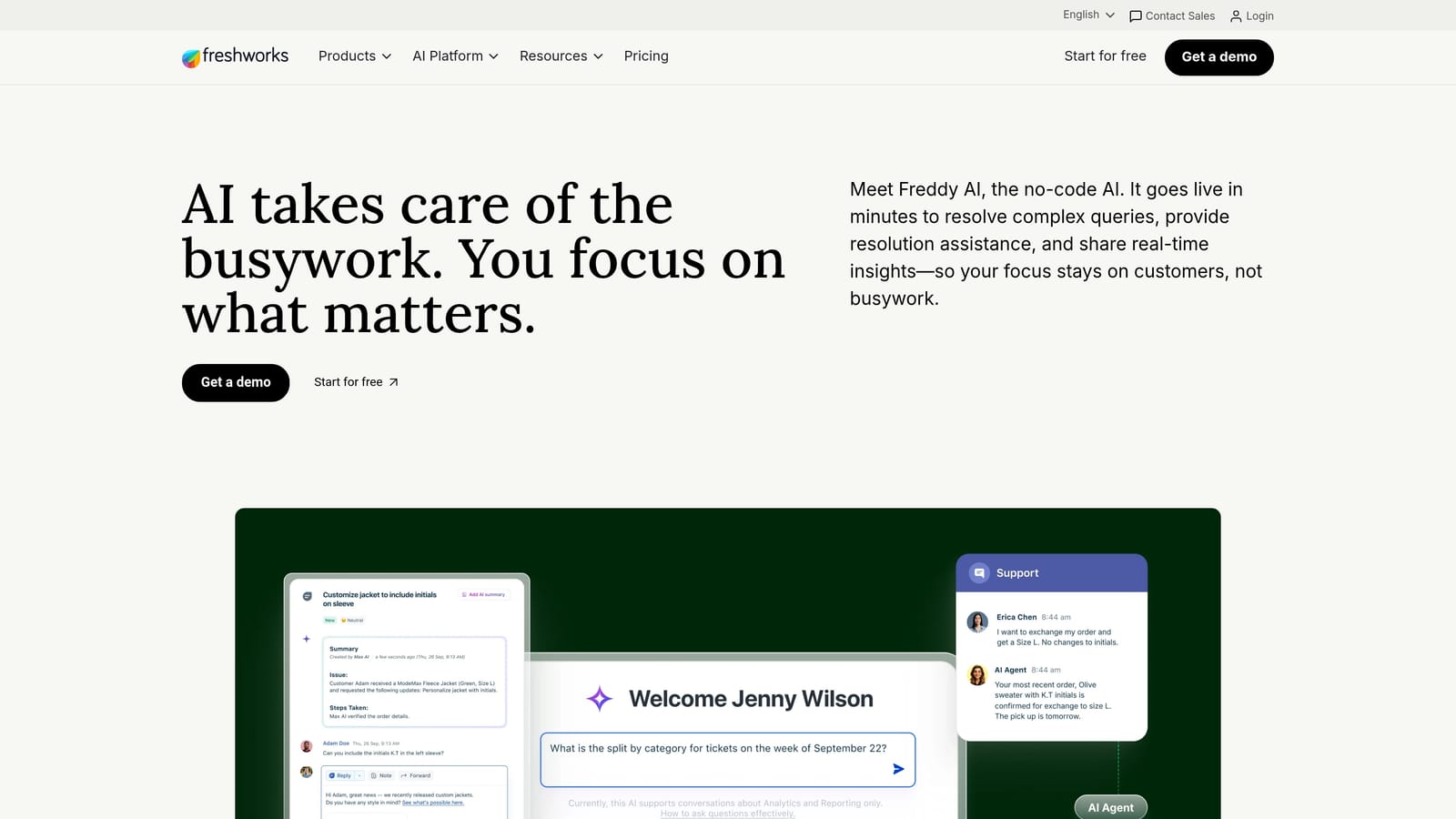
Freddy AI is Freshworks' AI layer for Freshdesk, offering self-service bots, agent copilot features, and AI-powered analytics across their support suite.
Where This Tool Shines
Freddy AI stands out for its modularity. Rather than a monolithic AI add-on, Freshworks has built Freddy as distinct modules: Self Service for customer-facing deflection, Copilot for agent assistance, and Insights for analytics. Teams can adopt what they need without paying for what they don't.
The pricing accessibility is also a genuine differentiator. Freshdesk's overall cost structure is more approachable than enterprise-tier competitors, which matters for teams that want meaningful AI capabilities without committing to enterprise-level spend.
Key Features
Freddy Self Service: Customer-facing AI chatbot for deflecting common questions before they reach human agents.
Freddy Copilot: Real-time suggestions, ticket summaries, and knowledge retrieval for agents handling live tickets.
Freddy Insights: AI-driven analytics and anomaly detection designed for support leaders monitoring team performance.
Tiered Availability: Freddy modules available across Growth, Pro, and Enterprise plans, giving teams flexibility as they scale.
Affordable Entry Point: Lower baseline cost compared to enterprise-only competitors, with meaningful AI available at mid-tier plan levels.
Best For
SMBs and mid-market teams already on Freshdesk who want to layer in AI incrementally. Also a strong choice for support leaders who want analytics and anomaly detection without a separate BI tool.
Pricing
Freddy AI modules available as add-ons on Pro and Enterprise plans. See freshworks.com for current pricing and plan availability.
5. Tidio (Lyro AI)
Best for: E-commerce merchants on Shopify or WooCommerce needing fast deployment and conversational support
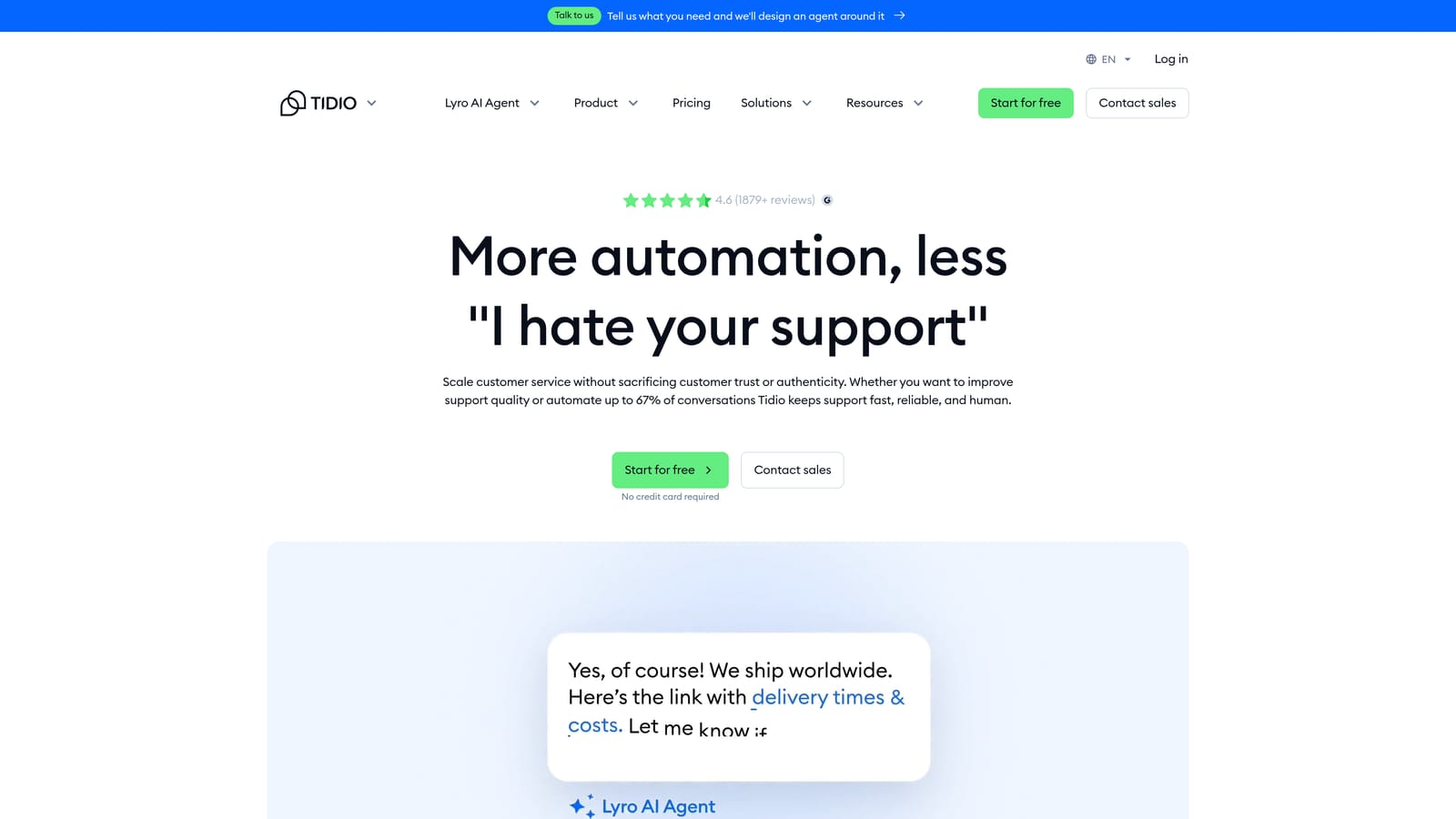
Tidio's Lyro AI is a conversational support agent built for fast deployment, particularly popular with e-commerce businesses running on Shopify and WooCommerce.
Where This Tool Shines
Lyro is built for speed. Setup is minimal, configuration is no-code, and native e-commerce integrations mean the AI can pull order data, shipping status, and product information without complex middleware. For merchants handling high volumes of repetitive queries, Lyro reduces ticket load quickly.
The per-conversation pricing model also suits e-commerce's seasonal nature. Rather than paying flat monthly fees during slow periods, costs scale with actual conversation volume, which maps naturally to peak-season demand patterns.
Key Features
Fast Deployment: Lyro AI can be configured and live with minimal setup time, requiring no technical expertise.
E-Commerce Integrations: Native connections to Shopify, WooCommerce, and major e-commerce platforms for order and product context.
Per-Conversation Pricing: Predictable cost scaling tied to actual usage rather than seat count or flat fees.
Live Chat Fallback: Automatically routes to human agents when the AI reaches its confidence limits on complex queries.
No-Code Configuration: Non-technical teams can build, adjust, and manage conversation flows without developer involvement.
Best For
E-commerce merchants and direct-to-consumer brands with high volumes of order-related queries. Less suited to complex B2B SaaS support scenarios but excellent for straightforward, high-frequency customer interactions.
Pricing
Free plan available; Lyro AI conversations priced per use. See tidio.com for current rates and plan tiers.
6. Forethought
Best for: Support operations teams wanting AI triage and routing layered on top of an existing helpdesk
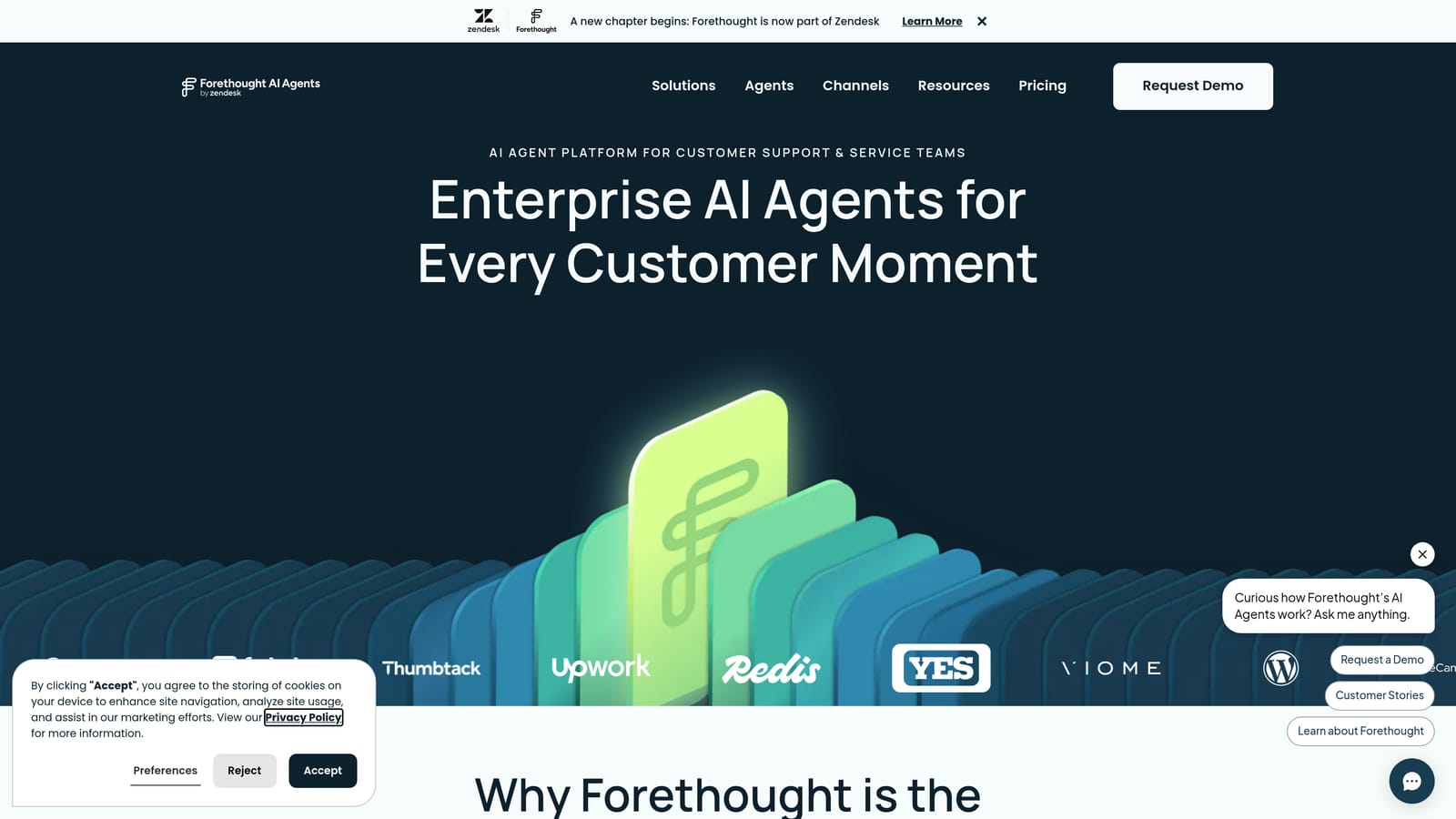
Forethought is an AI support automation layer designed to sit on top of existing helpdesks, specializing in intelligent triage, routing, and agent assistance.
Where This Tool Shines
Forethought's core value proposition is that it enhances your existing helpdesk rather than replacing it. For teams with significant investment in Zendesk or Salesforce Service Cloud, this is a meaningful consideration. The AI improves routing accuracy and reduces misclassification without requiring a platform migration.
The three-product structure (Triage, Assist, Solve) gives support operations leaders clear levers to pull depending on where their efficiency gaps are. Teams can start with routing improvements and expand to autonomous resolution as confidence in the AI builds.
Key Features
Triage: AI-powered ticket classification and routing to the correct team or queue based on detected intent.
Assist: Real-time response suggestions and knowledge retrieval surfaced to agents during active ticket handling.
Solve: Autonomous resolution for common, repeatable ticket types that don't require human judgment.
Helpdesk Integrations: Works directly with Zendesk, Salesforce Service Cloud, and other major helpdesk platforms.
Support Ops Focus: Reporting and metrics built around efficiency gains, routing accuracy, and resolution rate improvements.
Best For
Support operations leaders at mid-market to enterprise companies who want to improve the performance of their existing helpdesk without switching platforms. Strong fit for teams where routing accuracy and misclassification are measurable pain points.
Pricing
Custom enterprise pricing. Contact Forethought directly for a quote based on volume and use case.
7. Ada
Best for: Large enterprise and global brands needing multilingual, no-code AI agent management at scale
Ada is an enterprise-grade no-code AI agent platform used by large consumer and B2B brands to automate customer interactions across multiple channels and languages.
Where This Tool Shines
Ada's no-code conversation builder is genuinely powerful for non-technical teams. Customer experience and support operations staff can build, test, and iterate on AI conversation flows without involving engineering, which matters for large organizations where developer resources are constrained.
The multilingual and compliance capabilities make Ada a strong choice for global brands operating across regions with different regulatory requirements. The platform's enterprise security certifications reduce procurement friction in regulated industries.
Key Features
No-Code Flow Builder: Non-technical teams can build and maintain AI conversation flows without developer involvement.
Multilingual Support: Broad language coverage for global customer bases without separate regional configurations.
Enterprise Compliance: Security certifications and compliance features designed for regulated industries and large procurement requirements.
Platform Integrations: Connects with major CRM, helpdesk, and data platforms across the enterprise stack.
Containment Analytics: Reporting dashboard tracking resolution rate, containment, and AI performance over time.
Best For
Large enterprise brands with global operations, multilingual customer bases, or strict compliance requirements. Ada works particularly well when non-technical CX teams need ownership over AI conversation management without relying on engineering.
Pricing
Custom enterprise pricing. Contact Ada directly for a quote tailored to your organization's scale and requirements.
8. Kustomer
Best for: High-volume consumer brands needing AI with full customer history context across every channel
Kustomer is a CRM-native customer service platform with AI automation built on top of full customer history, giving AI agents richer context than ticket-only systems provide.
Where This Tool Shines
The key differentiator for Kustomer is context depth. Most AI support tools operate on the current ticket in isolation. Kustomer's AI operates with the full customer timeline: purchase history, previous interactions, lifetime value, and behavioral data across every channel. This produces more nuanced, personalized responses.
For high-volume direct-to-consumer brands where customer context dramatically changes how an issue should be handled, this architecture is a genuine advantage. Routing decisions can factor in customer attributes rather than just ticket content.
Key Features
Full Customer History Context: AI operates with complete customer data, not just the current ticket, enabling more informed and personalized responses.
Unified Customer Timeline: Single view of all customer interactions across chat, email, social, and voice channels.
AI-Powered Routing: Routes tickets based on customer attributes, lifetime value, and behavioral history rather than keyword matching alone.
Automated Workflows: Triggers based on customer behavior and history, not just ticket content.
Omnichannel Coverage: Consistent AI-assisted support across every customer communication channel from one platform.
Best For
High-volume DTC and consumer brands where customer history significantly affects how support should be handled. Also strong for teams that want to unify support data across multiple channels into a single customer view.
Pricing
Enterprise pricing per agent per month. See kustomer.com for current plan details.
9. Zoho Desk with Zia AI
Best for: Budget-conscious teams already in the Zoho ecosystem wanting AI-enhanced support without high costs
Zoho Desk's Zia AI assistant brings sentiment analysis, ticket tagging, anomaly detection, and response suggestions to one of the most affordable helpdesk platforms on the market.
Where This Tool Shines
Zia's value proposition is straightforward: meaningful AI capabilities at a price point that doesn't require enterprise budget approval. For teams already using Zoho CRM, Zoho Analytics, or other Zoho products, the integration depth is a natural advantage that larger, more expensive platforms can't easily replicate.
The anomaly detection capability is particularly useful for support leaders who want early warning systems for unusual ticket volume spikes, which often signal product issues or external incidents before they escalate.
Key Features
Zia Sentiment Analysis: Flags tickets requiring urgent or sensitive handling based on detected customer sentiment and tone.
Automatic Ticket Tagging: Reduces manual data entry by automatically populating ticket fields and tags based on content analysis.
Anomaly Detection: Alerts support leaders when ticket volumes spike unusually, enabling faster response to emerging issues.
Response Suggestions: Surfaces relevant answers from the knowledge base and ticket history to speed up agent responses.
Zoho Ecosystem Integration: Deep native integration with Zoho CRM, Zoho Analytics, and the broader Zoho product suite.
Best For
Small to mid-size teams already invested in the Zoho ecosystem, or budget-conscious organizations that want AI-enhanced support without committing to enterprise-tier pricing. Zia delivers solid value for teams where cost efficiency is a primary constraint.
Pricing
Zia AI is available on the Zoho Desk Enterprise plan, which is among the most affordable in the market. See zoho.com/desk for current rates.
Which Tool Is Right for Your Team?
The honest answer is that no single platform wins across every scenario. The right choice depends on where your team is today and what you're optimizing for.
If you're a B2B SaaS or product-led team that wants AI-first architecture with page-aware context, business intelligence, and a continuous learning loop, Halo AI is purpose-built for exactly that use case. It's the only platform here that treats support as both a resolution function and a business intelligence layer.
If you're already on Intercom and want autonomous resolution without switching platforms, Fin AI Agent is the path of least resistance. For large enterprises running Zendesk, Zendesk AI makes sense as an extension of existing infrastructure. Freshdesk Freddy AI is the best modular option for SMBs watching their budget. Tidio's Lyro is the go-to for e-commerce merchants on Shopify or WooCommerce.
For teams wanting an AI layer on top of an existing helpdesk without migration, Forethought fits neatly. Ada serves global enterprise brands with multilingual needs and compliance requirements. Kustomer shines when full customer history context matters. And Zoho Desk with Zia delivers solid AI value for teams already in the Zoho ecosystem.
Your support team shouldn't scale linearly with your customer base. Let AI agents handle routine tickets, guide users through your product, and surface business intelligence while your team focuses on complex issues that need a human touch. See Halo in action and discover how continuous learning transforms every interaction into smarter, faster support.