8 Best AI Support Tools for API Companies in 2026
This guide evaluates the 8 best AI support for API companies in 2026, covering tools that go beyond generic helpdesks to deliver autonomous ticket resolution, accurate documentation referencing, and native integration with developer workflows like Slack and Linear. Whether your team needs faster 2am incident responses or deeper technical context handling, these picks were chosen on criteria that matter to API-first businesses.
 Matt PattoliFounder12 min read
Developers don't do patience. When an API call fails at 2am, your developer customer wants an answer in seconds, not a ticket confirmation email and a 24-hour SLA. They want to know if it's an auth header issue, a rate limit edge case, or something broken on your end. Generic helpdesk tools weren't built for that level of specificity, and they show.
The best AI support tools for API companies do more than deflect tickets. They understand technical context, reference documentation accurately, integrate with developer-native workflows like Slack and Linear, and know when to hand off to a human engineer without losing the thread. The tools below were evaluated on exactly those criteria.
1. Halo AI
Best for: API companies wanting fully autonomous ticket resolution with deep engineering workflow integration.
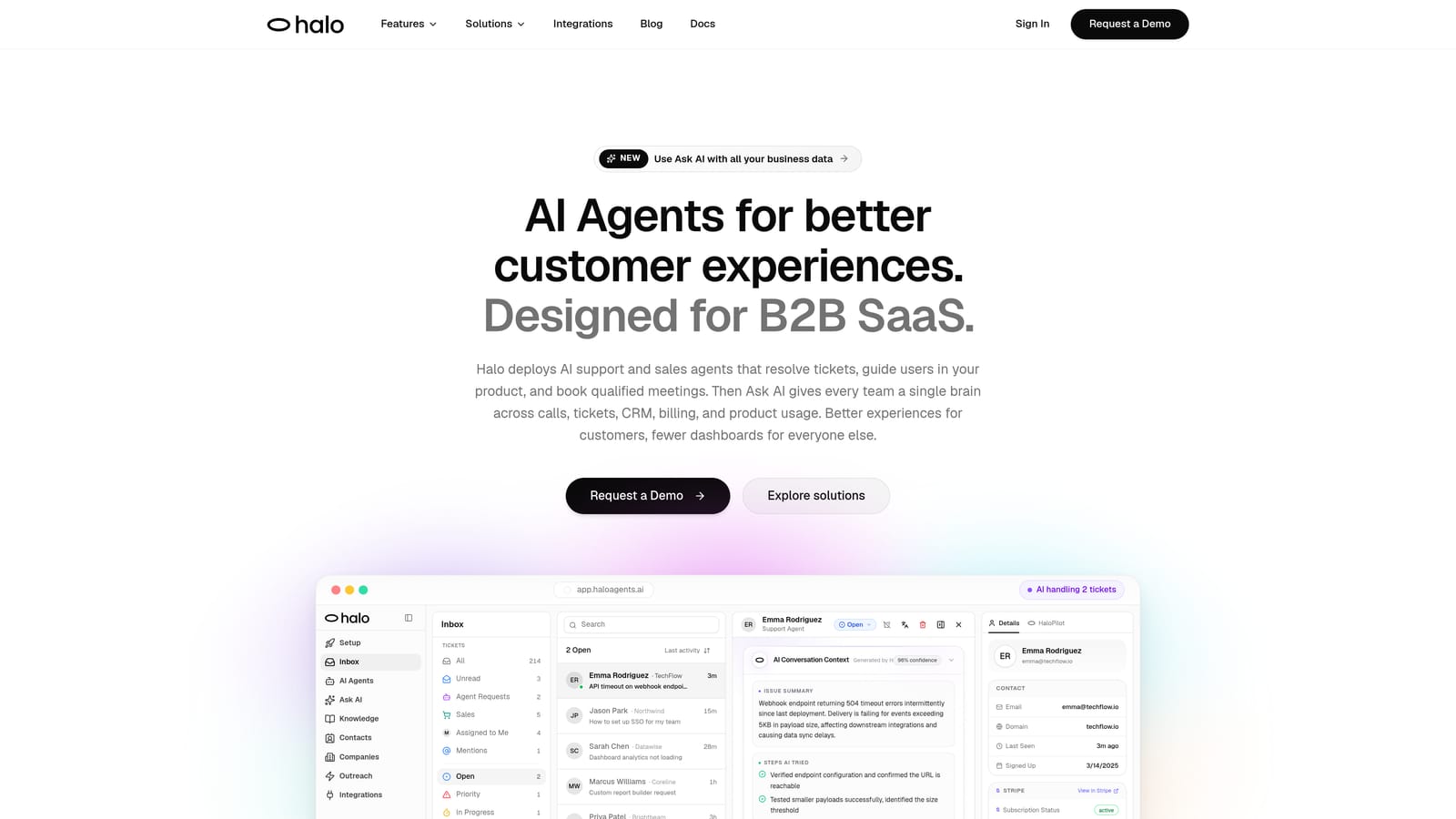
Halo AI is an AI-first customer support platform built for autonomous resolution, not just AI-assisted routing on top of a legacy helpdesk.
Where This Tool Shines
What sets Halo apart for API companies is the combination of page-aware context and engineering workflow integration. The chat widget understands what a user is actually looking at in your product, which means when a developer hits an authentication error on your dashboard, the AI already has context before they type a word. That kind of situational awareness dramatically improves first-response accuracy.
The auto bug ticket creation feature is particularly valuable for API platforms, where a meaningful portion of support volume is actually bug reports in disguise. Halo identifies these automatically and routes them directly to Linear or your existing engineering workflow, closing the loop between support and product without manual triage.
Key Features
Intelligent AI Agents: Resolve support tickets autonomously end-to-end, learning from every interaction to improve over time.
Page-Aware Chat Widget: Understands the user's current product context, enabling more precise, relevant responses from the first message.
Auto Bug Ticket Creation: Detects bug reports within support conversations and routes them to Linear or your engineering workflow automatically.
Smart Inbox with Business Intelligence: Surfaces customer health signals, anomaly detection, and revenue intelligence beyond standard support metrics.
Live Agent Handoff: Escalates to human agents with full conversation context preserved, so nothing gets repeated.
Deep Integrations: Connects with Linear, Slack, HubSpot, Intercom, Stripe, Zoom, PandaDoc, and Fathom across the business stack.
Best For
API companies and developer-facing SaaS platforms that want autonomous resolution rather than agent assist. Particularly strong for teams that need the support layer to connect directly to engineering workflows and business intelligence, not just close tickets.
Pricing
Contact Halo AI directly for pricing. The platform is enterprise-focused, and pricing is customized based on volume and integration requirements.
2. Intercom
Best for: Teams already in the Intercom ecosystem who want to layer AI onto existing customer messaging workflows.
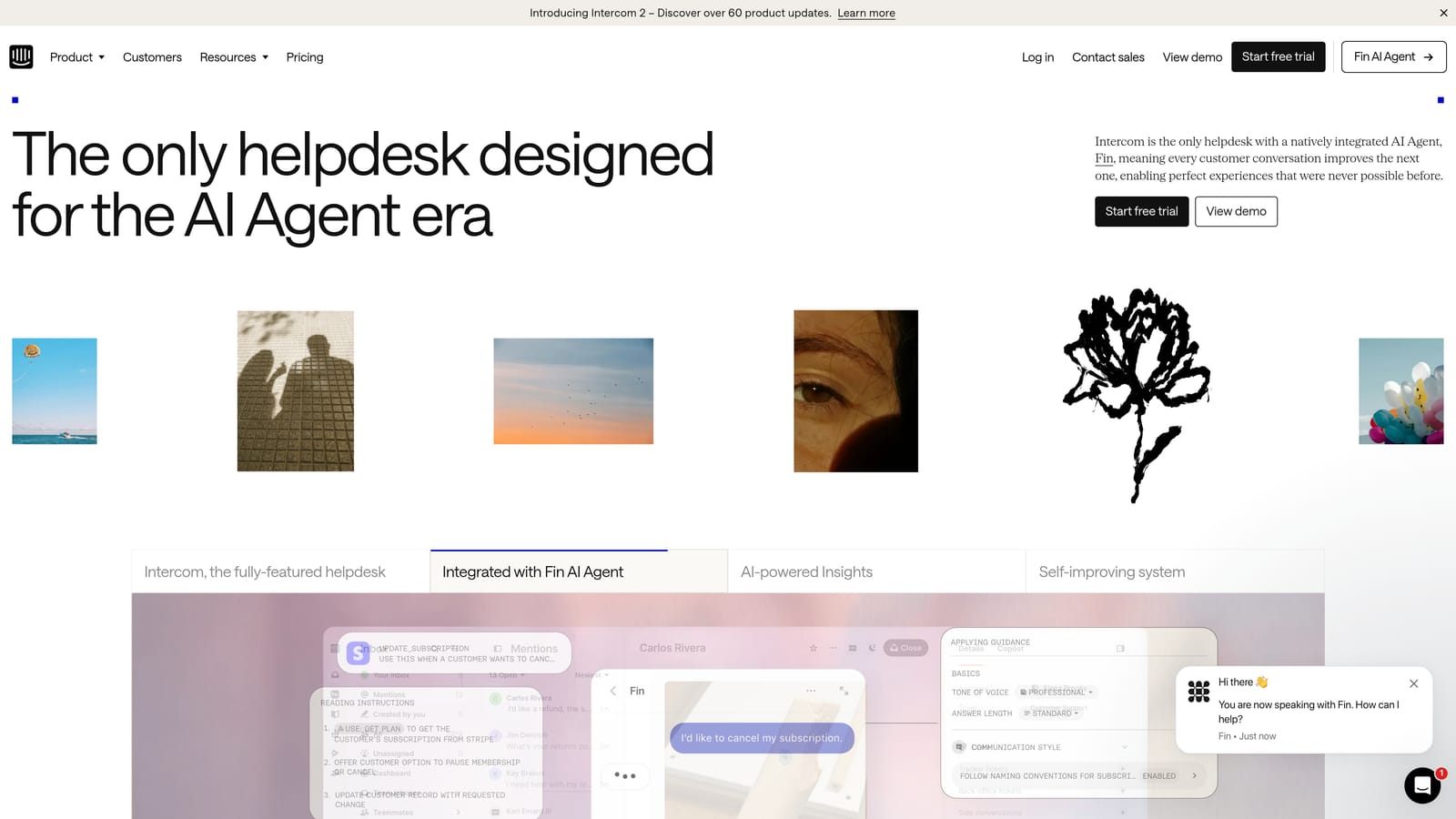
Intercom is a mature customer messaging platform with a powerful AI agent, Fin, built on large language models and trained on your help center content.
Where This Tool Shines
Fin AI handles a broad range of customer queries by drawing on your existing documentation and help center articles. For API companies with well-maintained docs, this can deflect a significant portion of repetitive questions about endpoints, authentication flows, and common errors without any manual configuration per query type.
Intercom also has a robust developer API that API companies tend to appreciate. If you're already building on top of Intercom for product messaging, adding Fin AI to your support workflow is a relatively low-friction upgrade rather than a platform change.
Key Features
Fin AI Agent: Automated query resolution trained on your help center content, with fallback to human agents when confidence is low.
Help Center Integration: Pulls from your existing documentation to generate accurate, source-grounded responses.
Developer API: Extensive API for custom integrations, appealing to teams that build on top of their tools.
Omnichannel Support: Covers chat, email, and in-app messaging from a single platform.
AI-Assisted Inbox: Provides human agents with AI-suggested replies and conversation summaries.
Best For
Companies already using Intercom for customer engagement who want to add AI resolution without switching platforms. Less specialized for developer support than purpose-built tools, but a strong general-purpose choice.
Pricing
Starts around $39 per seat per month. Fin AI resolution is priced separately on a usage basis. Verify current pricing directly with Intercom, as rates change frequently.
3. Zendesk
Best for: Larger API companies with dedicated support operations teams needing enterprise-grade ticketing and configurability.
Zendesk is an enterprise-grade support platform with AI-powered triage, routing, and agent assist built across a massive integration ecosystem.

Where This Tool Shines
Zendesk's strength is its depth. For API companies with complex support org structures, multiple product lines, and strict SLA requirements, Zendesk provides the configurability to match. Intelligent routing can direct API-specific tickets to the right specialist queue, while generative AI features help agents respond faster with suggested replies and ticket summaries.
The integration marketplace is one of the largest in the industry. Teams that have invested in Zendesk as their system of record can layer AI capabilities on top, or connect tools like Halo AI to extend autonomous resolution within their existing Zendesk structure.
Key Features
AI-Powered Triage and Routing: Automatically classifies and routes tickets based on content, intent, and configured rules.
Generative AI Features: Suggested replies, ticket summarization, and agent assist powered by large language models.
Extensive Marketplace: Hundreds of integrations covering CRM, engineering tools, analytics, and communication platforms.
Advanced Reporting: Detailed SLA management, performance dashboards, and custom reporting capabilities.
Configurable Workflows: Supports complex multi-team and multi-tier support structures.
Best For
Larger API platforms with established support operations that need enterprise reliability and configurability. Requires meaningful setup investment to optimize for developer-facing support specifically.
Pricing
Suite plans start around $55 per agent per month. Advanced AI features are available on higher tiers. Confirm current pricing with Zendesk directly.
4. Freshdesk
Best for: Growing API teams that need solid helpdesk fundamentals with AI assistance at an accessible price point.
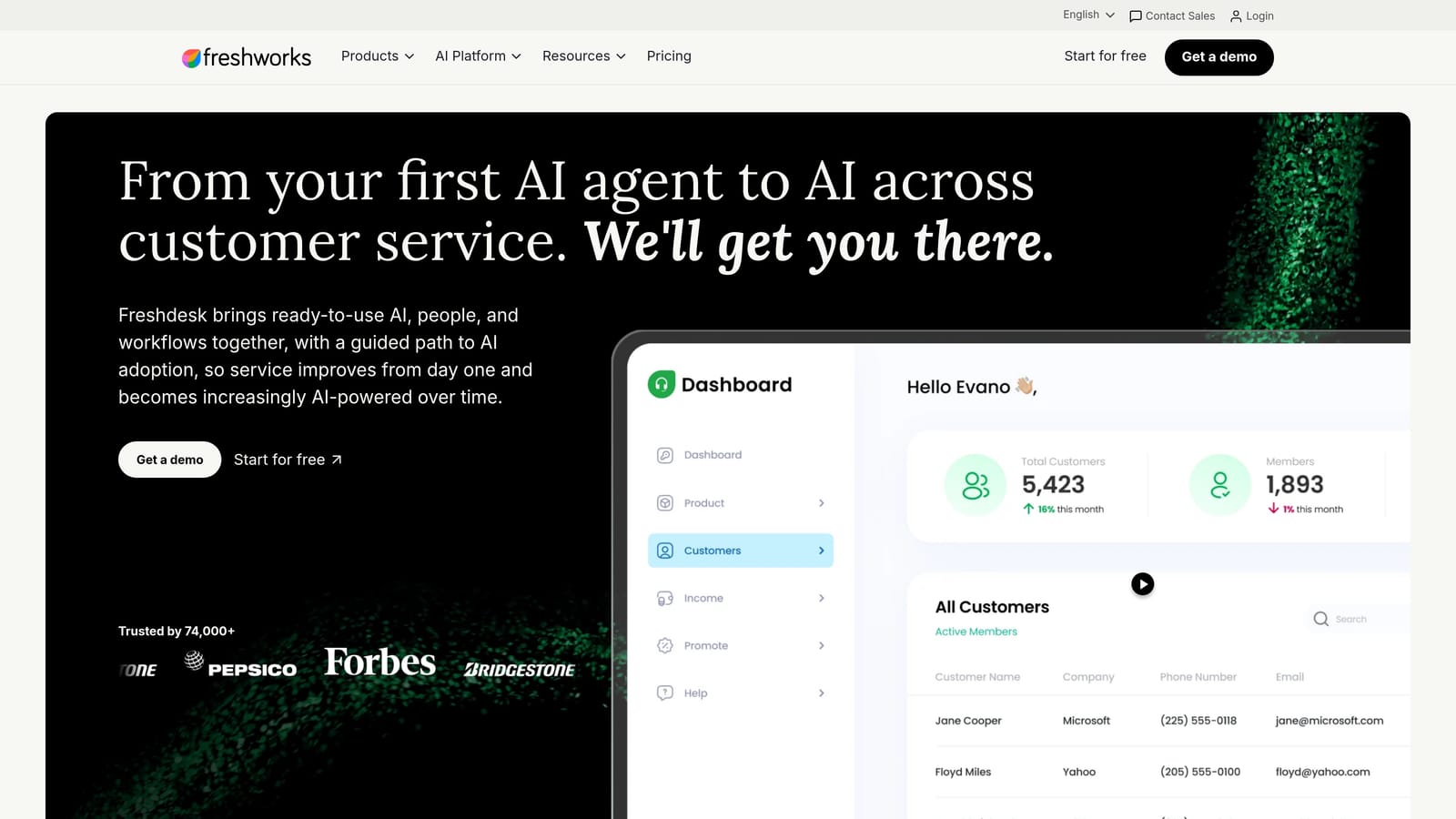
Freshdesk is an accessible helpdesk platform with Freddy AI providing ticket automation, summarization, and response suggestions.
Where This Tool Shines
Freshdesk hits a practical sweet spot for API startups and mid-size teams that aren't ready to commit to enterprise pricing but need more than a basic shared inbox. Freddy AI handles the routine work: summarizing long threads, suggesting responses based on similar past tickets, and routing new tickets to the right queue automatically.
The free tier makes it genuinely accessible for early-stage teams, and the upgrade path is gradual enough that you can grow into more advanced features without a disruptive platform switch mid-scale.
Key Features
Freddy AI: Provides ticket summarization, response suggestions, and sentiment analysis to help agents work faster.
Automated Routing: Rules-based and AI-assisted ticket prioritization and assignment.
Developer Portal and Knowledge Base: Supports documentation and self-service for developer customers.
Free Tier: Available for small teams with basic ticketing needs, no credit card required.
Omnichannel Coverage: Handles email, chat, phone, and social channels from a unified inbox.
Best For
Early-stage and growing API companies that need a cost-effective helpdesk with AI assistance. Not specialized for developer support, but a solid foundation that scales with the team.
Pricing
Free tier available. Growth plans start around $15 per agent per month. AI features are included on Pro and Enterprise tiers. Verify current pricing before committing.
5. Plain
Best for: Developer-tool companies that want a modern, opinionated support workflow built specifically for technical teams.
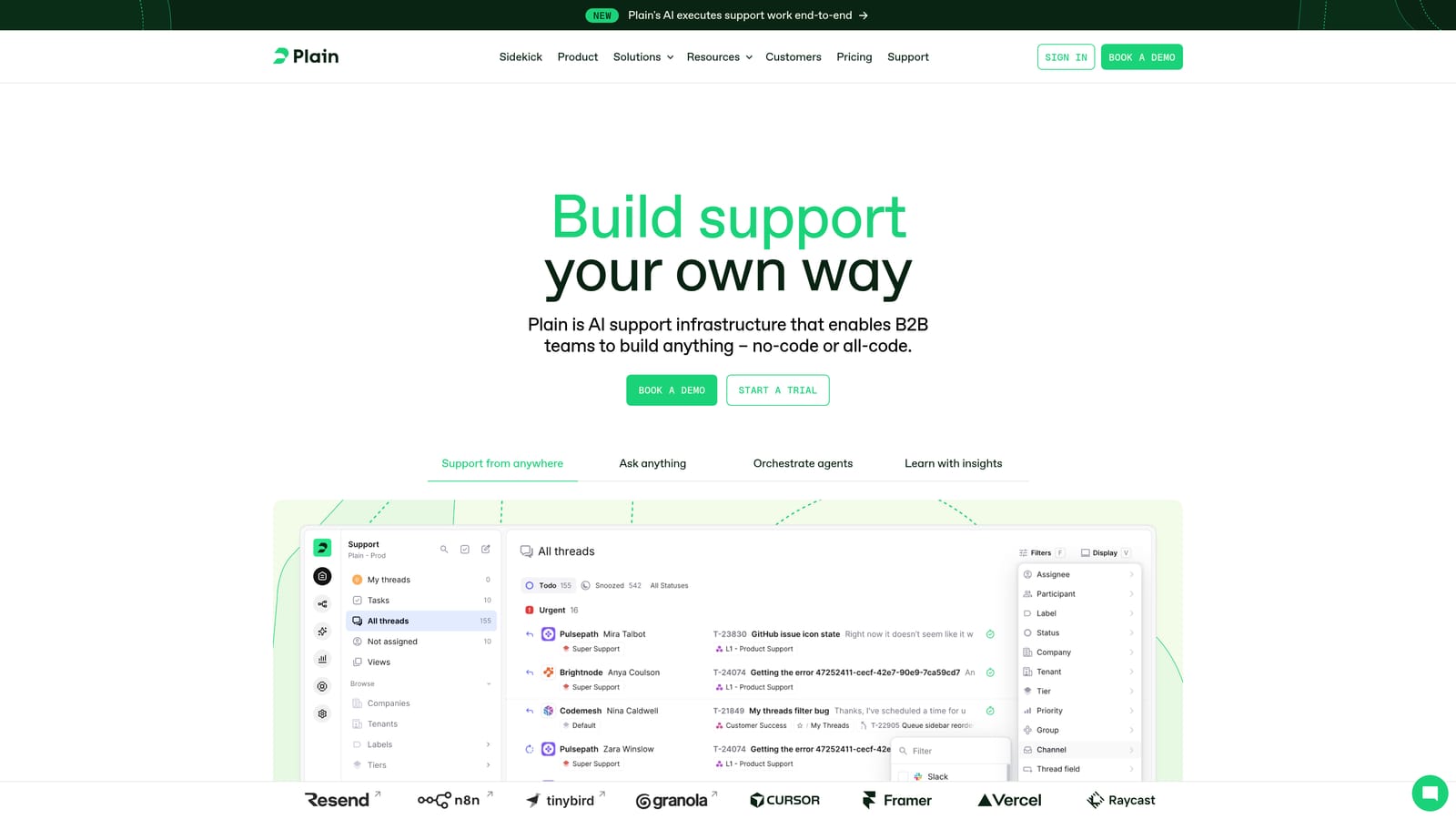
Plain is a modern, API-native support tool designed from the ground up for developer-facing companies, with deep Slack integration and a clean, focused workflow.
Where This Tool Shines
Plain is one of the few tools on this list that was designed with API companies as the primary customer, not an afterthought. The API-first architecture means you can build custom integrations, surface relevant customer data in the support view, and trigger workflows programmatically without fighting against a system built for a different use case.
The interface is notably fast and free of legacy helpdesk complexity. For support engineers who live in their tools all day, this matters more than it sounds. The Slack integration is deep enough that developer customers can get support in a channel they already use, while the Plain team manages context, timelines, and SLAs on the backend.
Key Features
API-First Architecture: Built for programmatic integration, allowing custom workflows and data surfacing without workarounds.
Deep Slack Integration: Enables developer-native support workflows where customers stay in Slack and agents manage everything in Plain.
Customer Timeline View: Full interaction history and context for every customer in a single view.
Technical Triage Design: Prioritization and queue management built for the specific patterns of developer support volume.
Lightweight Interface: Fast, modern UI with no legacy helpdesk overhead slowing down daily workflows.
Best For
Developer-tool startups and API companies that want a purpose-built support tool rather than a general helpdesk configured for technical support. Smaller ecosystem than Zendesk or Intercom, but far more focused.
Pricing
Usage-based pricing model. Contact Plain directly for current rates, as pricing is tailored to team size and volume.
6. Unthread
Best for: B2B API companies supporting enterprise customers through dedicated Slack Connect channels.
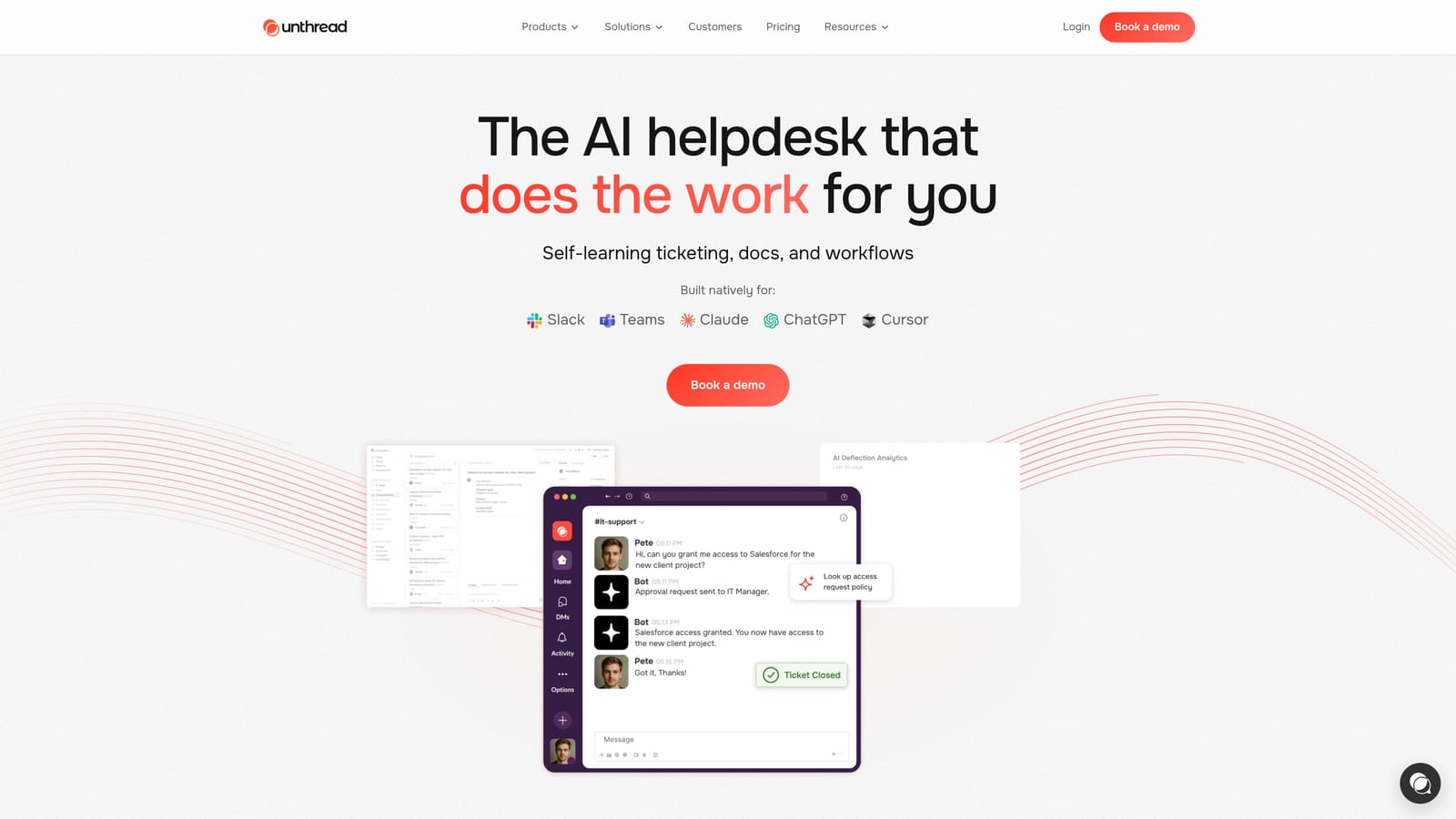
Unthread transforms Slack channels into a managed support inbox with AI-assisted responses, SLA tracking, and analytics, purpose-built for B2B companies whose customers live in Slack.
Where This Tool Shines
Many B2B API companies end up running de facto support through Slack Connect channels with their enterprise customers. It's fast, it's where developers already are, and it builds relationships. The problem is that Slack wasn't built for support operations: threads get lost, SLAs go untracked, and there's no visibility into response times or volume trends. Unthread solves exactly that problem without changing where the conversations happen.
AI-assisted response suggestions appear directly within Slack, so agents don't need to context-switch to a separate tool to get help drafting a reply. Everything, including escalation alerts and analytics, happens in the workflow teams are already using.
Key Features
Slack-Native Support Inbox: Converts Slack Connect channels into a tracked, managed support queue without moving conversations.
AI-Assisted Responses: Suggests replies within Slack based on conversation context and past resolutions.
SLA Tracking: Monitors response and resolution times with escalation alerts when thresholds are breached.
Customer Analytics: Tracks volume, response times, and trends by customer account.
Zero Context-Switching: The entire support workflow operates within Slack for both agents and customers.
Best For
B2B API companies with enterprise customers who communicate primarily through Slack Connect. A strong niche fit for teams that want operational discipline around Slack-based support without abandoning the channel.
Pricing
Contact Unthread directly for current pricing. Rates are based on team size and usage volume.
7. Kapa.ai
Best for: API platforms with extensive technical documentation that want to deflect repetitive developer questions at the docs layer.
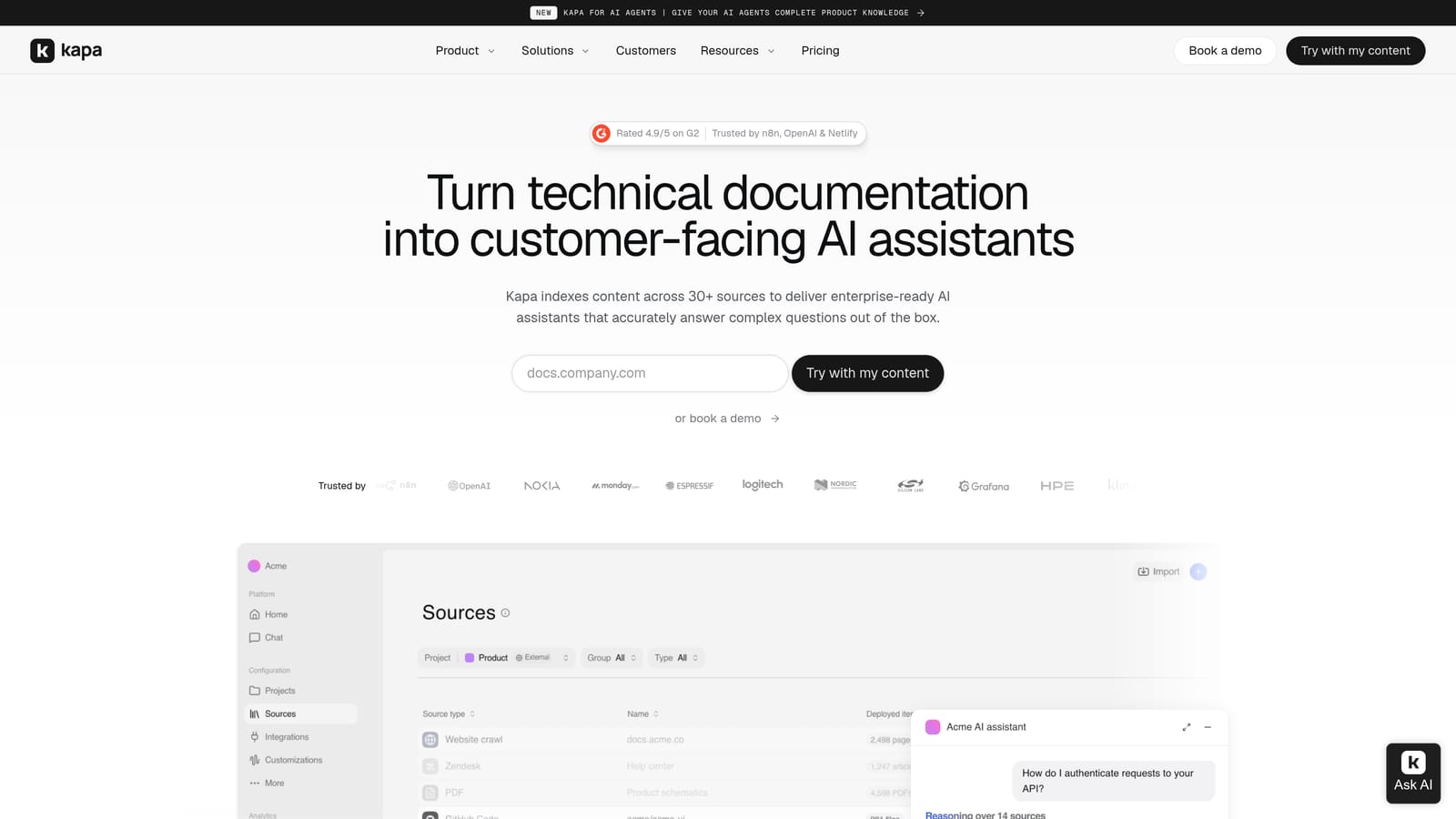
Kapa.ai is a specialized AI trained on your technical documentation, GitHub content, Discourse forums, and Slack history to answer developer questions with accurate, source-cited responses.
Where This Tool Shines
Kapa.ai occupies a distinct niche: it's not a helpdesk replacement, it's a documentation intelligence layer. For API companies with rich docs, GitHub READMEs, Discourse communities, and historical Slack conversations, Kapa ingests all of it and becomes a conversational interface over your existing knowledge. Developers get answers with cited sources from your actual content, not hallucinated responses.
The gap-identification feature is genuinely useful for product and docs teams. When Kapa can't answer a question because the content doesn't exist yet, it flags that as a documentation gap. Over time, this creates a feedback loop that improves both the AI's accuracy and the quality of your documentation.
Key Features
Multi-Source Ingestion: Pulls from docs sites, GitHub READMEs, Discourse forums, and Slack history to build a comprehensive knowledge base.
Source-Cited Responses: Answers developer questions with links to the specific documentation that supports each response.
Embeddable Everywhere: Can be deployed in documentation sites, Slack workspaces, Discord servers, and more.
Documentation Gap Detection: Identifies questions that couldn't be answered and flags them as content gaps for your docs team.
Developer-Specific Design: Built specifically for technical content and developer audiences, not general customer support.
Best For
API companies with substantial technical documentation who want to deflect repetitive questions before they become support tickets. Works best as a complement to a full helpdesk, not a standalone solution.
Pricing
Usage-based pricing. Contact Kapa.ai for current rates based on content volume and query volume.
8. Forethought
Best for: API companies with existing Zendesk or Salesforce investments that want to add AI intelligence without switching platforms.
Forethought is an AI layer that sits on top of existing helpdesks, providing intelligent triage, routing, and generative AI agent assist without replacing your current stack.
Where This Tool Shines
Forethought's core value proposition is additive rather than disruptive. If your API company has invested years in a Zendesk or Salesforce Service Cloud configuration, switching platforms carries real risk and migration cost. Forethought lets you keep that investment while adding meaningful AI capabilities on top: smarter triage, faster routing, and generative AI that helps agents respond more accurately and quickly.
The analytics layer is worth noting. Forethought tracks AI deflection rates and resolution quality, giving support operations teams visibility into where automation is working and where human intervention is still needed. For API companies managing high-volume technical queues, that visibility is operationally valuable.
Key Features
Intelligent Triage and Routing: Classifies and routes incoming tickets with AI on top of your existing helpdesk structure.
Generative AI Agent Assist: Provides suggested responses and contextual information to human agents in real time.
Workflow Automation: Handles repetitive ticket patterns automatically, reducing manual workload for routine cases.
Helpdesk Integrations: Works with Zendesk, Salesforce Service Cloud, and other major platforms without requiring migration.
Deflection Analytics: Tracks AI resolution rates and quality metrics to optimize automation over time.
Best For
Enterprise API companies with established helpdesk infrastructure that want to add AI capabilities incrementally. Not ideal for teams starting fresh who would benefit more from an AI-native platform from the outset.
Pricing
Enterprise-focused pricing. Contact Forethought directly for current rates based on seat count and integration requirements.
Choosing the Right Tool for Your API Company
The right choice depends on where your team is and what kind of support operation you're building toward.
Developer-first startups and API companies building from scratch should look hardest at Halo AI and Plain. Both are built with developer-facing support in mind, but Halo AI goes further with autonomous resolution, engineering workflow integration, and business intelligence that grows with your platform. Plain is an excellent choice if your team lives in Slack and wants a lightweight, opinionated tool without the complexity of a full AI platform.
Teams supporting enterprise customers via Slack Connect will find Unthread solves a very specific problem extremely well. Pair it with Kapa.ai if you have deep documentation and want to deflect questions before they reach your agents.
Larger API platforms with existing helpdesk investments should consider Zendesk or Forethought depending on whether they want to consolidate onto one platform or add AI capabilities to what they already have. Intercom fits well for teams already using it for product messaging who want to extend into AI-powered support without a separate tool.
Growing teams watching budget will find Freshdesk's pricing structure gives them room to start lean and scale into more advanced AI features as volume justifies it.
Your support team shouldn't scale linearly with your customer base. Let AI agents handle routine tickets, guide users through your product, and surface business intelligence while your team focuses on complex issues that need a human touch. See Halo in action and discover how continuous learning transforms every interaction into smarter, faster support.