9 Best AI Support Tools for B2B SaaS in 2026
Discover the 9 best AI support tools for B2B SaaS in 2026, evaluated on autonomous ticket resolution, SaaS-specific integrations, and scalability. This guide helps technical support teams find platforms built to handle complex product environments, 24/7 user demands, and intelligent escalation—without adding headcount.
 Matt PattoliFounder14 min read
B2B SaaS support teams face a challenge that generic tools weren't built to solve. Your customers are technical, your product is complex, and your users expect accurate answers at 2 AM on a Sunday. Overloaded help desks and basic chatbots that can only handle "what's your return policy?" simply don't match the demands of a modern SaaS environment.
AI support tools built specifically for SaaS can resolve tickets autonomously, guide users through product workflows, surface customer health signals, and escalate intelligently when a human is genuinely needed. The market has matured considerably, and the differences between platforms now matter more than ever.
This list covers the top AI support platforms for B2B SaaS teams in 2026, evaluated on depth of AI capability, SaaS-specific integrations, ease of deployment, and how well each tool scales without adding headcount. Whether you're replacing a legacy helpdesk, layering AI onto an existing stack, or building support from scratch, there's an option here for your stage and use case.
1. Halo AI
Best for: B2B SaaS teams that want AI-first support with product intelligence built in
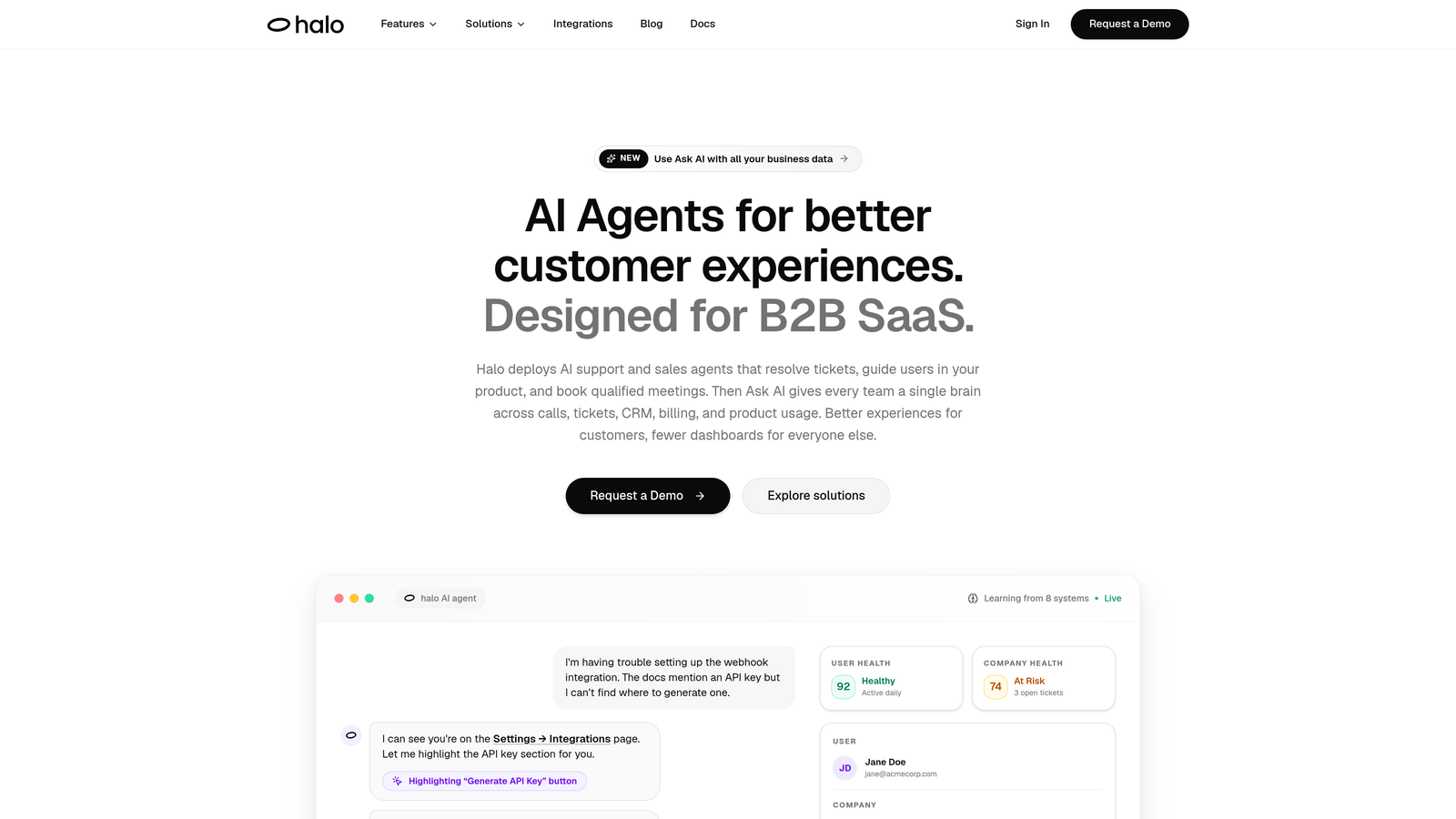
Halo AI is an AI-first customer support platform built specifically for B2B SaaS, deploying intelligent agents that resolve tickets, guide users through your product, and surface business intelligence signals.
Where This Tool Shines
Most AI support tools are helpdesks with AI bolted on. Halo is architected the other way around: AI is the foundation, not a feature. The standout capability is its page-aware chat widget, which understands exactly where a user is inside your product and provides contextually relevant guidance rather than generic answers. That distinction matters enormously when your product has dozens of workflows and your users are mid-task when something goes wrong.
Beyond ticket resolution, Halo surfaces business intelligence that most support tools ignore entirely. Its smart inbox detects customer health signals and revenue anomalies, turning support data into product and revenue insights. The continuous learning model means the AI improves with every resolved interaction, so the system gets smarter the longer you run it.
Key Features
Page-Aware Chat Widget: Understands the user's current product context to deliver precise, situationally relevant guidance rather than generic FAQ responses.
Autonomous Ticket Resolution: AI agents resolve tickets end-to-end with intelligent escalation to human agents when complexity warrants it.
Auto Bug Ticket Creation: Automatically generates and routes bug reports to Linear or connected tools, eliminating manual handoffs between support and engineering.
Smart Inbox with Business Intelligence: Surfaces customer health signals, revenue anomalies, and trend detection beyond standard support metrics.
SaaS Toolchain Integrations: Connects natively with Linear, Slack, HubSpot, Intercom, Stripe, Zoom, PandaDoc, and Fathom.
Continuous Learning: Every resolved interaction feeds back into the model, improving accuracy and resolution rates over time without manual retraining.
Best For
SaaS teams that want support to do more than close tickets. Halo is particularly well-suited for product-led growth companies where support interactions generate signals about user behavior, churn risk, and expansion opportunities. Also strong for teams that need engineering workflows (bug routing) tightly connected to support.
Pricing
Visit haloagents.ai for current pricing details. Pricing is not publicly listed and varies based on team size and use case.
2. Intercom
Best for: Teams already in the Intercom ecosystem wanting mature AI with broad messaging capabilities
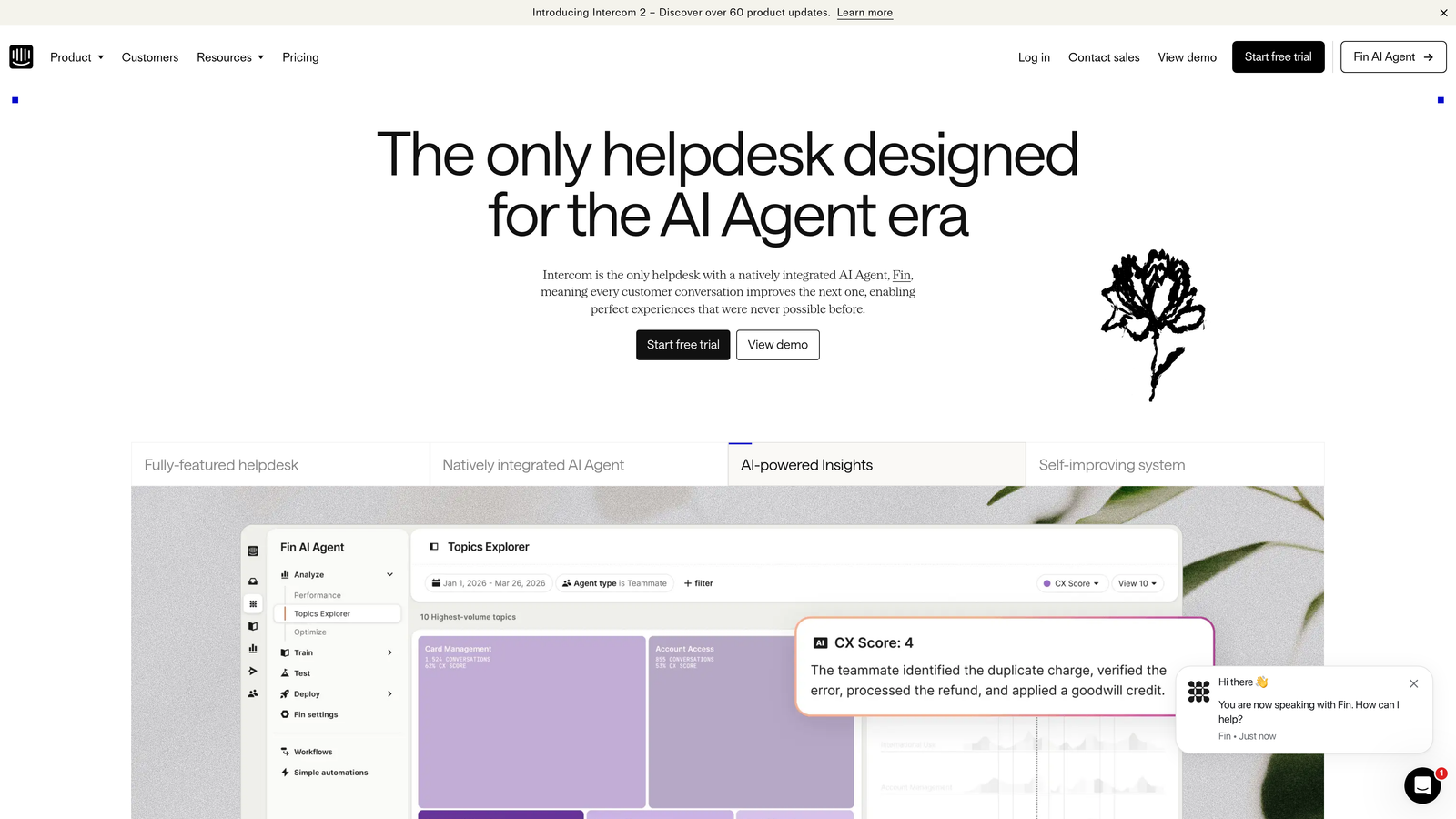
Intercom is one of the most established customer messaging platforms in SaaS, featuring Fin, its LLM-powered AI agent, alongside a full suite of messenger, help center, and inbox tools.
Where This Tool Shines
Intercom's Fin AI agent is genuinely capable of autonomous resolution for a meaningful share of support queries. It's built on large language models and integrates tightly with Intercom's help center, drawing on your existing content to answer questions without manual rule-building. For teams already running Intercom for customer messaging, adding Fin is a relatively low-friction upgrade.
The breadth of the platform is both a strength and a consideration. Intercom handles everything from onboarding flows to proactive messaging to support tickets, which makes it powerful for teams that want a single platform. That breadth also means it's not exclusively focused on support intelligence, and costs can climb at scale with usage-based AI pricing layered on top of seat costs.
Key Features
Fin AI Agent: LLM-powered autonomous resolution that draws on your help center content to answer queries without manual configuration.
Customizable Messenger: Flexible chat widget with flow builders for onboarding, proactive messages, and support routing.
AI-Powered Article Suggestions: Surfaces relevant help center content based on what users are asking before they submit a ticket.
AI-Assisted Agent Replies: Suggests responses to human agents in the inbox, reducing handle time on complex queries.
Usage-Based AI Pricing: Fin is priced per resolution, which can scale costs unpredictably at high volume.
Best For
SaaS teams that want a mature, widely adopted platform and are already using Intercom for customer communication. Strong for teams that need messaging, support, and onboarding in a single tool.
Pricing
Seat-based plans start around $39/month; Fin AI carries additional usage-based pricing per resolution. Verify current pricing at intercom.com.
3. Zendesk AI
Best for: Larger SaaS organizations with compliance requirements and complex reporting needs
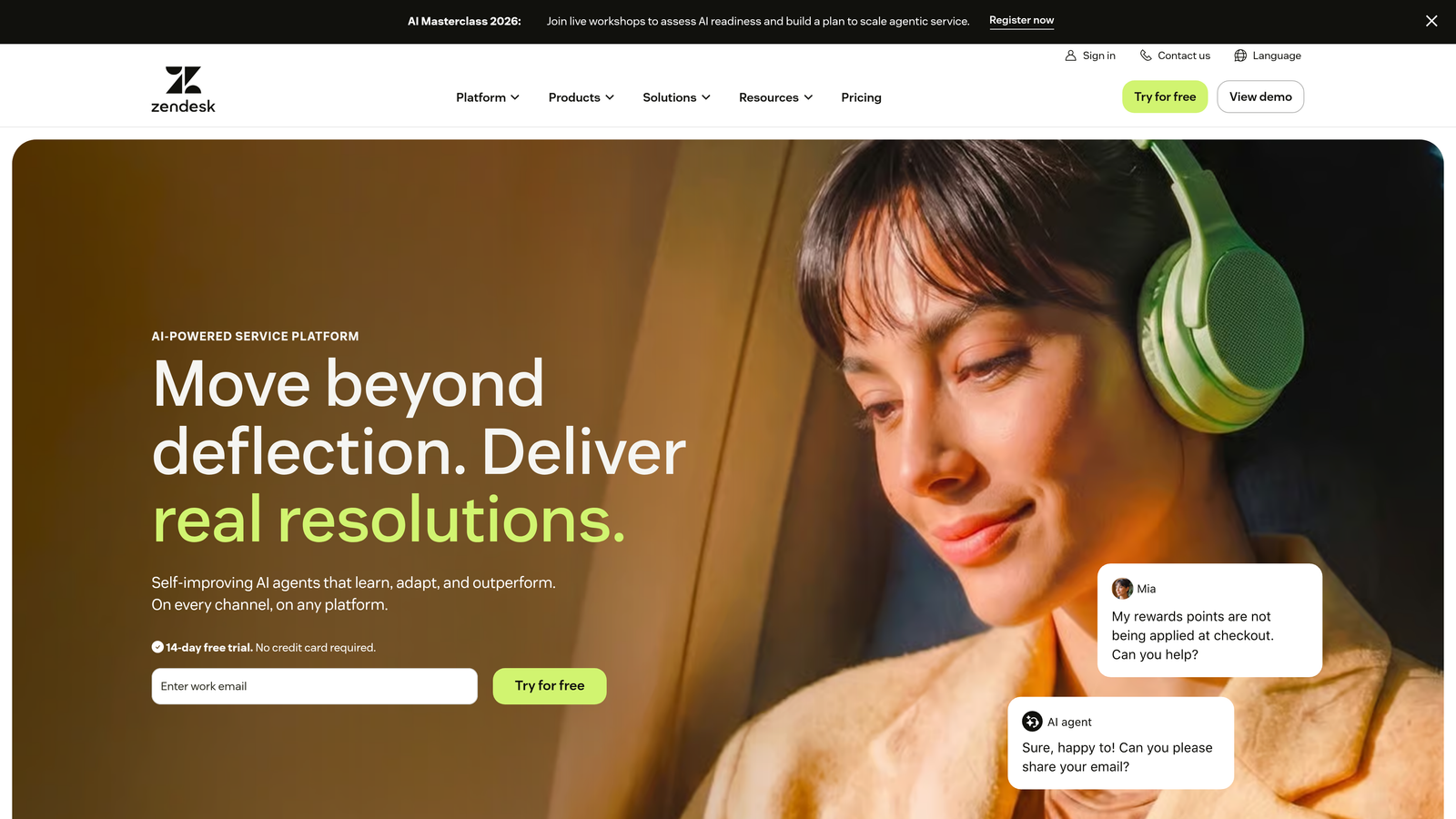
Zendesk is the enterprise-standard helpdesk platform, with AI triage, intelligent routing, and agent assist capabilities built into its Suite product.
Where This Tool Shines
Zendesk's strength has always been enterprise-grade reliability: audit trails, compliance certifications, advanced reporting, and an extensive app marketplace. Its AI capabilities have expanded significantly, with Agent Copilot providing suggested replies and next-best actions that reduce handle time for human agents. For organizations where regulatory compliance or detailed reporting is non-negotiable, Zendesk remains the default choice.
The honest caveat is that Zendesk's heritage is ticket management, not autonomous AI resolution. The AI features are capable but the platform's architecture reflects its origins. Teams looking for an AI agent that proactively resolves issues and surfaces product intelligence may find Zendesk's approach more reactive than they'd like.
Key Features
AI-Powered Triage and Routing: Automatically categorizes and routes incoming tickets based on intent, reducing manual sorting.
Agent Copilot: Provides human agents with suggested replies, macros, and next-best actions in real time.
Advanced Reporting: Deep analytics and compliance-ready audit trails suited to enterprise requirements.
Extensive App Marketplace: Hundreds of integrations covering most SaaS toolchains.
Enterprise Security: Role-based access controls, SSO, and compliance certifications for regulated industries.
Best For
Larger SaaS organizations (typically 50+ person support teams) that need compliance, audit trails, and deep reporting. Also suitable for teams with complex multi-channel support requirements across email, chat, voice, and social.
Pricing
Suite plans start around $55/agent/month. Verify current pricing at zendesk.com.
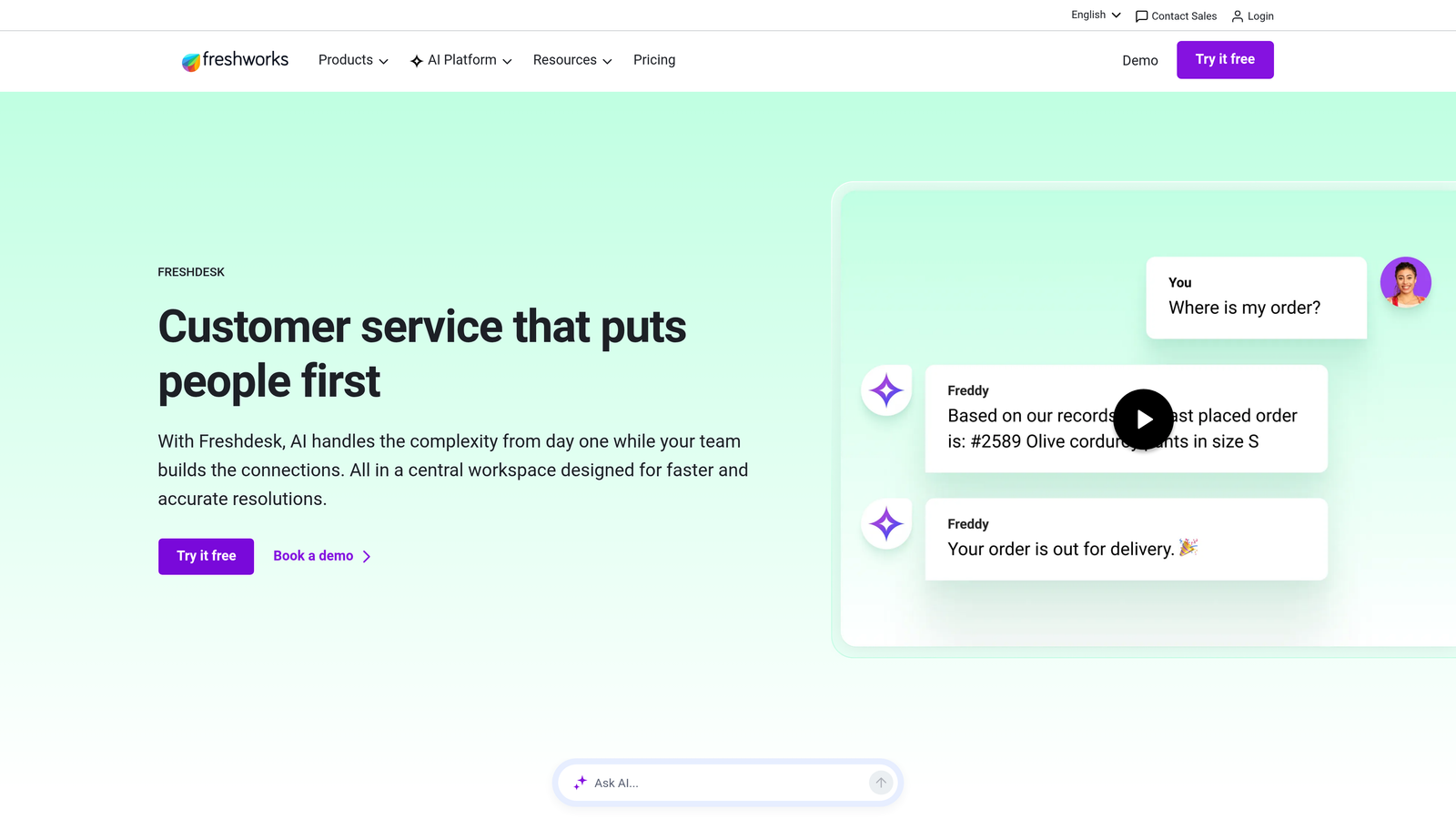
4. Freshdesk (Freddy AI)
Best for: SMB and mid-market SaaS teams wanting an affordable all-in-one option with solid AI capabilities
Freshdesk is Freshworks' helpdesk platform with Freddy AI built in, covering ticket deflection, agent suggestions, and support analytics at a competitive price point.
Where This Tool Shines
Freshdesk hits a practical sweet spot for teams that need capable AI support without enterprise-level budgets. Freddy AI handles deflection and suggested responses well, and Freddy Insights adds trend detection and analytics that help teams identify recurring issues before they become systemic. The free tier makes it accessible for early-stage teams testing the waters.
The platform is genuinely straightforward to set up, which matters for lean SaaS teams without dedicated ops resources. If you're also using other Freshworks products (CRM, ITSM), the native integration between them creates a coherent workflow that reduces context switching for agents.
Key Features
Freddy AI Deflection: Automatically suggests relevant articles and resolves common queries before they reach a human agent.
Freddy Insights: Analytics layer that surfaces support trends, volume patterns, and performance gaps.
Omnichannel Inbox: Handles email, chat, phone, and social channels in a unified view.
Free Tier: Functional free plan for small teams, with paid tiers adding Freddy AI capabilities.
Freshworks Ecosystem Integration: Native connections to Freshworks CRM, ITSM, and other products in the suite.
Best For
SMB and mid-market SaaS companies that want solid AI-assisted support without Zendesk or Intercom pricing. Also a natural fit for teams already using other Freshworks products.
Pricing
Free tier available; paid plans start around $15/agent/month with Freddy AI on higher tiers. Verify current pricing at freshdesk.com.
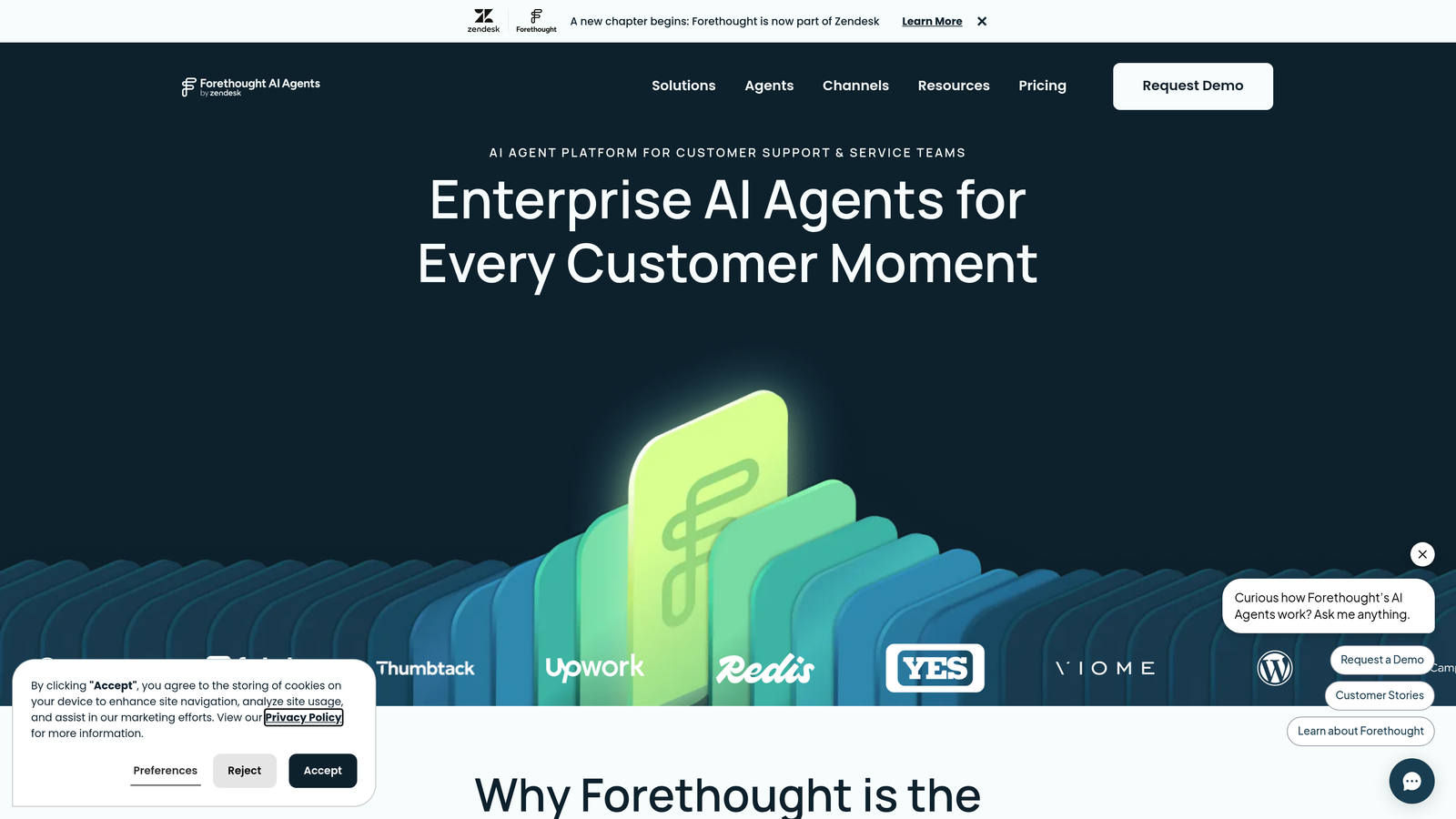
5. Forethought
Best for: Teams that want AI augmentation without migrating away from their existing helpdesk
Forethought is an AI layer designed to sit on top of existing helpdesks like Zendesk, Salesforce Service Cloud, and Freshdesk, adding triage, deflection, and workflow automation without requiring a platform migration.
Where This Tool Shines
Forethought's core value proposition is additive: if your team has invested heavily in Zendesk or Salesforce and switching platforms isn't realistic, Forethought gives you meaningful AI capabilities without starting over. Its Solve product handles autonomous deflection, while Assist surfaces suggested replies for human agents, and Discover analyzes your support data to identify inefficiencies and coverage gaps.
The integration-first architecture means implementation is typically faster than a full platform migration. For teams where the bottleneck is AI capability rather than the underlying helpdesk, Forethought is a targeted solution that addresses that specific gap.
Key Features
Solve AI: Autonomous ticket deflection that resolves queries without human involvement across supported helpdesk platforms.
Assist AI: Agent-facing tool that surfaces suggested replies and relevant knowledge base articles in real time.
Discover Analytics: Identifies support inefficiencies, coverage gaps, and high-volume topics that warrant automation.
Native Helpdesk Integrations: Works directly with Zendesk, Salesforce Service Cloud, Freshdesk, and ServiceNow.
AI Triage and Routing: Classifies and routes incoming tickets intelligently within existing helpdesk workflows.
Best For
Mid-market and enterprise SaaS teams with significant existing investment in a helpdesk platform who want AI capabilities without a rip-and-replace migration. Strong for Zendesk and Salesforce Service Cloud shops specifically.
Pricing
Custom pricing. Contact Forethought for a quote at forethought.ai.
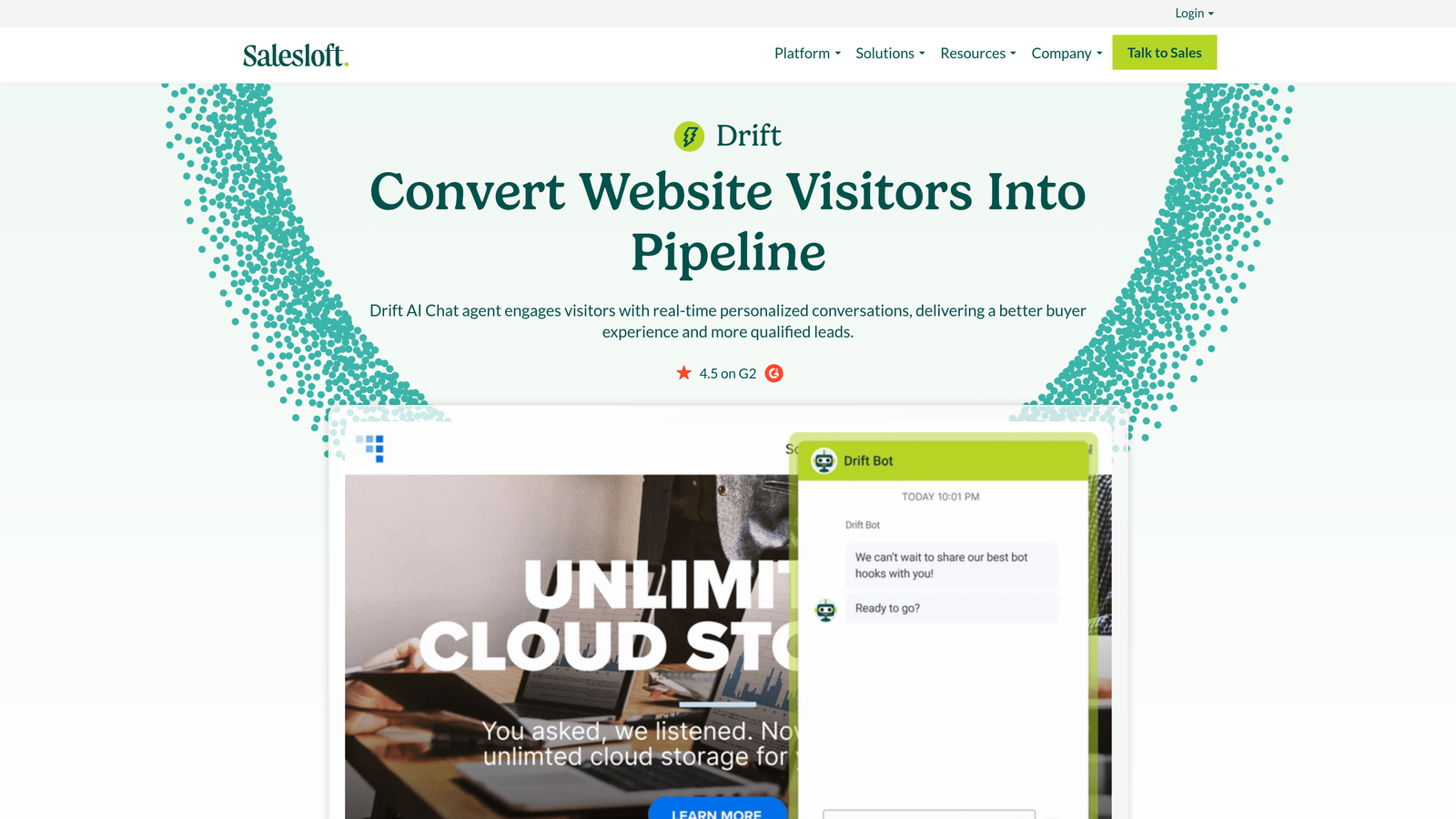
6. Drift (Salesloft)
Best for: B2B SaaS teams where support and revenue conversations overlap
Drift, now part of Salesloft, is a conversational AI platform that handles both pre-sales and post-sales interactions, making it relevant for SaaS teams where support and expansion opportunities share the same conversation.
Where This Tool Shines
Drift occupies an interesting position in this list because it's not purely a support tool. After its acquisition by Salesloft, it has evolved toward revenue-focused conversational AI, where a support interaction can become an upsell conversation with the right routing logic. For product-led growth SaaS companies, that blurred line between support and sales is a real dynamic that most pure support tools don't address.
The account-based targeting capabilities let you personalize conversations based on who the user is and what account they belong to, which creates a more sophisticated experience than generic chat flows. Meeting scheduling built directly into chat flows reduces friction for conversations that need a human sales or success touchpoint.
Key Features
Conversational AI for Sales and Support: Handles both pre-sales qualification and post-sales support in a unified platform.
Meeting Scheduling: Routes conversations to calendar booking flows when a human touchpoint is appropriate.
Account-Based Targeting: Personalizes chat experiences based on company, account tier, or user attributes.
Revenue Intelligence Reporting: Tracks conversational data across the customer lifecycle for revenue insights.
CRM and MAP Integrations: Connects with Salesloft, Salesforce, HubSpot, and Marketo for full-funnel visibility.
Best For
B2B SaaS companies with a significant overlap between support and sales motions, particularly those running account-based strategies where personalization and revenue intelligence matter alongside ticket resolution.
Pricing
Custom pricing. Contact Drift/Salesloft for current plans at drift.com.
7. Tidio
Best for: Early-stage or budget-conscious SaaS teams that need something running quickly
Tidio is a lightweight, fast-to-deploy chat and AI support platform featuring Lyro AI for automated FAQ resolution and a visual flow builder for no-code chatbot setup.
Where This Tool Shines
Tidio's appeal is speed and accessibility. If you need a functional AI support layer live within days rather than weeks, Tidio delivers that. Lyro AI handles conversational FAQ deflection competently, and the visual flow builder means non-technical team members can build and modify chatbot flows without engineering involvement. For early-stage SaaS companies where every hour of engineering time is precious, that matters.
The trade-off is depth. Tidio doesn't offer the business intelligence, deep SaaS integrations, or sophisticated escalation logic that more specialized platforms provide. It's a practical starting point, not a long-term enterprise solution, and the platform is honest about that positioning.
Key Features
Lyro AI: Conversational AI that handles FAQ-style queries autonomously without manual rule configuration.
Visual Flow Builder: No-code interface for building and modifying chatbot flows without engineering resources.
Live Chat with Agent Handoff: Smooth transition from AI to human agents when queries exceed automation capability.
Email and Messenger Integrations: Connects with email and social messaging channels alongside the web widget.
Free Tier: Functional free plan for teams testing AI deflection before committing to a paid platform.
Best For
Early-stage SaaS companies and budget-conscious teams that need fast deployment and basic AI deflection. Also useful as a stopgap while evaluating more sophisticated platforms.
Pricing
Free tier available; paid plans start around $29/month. Verify current pricing at tidio.com.
8. Kustomer
Best for: SaaS companies where customer history and full context drive resolution quality
Kustomer, owned by Meta, is a CRM-native helpdesk that ties every support interaction to a unified customer timeline, combining support history, product usage, and purchase data in a single view.
Where This Tool Shines
Kustomer's core differentiator is its data model, not its AI. By unifying support interactions with CRM and product data on a customer timeline, agents and AI alike have far more context when resolving issues. For SaaS companies where resolution quality depends on knowing a customer's history, account tier, or recent product activity, that unified view changes the quality of every interaction.
The AI capabilities sit on top of this rich data foundation, enabling deflection and suggested responses that are more contextually accurate than tools working from support data alone. The omnichannel inbox handles email, chat, SMS, social, and voice in a single workspace, reducing the fragmentation that plagues multi-channel support operations.
Key Features
Unified Customer Timeline: Combines support tickets, purchase history, and product usage data into a single customer view.
AI Deflection and Suggested Responses: Automated resolution and agent assist capabilities informed by full customer context.
Omnichannel Inbox: Email, chat, SMS, social, and voice channels in a unified agent workspace.
Workflow Automation: Automates repetitive routing and tagging tasks to reduce manual work for agents.
Deep CRM Integration: Pulls account and contact data into support views for context-rich agent interactions.
Best For
Mid-market and enterprise SaaS companies where customer context, account history, and relationship data are central to support quality. Particularly strong for teams with high-value accounts where personalized, context-aware support is a competitive differentiator.
Pricing
Custom pricing. Contact Kustomer for a quote at kustomer.com.
9. Capacity
Best for: SaaS companies with both external customer support and significant internal helpdesk needs
Capacity is a knowledge management-driven AI platform that handles customer-facing and internal support simultaneously, with knowledge gap detection that surfaces unanswered question patterns across the business.
Where This Tool Shines
Capacity occupies a unique position in this list: it's the only platform here that explicitly serves both external customers and internal employees from the same knowledge layer. For SaaS companies at a stage where IT, HR, and internal operations are generating significant support volume alongside customer queries, that dual capability reduces the number of tools in the stack.
The knowledge gap detection feature is genuinely useful. Rather than waiting for agents to notice recurring questions, Capacity surfaces patterns in unanswered or poorly answered queries, giving teams a clear roadmap for knowledge base improvement. That proactive intelligence loop is something most pure-support tools don't offer.
Key Features
Unified Knowledge Base: A single AI-powered knowledge layer that answers questions for both customers and internal employees.
Customer-Facing Chatbot: Automated deflection and resolution for external support queries.
Internal Employee Helpdesk: Handles IT, HR, and operational queries from internal teams in the same platform.
Knowledge Gap Detection: Identifies patterns in unanswered questions to guide knowledge base development.
Workflow Automation and Integrations: Connects with Zendesk, Salesforce, Slack, and Microsoft Teams for routing and escalation.
Best For
SaaS companies at growth stage where internal support needs (IT, HR, operations) are scaling alongside external customer support. Also strong for knowledge-heavy businesses where surfacing the right information quickly is the primary challenge.
Pricing
Custom pricing. Contact Capacity for a quote at capacity.com.
Which Tool Is Right for Your Team?
The right choice depends on where you are, what you're building, and how much you want your support layer to do beyond closing tickets.
Early-stage teams that need something running fast without heavy configuration should start with Tidio or Freshdesk. Both offer free tiers, straightforward setup, and enough AI capability to meaningfully reduce ticket volume while you figure out what you actually need at scale.
Mid-market SaaS teams ready to invest in a more capable platform should look closely at Halo AI and Intercom. Halo is the stronger choice if you want AI-first architecture, page-aware context, and business intelligence signals that go beyond support metrics. Intercom is the right call if you're already embedded in their ecosystem and want a mature, widely adopted platform.
Enterprise teams with compliance requirements, complex reporting needs, and large agent headcounts will find Zendesk or Kustomer most aligned with their requirements. Zendesk for audit trails and operational scale; Kustomer for context-rich, CRM-native support where account history drives resolution quality.
Teams augmenting an existing stack rather than replacing it should evaluate Forethought first. It adds genuine AI capability on top of Zendesk, Salesforce, or Freshdesk without requiring a migration.
Revenue-focused SaaS companies where support and sales conversations overlap should consider Drift. It's the only platform here built to handle both motions in a single workflow.
One theme cuts across all of these evaluations: the distinction between AI bolted onto a helpdesk and AI built from the ground up matters more than most teams realize at the start. The former gives you features; the latter gives you a system that learns and improves continuously.
Your support team shouldn't scale linearly with your customer base. Let AI agents handle routine tickets, guide users through your product, and surface business intelligence while your team focuses on complex issues that need a human touch. See Halo in action and discover how continuous learning transforms every interaction into smarter, faster support.