9 Best AI Support Tools for Developer Tool Companies in 2026
This guide evaluates the 9 best AI support for developer tools platforms in 2026, comparing them on technical depth, integration ecosystems, and their ability to autonomously handle the complex, code-heavy queries that engineers actually send. Whether you're replacing a legacy helpdesk or scaling a growing developer tool company, these picks offer a concrete starting point.
 Grant CooperFounder12 min read
Your users are engineers. They're debugging API integrations at midnight, filing bug reports with stack traces, and expecting answers that go beyond "have you tried clearing your cache?" When they hit a wall, they don't open a ticket and wait three days. They churn, post on Hacker News, or both.
Traditional helpdesks weren't designed for this. AI support tools are changing the equation, handling complex technical queries autonomously, routing edge cases to the right engineers, and even creating bug tickets without human intervention. Here are the top AI support tools purpose-built or well-suited for developer tool companies in 2026, evaluated on technical depth, integration ecosystem, automation quality, and how well they handle the code-heavy queries your users actually send.
1. Halo AI
Best for: Developer tool companies wanting an AI-first support platform that replaces, not just augments, traditional helpdesks.
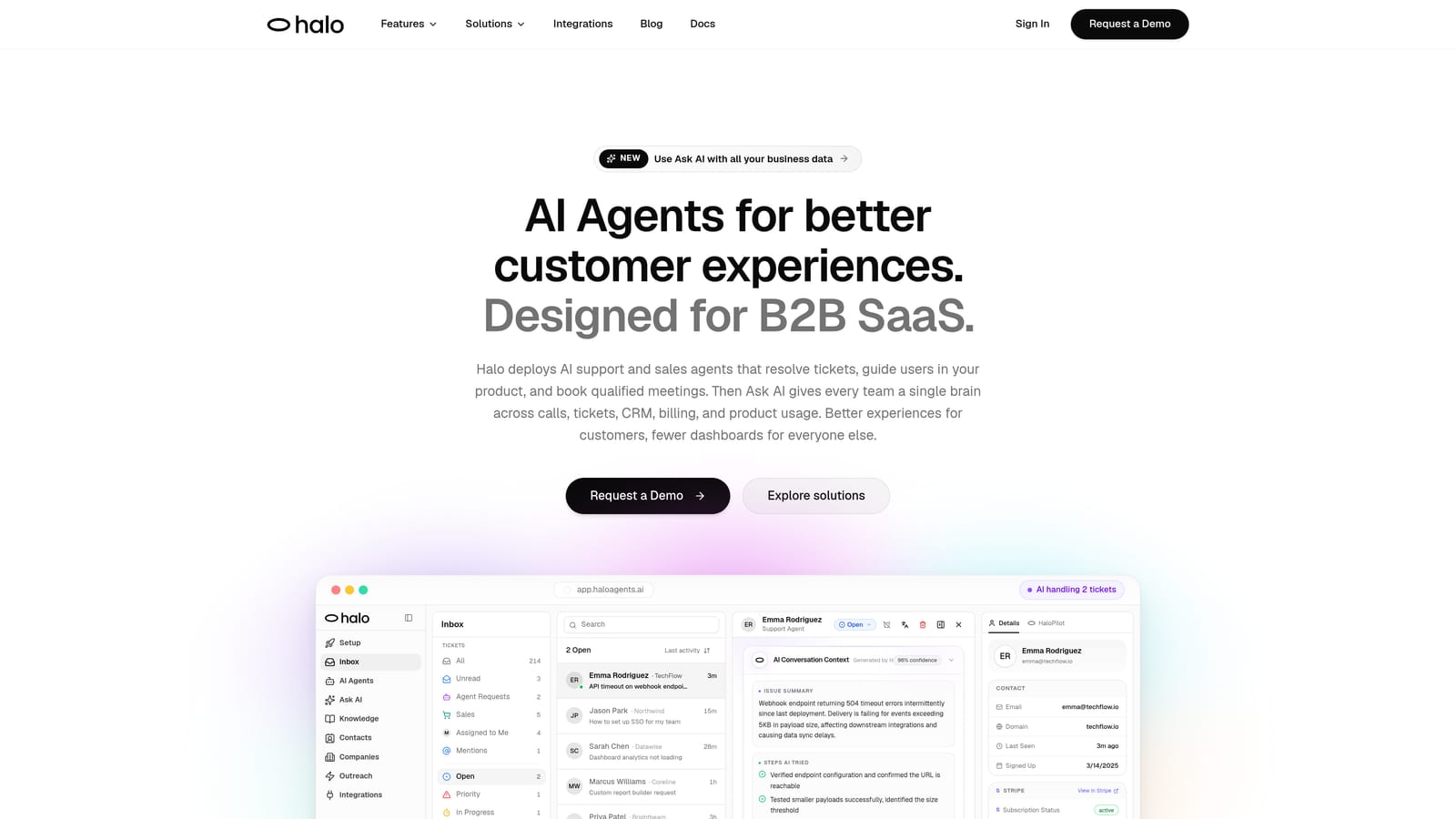
Halo AI is an AI-first customer support platform built specifically for B2B SaaS and developer tool companies, deploying intelligent agents that resolve tickets, guide users contextually, and surface business intelligence from every interaction.
Where This Tool Shines
Halo's standout capability is its page-aware architecture. The chat widget understands what screen a user is on and can provide contextual UI guidance, which is particularly valuable when a developer is stuck mid-integration and needs precise, situational help rather than a generic knowledge base article.
Beyond resolving tickets, Halo connects support to your broader engineering and revenue stack. When a conversation reveals a bug, Halo auto-creates a ticket in Linear without any human intervention. When patterns emerge across conversations, the smart inbox surfaces customer health signals, revenue anomalies, and churn indicators, turning support into a genuine intelligence layer for your business.
Key Features
Page-Aware Chat Widget: Understands the user's current screen context and delivers targeted UI guidance rather than generic responses.
Auto Bug Ticket Creation: Automatically routes identified bugs directly into Linear, eliminating the manual handoff between support and engineering.
Smart Inbox with Business Intelligence: Surfaces customer health signals, revenue anomalies, and churn indicators from support conversation patterns.
Live Agent Handoff: Escalates complex issues to human agents with full conversation context preserved, so nothing gets repeated.
Deep Integration Ecosystem: Connects natively with Linear, Slack, HubSpot, Intercom, Stripe, Zoom, PandaDoc, and Fathom.
Continuous Learning: Every resolved interaction improves the AI's future responses, compounding accuracy over time.
Best For
Developer tool companies ready to move beyond augmented helpdesks toward autonomous AI support. Particularly strong for teams that want their support layer to feed directly into engineering workflows and revenue intelligence, without maintaining two separate systems to accomplish that.
Pricing
Contact for pricing. You can book a demo directly at haloagents.ai to get a tailored walkthrough based on your team's support volume and stack.
2. Intercom Fin
Best for: Teams already running Intercom who want to add an AI front line without migrating to a new platform.
Intercom Fin is Intercom's native AI agent, built to handle front-line support conversations using your existing help center content and pass complex issues seamlessly to human agents.
Where This Tool Shines
If your team is already invested in the Intercom ecosystem, Fin is the path of least resistance to AI-powered support. It handles multi-step conversations, follows up when users go quiet, and references help center articles to construct answers rather than hallucinating responses.
The handoff experience to human agents is smooth because everything stays within the Intercom inbox. Agents inherit the full conversation context without switching tools or asking users to repeat themselves.
Key Features
Help Center-Grounded Responses: Generates answers from your existing Intercom help center content, reducing hallucination risk.
Multi-Step Conversation Handling: Manages follow-up questions and clarifications within a single conversation thread.
Native Human Handoff: Routes to live agents inside the Intercom inbox with full context intact.
Resolution-Based Pricing Option: Pay per resolved conversation rather than per seat, which can be cost-effective at scale.
Best For
Companies already using Intercom as their primary support and messaging layer. Less compelling for teams not on Intercom, given the migration complexity involved in adopting the full platform just for Fin.
Pricing
Included in Intercom plans; resolution-based pricing for Fin is also available as an alternative billing model.
3. Zendesk AI
Best for: Enterprise developer tool companies with high ticket volume, complex routing rules, and mature support operations.
Zendesk AI layers intelligent triage, suggested replies, and automated workflows across Zendesk's established enterprise helpdesk infrastructure.
Where This Tool Shines
Zendesk's AI capabilities have matured considerably. Intelligent triage routes tickets to the right queue based on content and intent, while AI-suggested macros help agents respond faster without starting from scratch. For teams managing thousands of tickets across multiple product lines, the reporting and analytics layer is genuinely powerful.
The trade-off is that Zendesk AI remains largely augmentation-focused rather than autonomous-first. It makes human agents more efficient rather than replacing the need for them at scale. For smaller developer tool teams, the platform can feel heavyweight relative to what they actually need.
Key Features
Intelligent Ticket Triage: Automatically classifies and routes incoming tickets based on content, intent, and configured rules.
AI-Suggested Macros: Recommends pre-written response templates to agents based on ticket context.
Automated Workflows: Triggers actions across the ticketing system based on ticket properties and AI classification.
Advanced Reporting: Detailed analytics across ticket volume, resolution time, CSAT, and agent performance.
Best For
Larger developer tool companies with established Zendesk infrastructure, complex routing requirements, and dedicated support operations teams who benefit from AI augmentation rather than full automation.
Pricing
AI features included in Suite plans starting at $55/agent/month; an advanced AI add-on is available for teams needing deeper automation capabilities.
4. Freshdesk Freddy AI
Best for: Growing developer tool companies that want AI-powered support at a more accessible price point than enterprise alternatives.
Freshdesk Freddy AI is Freshdesk's embedded AI layer covering automated ticket deflection, intelligent classification, and suggested responses across their helpdesk suite.
Where This Tool Shines
Freddy AI's answer bot handles repetitive incoming questions before they ever reach an agent, which is particularly useful for developer tool companies fielding the same "how do I authenticate the API?" questions repeatedly. The deflection rate can free up meaningful agent time for genuinely complex technical issues.
Freshdesk's pricing structure makes AI-assisted support accessible to teams that aren't ready for Zendesk-level investment. The Freshworks product suite also integrates natively, so teams using Freshservice or Freshsales alongside Freshdesk get a connected experience without custom work.
Key Features
Freddy Answer Bot: Deflects common support questions automatically before they generate tickets.
AI Ticket Classification: Categorizes and routes incoming tickets based on content analysis.
Suggested Reply Recommendations: Surfaces relevant response suggestions to agents based on ticket content and resolution history.
Native Freshworks Integration: Works seamlessly across the broader Freshworks product ecosystem.
Best For
Developer tool companies in growth stages that want meaningful AI automation without committing to enterprise pricing. A solid middle ground between basic helpdesks and more sophisticated AI-first platforms.
Pricing
Freddy AI features available on Growth plan and above; Growth starts at $15/agent/month, making it one of the more accessible options in this category.
5. Plain
Best for: Developer tool companies wanting a support platform built natively for technical users, with API-first architecture and Slack-native workflows.
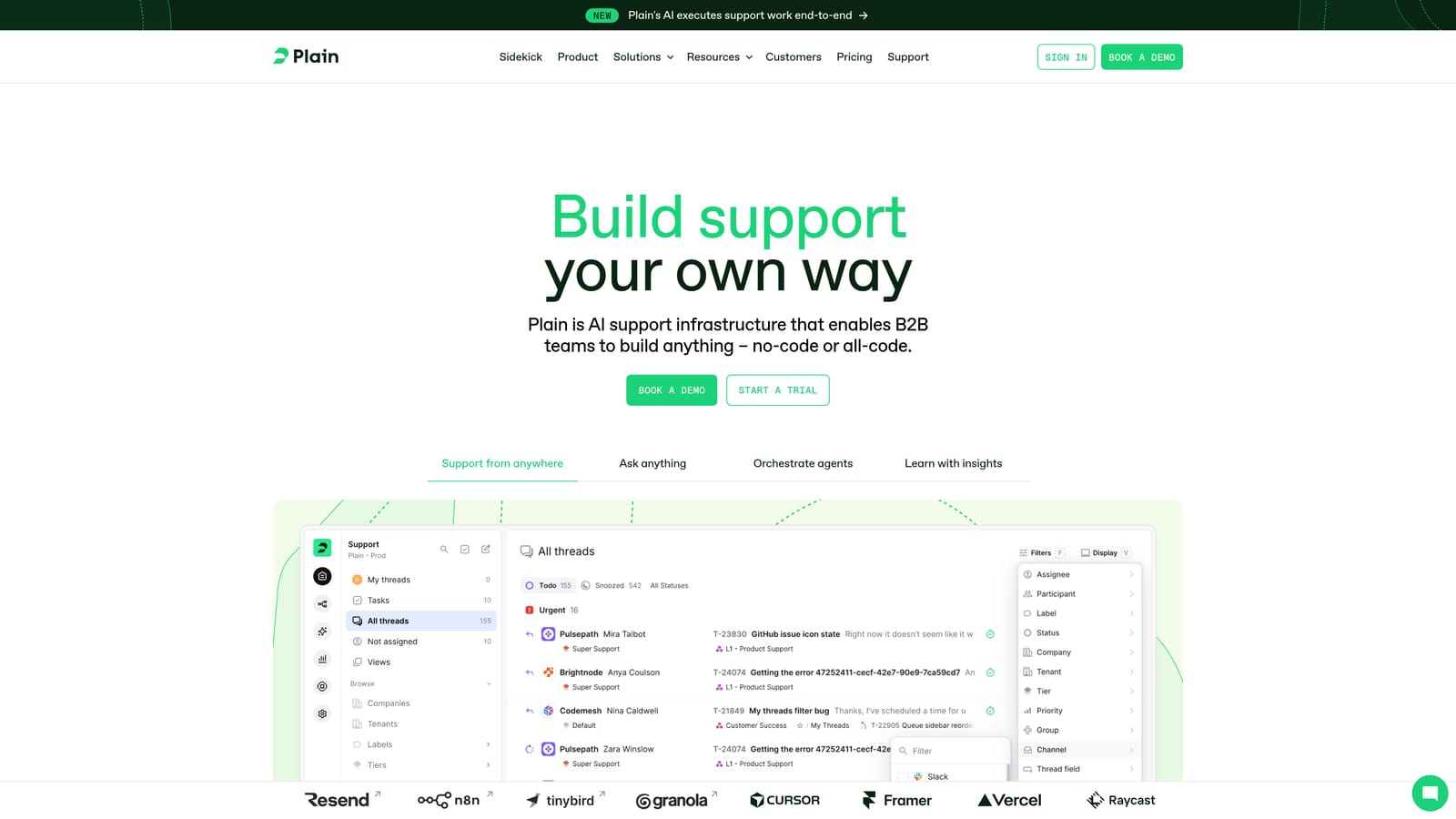
Plain is a developer-first support platform designed specifically for companies whose customers are developers, built around threads, APIs, and webhooks rather than traditional ticket queues.
Where This Tool Shines
Plain's API-first design lets teams embed support workflows directly into their product rather than forcing users to context-switch to an external portal. For developer tool companies, this means support can live where developers already are, whether that's inside your dashboard, your CLI output, or your Slack workspace.
The customer timeline feature is particularly useful: it shows full product usage context alongside support history, so when a developer reports an issue, the support team sees exactly what they were doing in the product before they reached out. That context eliminates a lot of back-and-forth.
Key Features
API-First Architecture: Embed support workflows directly into your product interface via API rather than relying on external portals.
Slack-Native Workflows: Handle support conversations natively in Slack without losing structure or trackability.
Thread-Based Interface: Designed for technical conversations with a clean, focused threading model.
Customer Timeline: Combines full product usage history with support conversation history in a single view.
Best For
Developer tool companies that prioritize a developer-native support experience and want to embed support directly into their product. Strong fit for teams whose users actively resist traditional ticket-based support flows.
Pricing
Starts at $200/month; custom enterprise pricing available for larger teams and higher volumes.
6. Unthread
Best for: Developer tool companies whose enterprise customers prefer communicating in shared Slack channels rather than submitting formal tickets.
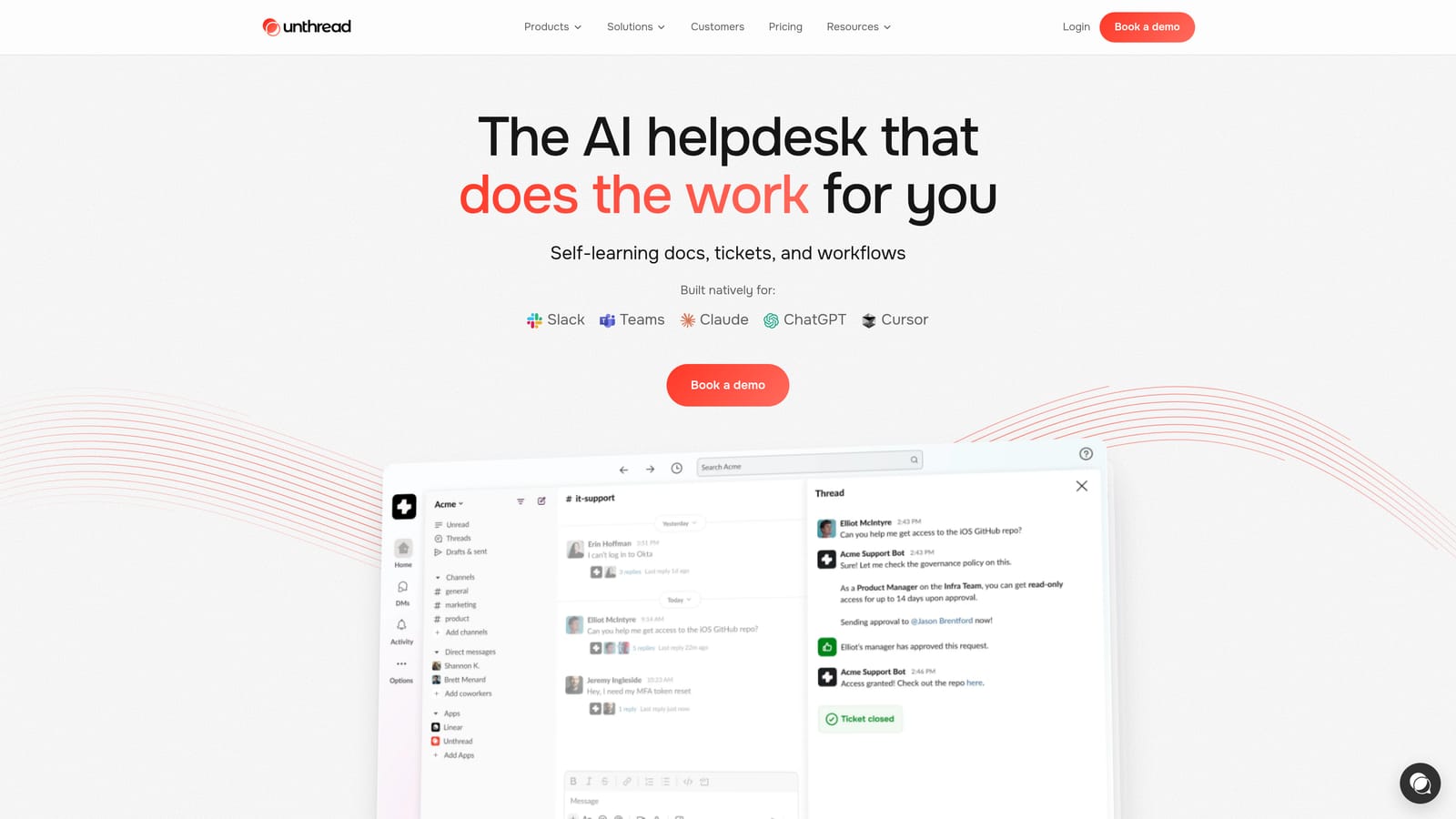
Unthread converts Slack-based customer conversations into structured, trackable support tickets, with AI triage and tagging to bring order to the chaos of Slack-first support.
Where This Tool Shines
Many developer tool companies end up managing support across dozens of shared Slack channels with enterprise customers. It's fast and personal, but it's also a tracking nightmare. Unthread solves this by automatically detecting support requests in those channels and converting them into structured tickets without requiring anyone to change their behavior.
The AI triage layer tags and prioritizes incoming requests, and integrations with Linear, Jira, and GitHub mean that when a Slack conversation reveals a bug, escalation to engineering is a single step rather than a manual copy-paste process.
Key Features
Automatic Slack Ticket Capture: Detects and tracks support requests from shared Slack channels without manual intervention.
AI Triage and Tagging: Classifies and prioritizes incoming requests based on content and urgency signals.
SLA Tracking: Monitors response times and SLA compliance directly within Slack workflows.
Engineering Escalation Integrations: Connects with Linear, Jira, and GitHub for seamless bug escalation from support to engineering.
Best For
Developer tool companies managing enterprise customer relationships through shared Slack channels. Unthread is the right tool when your support already lives in Slack and you need structure without forcing customers or agents to change their communication habits.
Pricing
Starts at $50/month; pricing scales with channel and team volume.
7. Forethought
Best for: High-volume support teams that want smarter AI triage and routing layered on top of their existing helpdesk without replacing it.
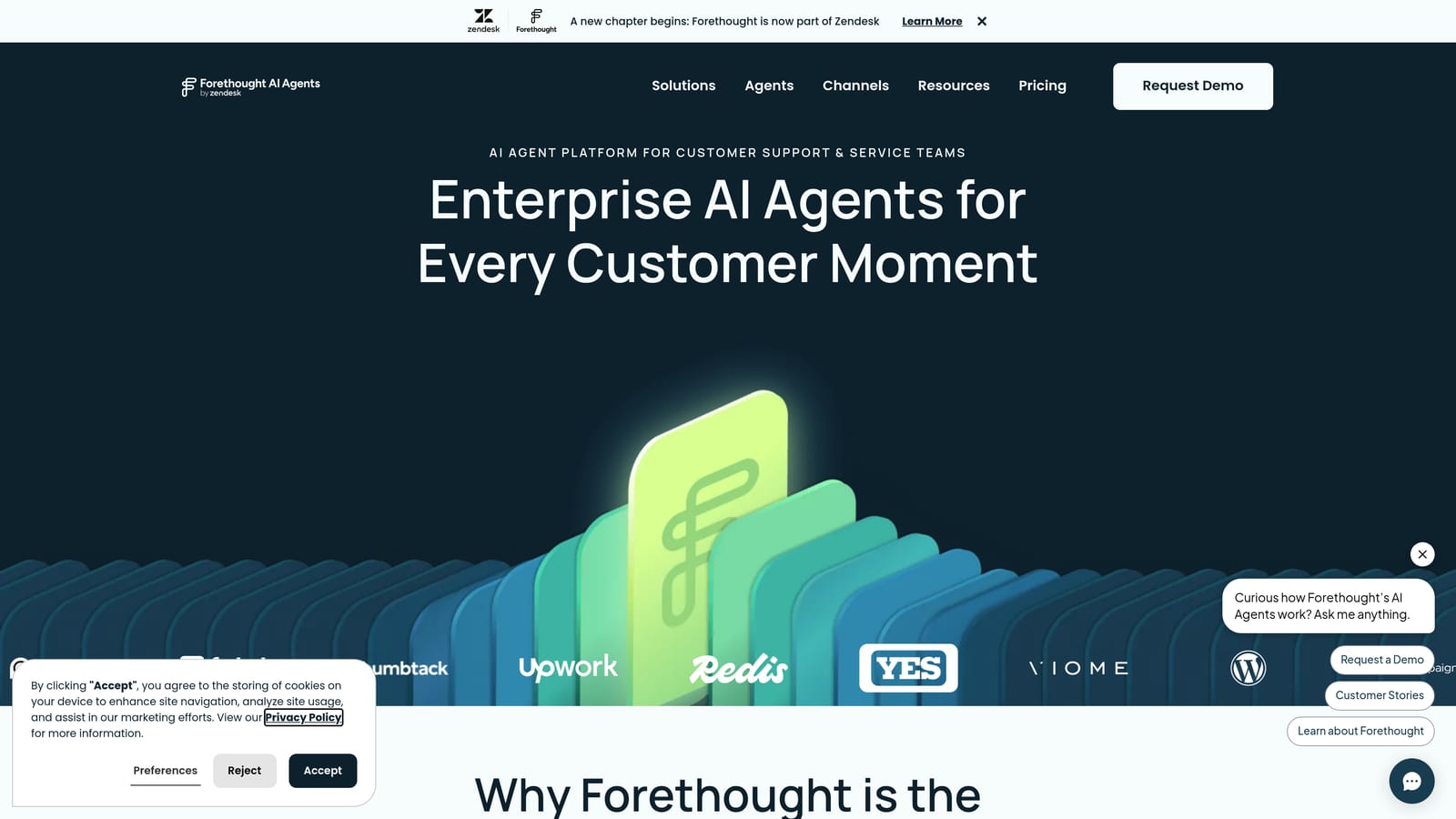
Forethought is AI-powered support automation middleware that adds intelligent triage, routing, and deflection on top of existing helpdesks like Zendesk, Salesforce, and Freshdesk.
Where This Tool Shines
Forethought's intent detection is strong. It classifies incoming tickets by technical query type before they reach an agent, which means complex API questions go to engineers, billing issues go to account managers, and common how-to questions get deflected with relevant content before they generate any queue volume at all.
For teams with significant investment in an existing helpdesk, Forethought is a compelling middle path: you get meaningfully smarter routing and deflection without the disruption of a platform migration.
Key Features
Intent Detection: Classifies incoming tickets by technical query type and routes them to the appropriate team or queue.
AI-Powered Deflection: Surfaces relevant answers to users before tickets are formally submitted, reducing queue volume.
Workflow Automation: Triggers routing and escalation rules based on AI classification results.
Helpdesk Compatibility: Works alongside Zendesk, Salesforce Service Cloud, Freshdesk, and other major platforms.
Best For
Developer tool companies with high ticket volume and existing helpdesk infrastructure who want AI augmentation without a platform change. Forethought works best as a middleware layer, not a standalone support platform.
Pricing
Custom pricing based on ticket volume; contact Forethought directly for a quote tailored to your support scale.
8. Kapa.ai
Best for: Developer tool companies and open-source projects with extensive technical documentation that want AI to answer "how do I..." questions at scale.
Kapa.ai is a specialized AI for developer documentation, ingesting your docs, GitHub READMEs, Discourse forums, and Slack history to answer technical questions with cited sources.
Where This Tool Shines
Kapa.ai is purpose-built for the documentation-heavy support burden that developer tool companies know well. Instead of pointing users to a search bar and hoping they find the right page, Kapa reads across your entire documentation corpus and constructs precise answers with citations, so developers can verify the source rather than just trusting the AI.
The analytics layer is genuinely useful beyond deflection: it shows you what users are asking most frequently, which reveals documentation gaps you might not have known existed. That feedback loop helps content and engineering teams prioritize documentation improvements with real data.
Key Features
Multi-Source Ingestion: Ingests documentation sites, GitHub READMEs, Discourse forums, and Slack conversation history.
Source-Cited Answers: Provides answers with citations so developers can verify and explore further.
Flexible Embedding: Deploys in docs sites, Slack, Discord, and web chat interfaces.
Documentation Gap Analytics: Tracks what users are asking to surface content gaps and improvement opportunities.
Best For
Developer platforms and open-source projects with deep documentation libraries that generate high volumes of repetitive "how do I..." questions. Kapa is a documentation intelligence layer, not a full ticket management system, so it works best alongside rather than instead of a helpdesk.
Pricing
Custom pricing based on usage volume; contact Kapa.ai directly for a quote.
9. Chatwoot
Best for: Developer tool companies with strict data residency, privacy requirements, or a preference for self-hosted infrastructure they fully control.
Chatwoot is an open-source, self-hostable omnichannel customer support platform with AI assist features and a strong developer community behind it.
Where This Tool Shines
For developer tool companies operating in regulated industries or regions with strict data residency requirements, Chatwoot's self-hosted model is a genuine differentiator. Your support data stays on your infrastructure, under your control, without relying on a third-party vendor's compliance posture.
The open-source community also means Chatwoot has a growing plugin and integration ecosystem. Teams with engineering resources can extend the platform in ways that closed SaaS alternatives simply don't allow. The trade-off is that self-hosting requires internal maintenance capacity that fully managed alternatives don't.
Key Features
Self-Hosted Deployment: Full data control with on-premise or private cloud hosting options.
Omnichannel Inbox: Handles email, live chat, Slack, and other channels in a unified interface.
AI Assist: Surfaces suggested responses to agents based on conversation context.
Open-Source Ecosystem: Active community with plugins, integrations, and extensibility for teams with engineering resources.
Best For
Privacy-conscious developer tool companies, teams in regulated industries, or organizations that prefer open-source infrastructure they can audit, modify, and fully control. Requires more internal engineering involvement than fully managed SaaS alternatives.
Pricing
Open-source and self-hosted deployment is free; cloud-managed plans start at $19/agent/month for teams that prefer a hosted option.
Matching the Right Tool to Your Situation
The right choice here depends less on which tool has the longest feature list and more on where your support actually lives today and how autonomous you want your AI to be.
If you're building a developer tool company and want AI support that goes beyond augmenting human agents, starting with an AI-first platform makes the most sense. Halo AI is the strongest fit here, particularly for teams that want page-aware context, automatic bug ticket creation in Linear, and business intelligence signals from every support interaction. It's built for the exact stack developer tool companies run.
For teams already deep in the Intercom or Zendesk ecosystem, Fin and Zendesk AI are the natural paths forward without a platform migration. Freshdesk Freddy AI is the right call for growing teams that want meaningful AI at a more accessible price point.
If your support primarily happens in Slack shared channels with enterprise customers, Unthread is purpose-built for that workflow. If your users are drowning in documentation questions, Kapa.ai handles that layer exceptionally well. Plain is the right choice when you want support that feels native to a developer product rather than bolted on. Forethought works best as middleware for high-volume teams that want smarter routing without replacing their helpdesk. And Chatwoot is the answer when data residency or open-source control is a hard requirement.
Your support team shouldn't scale linearly with your customer base. Let AI agents handle routine tickets, guide users through your product, and surface business intelligence while your team focuses on complex issues that need a human touch. See Halo in action and discover how continuous learning transforms every interaction into smarter, faster support.