9 Best AI Support Tools for Ecommerce Platforms in 2026
Ecommerce businesses struggling with high-volume, round-the-clock customer inquiries can find relief through AI support for ecommerce platforms, which automate routine questions about orders, returns, and shipping while integrating directly with storefronts and real-time data. This guide evaluates the 9 best AI support tools in 2026 based on ecommerce-specific features, integration depth, automation quality, and pricing to help online retailers scale without sacrificing customer experience.
 Grant CooperFounder13 min read
Ecommerce customers expect instant answers. About shipping timelines, return policies, order status, product details—and they expect those answers at 2am on a Sunday just as readily as during business hours. As online stores scale, the volume of repetitive support tickets can overwhelm even well-staffed teams, leading to slower response times and frustrated buyers who simply take their business elsewhere.
AI-powered support tools are changing the equation. The best ones automate routine inquiries, personalize interactions based on real order data, and free human agents to focus on the complex issues that genuinely need a personal touch. But not every AI support tool is built with ecommerce in mind. The best options integrate directly with your storefront, pull real-time order data, and handle the unique workflows that online retail demands.
We evaluated these tools based on ecommerce-specific capabilities, integration depth, automation quality, scalability, and pricing transparency. Here are the top picks for 2026.
1. Halo AI
Best for: Ecommerce teams that want AI-first architecture with continuous learning and business intelligence built in.
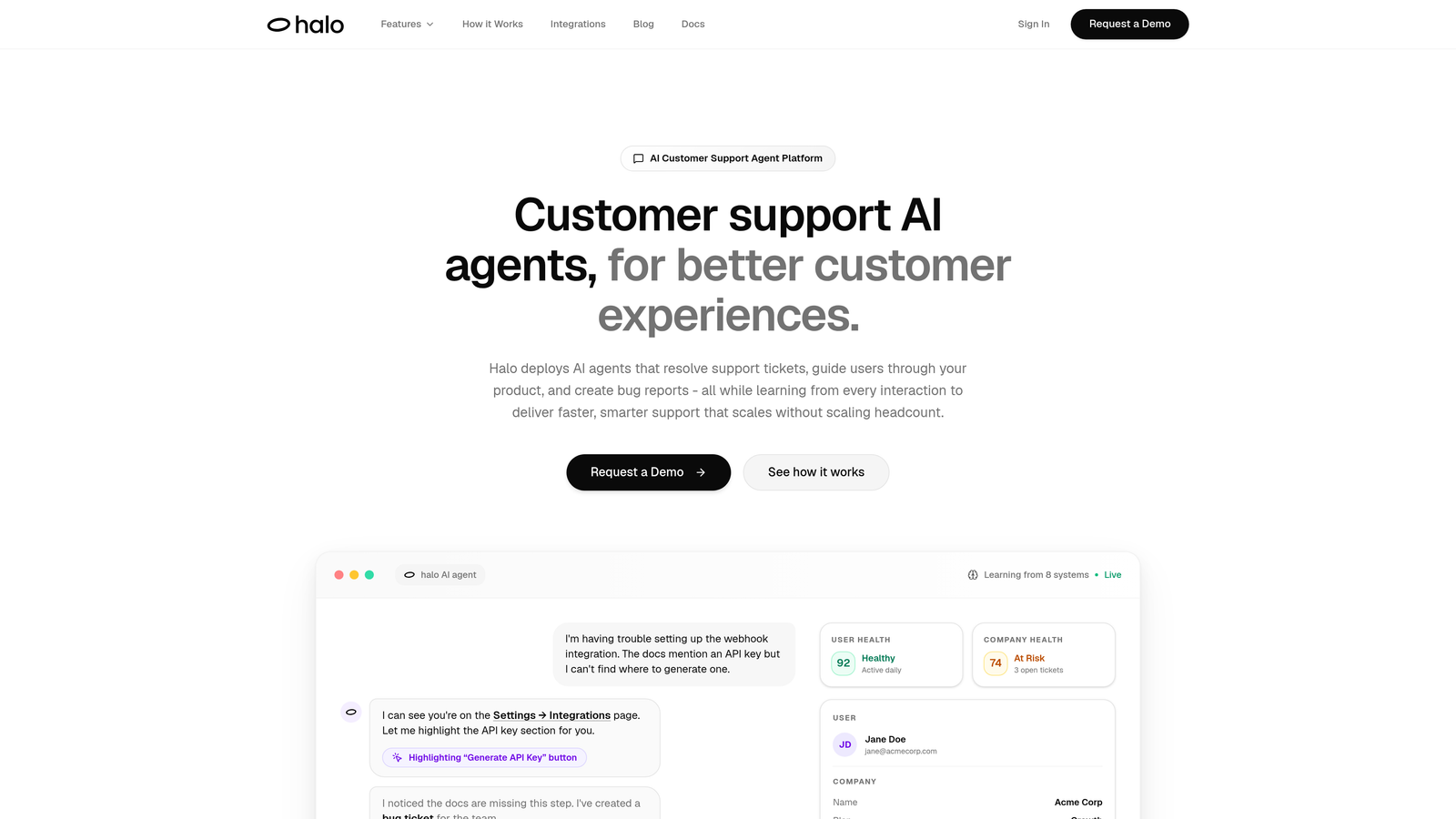
Halo AI is an AI-first customer support platform where intelligent agents resolve tickets autonomously, provide page-aware visual guidance, and surface business intelligence insights—all while learning from every interaction.
Where This Tool Shines
What separates Halo from most support tools is the architecture. Rather than layering AI onto an existing helpdesk, Halo was built AI-first, which means the intelligence runs deeper. The page-aware chat widget actually sees what the user is seeing on your site, enabling contextual guidance that feels genuinely helpful rather than generic. For ecommerce, this translates to support that can walk a customer through a return process on the exact page they're stuck on.
The continuous learning engine is another standout. Every resolved ticket makes the system smarter, so resolution quality improves over time rather than staying static. Combined with the smart inbox that surfaces customer health signals and revenue intelligence, Halo gives support teams visibility that goes well beyond ticket counts.
Key Features
Page-Aware Chat Widget: Sees what users see in real time, enabling contextual visual guidance based on the exact page and product a customer is viewing.
Continuous Learning AI: Improves resolution quality with every interaction rather than relying on static training data alone.
Smart Inbox with Business Intelligence: Surfaces customer health signals, anomaly detection, and revenue intelligence alongside standard support metrics.
Auto Bug Ticket Creation: Automatically generates bug reports and routes complex issues to the right teams without manual intervention.
Deep Integration Stack: Connects with Stripe, HubSpot, Intercom, Slack, Linear, Zoom, PandaDoc, and Fathom for a unified operational view.
Best For
Ecommerce teams and B2B product companies that want AI support to do more than answer questions—teams that want their support platform to surface business intelligence, integrate with their entire stack, and improve autonomously over time. Particularly strong for companies already using tools like Stripe, HubSpot, or Intercom.
Pricing
Contact for pricing; plans are tailored based on support volume and feature needs. Pricing details available directly at haloagents.ai.
2. Gorgias
Best for: High-volume Shopify, BigCommerce, and Magento stores that want order management inside their helpdesk.
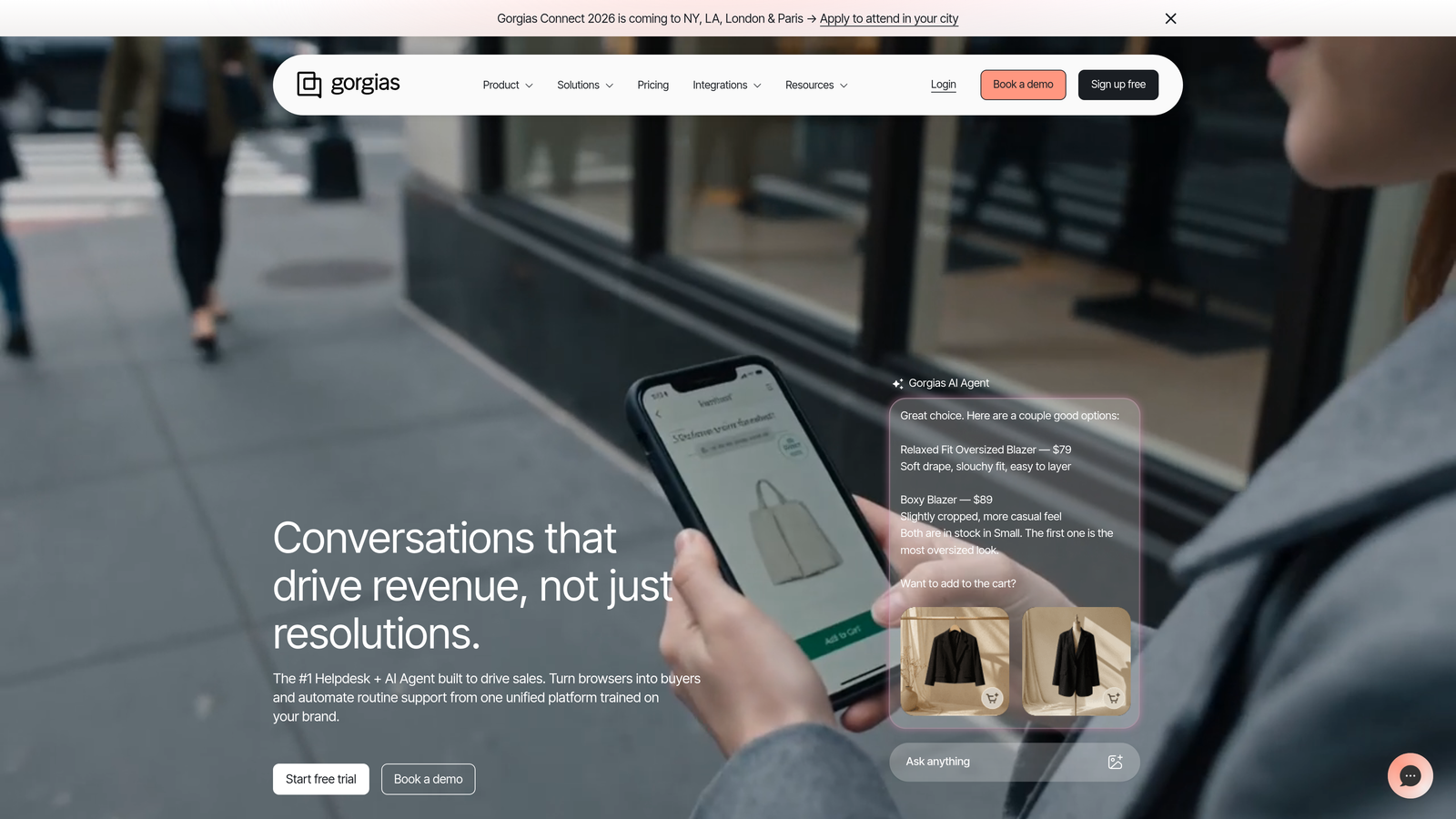
Gorgias is an ecommerce-focused helpdesk that lets support agents view and manage orders directly within the support interface, with AI automation handling common queries.
Where This Tool Shines
Gorgias was built specifically for ecommerce, and it shows. The native integrations with Shopify, BigCommerce, and Magento are genuinely deep—agents can pull order details, issue refunds, and modify orders without leaving the helpdesk interface. That kind of embedded workflow reduces handle time considerably for high-volume stores.
The revenue-tracking dashboard is a differentiator worth noting. Gorgias ties support interactions directly to sales, helping teams understand which conversations convert and quantifying the business impact of good support. For ecommerce operators who think about support as a revenue function, this framing resonates.
Key Features
Native Ecommerce Integrations: Deep Shopify, BigCommerce, and Magento connections with order management capabilities directly inside the helpdesk.
AI Auto-Responses: Handles order status, shipping, and return inquiries automatically using real order data from your storefront.
Revenue-Tracking Dashboard: Ties support interactions to sales outcomes so teams can measure support's impact on revenue.
Omnichannel Support: Manages email, chat, social media, and SMS conversations from a single unified interface.
Best For
Direct-to-consumer ecommerce brands running on Shopify or BigCommerce with significant ticket volume around orders, shipping, and returns. Especially useful for teams that want to frame support as a revenue driver rather than a cost center.
Pricing
Starts at around $10/month for a basic plan; pricing scales based on ticket volume. Verify current pricing on Gorgias's website as plans evolve frequently.
3. Tidio
Best for: Small to mid-size ecommerce stores that want an affordable AI chatbot with quick setup and a visual builder.
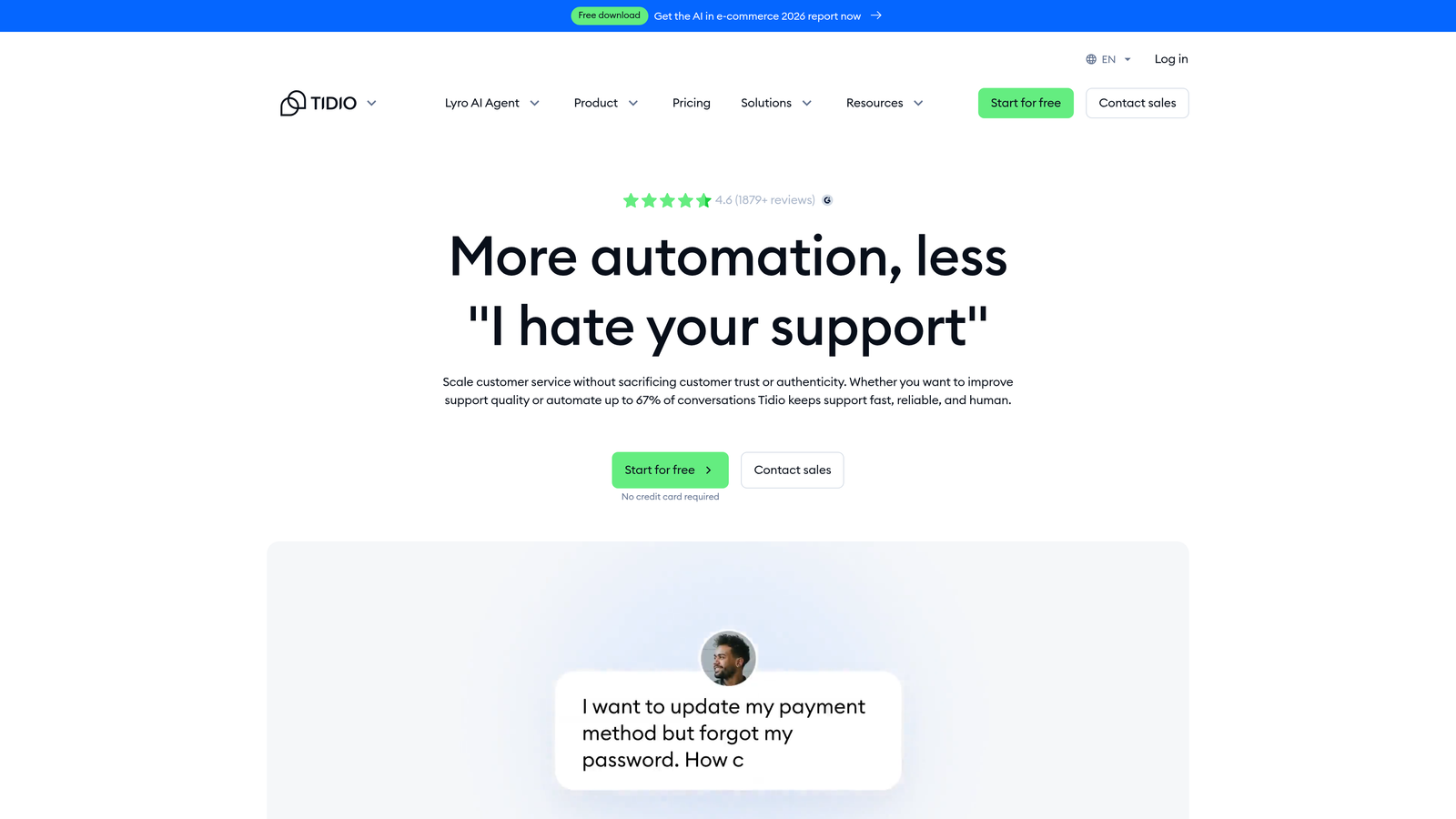
Tidio is an accessible AI chatbot and live chat platform whose Lyro AI learns from your content to handle common ecommerce questions without requiring technical expertise to configure.
Where This Tool Shines
Tidio's strength is approachability. The visual drag-and-drop chatbot builder makes it genuinely easy for non-technical ecommerce teams to create custom workflows for common scenarios: abandoned cart follow-ups, order status checks, return policy explanations. You don't need a developer to get something useful running quickly.
Lyro AI adds a layer of intelligence on top of the visual builder by training on your FAQ and help content. It handles conversational queries that don't fit neatly into predefined flows, which is where many simpler chatbots fall short. The combination of structured flows and conversational AI covers a wide range of customer scenarios.
Key Features
Lyro AI Chatbot: Trains on your FAQ and help content to handle conversational queries and common ecommerce questions automatically.
Visual Chatbot Builder: Drag-and-drop interface for building custom ecommerce workflows without writing code.
Ecommerce Platform Integrations: Connects with Shopify, WooCommerce, Wix, and other major platforms for order data access.
Combined Live Chat and AI: Delivers both AI automation and human chat from a single widget, making handoffs smooth.
Best For
Budget-conscious ecommerce teams and growing SMBs that need solid AI chatbot functionality without enterprise-level complexity or cost. Great for stores on Shopify or WooCommerce that are handling their first wave of support automation.
Pricing
Free plan available; paid plans start at around $29/month. Check Tidio's current pricing page for the latest plan structure.
4. Zendesk AI
Best for: Large ecommerce operations that need enterprise-grade infrastructure, advanced analytics, and mature workflow automation.
Zendesk AI is a mature enterprise helpdesk platform with AI agent capabilities, omnichannel support, and an extensive integration marketplace built for large-scale operations.

Where This Tool Shines
Zendesk's advantage is depth and maturity. The platform has been refined over many years, and the AI capabilities layer on top of infrastructure that already handles enterprise-scale ticket volumes reliably. For large ecommerce operations with complex routing needs, multiple support tiers, and sophisticated reporting requirements, Zendesk provides a level of configurability that newer tools often can't match.
The integration marketplace is extensive. Most major ecommerce platforms, fulfillment systems, and adjacent tools have Zendesk integrations available, which reduces the custom development work needed to get a complete support stack running. Intelligent ticket routing and prioritization also help high-volume teams ensure urgent issues reach the right agents quickly.
Key Features
AI Agents: Autonomously resolve common support queries using your knowledge base and connected data sources.
Advanced Analytics: Detailed reporting on support performance, agent productivity, and customer satisfaction across all channels.
Omnichannel Support: Manages chat, email, phone, social, and messaging app conversations from a unified workspace.
Extensive App Marketplace: Hundreds of ecommerce integrations and apps available for extending platform functionality.
Intelligent Ticket Routing: AI-powered triage and prioritization to ensure tickets reach the right teams efficiently.
Best For
Enterprise ecommerce operations and multi-channel retailers with large support teams, complex workflows, and the need for robust reporting and compliance features. Less ideal for small teams where the cost and complexity may outweigh the benefits.
Pricing
Suite plans start at around $55/agent/month; AI add-ons may incur additional costs. Pricing can vary significantly based on features and scale.
5. Intercom Fin
Best for: Ecommerce teams already using Intercom that want a conversational AI agent with strong language understanding and seamless human handoff.
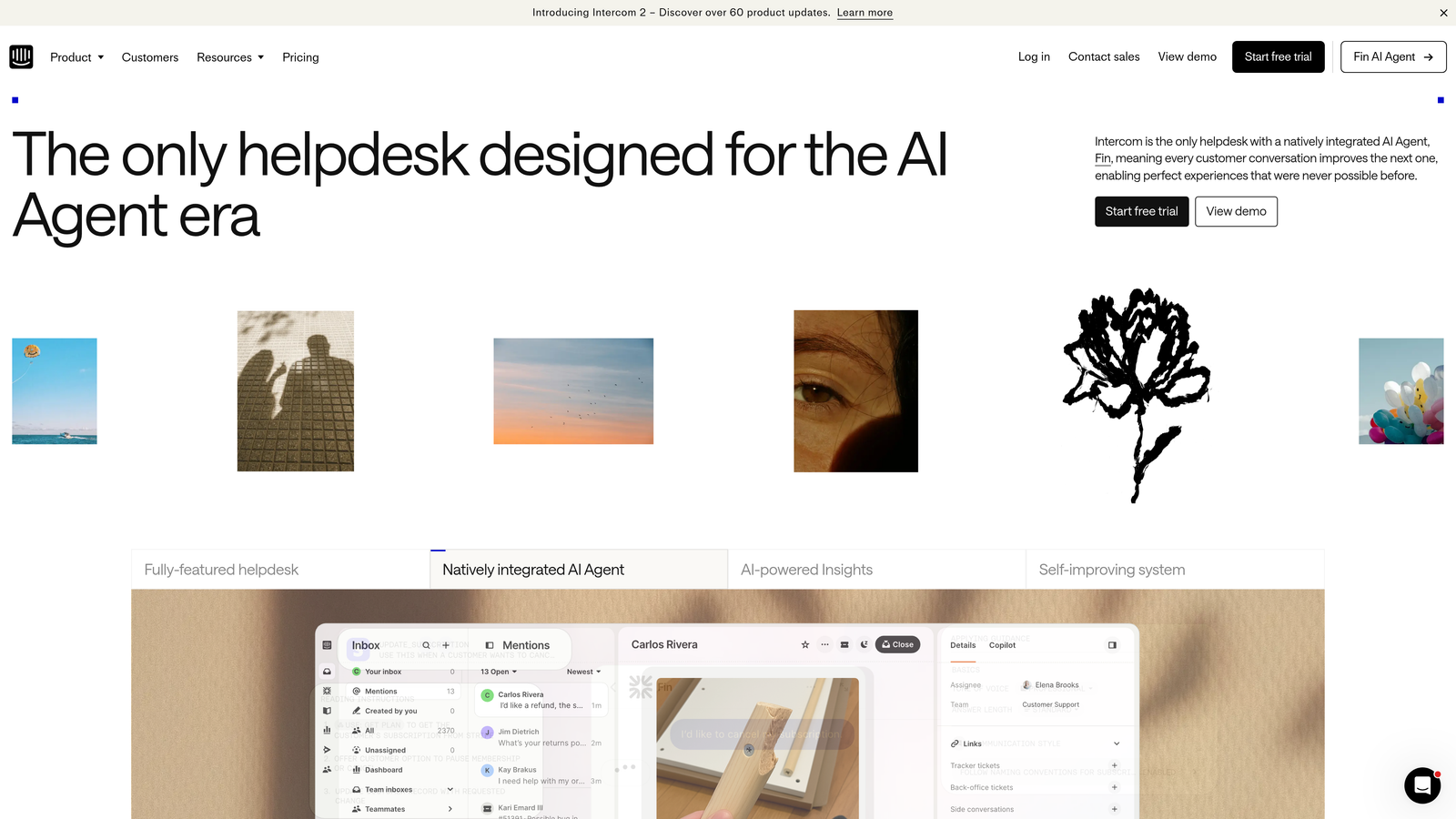
Intercom Fin is a conversational AI agent that uses your help center and business data to resolve customer issues end-to-end, with natural language understanding and smooth escalation to human agents.
Where This Tool Shines
Fin's conversational quality stands out. The natural language understanding handles the kind of messy, ambiguous questions real customers ask rather than requiring them to phrase things precisely. For ecommerce, where customers might ask "where's my stuff" or "I got the wrong size," that flexibility matters. Fin resolves issues using your existing knowledge base and connected data, so setup builds on content you likely already have.
The seamless handoff to human agents is well-executed. When Fin can't resolve an issue, it passes the full conversation context to a human agent, so customers don't have to repeat themselves. That continuity is often where chatbot experiences break down, and Intercom handles it better than most.
Key Features
Fin AI Agent: Resolves customer issues using your knowledge base and connected business data with strong conversational language understanding.
Seamless Human Handoff: Transfers conversations to human agents with full context intact so customers never have to repeat themselves.
Customizable Workflows: Configurable automation flows and integrations with ecommerce and business tools.
AI Resolution Reporting: Tracks resolution rates, customer satisfaction scores, and Fin's performance over time.
Best For
Ecommerce teams already invested in the Intercom ecosystem, or companies that prioritize high-quality conversational AI and smooth agent handoffs over deep ecommerce-specific workflow features.
Pricing
Fin AI Agent is charged per resolution; Intercom plans start at $39/seat/month. The per-resolution model can become significant at high volumes, so model your expected usage carefully.
6. Ada
Best for: Enterprise ecommerce brands with high automation ambitions and the technical resources to connect Ada to backend systems via APIs.
Ada is an enterprise AI agent platform designed for high-volume automation, capable of taking real actions like processing returns and checking order status by connecting to backend systems.
Where This Tool Shines
Ada's differentiator is action-taking capability at scale. Most AI support tools answer questions; Ada can actually do things. By connecting to your backend systems through APIs, Ada can process returns, update account information, check inventory status, and handle other transactional workflows autonomously. For high-volume ecommerce operations where a significant portion of tickets require backend actions, this is a meaningful capability gap versus simpler chatbot tools.
The no-code platform for building and managing AI agent workflows makes it accessible to operations teams without requiring engineering resources for every configuration change. Multilingual support also makes Ada a practical option for ecommerce brands with global customer bases.
Key Features
Action-Oriented AI: Connects to backend systems to process orders, returns, and account updates rather than just providing information.
No-Code Workflow Builder: Build and manage AI agent workflows without engineering resources for routine configuration.
Multilingual Support: Handles customer interactions in multiple languages for global ecommerce operations.
Omnichannel Deployment: Deploys across web, mobile, social, and messaging channels from a single platform.
Best For
Enterprise ecommerce brands with large support volumes, global operations, and the technical infrastructure to connect Ada to backend systems. The platform's power scales with the sophistication of your integrations.
Pricing
Enterprise pricing; contact Ada directly for custom quotes based on your volume and requirements.
7. Freshdesk Freddy AI
Best for: Small and mid-size ecommerce teams that want accessible AI features without enterprise pricing.
Freshdesk Freddy AI is the AI layer built into Freshworks' Freshdesk helpdesk, offering auto-triage, AI-suggested responses, and chatbot capabilities at price points accessible to growing ecommerce teams.
Where This Tool Shines
Freshdesk's primary appeal for ecommerce SMBs is the value-to-cost ratio. The Freddy AI capabilities—auto-triage, ticket classification, suggested responses—are genuinely useful and available at price points that smaller operations can absorb. You get meaningful AI functionality without committing to enterprise-tier budgets.
The free tier makes Freshdesk a practical starting point for early-stage ecommerce brands building their first support infrastructure. As volume grows, the paid plans scale incrementally, which reduces the risk of overcommitting to a platform before you know what you actually need.
Key Features
Freddy AI Auto-Triage: Automatically classifies and routes incoming tickets based on content and priority signals.
AI-Suggested Responses: Recommends responses to agents based on ticket content and historical resolutions.
AI-Powered Chatbot: Handles customer self-service for common queries before tickets are created.
Ecommerce Integrations: Marketplace connections with Shopify, WooCommerce, and other major ecommerce platforms.
Best For
Small and mid-size ecommerce teams looking for solid AI-assisted helpdesk functionality at accessible price points. Also a good fit for teams just beginning to formalize their support operations who want room to grow.
Pricing
Free plan available; paid plans start at around $15/agent/month. One of the more accessible entry points among AI-enabled helpdesks.
8. Richpanel
Best for: Ecommerce stores that want to reduce ticket volume through customer self-service before issues ever reach a support agent.
Richpanel is an ecommerce-focused customer support platform with a self-service portal that lets shoppers track orders, manage subscriptions, and initiate returns without contacting support.
Where This Tool Shines
Richpanel takes a different approach than most tools on this list. Rather than making agents faster, it focuses on eliminating the ticket in the first place. The self-service portal empowers customers to resolve their own order tracking, return, and subscription management needs without ever reaching out to support. For ecommerce teams where a large percentage of tickets are routine "where's my order" inquiries, this deflection-first approach can have a significant impact on overall ticket volume.
When customers do reach agents, the workspace provides full order history and context, so agents aren't starting conversations blind. The combination of self-service deflection and well-contextualized agent handling covers the full spectrum of ecommerce support interactions.
Key Features
Customer Self-Service Portal: Lets shoppers independently track orders, manage subscriptions, and initiate returns without contacting support.
AI-Powered Automation: Automates common ecommerce support workflows for inquiries that do reach the support team.
Native Ecommerce Integrations: Built-in connections with Shopify, Magento, and WooCommerce for real-time order data.
Contextualized Agent Workspace: Provides agents with full customer order history and interaction context in one view.
Best For
Ecommerce brands with high volumes of routine, transactional inquiries like order tracking and returns, where reducing ticket volume through self-service is a higher priority than AI response generation.
Pricing
Plans start at around $29/month; pricing scales based on conversation volume. Verify current plan details on Richpanel's website.
9. HubSpot Service Hub
Best for: Ecommerce teams already in the HubSpot ecosystem that want support, marketing, and sales data unified in one platform.
HubSpot Service Hub is an AI-powered customer service solution built into HubSpot's CRM ecosystem, offering chatbots, ticket automation, and knowledge base features with a unified view across marketing, sales, and support data.
Where This Tool Shines
Service Hub's unique advantage is context. Because it lives inside HubSpot's CRM, support agents see a customer's full history across marketing interactions, sales touchpoints, and previous support conversations in one place. For ecommerce brands that use HubSpot for marketing automation or sales, this unified view eliminates the fragmented context that typically forces customers to re-explain their situation every time they reach out.
The AI chatbot capabilities are solid rather than exceptional, but they benefit from the same CRM data advantage. Automated ticket routing and prioritization also improve when the system understands a customer's purchase history and relationship value, which is data HubSpot already holds.
Key Features
CRM-Connected AI Chatbots: Conversational tools that leverage HubSpot CRM data for more contextual, personalized interactions.
AI-Powered Ticket Routing: Automated routing and prioritization informed by customer data and relationship context.
Unified Customer View: Single view of support, marketing, and sales interactions across the full customer relationship.
Knowledge Base Builder: Creates and manages self-service content with AI-suggested article recommendations.
Ecommerce App Marketplace: Connects to ecommerce platforms and tools through HubSpot's extensive integration library.
Best For
Ecommerce businesses already using HubSpot for CRM, marketing, or sales that want to extend that investment into support without managing a separate platform. Less compelling as a standalone support tool if you're not already in the HubSpot ecosystem.
Pricing
Free tools available; Service Hub Starter from $20/month/seat; Professional from $100/month/seat. Pricing scales with seat count and feature tier.
Which Tool Is Right for Your Ecommerce Store?
The right choice depends heavily on your current setup, scale, and what you're actually trying to solve. Here's a quick orientation by scenario.
High-volume Shopify or BigCommerce stores with heavy order-related ticket volume will find Gorgias or Richpanel most immediately useful. Gorgias excels when agents need to take action on orders inside the helpdesk; Richpanel shines when you want to deflect routine inquiries before they become tickets at all.
Enterprise multi-channel retailers with complex routing requirements, large agent teams, and compliance needs will likely gravitate toward Zendesk AI or Ada. Both are built for scale, though Ada's action-taking capabilities make it particularly strong for brands with sophisticated backend integrations.
Budget-conscious SMBs just getting started with AI support should look at Tidio or Freshdesk Freddy AI. Both offer free tiers and accessible paid plans, with enough AI functionality to make a meaningful difference without requiring significant investment upfront.
B2B ecommerce teams or product-led companies that want support to do more than answer tickets—teams that want business intelligence, continuous learning, and deep integrations across their entire stack—should take a closer look at Halo AI. The AI-first architecture means the intelligence isn't a feature bolted on after the fact; it's the foundation everything else is built on.
Your support team shouldn't scale linearly with your customer base. Let AI agents handle routine tickets, guide users through your product, and surface business intelligence while your team focuses on complex issues that need a human touch. See Halo in action and discover how continuous learning transforms every interaction into smarter, faster support.