9 Best AI Support Tools for Fintech Companies in 2026
Fintech companies face unique support challenges—regulatory compliance, complex workflows, and 24/7 customer demands—making the right AI support for fintech companies a true competitive differentiator. This guide evaluates nine platforms built specifically for fintech's nuances, including compliance-aware responses, deep stack integrations, and intelligent escalation capabilities that go beyond standard ticketing metrics.
 Matt PattoliFounder13 min read
Fintech companies operate under a unique set of pressures that most support tools simply aren't built for. Your customers expect instant answers about transactions, account access, and compliance-sensitive questions, often at 2 AM. Meanwhile, your team is navigating strict regulatory requirements, complex product workflows, and the constant threat of churn if a single support interaction goes sideways.
AI-powered support has become a genuine competitive advantage in fintech, not just a cost-cutting measure. The right tool can resolve tier-1 tickets autonomously, surface revenue signals from support conversations, and escalate sensitive issues to human agents without friction. But not all AI support platforms are built with fintech's complexity in mind.
This list focuses on tools that handle the nuances: compliance-aware responses, deep integrations with fintech stacks, intelligent escalation, and business intelligence that goes beyond basic ticket metrics. Whether you're a neobank, payments platform, or B2B fintech SaaS, here are the top AI support tools worth evaluating in 2026.
1. Halo AI
Best for: B2B fintech and SaaS teams needing AI-first support with business intelligence built in
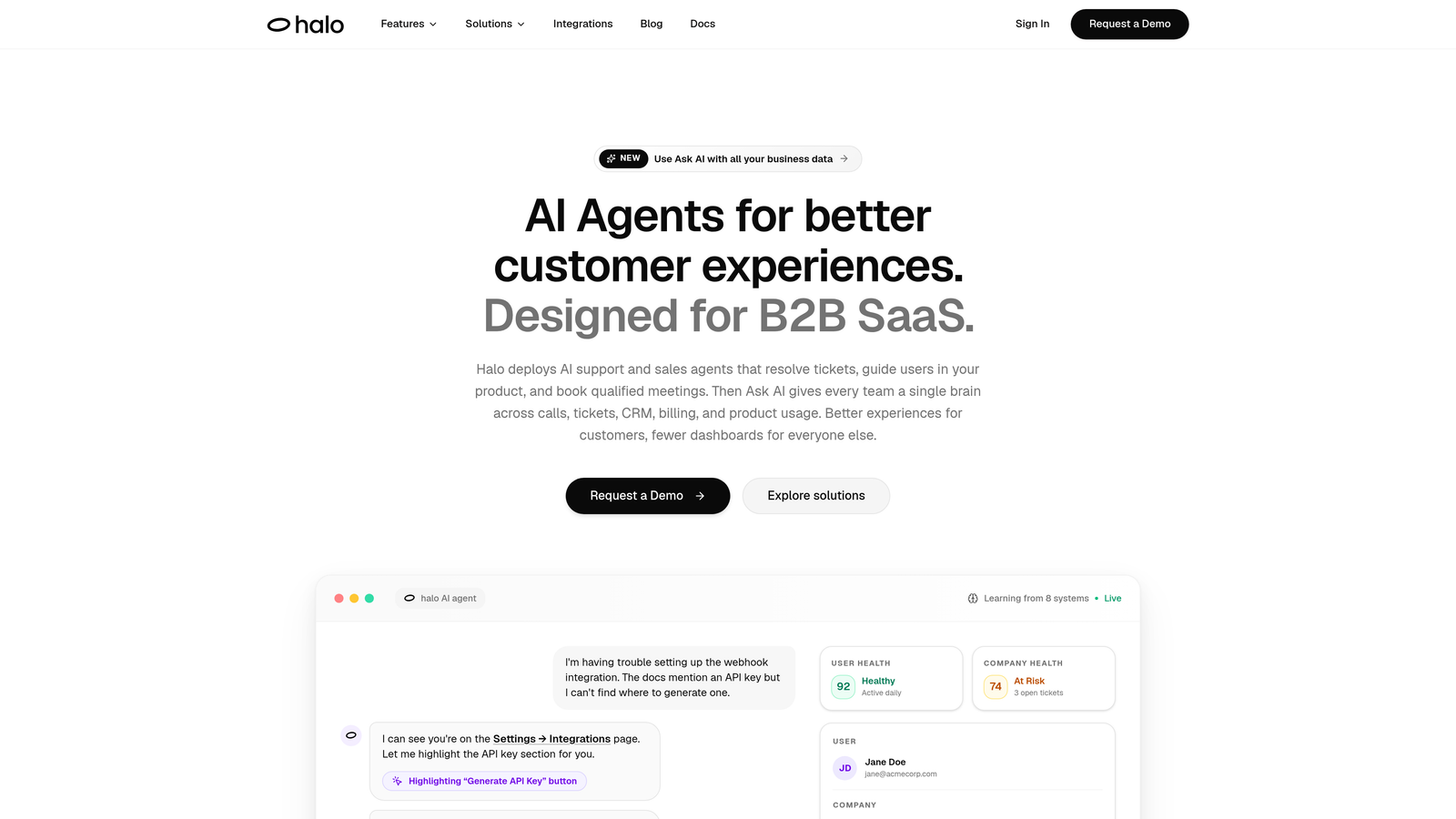
Halo AI is an AI-first customer support platform that deploys intelligent agents to resolve tickets, guide users through your product with page-aware context, and surface actionable business intelligence.
Where This Tool Shines
What sets Halo apart in a fintech context is its page-aware architecture. The AI agent can see what page or product state a user is currently on, then provide visual UI guidance specific to that context. For fintech products with complex dashboards, multi-step onboarding flows, or intricate account management screens, this is a meaningful advantage over a generic chatbot that can only respond to what users type.
The smart inbox goes further than ticket management. It surfaces customer health signals, revenue intelligence, and anomaly detection, turning your support queue into a source of business intelligence. For fintech teams where a struggling customer might also be a churn risk or an expansion opportunity, that context matters.
Key Features
Page-Aware AI Agent: Sees the user's current product state and delivers visual UI guidance tailored to their exact context.
Continuous Learning: Improves with every resolved interaction, so the AI gets smarter as your product and customer base evolve.
Smart Inbox with Business Intelligence: Surfaces customer health signals, revenue intelligence, and anomaly detection alongside ticket data.
Auto Bug Ticket Creation: Automatically routes bug reports to Linear or connected tools, closing the loop between support and engineering.
Live Agent Handoff: Transfers to human agents with full conversation context intact, critical for high-stakes fintech escalations.
Native Integrations: Connects with Stripe, HubSpot, Intercom, Slack, Linear, Zoom, PandaDoc, and Fathom, covering much of the modern fintech stack.
Best For
Growth-stage and enterprise B2B fintech teams that want AI-first architecture rather than AI bolted onto an existing helpdesk. Particularly strong for companies that need support to inform product and revenue decisions, not just close tickets. The Stripe integration makes it especially relevant for payments-adjacent products.
Pricing
Check haloagents.ai for current pricing details and available plans.
2. Intercom
Best for: Companies wanting a proven all-in-one messaging and AI support platform
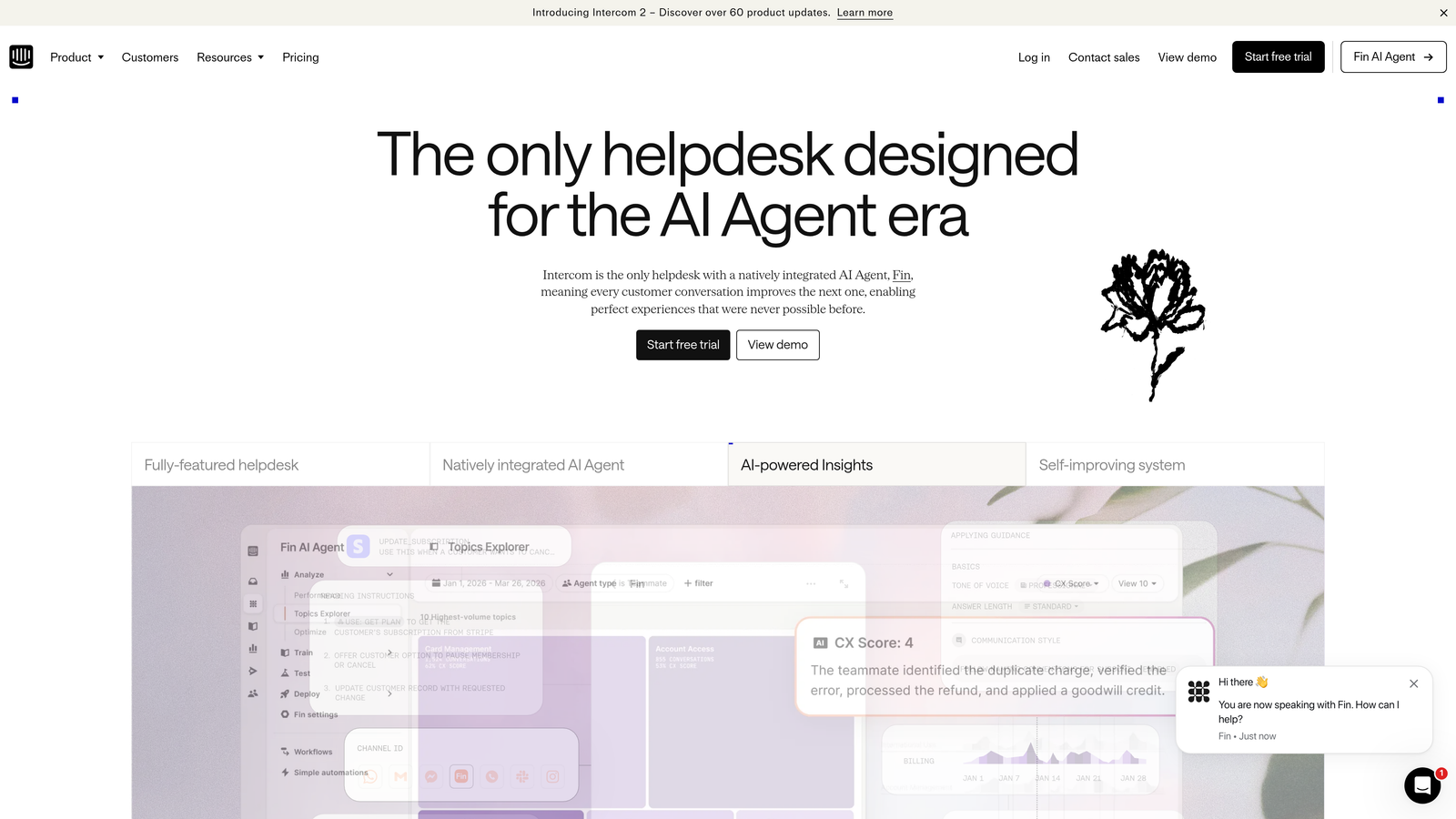
Intercom is a mature customer messaging platform with Fin, its AI agent, built for teams that want a battle-tested solution across chat, email, and self-service support.
Where This Tool Shines
Intercom has deep roots in fintech. Fin, its AI agent, is trained on your existing knowledge base and handles a broad range of tier-1 queries autonomously. The messenger experience is polished and widely trusted, which matters when your customers are asking sensitive questions about their accounts or transactions.
The workflow automation layer is mature, giving support operations teams real control over routing, escalation logic, and ticket assignment. For fintech companies that have already standardized on Intercom's messenger, the AI upgrade path is relatively smooth.
Key Features
Fin AI Agent: Trained on your knowledge base to autonomously resolve common queries without human intervention.
Omnichannel Messenger: Strong mobile and web experience that customers in financial services already recognize and trust.
Workflow Automation: Configurable routing and escalation rules for ticket handling across teams.
Fintech-Relevant Integrations: Native connections with Stripe, Salesforce, and a wide range of common fintech tools.
Conversation Analytics: Detailed reporting on resolution rates, CSAT, and conversation trends.
Best For
Fintech companies that already use Intercom's messenger and want to layer AI on top of an established support infrastructure. Also a strong choice for consumer-facing products where the quality of the chat experience is a brand differentiator.
Pricing
Tiered pricing structure; AI features are available on higher plans. Check intercom.com for current pricing.
3. Zendesk AI
Best for: Enterprise fintech teams with complex ticketing, SLA requirements, and compliance documentation needs
Zendesk AI is the enterprise helpdesk standard, now with AI Agents and Agent Copilot layered across its ticketing, routing, and knowledge base infrastructure.

Where This Tool Shines
Zendesk's strength in regulated industries comes from its depth, not its novelty. SLA management, compliance documentation, audit logging, and granular permissions are all mature features. For enterprise fintechs operating under regulatory scrutiny, that foundation is hard to replicate quickly.
The AI Agents handle common queries autonomously, while Agent Copilot provides real-time suggestions and draft responses to human agents handling more complex issues. Intent detection and priority scoring mean tickets get to the right person faster, reducing the risk of a high-priority dispute sitting in a general queue.
Key Features
AI Agents: Autonomous resolution for high-frequency, lower-complexity queries across channels.
Agent Copilot: Real-time response suggestions and draft generation to accelerate human agent handling.
Advanced Ticket Routing: Intent detection and priority scoring to ensure tickets reach the right team.
SLA and Compliance Support: Robust tools for managing response time commitments and maintaining documentation.
Integration Marketplace: Extensive ecosystem including fintech-relevant tools for billing, CRM, and fraud management.
Best For
Large fintech organizations with established support operations that need enterprise-grade compliance controls, complex routing logic, and a proven track record in regulated industries. Less suited for early-stage teams that need fast deployment over deep configurability.
Pricing
Enterprise-tier pricing. Check zendesk.com for current plan details.
4. Freshdesk Freddy AI
Best for: Mid-market fintech teams seeking AI-augmented support at a more accessible price point
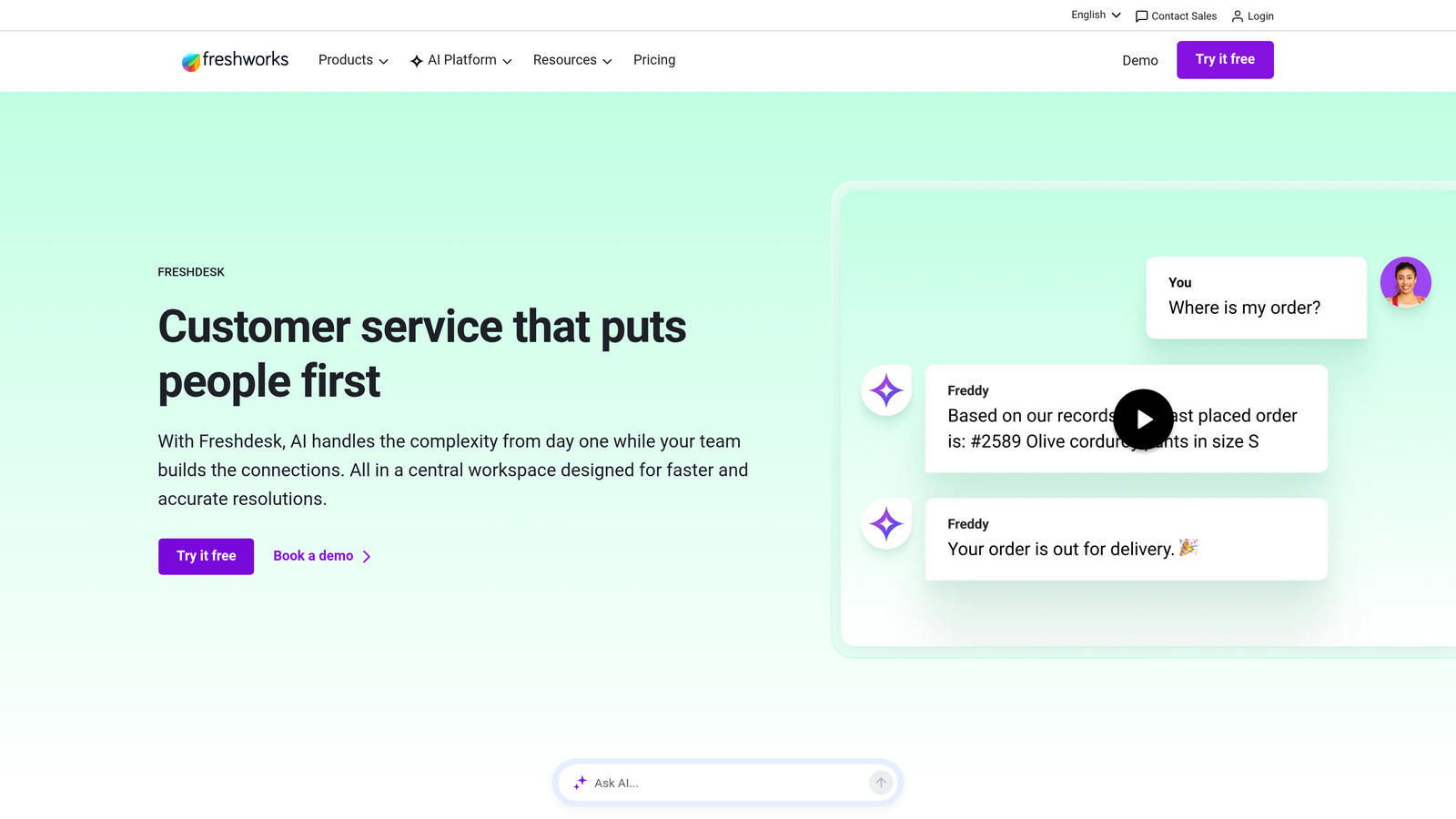
Freshdesk's AI layer, Freddy, spans self-service, agent assist, and analytics, offering a practical alternative to enterprise-only platforms for growing fintech companies.
Where This Tool Shines
Freddy AI is embedded across the Freshdesk experience in three distinct modes: Freddy Self Service for chatbot-driven deflection, Freddy Copilot for agent productivity, and Freddy Insights for analytics. This modular approach lets mid-market teams adopt AI incrementally rather than committing to a full platform overhaul.
For fintech teams that don't yet need the full weight of Zendesk's enterprise infrastructure, Freshdesk offers a credible path to AI-augmented support without the corresponding price tag. The omnichannel coverage across email, chat, phone, and social is solid for teams managing diverse customer contact points.
Key Features
Freddy Self Service: AI-powered chatbot for deflection and self-service resolution before a human agent is needed.
Freddy Copilot: Agent productivity tool offering response suggestions and workflow assistance.
Freddy Insights: AI-driven analytics that surface trends and operational improvement opportunities.
Omnichannel Support: Unified coverage across email, chat, phone, and social channels.
Scalable Add-Ons: Mid-market pricing with the ability to add capabilities as the team grows.
Best For
Mid-market fintech companies that want AI-enhanced support without enterprise pricing. A good fit for teams currently on basic helpdesk tools looking to upgrade without a full platform migration.
Pricing
Freddy AI features are available on higher tiers. Check freshdesk.com for current pricing.
5. Salesforce Agentforce
Best for: Enterprise fintechs already invested in the Salesforce ecosystem needing AI with full CRM context
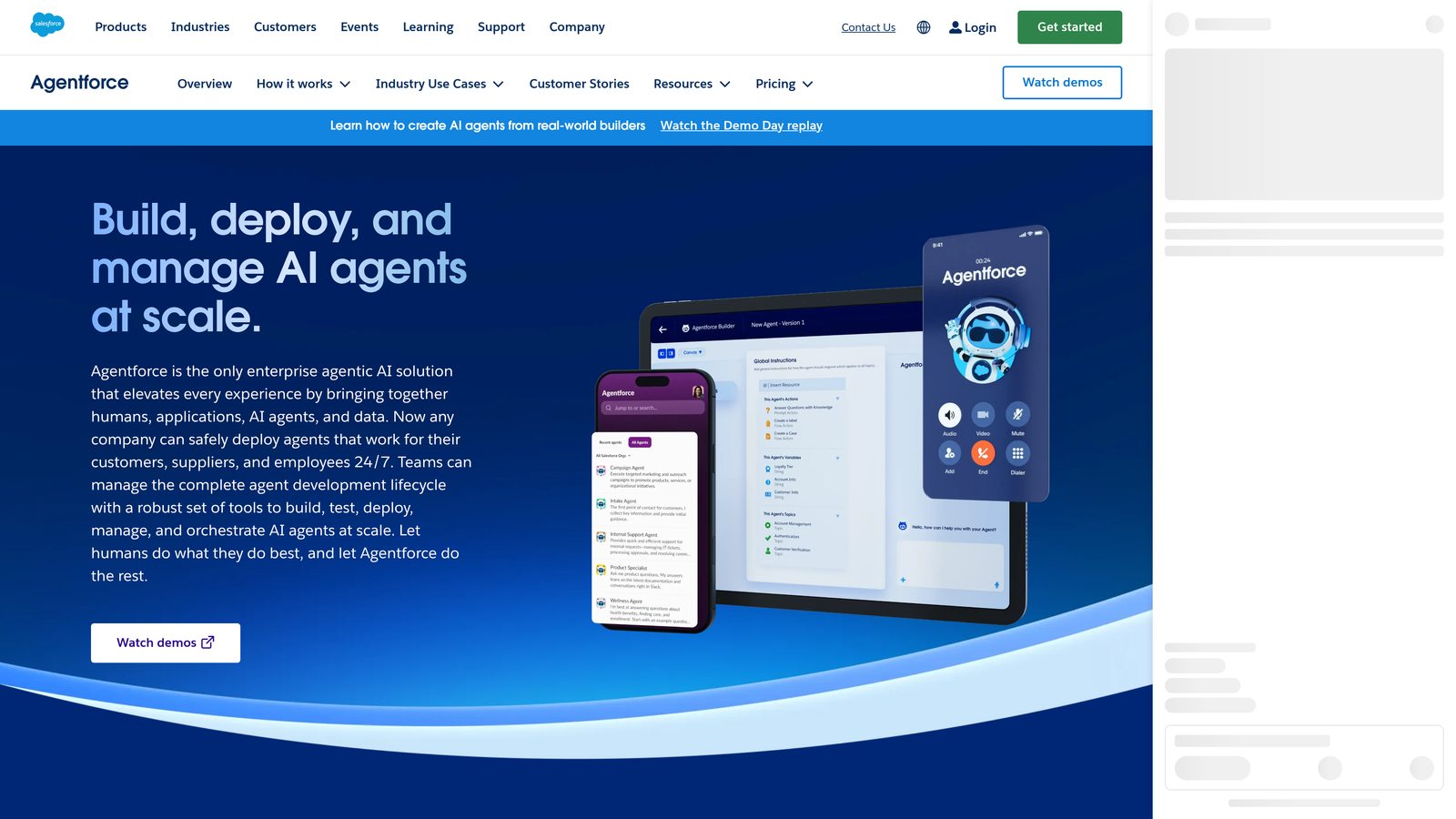
Salesforce Agentforce is Salesforce's autonomous AI agent platform, drawing on full CRM data to personalize and resolve support interactions at enterprise scale.
Where This Tool Shines
The core advantage of Agentforce is context. Because it's native to Salesforce, AI agents can reference a customer's full history: account status, contract data, open opportunities, prior support interactions, and financial services-specific data from Financial Services Cloud. For enterprise B2B fintechs where sales and support overlap significantly, that unified context changes the quality of every interaction.
The compliance and audit controls are enterprise-grade, and the configurable guardrails are specifically designed for regulated industry use cases. Agentforce agents can take actions across Salesforce objects, not just answer questions, making them genuinely agentic rather than conversational-only.
Key Features
Full CRM Data Access: AI agents reference complete customer history, account status, and contract data in every interaction.
Autonomous Action Capability: Agents can take actions across Salesforce objects, not just provide answers.
Enterprise Compliance Controls: Robust audit trails and governance tools designed for regulated industries.
Financial Services Cloud Integration: Deep native connection with Salesforce's financial services-specific data model.
Configurable Guardrails: Customizable boundaries for what AI agents can and cannot do autonomously.
Best For
Enterprise fintech organizations already operating within the Salesforce ecosystem. The value is highest when Sales Cloud, Service Cloud, and Financial Services Cloud are all in play. Teams without existing Salesforce infrastructure will find the entry cost significant.
Pricing
Enterprise pricing. Check salesforce.com/agentforce for current details.
6. Ada
Best for: Enterprise fintech teams that need AI to take actions, not just answer questions, with strong governance controls
Ada is a no-code AI agent platform built for enterprise teams that need measurable automation outcomes with clear controls over what the AI can and cannot do.
Where This Tool Shines
Ada's distinction is its action orientation. Rather than simply answering questions from a knowledge base, Ada agents can perform account lookups, check transaction statuses, trigger workflow actions, and complete tasks on behalf of users. In fintech, where customers frequently need resolution rather than just information, this matters.
The no-code builder is genuinely accessible for non-technical teams, which reduces the dependency on engineering resources to update agent behavior as products and policies change. The multilingual support is also relevant for global fintech operations serving customers across different markets.
Key Features
Action-Oriented AI: Agents perform account lookups, status checks, and workflow triggers rather than just providing answers.
No-Code Builder: Non-technical teams can configure and update agent behavior without engineering support.
Enterprise Guardrails: Configurable controls and escalation logic designed for regulated environments.
Multilingual Support: Handles customer interactions across multiple languages for global fintech operations.
Automation Rate Reporting: Clear measurement of how much volume AI is handling versus human agents.
Best For
Enterprise fintech companies that need AI to take meaningful actions in support workflows, not just deflect tickets. Strong fit for organizations that want non-technical teams to own and iterate on AI agent behavior over time.
Pricing
Enterprise pricing. Check ada.cx for current details.
7. Kustomer
Best for: Consumer fintechs with high-volume omnichannel support and complex customer histories
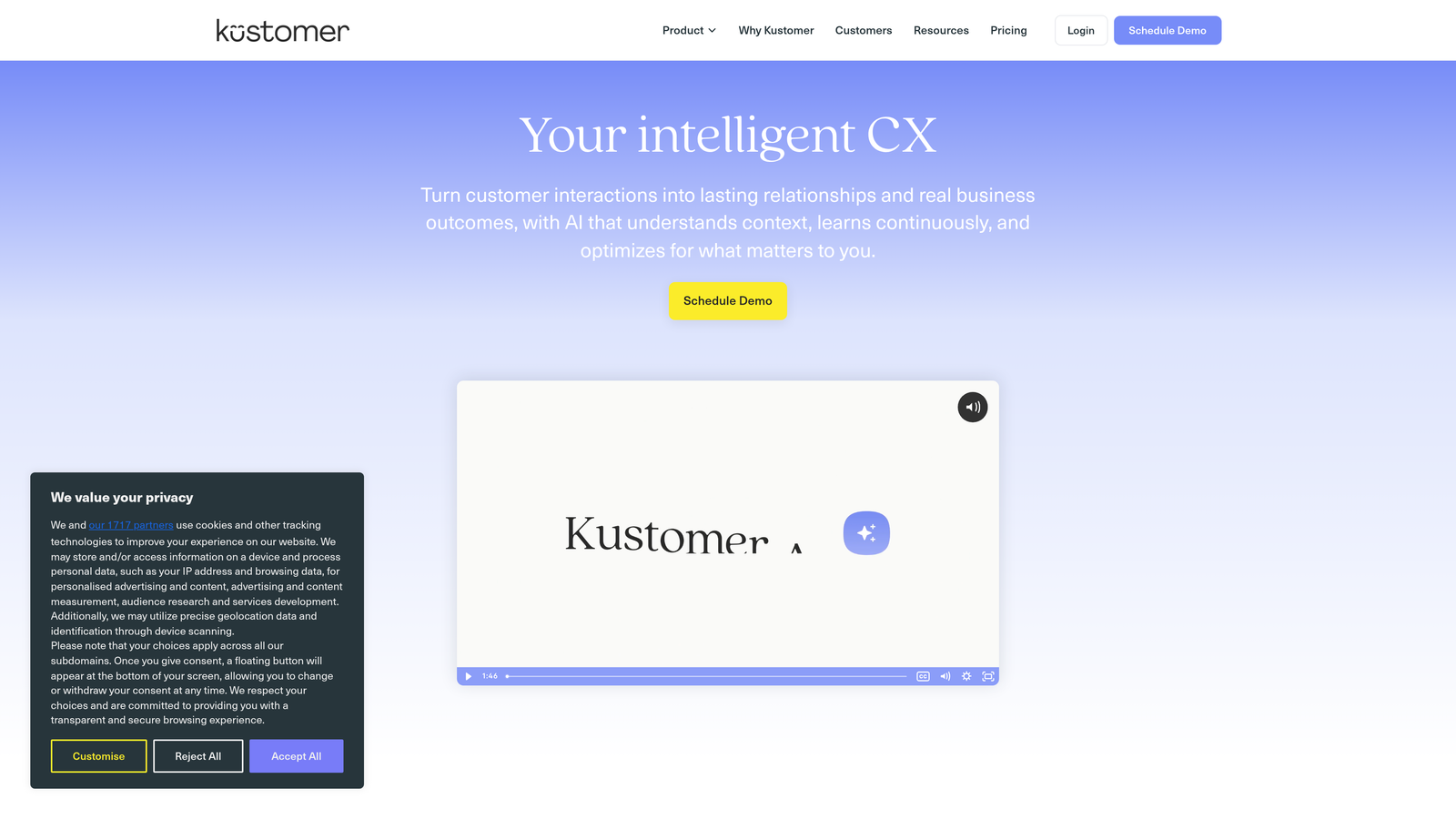
Kustomer is a CRM-first customer service platform that gives AI agents a unified customer timeline across every channel before responding to any interaction.
Where This Tool Shines
Kustomer's unified timeline is its defining feature. Every interaction a customer has ever had, across chat, email, social, SMS, and voice, is visible in a single view before the AI or human agent responds. For consumer fintechs like neobanks or payment apps where a customer might have contacted support through three different channels about the same transaction dispute, that context prevents the frustrating experience of starting over.
The CRM-native data model supports financial services customer profiles well, and the proactive outreach capabilities allow teams to get ahead of issues rather than waiting for customers to contact support.
Key Features
Unified Customer Timeline: Every interaction across all channels consolidated in one view for AI and human agents.
Context-Driven AI: AI uses full customer history before generating any response.
Omnichannel Routing: Automated routing and workflow management across chat, email, social, SMS, and voice.
Financial Services Data Model: CRM-native structure suited for consumer fintech customer profiles.
Proactive Outreach: Notification and outreach capabilities to address issues before customers escalate.
Best For
Consumer fintechs, particularly neobanks and payment apps, with high-volume omnichannel support needs. Teams where customer history and cross-channel context are critical to delivering a quality support experience.
Pricing
Check kustomer.com for current pricing.
8. Tidio
Best for: Early-stage fintech startups that need AI chat deployed quickly without complex setup
Tidio is an accessible AI chat platform with Lyro AI for conversational automation, designed for fast deployment and practical entry-level pricing.
Where This Tool Shines
For early-stage fintech teams that need to provide responsive support without a dedicated support operations function, Tidio's speed of deployment is its biggest advantage. Lyro AI handles conversational automation without requiring complex configuration, and the live chat handoff is straightforward enough for small teams to manage.
It's worth being clear about what Tidio is and isn't. It's not built for enterprise compliance requirements or deep fintech stack integrations. But for a seed-stage or Series A fintech that needs to stop answering the same ten questions manually, it's a practical and affordable starting point.
Key Features
Lyro AI: Conversational automation that handles common queries without complex initial setup.
Live Chat with AI Handoff: Smooth transition from AI to human agents for queries that need escalation.
Fast Deployment: Minimal technical requirements to get up and running quickly.
SaaS Integrations: Connects with common e-commerce and SaaS tools for basic workflow support.
Accessible Pricing: Free tier available with paid plans at price points suited for early-stage teams.
Best For
Early-stage fintech startups that need AI-assisted chat without enterprise complexity or budget. A good first step before migrating to a more sophisticated platform as the business scales.
Pricing
Free tier available; paid plans start at accessible price points. Check tidio.com for current details.
9. Forethought
Best for: Operations-focused fintech teams that want AI optimized for triage, routing, and measurable deflection outcomes
Forethought is an AI platform focused on support operations intelligence, with a strong emphasis on triage, routing, and quantifiable operational metrics.
Where This Tool Shines
Forethought takes a distinct approach: rather than replacing your existing helpdesk, it layers AI intelligence on top of it. Solve AI handles autonomous resolution for high-frequency queries, while Triage AI classifies and routes tickets before a human agent ever sees them. The result is a system designed to make your existing helpdesk infrastructure significantly more efficient.
The reporting focus on deflection rate, handle time, and first-contact resolution makes it particularly appealing to fintech support leaders who need to demonstrate ROI to finance or operations stakeholders. If your evaluation criteria center on measurable outcomes rather than feature breadth, Forethought is worth a serious look.
Key Features
Solve AI: Autonomous resolution for high-frequency, repeatable queries without human involvement.
Triage AI: Intelligent routing and classification before tickets reach human agents.
Predictive Intent Detection: Accurate ticket classification based on predicted customer intent.
Helpdesk Integration: Layers on top of existing platforms including Zendesk and Salesforce rather than replacing them.
Operational Metrics Reporting: Focused reporting on deflection rate, handle time, and first-contact resolution.
Best For
Fintech support operations teams already on Zendesk or Salesforce that want to add AI triage and resolution without migrating platforms. Strong fit for teams where measurable operational outcomes are the primary evaluation criterion.
Pricing
Enterprise pricing. Check forethought.ai for current details.
Which Tool Is Right for Your Fintech Team?
The honest answer is that the right AI support tool depends heavily on your company's stage, existing stack, and the specific support challenges you're trying to solve. Here's a quick orientation by use case.
Early-stage fintech startups: Start with Tidio for fast, low-cost deployment, or Halo AI if you want AI-first architecture with business intelligence from the beginning.
Growth-stage B2B fintechs: Halo AI or Ada are strong fits. Both offer genuine agentic capability, and Halo's page-aware context and Stripe integration make it particularly well-suited for SaaS fintech products with complex dashboards.
Enterprise fintechs on Salesforce: Agentforce is the natural choice if you're already deep in the Salesforce ecosystem and need AI that draws on full CRM context.
Companies on existing helpdesks: Zendesk AI and Freshdesk Freddy both offer AI layers that upgrade your current infrastructure without a full migration. Forethought is worth considering if you want AI triage and routing without switching platforms at all.
Consumer fintechs with omnichannel needs: Kustomer's unified customer timeline is purpose-built for this scenario. Intercom is also a strong contender if the messenger experience is central to your support strategy.
Before committing to any vendor, it's worth asking three questions directly. Does it understand fintech workflows, including compliance-sensitive topics and complex product surfaces? Can it escalate intelligently, transferring full context to a human agent without losing the thread? And does it provide business intelligence beyond ticket counts, surfacing signals that help your product and revenue teams, not just your support team?
Your support team shouldn't scale linearly with your customer base. Let AI agents handle routine tickets, guide users through your product, and surface business intelligence while your team focuses on complex issues that need a human touch. See Halo in action and discover how continuous learning transforms every interaction into smarter, faster support.