9 Best AI Support Tools for Growing Companies in 2026
Growing companies struggling with support ticket volume can leverage AI support for growing companies to resolve issues autonomously, surface product insights, and reduce reliance on constant headcount growth. This guide evaluates nine top AI support platforms on autonomous resolution capability, integration depth, and scalability, helping B2B companies find the right tool as they outgrow traditional helpdesks.
 Grant CooperFounder13 min read
Growing companies face a brutal support paradox: your customer base scales faster than your team can hire. Every new product feature, every new market segment, every new pricing tier generates a fresh wave of tickets — and traditional helpdesks just route them faster without actually resolving them.
AI support tools change that equation entirely. Instead of adding headcount to keep up, the right platform lets you resolve tickets autonomously, surface product insights from support conversations, and hand off only the genuinely complex issues to your human team.
This guide covers the top AI support tools built specifically for scaling B2B companies, evaluated on autonomous resolution capability, integration depth, learning over time, and how well they handle the messy reality of rapid growth. Whether you're graduating from a basic helpdesk or replacing a tool that's stopped scaling with you, this list will help you find the right fit.
1. Halo AI
Best for: B2B SaaS companies that need autonomous ticket resolution and product intelligence, not just a smarter helpdesk.
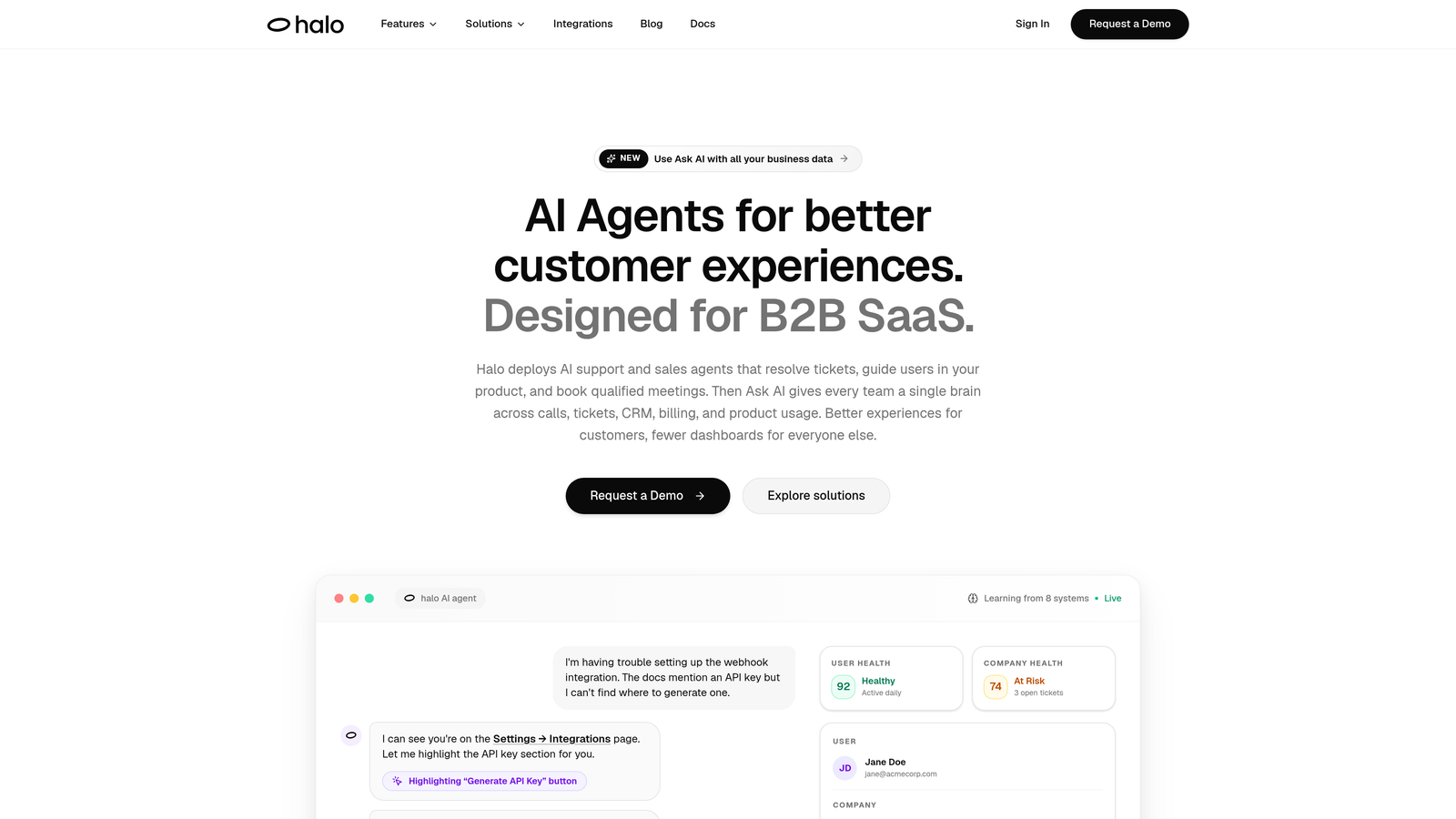
Halo AI is an AI-first customer support platform built from the ground up for B2B SaaS teams that need to scale support without scaling headcount.
Where This Tool Shines
What separates Halo from most tools on this list is its architecture. Rather than bolting AI onto an existing helpdesk, Halo was designed with AI decision-making at its core. That distinction matters: the entire data model is built around autonomous resolution, which means the system genuinely improves from every interaction instead of just suggesting faster replies.
The page-aware chat widget is a standout capability. Halo's AI sees exactly what the user sees on screen, enabling contextual guidance that goes beyond generic FAQ responses. Pair that with a smart inbox that surfaces customer health signals, revenue anomalies, and churn indicators, and you have a support tool that doubles as a business intelligence layer.
Key Features
Page-Aware Chat Widget: The AI understands the user's current page context, enabling visual, step-by-step guidance that's specific to where they are in your product.
Continuous Learning Agents: Every resolved ticket trains the system, so autonomous resolution capability compounds over time rather than staying static.
Smart Inbox with Business Intelligence: Surfaces customer health signals, revenue anomalies, and churn indicators directly from support conversation patterns.
Auto Bug Ticket Creation: Detects recurring support patterns and automatically routes issues to Linear or your engineering tools, closing the loop between support and product.
Live Agent Handoff: Escalates complex issues to human agents with full conversation context preserved, so nothing gets lost in the transfer.
Deep Integration Stack: Connects natively with Linear, Slack, HubSpot, Intercom, Stripe, Zoom, PandaDoc, and Fathom for compounding value across your entire business stack.
Best For
B2B SaaS companies at growth stage that need more than ticket deflection. Particularly strong for product-led growth teams where support conversations carry meaningful signals about feature friction, churn risk, and customer health. If you want support intelligence, not just support automation, Halo is worth a close look.
Pricing
Contact Halo for pricing. Given the platform's depth and B2B focus, pricing is customized to team size and resolution volume.
2. Intercom
Best for: Teams already in the Intercom ecosystem that want autonomous AI resolution layered into their existing messenger and inbox.
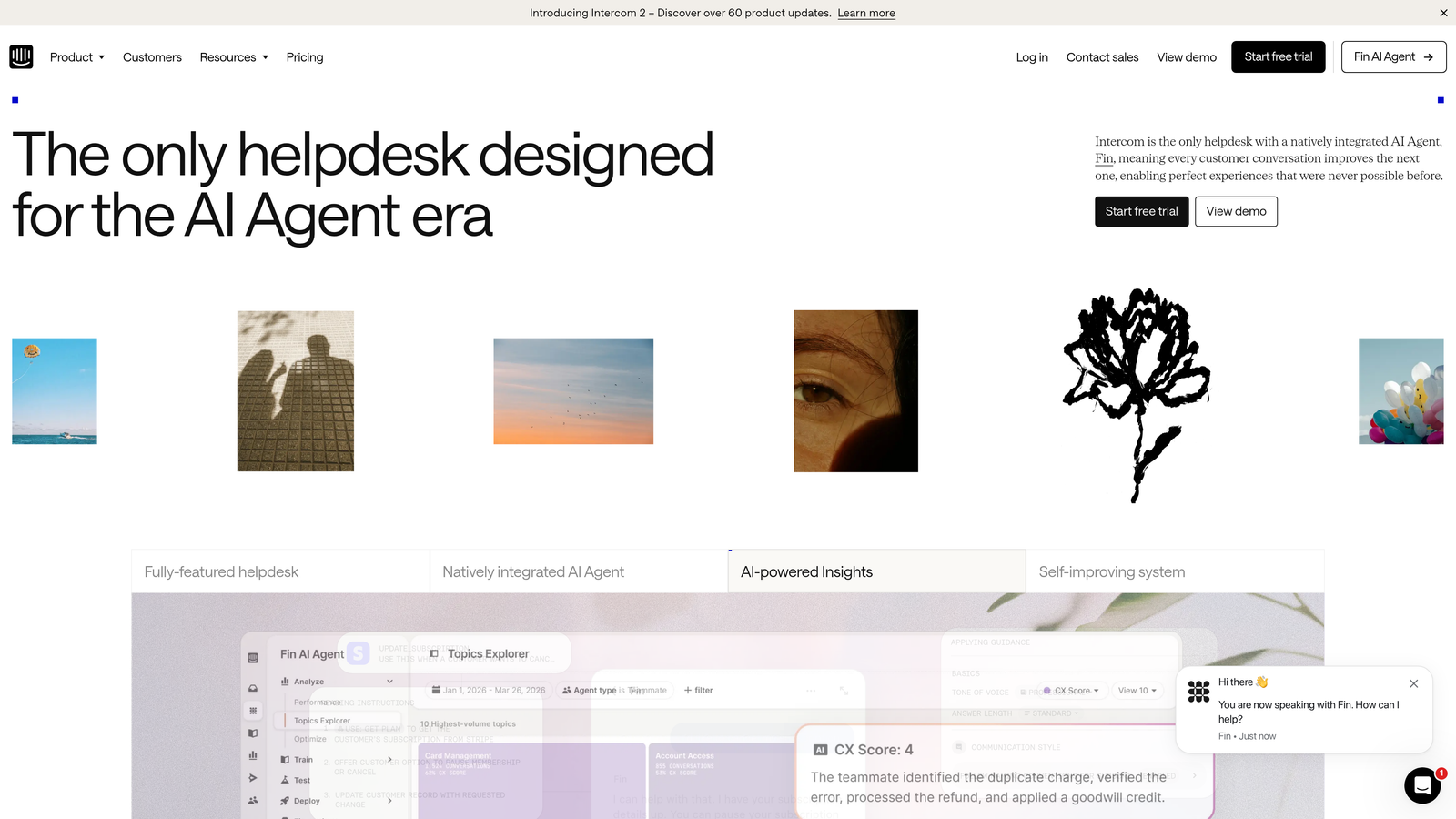
Intercom is a mature, all-in-one customer messaging platform with Fin AI Agent handling autonomous resolution across a widely adopted messenger infrastructure.
Where This Tool Shines
Intercom's Fin AI Agent is one of the more capable autonomous resolution tools in the market, built on large language model reasoning rather than rigid decision trees. For companies already using Intercom's Messenger and Inbox, adding Fin feels seamless rather than disruptive.
The platform also layers in productivity tools for human agents: AI Compose for drafting replies, AI Summarize for quick context on long threads, and Conversation Topics for automatically identifying support trends. It's a well-rounded package if you're already committed to the Intercom ecosystem.
Key Features
Fin AI Agent: LLM-powered autonomous resolution for common questions, with the ability to reference your help center and knowledge base.
AI Summarize and AI Compose: Productivity tools that help human agents handle complex conversations faster and more consistently.
Conversation Topics: Automatically identifies and categorizes support trends from incoming ticket patterns.
Messenger and Inbox Integration: AI capabilities are deeply woven into Intercom's existing interface, not added as a separate module.
Best For
Companies already using Intercom for customer communications who want to layer in autonomous resolution without migrating platforms. Also strong for product-led SaaS teams with an established help center that Fin can draw from immediately.
Pricing
Tiered plans with AI features on higher tiers. Fin AI Agent is billed per resolution on some plans, which can create unpredictable costs at scale. Worth modeling your expected resolution volume before committing.
3. Zendesk AI
Best for: Large or enterprise support teams that need AI to augment a high-volume, multi-channel helpdesk operation.
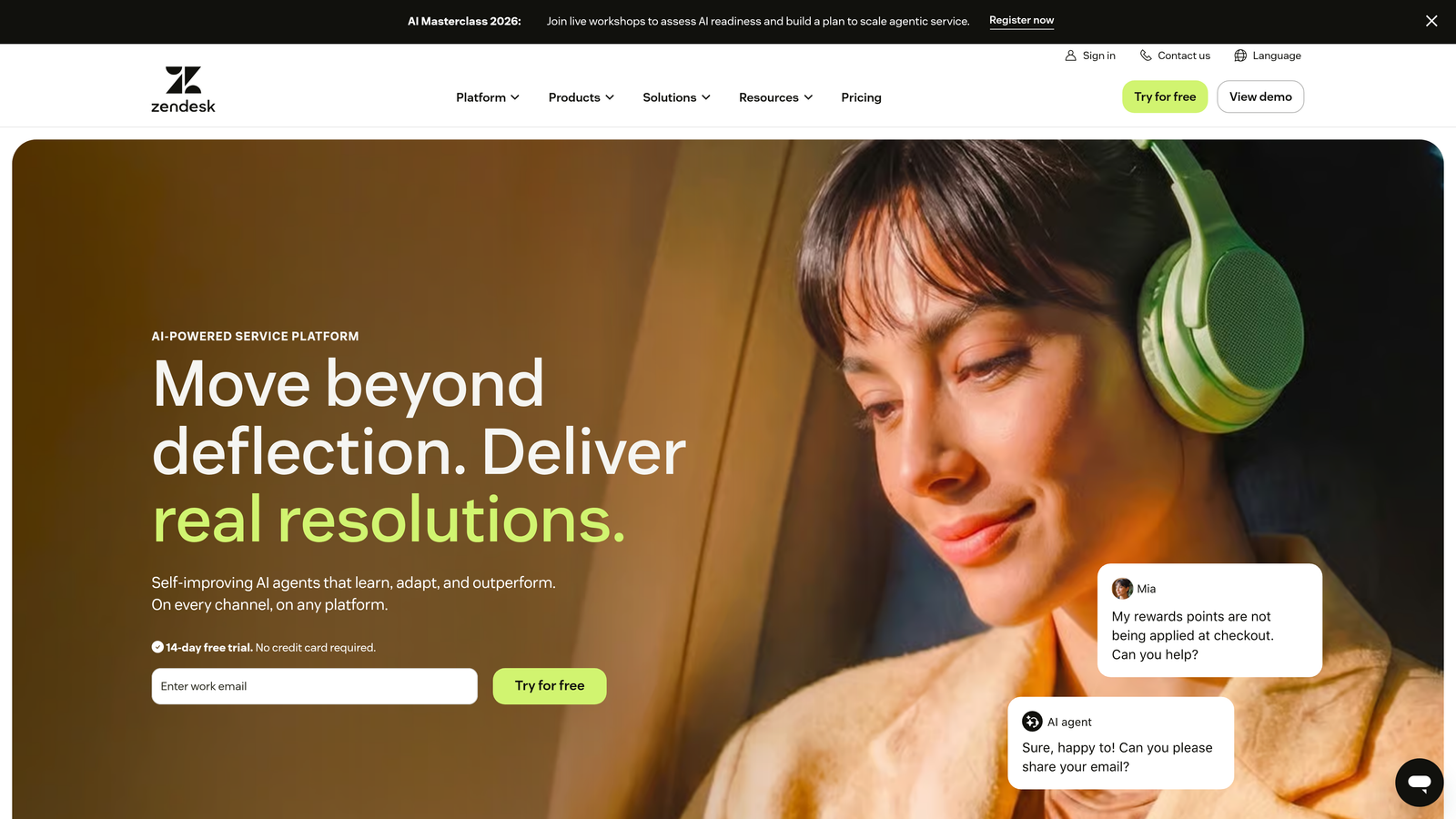
Zendesk AI is the industry's most established helpdesk platform with intelligent triage, agent copilot, and automated response capabilities layered across its full suite.
Where This Tool Shines
Zendesk's strength is breadth. When you need to handle email, chat, voice, social, and messaging from a single platform with AI working across every channel, Zendesk delivers. Its intelligent triage automatically categorizes, routes, and prioritizes tickets before a human ever touches them.
Agent Copilot is particularly useful for teams handling complex, nuanced conversations: it suggests responses and next actions in real time, reducing the cognitive load on agents without removing human judgment from the loop. The AI-powered QA feature adds automated quality scoring, which is valuable for teams managing agent performance at scale.
Key Features
Intelligent Triage: Automatically categorizes, routes, and prioritizes incoming tickets based on content, intent, and historical patterns.
Agent Copilot: Real-time response suggestions and next-action recommendations for human agents handling complex conversations.
AI-Powered QA: Automated quality scoring of support interactions, helping managers identify coaching opportunities without manual review.
Broad Channel Support: Covers email, chat, voice, social, and messaging channels from a single unified interface.
Best For
Mid-market to enterprise teams with established support operations that want AI to improve efficiency across a complex, multi-channel environment. Less ideal for early-stage companies that don't need the full complexity or cost of the Zendesk suite.
Pricing
AI features are available on Suite Professional and above. Contact Zendesk for current pricing. Expect enterprise-level investment for full AI capability.
4. Freshdesk Freddy AI
Best for: Growing teams that want AI across self-service, agent assist, and analytics without enterprise-level complexity or pricing.
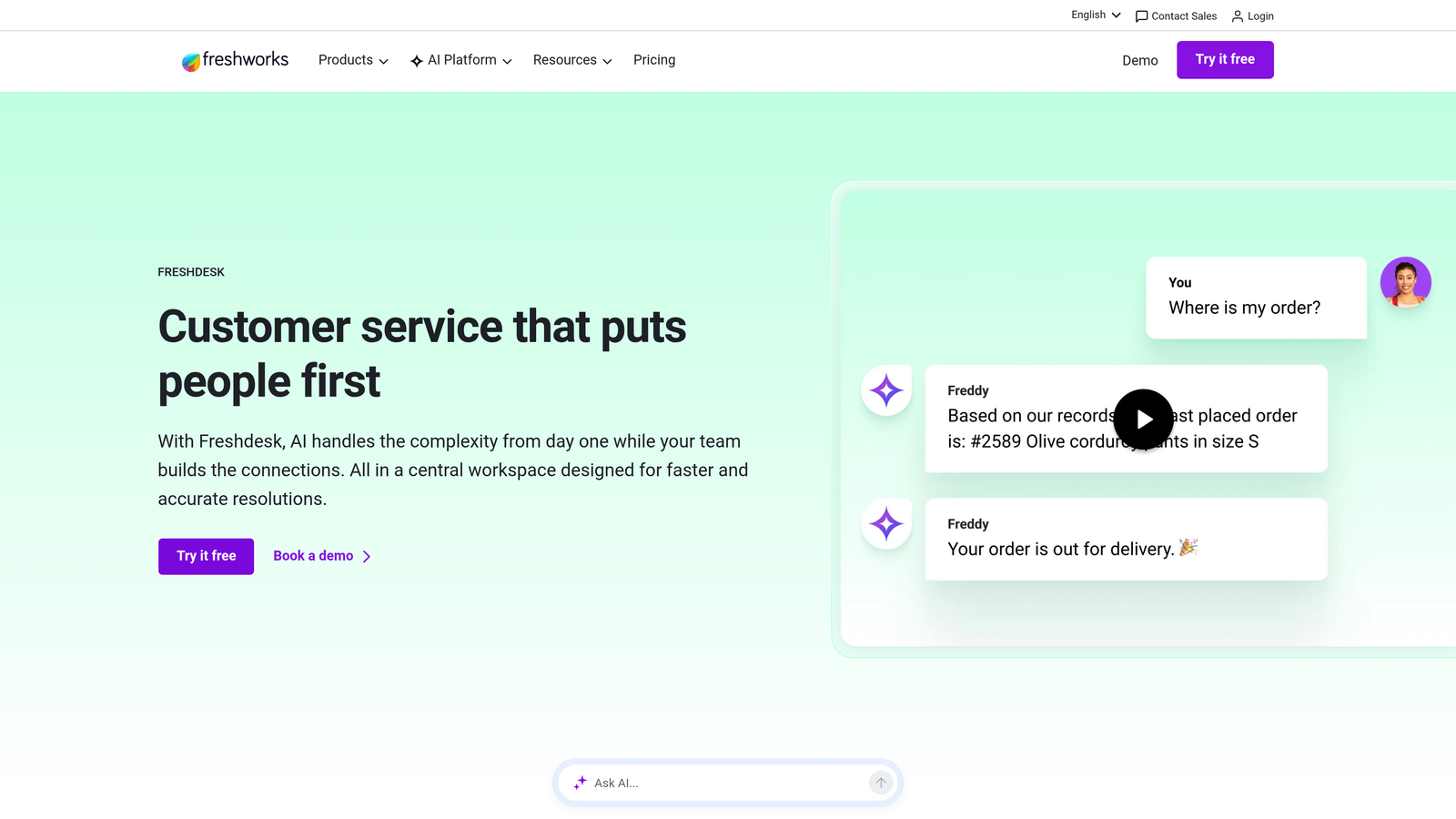
Freshdesk's Freddy AI spans chatbot deflection, agent productivity, and analytics across the Freshworks ecosystem at more accessible price points than many competitors.
Where This Tool Shines
Freddy AI is notable for covering three distinct layers of support intelligence: self-service deflection, agent-side assistance, and analytics insights. Most tools do one or two of these well; Freddy attempts all three under a single umbrella, which reduces the need for additional tooling as you grow.
For companies already in the Freshworks ecosystem, the integration with Freshsales and Freshchat creates a connected view of customer interactions across sales and support. Freddy Insights also brings anomaly detection to support metrics, which can flag unusual ticket spikes or emerging issues before they escalate.
Key Features
Freddy Self Service: AI chatbot that deflects common questions before they reach the agent queue, drawing from your knowledge base.
Freddy Copilot: In-context suggestions, ticket summaries, and response drafts for agents handling live conversations.
Freddy Insights: AI-generated analytics with anomaly detection across support metrics, surfacing trends and irregularities automatically.
Freshworks Ecosystem Integration: Native connections with Freshsales and Freshchat for broader customer experience coverage.
Best For
Growing B2B teams that want meaningful AI breadth across self-service, agent assist, and analytics without committing to enterprise pricing. Strong fit for companies already using other Freshworks products.
Pricing
Freddy AI features available on Growth plan and above. Tiered pricing makes it accessible for teams at different stages of scale.
5. Tidio
Best for: Early-stage teams and SMBs that need fast AI chat deployment with a free starting point and strong e-commerce integrations.
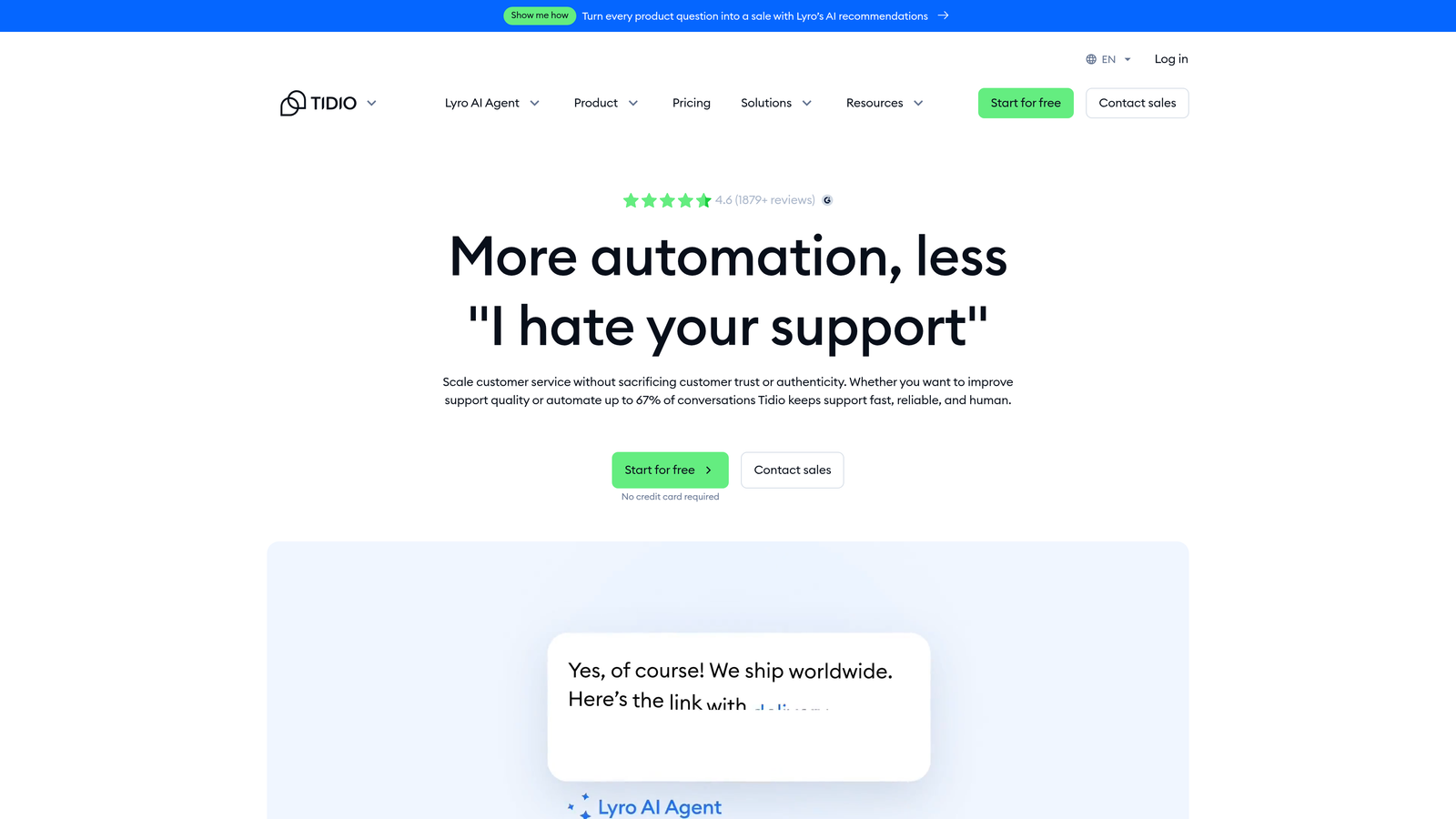
Tidio is a lightweight AI chat platform built around its Lyro AI chatbot, popular with smaller businesses and e-commerce companies that prioritize speed of deployment over enterprise depth.
Where This Tool Shines
Tidio's biggest advantage is accessibility. The free tier lets early-stage teams test AI-powered chat deflection without a financial commitment, and setup is fast enough that you can be live in hours rather than weeks. Lyro AI handles conversational FAQ resolution competently for common, predictable question types.
The e-commerce integrations with Shopify, WooCommerce, and BigCommerce make Tidio particularly strong for direct-to-consumer businesses. For pure B2B SaaS teams with complex product questions and deep integration needs, the platform's scope may feel limited compared to more specialized tools.
Key Features
Lyro AI: Conversational AI chatbot focused on chat deflection and FAQ resolution for common, repeatable questions.
E-Commerce Integrations: Native connections with Shopify, WooCommerce, and BigCommerce for order-related support workflows.
Live Chat Fallback: Smooth handoff to human agents when Lyro reaches the edge of its resolution capability.
Free Tier: Generous starting point that lets teams validate AI support before committing to paid plans.
Best For
Early-stage companies, SMBs, and e-commerce businesses that need fast, affordable AI chat deployment. Less suited for B2B SaaS teams that need deep product integrations or autonomous resolution of complex technical questions.
Pricing
Free tier available. Paid plans start at approximately $29/month, making it one of the most accessible options on this list.
6. Forethought
Best for: Teams with an existing helpdesk investment that want to improve triage accuracy and agent productivity without replacing their current setup.
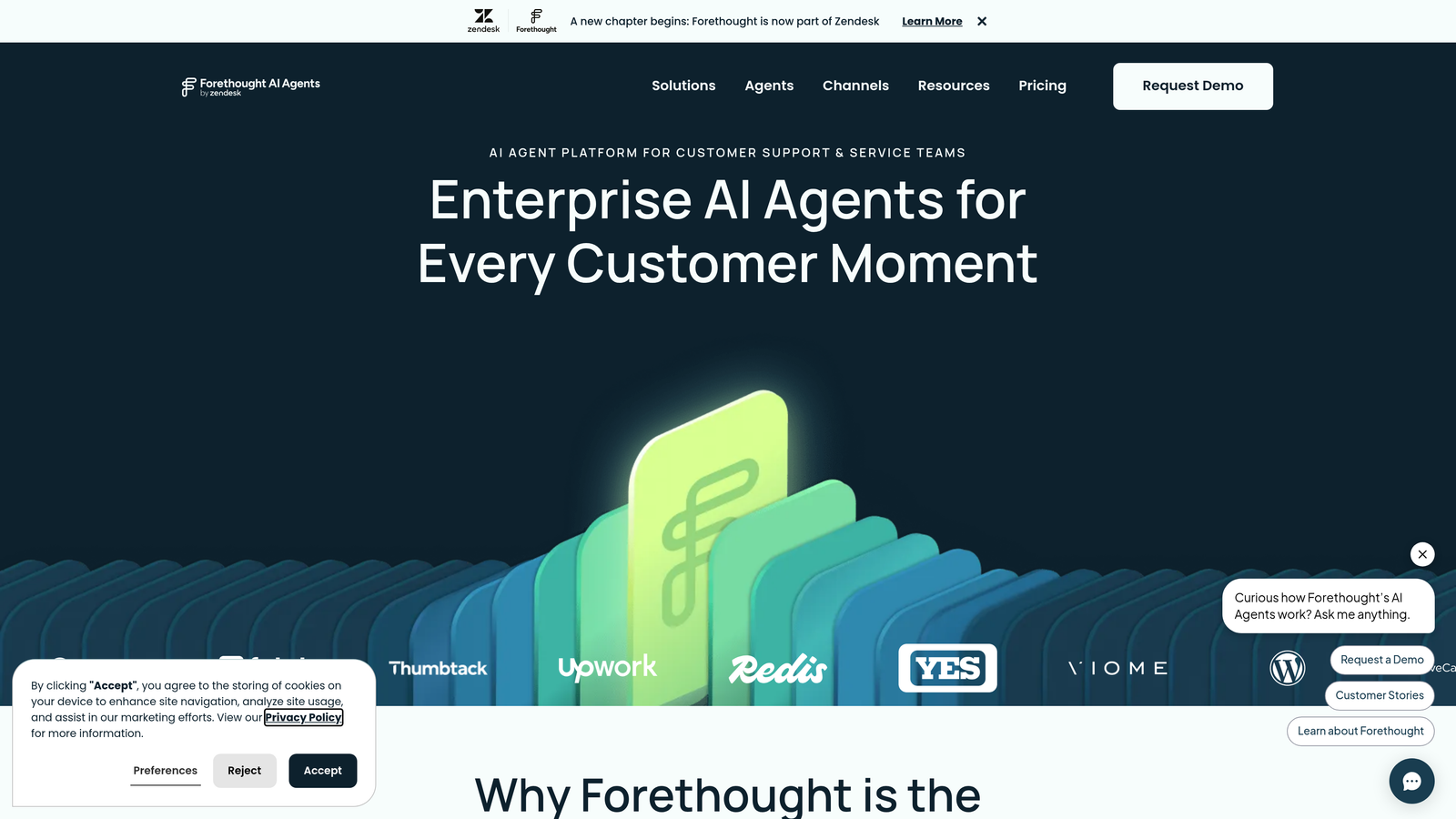
Forethought is an AI intelligence layer designed to sit on top of existing helpdesks, focused on triage accuracy, routing, and agent-assist suggestions rather than replacing your current infrastructure.
Where This Tool Shines
Forethought's Agatha AI is purpose-built for routing accuracy. If misrouted tickets are a significant source of inefficiency in your support operation, Forethought addresses that problem directly without requiring a platform migration. It layers cleanly onto Zendesk, Salesforce Service Cloud, and other established helpdesks.
The Agent Assist feature surfaces relevant knowledge base articles and suggested responses in real time, reducing the time agents spend searching for context. Solve, Forethought's deflection module, handles common and repeatable questions before they enter the agent queue.
Key Features
Agatha AI Triage: Intelligent ticket classification and routing with high accuracy, reducing misrouted tickets and queue inefficiency.
Agent Assist: Surfaces relevant knowledge base content and suggested responses in real time during live agent conversations.
Solve: AI-powered deflection module for handling common, predictable support questions before they reach agents.
Helpdesk-Agnostic Architecture: Designed to layer on top of Zendesk, Salesforce Service Cloud, and other established platforms without requiring migration.
Best For
Companies with significant existing investment in Zendesk or Salesforce Service Cloud that want to improve AI capability without a full platform switch. A practical choice when migration risk is high but efficiency gains are needed quickly.
Pricing
Contact sales for pricing. Forethought is positioned as an enterprise-grade add-on, so expect pricing to reflect that.
7. Kustomer
Best for: High-volume consumer-facing operations that need unified customer data and AI-powered routing in a CRM-native environment.
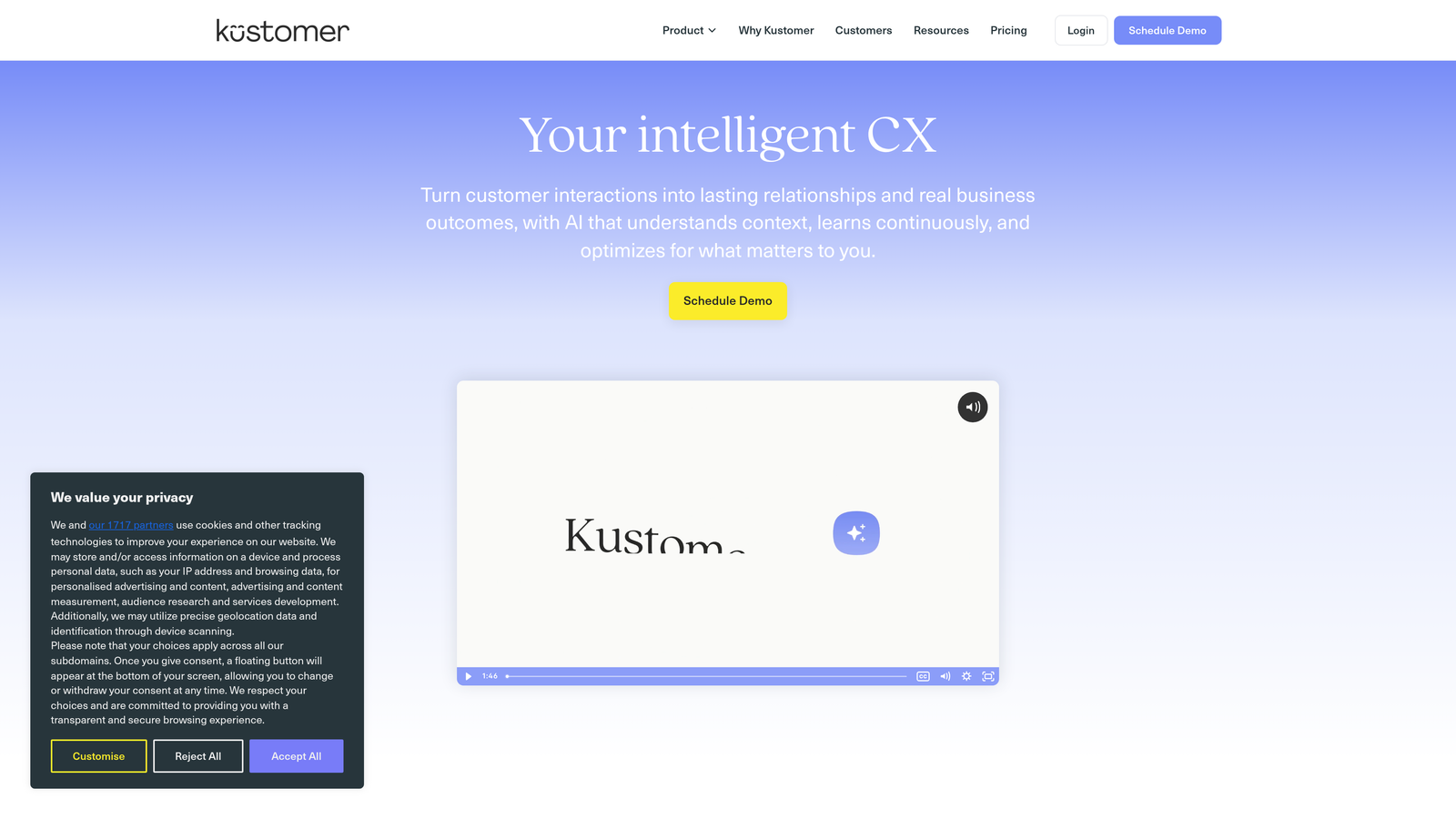
Kustomer is a CRM-native support platform that combines full customer timeline data with AI-powered routing and automation, particularly strong for B2C and D2C companies handling large interaction volumes.
Where This Tool Shines
Kustomer's defining characteristic is the customer timeline view: a single pane showing the complete history of purchases, interactions, and behavior for any given customer. This context-rich environment makes AI routing decisions more accurate because the system has more signal to work with than ticket content alone.
For teams where support and CRM data have historically lived in separate systems, Kustomer's unified architecture removes that friction by default. The tradeoff is that it's more commonly adopted in high-volume B2C operations than in pure B2B SaaS environments.
Key Features
Customer Timeline View: Full history of purchases, interactions, and behavior in a single pane, giving agents and AI complete context for every conversation.
AI-Powered Routing: Intelligent conversation assignment based on customer data, agent skills, and conversation context.
Automation Workflows: Configurable automation for repetitive ticket patterns, reducing manual handling of predictable issue types.
CRM-Native Architecture: Support and customer data are unified by default, eliminating the integration overhead of connecting separate systems.
Best For
High-volume consumer-facing brands where customer purchase history and behavior context are critical to support quality. Less common in pure B2B SaaS environments, but worth evaluating if unified CRM and support data is a priority.
Pricing
Per-agent pricing model. Contact Kustomer for current rates.
8. Help Scout
Best for: Smaller teams that prioritize clean UX and high-quality customer interactions over automation volume.
Help Scout is a human-first support platform with thoughtfully integrated AI assist features, built for teams where conversation quality matters as much as efficiency.
Where This Tool Shines
Help Scout has earned a loyal following for its clean, minimal UX and its philosophy of keeping humans genuinely in the loop rather than automating them out of the picture. The AI features added in recent years reflect that same restraint: they assist agents without trying to replace them.
AI Summarize and AI Drafts are genuinely useful for teams handling varied, nuanced conversations. Rather than forcing agents to read entire threads before responding, Summarize provides instant context. Drafts suggests replies based on conversation context and knowledge base content, which agents can refine rather than send verbatim.
Key Features
AI Summarize: Instant conversation summaries that let agents get up to speed quickly when context-switching between tickets.
AI Drafts: Suggested reply drafts generated from conversation context and knowledge base content, ready for agent review and editing.
Beacon Chat Widget: Self-service and proactive messaging capabilities for website and in-app support.
Team Collaboration Features: Clean shared inbox with strong internal notes, assignment, and collaboration tools for small to mid-sized teams.
Best For
Smaller support teams that handle complex, relationship-driven conversations and want AI to make agents faster without removing human judgment. Not the right fit if autonomous resolution at scale is the primary goal.
Pricing
Tiered plans starting around $20/user/month, making it one of the more affordable options for teams that don't need enterprise-scale automation.
9. Drift (Salesloft)
Best for: B2B companies where support and sales conversations overlap and pipeline intelligence matters alongside ticket resolution.
Drift, now part of Salesloft, is a conversational AI platform positioned at the intersection of sales and support, with deep CRM integrations and revenue-focused analytics built into its core.
Where This Tool Shines
Drift's differentiation is its revenue orientation. Where most support tools measure success in deflection rates and resolution times, Drift connects conversation outcomes to pipeline metrics. For B2B companies where a support conversation can turn into an expansion opportunity, that framing matters.
The meeting scheduling and routing built directly into chat flows is a practical feature for sales-assisted support models. Deep integrations with Salesforce and HubSpot mean conversation data flows into your CRM without manual logging, keeping revenue teams informed of customer health signals from support interactions.
Key Features
Conversational AI: Handles both support deflection and sales qualification workflows within the same chat interface.
CRM Integrations: Deep native connections with Salesforce and HubSpot, automatically logging conversation data and customer signals.
Meeting Scheduling: Built-in routing and scheduling capabilities that convert support conversations into sales meetings without friction.
Revenue Analytics: Connects conversation outcomes to pipeline data, giving revenue teams visibility into how support interactions influence deals.
Best For
B2B companies with a sales-assisted motion where support and revenue conversations frequently overlap. Less suited for teams that need pure support automation without a sales layer built in.
Pricing
Contact sales for pricing. Drift is positioned as an enterprise and mid-market solution, and pricing reflects the combined Salesloft platform investment.
Which Tool Is Right for Your Growing Company?
The right AI support tool depends heavily on where you are in your growth journey and what you need the tool to do beyond answering tickets.
If you're a B2B SaaS company that needs genuine autonomous resolution, product intelligence, and a support platform that gets smarter over time, Halo AI is the strongest fit. Its AI-first architecture, page-aware context, and business intelligence layer address the full scope of what growing companies need from support, not just faster ticket handling.
If you're already invested in the Intercom ecosystem, Intercom with Fin AI Agent is a natural next step. For large enterprise teams managing multi-channel complexity, Zendesk AI offers the broadest coverage. Teams looking for accessible AI breadth without enterprise pricing will find Freshdesk Freddy AI worth a close look, while Forethought is the smart choice if you want to improve your existing helpdesk without migrating away from it.
When evaluating any of these tools, focus on three things: how autonomous resolution actually works (not just how it's marketed), whether pricing scales predictably with your growth, and how deeply the tool connects to the rest of your stack. A support tool that integrates with your CRM, billing system, and engineering tools compounds in value over time. One that lives in isolation will eventually become a bottleneck.
Your support team shouldn't scale linearly with your customer base. Let AI agents handle routine tickets, guide users through your product, and surface business intelligence while your team focuses on complex issues that need a human touch. See Halo in action and discover how continuous learning transforms every interaction into smarter, faster support.