9 Best AI Support Tools for SaaS Platforms in 2026
This guide reviews the 9 best AI support tools for SaaS platforms in 2026, evaluating each solution on autonomy, integrations, and SaaS-specific workflows like bug escalation and churn prevention. It helps SaaS teams scale customer support efficiently without growing headcount, covering tools that go beyond basic chatbots to autonomously resolve tickets and detect customer health signals.
 Grant CooperFounder13 min read
SaaS teams are under constant pressure to scale support without scaling headcount. As product complexity grows and user expectations rise, traditional helpdesk workflows buckle under ticket volume, slow response times, and reactive triaging. The good news: AI support tools have matured significantly, moving well beyond scripted chatbots into systems that resolve tickets autonomously, detect customer health signals, and integrate across your entire business stack.
This guide covers the top AI support tools built for SaaS platforms in 2026. Whether you're evaluating your first AI layer or replacing a bolt-on chatbot that never quite delivered, this list will help you find the right fit. We've assessed each tool on autonomy depth, integration breadth, learning capabilities, and how well it serves SaaS-specific workflows like bug escalation, onboarding guidance, and churn prevention.
1. Halo AI
Best for: SaaS teams wanting AI-first architecture with business intelligence and page-aware context
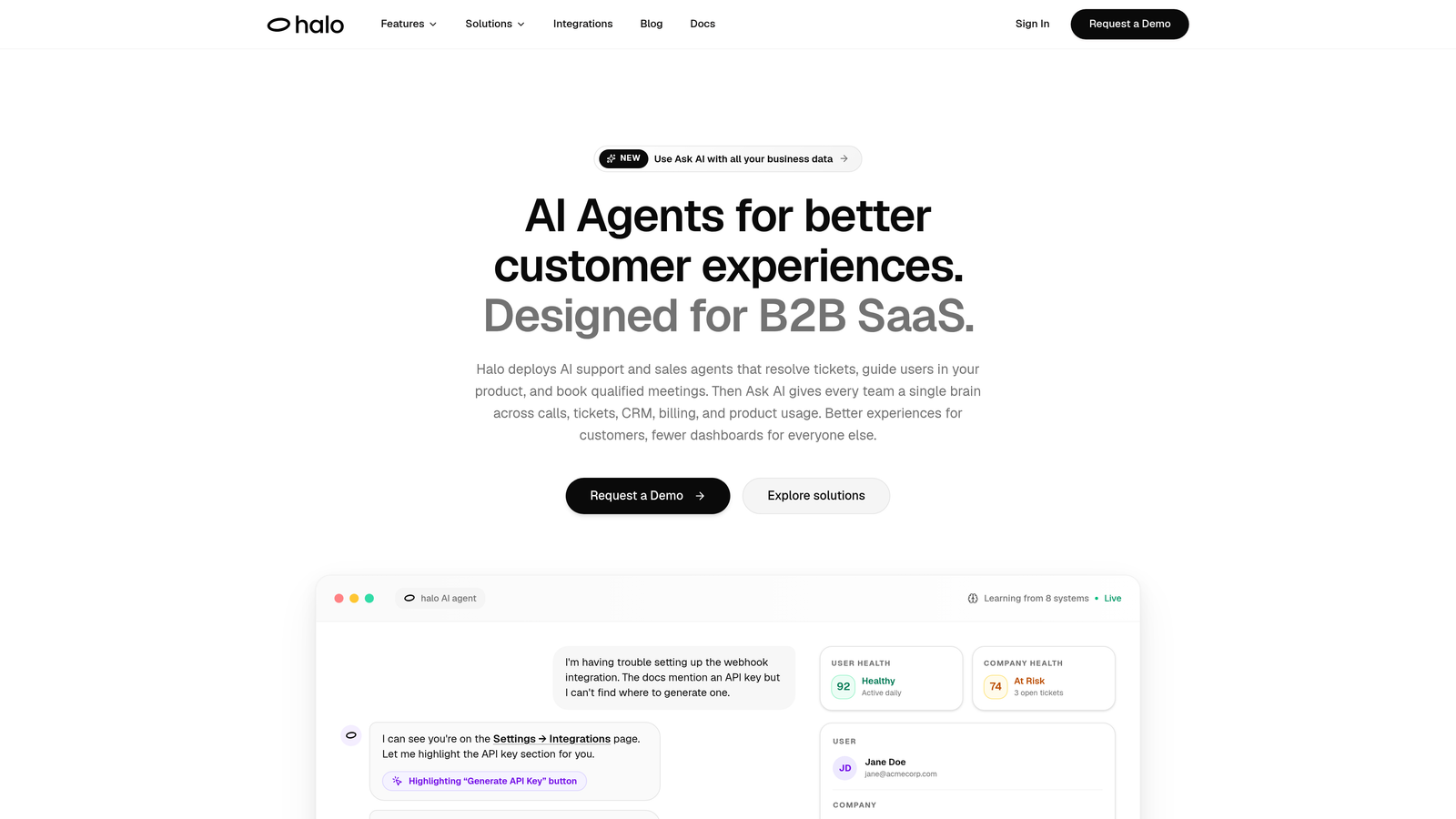
Halo AI is an AI-first customer support platform built specifically for SaaS teams, deploying intelligent agents that resolve tickets, guide users with page-aware context, auto-create bug reports, and surface business intelligence signals.
Where This Tool Shines
What sets Halo apart from most tools on this list is its architecture. Rather than layering AI onto an existing helpdesk, Halo was built AI-first from the ground up. That distinction matters in practice: the system doesn't just deflect tickets, it understands them, resolves them, and learns from every interaction without requiring manual retraining.
The page-aware chat widget is a particularly compelling feature for SaaS products. Instead of asking users to describe where they are in the product, Halo sees what the user sees, enabling guidance that's precise and contextual. Pair that with auto bug ticket creation connected to tools like Linear, and you have a support layer that actively feeds your product team, not just your inbox.
Key Features
Page-Aware Chat Widget: Sees exactly where users are in your product to deliver contextually accurate guidance without requiring users to explain their situation.
Autonomous Ticket Resolution: Handles tickets end-to-end with intelligent handoff to live agents when complexity warrants human involvement.
Auto Bug Ticket Creation: Automatically generates bug reports and routes them to tools like Linear, turning support conversations into actionable product intelligence.
Smart Inbox with Business Intelligence: Surfaces customer health signals, revenue intelligence, and anomaly detection — support that informs your entire business, not just your queue.
Continuous Learning: Improves from every resolved interaction without manual retraining, compounding value over time.
Cross-Stack Integrations: Connects natively with Linear, Slack, HubSpot, Intercom, Stripe, Zoom, PandaDoc, and Fathom.
Best For
B2B SaaS teams that want support to do more than deflect tickets. Halo is particularly well-suited for product teams that want bug reports auto-created, customer success teams that need health signals from support data, and companies that have outgrown bolt-on AI add-ons on legacy helpdesks.
Pricing
Contact for pricing. Halo is designed for B2B SaaS teams and offers custom plans based on team size and usage requirements.
2. Intercom (Fin AI Agent)
Best for: Teams already invested in Intercom's messenger and inbox ecosystem
Intercom Fin is an LLM-powered AI agent that resolves customer conversations using your help content and custom answers, operating natively within Intercom's messenger ecosystem.
Where This Tool Shines
Fin's biggest advantage is how naturally it fits within Intercom's existing infrastructure. If your team already runs support through Intercom's messenger and inbox, Fin drops in without requiring workflow changes or platform migrations. It draws from your help center content and custom-configured answers to resolve conversations with reasonable accuracy.
The handoff experience is also well-executed. When Fin reaches the limits of what it can resolve, it passes the conversation to a human agent with full context preserved, which prevents the frustrating experience of customers having to repeat themselves.
Key Features
LLM-Powered Resolution: Uses your help center content and custom answers to resolve conversations autonomously.
Native Intercom Integration: Works within Intercom's messenger, inbox, and workflow tools without additional setup complexity.
Context-Preserving Handoff: Transfers conversations to human agents with full conversation history intact.
Multilingual Support: Handles conversations across multiple languages, useful for SaaS teams with a global user base.
Usage-Based Pricing: Charged per resolution on top of your existing Intercom subscription, giving you flexibility as volume scales.
Best For
SaaS teams already on Intercom who want to add AI resolution without changing their support stack. Less compelling for teams not already in the Intercom ecosystem, given the subscription costs involved.
Pricing
Usage-based pricing added to existing Intercom plans. Intercom base plans start at approximately $39/month, with Fin priced per resolved conversation on top.
3. Zendesk AI
Best for: Enterprise SaaS teams with established Zendesk configurations seeking AI at scale
Zendesk AI is a native AI layer spanning intelligent triage, automated routing, agent copilot suggestions, and self-service resolution, built into the Zendesk Support Suite for enterprise-scale operations.
Where This Tool Shines
Zendesk AI earns its place for organizations that have built significant infrastructure around the Zendesk platform. The AI layer integrates across Support, Guide, and Talk, meaning you can apply intelligence across the full support workflow without stitching together third-party tools.
The agent copilot is particularly useful for larger teams where consistency matters. Suggested replies and real-time knowledge surfacing help agents respond faster and more accurately, reducing variance in support quality across a big team.
Key Features
Intelligent Triage and Routing: Classifies tickets by intent, sentiment, and priority, routing them to the right agent or queue automatically.
Agent Copilot: Provides suggested replies and surfaces relevant knowledge articles in real time as agents work tickets.
AI-Powered Self-Service: Powers Zendesk Guide with AI to help users find answers without opening tickets.
Advanced Analytics and QA: Includes quality assurance tools and analytics for monitoring support performance at scale.
Full Suite Integration: AI capabilities span the entire Zendesk product suite, creating a unified intelligent support environment.
Best For
Mid-market to enterprise SaaS companies already running on Zendesk. Teams starting fresh or looking for a more AI-native approach may find Zendesk's AI layer feels like an addition rather than a foundation.
Pricing
AI features are included in Suite Professional and above. Zendesk Suite plans start at approximately $115/agent/month.
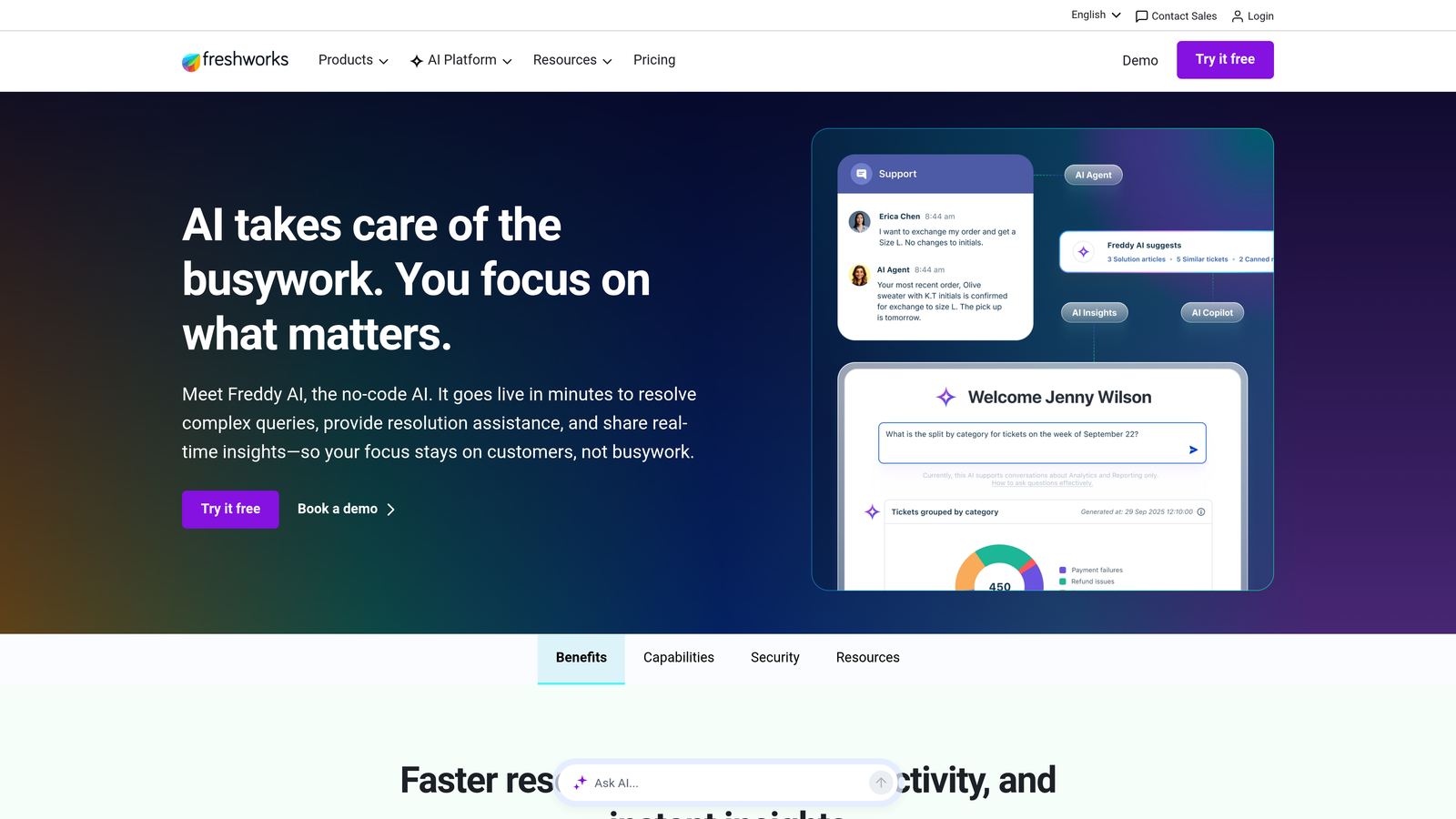
4. Freshdesk Freddy AI
Best for: SMB and mid-market SaaS teams on the Freshworks platform looking for accessible AI pricing
Freshdesk Freddy AI is Freshworks' multi-component AI layer covering self-service bots, agent assist, and analytics, making it a well-rounded option for teams already in the Freshworks ecosystem.
Where This Tool Shines
Freddy AI's three-component structure gives teams flexibility in how they deploy AI. You can start with the self-service bot for autonomous resolution, add the copilot for agent assist, and layer in Freddy Insights for trend detection as your maturity grows. That modularity is useful for teams that want to phase in AI rather than flip a switch.
Compared to Zendesk's AI pricing, Freshdesk's approach is meaningfully more accessible for smaller teams. If you're a growing SaaS company watching your support costs closely, that difference matters.
Key Features
Freddy Self Service: AI bot that handles autonomous customer resolution using your knowledge base and configured responses.
Freddy Copilot: Real-time agent assist with suggested responses, ticket summaries, and next-best-action recommendations.
Freddy Insights: Analytics layer that surfaces trends, anomalies, and performance signals across your support data.
Cross-Product Availability: Freddy AI spans Freshdesk, Freshsales, and other Freshworks products, creating continuity across your stack if you use multiple Freshworks tools.
Competitive Pricing: More accessible than many enterprise alternatives, particularly for smaller team sizes.
Best For
SMB and mid-market SaaS teams already using Freshworks products who want a capable AI layer without the enterprise price tag. Teams outside the Freshworks ecosystem will need to factor in migration effort.
Pricing
Freddy Copilot is available as an add-on. Freshdesk plans start free, with paid plans from approximately $15/agent/month.
5. Tidio
Best for: SaaS startups needing fast AI support deployment with minimal technical overhead
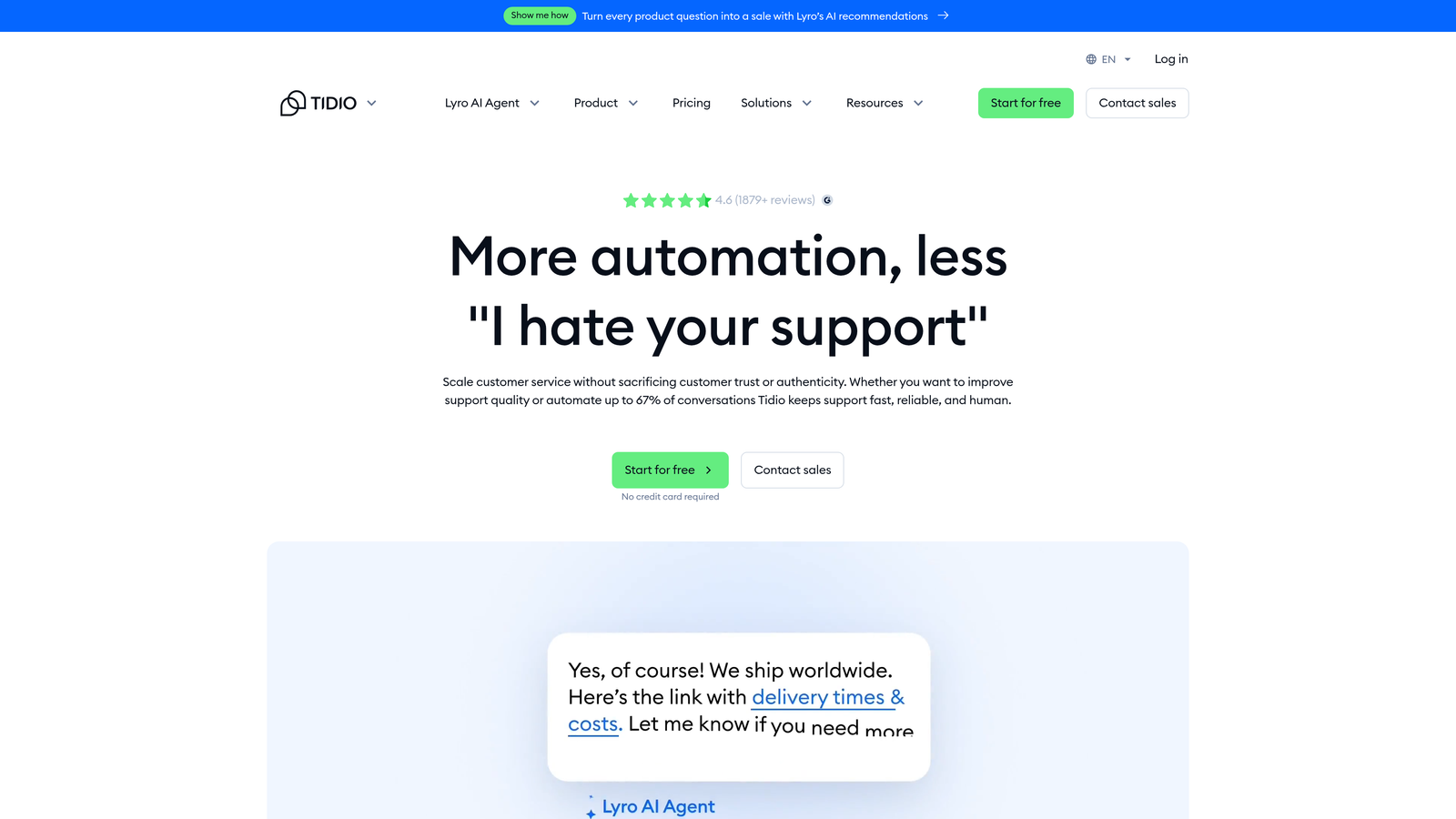
Tidio combines a visual chatbot builder with Lyro, its AI-powered conversation agent, making it one of the fastest tools to deploy for SaaS startups that need immediate AI support coverage.
Where This Tool Shines
Speed to deployment is Tidio's clearest differentiator. While enterprise tools require configuration, training, and integration work measured in weeks, Tidio can typically be live in hours. The visual flow builder means non-technical team members can create and modify chatbot paths without engineering involvement.
Lyro handles automated conversation resolution for common queries, with smooth handoff to live agents when needed. For early-stage SaaS teams that need coverage without a dedicated support infrastructure, Tidio provides a practical starting point.
Key Features
Lyro AI Agent: Handles automated conversation resolution for frequently asked questions and common support scenarios.
Visual Flow Builder: Drag-and-drop chatbot path creation accessible to non-technical team members.
Live Chat with Handoff: Smooth transition from AI to human agents when conversations exceed automated handling.
SaaS and E-Commerce Integrations: Connects with popular tools commonly used by growing SaaS and e-commerce teams.
Fast Setup: Deployable in hours rather than weeks, with minimal technical configuration required.
Best For
Early-stage SaaS startups and small teams that need AI support coverage quickly and affordably. Less suited for enterprise SaaS with complex workflows, deep integration requirements, or high-volume ticket environments.
Pricing
Free plan available. Paid plans start at approximately $29/month. Lyro AI is priced by conversation volume, allowing costs to scale with usage.
6. Forethought
Best for: SaaS teams wanting AI on top of their existing helpdesk without migrating platforms
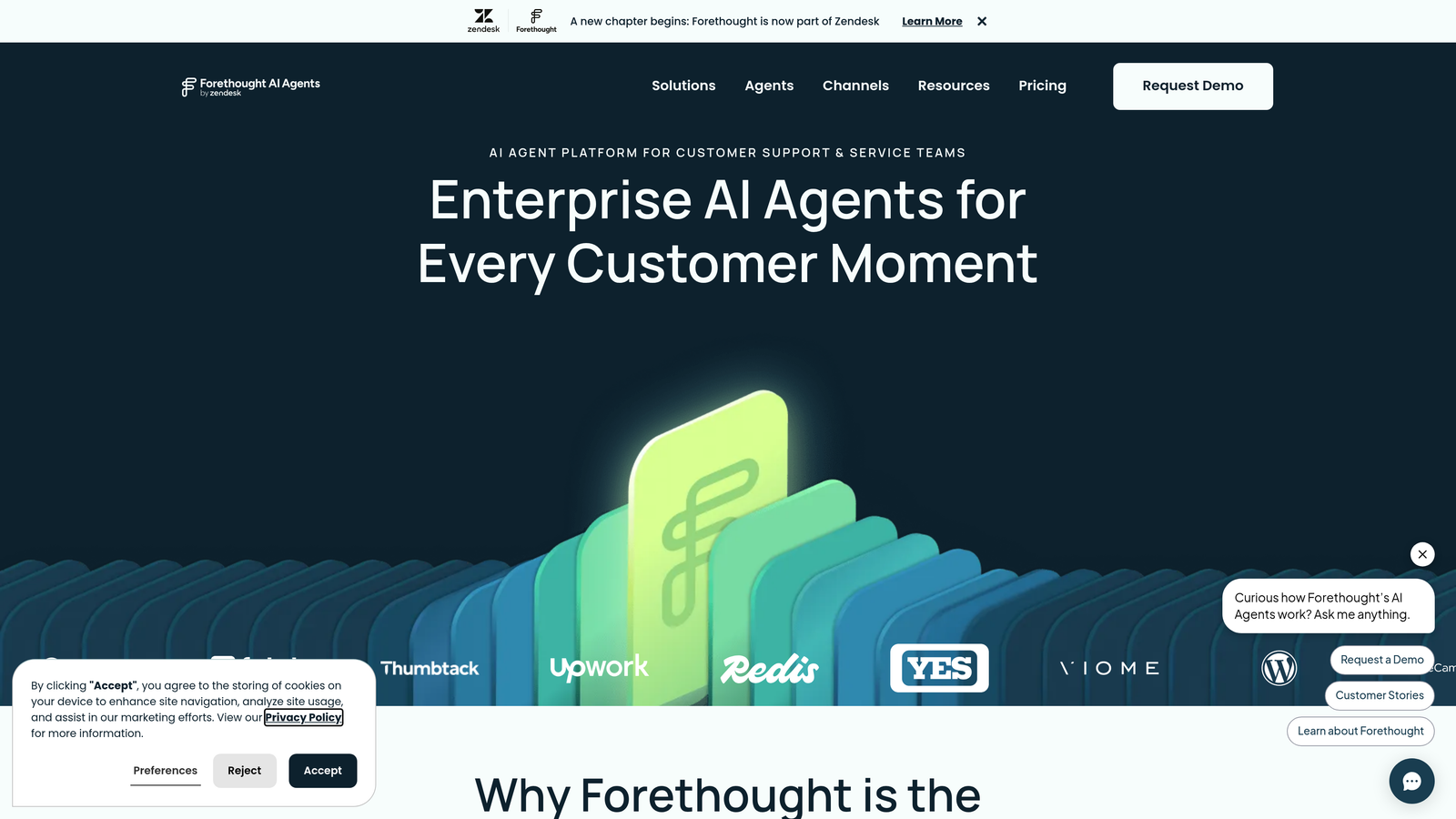
Forethought is a helpdesk-agnostic AI layer that sits on top of existing support tools like Zendesk, Salesforce, and Freshdesk, offering AI triage, resolution, agent assist, and analytics without requiring a platform switch.
Where This Tool Shines
Forethought's core value proposition is clear: if you've built years of workflow and data inside an existing helpdesk and don't want to migrate, Forethought brings AI to where you already are. This is a meaningful advantage for teams that have significant institutional knowledge locked into their current platform configuration.
The Discover component is worth highlighting specifically for SaaS teams. It surfaces knowledge gaps and support trends from your ticket data, helping you identify where your documentation is falling short or where product issues are generating disproportionate volume.
Key Features
Solve: AI agent for autonomous ticket resolution that works within your existing helpdesk environment.
Triage: Intelligent ticket routing and priority classification to ensure tickets reach the right agent or queue.
Assist: Agent copilot that surfaces contextually relevant knowledge during live ticket handling.
Discover: Analytics layer that identifies support trends, knowledge gaps, and recurring issue patterns.
Platform Agnostic: Works across multiple helpdesk platforms, removing the need for migration or workflow restructuring.
Best For
Mid-market and enterprise SaaS teams committed to their current helpdesk who want AI capabilities without switching platforms. Particularly useful for teams with high ticket volume where triage accuracy has a meaningful operational impact.
Pricing
Custom pricing based on ticket volume and features. Contact Forethought directly for a quote.
7. Kustomer
Best for: B2B SaaS teams managing complex, relationship-driven support with rich customer history
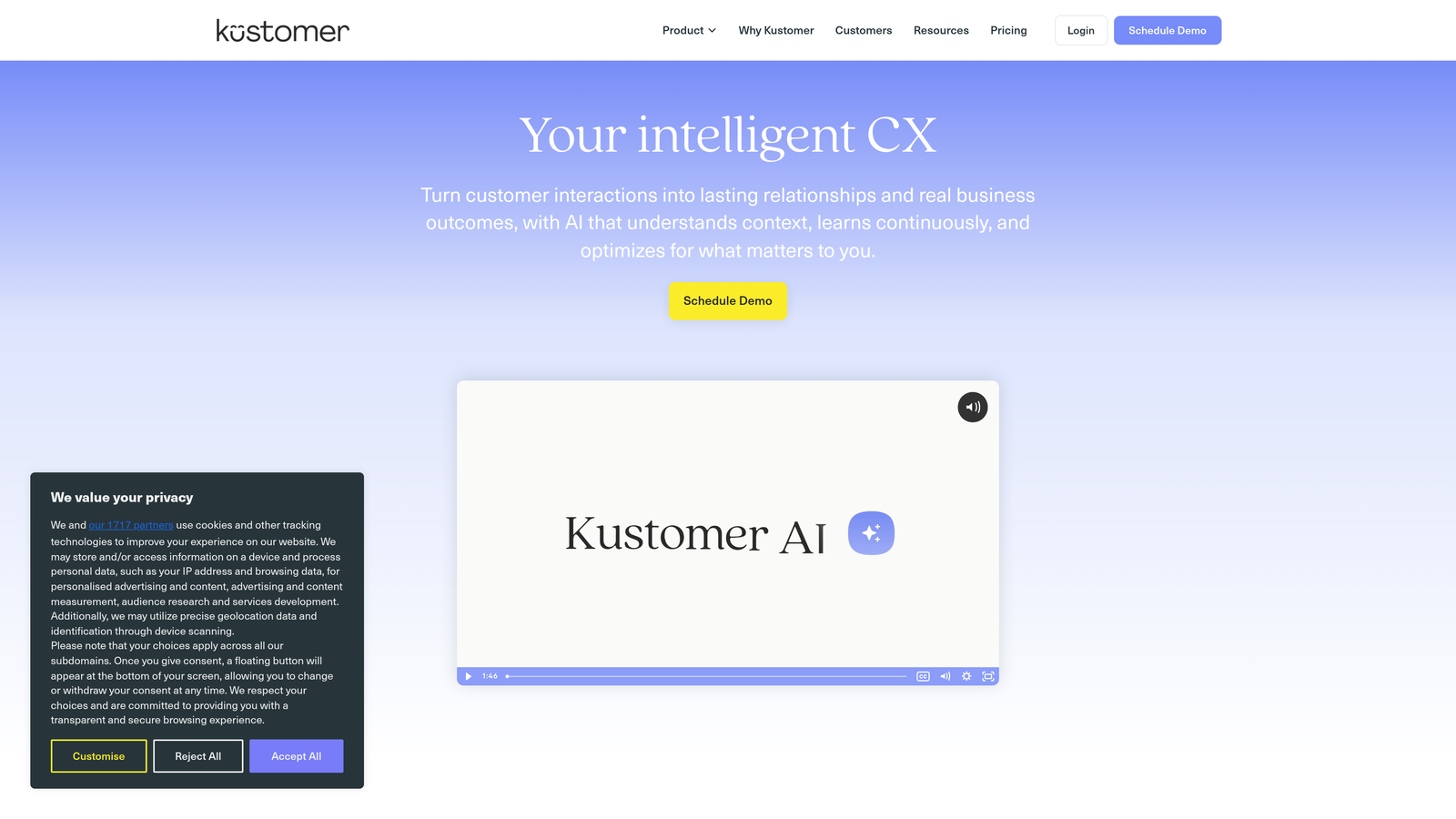
Kustomer is a CRM-native customer service platform with AI-powered conversation handling, offering a unified customer timeline that makes it well-suited for B2B SaaS teams managing high-touch, relationship-driven support.
Where This Tool Shines
Kustomer's unified customer timeline is the feature that differentiates it from most tools on this list. Rather than treating each ticket in isolation, Kustomer surfaces the full interaction history across every channel in a single view. For B2B SaaS teams where context about a customer's account, past issues, and relationship status directly affects how you respond, this is genuinely valuable.
The CRM-native architecture means support and customer data live in the same place. That eliminates the friction of switching between a helpdesk and a separate CRM to understand who you're talking to before you respond.
Key Features
Unified Customer Timeline: Full interaction history across all channels in a single view, giving agents complete context before they respond.
AI-Powered Routing and Responses: Automates conversation routing and generates AI-assisted responses based on customer context and history.
CRM-Native Architecture: Support and customer data in one platform, reducing the need to toggle between separate systems.
Omnichannel Support: Handles email, chat, social, and voice from a unified inbox.
Workflow Automation: Automates repetitive support processes to reduce manual handling for common scenarios.
Best For
B2B SaaS companies with complex customer relationships where account context is essential to quality support. Less suited for high-volume, transactional support environments where speed matters more than relationship depth.
Pricing
Plans start at approximately $89/agent/month. Enterprise pricing is available for larger teams.
8. Drift (Salesloft)
Best for: Product-led growth SaaS companies where support and sales conversations frequently overlap
Drift, now part of Salesloft, bridges support and revenue workflows with conversational AI, making it a strong fit for PLG companies where customer success and sales conversations regularly intersect.
Where This Tool Shines
Drift occupies an interesting position: it's not purely a support tool, and that's intentional. For product-led growth companies where a user might start a conversation asking a product question and end up ready to upgrade, having AI that can handle both support qualification and sales routing in the same interaction is genuinely useful.
The integration with Salesloft's broader revenue platform means conversations can flow naturally from support to sales without handoff friction. If your CS and sales teams share workflows or if your support team is expected to identify expansion opportunities, Drift's positioning makes sense.
Key Features
Conversational AI for Support and Sales: Handles both support resolution and sales qualification within the same chat interface.
Intelligent Routing: Routes conversations to the right team, support or sales, based on intent signals detected in real time.
AI-Powered Meeting Scheduling: Books meetings and qualifies leads directly within chat conversations.
Salesloft Revenue Platform Integration: Connects with Salesloft's broader suite for teams that want support and revenue data in one ecosystem.
PLG-Optimized Workflows: Designed for companies where the product drives acquisition and the support experience directly influences conversion.
Best For
PLG SaaS companies with blended customer success and sales motions. Less suited for teams that need pure-play support depth or those outside the Salesloft ecosystem.
Pricing
Custom pricing through Salesloft. Contact for a quote based on your team size and use case.
9. Chatwoot
Best for: Technical SaaS teams that want full infrastructure control and open-source flexibility
Chatwoot is an open-source customer support platform that technical SaaS teams can self-host and customize, with a growing ecosystem of AI integrations for teams that want complete control over their support infrastructure.
Where This Tool Shines
Chatwoot's appeal is specific: if your team has the technical capability to self-host and the requirement to own your data entirely, no other tool on this list gives you that combination at this price point. The open-source community is active, and the codebase is extensible for teams that want to build custom functionality.
The AI capabilities require more configuration than plug-and-play alternatives. Chatwoot integrates with OpenAI and supports custom LLM connections, but you'll need to set that up intentionally. For teams comfortable doing that work, the result is a support platform that fits your exact requirements rather than a vendor's product roadmap.
Key Features
Open-Source and Self-Hostable: Full data ownership and infrastructure control, with the ability to audit and modify the codebase.
Omnichannel Inbox: Handles email, live chat, social channels, and WhatsApp from a unified interface.
Growing AI Integration Ecosystem: Supports OpenAI connections and custom LLM integrations for teams that want to configure AI capabilities.
Active Community: Regular releases and an engaged open-source community that contributes features and fixes.
Cloud Option Available: Managed cloud hosting for teams that want Chatwoot's flexibility without self-managing infrastructure.
Best For
Technical SaaS teams with data sovereignty requirements, infrastructure preferences, or the desire to build a fully customized support experience. Not the right fit for teams that need AI capabilities out of the box without configuration work.
Pricing
Open-source self-hosted version is free. Cloud-hosted plans start at approximately $19/month.
Which Tool Is Right for Your SaaS Team?
The right AI support tool depends heavily on where your team is today and what you're optimizing for. Here's a practical way to think through the decision.
If you're an early-stage startup needing fast deployment: Tidio gets you live in hours with minimal technical overhead and a free starting tier. It won't scale to enterprise complexity, but it's the right tool for getting AI coverage in place quickly.
If you're already on Zendesk or Freshdesk: The native AI add-ons are the path of least resistance. Zendesk AI suits larger teams with established configurations. Freshdesk Freddy AI offers comparable capability at more accessible pricing for smaller teams.
If you don't want to change your helpdesk: Forethought sits on top of your existing platform and adds AI triage, resolution, and analytics without requiring migration. It's a strong option for teams with significant investment in their current setup.
If data ownership and customization are non-negotiable: Chatwoot's open-source architecture gives technical teams full control. Bring your own LLM and build exactly what you need.
If you want AI-first architecture with business intelligence beyond ticket deflection: Halo AI is built differently from the ground up. Page-aware context, continuous learning, auto bug ticket creation, and a smart inbox that surfaces customer health signals and revenue intelligence make it the strongest fit for SaaS teams that want support to actively inform the business, not just manage the queue.
Your support team shouldn't scale linearly with your customer base. Let AI agents handle routine tickets, guide users through your product, and surface business intelligence while your team focuses on complex issues that need a human touch. See Halo in action and discover how continuous learning transforms every interaction into smarter, faster support.