9 Best AI Support Tools for SaaS Products in 2026
Discover the 9 best AI support tools built specifically for SaaS products in 2026, designed to handle complex workflow questions, resolve tickets autonomously, and scale support capacity without proportional headcount growth. This guide evaluates each platform on integration depth, contextual awareness, and SaaS-specific functionality to help teams find the right AI support for SaaS products at any stage of growth.
 Grant CooperFounder14 min read
SaaS companies face a support challenge that's genuinely different from everyone else's. Your users aren't just asking "where's my order?" — they're navigating complex workflows, hitting unexpected errors, and expecting help that actually understands the product they're using. Generic chatbot deflection doesn't cut it. Neither does a support team that grows one hire for every thousand new users.
As ticket volumes scale alongside your user base, the gap between customer expectations and support capacity widens fast. AI support tools purpose-built for SaaS products bridge that gap by resolving tickets autonomously, guiding users through complex workflows, and surfacing insights that help product teams build better software.
The market is crowded, though, and not every AI tool is designed with SaaS-specific needs in mind. We evaluated dozens of platforms and narrowed the field to nine that stand out for SaaS teams in 2026 — based on integration depth, contextual awareness, autonomous resolution capabilities, and value for scaling companies. Whether you're a startup looking to delay your first support hire or an established product team looking to reduce ticket backlog, this list has a tool for you.
1. Halo AI
Best for: SaaS teams that need AI-first, context-aware support with business intelligence built in
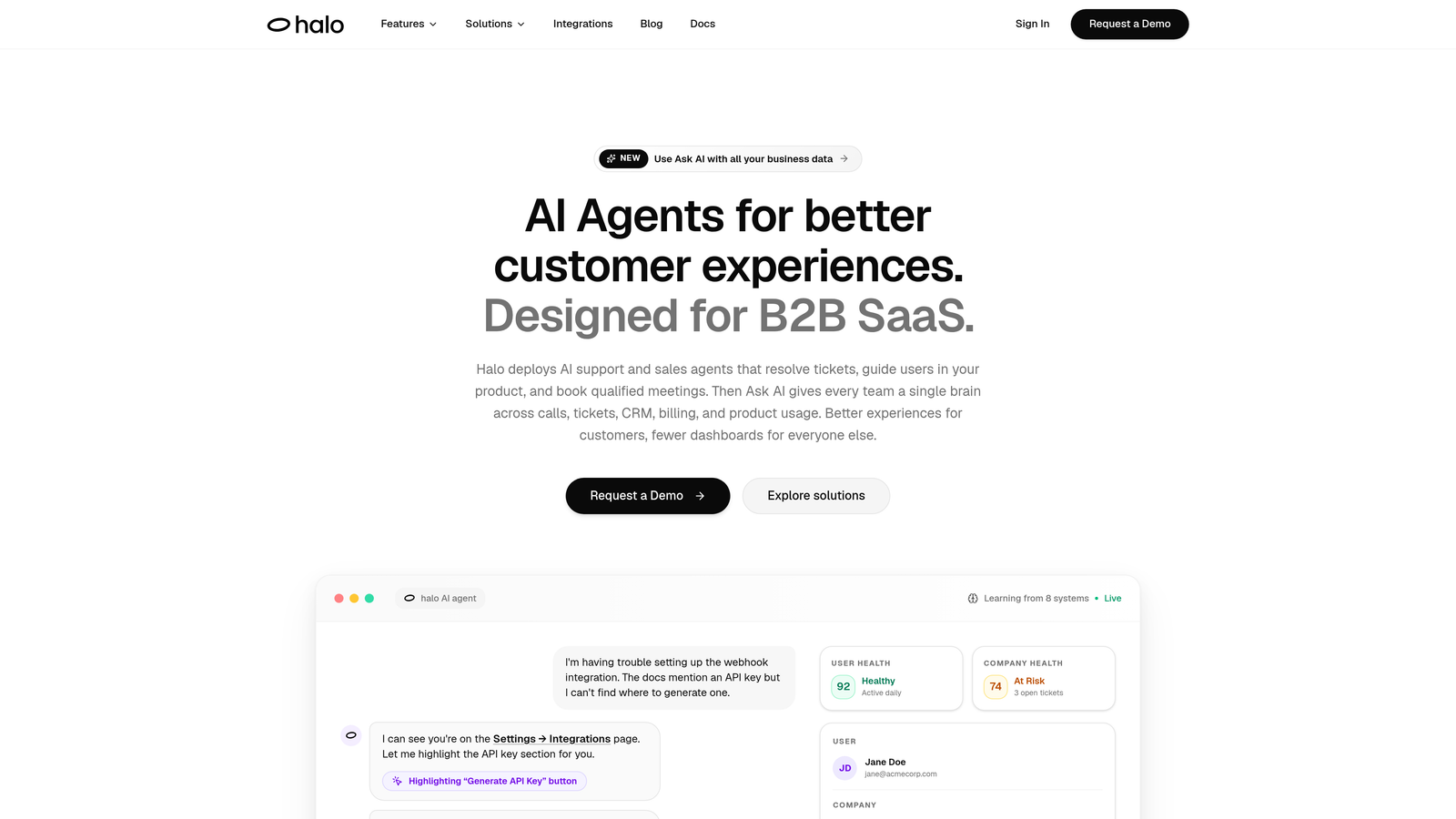
Halo AI is an AI-first customer support platform that deploys autonomous agents to resolve tickets, guide users with page-aware context, and surface business intelligence from every support interaction.
Where This Tool Shines
What separates Halo from most tools on this list is its architecture. It was built from the ground up as an AI-first platform, not a helpdesk that bolted on AI features after the fact. That distinction matters in practice: the autonomous resolution capabilities run deeper, and the system learns continuously from every interaction rather than relying solely on static knowledge base content.
The page-aware chat widget is a standout feature for SaaS products specifically. The AI can see what screen a user is on and provide visual UI guidance — so instead of sending someone a generic article, it can walk them through the exact interface they're looking at. That's the kind of contextual support SaaS users actually expect.
Key Features
Page-Aware Chat Widget: Understands the user's current screen and delivers visual UI guidance tailored to their exact context within the product.
Autonomous AI Agents: Resolve support tickets end-to-end and continuously learn from every interaction to improve resolution quality over time.
Smart Inbox with Business Intelligence: Goes beyond ticket management to surface customer health scores, revenue signals, and anomaly detection from support data.
Auto Bug Ticket Creation: Automatically generates bug reports with full context and routes them directly to engineering tools like Linear — no manual handoff required.
Deep SaaS Stack Integrations: Connects natively with Slack, HubSpot, Intercom, Stripe, Zoom, PandaDoc, and Fathom, making it a central intelligence layer across your entire product stack.
Best For
B2B SaaS teams of any size that want AI support to do more than deflect tickets. Particularly strong for product teams that want support interactions to feed back into development and customer success workflows, and for companies that need support intelligence to inform churn risk and revenue decisions.
Pricing
Contact for pricing. Designed for B2B SaaS teams of all sizes, with a platform built to scale alongside your product and customer base.
2. Intercom Fin
Best for: Intercom users who want native AI resolution without switching platforms
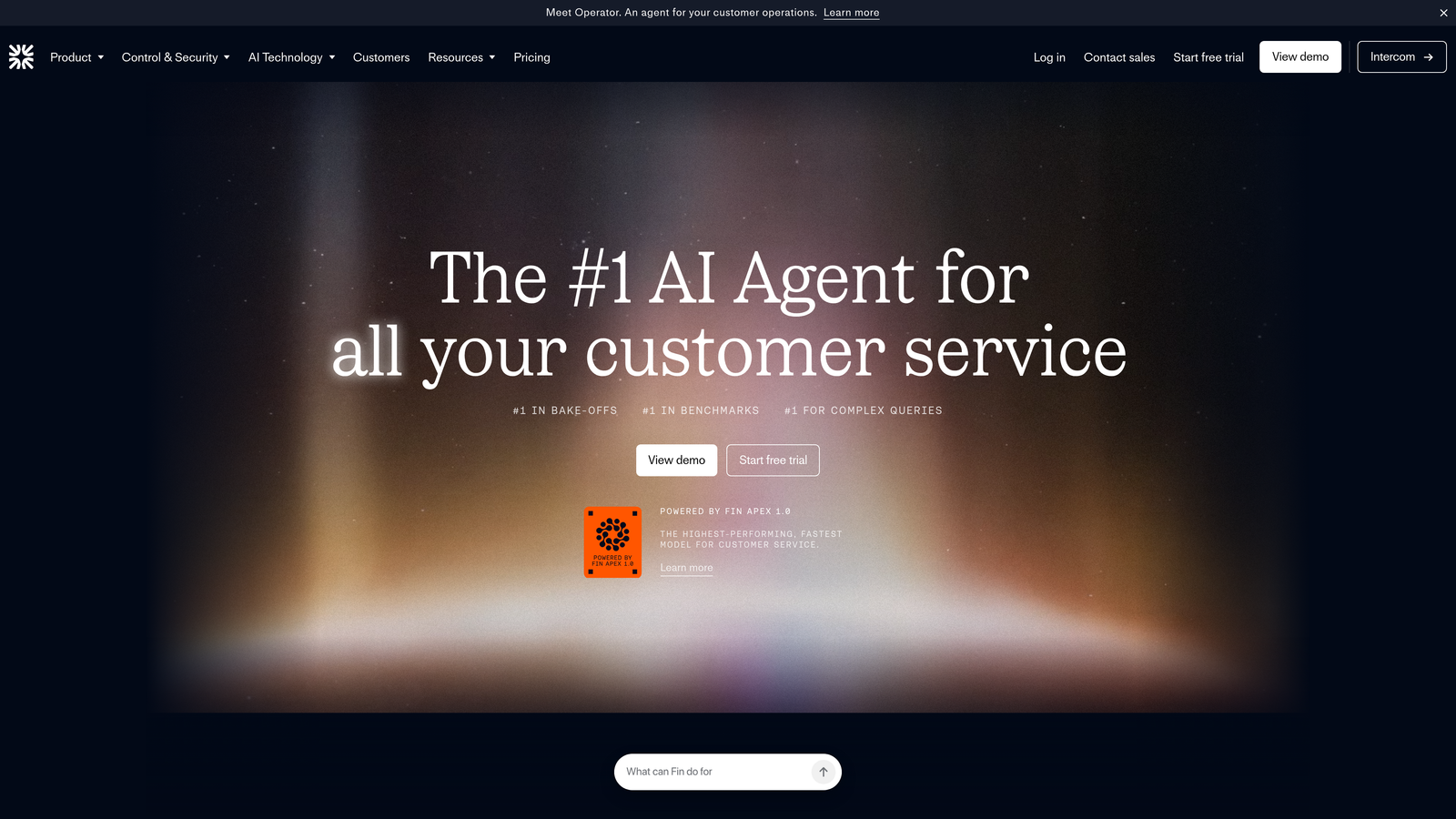
Intercom Fin is Intercom's native AI agent that resolves customer questions using your existing help center content, conversation history, and custom data sources.
Where This Tool Shines
If your team is already living inside Intercom, Fin is the path of least resistance to AI-powered resolution. It draws on your existing help center articles, past conversation history, and custom data sources to answer questions without requiring you to rebuild your knowledge base elsewhere. Setup is relatively fast for teams with mature Intercom content libraries.
The handoff experience is genuinely smooth. When Fin can't resolve something, it passes the conversation to a human agent within the same Intercom inbox with full context intact — no awkward transitions or lost conversation history that frustrates both agents and customers.
Key Features
Multi-Source Answers: Draws from help center articles, past conversations, and custom data to generate accurate, contextual responses.
Seamless Human Handoff: Escalates to live agents within the Intercom inbox with full conversation context preserved.
Multi-Language Support: Handles conversations in multiple languages with automatic translation built in.
Customizable AI Persona: Lets you configure tone of voice and personality to match your brand voice.
Usage-Based Pricing: Pay per resolution rather than per seat, which can be cost-effective for teams with variable ticket volumes.
Best For
SaaS teams already using Intercom as their primary support and messaging platform who want to add AI resolution without migrating to a new tool. Less compelling for teams not already in the Intercom ecosystem.
Pricing
Starts at approximately $0.99 per resolution. Verify current pricing on the Intercom website, as rates may have been updated.
3. Zendesk AI
Best for: Enterprise SaaS teams with high ticket volume and complex support operations
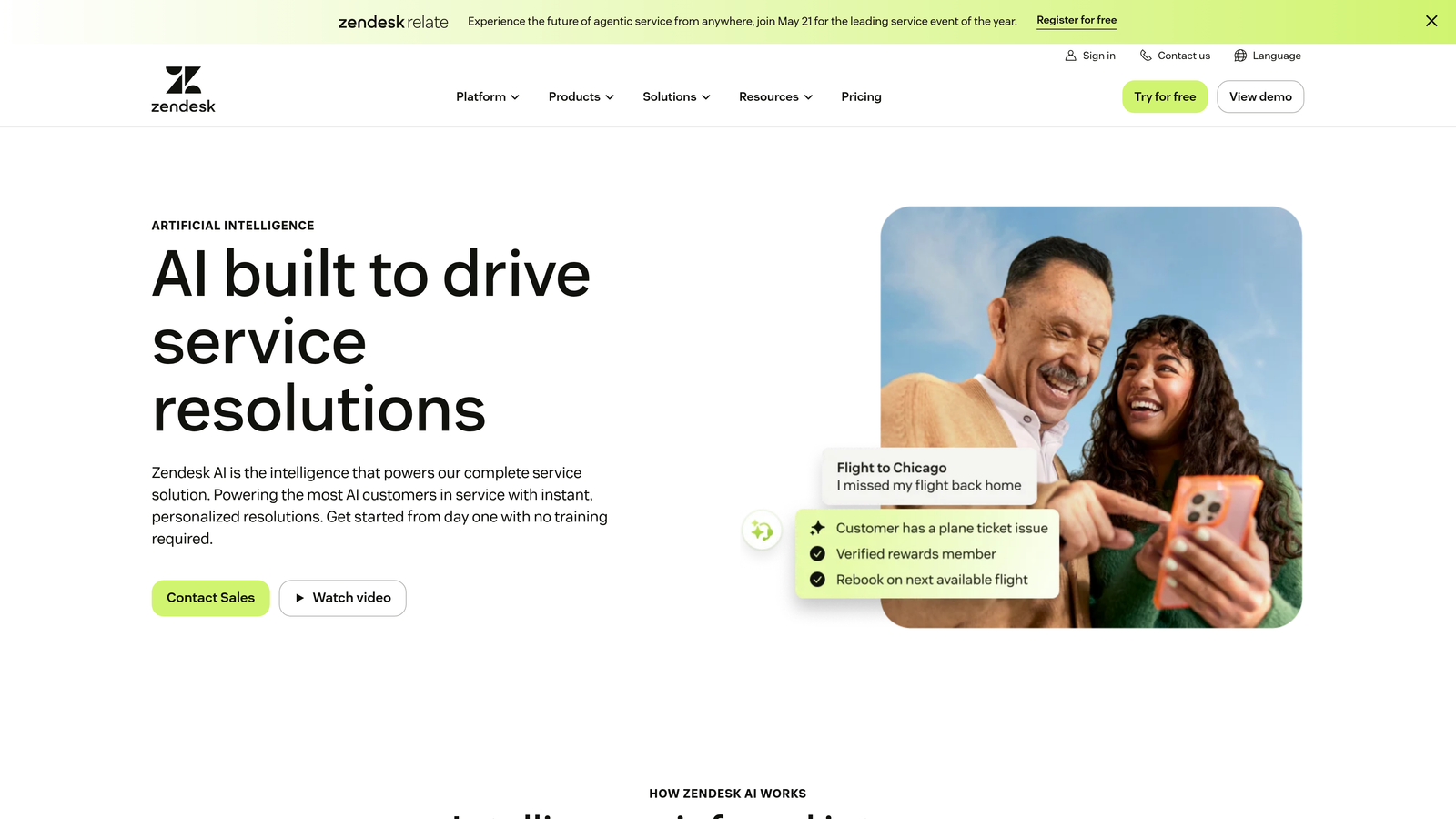
Zendesk AI is an enterprise-grade AI layer built into the Zendesk Suite, offering intelligent triage, AI-powered agents, and agent productivity tools trained on a massive customer service dataset.
Where This Tool Shines
Zendesk's AI benefits from scale in a way few competitors can match. The models are trained on billions of customer service interactions across industries, which gives the triage and intent detection capabilities a level of accuracy that's hard to replicate with smaller datasets. For enterprise SaaS teams handling thousands of tickets daily across multiple channels, that foundation makes a real difference.
The agent productivity layer is also well-developed. Suggested replies, ticket summaries, and intelligent routing reduce the cognitive load on human agents handling escalations — which matters when your team is stretched thin during product incidents or major releases.
Key Features
Intelligent Triage: Automatically detects intent, sentiment, and language to route tickets to the right queue or agent without manual sorting.
AI Agents: Resolve common requests autonomously across email, chat, and messaging channels.
Agent Productivity Tools: Provide suggested replies, ticket summaries, and next-best-action recommendations to speed up human resolution.
Advanced Analytics: Track AI performance, deflection rates, and resolution metrics with detailed reporting dashboards.
Broad Industry Training: Models trained on billions of real customer service interactions across verticals for high out-of-the-box accuracy.
Best For
Larger SaaS companies already invested in the Zendesk ecosystem, or those with complex, high-volume support operations that need enterprise-grade reliability and reporting. Smaller teams may find the pricing and complexity more than they need.
Pricing
AI features are included in Zendesk Suite plans starting around $55 per agent per month, with an advanced AI add-on available for additional capabilities.
4. Ada
Best for: SaaS teams that need AI agents that can take actions, not just answer questions
Ada is an AI-powered customer service automation platform that enables SaaS companies to build and deploy AI agents across chat, email, voice, and SMS without writing code.
Where This Tool Shines
Ada has made a meaningful shift toward agentic AI — meaning its AI doesn't just retrieve answers, it can take actions within connected systems. Think updating account details, processing requests, or triggering workflows in your CRM or helpdesk. For SaaS products where support often involves account management tasks, this is a significant capability upgrade over pure Q&A bots.
The no-code builder makes it accessible to support and operations teams without engineering involvement, which is valuable for SaaS companies where engineering bandwidth is always at a premium. Automated resolution measurement also gives teams clear visibility into what's working and where the AI needs coaching.
Key Features
Reasoning Engine: AI agent that can take actions in connected systems, not just retrieve and display information.
No-Code Builder: Create and modify automated resolution workflows without engineering support.
Multi-Channel Deployment: Deploy across web chat, email, SMS, voice, and social from a single platform.
CRM and Helpdesk Integrations: Connects with Salesforce, Zendesk, and other major platforms for personalized, action-oriented responses.
Resolution Coaching Tools: Measure automated resolution rates and identify gaps where the AI needs improvement.
Best For
Mid-market to enterprise SaaS companies that need AI agents capable of completing tasks within their product ecosystem, not just answering FAQs. Strong fit for teams with multi-channel support needs and a desire to reduce engineering dependency in support operations.
Pricing
Custom pricing. Contact Ada directly for a quote based on your team size and support volume.
5. Freshdesk Freddy AI
Best for: Budget-conscious SaaS teams that want AI bundled with a full helpdesk suite
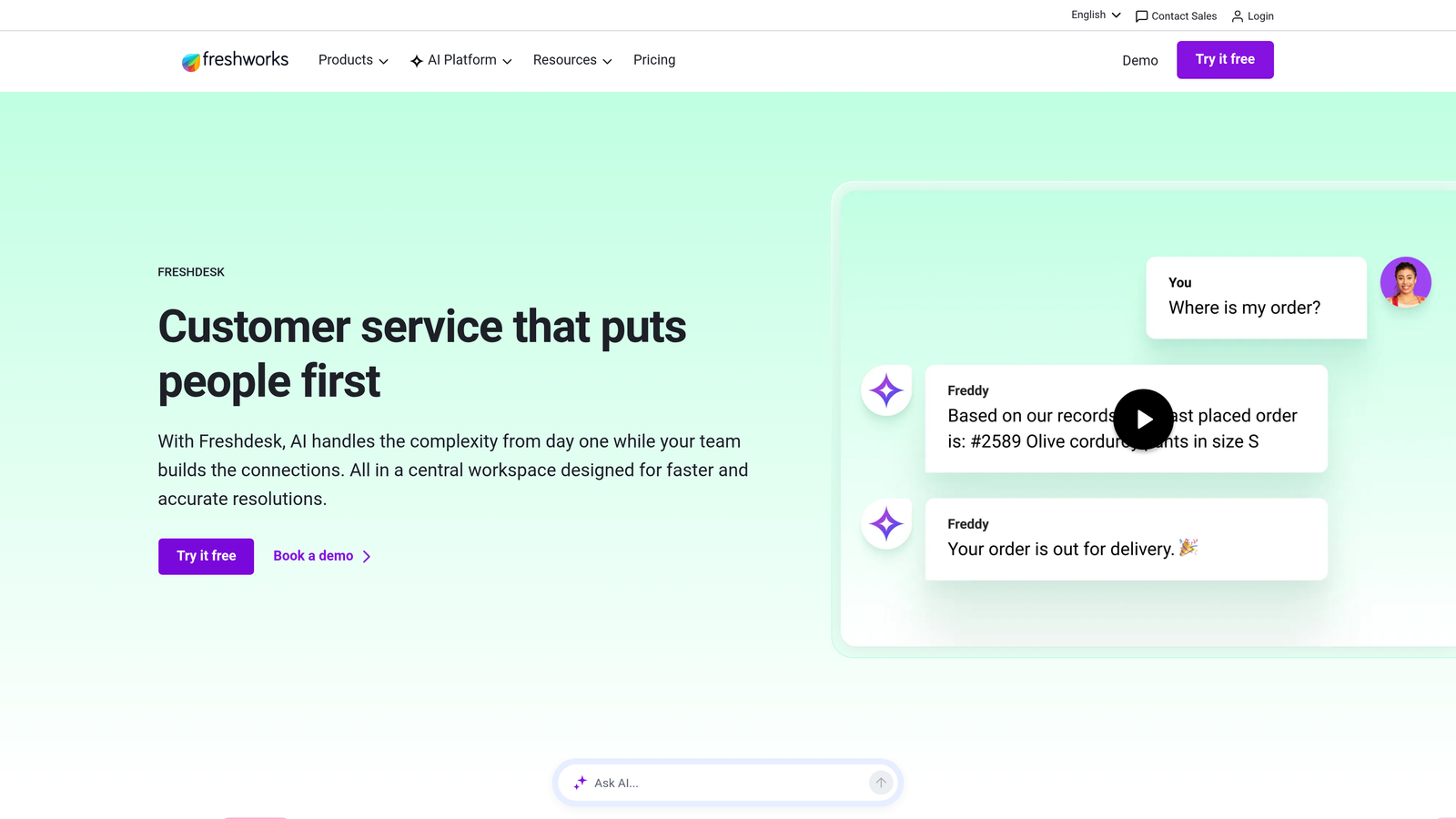
Freshdesk Freddy AI is Freshworks' AI assistant built into Freshdesk, offering auto-triage, suggested responses, and a customer-facing chatbot within an affordable helpdesk package.
Where This Tool Shines
Freshdesk's biggest advantage is value density. You get a full helpdesk suite with AI capabilities bundled in at price points that are genuinely accessible for early-stage SaaS companies. For teams that don't yet have a helpdesk and want to avoid stitching together multiple tools, Freshdesk offers a reasonable all-in-one starting point.
Freddy AI handles the core AI support tasks competently: auto-triage for ticket categorization, AI-suggested responses for agents, and a customer-facing chatbot for self-service. It won't match the depth of AI-first platforms, but for teams that prioritize affordability and simplicity over cutting-edge AI capabilities, it's a solid choice.
Key Features
Freddy Auto-Triage: Automatically categorizes and prioritizes incoming tickets to reduce manual sorting by support agents.
AI-Suggested Responses: Recommends replies to agents based on knowledge base content and past ticket resolutions.
Freddy Chatbot: Customer-facing bot that handles self-service resolution before tickets reach the support queue.
Ticket Summarization: Condenses long ticket threads so agents can get up to speed quickly on escalated issues.
Competitive Pricing: AI features bundled into Freshdesk plans at price points accessible for smaller SaaS teams.
Best For
Early-stage SaaS companies and small support teams that need a full helpdesk with AI capabilities at an affordable price point. Teams looking for deep AI customization or advanced business intelligence will likely need to look elsewhere as they scale.
Pricing
Free tier available. AI features included in the Pro plan starting around $49 per agent per month. Verify current pricing on the Freshdesk website.
6. Forethought
Best for: SaaS teams that want generative AI layered on top of their existing helpdesk
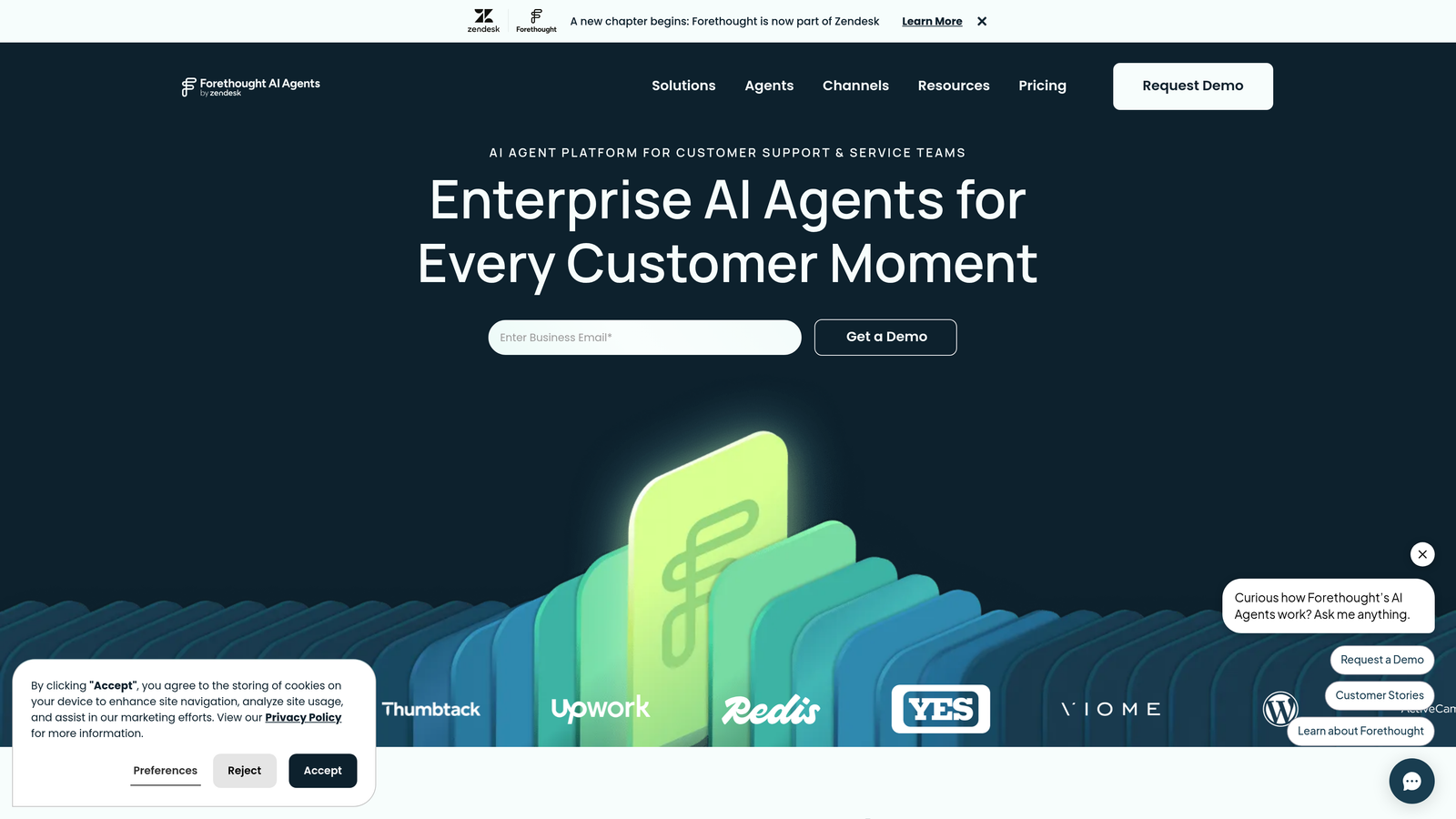
Forethought is an AI platform for customer support that uses generative AI to automate ticket resolution, triage, and agent assist across the full support lifecycle.
Where This Tool Shines
Forethought's strength is its flexibility as a layer that sits on top of your existing helpdesk rather than replacing it. If your team has significant investment in Zendesk, Salesforce Service Cloud, or Freshdesk, Forethought lets you add generative AI capabilities without migrating your entire support operation. That's a practical consideration for teams with mature helpdesk configurations they don't want to rebuild.
SupportGPT, Forethought's generative AI engine, handles both customer-facing resolution and agent assist. The triage layer is particularly strong, with intent detection and automated routing that reduces the manual overhead of ticket management at scale.
Key Features
SupportGPT: Generative AI engine that powers both automated customer responses and real-time agent assistance.
Intelligent Triage: Detects ticket intent and routes to the appropriate team or workflow automatically.
Agent Assist: Surfaces relevant knowledge suggestions to human agents in real time during live conversations.
Helpdesk Compatibility: Works across Zendesk, Salesforce, Freshdesk, and other major platforms without requiring migration.
Deflection Analytics: Dashboard tracking deflection rates, resolution metrics, and AI performance over time.
Best For
Mid-market and enterprise SaaS teams that have existing helpdesk infrastructure they want to keep, but need to add a more capable AI layer on top. Also strong for teams that want both agent assist and autonomous resolution from a single platform.
Pricing
Custom pricing based on ticket volume and modules selected. Contact Forethought for a quote tailored to your support operation.
7. Tidio
Best for: Small SaaS teams that want quick setup and affordable AI chat automation
Tidio is a conversational AI platform combining live chat and the Lyro AI chatbot, designed for small-to-mid SaaS teams that want fast setup and accessible automation.
Where This Tool Shines
Tidio's appeal is its simplicity. The Lyro AI chatbot learns from your existing FAQ and help content without requiring complex configuration, and the combined live chat and AI widget means you're not managing separate tools for human and automated conversations. For small SaaS teams where the founder or a small team handles support, that operational simplicity has real value.
The visual chatbot flow builder gives non-technical team members the ability to create custom automations without developer help. It's not the most powerful builder on this list, but it covers the common use cases well for teams at the earlier stages of building out their support infrastructure.
Key Features
Lyro AI Chatbot: Learns from your FAQ and help content to answer customer questions automatically without manual training.
Combined Chat Widget: Handles both AI-automated and live human conversations within a single unified widget.
Visual Flow Builder: Create custom chatbot automations without writing code or involving engineering.
Platform Integrations: Connects with HubSpot, WordPress, Shopify, and other popular tools.
Conversation Analytics: Visitor tracking and conversation data to understand support patterns and user behavior.
Best For
Small SaaS teams, solo founders, and early-stage products that need affordable AI chat support without complex setup. Teams with high ticket volumes or need for deep product integrations will likely outgrow Tidio as they scale.
Pricing
Free plan available. Lyro AI add-on starts around $39 per month. Verify current pricing on the Tidio website.
8. Ultimate (by Zendesk)
Best for: Global SaaS products with multilingual support needs and no-code bot requirements
Ultimate is an AI-powered support automation platform, now part of Zendesk, known for strong multilingual capabilities and a no-code bot builder designed for global SaaS products.
Where This Tool Shines
If your SaaS product serves customers across multiple languages and regions, Ultimate's multilingual capabilities are genuinely impressive. Support across 100-plus languages with a no-code dialogue builder means global teams can create localized conversation flows without building separate bots for each market. That's a meaningful operational advantage for SaaS companies with international user bases.
Since joining the Zendesk ecosystem, Ultimate benefits from tighter integration with Zendesk's broader AI and helpdesk infrastructure. For teams already on Zendesk that need stronger multilingual automation than the native Zendesk AI provides, Ultimate offers a complementary layer of capability.
Key Features
Multilingual AI Resolution: Handles automated support conversations across 100-plus languages without requiring separate bot configurations per language.
No-Code Dialogue Builder: Create and manage custom conversation flows without engineering involvement.
Backend Integrations: Connect to internal systems for personalized, action-oriented responses that go beyond FAQ retrieval.
CS Automation Analytics: Insights into automation performance, deflection rates, and conversation quality across languages and regions.
Zendesk Integration: Now part of Zendesk's AI ecosystem, enabling tighter workflow integration for Zendesk customers.
Best For
Mid-market to enterprise SaaS companies with significant international customer bases that need reliable multilingual automation. Particularly valuable for Zendesk customers looking to extend their AI capabilities across global markets.
Pricing
Available as part of Zendesk's AI offerings. Contact Zendesk or Ultimate directly for current pricing specific to your team's needs.
9. Kastro
Best for: Solo founders and small SaaS teams that need lightweight AI support at minimal cost
Kastro is a lightweight, AI-first support widget built specifically for SaaS products, designed to train on your documentation and deliver instant answers without complex setup.
Where This Tool Shines
Kastro is the most accessible entry point on this list. It's built specifically for SaaS and digital products, and the setup process is genuinely simple: point it at your documentation, embed the widget, and you're live. For solo founders and very small teams that need some level of AI support without the overhead of configuring an enterprise platform, Kastro removes most of the friction.
The ChatGPT-powered foundation means the quality of answers is solid for documentation-based questions. When the AI can't handle something, conversation handoff to a human support channel keeps users from hitting a dead end. It's not built for complex enterprise workflows, but it doesn't try to be.
Key Features
Documentation-Trained AI: Learns from your existing docs and knowledge base to answer product questions accurately out of the box.
SaaS-Specific Design: Built specifically for software products and digital services, not adapted from a generic chat tool.
Simple Embed Setup: Install and go — no complex configuration or lengthy onboarding required.
Human Handoff: Routes conversations to human support when the AI reaches the limits of its knowledge.
Affordable Pricing: One of the most cost-accessible options on this list, designed for small teams and individual founders.
Best For
Solo founders, indie developers, and very small SaaS teams that need basic AI support coverage at minimal cost. Teams with growing support complexity or enterprise integration needs will need a more robust platform as they scale.
Pricing
Free plan available. Paid plans start around $25 per month. Verify current pricing on the Kastro website.
Choosing the Right AI Support Tool for Your SaaS
The right tool depends almost entirely on where your SaaS product is in its growth trajectory and what you need AI support to actually do.
If you're an early-stage team or solo founder, Kastro and Tidio offer fast setup and affordable entry points that get you to basic AI coverage without significant investment. Freshdesk Freddy AI is worth considering if you also need a full helpdesk bundled in at a competitive price.
For teams already committed to a specific helpdesk ecosystem, the native options are compelling. Intercom Fin is the natural choice for Intercom users, Zendesk AI and Ultimate for Zendesk customers, and Forethought for teams that want generative AI layered on top of whatever helpdesk they're running. Ada stands out when you need AI agents that can take actions, not just retrieve answers.
For SaaS teams that want AI support to do more than deflect tickets, Halo AI is in a different category. The page-aware context, continuous learning architecture, and business intelligence layer mean that support interactions become a source of product and revenue intelligence, not just a cost center to optimize. The auto bug ticket creation alone saves meaningful engineering coordination time for product teams.
The broader trend in 2026 is clear: the most valuable AI support tools aren't just answering questions, they're taking actions, learning continuously, and feeding intelligence back into the product and customer success workflows that drive growth.
Your support team shouldn't scale linearly with your customer base. Let AI agents handle routine tickets, guide users through your product, and surface business intelligence while your team focuses on complex issues that need a human touch. See Halo in action and discover how continuous learning transforms every interaction into smarter, faster support.