9 Best AI Support Tools for Tech Companies in 2026
The 9 best AI support tools for tech companies in 2026 go beyond basic ticket deflection to deliver autonomous resolution, deep developer integrations, and context-aware responses capable of handling complex technical queries. Evaluated on AI capability depth, integration ecosystem, and scalability, this guide helps technical teams—from early-stage startups to growing SaaS organizations—find the right fit for sophisticated user support needs.
 Matt PattoliFounder13 min read
Tech companies face a support challenge that most platforms aren't built for. Your users are technically sophisticated, they can tell when an AI is deflecting rather than resolving, and they expect answers that match the complexity of their questions. A chatbot that responds to "my API webhook isn't firing" with a link to your FAQ is worse than no chatbot at all.
The tools on this list are different. They go beyond ticket deflection to offer autonomous resolution, deep integrations with developer tooling, and the kind of context-awareness that makes AI support actually useful in a technical environment. Whether you're a seed-stage startup or a scaling SaaS organization, there's a strong option here for your team.
Selection criteria: depth of AI capability, integration ecosystem, technical use case fit, and value at scale.
The Landscape: What Makes AI Support Work for Tech Teams
Before diving into the tools, it's worth naming what separates genuinely useful AI support from the kind that frustrates technically literate users. The best tools share a few characteristics: they handle multi-step troubleshooting rather than keyword matching, they integrate with developer and product tooling, they understand context, and they know when to escalate to a human.
Keep those criteria in mind as you evaluate each option below.
1. Halo AI
Best for: B2B SaaS and tech companies wanting an AI-first support platform built to resolve, learn, and scale.
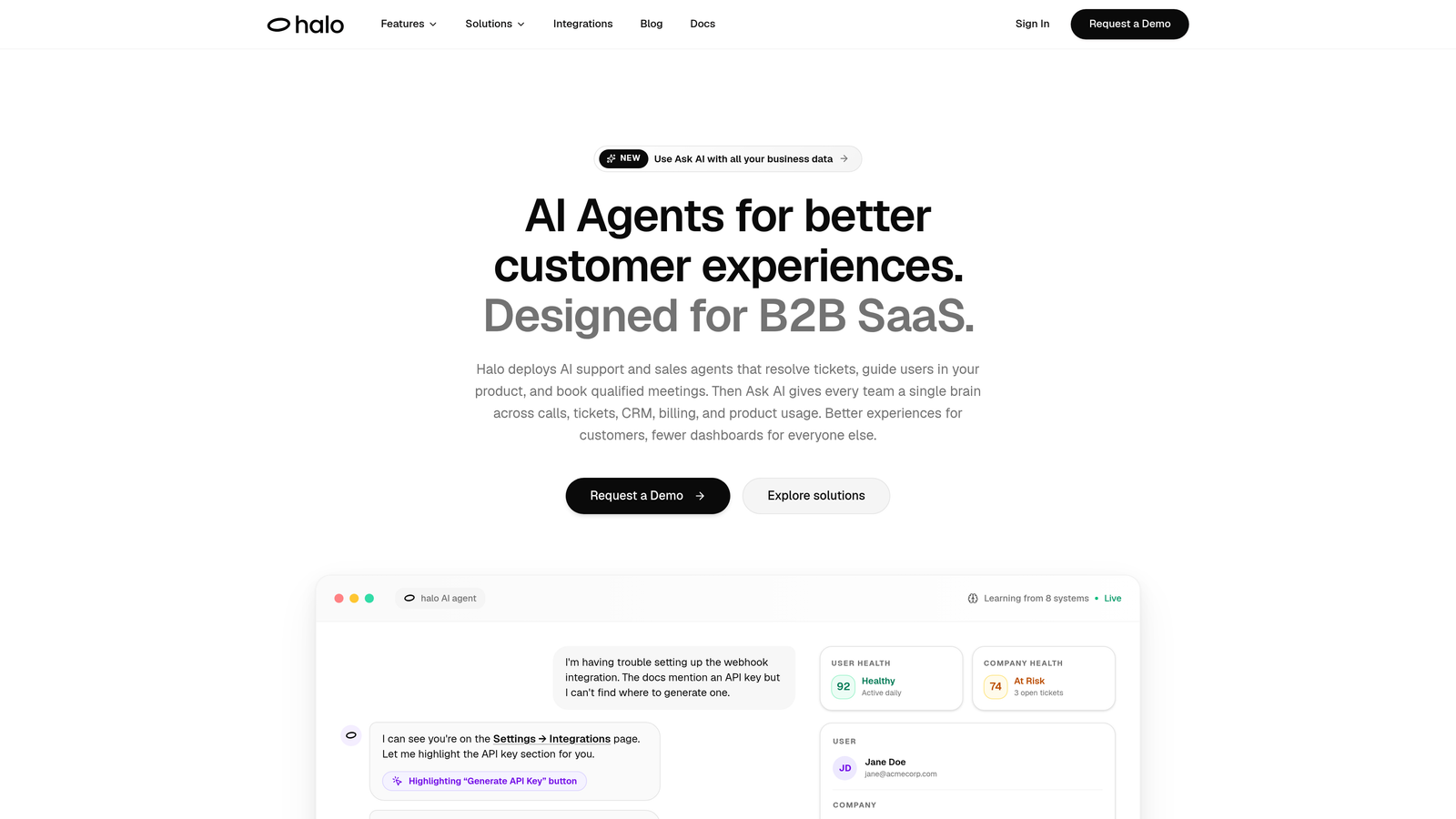
Halo AI is an AI-first customer support platform designed specifically for the demands of B2B SaaS and technical product teams.
Where This Tool Shines
What sets Halo apart from most tools on this list is its architecture. It wasn't built as an AI layer bolted onto an existing helpdesk. It was designed AI-first from the ground up, which means the intelligence is baked into every part of the workflow rather than added as an afterthought.
The standout capability is page-aware context. When a user opens the chat widget, Halo's AI already knows which feature or page they're looking at. That means the response to "this isn't working" can be specific and useful, not generic. Combine that with continuous learning from every resolved interaction, and the platform gets meaningfully smarter over time without requiring manual retraining.
Key Features
Page-Aware AI Agents: The AI understands which product page or feature a user is viewing when they ask for help, enabling context-specific responses from the first message.
Autonomous Ticket Resolution: Halo resolves support tickets end-to-end, learning from every interaction to improve future performance continuously.
Auto Bug Ticket Creation: When a user reports a bug, Halo automatically creates and routes a ticket to Linear or Jira, removing a manual step from your engineering workflow.
Smart Inbox with Business Intelligence: Beyond support metrics, the smart inbox surfaces customer health signals, anomaly detection, and revenue intelligence, turning support data into strategic insight.
Live Agent Handoff: Complex issues escalate to human agents with full conversation context preserved, so nothing gets repeated or lost.
Deep Integration Ecosystem: Connects natively with Linear, Slack, HubSpot, Intercom, Stripe, Zoom, PandaDoc, and Fathom.
Best For
Halo is best suited for B2B SaaS companies and technical product teams that want AI to handle the full support lifecycle rather than just assist agents. It's particularly well-matched for teams where support context is tightly tied to product behavior and where engineering and support workflows need to stay in sync.
Pricing
Contact Halo directly for pricing. Given the platform's scope and integrations, it's positioned for teams serious about AI-first support rather than entry-level deployments.
2. Intercom
Best for: SaaS teams already in the Intercom ecosystem looking to add capable AI resolution to their existing workflows.
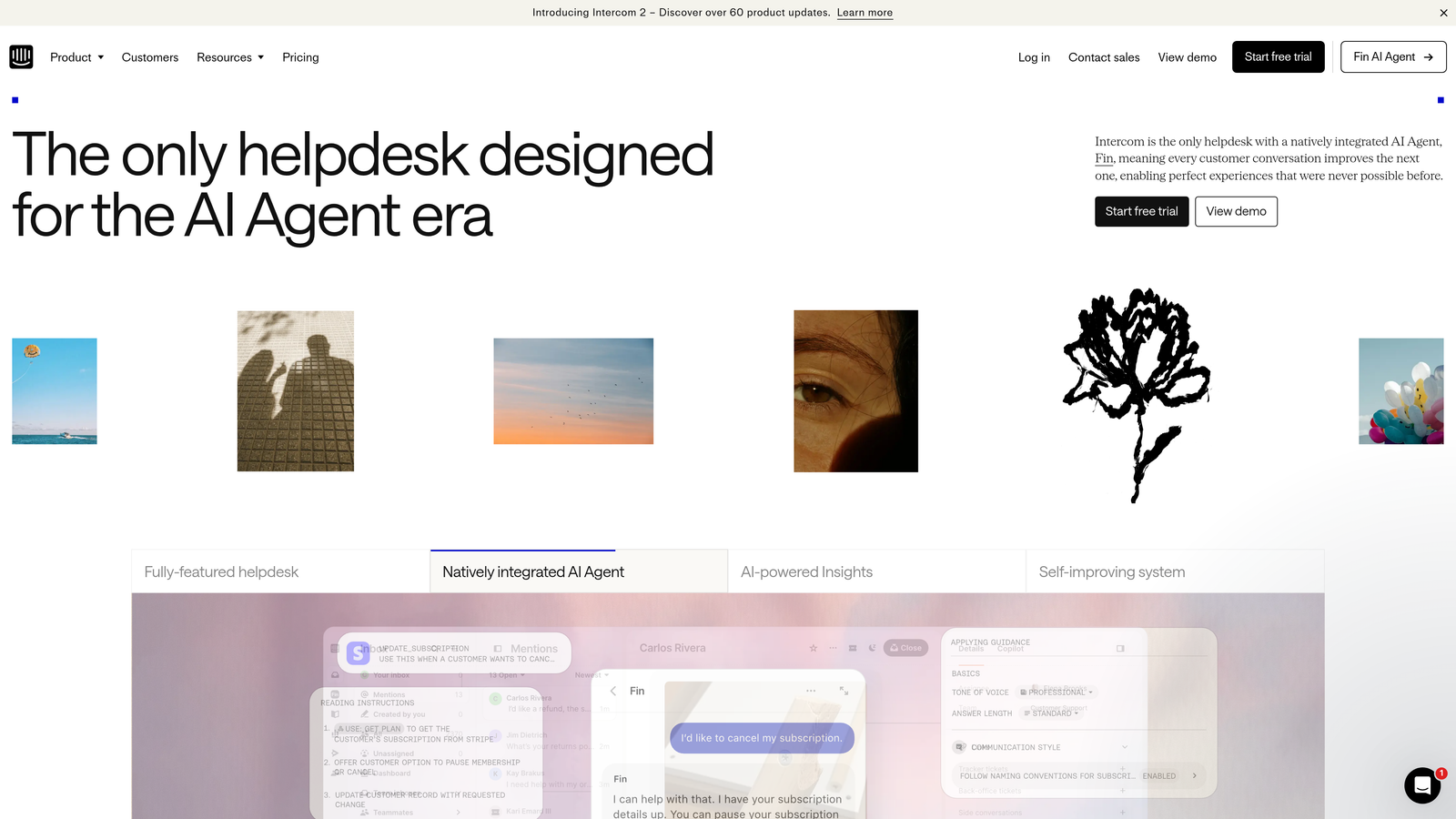
Intercom is an established customer messaging platform that has evolved into a broader customer service suite, with Fin as its AI agent at the center.
Where This Tool Shines
Fin is one of the more capable AI agents in this category. It's trained on your support content and can resolve common queries autonomously, which is a meaningful step beyond basic chatbot behavior. For teams already using Intercom for live chat and messaging, adding Fin is a natural extension rather than a platform migration.
The ecosystem is also a real strength. Intercom's app marketplace and integrations are extensive, and the platform handles omnichannel messaging across chat, email, and in-app surfaces cleanly.
Key Features
Fin AI Agent: Trained on your support content to handle common queries autonomously without human intervention.
Omnichannel Messaging: Unified support across chat, email, and in-app messaging from a single workspace.
Workflow Automation: Ticket routing and automation rules to streamline support operations.
Agent Workspace: AI-assisted reply suggestions and context for human agents handling escalations.
App Marketplace: Broad integration ecosystem for connecting Intercom to your existing stack.
Best For
Teams already using Intercom who want to add AI resolution without switching platforms. Also a strong fit for SaaS companies that prioritize polished in-app messaging and have well-structured support documentation to train Fin on.
Pricing
Starts at approximately $39 per seat per month. Fin AI is charged per resolution, so costs scale with usage volume. Worth modeling out at your current ticket volume before committing.
3. Zendesk AI
Best for: Large technical support operations with complex workflows and existing Zendesk infrastructure.
Zendesk is the enterprise helpdesk standard, with AI capabilities layered across triage, agent assistance, and self-service throughout the suite.

Where This Tool Shines
Zendesk's AI investment has been substantial, both through acquisitions and native development. The result is a mature set of AI features that cover the full support workflow: intelligent triage routes tickets before a human touches them, the agent copilot suggests replies and summarizes ticket history, and AI-driven self-service helps customers resolve issues without opening a ticket.
For large organizations with complex routing logic, multiple support tiers, and established Zendesk workflows, the AI features integrate naturally into what's already there. The reporting and analytics suite is also among the most robust in the category.
Key Features
Intelligent Triage: AI-powered ticket classification and routing that directs issues to the right team or tier automatically.
Agent Copilot: Suggested replies, ticket summarization, and next-step recommendations for human agents.
AI Self-Service: Knowledge base optimization and AI-driven deflection to reduce inbound ticket volume.
Advanced Analytics: Comprehensive reporting across team performance, ticket trends, and customer satisfaction.
Enterprise Integrations: Broad ecosystem connecting Zendesk to CRMs, developer tools, and business systems.
Best For
Enterprise and mid-market tech companies with existing Zendesk deployments and the operational complexity that justifies the platform's cost and configuration overhead. Less ideal for smaller teams starting fresh.
Pricing
Suite plans start at approximately $55 per agent per month. AI add-ons are priced separately, so total cost can climb quickly for teams that want the full AI feature set.
4. Freshdesk (Freddy AI)
Best for: SMB and mid-market tech teams that want AI-powered support at accessible price points.
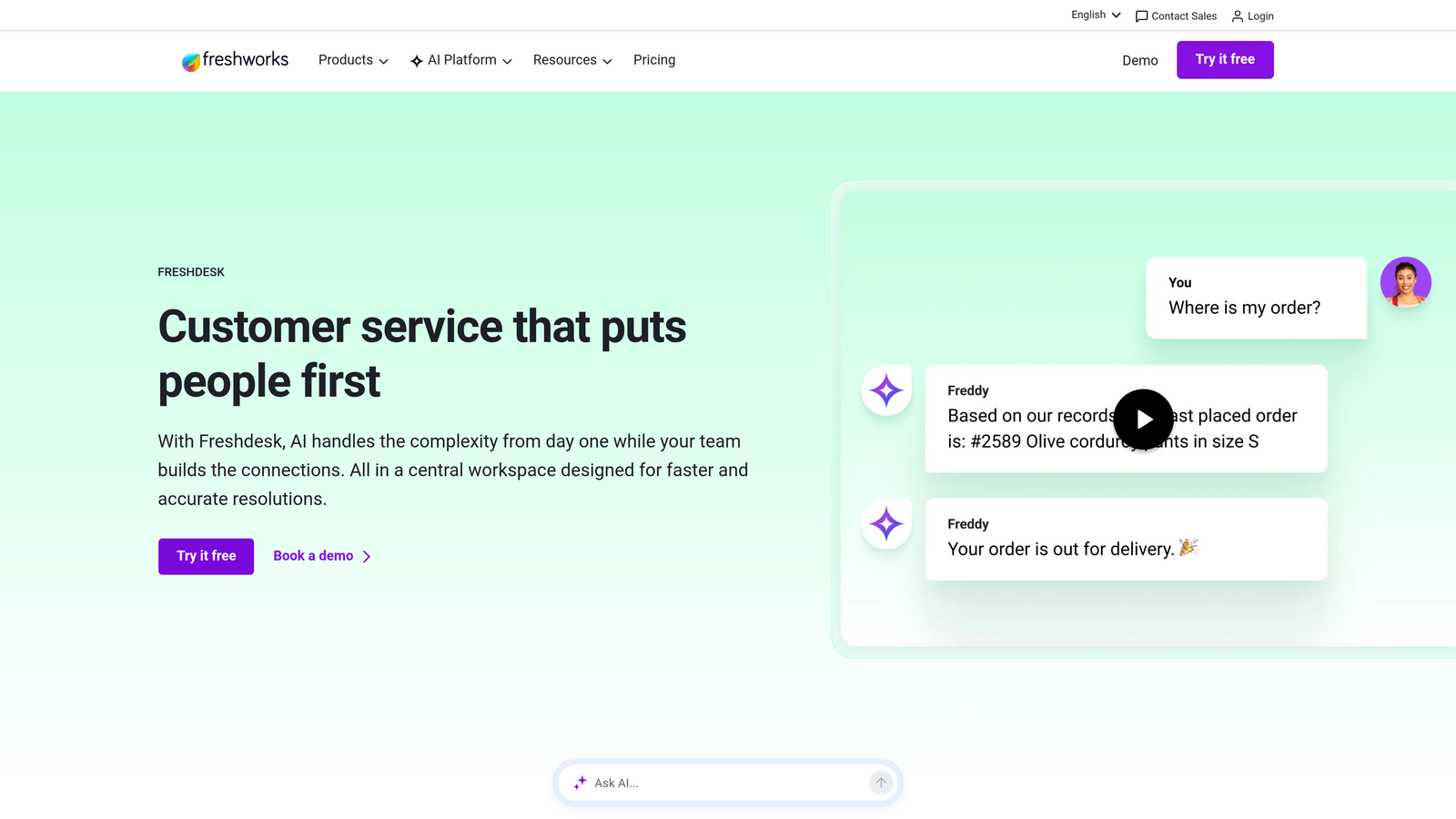
Freshdesk is a mid-market helpdesk platform with Freddy AI embedded across self-service, agent assistance, and analytics.
Where This Tool Shines
Freshdesk's primary advantage is delivering meaningful AI capability without the enterprise price tag. Freddy has matured considerably and now covers a reasonable range of support scenarios across three distinct functions: customer-facing resolution, agent assistance, and analytics. That breadth at this price point is genuinely competitive.
For growing tech teams that need to handle increasing ticket volume without proportionally increasing headcount, Freshdesk offers a practical path. The free tier also makes it easy to evaluate before committing.
Key Features
Freddy Self Service: AI-powered customer-facing resolution that handles common queries without agent involvement.
Freddy Copilot: Agent assistance with reply suggestions, summarization, and workflow guidance.
Freddy Insights: AI-generated analytics that surface trends and performance insights from support data.
Omnichannel Support: Unified inbox across email, chat, phone, and social channels.
Accessible Pricing: Free tier available with paid plans starting at competitive rates for growing teams.
Best For
SMB and mid-market tech companies looking for a well-rounded helpdesk with solid AI features and pricing that scales reasonably. A good alternative to Zendesk for teams that don't need enterprise-level complexity.
Pricing
Free plan available. Paid plans start at approximately $15 per agent per month. Freddy AI features are available on higher tiers and as add-ons.
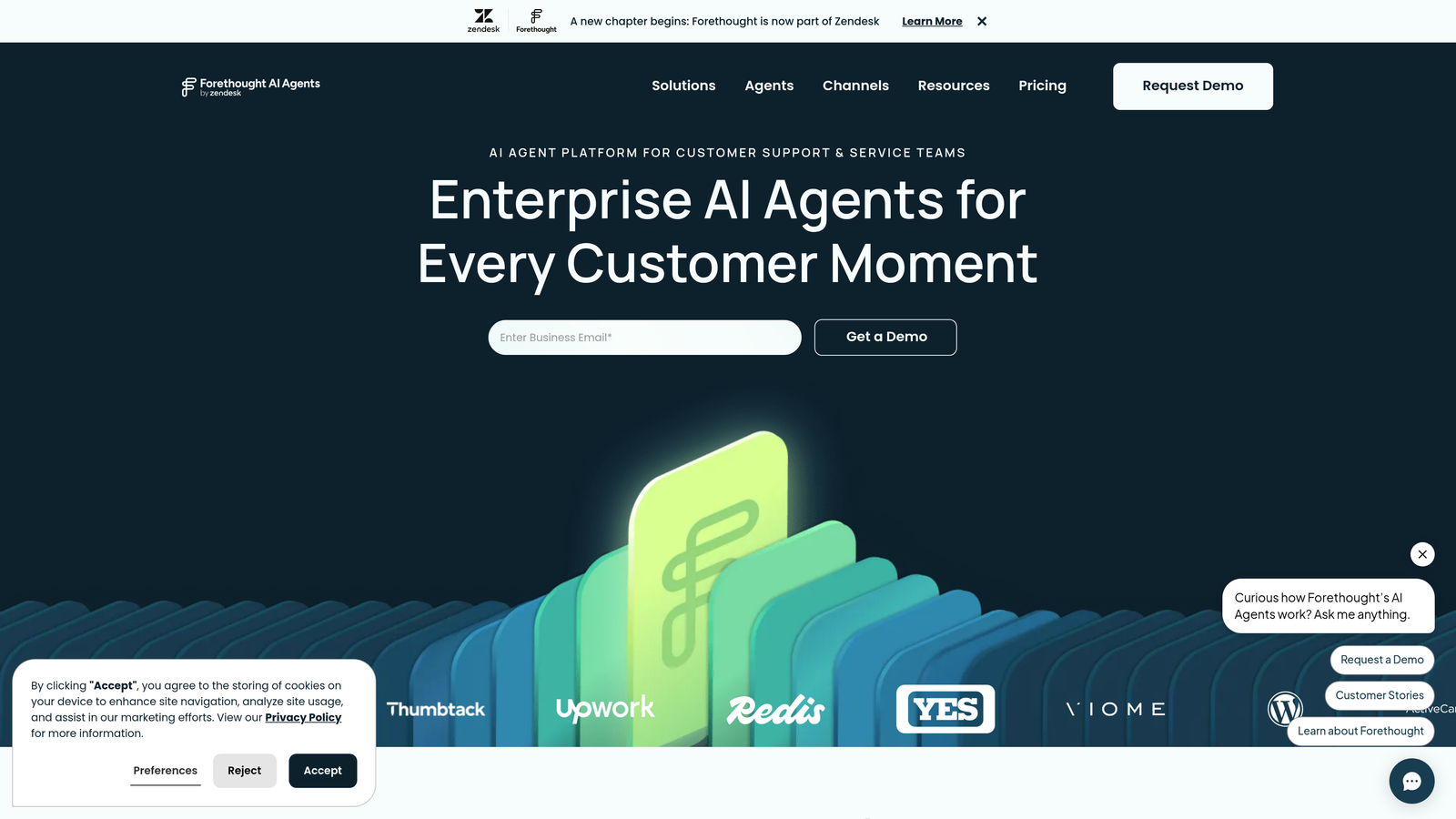
5. Forethought
Best for: Teams with mature helpdesk deployments that want to add AI without migrating platforms.
Forethought is an AI layer designed to sit on top of existing helpdesks, adding intelligent triage, resolution, and agent assistance to platforms like Zendesk, Salesforce, and Freshdesk.
Where This Tool Shines
The core appeal of Forethought is additive intelligence. If your team has spent years building workflows, macros, and routing logic inside an existing helpdesk, replacing that platform is a significant undertaking. Forethought lets you keep what you've built while layering in AI capabilities that meaningfully improve resolution rates and agent efficiency.
Its intent detection is trained on your historical ticket data, which means it learns from your actual support history rather than starting from generic patterns. That's a meaningful advantage for teams with large ticket archives.
Key Features
Solve: AI agent for autonomous ticket resolution, handling common queries end-to-end.
Triage: Intelligent classification and routing that directs tickets to the right team or tier.
Assist: In-workflow agent copilot with suggested responses and context for human agents.
Historical Training: Intent detection trained on your existing ticket data for faster, more accurate performance from day one.
Helpdesk Compatibility: Works alongside Zendesk, Salesforce Service Cloud, and Freshdesk without requiring platform migration.
Best For
Companies with significant investment in an existing helpdesk who want to enhance it with AI rather than replace it. Particularly valuable for teams with large historical ticket datasets that can accelerate Forethought's training.
Pricing
Contact for pricing. Forethought is enterprise-oriented and pricing reflects that positioning. Best evaluated alongside a clear understanding of your current ticket volume and resolution costs.
6. Kustomer
Best for: Tech companies where support context is deeply tied to customer history and lifecycle data.
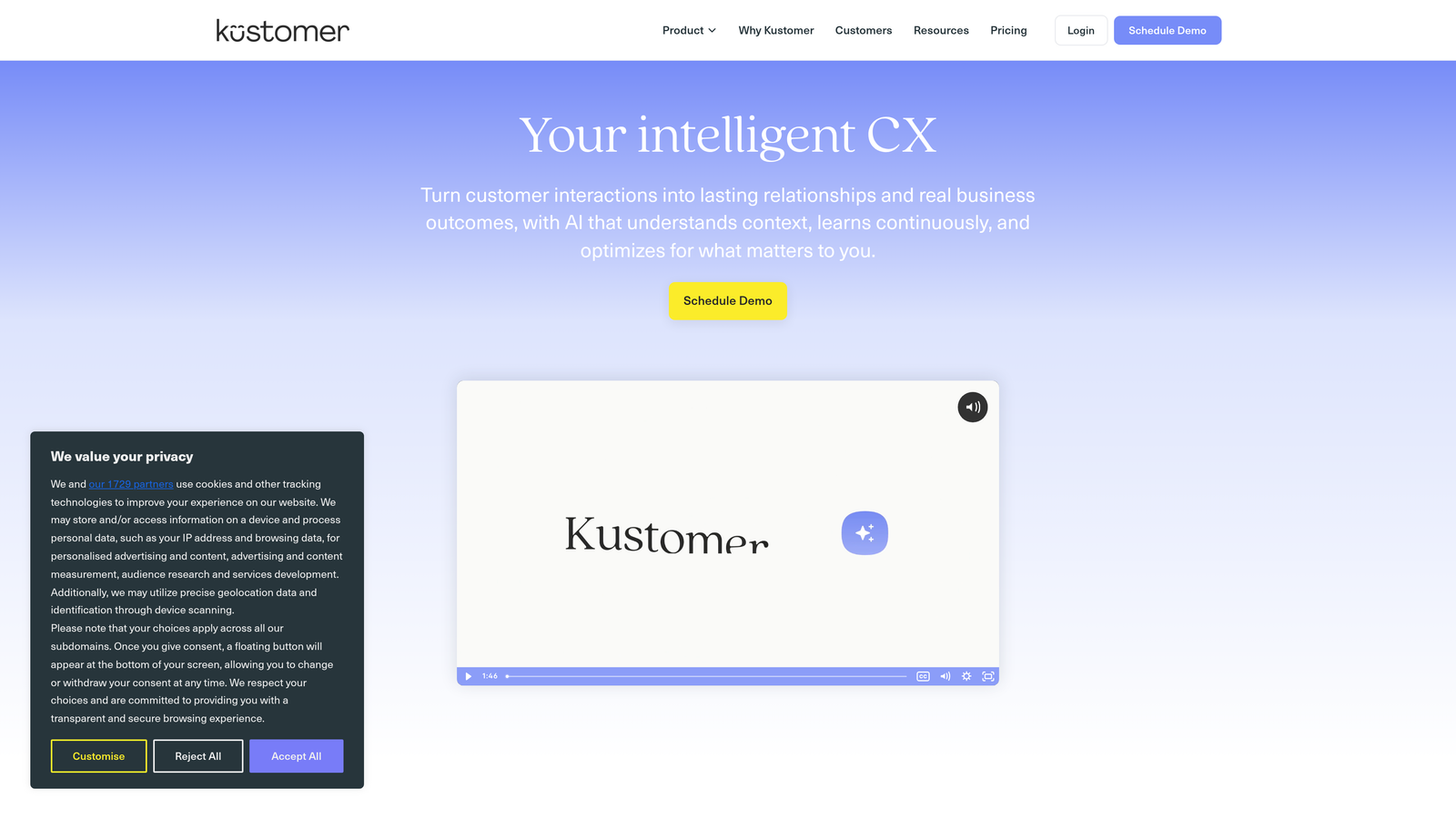
Kustomer is a CRM-native customer service platform that builds AI automation around a unified customer timeline, combining every interaction, event, and data point in a single view.
Where This Tool Shines
Kustomer's differentiator is the richness of its data model. Rather than treating each support ticket as an isolated event, Kustomer builds a complete timeline of every customer interaction, purchase, and product event. AI automation built on top of that context is inherently more intelligent than automation that only sees the current conversation.
For tech companies where understanding a customer's usage history, subscription status, or recent product behavior is essential to resolving their issue correctly, this unified view is genuinely valuable.
Key Features
Unified Customer Timeline: Every support interaction, CRM event, and product data point in a single chronological view.
Context-Aware AI Automation: Automation rules and AI responses built on the full customer data model, not just the current ticket.
Omnichannel Routing: Intelligent routing across channels with full customer context attached.
Proactive Support Triggers: Automated outreach based on customer behavior signals before issues escalate.
Flexible Data Model: Customizable to accommodate complex workflows and unique data structures common in tech companies.
Best For
Tech companies where support quality depends on understanding the full customer context, particularly those with complex customer journeys or where support and CRM data are currently siloed.
Pricing
Starts at approximately $89 per agent per month. Enterprise-oriented pricing that reflects the platform's depth and CRM capabilities.
7. Tidio
Best for: Early-stage startups and smaller tech teams that need AI support running quickly with minimal overhead.
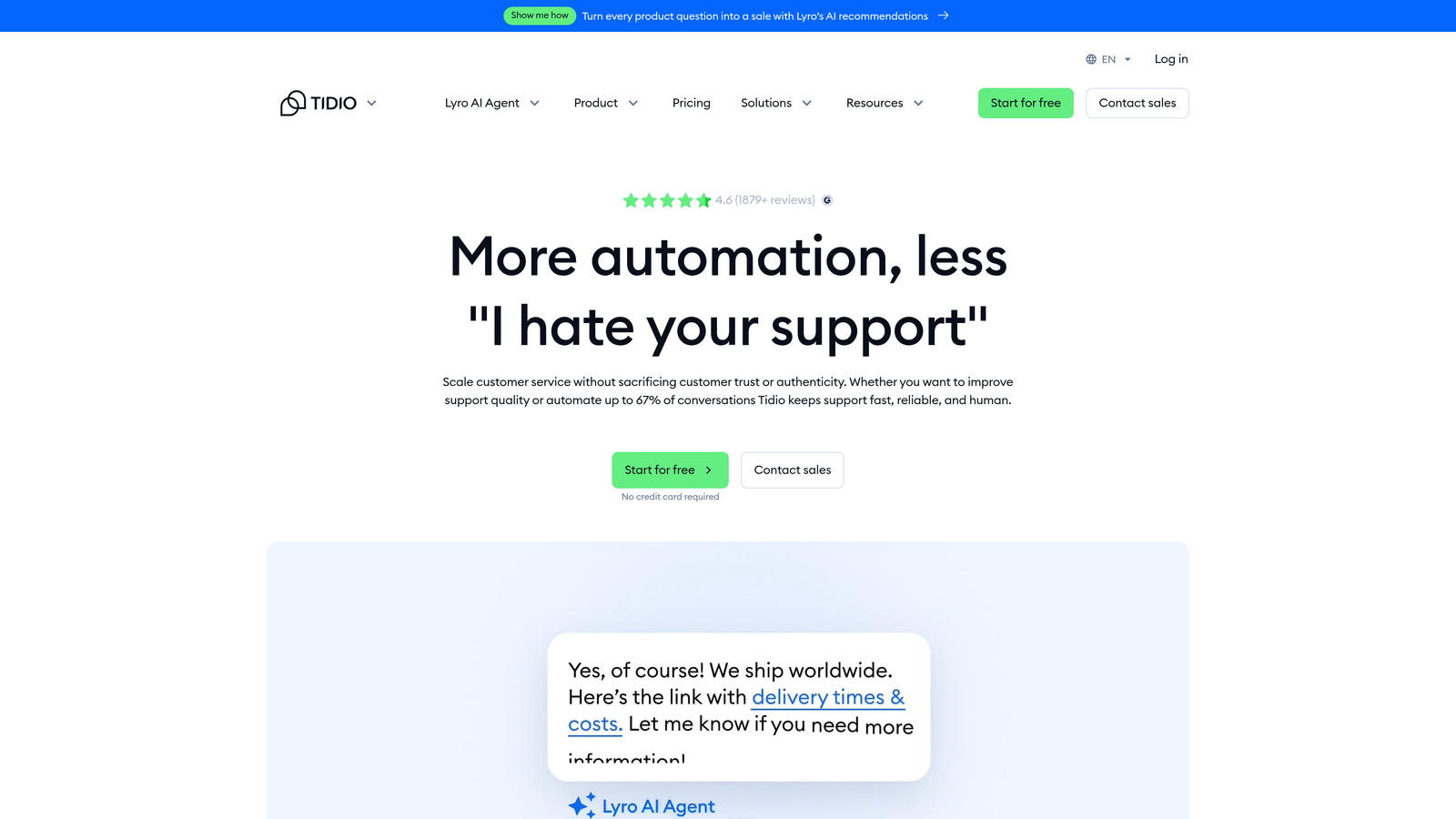
Tidio is an accessible AI chat platform featuring Lyro, its conversational AI agent, with fast setup and affordable pricing tiers.
Where This Tool Shines
Tidio earns its place on this list by solving a real problem: many early-stage tech teams need AI support capability but don't have the resources or operational maturity to implement an enterprise platform. Lyro handles automated customer conversations with a setup process that doesn't require a dedicated implementation project.
The visual chatbot builder also makes it easy to design support flows without engineering involvement, which matters when your developers' time is better spent elsewhere.
Key Features
Lyro AI Agent: Conversational AI that handles customer queries automatically, learning from your support content.
Visual Chatbot Builder: No-code flow design for creating custom conversation paths without engineering resources.
Live Chat with Handoff: Seamless escalation to human agents when Lyro reaches the limits of its capability.
Multi-Channel Integrations: Connects with email and Messenger for broader coverage beyond website chat.
Fast Setup: Minimal technical overhead to get AI support running, measured in hours rather than weeks.
Best For
Startups and smaller tech teams that need to establish AI support quickly and cost-effectively. Less suited to complex technical troubleshooting at scale, but a strong starting point for teams in early growth stages.
Pricing
Free plan available. Lyro AI starts at approximately $29 per month, making it one of the most accessible entry points on this list.
8. Guru
Best for: Support teams that need AI-powered access to accurate knowledge inside the tools they already use.
Guru is an AI-powered knowledge management platform that surfaces verified answers directly inside Slack, Chrome, Zendesk, and other tools your support team uses daily.
Where This Tool Shines
Guru occupies a different category from the other tools here. It's not a support platform or AI agent. It's the layer that ensures your support team can find accurate, up-to-date information fast, wherever they're working. In technical support environments where documentation changes frequently and accuracy matters, that's a significant capability gap for many teams.
The knowledge verification workflows are particularly useful: content owners are prompted to review and confirm information on a schedule, which keeps the knowledge base reliable rather than gradually drifting out of date.
Key Features
AI-Powered Search: Surfaces relevant answers across your entire knowledge base instantly, with natural language queries.
In-Tool Delivery: Answers appear directly inside Slack, Chrome, Zendesk, and other tools without context switching.
Verification Workflows: Scheduled review prompts keep knowledge accurate and prevent outdated content from being surfaced.
Support Tool Integrations: Connects with Zendesk, Intercom, Salesforce, and other platforms to bring knowledge into existing workflows.
Knowledge Gap Analytics: Surfaces what your team is searching for but not finding, highlighting documentation needs.
Best For
Technical support teams with large or frequently-updated knowledge bases who need agents to find accurate answers quickly. Most valuable as a complement to a primary support platform rather than a standalone solution.
Pricing
Free plan available. Paid plans start at approximately $10 per user per month, making it an affordable addition to an existing support stack.
9. Assembled
Best for: Scaling support operations that need AI-powered workforce management, forecasting, and performance analytics.
Assembled is a support operations platform combining AI-powered workforce management, volume forecasting, and performance analytics for teams that are growing their support function.
Where This Tool Shines
Assembled addresses a problem that becomes acute as tech companies scale: knowing how many support agents you need, when you need them, and whether your current team is performing effectively. Without this operational intelligence, teams either over-hire or under-staff, both of which are expensive.
The AI-powered forecasting takes historical volume patterns and translates them into staffing recommendations, and the scenario planning tools let support leaders model out what happens if volume spikes or a major release drives a surge in tickets.
Key Features
AI Volume Forecasting: Predicts ticket volume based on historical patterns and surfaces staffing recommendations accordingly.
Scheduling and Adherence: Scheduling tools with real-time adherence tracking to keep teams operating as planned.
Performance Analytics: Real-time and historical reporting on team and individual performance across key support metrics.
Helpdesk Integrations: Connects with Zendesk, Intercom, Salesforce, and Freshdesk to pull live data into forecasts.
Scenario Planning: Capacity modeling tools for planning around product launches, seasonal spikes, or team changes.
Best For
Mid-market and enterprise tech companies with dedicated support operations teams who need to manage workforce efficiency at scale. Particularly valuable during periods of rapid growth where demand patterns are hard to predict manually.
Pricing
Contact for pricing. Assembled is focused on mid-market and enterprise buyers, and pricing reflects that positioning.
Choosing the Right Tool for Your Team
The right choice depends heavily on where you are as a company and what problem you're actually trying to solve.
If you want an AI-first platform built specifically for B2B SaaS support, with page-aware context, autonomous resolution, and business intelligence built in, Halo AI is the strongest option on this list. It's designed for technical environments from the ground up, not adapted from a general-purpose helpdesk.
If you're already invested in Intercom or Zendesk and want to add AI without migrating, Forethought is worth a close look. It enhances what you've already built rather than replacing it. Intercom's Fin is similarly compelling for teams already in that ecosystem.
For teams at the earlier end of the growth curve, Tidio offers a fast, affordable path to getting AI support running. It won't handle complex technical troubleshooting at enterprise scale, but it's a legitimate starting point. Freshdesk sits in a useful middle ground for teams that have outgrown startup tools but aren't ready for enterprise complexity or pricing.
Guru and Assembled are best understood as complements rather than primary platforms. Guru solves the knowledge access problem; Assembled solves the workforce management problem. Both are genuinely valuable to scaling support teams, but neither replaces a core support platform.
One principle worth holding onto: your support team shouldn't need to scale linearly with your customer base. The tools on this list, used well, make that possible. See Halo in action and discover how continuous learning transforms every interaction into smarter, faster support that scales without scaling headcount.