9 Best AI Support Integration Services for Seamless Customer Experiences in 2026
Discover the 9 best AI support integration services that connect your AI agent to CRMs, ticketing systems, billing platforms, and communication tools for truly intelligent, context-aware customer support. This guide evaluates each solution on integration depth, AI sophistication, and scalability to help B2B teams—from Zendesk-locked enterprises to lean SMBs—find the right fit for seamless, informed customer experiences in 2026.
 Grant CooperFounder13 min read
Your support stack is only as smart as the connections between its parts. When your AI agent can't see what's in your CRM, doesn't know a customer is on a trial plan, and has no idea they just filed a bug report last week, you're not delivering intelligent support. You're delivering fast guessing.
The best AI support integration services solve this by weaving AI into your existing business tools rather than bolting on yet another disconnected layer. They pull context from ticketing systems, CRMs, billing platforms, and communication tools to resolve issues with the full picture in view.
To build this list, we evaluated tools on integration depth and breadth, AI sophistication, ease of setup, scalability for B2B teams, and overall value. Whether you're ecosystem-locked into Zendesk or Salesforce, running a lean SMB stack, or building an AI-first support operation from scratch, there's a fit here for you.
1. Halo AI
Best for: B2B teams that want AI-first support with deep, bidirectional integrations across their entire business stack.
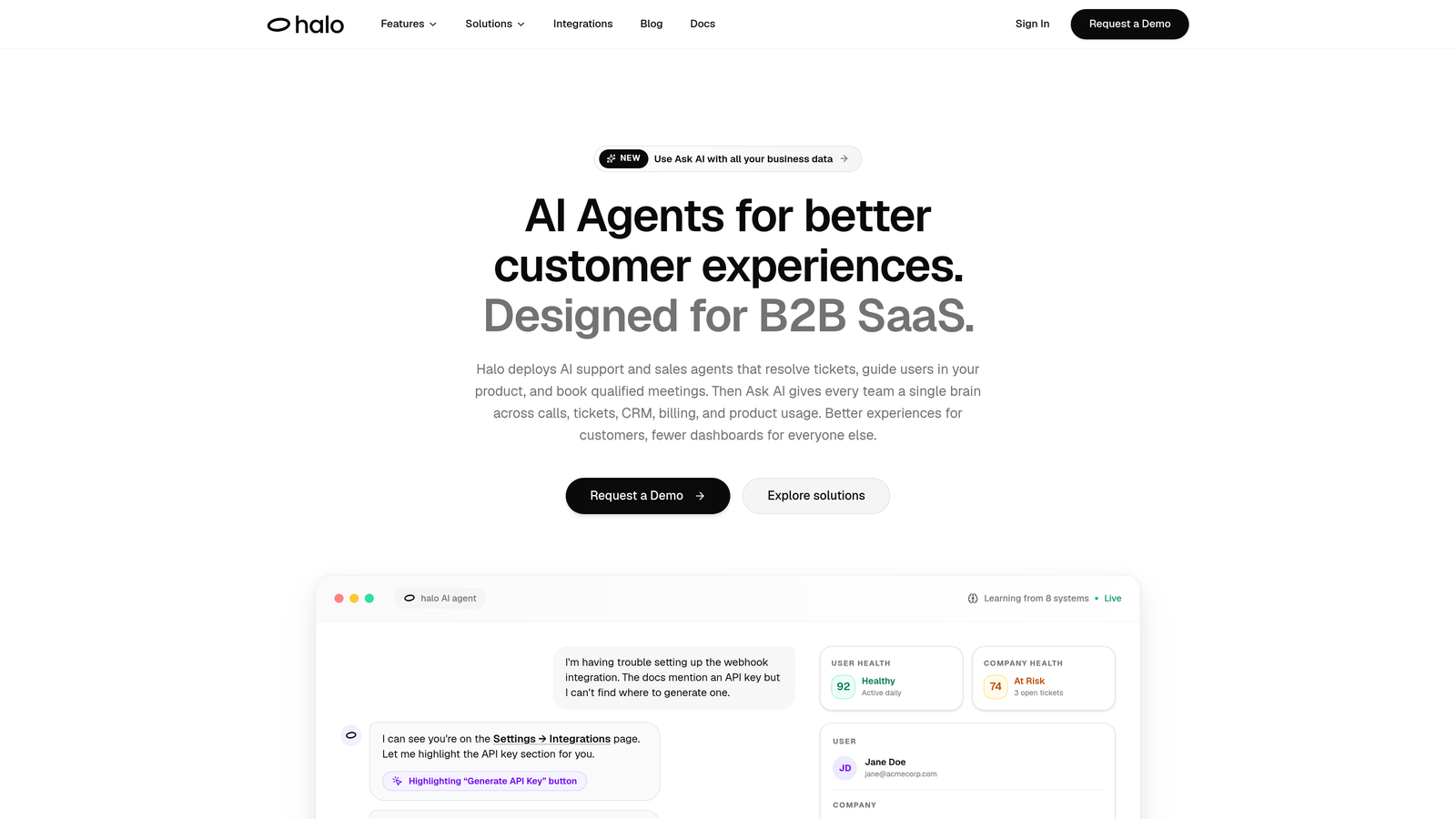
Halo AI is an AI-native customer support platform built from the ground up to connect across your full business stack, not just your helpdesk.
Where This Tool Shines
Most AI support tools are retrofitted onto existing platforms. Halo was designed differently: integrations are a core architectural feature, not an afterthought. This means when a support conversation happens, the AI agent isn't working in isolation. It can see what the user sees on the page, pull in billing data from Stripe, check open issues in Linear, and reference CRM context from HubSpot, all in a single interaction.
The continuous learning engine is another genuine differentiator. Every resolved ticket, every escalation, every user interaction feeds back into the model, making resolutions progressively smarter over time. For B2B teams managing complex products, that compounding intelligence is hard to replicate with tools that treat each conversation as a blank slate.
Key Features
Page-Aware Chat Widget: The AI agent sees the exact page and UI state a user is on, enabling precise visual guidance rather than generic help article links.
Native Integrations: Out-of-the-box connections with Linear, Slack, HubSpot, Intercom, Stripe, Zoom, PandaDoc, and Fathom for full business context in every conversation.
Smart Inbox with Business Intelligence: Goes beyond ticket management to surface customer health signals, revenue intelligence, and anomaly detection directly from support data.
Automatic Bug Ticket Creation: Converts support conversations into structured bug reports in your engineering tools without manual intervention.
Continuous Learning: The AI model improves with every interaction, refining resolution quality without requiring manual retraining or rule updates.
Best For
B2B SaaS companies and product teams that have outgrown basic helpdesk AI and need support that connects across their full stack. Particularly strong for teams where support insights need to feed into product, engineering, and revenue workflows.
Pricing
Contact for pricing. Designed for B2B teams scaling support operations without scaling headcount proportionally.
2. Intercom Fin
Best for: Teams already running Intercom who want AI resolution without migrating to a new platform.
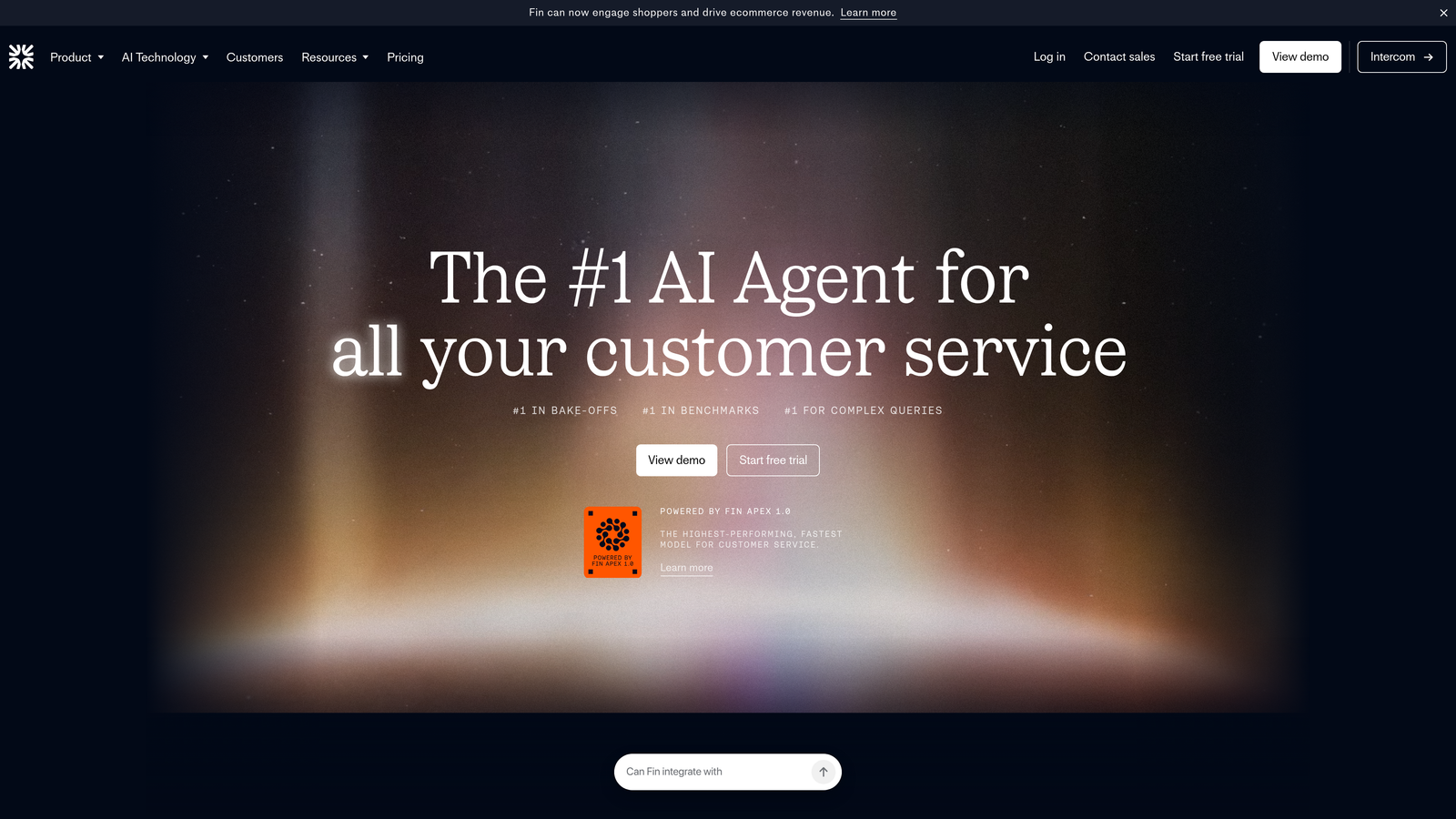
Intercom Fin is Intercom's native AI agent, built to resolve support conversations end-to-end within the Intercom ecosystem.
Where This Tool Shines
If your support operation lives inside Intercom, Fin is the path of least resistance to AI-powered resolution. It draws directly from your existing knowledge base, conversation history, and inbox workflows without requiring any external configuration. The setup experience is genuinely fast for Intercom customers.
Where Fin is more constrained is outside the Intercom ecosystem. It's a strong choice if you're committed to Intercom as your primary support platform, but teams that need deep integrations with engineering tools, billing systems, or CRMs outside the Intercom world will feel the limits relatively quickly.
Key Features
Native Intercom Integration: Fully embedded in Intercom Messenger, inbox, and help center with no third-party setup required.
Knowledge Base Sourcing with Citations: Resolves tickets by pulling from your help content and shows users exactly where the answer came from.
Customizable Tone and Behavior: Adjust how Fin communicates to match your brand voice and support policies.
Human Handoff with Context: Escalates to live agents with full conversation history preserved, so customers never have to repeat themselves.
Multi-Language Support: Handles conversations across multiple languages without separate configuration.
Best For
Support teams already invested in the Intercom platform who want to add AI resolution quickly. Less suited to teams that need integrations beyond the Intercom ecosystem.
Pricing
Per-resolution pricing model. Requires an active Intercom subscription; pricing scales with conversation volume.
3. Zendesk AI
Best for: Established Zendesk customers looking to add AI capabilities to existing workflows without changing platforms.
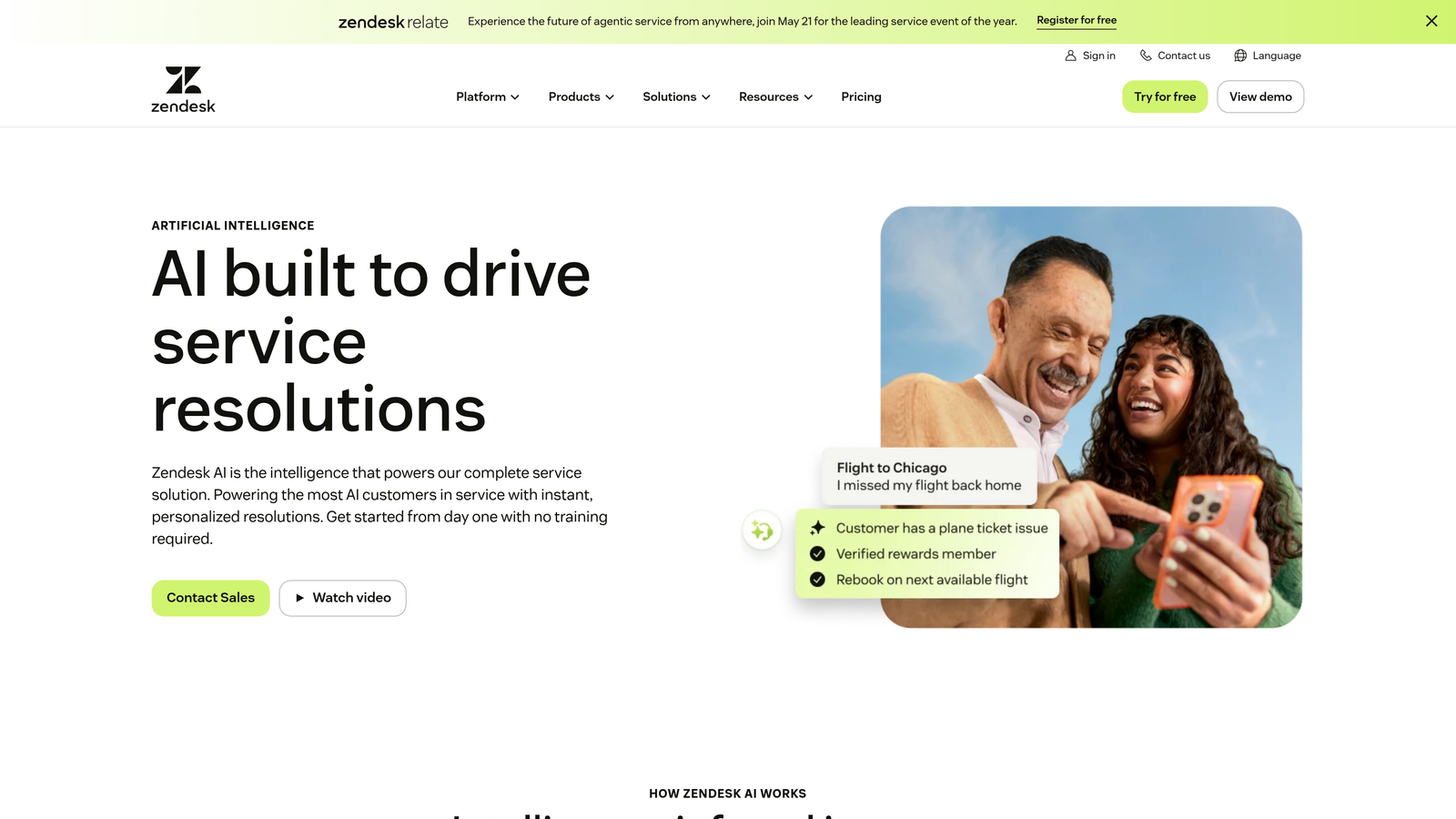
Zendesk AI embeds intelligent triage, agent assist, and automated resolution directly into the Zendesk Suite.
Where This Tool Shines
Zendesk AI's biggest advantage is its training data. Zendesk has processed an enormous volume of customer service interactions over the years, and the AI reflects that. Out-of-the-box intent detection, sentiment analysis, and language classification tend to perform well from day one without extensive custom training.
The agent assist features are particularly useful for teams with large, distributed support organizations. Suggested replies, automatic ticket summarization, and in-context knowledge surfacing can meaningfully reduce handle time for agents working high ticket volumes.
Key Features
Intelligent Triage: Automatically detects intent, language, and sentiment to route tickets to the right team without manual sorting.
Agent Assist: Surfaces suggested replies and relevant knowledge articles in real time as agents work tickets.
Generative AI Drafting: Drafts ticket responses and summaries using generative AI, reducing time spent on repetitive writing tasks.
Pre-Trained Accuracy: Benefits from training on a large dataset of real customer service interactions for faster time-to-value.
Marketplace Integrations: Connects with hundreds of apps through the Zendesk marketplace for extended functionality.
Best For
Mid-market to enterprise teams with mature Zendesk deployments. Strong for organizations prioritizing agent productivity over full AI autonomy.
Pricing
Core AI features included in Zendesk Suite plans. Advanced AI capabilities available as a paid add-on.
4. Ada
Best for: Enterprise teams running high-volume, multi-channel support who need no-code AI automation with broad integration coverage.
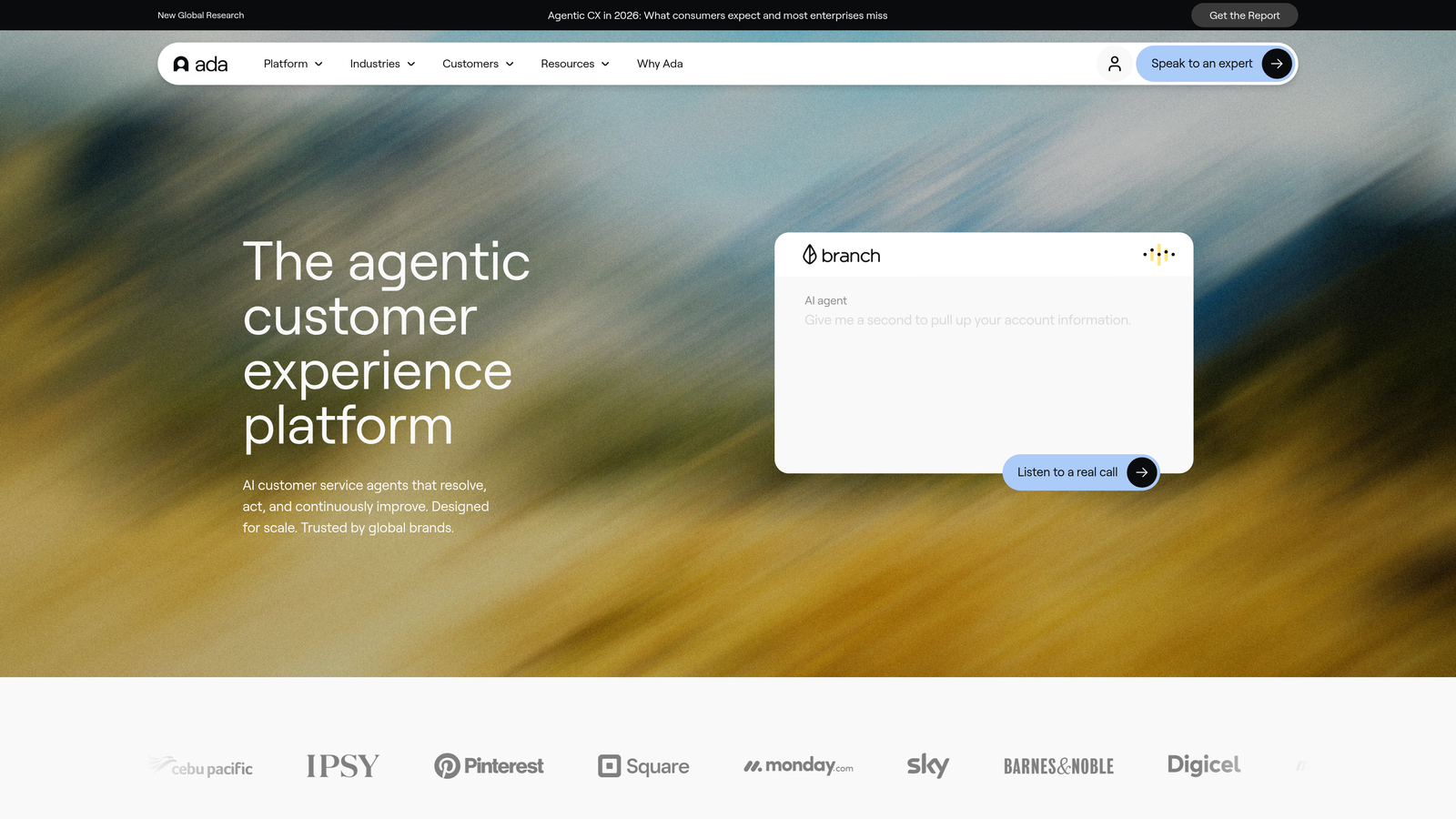
Ada is an enterprise-grade AI automation platform with a no-code builder and over 35 pre-built integrations for multi-channel support operations.
Where This Tool Shines
Ada's strength is accessibility at scale. The no-code builder lets support operations teams build and modify AI workflows without engineering involvement, which matters a lot when your support processes change frequently. The AI reasoning engine handles multi-step resolutions without relying on rigid scripted flows, making conversations feel more natural than traditional decision-tree bots.
The platform's omnichannel deployment is genuinely broad, covering web, mobile, social, and messaging channels from a single configuration. For enterprise teams managing fragmented channel coverage, that consolidation has real operational value.
Key Features
No-Code AI Agent Builder: Drag-and-drop workflow creation that non-technical teams can build and maintain independently.
35+ Pre-Built Integrations: Includes Zendesk, Salesforce, Shopify, and other common enterprise tools out of the box.
Omnichannel Deployment: Single configuration deploys across web, mobile, social media, and messaging platforms simultaneously.
AI Reasoning Engine: Handles complex, multi-step resolutions without requiring pre-scripted conversation flows.
Performance Analytics: Coaching dashboard surfaces resolution rates, deflection metrics, and areas for improvement.
Best For
Enterprise support organizations with high ticket volumes across multiple channels. Well-suited to teams that want business users to own AI configuration without engineering dependency.
Pricing
Custom enterprise pricing. Contact sales for a quote tailored to your volume and channel requirements.
5. Freshdesk Freddy AI
Best for: Teams running the Freshworks ecosystem who want AI tightly integrated across support, sales, and chat in one platform.
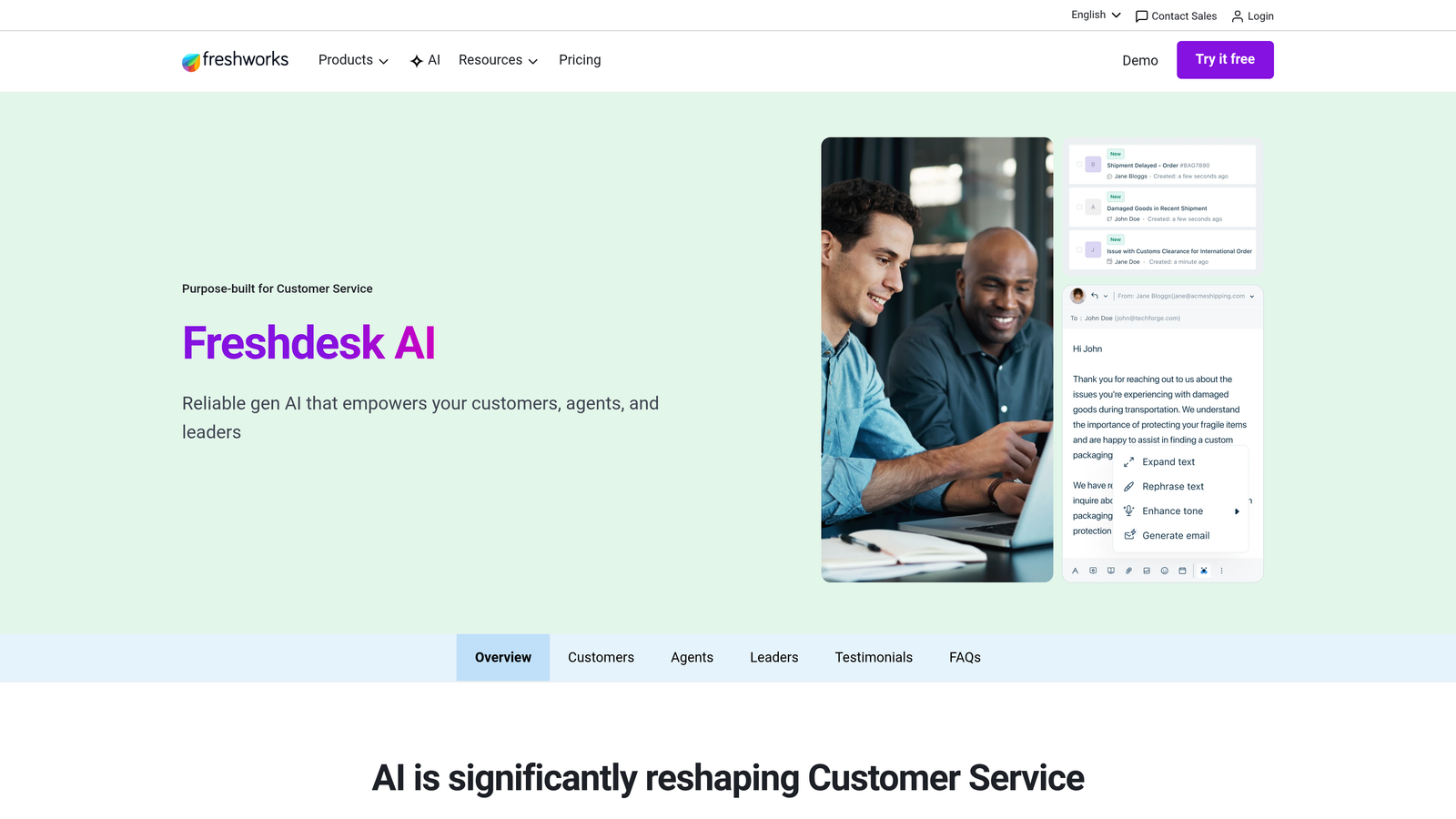
Freshdesk Freddy AI delivers AI copilot capabilities, auto-triage, and self-service bots within the Freshworks product suite.
Where This Tool Shines
Freddy AI's value proposition is cohesion across the Freshworks stack. If you're using Freshdesk for support, Freshsales for CRM, and Freshchat for messaging, Freddy can share context across all three without custom integration work. That cross-product intelligence is a genuine advantage for teams that have standardized on Freshworks.
Some thoughtful details stand out, like the thank-you detector that prevents tickets from being reopened when a customer sends a simple acknowledgment. These kinds of workflow refinements reflect real-world support operations experience baked into the product.
Key Features
Freddy Copilot: Provides agents with real-time response suggestions, ticket summarization, and knowledge recommendations.
Auto-Triage: Automatically classifies and routes incoming tickets based on content, intent, and priority.
Self-Service Bots: Deploys AI-powered bots connected to your Freshdesk knowledge base for deflection before tickets are created.
Cross-Product Intelligence: Shares context across Freshdesk, Freshsales, and Freshchat for a unified customer view.
Sentiment Analysis and Thank-You Detector: Prevents false ticket reopenings and flags conversations that need attention based on customer tone.
Best For
Growing businesses already using Freshworks products. The cross-suite integration is most valuable when you're using at least two Freshworks products together.
Pricing
AI features included in Pro and Enterprise plans, starting at $49 per agent per month. Check the Freshworks site for current tier details.
6. Forethought
Best for: Teams that want to add AI intelligence on top of an existing helpdesk without replacing it.
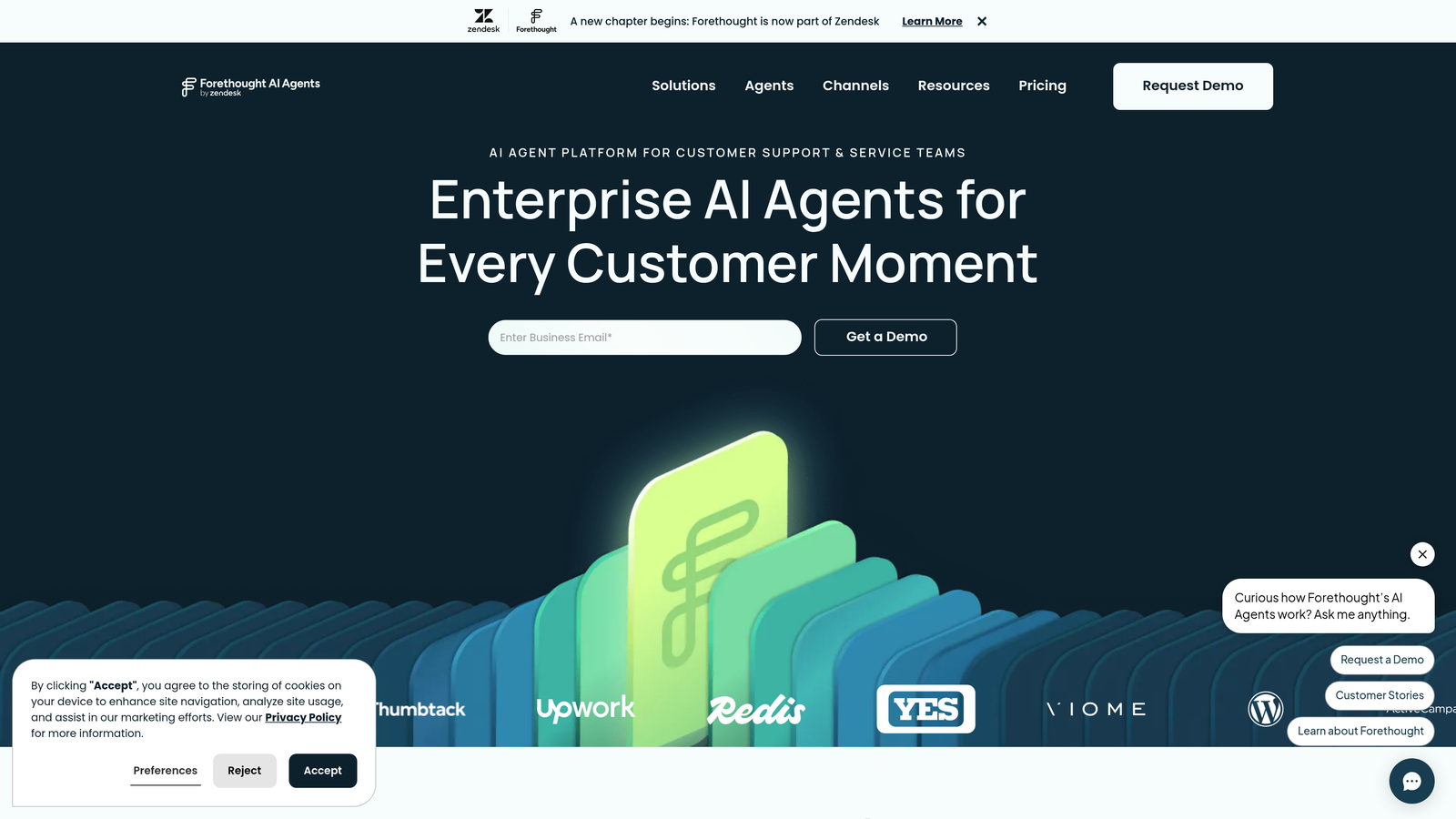
Forethought is an AI middleware platform that layers intelligent triage, auto-resolution, and agent assist on top of platforms like Zendesk, Salesforce, and Freshdesk.
Where This Tool Shines
Forethought's positioning as middleware is its defining characteristic. Rather than asking you to migrate to a new platform, it enhances what you already have. This makes it particularly appealing to organizations that have significant investments in their existing helpdesk configuration and don't want to start over.
The SupportGPT generative AI layer handles ticket resolution with contextual understanding rather than simple keyword matching, which improves resolution quality for nuanced or multi-part customer questions. The triage engine is also notably strong at classifying tickets by both intent and urgency, not just topic.
Key Features
SupportGPT: Generative AI-powered ticket resolution that handles complex, multi-part questions with contextual understanding.
Intelligent Triage: Classifies and routes tickets by intent and urgency for more accurate prioritization.
Multi-Platform Integration: Connects with Zendesk, Salesforce Service Cloud, and Freshdesk without requiring platform migration.
Agent Assist: Surfaces real-time knowledge suggestions to agents as they work, reducing time spent searching documentation.
Workflow Automation: Automates resolution paths for repetitive ticket types to reduce manual handling.
Best For
Mid-market and enterprise teams with mature helpdesk deployments who want AI augmentation without platform disruption. Strong fit for organizations where migration is not an option.
Pricing
Custom pricing based on ticket volume. Contact sales for a quote.
7. Tidio
Best for: Small businesses and e-commerce teams that need fast setup, affordable pricing, and integrations with common SMB tools.
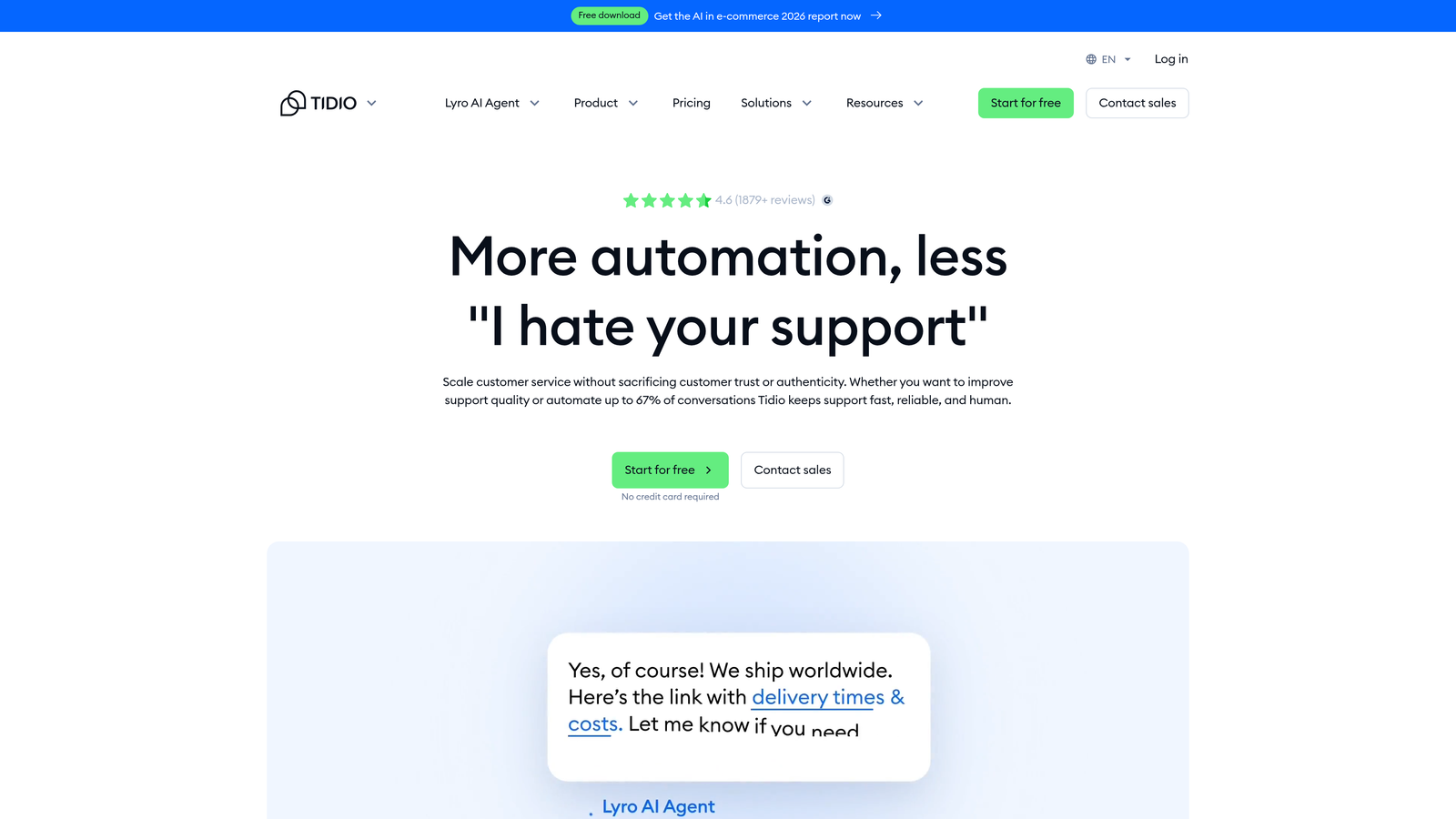
Tidio is an accessible AI chatbot platform featuring the Lyro AI assistant, designed for teams that need quick deployment without enterprise complexity.
Where This Tool Shines
Tidio competes on ease and affordability. The Lyro AI assistant trains on your existing FAQ and help content, meaning you can have a functional AI chatbot running in a matter of hours rather than weeks. For small teams without dedicated support operations resources, that speed to value is significant.
The integration list is well-matched to the SMB market: Shopify, WordPress, Wix, and HubSpot cover the core stack for most small businesses and e-commerce stores. It won't replace a purpose-built enterprise platform, but it's a strong fit for teams in its target segment.
Key Features
Lyro AI Chatbot: Trains on your FAQ and help content to answer customer questions automatically without manual flow building.
One-Click Integrations: Quick connections with Shopify, WordPress, Wix, and HubSpot for fast deployment.
Live Chat with AI Assist: Combines live agent chat with AI-suggested replies to improve agent response speed.
Visual Flow Builder: Drag-and-drop chatbot builder for creating custom automation sequences beyond FAQ responses.
Multichannel Support: Handles conversations across web chat, email, and Facebook Messenger from one inbox.
Best For
Small businesses, e-commerce stores, and early-stage SaaS teams that need affordable AI chat without enterprise setup complexity. Not designed for high-volume B2B support operations.
Pricing
Free plan available. Paid plans start at $29 per month. Lyro AI add-on starts at $39 per month. Pricing is among the most accessible on this list.
8. Salesforce Einstein Service Cloud
Best for: Enterprise organizations running Salesforce CRM who need AI-powered service with full customer data context.
Salesforce Einstein Service Cloud embeds AI directly into the Salesforce ecosystem, providing case classification, agent assist, and autonomous resolution with complete CRM context.
Where This Tool Shines
The core advantage here is CRM depth. When your support AI can reference a customer's full purchase history, open opportunities, contract value, and prior interactions without any data syncing, the quality of context available for resolution is substantially higher than most standalone support tools can achieve.
The introduction of Agentforce has also moved Einstein beyond assist-only capabilities into genuine autonomous resolution. For Salesforce shops, this represents a meaningful upgrade from AI as a productivity tool to AI as a resolution engine.
Key Features
Einstein AI Classification: Automatically classifies, routes, and prioritizes cases using AI trained on your historical data.
Agentforce Autonomous Agents: AI agents capable of handling full case resolution without human involvement for defined case types.
Full CRM Context: Accesses complete customer records, purchase history, and interaction history from Salesforce for context-rich support.
Knowledge Recommendations: Surfaces relevant knowledge articles for both agents and self-service customers in real time.
Cross-Cloud Integration: Connects with Sales Cloud, Marketing Cloud, and Slack for a unified view of the customer relationship.
Best For
Enterprise organizations already running Salesforce CRM. The ROI is highest when support, sales, and marketing data all live in the Salesforce ecosystem.
Pricing
Service Cloud starts at $25 per user per month. Einstein AI features are available in higher tiers and as add-ons. Full pricing depends on edition and feature selection.
9. Cognigy
Best for: Large enterprises with complex backend systems, voice channel requirements, or highly regulated environments.
Cognigy is an enterprise conversational AI platform supporting both voice and digital channels, with over 100 pre-built integrations for organizations with sophisticated infrastructure needs.
Where This Tool Shines
Cognigy operates at the high end of complexity and capability. The 100+ pre-built integrations include enterprise systems like SAP and ServiceNow that most other tools on this list don't natively support. For organizations where support needs to interact with ERP systems, ITSM platforms, or legacy infrastructure, that integration depth is often a deciding factor.
The voice AI capabilities also set Cognigy apart. Most AI support tools focus exclusively on digital channels. Cognigy extends the same AI intelligence to voice, which matters significantly for contact centers that handle a meaningful volume of phone-based support.
Key Features
100+ Pre-Built Integrations: Covers enterprise systems including SAP, ServiceNow, Genesys, and Microsoft Teams alongside standard support tools.
Voice AI for Contact Centers: Extends conversational AI to phone channels, enabling consistent AI support across voice and digital.
Low-Code Conversation Designer: Visual design environment with LLM orchestration for building complex conversation flows without heavy engineering work.
Omnichannel Deployment: Deploys across web, voice, WhatsApp, and additional channels from a single platform configuration.
Enterprise Security and Compliance: Carries enterprise-grade security certifications for organizations with strict regulatory requirements.
Best For
Large enterprises with complex backend integrations, voice support requirements, or compliance-sensitive environments. Typically overkill for SMB and mid-market teams without these specific needs.
Pricing
Custom enterprise pricing. Contact sales for a tailored quote based on channel mix and integration requirements.
Choosing the Right AI Support Integration Service
The right choice depends less on which tool has the longest feature list and more on where your support operation lives today and where you need it to go.
If you're building AI-first from the ground up: Halo AI is built for exactly this. The integration depth across CRMs, engineering tools, billing systems, and communication platforms gives your AI agents the full business context they need to resolve tickets intelligently, not just quickly. The continuous learning engine means the system gets smarter with every interaction rather than plateauing.
If you're ecosystem-locked: Stick with the native AI for your platform. Intercom Fin for Intercom teams, Zendesk AI for Zendesk shops, Freddy AI for Freshworks customers, and Einstein Service Cloud for Salesforce organizations. You'll get faster setup and tighter workflow integration than any third-party tool can offer.
If you need AI without platform migration: Forethought is the strongest middleware option, layering generative AI resolution and triage on top of your existing helpdesk without requiring you to rebuild anything.
For SMB and e-commerce teams: Tidio delivers strong value at an accessible price point, with integrations matched to the tools most small businesses actually use.
For enterprise complexity: Ada handles high-volume multi-channel operations with no-code flexibility, while Cognigy serves organizations that need voice AI and connections to enterprise backend systems like SAP or ServiceNow.
Your support team shouldn't scale linearly with your customer base. Let AI agents handle routine tickets, guide users through your product, and surface business intelligence while your team focuses on complex issues that need a human touch. See Halo in action and discover how continuous learning transforms every interaction into smarter, faster support.