9 Best AI Support Platforms in 2026: Evaluation Criteria & Top Picks
This guide applies rigorous AI support platform evaluation criteria—covering resolution quality, integrations, escalation handling, and total cost of ownership—to rank nine leading platforms for B2B and SaaS teams. Whether you're replacing an existing tool or building your support stack from scratch, it provides a practical framework for identifying which AI platforms deliver genuine autonomous resolution versus surface-level automation.
 Matt PattoliFounder13 min read
Choosing an AI support platform is no longer just a technology decision — it's a strategic one. With dozens of vendors claiming to "automate support," the real challenge is knowing which evaluation criteria actually matter: Does the AI learn continuously, or is it static? Can it handle complex, multi-step tickets autonomously? Does it integrate with your existing stack without a six-month implementation?
This guide evaluates nine leading platforms against the criteria that B2B and SaaS teams care about most: resolution quality, integrations, escalation handling, business intelligence, and total cost of ownership. Whether you're migrating from Zendesk, replacing Intercom, or building your AI support stack from scratch, use this list as your evaluation framework. For deeper reading, check out our guides on automated customer support and AI helpdesk software after you finish here.
1. Halo AI
Best for: Product-led SaaS companies that want AI-native support with deep business intelligence
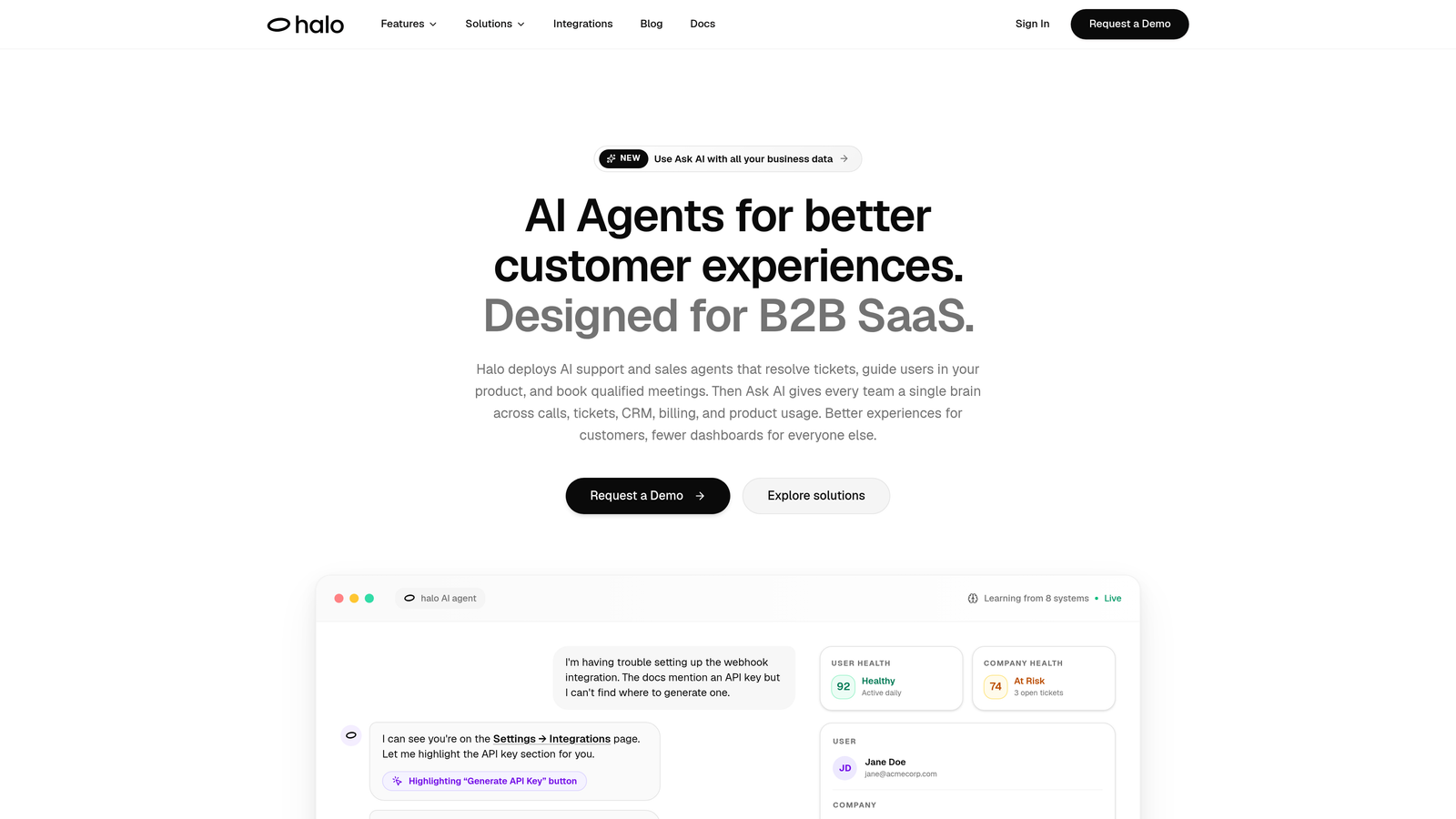
Halo AI is an AI-native customer support platform that deploys intelligent agents to resolve tickets, guide users through your product, and surface actionable business intelligence — all while learning from every interaction.
Where This Tool Shines
What separates Halo from AI-augmented helpdesks is the architecture. Rather than layering AI onto an existing ticketing system, Halo is built AI-first, which means the intelligence isn't an add-on — it's the core. Every resolved ticket feeds back into the system, making the AI progressively smarter over time rather than staying static.
The page-aware chat widget is a genuinely differentiated feature. It understands where a user is in your product and can provide contextual, visual UI guidance rather than generic FAQ responses. For SaaS products with complex onboarding or multi-step workflows, this is the kind of context-aware support that actually reduces churn.
Key Features
Page-Aware Chat Widget: Sees what the user sees in real time, delivering contextual UI guidance rather than generic answers.
Continuous Learning Loop: Every resolved ticket improves the AI's future responses — the system gets smarter with use, not stagnant.
Auto Bug Ticket Creation: Automatically creates and routes bug reports to Linear or other project management tools, closing the loop between support and engineering.
Smart Inbox with Business Intelligence: Surfaces anomaly detection, customer health signals, and revenue intelligence — turning your support inbox into a strategic data source.
Live Agent Handoff: Escalates to human agents with full conversation context preserved, so customers never have to repeat themselves.
Deep Integrations: Connects to Slack, HubSpot, Intercom, Stripe, Zoom, PandaDoc, Fathom, and Linear out of the box.
Best For
Product-led SaaS companies that need more than ticket deflection — teams that want their support platform to surface product gaps, flag at-risk accounts, and feed intelligence back into the business. Also a strong fit for companies migrating off traditional helpdesks who want a genuinely modern foundation.
Pricing
Contact for pricing at haloagents.ai. Given the AI-native architecture and business intelligence layer, pricing is customized based on volume and integration requirements.
2. Intercom
Best for: Mid-market SaaS teams wanting a mature conversational support platform with broad integrations
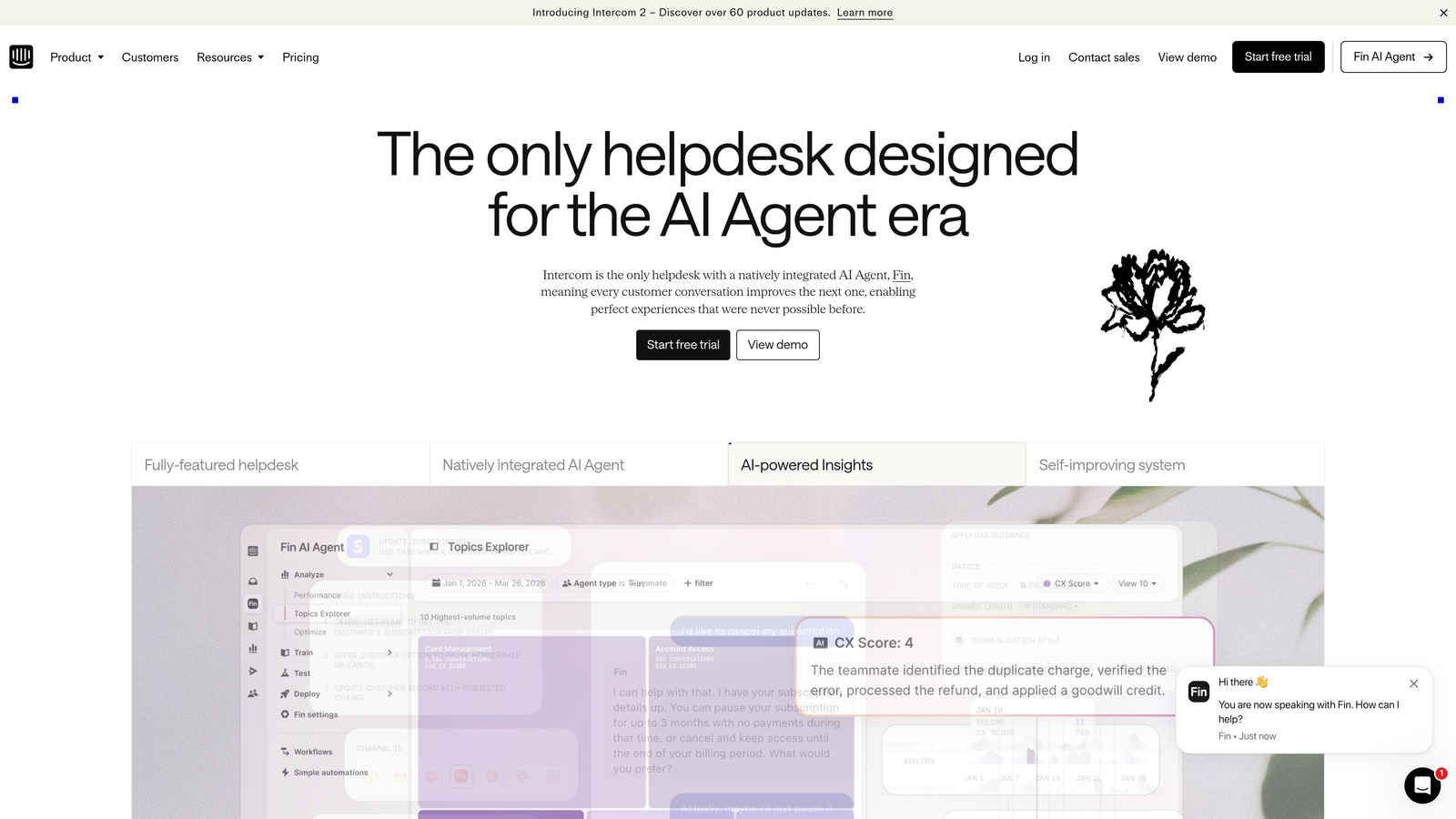
Intercom is a mature conversational support platform with its Fin AI agent, a powerful unified inbox, and a broad integration ecosystem built for mid-market SaaS and e-commerce teams.
Where This Tool Shines
Intercom's Fin AI agent is one of the more capable LLM-based resolution engines in the mid-market space. It can handle nuanced queries by reasoning across your help content rather than relying on rigid decision trees. The unified inbox — combining chat, email, and in-app messaging — is genuinely well-designed and reduces context-switching for support teams.
The maturity of the platform shows in its ecosystem: 400+ integrations, robust reporting, CSAT measurement, and proactive messaging tools. If your team is already familiar with Intercom's interface, the AI upgrade path is relatively smooth.
Key Features
Fin AI Agent: LLM-powered resolution engine that handles complex queries by reasoning across your knowledge base.
Unified Inbox: Combines chat, email, and in-app messaging in a single workspace for support teams.
Proactive Messaging and Product Tours: Enables outbound support and onboarding flows alongside reactive support.
Robust Reporting and CSAT: Solid analytics for tracking resolution rates, agent performance, and customer satisfaction.
400+ Integration Marketplace: Extensive app ecosystem covering CRM, billing, analytics, and more.
Best For
Mid-market SaaS teams that want a proven platform with strong conversation UX and a large integration library. Less ideal for teams that need deep business intelligence or autonomous resolution without ongoing manual configuration.
Pricing
Starts at $39/seat/month. Fin AI is usage-based on top of the base plan, so costs can escalate at higher conversation volumes — worth modeling before committing.
3. Zendesk AI
Best for: Enterprises already invested in the Zendesk ecosystem seeking AI-augmented workflows
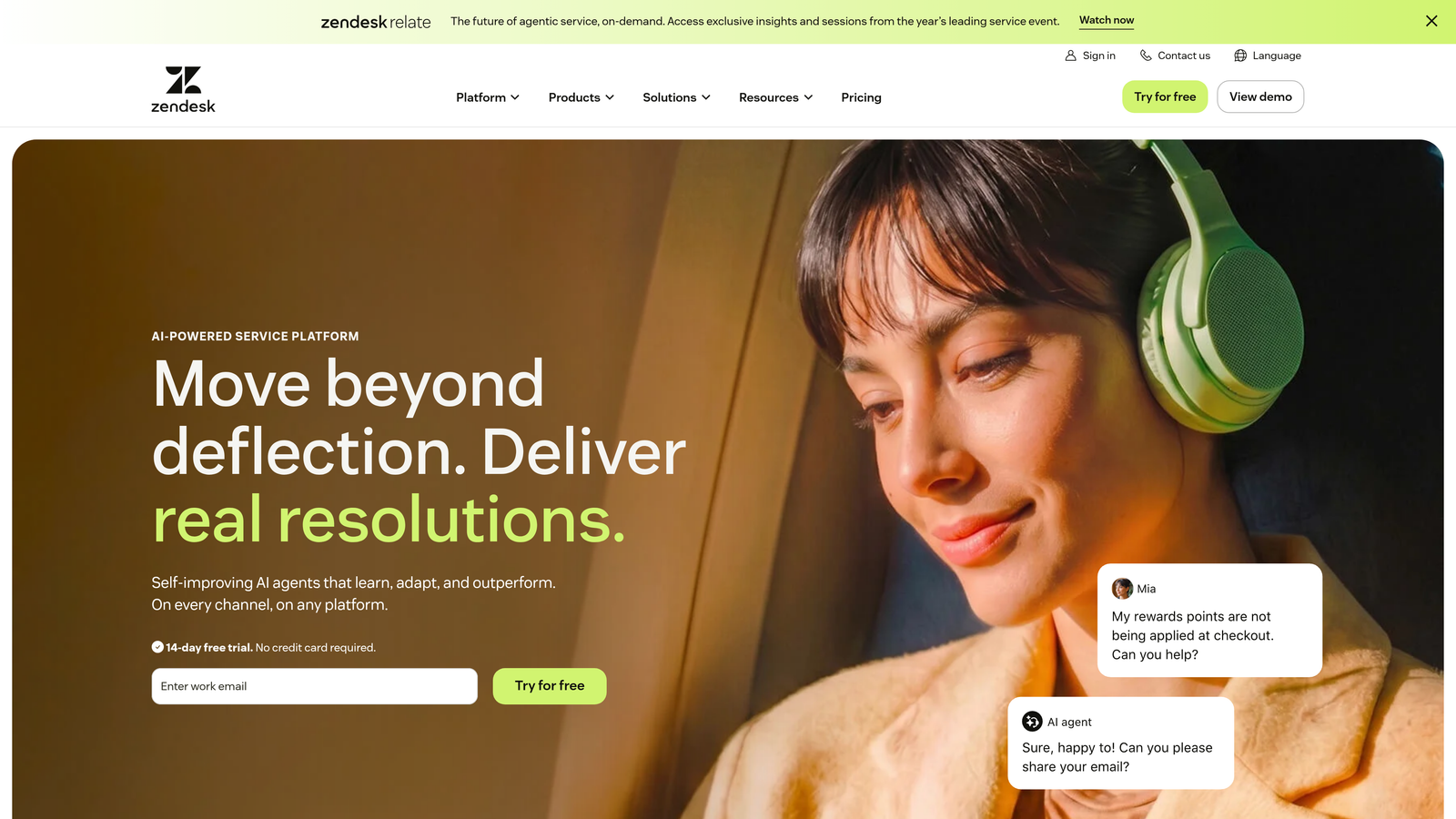
Zendesk AI is the industry-standard helpdesk with AI capabilities layered across ticket triage, agent assist, and workflow automation — purpose-built for teams already operating on the Zendesk platform.
Where This Tool Shines
If your organization has years of Zendesk data, workflows, and agent training invested, the AI layer makes a lot of sense as an upgrade path. Intelligent triage, AI-suggested replies, and the agent copilot features integrate directly into familiar interfaces — reducing adoption friction considerably.
Zendesk's enterprise-grade compliance, SLA management, and audit logging remain best-in-class. For regulated industries or large support orgs with strict governance requirements, this infrastructure is hard to replicate quickly with a newer vendor.
Key Features
Intelligent Triage and Routing: Automatically classifies and routes incoming tickets based on intent, urgency, and content.
AI-Suggested Replies and Agent Copilot: Surfaces recommended responses and relevant knowledge to agents in real time.
Advanced Workflow Automation: Triggers, macros, and business rules that handle complex routing logic at scale.
Enterprise Compliance and SLAs: Audit logs, role-based access, and SLA enforcement built for regulated environments.
AI-Powered Voice and Messaging: Extends AI capabilities across phone and messaging channels, not just chat and email.
Best For
Enterprises with existing Zendesk investments, large support teams, and compliance requirements. Less compelling as a greenfield choice for companies that want AI-native architecture rather than AI retrofitted onto a traditional helpdesk.
Pricing
Suite plans start at $55/agent/month. AI add-ons are priced separately, so total cost of ownership can be higher than it first appears — factor in the full stack before comparing to competitors.
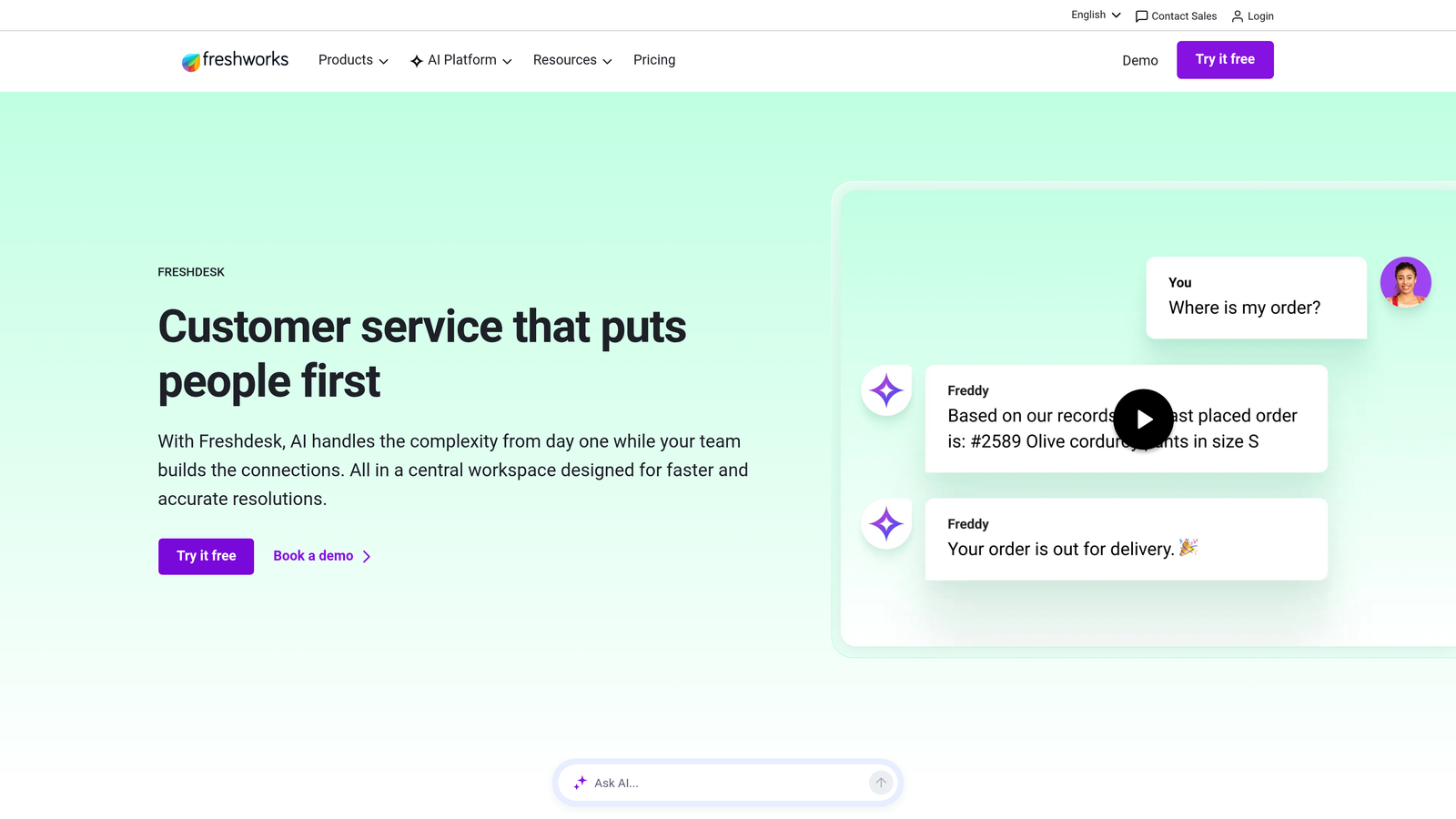
4. Freshdesk Freddy AI
Best for: SMBs and growing startups needing accessible AI support within the Freshworks ecosystem
Freshdesk's AI layer — called Freddy — delivers auto-triage, bot flows, and suggested responses across the Freshworks suite at price points accessible to smaller teams and growing startups.
Where This Tool Shines
Freshdesk's biggest advantage is the combination of affordability and suite breadth. Freddy AI integrates across Freshworks' CRM, ITSM, and sales tools, which means teams that want a unified platform without enterprise-level pricing have a credible option. The Freddy Self Service chatbot handles deflection before tickets are even created, which keeps volume manageable for lean teams.
Sentiment detection is a useful addition — flagging frustrated customers before they escalate gives agents a chance to intervene proactively rather than reactively.
Key Features
Freddy AI Auto-Triage: Automatically categorizes, prioritizes, and routes incoming tickets without manual intervention.
Suggested Replies and Sentiment Detection: Surfaces recommended responses and flags negative sentiment in real time.
Freddy Self Service Chatbot: Deflects common queries before they reach the ticket queue.
Freshworks Suite Integration: Connects natively to Freshworks CRM, ITSM, and sales tools for a unified view.
Omnichannel Coverage: Handles email, chat, phone, and social from a single platform.
Best For
SMBs and startups that want AI-assisted support without enterprise pricing, especially those already using or considering other Freshworks products. Less suited for teams that need sophisticated autonomous resolution or deep third-party integrations outside the Freshworks ecosystem.
Pricing
Free plan available. Growth plan from $15/agent/month. AI features are included on higher tiers — one of the more accessible entry points in this comparison.
5. Tidio
Best for: E-commerce businesses on Shopify or WooCommerce needing fast, lightweight AI support
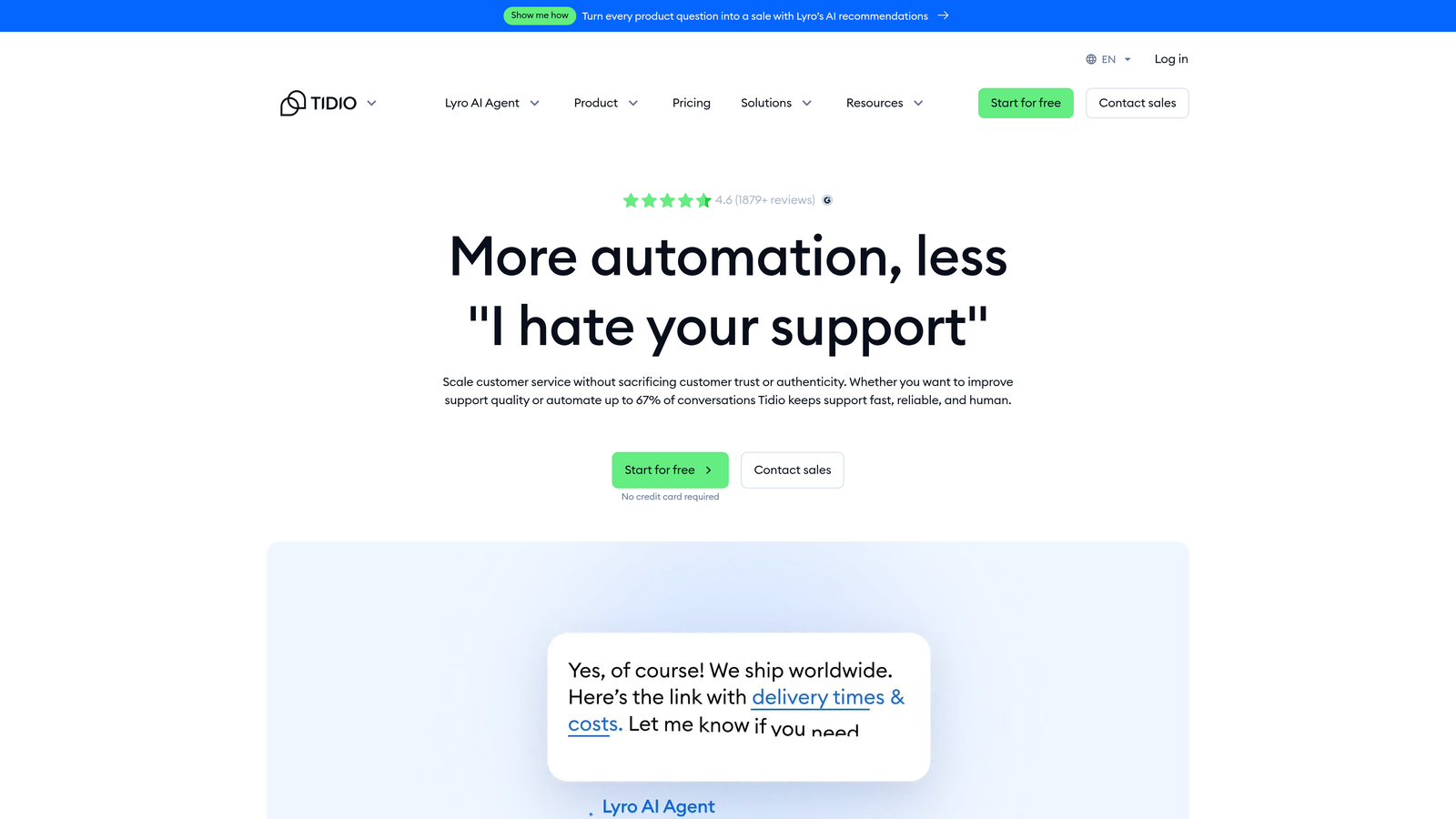
Tidio is a lightweight AI support tool built around the Lyro AI agent, designed for fast deployment and tight e-commerce integrations — particularly with Shopify and WooCommerce stores.
Where This Tool Shines
Tidio's strength is speed and simplicity. Teams can deploy Lyro in under an hour without engineering involvement, which is genuinely rare in this space. For e-commerce operators who need to handle order status queries, return requests, and product questions at scale, Lyro handles the repetitive high-volume work effectively.
The native Shopify and WooCommerce integrations mean the AI can pull order data directly rather than requiring custom API work. For small teams without dedicated technical resources, this out-of-the-box functionality is a significant practical advantage.
Key Features
Lyro AI Agent: Handles automated customer query resolution with a conversational, context-aware approach.
Native E-Commerce Integrations: Deep Shopify and WooCommerce connections for order data, product info, and customer history.
Unified Inbox: Combines live chat, chatbot, and email in a single interface.
No-Code Setup: Deploy and configure without engineering resources — live in under an hour.
Conversation Analytics: Bot performance tracking and conversation insights to optimize deflection rates.
Best For
Small to mid-size e-commerce businesses, particularly Shopify merchants, that need fast deployment and strong order-related automation. Less suited for complex B2B SaaS support workflows or teams that need deep business intelligence beyond conversation analytics.
Pricing
Free plan available. Lyro AI from $29/month. Paid plans start at $29/month — among the most affordable options in this guide for smaller teams.
6. Drift (Salesloft)
Best for: B2B teams where support and revenue generation overlap and sales-assist conversations matter
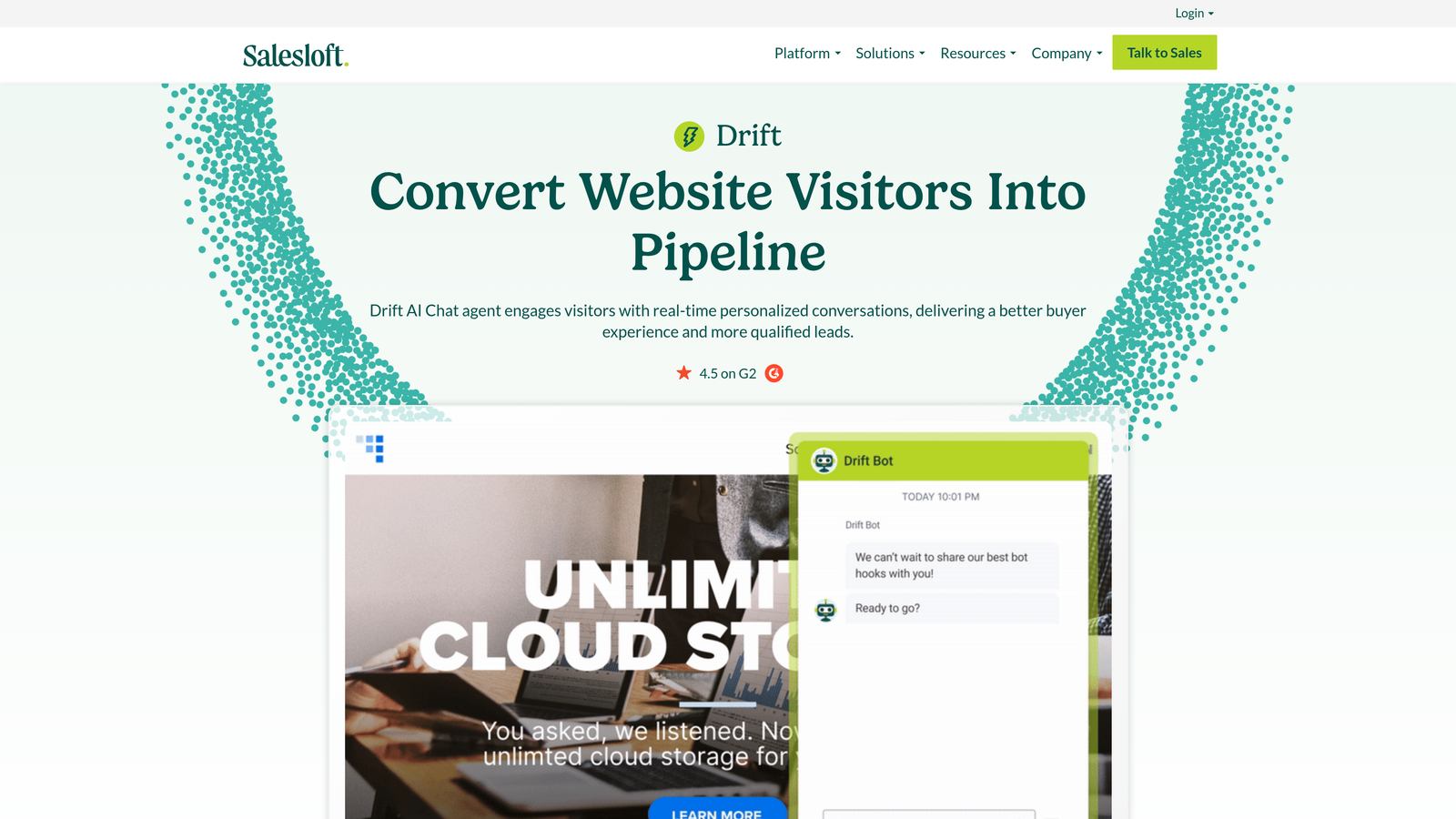
Drift is a conversational AI platform — now part of Salesloft — that blends support with revenue generation, routing conversations to sales or support based on real-time intent signals.
Where This Tool Shines
Drift occupies an interesting position: it's less a pure support tool and more a revenue-aware conversation platform. If your support team regularly fields questions that have sales implications — pricing, upgrades, renewals — Drift's intent-based routing can connect those conversations to the right person at the right moment rather than letting them fall into a generic ticket queue.
The ABM-friendly targeting for high-value accounts is a genuine differentiator for enterprise B2B teams. Recognizing a target account and routing them differently from a standard inbound query is a capability most pure-play support tools don't offer.
Key Features
Intent-Based Conversation Routing: Routes chats to sales or support based on visitor intent signals and account data.
Lead Qualification and Meeting Booking: Qualifies leads and books sales meetings directly within support conversations.
ABM-Friendly Targeting: Identifies and prioritizes high-value accounts for personalized routing and engagement.
CRM and Sales Stack Integrations: Connects to Salesforce, HubSpot, and Salesloft workflows natively.
Real-Time Sales Notifications: Alerts sales reps when target accounts are active in a conversation.
Best For
Enterprise B2B teams where the boundary between support and sales is blurry, or where support conversations regularly generate pipeline. Less appropriate for teams that need deep ticket management, mobile support, or AI that learns from resolution history.
Pricing
Contact for pricing. Drift is enterprise-focused, and pricing reflects that — it's not typically the right fit for smaller teams without a dedicated sales-support overlap use case.
7. Kustomer
Best for: High-volume omnichannel support teams that need a unified customer timeline across all channels
Kustomer is a CRM-native omnichannel support platform owned by Meta that unifies the full customer timeline across chat, email, social, and voice — with AI layered throughout for routing, resolution, and automation.
Where This Tool Shines
The unified customer timeline is Kustomer's signature feature. Rather than treating each interaction as an isolated ticket, Kustomer assembles a complete picture of the customer across every channel and touchpoint. For support teams handling customers who contact via email one day, social the next, and chat the day after, this context continuity is operationally significant.
The built-in CRM eliminates the need for a separate customer data tool, which reduces both cost and integration complexity. For D2C brands and high-volume consumer support operations, this consolidation is a real efficiency gain.
Key Features
Unified Customer Timeline: Assembles every interaction across all channels into a single, chronological customer view.
AI-Powered Routing and Auto-Resolution: Intelligently routes tickets and resolves common queries without human involvement.
Built-In CRM: Eliminates the need for a separate customer data platform by storing customer records natively.
Omnichannel Coverage: Handles chat, email, social media, SMS, and voice from one platform.
Business Rules Engine: Flexible workflow automation for complex routing and escalation logic.
Best For
D2C brands and consumer businesses managing high volumes across multiple channels who want a CRM and support platform in one. Less optimized for pure B2B SaaS teams that don't need social and SMS coverage but do need deep product integration and business intelligence.
Pricing
Enterprise and Ultimate plans available — contact for pricing. Kustomer is positioned for mid-market to enterprise customers, so expect pricing to reflect that scale.
8. Helpshift
Best for: Mobile-first products — particularly gaming apps and fintech — needing in-app support without redirecting users
Helpshift is an SDK-based in-app support platform purpose-built for mobile applications, offering async messaging, AI bot flows, and in-app FAQs without ever redirecting users out of the app experience.
Where This Tool Shines
Helpshift solves a problem that most support platforms ignore entirely: mobile users hate leaving an app to get help. By embedding support directly via native iOS and Android SDKs, Helpshift keeps users in the product while still delivering structured bot flows, async messaging, and searchable FAQs. For gaming companies and mobile fintech apps, this is often a critical retention consideration.
The integrations with Unity and Unreal Engine are a strong signal of how specialized this tool is. If your product is a mobile game, Helpshift has been built with your specific support patterns in mind — something general-purpose platforms simply haven't prioritized.
Key Features
Native Mobile SDK: Embeds support directly into iOS and Android apps without redirecting users to external pages.
Async Messaging with AI Bot Flows: Handles asynchronous conversations with structured automation for common mobile support patterns.
In-App FAQ and Self-Service Search: Surfaces relevant help content within the app interface.
Smart Automation for Mobile Patterns: Pre-built automation for common mobile issues like account recovery, payment problems, and connectivity errors.
Gaming Engine Integrations: Native integrations with Unity and Unreal Engine for game-specific support workflows.
Best For
Mobile app companies — particularly gaming studios, fintech apps, and consumer mobile products — where keeping users in-app during support interactions is a priority. Not the right choice for web-based SaaS products or teams that need broad omnichannel coverage.
Pricing
Contact for pricing. Usage-based tiers are available, which can be cost-effective for apps with variable monthly active user counts.
9. Ada
Best for: Large enterprises needing high-volume deflection with multilingual support and governance controls
Ada is an enterprise-grade no-code AI bot builder focused on high-volume deflection, multilingual support across 50+ languages, and governance controls designed for large support organizations with global customer bases.
Where This Tool Shines
Ada's no-code conversation builder is genuinely accessible to non-technical teams — support managers can design and iterate on bot flows without waiting for engineering resources. For large organizations where speed of iteration matters and technical bottlenecks are a real constraint, this autonomy is valuable.
The multilingual capabilities and enterprise governance features (role-based access, audit trails, approval workflows) are where Ada truly earns its enterprise positioning. Organizations operating across multiple regions with compliance requirements around bot content and change management will find these controls essential rather than optional.
Key Features
No-Code Bot Builder: Drag-and-drop conversation design that non-technical teams can own and iterate on independently.
Multilingual Support: Handles customer interactions across 50+ languages with localized conversation flows.
Enterprise Governance Controls: Role-based access, audit trails, and approval workflows for regulated or compliance-sensitive environments.
AI Intent Detection and Entity Extraction: Understands customer intent beyond keyword matching for more accurate routing and resolution.
CRM and Helpdesk Integrations: Connects to Salesforce, Zendesk, and major CRM platforms for data continuity.
Best For
Large enterprises with global customer bases, high deflection volume targets, and strict governance requirements around bot content. Less focused on deep autonomous ticket resolution or the kind of continuous learning loops that improve resolution quality over time.
Pricing
Contact for pricing. Ada operates on enterprise contracts — typically structured around conversation volume and deployment scope.
Which Platform Fits Your Situation
The right AI support platform depends on three things: your company size, your existing stack, and what you actually need the AI to do. Here's a quick-reference framework to cut through the options.
You're a product-led SaaS company that wants AI to do more than deflect tickets: Halo AI is the strongest fit. The combination of page-aware context, continuous learning, auto bug ticket creation, and business intelligence signals makes it genuinely differentiated for teams that want support to inform product and revenue decisions — not just reduce ticket volume.
You're already on Zendesk or Freshdesk and want to add AI without migrating: Zendesk AI or Freshdesk Freddy AI are the pragmatic choices. You'll get meaningful AI augmentation without disrupting existing workflows, though the AI depth won't match a purpose-built platform.
You're mid-market SaaS with a mature support team: Intercom's Fin AI agent and unified inbox offer a polished experience with a proven track record. Just model the usage-based Fin pricing carefully before committing.
You run an e-commerce store on Shopify: Tidio with Lyro is the fastest path to meaningful automation, with native integrations that don't require technical setup.
You're a mobile app or game studio: Helpshift is purpose-built for your use case. No other platform on this list offers SDK-based in-app support with gaming engine integrations.
You're a global enterprise needing governance and multilingual scale: Ada's no-code builder and compliance controls are built for exactly this scenario.
Your support team shouldn't scale linearly with your customer base. Let AI agents handle routine tickets, guide users through your product, and surface business intelligence while your team focuses on complex issues that need a human touch. See Halo in action and discover how continuous learning transforms every interaction into smarter, faster support.