9 Best AI Support Platforms for Businesses in 2026
This guide ranks the 9 best AI support platforms for businesses in 2026, evaluating each on autonomy, integration depth, learning capability, scalability, and pricing transparency. Whether you're a SaaS team or a large enterprise, it cuts through the noise between AI-native platforms and legacy helpdesks to help you find the right fit.
 Matt PattoliFounder13 min read
Customer support has crossed a threshold. The question for most B2B teams is no longer whether to bring AI into the support stack, but which approach actually fits how your business works. And that distinction matters more than most buyers realize.
There's a meaningful difference between an AI-native platform built from the ground up for autonomous resolution and a legacy helpdesk that added AI features to stay competitive. The former learns, adapts, and operates independently. The latter assists. Knowing which one you need is half the battle.
This list covers the top AI support platforms for businesses across a range of company sizes and use cases. Each tool was evaluated on autonomy, integration depth, learning capability, scalability, and pricing transparency. Whether you're a SaaS team looking for something that feeds product intelligence back into your roadmap, or an enterprise running Salesforce as your system of record, there's an option here for you. If you're weighing a purpose-built AI platform against a traditional helpdesk, this comparison breaks down the key differences. And if you want to see what an AI-native approach looks like in practice, Halo AI's customer support solution is a good place to start.
1. Halo AI
Best for: SaaS companies that want AI-native support with business intelligence built in
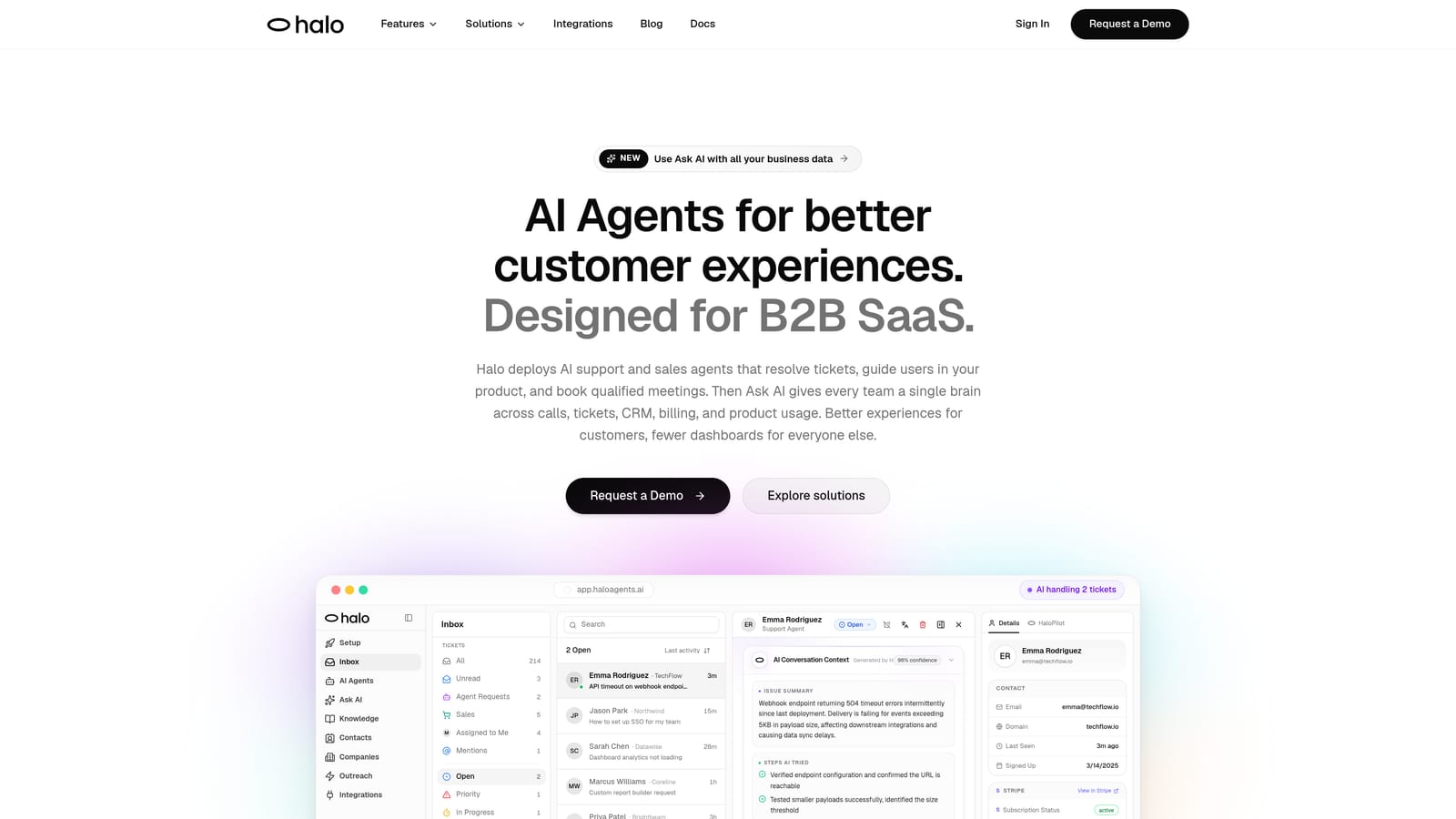
Halo AI is an AI-native customer support platform that deploys intelligent agents to resolve tickets, guide users through your product, and surface business intelligence across your entire customer base.
Where This Tool Shines
Halo was built AI-first, not retrofitted. That architectural difference shows up in how the platform handles context: the page-aware chat widget can see exactly what a user is looking at and provide guidance specific to that screen, not just generic help center content. This is particularly valuable for SaaS products with complex UIs where users often need a nudge in the right direction rather than a full support ticket.
Beyond resolving tickets, Halo surfaces insights that most support platforms simply don't capture. The smart inbox goes beyond ticket counts, surfacing customer health signals, revenue anomalies, and product usage patterns. Support becomes a source of business intelligence, not just a cost center.
Key Features
Page-Aware Chat Widget: The AI sees what the user sees, delivering contextual UI guidance based on their current location in your product.
Autonomous Ticket Resolution with Continuous Learning: The system improves from every resolved interaction, getting smarter over time without manual retraining.
Auto Bug Ticket Creation: Automatically generates bug reports and routes them to engineering via Linear integration, closing the loop between support and product.
Smart Inbox with Business Intelligence: Surfaces customer health signals, revenue anomalies, and product insights alongside standard support metrics.
Seamless Live Agent Handoff: When complexity exceeds AI confidence, escalation to a human agent is smooth and contextually complete.
Deep Integration Stack: Connects to Linear, Slack, HubSpot, Intercom, Stripe, Zoom, PandaDoc, and Fathom out of the box.
Best For
SaaS companies and B2B product teams that want support to do more than close tickets. If you need your support layer to feed revenue intelligence, product insights, and customer health data back into the business, Halo is purpose-built for that use case. Particularly strong for teams scaling headcount concerns, where autonomous resolution is a priority.
Pricing
Contact for pricing via demo request. Given the platform's depth and integration capabilities, pricing is scoped to your specific use case and team size.
2. Intercom
Best for: Teams that want conversational-first support with AI handling first-line resolution
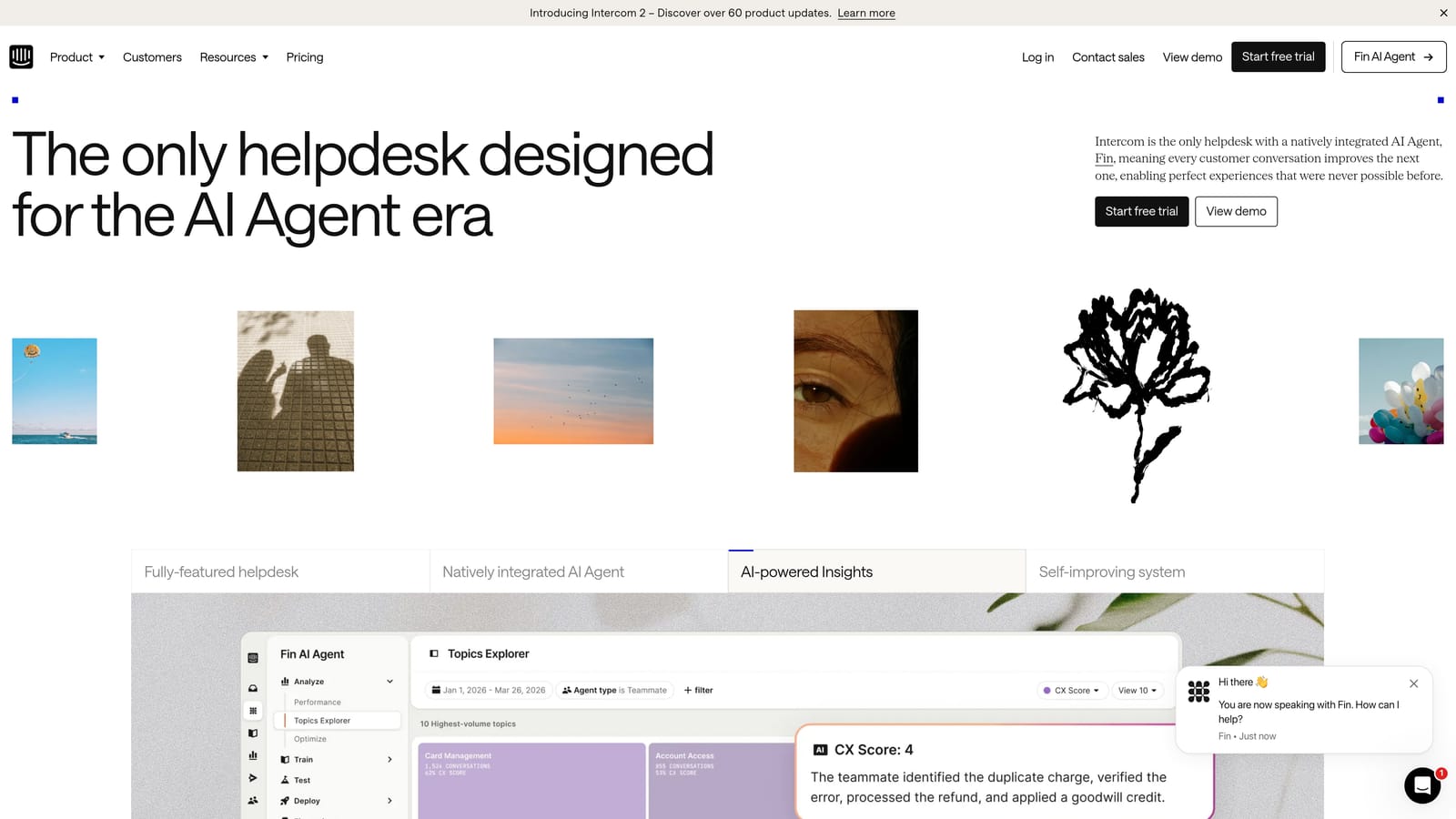
Intercom is a mature conversational support platform featuring Fin, an AI agent built on large language models that handles first-line resolution across chat and email.
Where This Tool Shines
Intercom has spent years building a conversational support experience that feels natural to end users. Fin, their AI agent, draws from help center content and custom answers to resolve common queries without human involvement. The experience is polished and the handoff to human agents is well-designed.
Intercom also excels at proactive support: in-app messages, product tours, and behavior-triggered outreach that catches problems before they become tickets. For teams where the support and product experience are deeply intertwined, that proactive layer adds real value.
Key Features
Fin AI Agent: Resolves common queries autonomously using help center content and custom knowledge, with consumption-based pricing per resolution.
In-App Messaging and Product Tours: Proactive support tools that reduce inbound volume by guiding users before issues arise.
Omnichannel Inbox: Unifies chat, email, and social conversations in a single workspace for agents.
Large Integration Marketplace: Hundreds of integrations covering CRM, analytics, and engineering tools.
Best For
Teams that have built their support workflows around conversational channels and want AI to handle first-line resolution without rebuilding their entire stack. Strong fit for SaaS companies with active in-app engagement needs.
Pricing
Tiered plans with Fin AI priced per resolution. See Intercom's pricing page for current rates, as consumption-based pricing varies by volume.
3. Zendesk
Best for: Enterprise teams needing a highly configurable helpdesk with AI-enhanced workflows
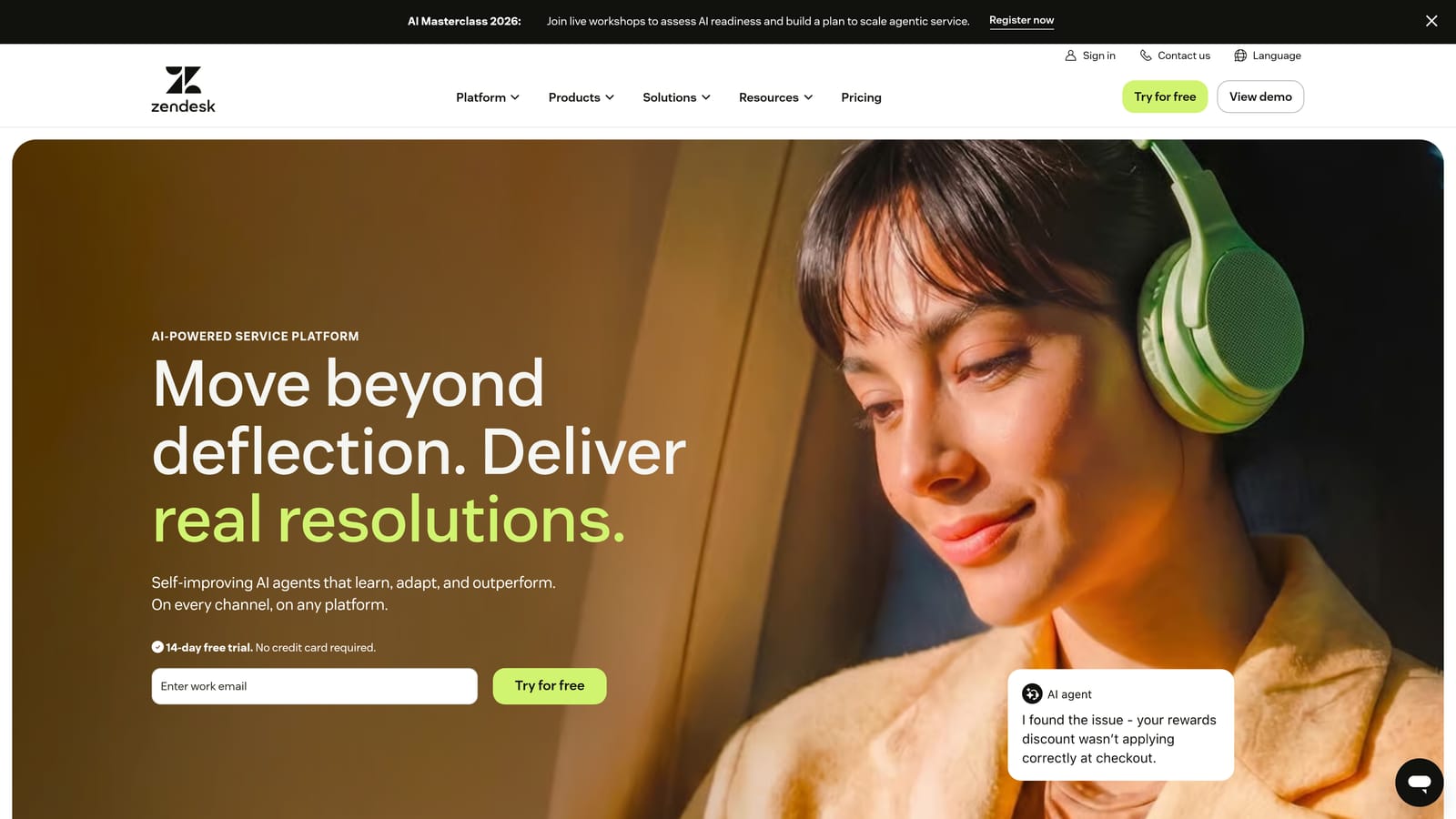
Zendesk is the enterprise-grade helpdesk standard, now with Zendesk AI layered in for intelligent ticket triage, suggested replies, and agent copilot capabilities.
Where This Tool Shines
Zendesk's strength is its configurability and its ecosystem. Decades of enterprise adoption have produced a platform that can be shaped to fit almost any support workflow, with SLA management, custom routing rules, and compliance features that large organizations require. The app marketplace is one of the largest in the industry.
The AI layer, built in partnership with OpenAI, adds meaningful capability to the ticketing foundation: intelligent routing, suggested responses, and agent guidance that speeds up resolution without requiring a full platform switch. It's AI as an enhancement, not a replacement architecture.
Key Features
Zendesk AI Triage and Routing: Automatically classifies, prioritizes, and routes incoming tickets based on content and intent.
Suggested Replies and Agent Copilot: AI-generated response suggestions that help agents resolve tickets faster with less effort.
Highly Configurable Workflows: SLA management, custom triggers, and automation rules that scale to enterprise complexity.
Enterprise Compliance: SOC 2 certification and HIPAA-eligible options for regulated industries.
Large App Marketplace: Hundreds of integrations across CRM, analytics, e-commerce, and engineering tools.
Best For
Enterprise organizations with complex support operations that need deep configurability, compliance features, and a proven track record. Teams already invested in the Zendesk ecosystem will find the AI additions meaningful without requiring migration.
Pricing
Suite plans published on Zendesk's site. AI features are available on higher tiers. See Zendesk's pricing page for current rates.
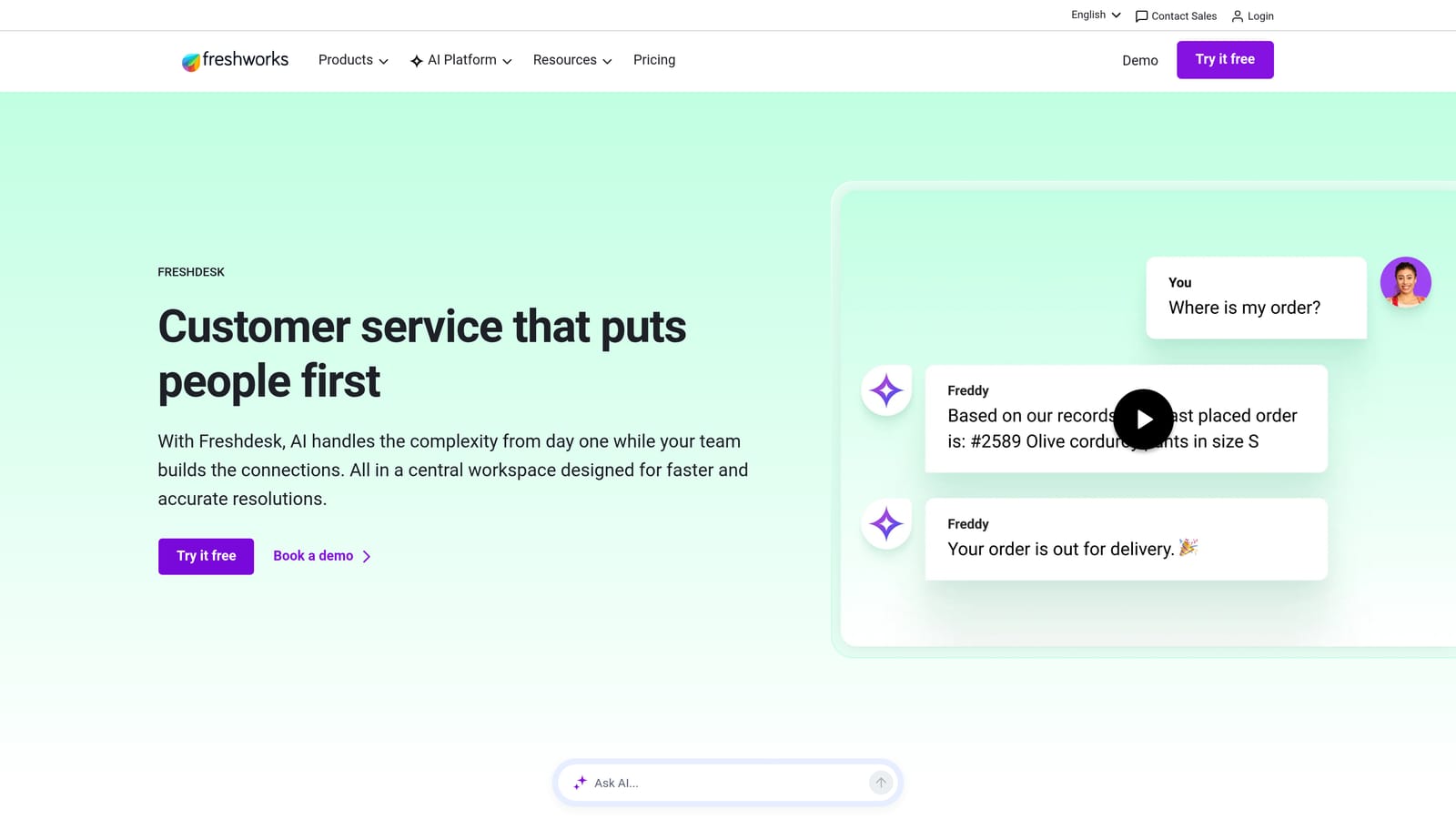
4. Freshdesk (Freddy AI)
Best for: SMBs that need a full helpdesk suite with AI assistance at accessible pricing
Freshdesk is Freshworks' all-in-one helpdesk with Freddy AI embedded for ticket categorization, agent assist, and automated resolution suggestions at SMB-friendly pricing.
Where This Tool Shines
Freshdesk hits a sweet spot for growing teams: it delivers a complete omnichannel helpdesk at a price point that doesn't require an enterprise budget. Freddy AI handles the repetitive work, auto-tagging tickets, suggesting replies, and guiding agents during live conversations, so smaller teams can punch above their weight without hiring more headcount.
The free tier makes it genuinely accessible for early-stage companies, and the platform scales upward as teams grow. For SMBs that need structure and AI assistance without full autonomy, Freshdesk is a practical choice.
Key Features
Freddy AI Ticket Categorization: Automatically tags and categorizes incoming tickets to reduce manual triage work.
Agent Assist Mode: Real-time AI guidance during live conversations, including suggested responses and relevant knowledge articles.
Omnichannel Inbox: Email, chat, phone, and social channels unified in a single workspace.
Free Tier Available: Functional free plan for small teams, with paid tiers and Freddy AI add-ons scaling upward.
Best For
Small to mid-sized businesses that need a complete helpdesk with AI assistance at a budget-conscious price point. Teams that want AI to reduce agent workload without committing to a fully autonomous architecture.
Pricing
Free tier available. Paid plans and Freddy AI add-ons at published rates on Freshworks' site.
5. Salesforce Service Cloud
Best for: Enterprise organizations already running Salesforce as their system of record
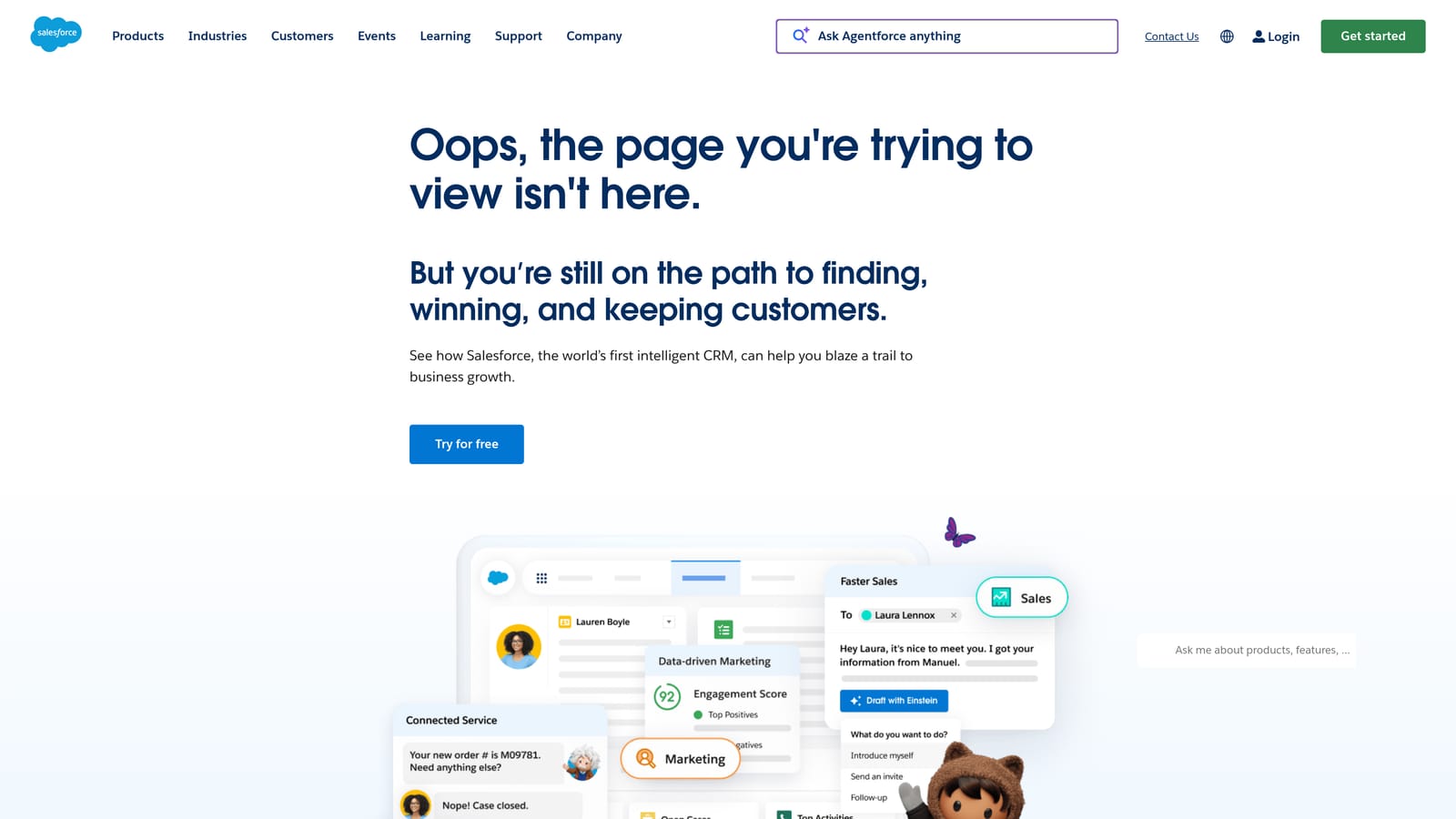
Salesforce Service Cloud is an enterprise customer service platform tightly integrated with Salesforce CRM, featuring Einstein AI for case intelligence and Agentforce for more autonomous support workflows.
Where This Tool Shines
If your organization runs on Salesforce, Service Cloud is the natural home for customer support. The native integration with Sales Cloud and Marketing Cloud means support agents have full customer context: deal history, account health, marketing touchpoints, all in one view. Einstein AI adds predictive intelligence on top of that data, surfacing next-best-action recommendations and flagging at-risk accounts before they churn.
Agentforce, Salesforce's newer AI agent capability, pushes toward more autonomous resolution and self-service workflows. It's a significant step beyond Einstein's assist-oriented approach, though implementation complexity is real.
Key Features
Einstein AI Case Intelligence: Case classification, next-best-action recommendations, and knowledge article suggestions powered by your Salesforce data.
Agentforce: Autonomous AI agent capabilities for self-service resolution and more complex workflow automation.
Native Salesforce Ecosystem Integration: Deep connection to Sales Cloud, Marketing Cloud, and the full Salesforce platform for unified customer data.
Predictive CSAT and Customer Health Scoring: AI-driven signals that surface at-risk customers before satisfaction drops.
Best For
Enterprise organizations where Salesforce is the system of record and support data needs to flow naturally into sales and marketing workflows. The implementation investment is significant, so it's best suited to teams with dedicated Salesforce administration resources.
Pricing
Enterprise pricing; contact Salesforce directly for current rates. Implementation costs typically add to the total investment.
6. Tidio
Best for: Small businesses and e-commerce stores needing fast, low-friction AI deployment
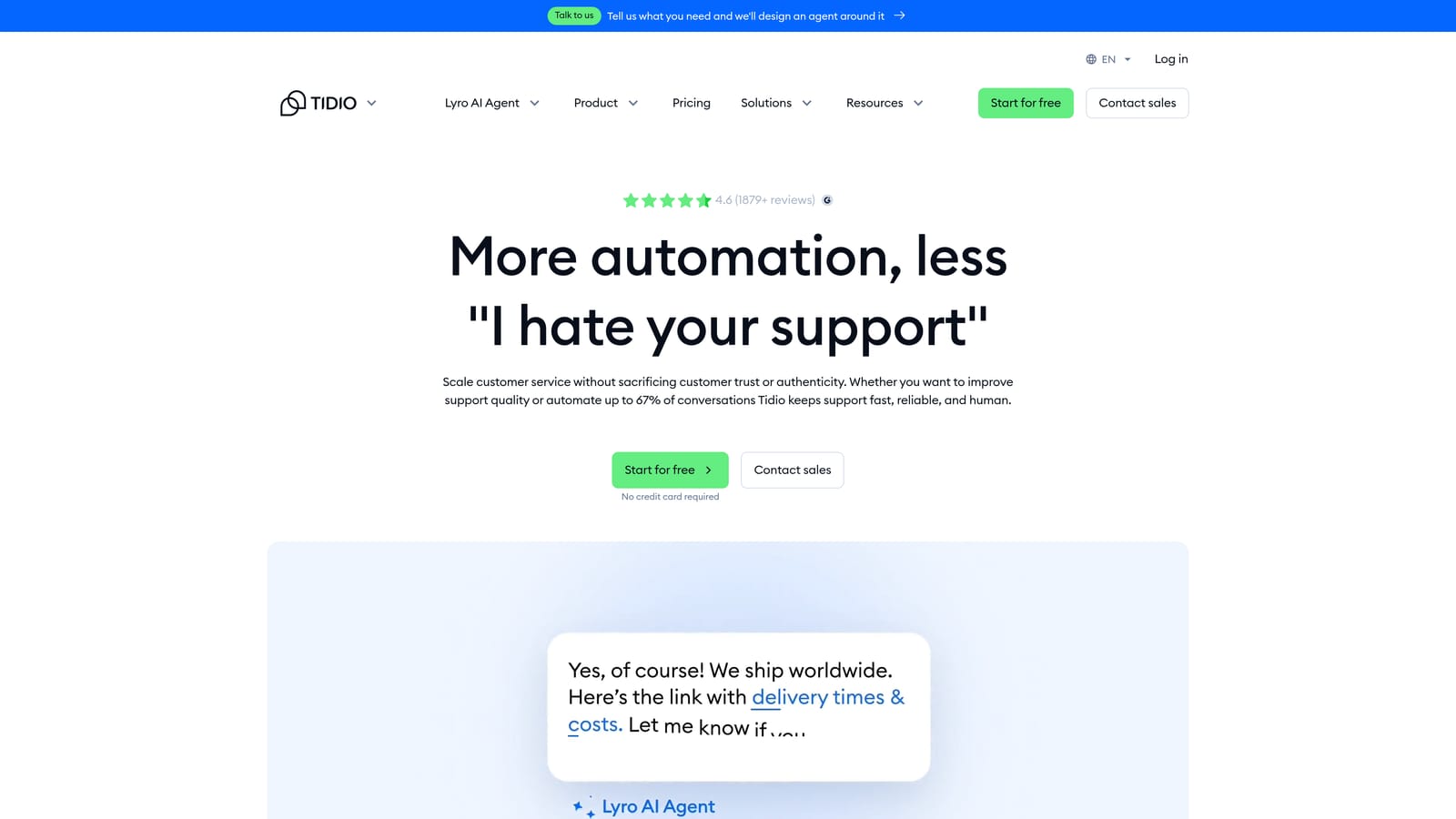
Tidio is a lightweight AI chat and support platform built for small businesses and e-commerce, featuring Lyro AI for conversational resolution with minimal setup required.
Where This Tool Shines
Tidio's biggest advantage is speed to value. Most platforms in this space require meaningful setup, training, and integration work before the AI does anything useful. Tidio gets Lyro AI running quickly, drawing from your existing support content to handle common questions without technical expertise on your end.
The Shopify integration is particularly strong for e-commerce teams, connecting order data, shipping status, and product information directly into the support conversation. For small businesses that need AI-powered chat without a dedicated IT team, Tidio removes most of the friction.
Key Features
Lyro AI Chatbot: Conversational AI that handles first-line resolution by drawing from your support content and FAQs.
Quick Deployment: Minimal technical setup required; most teams are live within hours rather than weeks.
E-Commerce Integrations: Strong Shopify integration with access to order and product data within support conversations.
Live Chat Fallback: Smooth handoff to a human agent when Lyro reaches the limits of its knowledge.
Best For
Small businesses and e-commerce stores that need AI-powered chat without technical complexity. Less suited to complex B2B SaaS support workflows where context depth and integration breadth matter more.
Pricing
Free tier available. Paid plans at accessible price points. See Tidio's site for current rates.
7. HubSpot Service Hub
Best for: Companies already using HubSpot who want support data integrated with CRM and marketing
HubSpot Service Hub is HubSpot's customer service product that unifies ticketing, knowledge base, and AI-powered conversation tools with the HubSpot CRM for a single view of every customer relationship.
Where This Tool Shines
The core value proposition of Service Hub is data unity. When support, sales, and marketing all live in the same HubSpot ecosystem, every ticket is automatically enriched with CRM context: the customer's deal stage, marketing engagement history, and lifecycle status. AI features like conversation summarization and reply drafting sit on top of that unified data layer.
For teams where support insights need to flow back into sales conversations or marketing segmentation, this unified architecture removes a lot of manual data work. The knowledge base with AI-assisted content suggestions also helps teams build self-service resources more efficiently.
Key Features
AI-Powered Ticket Routing and Reply Drafting: Intelligent routing suggestions and AI-generated reply drafts that speed up agent response times.
Conversation Summarization: Automatic summaries of support conversations for faster handoffs and QA review.
Unified HubSpot CRM Data: Every support interaction enriched with marketing, sales, and customer lifecycle data from across the HubSpot platform.
Customer Portal and Knowledge Base: Self-service tools with AI-assisted content suggestions for keeping help content current.
Conversation Intelligence: Quality assurance and coaching tools built on recorded and analyzed support interactions.
Best For
Companies running HubSpot as their CRM who want support data to flow naturally into revenue and marketing workflows. Teams that prioritize unified customer data over deep AI autonomy.
Pricing
Starter, Professional, and Enterprise tiers published on HubSpot's site.
8. Kustomer
Best for: High-volume D2C and subscription businesses with omnichannel support needs
Kustomer is a CRM-first customer service platform that unifies every customer interaction into a single conversation timeline, with AI handling intent detection, routing, and automated workflows across channels.
Where This Tool Shines
Kustomer's defining feature is the unified conversation timeline. Rather than organizing support around individual tickets, Kustomer organizes it around the customer. Every email, chat, SMS, social message, and voice interaction appears in a single chronological thread, giving agents full context without hunting across channels.
AI adds meaningful automation on top of that structure: intent detection identifies what the customer needs before the agent reads a word, sentiment analysis flags at-risk conversations, and automated workflows handle routine resolutions based on customer history and behavior.
Key Features
Unified Conversation Timeline: All customer interactions across email, chat, SMS, social, and voice in a single chronological view per customer.
AI Intent Detection and Sentiment Analysis: Automatically identifies customer intent and emotional state to prioritize and route conversations appropriately.
Automated Workflows: Behavior and history-triggered automations that handle routine cases without agent involvement.
Suggested Responses and Agent Guidance: AI-assisted reply suggestions and knowledge retrieval during live conversations.
Best For
High-volume D2C brands and subscription businesses with complex omnichannel support needs. The CRM-first model is particularly valuable for teams where customer history and lifetime value should inform every support interaction.
Pricing
Per-user pricing. See Kustomer's site for current rates.
9. Forethought
Best for: Teams with significant helpdesk investment who want AI improvements without migration
Forethought is an AI middleware platform that adds intelligent triage, autonomous resolution, and agent assist capabilities on top of existing helpdesks like Zendesk, Salesforce, and Freshdesk, without requiring replacement.
Where This Tool Shines
Forethought solves a specific problem: you've invested heavily in a helpdesk, your team knows it, your workflows are built around it, and you're not ready to migrate. But you want AI to do more than what your current platform offers. Forethought sits in between, adding a meaningful AI layer without disrupting the underlying infrastructure.
The three-product structure is well thought out. Triage handles intelligent routing and prioritization. Solve handles autonomous resolution for common queries. Assist gives agents real-time knowledge retrieval and suggested responses during live conversations. Each module addresses a different stage of the support workflow.
Key Features
Triage: Intelligent ticket routing and prioritization based on content, intent, and historical patterns.
Solve: Autonomous AI resolution for common queries, reducing ticket volume reaching human agents.
Assist: Real-time agent copilot with suggested responses and knowledge retrieval during live conversations.
Works With Existing Infrastructure: Integrates with Zendesk, Salesforce, Freshdesk, and other major helpdesks without replacing them.
Best For
Enterprise teams with significant helpdesk investment and mature workflows who want AI capability improvements without the disruption of a full platform migration. The trade-off is that Forethought adds AI on top of existing architecture rather than replacing it with an AI-native design.
Pricing
Enterprise-focused. Contact Forethought directly for pricing.
Which Platform Is Right for Your Business?
The right AI support platform depends less on feature checklists and more on your architecture goals. Here's a quick way to think through the decision.
AI-native with business intelligence: If you want support to generate product insights, surface revenue signals, and learn from every interaction, Halo AI is built specifically for that use case. It's the strongest fit for SaaS teams where support is a strategic function, not just a cost center.
Enterprise scale and configurability: Zendesk remains the benchmark for complex enterprise support operations. Salesforce Service Cloud is the natural choice if your organization runs on the Salesforce ecosystem and needs support tightly integrated with CRM and marketing data.
SMB and budget-conscious teams: Freshdesk offers a complete helpdesk with meaningful AI assistance at accessible pricing, including a free tier. Tidio is the fastest path to AI-powered chat for small businesses and e-commerce stores that need quick deployment without technical complexity.
Existing HubSpot stack: HubSpot Service Hub is the obvious choice for teams where support data needs to flow naturally into CRM, sales, and marketing workflows without additional integration work.
Conversational-first support: Intercom's Fin AI and proactive messaging tools make it the strongest option for teams where in-app conversation is the primary support channel.
CRM-first, high-volume omnichannel: Kustomer's unified conversation timeline is purpose-built for D2C and subscription businesses managing high volumes across many channels.
AI overlay without migration: Forethought is the right call if you have real investment in an existing helpdesk and want AI improvements without the disruption of switching platforms.
Your support team shouldn't scale linearly with your customer base. Let AI agents handle routine tickets, guide users through your product, and surface business intelligence while your team focuses on complex issues that need a human touch. See Halo in action and discover how continuous learning transforms every interaction into smarter, faster support.