9 Best AI Support Platforms for Small Teams in 2026
This guide reviews the 9 best AI support platforms for small teams in 2026, focusing on tools that are affordable, fast to deploy, and capable of handling real customer conversations without enterprise-level complexity or headcount.
 Matt PattoliFounder14 min read
Small teams face a support paradox: customers expect instant, always-on help, but building a full support department isn't an option when you're running lean. AI support platforms have become the practical answer, automating ticket resolution, deflecting repetitive questions, and giving small teams the capacity of a much larger operation without adding headcount.
The catch? Many platforms are enterprise-first tools with complex onboarding, opaque pricing, and feature sets built for 200-person support orgs. This list focuses on platforms that genuinely work for teams of 1 to 15 support agents: quick to deploy, affordable to scale, and smart enough to handle real customer conversations without a dedicated support ops person to manage them.
We evaluated each platform on ease of setup, AI resolution quality, pricing transparency, integration flexibility, and overall fit for lean teams. Here are nine worth your attention in 2026.
1. Halo AI
Best for: Small SaaS and product teams that want AI-native support with deep product and business context.
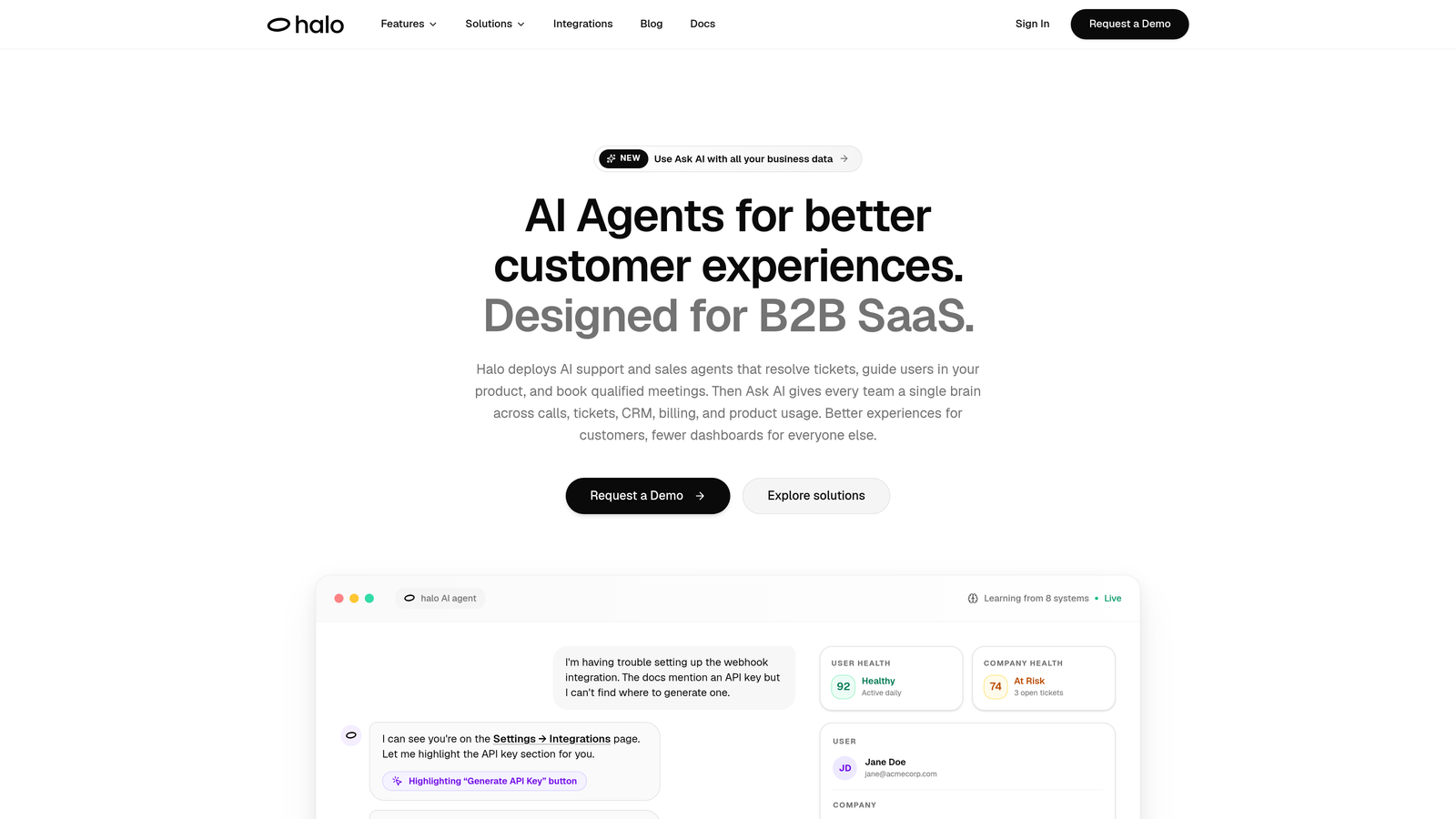
Halo AI is an AI-native customer support platform that deploys intelligent agents to resolve tickets, guide users through your product, and continuously learn from every interaction.
Where This Tool Shines
What separates Halo from most platforms on this list is its architecture. Rather than bolting AI onto an existing helpdesk, Halo was built AI-first — which means the intelligence isn't an add-on layer, it's the foundation. That distinction matters in practice: resolution quality tends to be stronger, and setup is more streamlined because you're not configuring legacy systems around new AI behavior.
The page-aware chat widget is a standout feature for product teams. Halo's agents can see what users see, understanding which page or feature they're on and providing visual UI guidance in context. For SaaS products where "how do I do X" questions dominate the queue, this contextual awareness can dramatically improve resolution rates without agent involvement.
Key Features
AI Agents with Continuous Learning: Halo's agents autonomously resolve support tickets and improve with every interaction, getting smarter over time without manual retraining.
Page-Aware Chat Widget: The widget understands which part of your product a user is viewing, enabling visual UI guidance and contextually accurate responses.
Smart Inbox with Business Intelligence: Beyond ticket management, the inbox surfaces customer health signals, anomaly detection, and revenue intelligence — turning support data into strategic insight.
Automatic Bug Ticket Creation: When support conversations reveal product issues, Halo automatically creates bug tickets, reducing the manual handoff between support and engineering.
Live Agent Handoff with Full Context: When issues exceed AI capability, escalation to a human agent preserves the entire conversation context so customers never have to repeat themselves.
Deep Integration Stack: Native connections to Linear, Slack, HubSpot, Intercom, Stripe, Zoom, PandaDoc, and Fathom mean Halo fits into existing workflows without middleware.
Best For
Product-led SaaS companies and B2B teams that want support to do more than deflect tickets. If you want your support layer to generate business intelligence, automatically route bugs to engineering, and learn continuously from customer interactions, Halo is built for exactly that use case.
Pricing
Contact for pricing. Halo is designed for small-to-mid-size team budgets, so it's worth a direct conversation to understand fit before assuming enterprise-level costs.
2. Intercom with Fin AI
Best for: Teams that want a mature, all-in-one messaging platform with a capable AI agent out of the box.
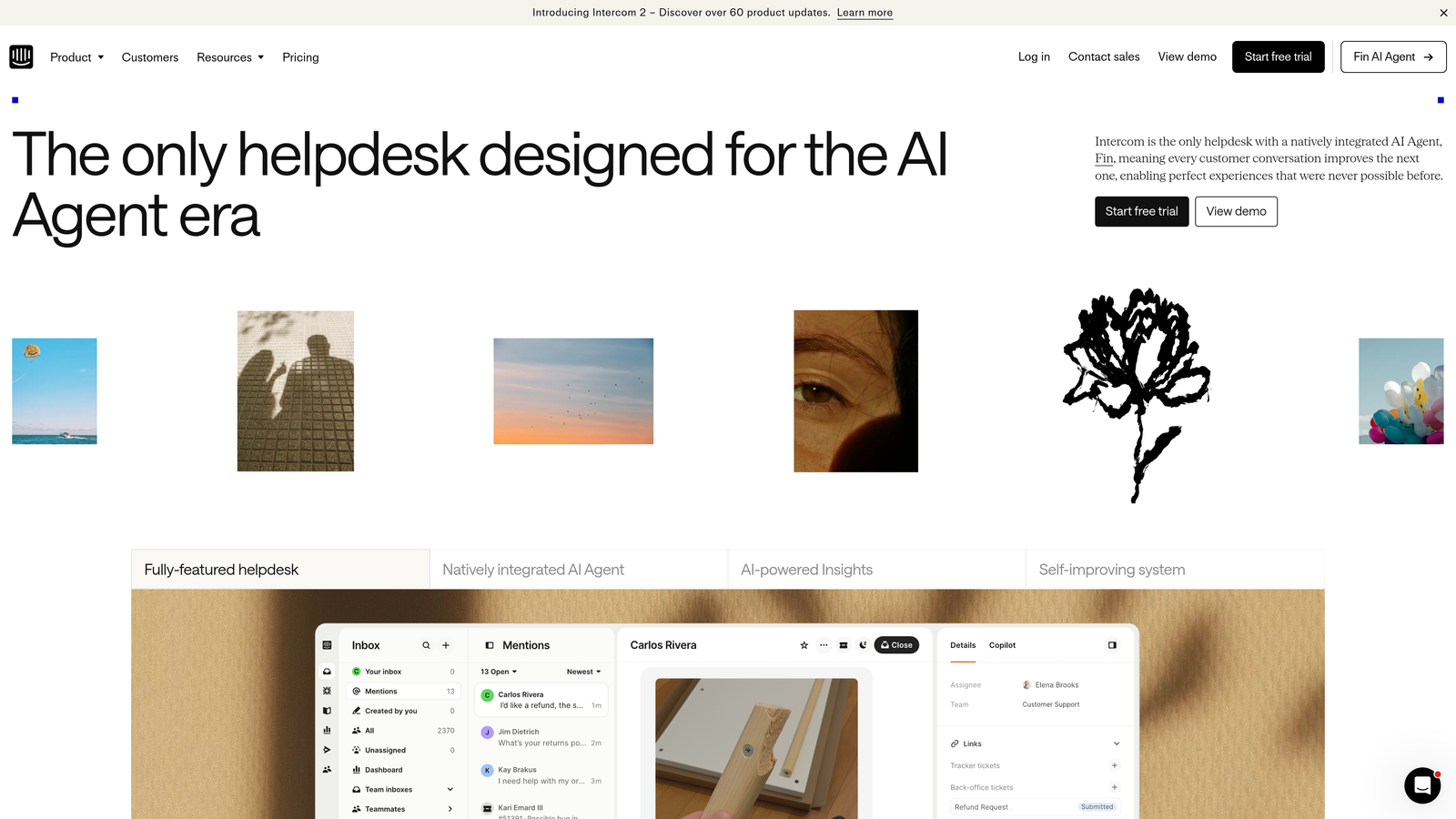
Intercom is a mature customer messaging platform with a native AI agent, Fin, that resolves customer questions using your existing help center content and conversation history.
Where This Tool Shines
Fin AI has earned a solid reputation for resolution quality, largely because it's trained on your actual help center content and benefits from Intercom's years of conversation data infrastructure. For teams that already have a well-maintained knowledge base, Fin can start deflecting tickets quickly without significant configuration work.
The unified inbox is genuinely strong, consolidating chat, email, and social messaging in a way that feels cohesive rather than bolted together. Intercom's workflow automation builder also gives small teams meaningful control over routing, escalation, and proactive messaging without requiring engineering support.
Key Features
Fin AI Agent: Trained on your help center content, Fin handles customer questions autonomously and escalates when it can't resolve.
Unified Inbox: Consolidates chat, email, and social messaging into a single workspace for agents.
Custom Workflow Builder: No-code automation for routing, escalation, and proactive outreach.
Rich Customer Data Layer: Conversation history and customer attributes inform both AI and human responses.
Proactive Messaging and In-App Tours: Enables teams to reach customers before they need support, reducing inbound volume.
Best For
Teams that want a proven, feature-rich platform and are comfortable with usage-based pricing for AI. Intercom works well for SaaS companies with established help centers that want Fin to start resolving immediately.
Pricing
Starts at $39 per seat per month. Fin AI is charged per resolution, which can work in your favor at low volumes but warrants close monitoring as usage scales.
3. Freshdesk with Freddy AI
Best for: Budget-conscious small teams that need solid helpdesk fundamentals with AI layered on top.
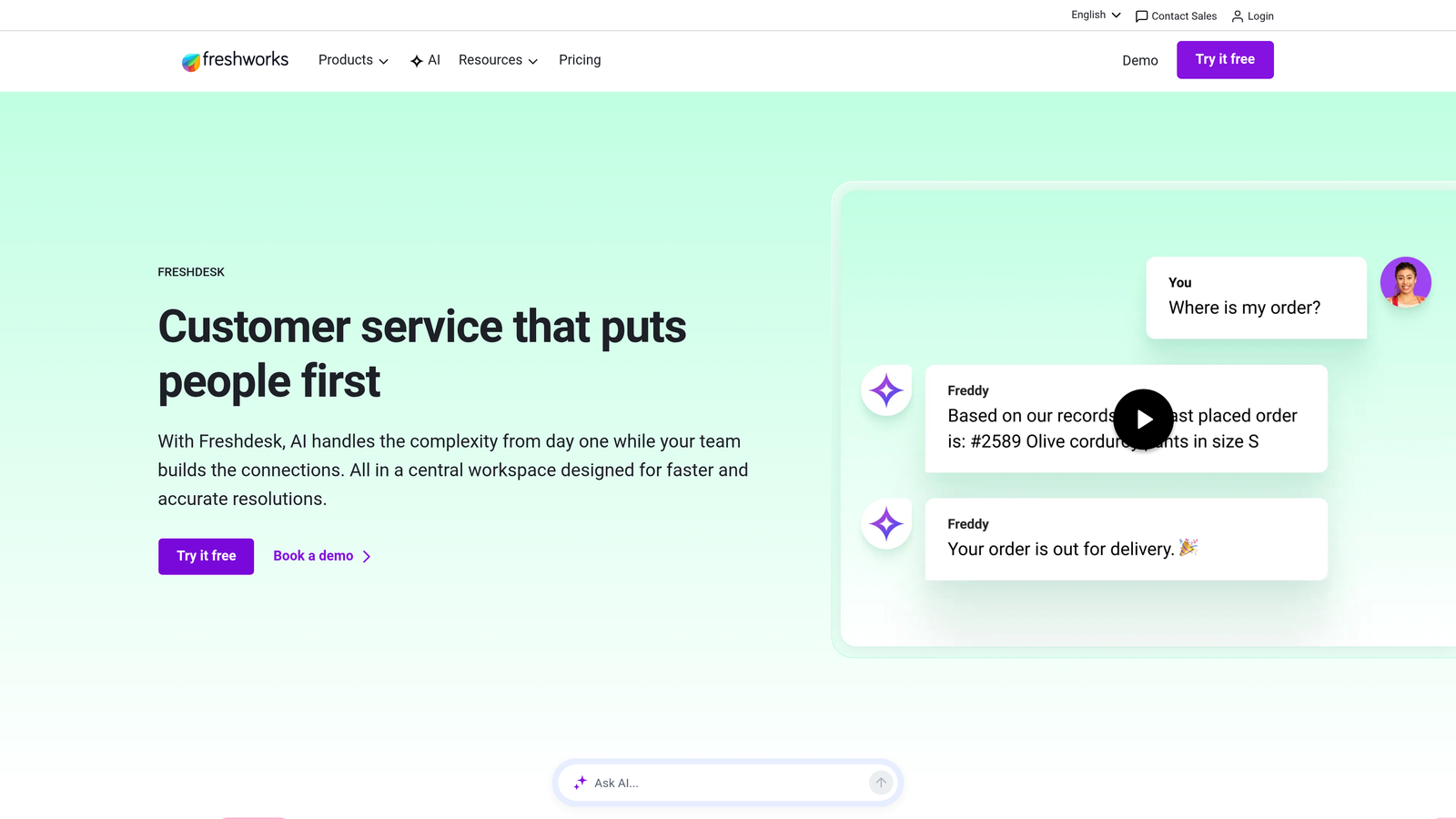
Freshdesk is a full-featured helpdesk platform with AI-powered ticket routing, suggested responses, and a chatbot builder — known for generous free and low-cost tiers.
Where This Tool Shines
Freshdesk's pricing structure is genuinely friendly to small teams. The free tier supports up to two agents with functional ticketing, making it one of the few platforms where you can run a real support operation at zero cost in the early stages. As you grow, the paid tiers remain competitive compared to alternatives with similar feature depth.
Freddy AI handles the core automation tasks well: auto-triage, suggested responses, and chatbot-based resolution. It's not the most sophisticated AI agent on this list, but for teams whose primary goal is reducing manual ticket handling, Freddy covers the fundamentals reliably.
Key Features
Freddy AI: Handles auto-triage, suggested agent responses, and autonomous chatbot resolution for common questions.
Free Tier: Supports up to two agents with basic ticketing — a meaningful entry point for early-stage teams.
Omnichannel Support: Covers email, chat, phone, and social from a single platform.
Built-in Knowledge Base: Includes community forums and self-service documentation tools.
App Marketplace: Hundreds of integrations covering CRM, e-commerce, and productivity tools.
Best For
Early-stage startups and small teams that want to start free, prove ROI, and scale into paid tiers without switching platforms. Also a strong fit for teams that need omnichannel coverage without a complex setup.
Pricing
Free tier available for up to two agents. Paid plans start at $15 per agent per month, with AI features available on higher tiers.
4. Zendesk with AI Agents
Best for: Small teams with complex support operations that need enterprise-grade infrastructure at a manageable entry price.
Zendesk is the industry-standard helpdesk platform that has added AI agent capabilities for automated resolution, intelligent triage, and agent-assist features across all channels.

Where This Tool Shines
Zendesk's core strength is depth. The reporting, SLA management, and compliance tooling are mature in a way that newer platforms simply haven't had time to build. For small teams that anticipate rapid growth or operate in regulated industries, starting on Zendesk means you won't outgrow your platform.
The AI agent additions have made Zendesk more competitive for automated resolution, with intent detection and sentiment analysis informing how tickets are routed and prioritized. The 1,500-plus app marketplace also means integration gaps are rare, which matters for small teams that can't build custom connectors.
Key Features
AI Agents for Automated Resolution: Handles ticket resolution across channels with intent detection and context awareness.
Intelligent Triage: Sentiment analysis and intent classification improve routing accuracy and prioritization.
Massive App Marketplace: Over 1,500 integrations covering virtually every tool category.
Advanced Reporting and Analytics: Detailed dashboards for tracking resolution rates, CSAT, and team performance.
Robust SLA Management: Built-in compliance tools for teams with formal service level commitments.
Best For
Small teams that expect to scale quickly, have complex workflows, or operate in industries with compliance requirements. Zendesk can feel like overkill for a two-person support team, but it becomes an asset as complexity grows.
Pricing
Starts at $19 per agent per month. AI agent features are available on higher-tier plans, so budget accordingly if AI resolution is a primary requirement.
5. Help Scout
Best for: Small teams that prioritize a human-first support experience with AI assisting agents rather than replacing them.
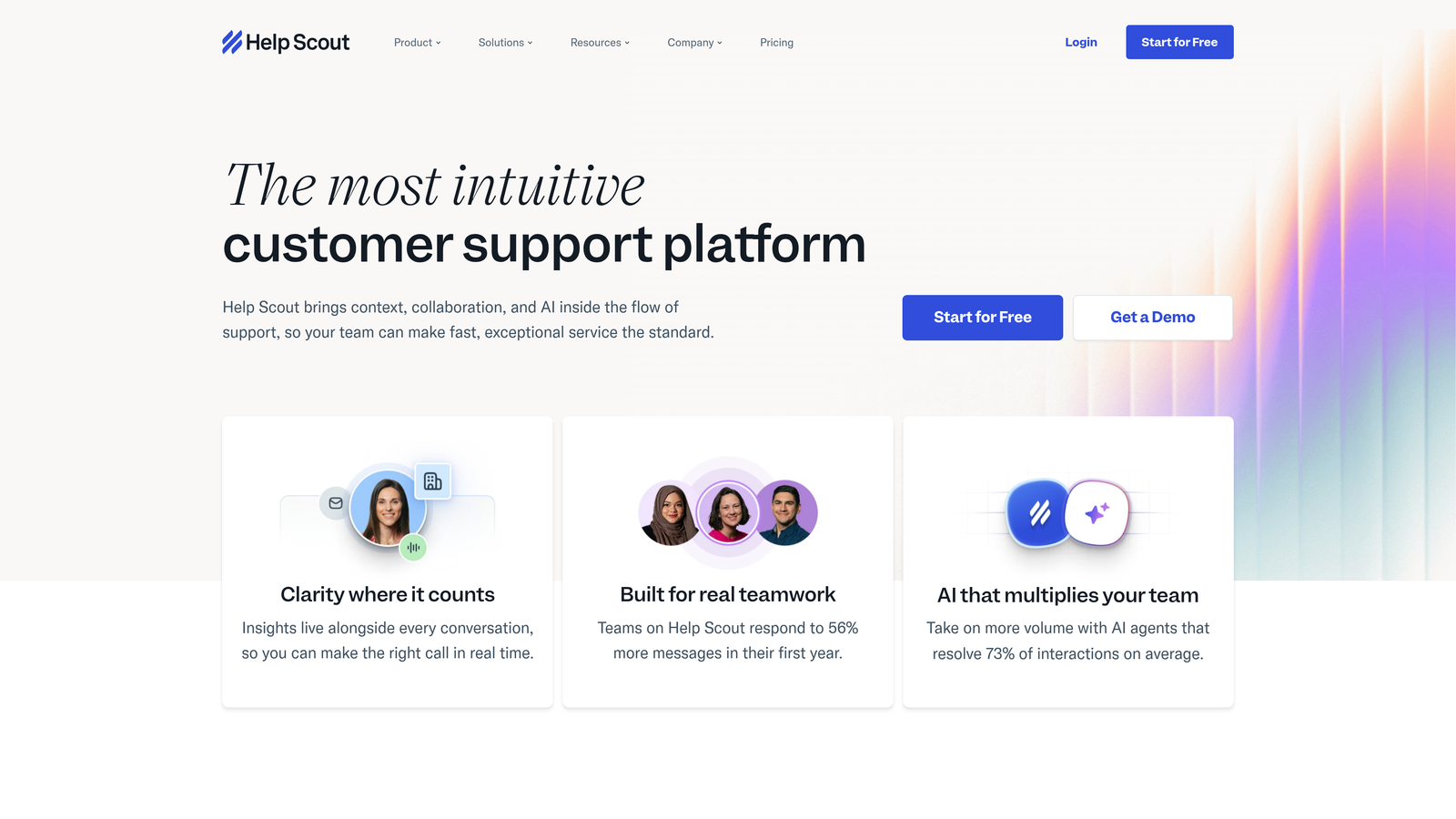
Help Scout is a customer support platform designed for small teams that prefer a thoughtful, relationship-driven approach, with AI features built to make agents faster rather than eliminate them from the conversation.
Where This Tool Shines
Help Scout has built a loyal following among small teams that find fully autonomous AI agents to be a poor fit for their customer relationships. The AI features here — draft reply suggestions, conversation summarization, and smart search — are designed to reduce agent effort without removing the human from the loop. That's a deliberate product philosophy, and it resonates with teams in professional services, consulting, and high-touch SaaS.
The shared inbox is clean and intuitive, avoiding the complexity creep that affects many helpdesk platforms as they scale. The lack of per-agent seat inflation on certain plans also makes Help Scout more predictable to budget than usage-heavy alternatives.
Key Features
AI Reply Drafts: Generates response suggestions based on knowledge base content, reducing time-to-reply for agents.
AI Conversation Summarization: Condenses long threads into quick summaries so agents can get up to speed instantly.
Clean Shared Inbox: Simple, well-designed inbox without the feature bloat that can overwhelm small teams.
Beacon Widget: Embedded help and chat widget for in-product support experiences.
Docs Knowledge Base: Built-in documentation tool with search, enabling customer self-service.
Best For
Teams in professional services, high-touch SaaS, or any context where customers expect a human voice and AI is best used as an agent co-pilot rather than a full replacement.
Pricing
Starts at $25 per user per month. Pricing is straightforward with no per-resolution charges or hidden AI add-ons.
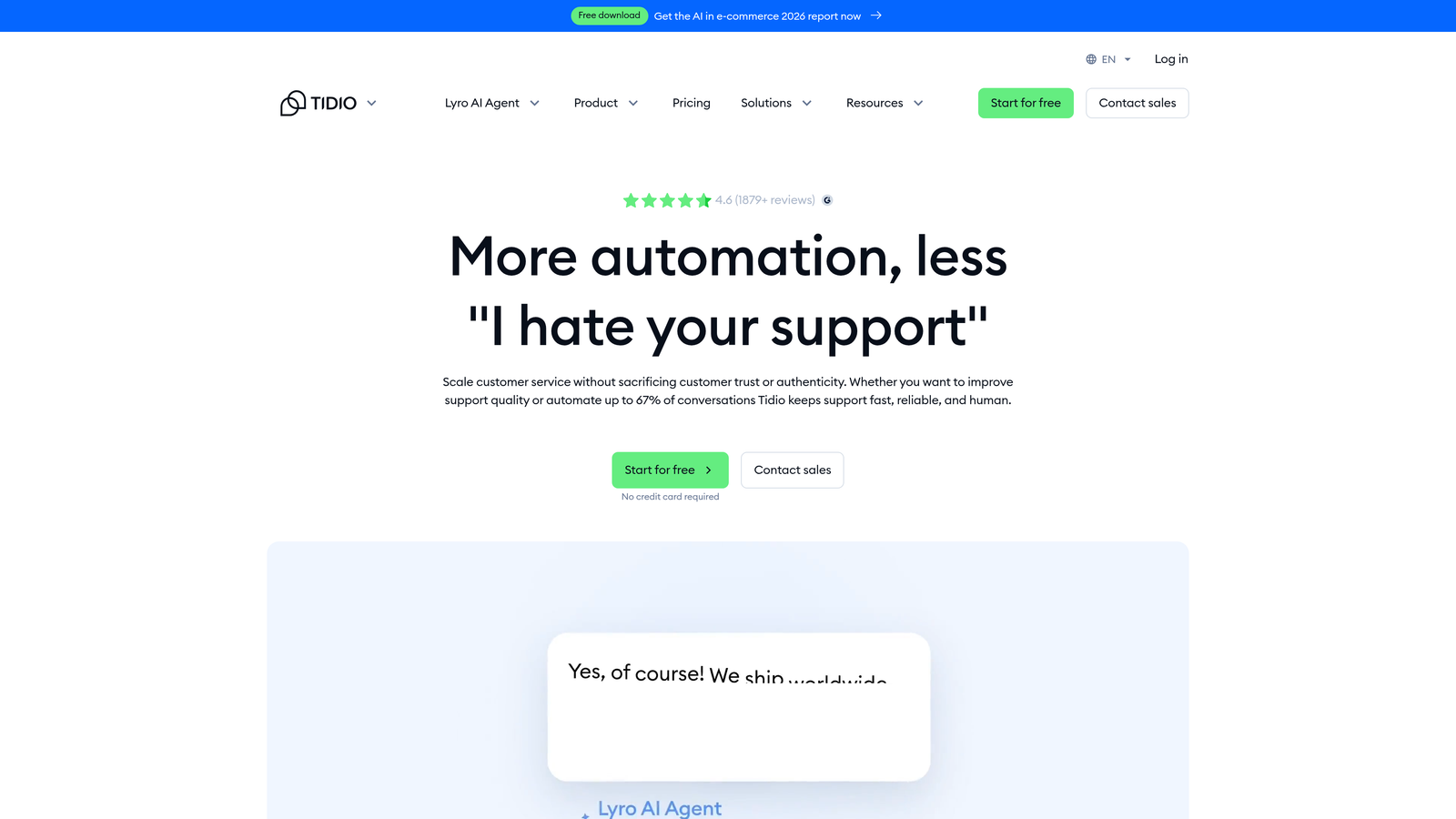
6. Tidio
Best for: Small e-commerce and service businesses that want autonomous AI chat without helpdesk complexity.
Tidio is a chat-first customer support platform featuring Lyro, an AI chatbot agent that handles conversations autonomously — particularly popular with small e-commerce and service businesses.
Where This Tool Shines
Tidio's strength is speed to value. Lyro can be trained on your content and deployed quickly, making it a practical choice for teams that need AI deflection running within days rather than weeks. The visual chatbot builder also gives non-technical users meaningful control over conversation flows without writing a line of code.
For e-commerce teams specifically, Tidio's native integrations with Shopify, WooCommerce, and BigCommerce make it easy to connect order data to support conversations — enabling Lyro to answer order status questions, return inquiries, and product queries with actual customer data behind the responses.
Key Features
Lyro AI Agent: Handles customer conversations autonomously using your content, escalating to humans when needed.
Visual Chatbot Builder: Drag-and-drop flow builder for teams that want custom conversation paths without code.
Real-Time Visitor Monitoring: Live chat with visibility into active visitors for proactive outreach.
E-Commerce Integrations: Native connections to Shopify, WooCommerce, and BigCommerce for order-aware support.
Multichannel Coverage: Supports email, Messenger, and Instagram alongside live chat.
Best For
Small e-commerce businesses and service companies that want fast deployment, autonomous AI chat, and e-commerce-specific integrations without a full helpdesk platform.
Pricing
Free tier available with limited AI conversations. AI features, including Lyro, start from $29 per month.
7. Crisp
Best for: Micro-teams and early-stage startups that need multi-channel messaging in a single, simple workspace.
Crisp is an all-in-one messaging workspace that combines live chat, email, and social channels into a unified inbox — built for micro-teams and startups that need simplicity above all else.
Where This Tool Shines
Crisp earns its place on this list by solving the multi-channel fragmentation problem at a price point that genuinely works for early-stage teams. Consolidating chat, email, WhatsApp, and Messenger into one workspace without paying enterprise rates is a meaningful operational improvement for teams currently juggling multiple tools.
The co-browsing and video chat features are a differentiator worth noting. For technical support scenarios where seeing a customer's screen accelerates resolution, having these capabilities built in rather than requiring a third-party tool reduces friction considerably.
Key Features
Unified Multi-Channel Inbox: Consolidates chat, email, Messenger, WhatsApp, and more in a single workspace.
AI-Powered Chatbot: Integrates with your knowledge base for automated response handling.
Co-Browsing and Video Chat: Built-in screen sharing and video for complex support scenarios.
CRM and Contact Management: Basic customer data management included without a separate CRM subscription.
Free Tier for Two Operators: Functional free plan that lets micro-teams get started without a budget commitment.
Best For
Micro-teams and early-stage startups that need multi-channel support coverage, value simplicity, and want co-browsing or video capabilities without adding another tool to the stack.
Pricing
Free tier available for up to two operators. Pro plan starts at $25 per month per workspace, making it one of the most affordable multi-channel options available.
8. Chatbase
Best for: Teams that want fast AI self-service deflection without committing to a full helpdesk platform.
Chatbase is a lightweight AI chatbot builder that lets you train a GPT-powered bot on your own content — ideal for teams that want quick self-service deflection without the overhead of a complete support platform.
Where This Tool Shines
Chatbase occupies a specific and useful niche: it's not trying to be a full helpdesk, and that focus is actually its advantage. If your primary problem is inbound volume from repetitive questions your documentation already answers, Chatbase can be deployed in hours and start deflecting tickets the same day. There's no ticketing system to configure, no routing rules to build — just a trained bot embedded on your site.
The API access also makes Chatbase a reasonable choice for technical teams that want to build custom experiences around an AI chatbot without starting from scratch on the underlying model infrastructure.
Key Features
Custom AI Training: Train your chatbot by uploading documents, URLs, or text — no ML expertise required.
Embeddable Chat Widget: Customizable branding and widget placement for seamless product integration.
Conversation Analytics: Track what users are asking to identify knowledge gaps and content opportunities.
Multi-Language Support: Handles conversations in multiple languages out of the box.
API Access: Enables custom integrations for teams that want to build around the chatbot layer.
Best For
Technical teams, solo founders, or small teams that need fast self-service deflection without a full support platform. Also useful as a supplementary layer alongside an existing helpdesk.
Pricing
Free tier available with limited messages. Paid plans start at $19 per month, making it one of the lowest-cost entry points on this list.
9. HubSpot Service Hub with Breeze AI
Best for: Small teams already running on HubSpot CRM that want support tools sharing the same customer data layer.
HubSpot Service Hub is HubSpot's service module with Breeze AI features, best suited for teams already invested in the HubSpot ecosystem who want support tools that share the same customer data foundation.
Where This Tool Shines
The core value proposition of Service Hub is data continuity. When your support team can see a customer's full marketing and sales history alongside their support tickets, context is immediate and responses are more informed. For teams already using HubSpot for CRM, marketing, or sales, adding Service Hub is a natural extension rather than a new system to integrate.
Breeze AI brings ticket summarization, reply suggestions, and chatbot capabilities into that CRM-connected context. The AI features aren't the most advanced on this list, but they benefit from having complete customer data behind them — which often matters more than raw AI capability for relationship-driven support.
Key Features
Breeze AI: Handles ticket summarization, reply suggestions, and chatbot interactions with full CRM context.
Full CRM Integration: Every support interaction is connected to the customer's complete HubSpot record.
Shared Inbox with Ticketing: Unified inbox with automation for routing and prioritization.
AI-Powered Knowledge Base: Documentation with intelligent search to support customer self-service.
Native Hub Connections: Seamless data flow between Service Hub, Marketing Hub, and Sales Hub.
Best For
Small teams already using HubSpot who want to avoid a separate helpdesk integration. The CRM data advantage is most valuable for teams with long customer relationships and complex account histories.
Pricing
Free tools available with basic functionality. Service Hub Starter begins at $20 per seat per month, with more advanced AI features on higher tiers.
Which Platform Fits Your Team?
The right AI support platform depends less on feature checklists and more on what kind of team you're running and what problem you're actually trying to solve.
Product-led SaaS teams should look closely at Halo AI. The combination of page-aware context, continuous learning, automatic bug ticket creation, and business intelligence from support data goes well beyond what most platforms offer — and it's built for teams that want support to be a strategic layer, not just a ticket queue.
E-commerce and service businesses will find Tidio's Lyro agent and native e-commerce integrations to be the most practical fit, with Crisp as a strong alternative for micro-teams that need multi-channel coverage at minimal cost.
Budget-first teams starting from scratch should evaluate Freshdesk's free tier first. It's genuinely functional, and the upgrade path is predictable. Chatbase is worth considering as a lightweight deflection layer alongside whatever platform you choose.
CRM-centric teams already running on HubSpot will get the most value from Service Hub with Breeze AI, where the CRM data advantage compounds over time.
One practical note before committing: evaluate AI resolution quality with your actual content, not demo scenarios. Most platforms offer trials — run them with real tickets from your queue and measure resolution rates before signing an annual contract.
Your support team shouldn't scale linearly with your customer base. Let AI agents handle routine tickets, guide users through your product, and surface business intelligence while your team focuses on complex issues that need a human touch. See Halo in action and discover how continuous learning transforms every interaction into smarter, faster support.