9 Best AI Support Platforms With Integrations in 2026
Discover the top AI support platforms with integrations in 2026, evaluated on integration depth, AI resolution quality, and how well they connect to CRMs, project trackers, billing systems, and team chat tools. This guide helps support teams find platforms that go beyond surface-level connectors to deliver automated context-sharing and smarter ticket resolution across their entire tech stack.
 Grant CooperFounder13 min read
Modern support teams don't operate in a vacuum. Your helpdesk needs to talk to your CRM, your bug tracker, your billing system, and your team chat — all without manual copy-pasting or constant context-switching. That's why the best AI support platforms in 2026 aren't just smart at resolving tickets; they're deeply connected to the tools your business already runs on.
The right platform pulls customer context from your CRM, creates bug tickets in your project tracker, escalates to agents in Slack, and surfaces revenue signals — automatically. But with dozens of platforms claiming "robust integrations," it's hard to know which ones actually deliver depth versus a surface-level connector list.
We evaluated these platforms on integration depth (not just quantity), AI resolution quality, ease of setup, and how well they use connected data to improve support outcomes. Whether you're a scaling startup or an enterprise team, here's where to look.
1. Halo AI
Best for: B2B SaaS teams that need AI agents grounded in real business context across their full stack.
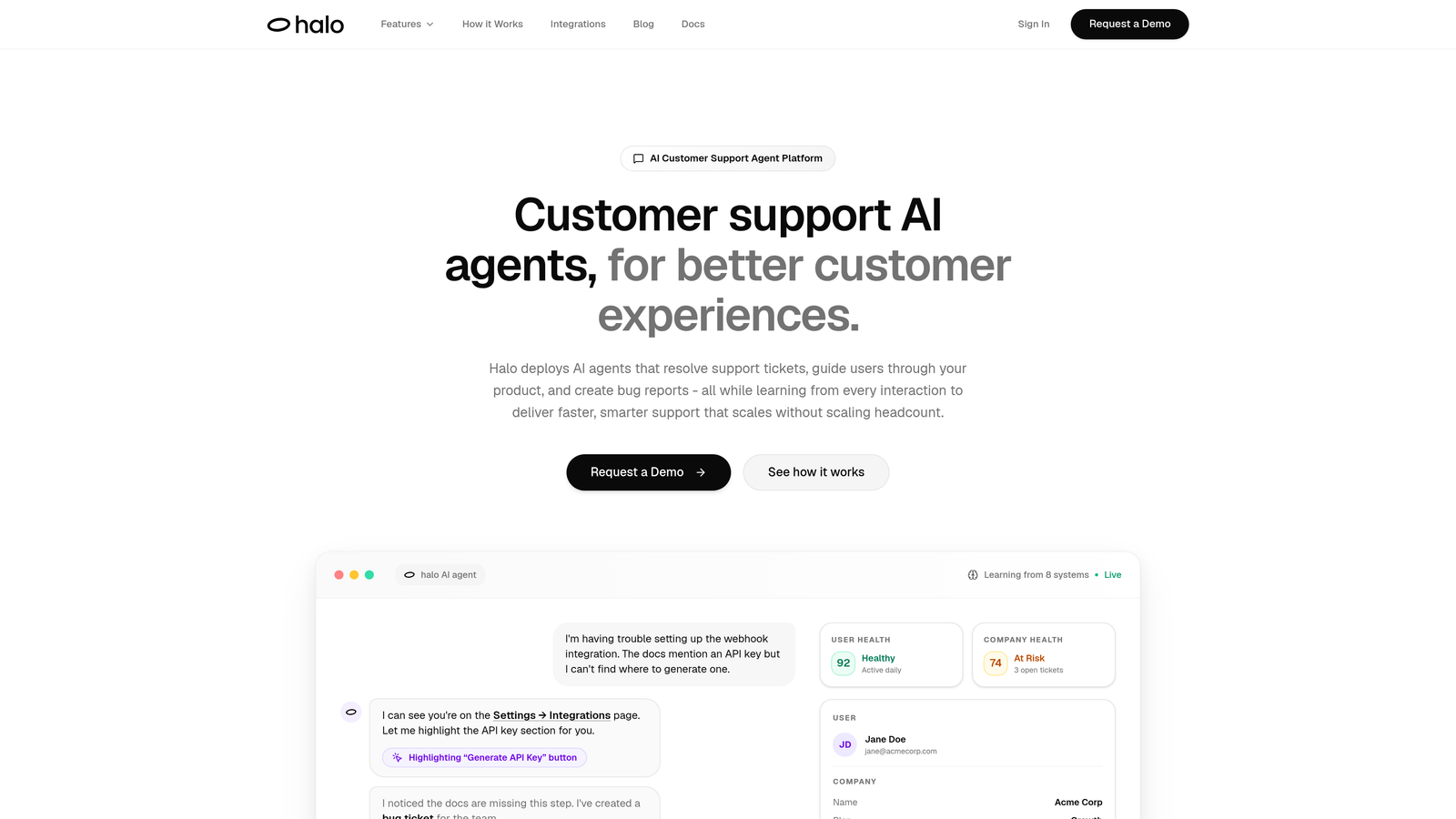
Halo AI is an AI-first customer support platform built around deep integrations with Linear, Slack, HubSpot, Intercom, Stripe, Zoom, PandaDoc, and Fathom — giving its AI agents the full business context needed to resolve tickets autonomously.
Where This Tool Shines
Most platforms treat integrations as add-ons. Halo treats them as the foundation. When a customer submits a ticket, Halo's AI doesn't just search a knowledge base — it pulls live data from connected systems to understand who the customer is, what they've purchased, and where they are in the product. That context drives resolution quality in a way that disconnected platforms simply can't match.
The page-aware chat widget is a standout differentiator. It sees what users see in real time, allowing the AI to provide visual UI guidance rather than generic instructions. Combined with a smart inbox that surfaces customer health signals and revenue intelligence, Halo positions support not just as a cost center but as a source of business intelligence.
Key Features
Autonomous AI Agents: Resolve support tickets using live context from connected tools — CRM data, billing history, product usage — without requiring human intervention for routine issues.
Page-Aware Chat Widget: The AI sees the user's current screen state, enabling precise visual guidance through product workflows rather than generic step-by-step instructions.
Smart Inbox with Business Intelligence: Goes beyond ticket management to surface customer health signals, revenue intelligence, and anomaly detection directly inside the support workflow.
Auto Bug Ticket Creation: Automatically generates bug tickets in Linear with full reproduction context, eliminating the manual handoff between support and engineering teams.
Live Agent Handoff: Escalates complex issues to human agents with complete conversation history and system context already attached, so agents never start from scratch.
Best For
Product-led B2B SaaS companies that want AI agents doing real work — not just answering FAQs. Particularly well-suited for teams already using Linear, HubSpot, Slack, or Stripe who want those systems to actively inform support resolution rather than sitting in separate tabs.
Pricing
Contact for pricing. A demo is available at haloagents.ai/demo to see the platform in action with your specific stack.
2. Intercom
Best for: Product-led growth companies that want a unified messaging layer with broad ecosystem connectivity.
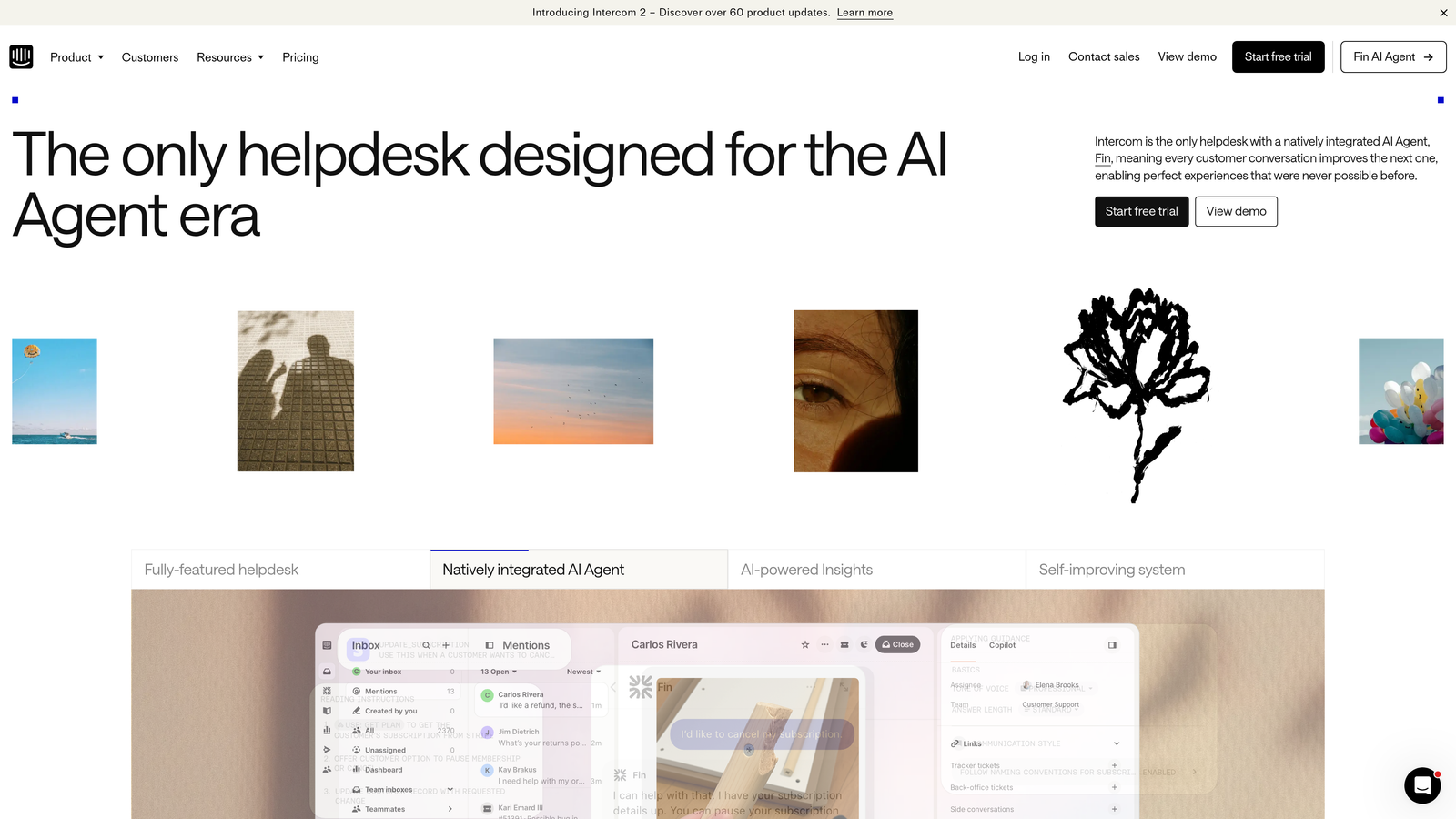
Intercom is a unified customer messaging platform featuring the Fin AI agent, with a broad app store ecosystem and first-party data integrations designed for product-focused teams.
Where This Tool Shines
Intercom's strength lies in its combination of in-product messaging infrastructure and the Fin AI agent. Fin is trained not just on help center content but on past conversations and connected data sources, making its answers more contextually relevant than a standard knowledge base bot.
The Custom Actions feature allows Fin to perform tasks in external systems — looking up orders, updating records, triggering workflows — which moves Intercom beyond pure Q&A into action-oriented automation. For teams already invested in the Intercom ecosystem, the depth of first-party data available to the AI is a genuine advantage.
Key Features
Fin AI Agent: Trained on help center content, past conversations, and connected data sources for contextually grounded responses.
350+ App Store Integrations: Covers CRM, analytics, e-commerce, and productivity tools with a well-maintained marketplace.
Custom Actions: Allows Fin to execute tasks in external systems, not just retrieve information.
Unified Inbox: Consolidates chat, email, and social with AI-assisted workflows for human agents.
Best For
SaaS companies with an existing Intercom investment looking to extend into AI-assisted resolution. Also strong for product teams that want in-app messaging and support tightly coupled in a single platform.
Pricing
Starts at $39/seat/month. Fin AI usage is billed per resolution, so costs scale with volume — worth modeling before committing.
3. Zendesk
Best for: Enterprise teams that need the largest integration marketplace and established AI copilot capabilities.
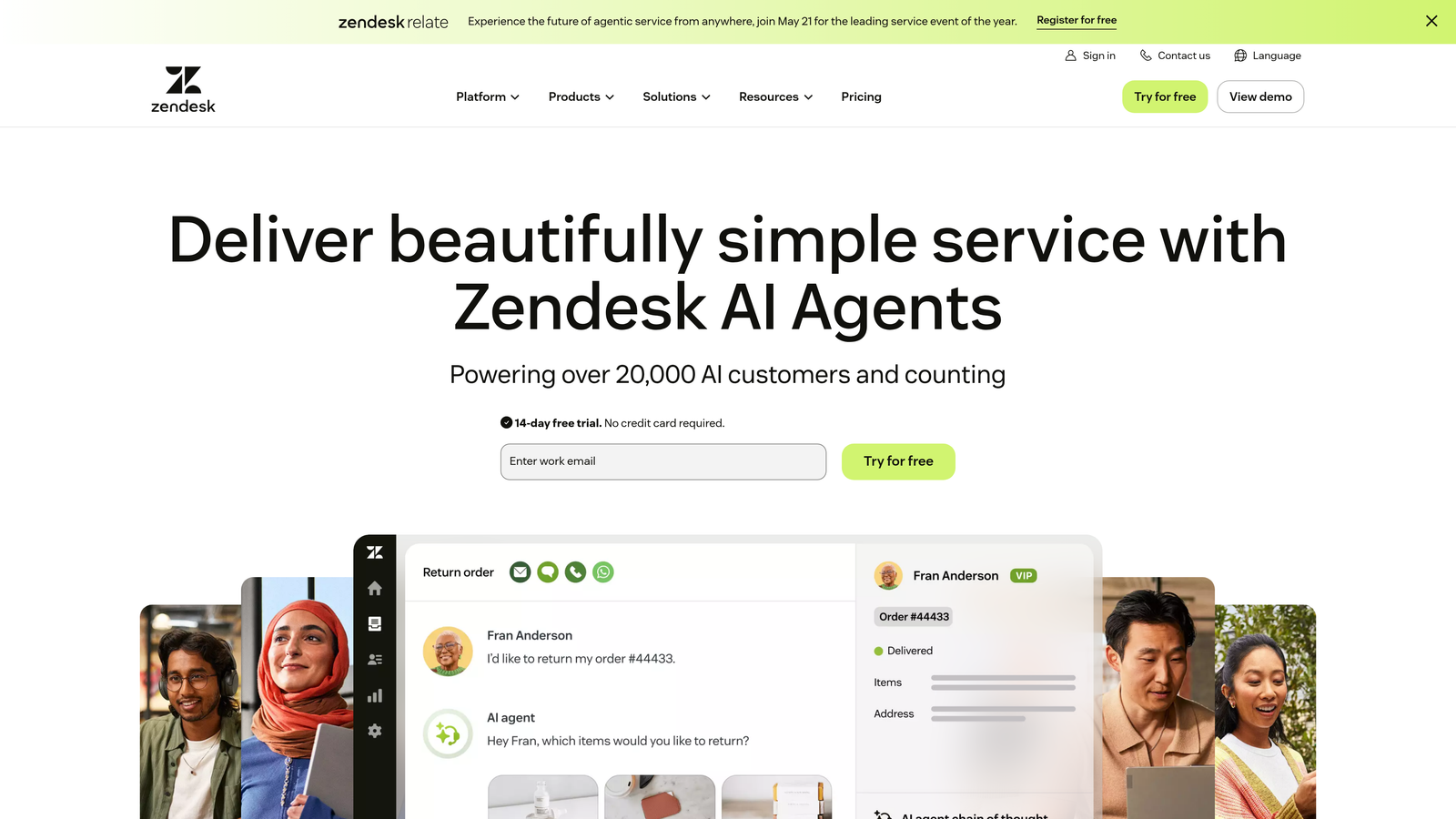
Zendesk is a mature enterprise helpdesk platform with over 1,500 pre-built integrations, AI-powered agent copilot features, and automated bot capabilities layered across its core ticketing infrastructure.
Where This Tool Shines
When it comes to sheer integration breadth, Zendesk is hard to beat. The Zendesk Marketplace covers virtually every enterprise tool category, and the platform's robust API means custom integrations are well-documented and widely supported. For organizations with complex, multi-system environments, this matters.
The AI agent copilot assists human agents in real time with context summaries, suggested responses, and next-step recommendations — which can meaningfully improve agent efficiency even without full automation. The tradeoff is that Zendesk's AI capabilities feel more like enhancements to a traditional helpdesk than a ground-up AI-native architecture.
Key Features
1,500+ Pre-Built Integrations: The most extensive marketplace in the support space, covering enterprise tools across every category.
AI Agent Copilot: Provides real-time context, suggestions, and guidance to human agents during live interactions.
Advanced AI Bots: Automated resolution across channels with configurable escalation paths.
Enterprise API Framework: Robust custom integration capabilities for teams with specific technical requirements.
Best For
Large enterprise support organizations with established Zendesk workflows, complex integration requirements, and dedicated technical resources to manage the platform. Less ideal for teams looking for a simpler, AI-native setup.
Pricing
Suite plans start at $55/agent/month. AI add-on pricing is separate and varies by feature set — total cost can climb quickly at scale.
4. Freshdesk (Freshworks)
Best for: Mid-market teams that want affordable AI support with native connectivity across a broader business suite.
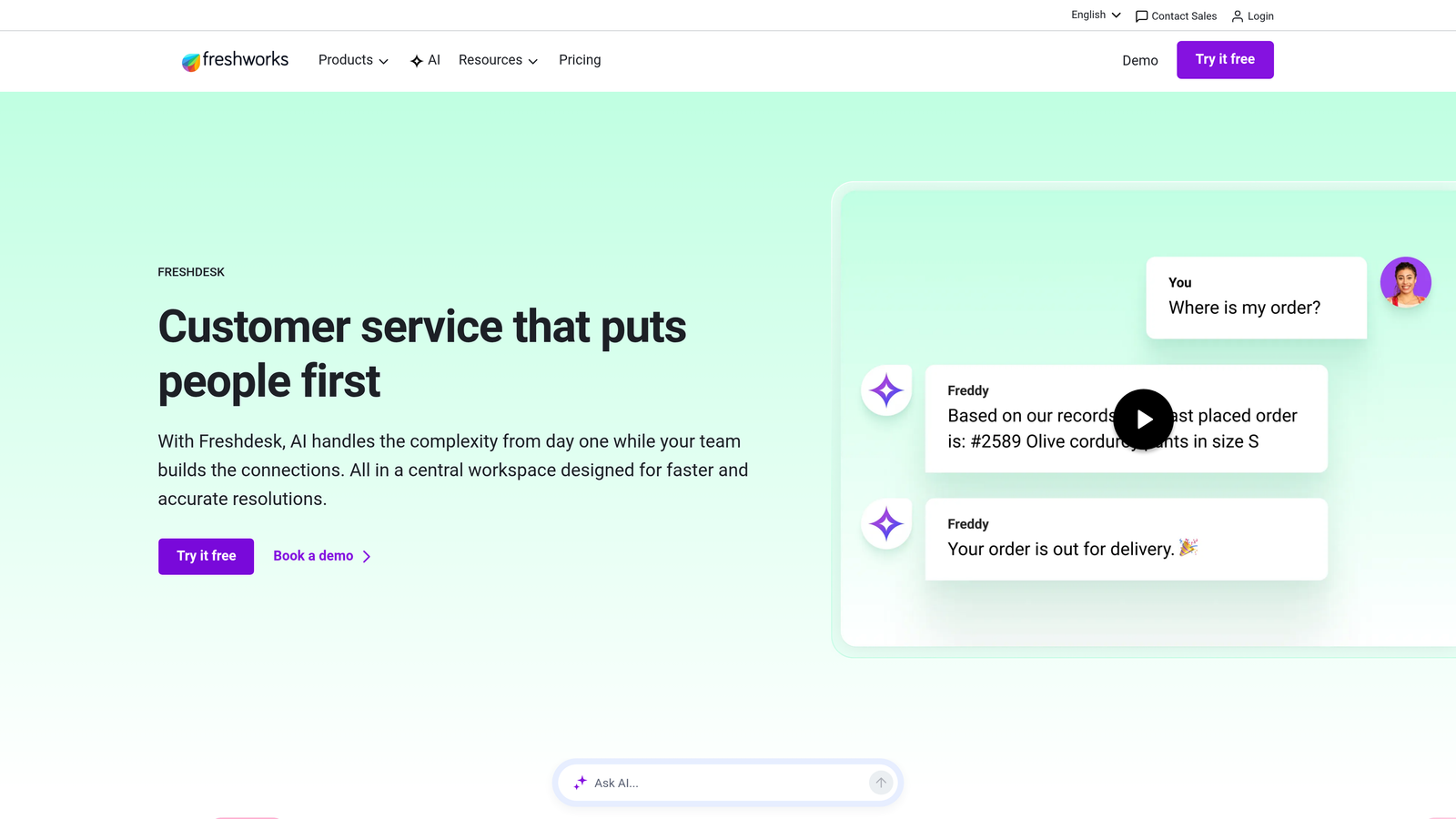
Freshdesk is a mid-market helpdesk platform featuring Freddy AI, with native integrations across the Freshworks product suite including CRM, sales, and marketing tools.
Where This Tool Shines
Freshdesk's biggest advantage for teams already using Freshworks products is the native suite integration. When your CRM (Freshsales), marketing platform (Freshmarketer), and IT service management (Freshservice) all share a unified data layer, the support agent's view of a customer is genuinely comprehensive without requiring complex integration work.
Freddy AI handles ticket triage, suggested responses, and self-service bots competently for the price point. It won't match the reasoning depth of AI-native platforms, but for teams prioritizing affordability and suite consolidation over cutting-edge AI, Freshdesk delivers solid value.
Key Features
Freddy AI: Automates ticket triage, generates suggested responses, and powers self-service bots across channels.
Native Freshworks Suite Integration: Deep connectivity with Freshsales, Freshmarketer, and Freshservice without third-party connectors.
1,000+ Marketplace Integrations: Broad third-party app coverage for teams using tools outside the Freshworks ecosystem.
Unified Customer View: Aggregates data from connected Freshworks products into a single agent-facing profile.
Best For
Growing mid-market teams already using or considering the Freshworks ecosystem. Also a strong choice for budget-conscious teams that need solid AI capabilities without enterprise pricing.
Pricing
Free tier available for small teams. Pro plans start at $49/agent/month, making it one of the more accessible options in the mid-market segment.
5. Ada
Best for: Enterprise teams that need an AI agent capable of taking autonomous actions in backend systems via API.
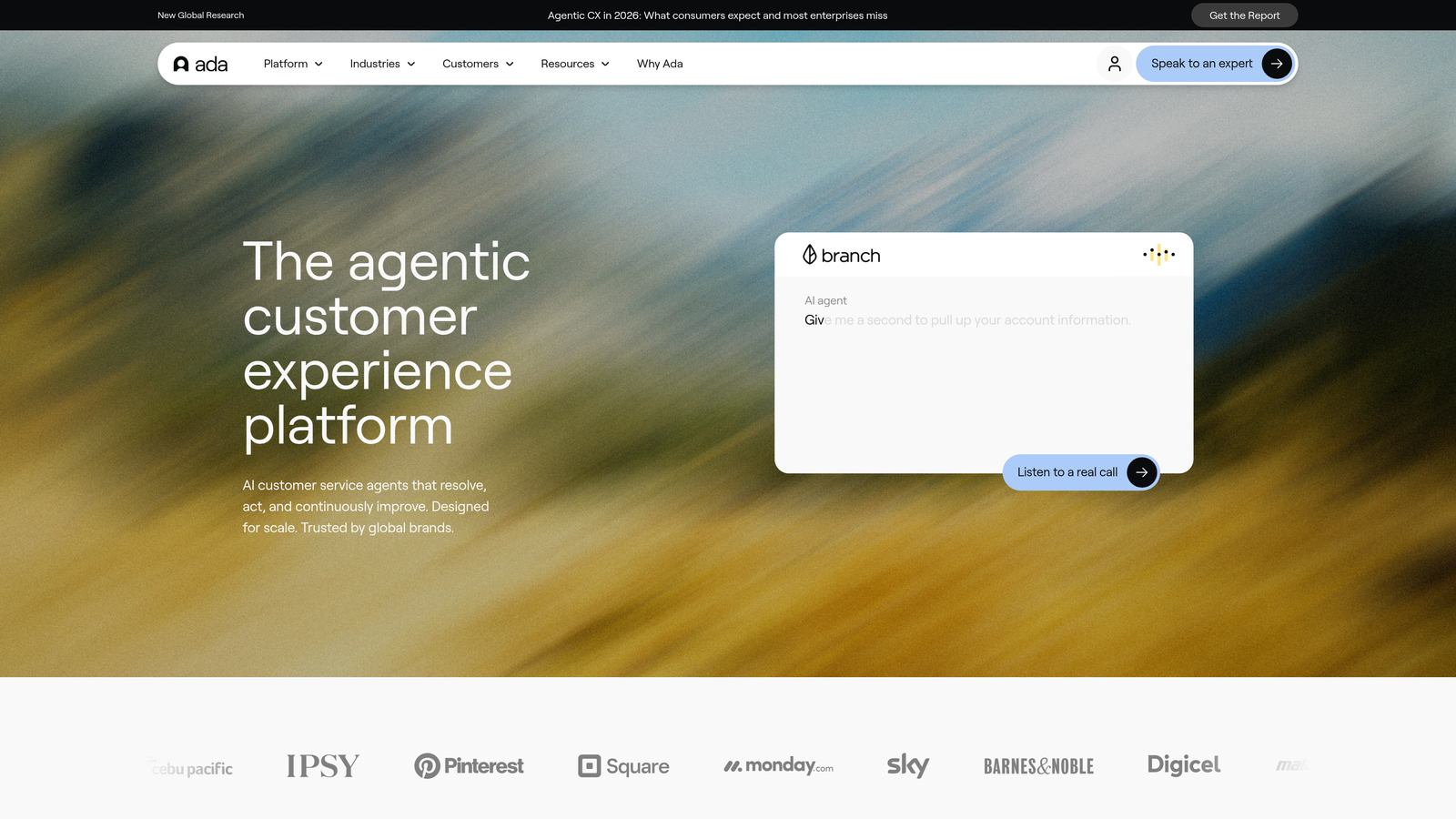
Ada is an enterprise AI agent platform focused on automated actions — processing refunds, updating orders, modifying accounts — through API-based integrations rather than simply answering questions.
Where This Tool Shines
Ada's core philosophy is that great AI support isn't about better answers — it's about actually doing things. The platform's action-oriented architecture lets AI agents connect to backend systems via API and complete transactions on behalf of customers, which is particularly powerful for e-commerce, fintech, and subscription businesses where most support requests involve account actions.
The no-code integration builder makes connecting to CRMs, e-commerce platforms, and internal tools accessible to non-technical teams. Ada's reasoning engine combines knowledge base content with live system data to make decisions, not just retrieve information.
Key Features
Action-Oriented AI: Processes refunds, updates orders, and modifies account settings via direct API integrations — not just information retrieval.
No-Code Integration Builder: Connects to CRM, e-commerce, and internal tools without requiring developer resources for each connection.
Reasoning Engine: Combines static knowledge base content with live data from integrated systems to make contextual decisions.
Multi-Channel Deployment: Operates across web, mobile, social, and messaging apps from a single configuration.
Best For
Enterprise teams in e-commerce, fintech, or subscription businesses where the majority of support volume involves transactional actions that can be automated via API. Requires investment in integration setup to unlock full value.
Pricing
Custom enterprise pricing. Contact Ada directly for a quote based on volume and integration requirements.
6. Tidio
Best for: Small businesses and e-commerce teams that need quick AI chatbot setup with tight Shopify and WooCommerce connectivity.
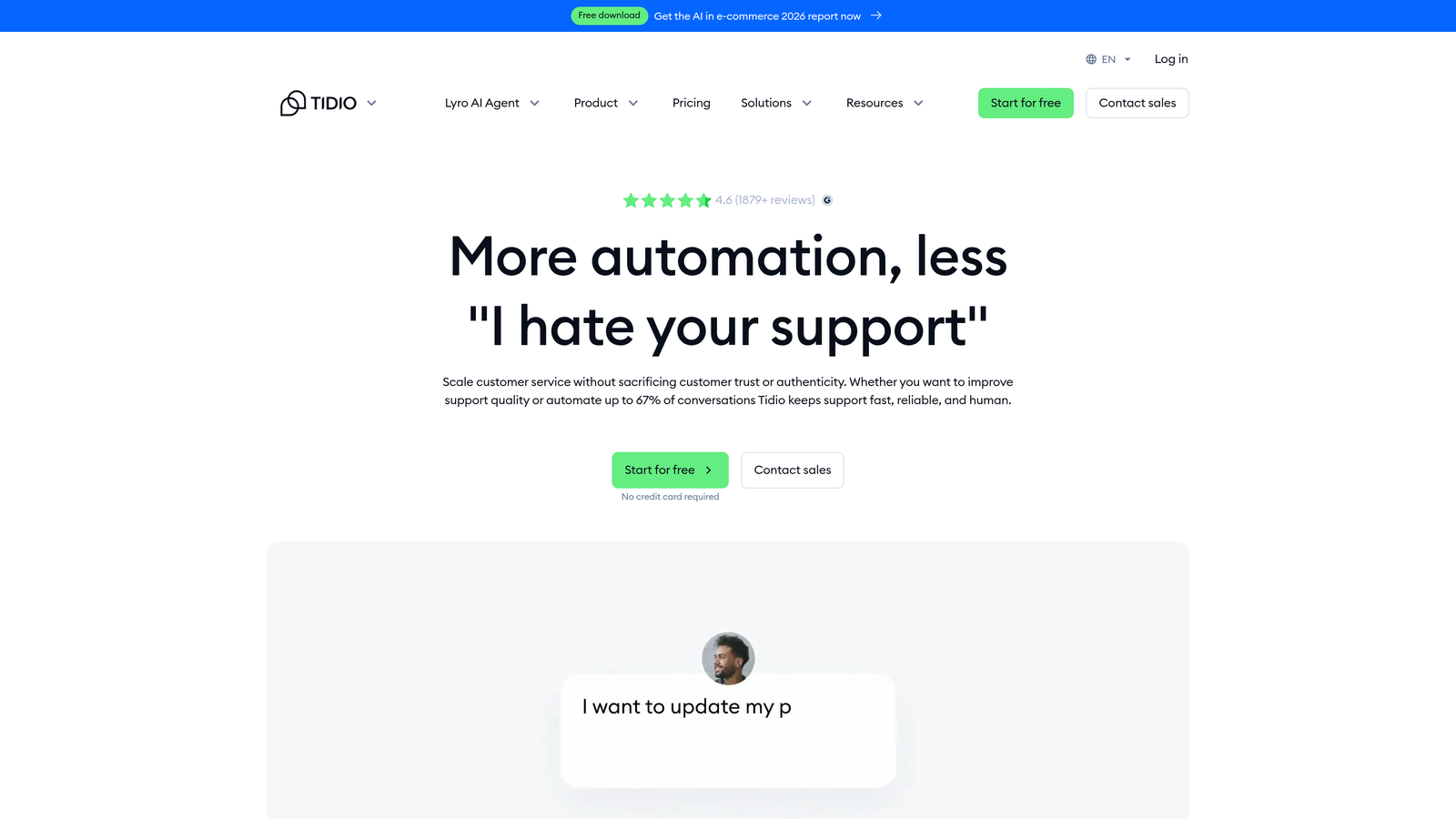
Tidio is an accessible AI chatbot platform featuring Lyro AI, designed for small businesses and e-commerce teams with native integrations for Shopify, WooCommerce, and WordPress.
Where This Tool Shines
For e-commerce teams on Shopify or WooCommerce, Tidio's native integrations are genuinely useful out of the box. Lyro AI can pull order data, make product recommendations, and handle common purchase-related queries without any custom development — which is a significant time saver for lean teams.
The visual chatbot flow builder makes automation accessible to non-technical users, and the overall setup experience is notably faster than enterprise alternatives. Tidio won't satisfy complex B2B support requirements, but for its target audience it delivers real value at a price point that makes sense.
Key Features
Lyro AI Chatbot: Learns from FAQ and help content to handle common queries with conversational, context-aware responses.
Native E-Commerce Integrations: Direct Shopify and WooCommerce connectivity for order lookup, status updates, and product recommendations.
Visual Flow Builder: No-code automation builder for creating custom chatbot workflows without developer involvement.
AI-Assisted Live Chat: Suggests replies to human agents during live conversations to improve response speed and consistency.
Best For
Small to mid-sized e-commerce businesses running on Shopify or WooCommerce that want AI-powered chat without enterprise complexity or pricing. Less suited for B2B SaaS teams with complex integration requirements.
Pricing
Free plan available for getting started. Paid plans begin at $29/month, making Tidio one of the most accessible entry points in the space.
7. HubSpot Service Hub
Best for: Teams already in the HubSpot ecosystem that want support deeply connected to marketing, sales, and CRM data.
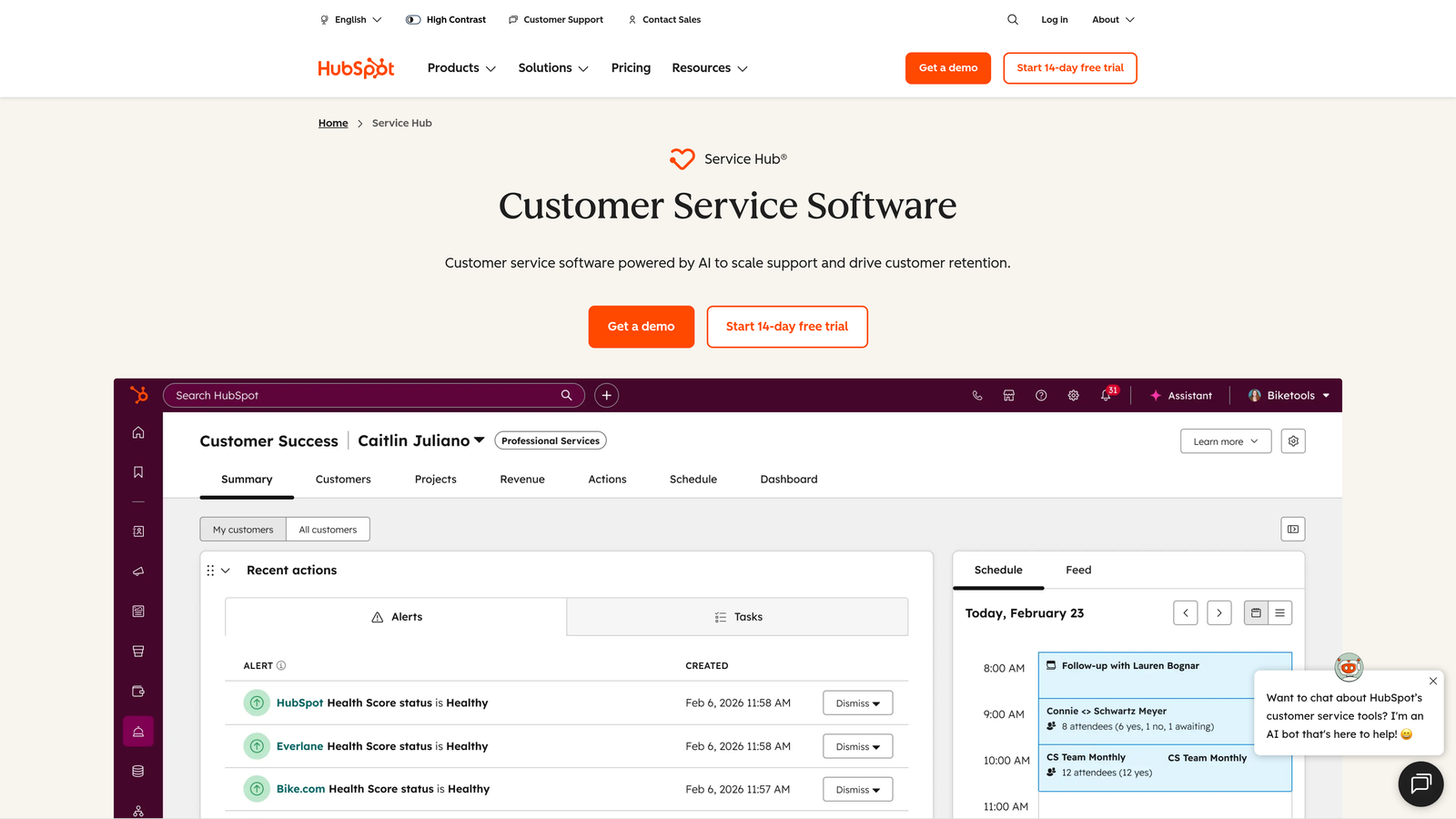
HubSpot Service Hub is a CRM-powered support platform with Breeze AI, offering native integration across HubSpot's marketing, sales, and operations tools for full customer lifecycle context in every ticket.
Where This Tool Shines
The core value proposition here is simple: if you're already in HubSpot, Service Hub gives your support team access to every deal, contact, and marketing interaction without any integration setup. That level of out-of-the-box context is hard to replicate with third-party connectors, and it makes Breeze AI's ticket routing and response suggestions noticeably more relevant.
The customer feedback and survey tools are tightly tied to support interactions, which creates a useful feedback loop between resolution quality and customer satisfaction data — all visible in the same CRM record your sales and marketing teams already use.
Key Features
Breeze AI: Handles ticket routing, response suggestions, and knowledge base generation grounded in CRM context.
Native CRM Integration: Full deal, contact, and interaction history from HubSpot CRM is available in every support ticket automatically.
1,700+ App Marketplace: Extensive third-party connectivity for teams using tools outside the HubSpot suite.
Integrated Feedback Tools: Customer surveys and satisfaction tracking tied directly to support interactions and CRM records.
Best For
Companies already using HubSpot for CRM, marketing, or sales who want to consolidate their customer-facing tools in a single platform. The value drops significantly for teams not already in the HubSpot ecosystem.
Pricing
Free tools available for basic use. Service Hub Professional starts at $100/month, with pricing scaling based on seat count and feature tier.
8. Salesforce Service Cloud
Best for: Large enterprises with complex CRM requirements that are deeply embedded in the Salesforce data ecosystem.
Salesforce Service Cloud is an enterprise support platform featuring Einstein AI and Agentforce, built for organizations that need autonomous case resolution grounded in deep Salesforce CRM data.
Where This Tool Shines
For organizations where Salesforce is the system of record for customer data, Service Cloud's native access to Sales Cloud, Marketing Cloud, Commerce Cloud, and Data Cloud creates an integration depth that external platforms struggle to match. Agentforce can resolve cases using the full breadth of that data without requiring complex API work.
The omnichannel routing with AI-powered classification is sophisticated, and the AppExchange marketplace is among the largest in enterprise software. The tradeoff is complexity: Service Cloud rewards organizations with dedicated Salesforce administrators and technical resources, and can be overkill for teams without that infrastructure.
Key Features
Einstein AI with Agentforce: Autonomous case resolution grounded in Salesforce CRM data across the full customer record.
Native Salesforce Suite Integration: Direct connectivity with Sales Cloud, Marketing Cloud, Commerce Cloud, and Data Cloud without third-party connectors.
AppExchange Marketplace: Thousands of enterprise integrations covering virtually every business tool category.
Omnichannel Routing: AI-powered case classification and escalation across all support channels from a unified interface.
Best For
Large enterprises with established Salesforce infrastructure, dedicated admin resources, and complex multi-cloud data requirements. Not the right fit for teams looking for fast setup or those without existing Salesforce investment.
Pricing
Starter tier begins at $25/user/month, but enterprise-grade configurations with AI features land significantly higher. Budget accordingly for implementation and admin costs beyond license fees.
9. Dixa
Best for: Mid-market teams that want a unified agent workspace across channels with an open integration framework.
Dixa is a conversational customer service platform featuring Mim AI, offering a unified agent workspace and an open integration framework designed for mid-market support teams managing multiple channels.
Where This Tool Shines
Dixa's unified workspace is genuinely well-executed. Combining email, chat, phone, and social into a single agent view without forcing agents to context-switch between tabs addresses a real operational pain point for mid-market teams handling mixed-channel volume.
The conversation-based routing is a differentiator: rather than simple rule-based assignment, Dixa routes based on conversation context and agent skill, which improves first-contact resolution rates. The open integration framework with native Shopify, Magento, and CRM connections makes it a reasonable fit for e-commerce and retail support teams at the mid-market level.
Key Features
Mim AI Chatbot: Handles automated resolution with a smooth handoff to human agents when escalation is needed.
Unified Agent Workspace: Combines email, chat, phone, and social channels into a single interface without tab-switching.
Open Integration Framework: Native connections to Shopify, Magento, and major CRMs with an open API for custom integrations.
Context-Based Routing: Assigns conversations based on content context and agent skill rather than simple round-robin or rule-based logic.
Best For
Mid-market teams managing high-volume, multi-channel support who need a clean agent experience and solid e-commerce integrations. A good fit for retail and e-commerce businesses that have outgrown simpler tools but don't need enterprise complexity.
Pricing
Starts at $39/agent/month. Enterprise pricing is available on request for larger teams with additional requirements.
How to Choose the Right AI Support Platform for Your Stack
The honest answer is that the best platform is the one that connects most naturally to the systems you already rely on. A list of 1,500 integrations means nothing if the three tools your team actually uses aren't among them — or if the connections only flow in one direction.
Here's a practical decision framework based on where teams typically land:
For B2B SaaS teams that want AI agents with real business context: Halo AI is purpose-built for this. Its integration architecture treats connected data as fuel for AI reasoning, not just a data display layer. If your stack includes Linear, HubSpot, Stripe, or Slack, the out-of-the-box depth is significant.
For teams already inside a major suite: HubSpot Service Hub wins if you're a HubSpot shop. Salesforce Service Cloud wins if Salesforce is your system of record. Freshdesk wins if you're consolidating on Freshworks. In each case, native suite connectivity beats any third-party integration.
For enterprise teams with complex requirements and dedicated resources: Zendesk and Salesforce Service Cloud offer the deepest marketplace coverage and the most mature enterprise tooling — at the cost of setup complexity and higher total cost of ownership.
For e-commerce and small business teams: Tidio and Dixa offer accessible entry points with strong native connections to Shopify, WooCommerce, and Magento without the overhead of enterprise platforms.
Your support team shouldn't scale linearly with your customer base. Let AI agents handle routine tickets, guide users through your product, and surface business intelligence while your team focuses on complex issues that need a human touch. See Halo in action and discover how continuous learning transforms every interaction into smarter, faster support.