9 Best AI Support Platforms for Enterprises in 2026
This guide evaluates the 9 best AI support platforms for enterprises in 2026, comparing leading solutions across autonomous ticket resolution, integration depth, security, and multi-channel scalability. It helps enterprise support teams identify the right platform to handle high-volume customer interactions without proportionally scaling headcount.
 Grant CooperFounder15 min read
Enterprise support teams face a scaling problem that doesn't solve itself: as your customer base grows into the hundreds of thousands or millions, you can't just keep hiring agents at the same rate. The math doesn't work, and the quality doesn't hold.
AI support platforms have matured well beyond simple chatbot scripts. The best ones today can resolve complex tickets autonomously, learn from every interaction, and integrate deeply with the enterprise tech stacks your teams already rely on. But with dozens of vendors competing for enterprise contracts, "which one is right for us?" is a genuinely hard question.
This guide evaluates the leading AI support platforms built for enterprise-scale operations, looking specifically at AI resolution capabilities, integration depth, analytics and reporting, security posture, and the ability to handle multi-channel, high-volume environments. Whether you're replacing a legacy helpdesk or augmenting an existing Zendesk or Salesforce setup, here's what you need to know.
1. Halo AI
Best for: B2B SaaS and product-led companies wanting AI-first support with deep product and stack integration.
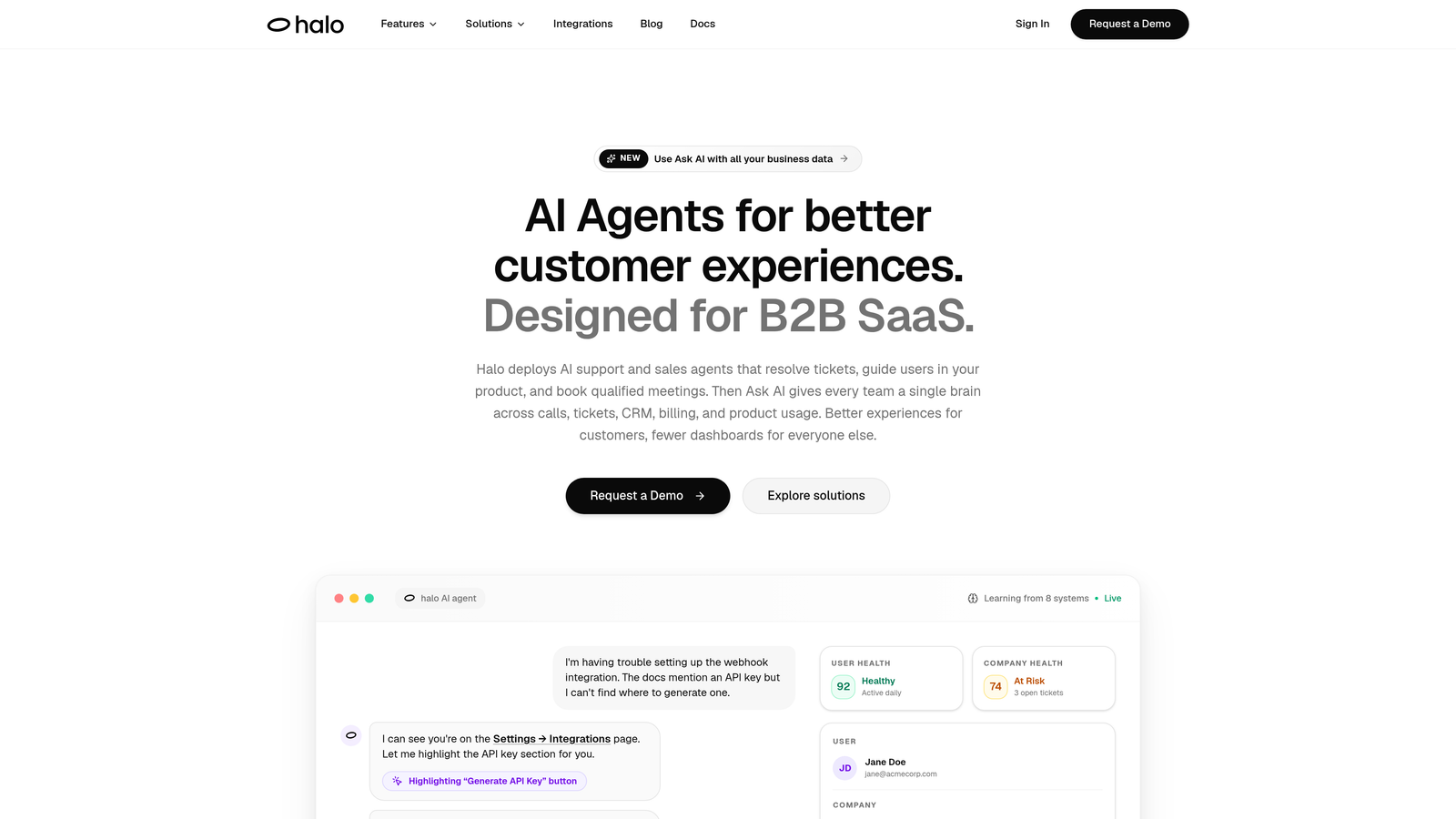
Halo AI is an AI-first customer support platform where intelligent agents resolve tickets, guide users visually through your product, and generate bug reports — continuously learning from every interaction.
Where This Tool Shines
What sets Halo apart from most enterprise platforms is its architectural foundation. Rather than layering AI on top of an existing helpdesk, Halo was built AI-first, which means the intelligence runs through the entire system rather than operating as a bolt-on feature. The result is an agent that can do more than answer questions: it can see what a user sees on the page, guide them through your UI visually, and connect context across your entire business stack.
The business intelligence layer is another differentiator. Halo's smart inbox doesn't just manage tickets; it surfaces customer health signals, revenue intelligence, and anomaly detection. For enterprise support leaders, this means your support operation stops being a cost center and starts generating insights that feed back into product and revenue decisions.
Key Features
Page-Aware Chat Widget: Halo's agents understand the specific page a user is on and provide contextual, visual UI guidance rather than generic help center links.
Autonomous Ticket Resolution with Live Agent Handoff: AI handles the full resolution lifecycle and escalates intelligently to human agents when complexity warrants it, with full context preserved.
Auto Bug Ticket Creation: Automatically identifies and logs bug reports directly into Linear and other engineering tools, closing the loop between support and product teams.
Smart Inbox with Business Intelligence: Surfaces customer health signals, revenue intelligence, and support anomalies alongside standard ticket management.
Deep Integration Stack: Connects natively with Slack, HubSpot, Intercom, Stripe, Zoom, PandaDoc, Fathom, and more, giving AI agents full business context when resolving issues.
Best For
Halo is particularly well-suited for B2B SaaS companies and product teams that want AI agents embedded deeply in their product experience, not just sitting on a generic chat widget. If your support operation also needs to feed intelligence back into product, sales, and engineering workflows, Halo's connected architecture makes that possible without custom middleware.
Pricing
Custom enterprise pricing based on your team's needs. Contact the Halo sales team directly at haloagents.ai for a quote tailored to your volume and stack.
2. Zendesk AI
Best for: Enterprises already on the Zendesk Suite wanting native AI capabilities without switching platforms.
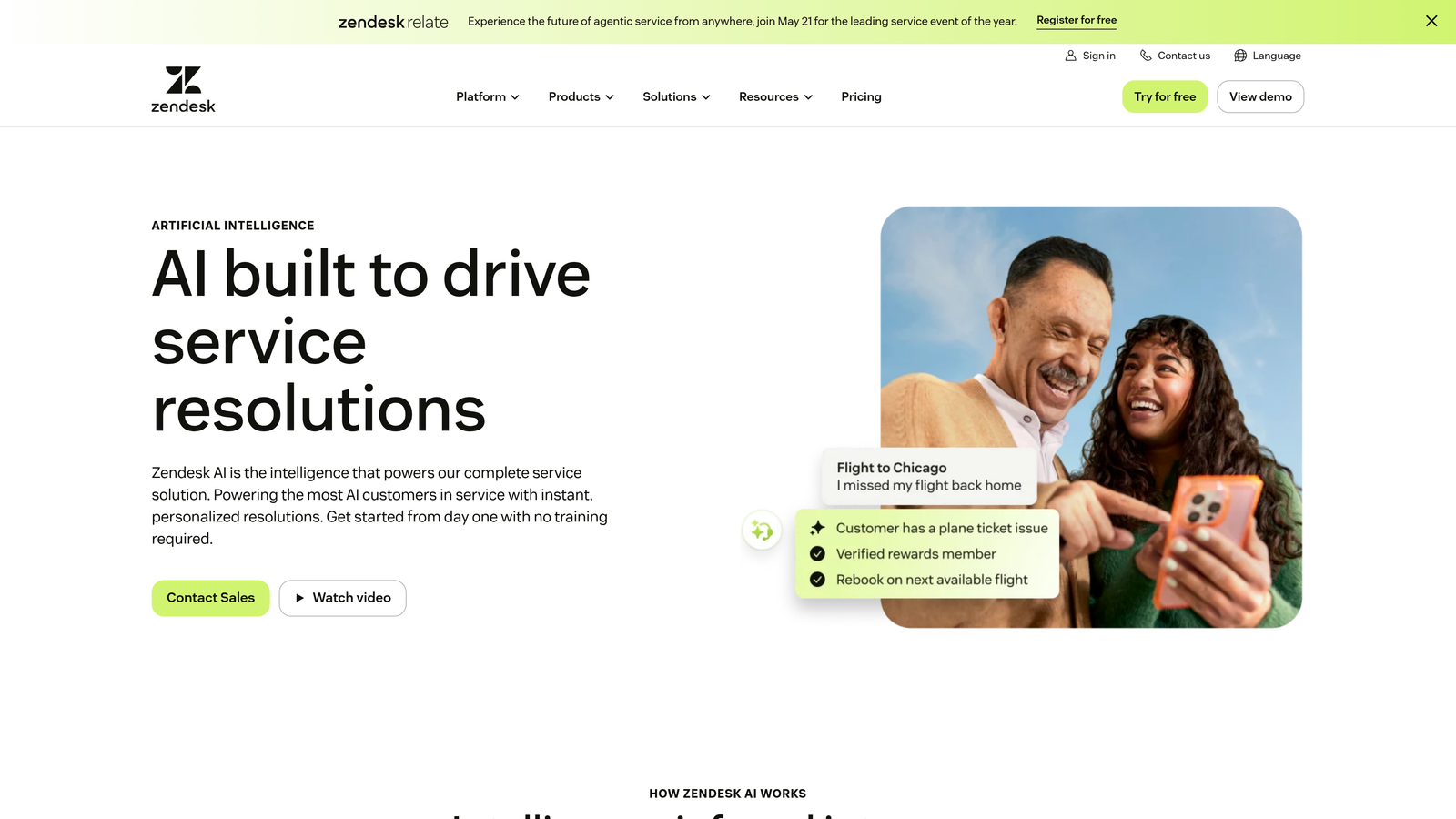
Zendesk AI is a suite of AI capabilities built natively into Zendesk, covering automated resolution, agent assistance, intelligent triage, and knowledge base management across all support channels.
Where This Tool Shines
For enterprises already invested in the Zendesk ecosystem, the AI layer is the path of least resistance. There's no migration, no new vendor relationship, and no integration work to get started. The agent copilot in particular is well-regarded for reducing handle time by surfacing relevant context and suggesting responses in real time.
Zendesk AI also benefits from years of training data across thousands of enterprise deployments, which gives its triage and classification models a strong baseline. The generative AI capabilities for knowledge base maintenance are genuinely useful for teams struggling to keep help content current at scale.
Key Features
Native AI Agents: Resolve common requests without human intervention, operating directly within the Zendesk workflow your team already knows.
Agent Copilot: Provides real-time response suggestions, context summaries, and next-best-action guidance for human agents during live interactions.
Intelligent Triage: Auto-classifies ticket intent, language, and sentiment to route issues to the right queue or agent automatically.
Generative AI for Knowledge Base: Assists with creating, updating, and maintaining help center articles based on resolved ticket patterns.
Enterprise Security: SOC 2, GDPR compliance, and HIPAA options for regulated industries.
Best For
Enterprises already running Zendesk Suite at scale who want to add AI resolution and agent assistance without a platform migration. Less ideal for teams wanting AI that integrates deeply outside the Zendesk ecosystem.
Pricing
AI features are included in Suite Professional at $115/agent/month and above. An Advanced AI add-on is available for enhanced capabilities. Pricing verified at time of writing; confirm current rates with Zendesk directly.
3. Intercom Fin
Best for: Product and SaaS companies wanting an LLM-powered AI agent that works from existing help content.
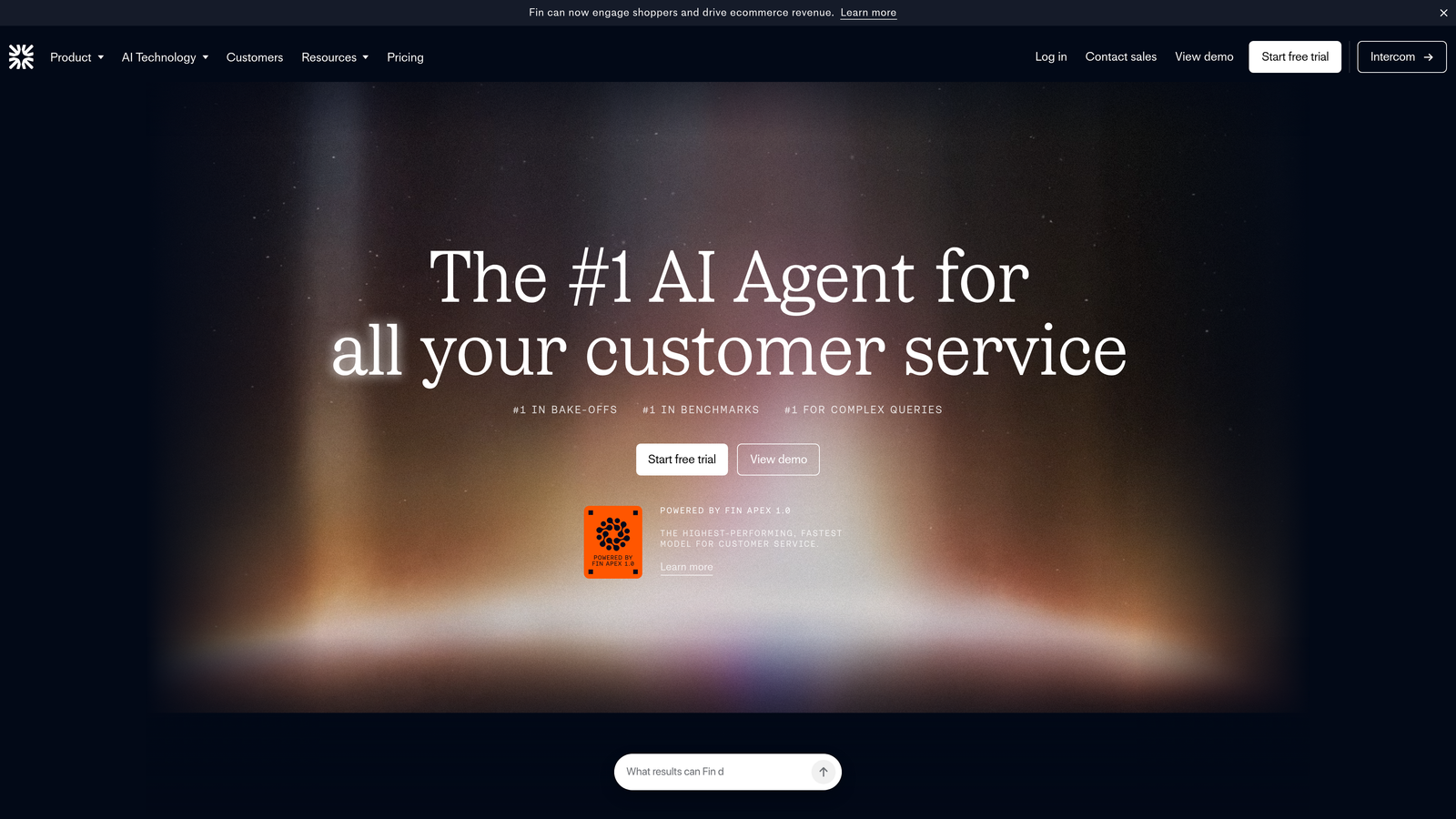
Intercom Fin is Intercom's AI agent that uses large language models trained on your help center and support content to hold natural conversations and resolve customer issues across chat, email, and SMS.
Where This Tool Shines
Fin's core strength is how quickly it can get to work. Rather than requiring extensive training or conversation flow design, Fin reads your existing help content and starts generating accurate, conversational answers from day one. For enterprises with mature knowledge bases, this dramatically shortens time-to-value compared to platforms that need significant setup before they're useful.
The per-resolution pricing model is also worth noting. Instead of paying a flat per-seat fee regardless of AI usage, you pay based on what Fin actually resolves. For enterprises with predictable ticket distributions, this can be more cost-effective, though volume-heavy operations should model costs carefully before committing.
Key Features
LLM-Powered AI Agent: Fin generates answers from your existing help content rather than requiring scripted conversation flows, enabling natural, contextual responses.
Multi-Channel Support: Operates across chat, email, SMS, and social channels from a single configuration.
Custom AI Workflows: Supports complex, multi-step resolution paths for issues that go beyond simple Q&A.
Resolution Rate Reporting: Built-in analytics tracking AI resolution rates, conversation quality, and deflection metrics.
Seamless Human Handoff: Passes full conversation context to human agents when escalation is needed, avoiding the frustrating "start over" experience for customers.
Best For
SaaS and product companies with well-maintained help centers who want fast deployment of an AI agent without heavy configuration. Enterprises needing deep CRM integration or voice support may find Fin's scope limiting.
Pricing
Fin is charged per resolution. Platform plans start at $29/seat/month, with enterprise pricing available for larger teams. Model resolution costs carefully for high-volume operations.
4. Salesforce Einstein Service Cloud
Best for: Enterprises running their business on Salesforce who want AI support tightly integrated with full CRM context.
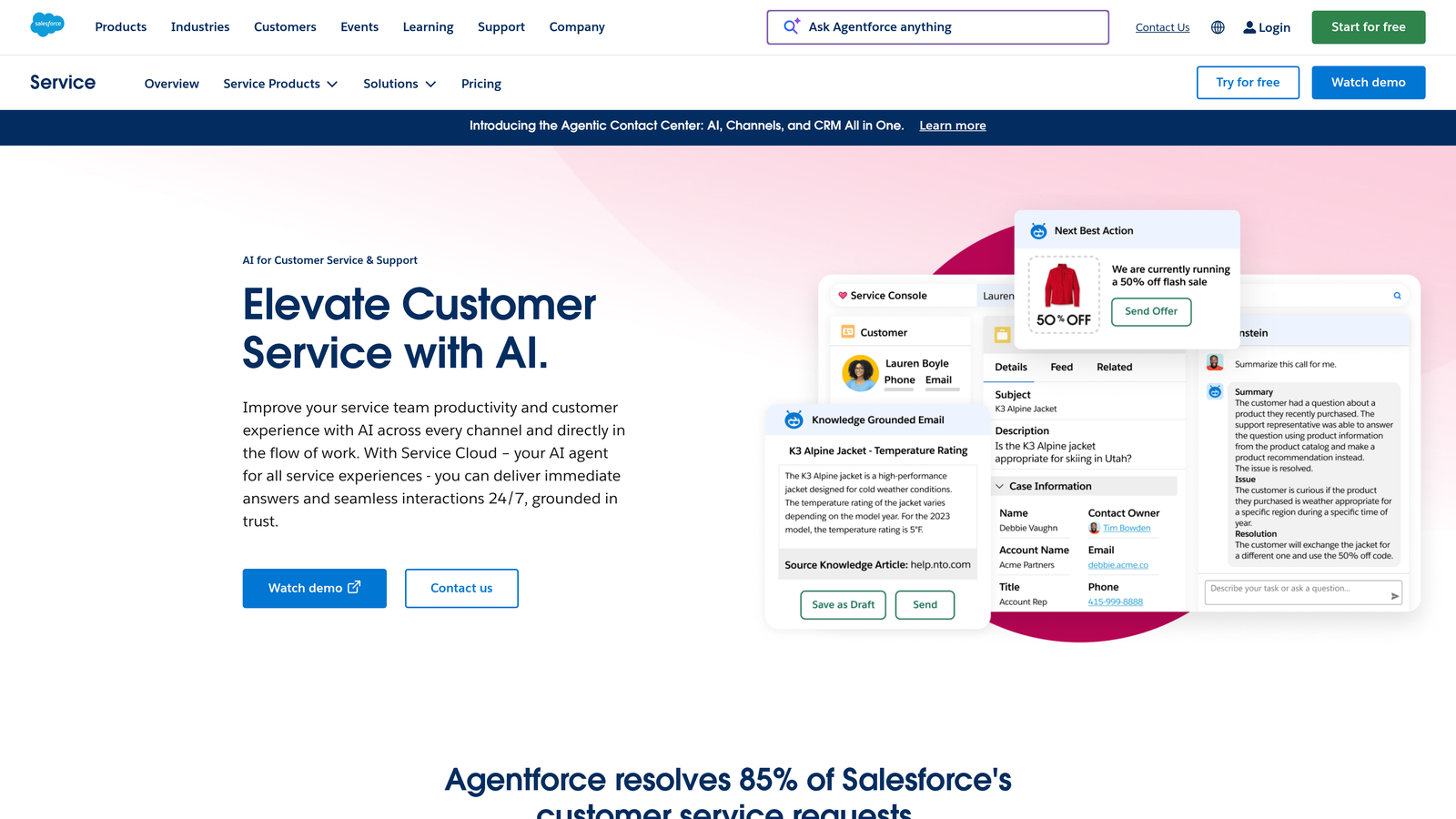
Salesforce Einstein Service Cloud is an AI-powered service platform that combines Einstein AI with complete Salesforce CRM data for case management, self-service, and agent productivity at enterprise scale.
Where This Tool Shines
The defining advantage of Einstein Service Cloud is CRM depth. When an AI bot or human agent is handling a case, they have immediate access to the customer's full Salesforce record: purchase history, open opportunities, previous cases, account health, and more. This level of context is difficult to replicate with platforms that treat the CRM as an external integration.
For enterprises where sales and service need to operate in close coordination — think complex B2B accounts or high-value customer relationships — this native context is genuinely powerful. The omnichannel routing with AI-driven skills matching is also strong, particularly for large contact center operations with specialized agent teams.
Key Features
CRM-Integrated AI Bots: Einstein bots have full access to Salesforce customer data, enabling highly personalized, context-aware automated responses.
AI Case Summaries and Next Actions: Generates case summaries and recommends next steps for agents, reducing time spent reading through ticket history.
Omnichannel Routing: AI-driven prioritization and skills-based routing across all support channels.
Knowledge Article Recommendations: Surfaces relevant knowledge articles using natural language understanding during live agent interactions.
Full Platform Integration: Native connection to Sales Cloud, Marketing Cloud, and the broader Salesforce ecosystem.
Best For
Enterprises already standardized on Salesforce across sales, marketing, and service. The value compounds significantly when other business units are on the platform. For companies not already in the Salesforce ecosystem, the licensing cost and implementation complexity are significant hurdles.
Pricing
Enterprise edition starts at $165/user/month. Einstein AI features require additional licensing on top of base Service Cloud costs. Total cost of ownership can be substantial; factor in implementation and customization costs.
5. Ada
Best for: High-volume enterprises prioritizing autonomous resolution across web, mobile, social, SMS, and voice channels.
Ada is an AI-first customer service automation platform built specifically for enterprises that need to drive autonomous resolution at scale, not just deflect tickets to a FAQ page.
Where This Tool Shines
Ada was built from the ground up around the concept of autonomous resolution, which is an important architectural distinction from platforms that added AI to existing helpdesk products. The platform is designed to handle the full resolution lifecycle across channels without human intervention, and it measures success by resolutions, not just deflections.
The no-code and low-code builder makes Ada accessible for support teams who want to build and iterate on conversation flows without waiting on engineering resources. Combined with multilingual support across more than 50 languages, Ada is particularly well-positioned for global enterprises managing support across multiple regions and languages simultaneously.
Key Features
Autonomous Resolution Platform: Built to fully resolve customer issues, not just deflect them to self-service content, with resolution rate as the primary success metric.
Omnichannel Deployment: Consistent AI agent experience across web, mobile, social, SMS, and voice channels from one platform.
No-Code and Low-Code Builder: Support and CX teams can build and modify conversation flows without engineering dependencies.
Broad Integration Support: Connects with major CRMs, helpdesks, and commerce platforms to give AI agents the context they need to resolve issues.
Multilingual AI: AI-powered translation and natural language understanding across 50+ languages for global enterprise deployments.
Best For
Large enterprises with high ticket volumes across multiple channels and geographies, particularly where autonomous resolution rate is the primary KPI. Strong fit for consumer-facing businesses with high repetitive inquiry volumes.
Pricing
Custom enterprise pricing based on resolution volume. Contact Ada's sales team for a quote specific to your channel mix and expected resolution volume.
6. Freshdesk Freddy AI
Best for: Mid-market and enterprise teams wanting capable AI support automation at more accessible price points than Zendesk or Salesforce.
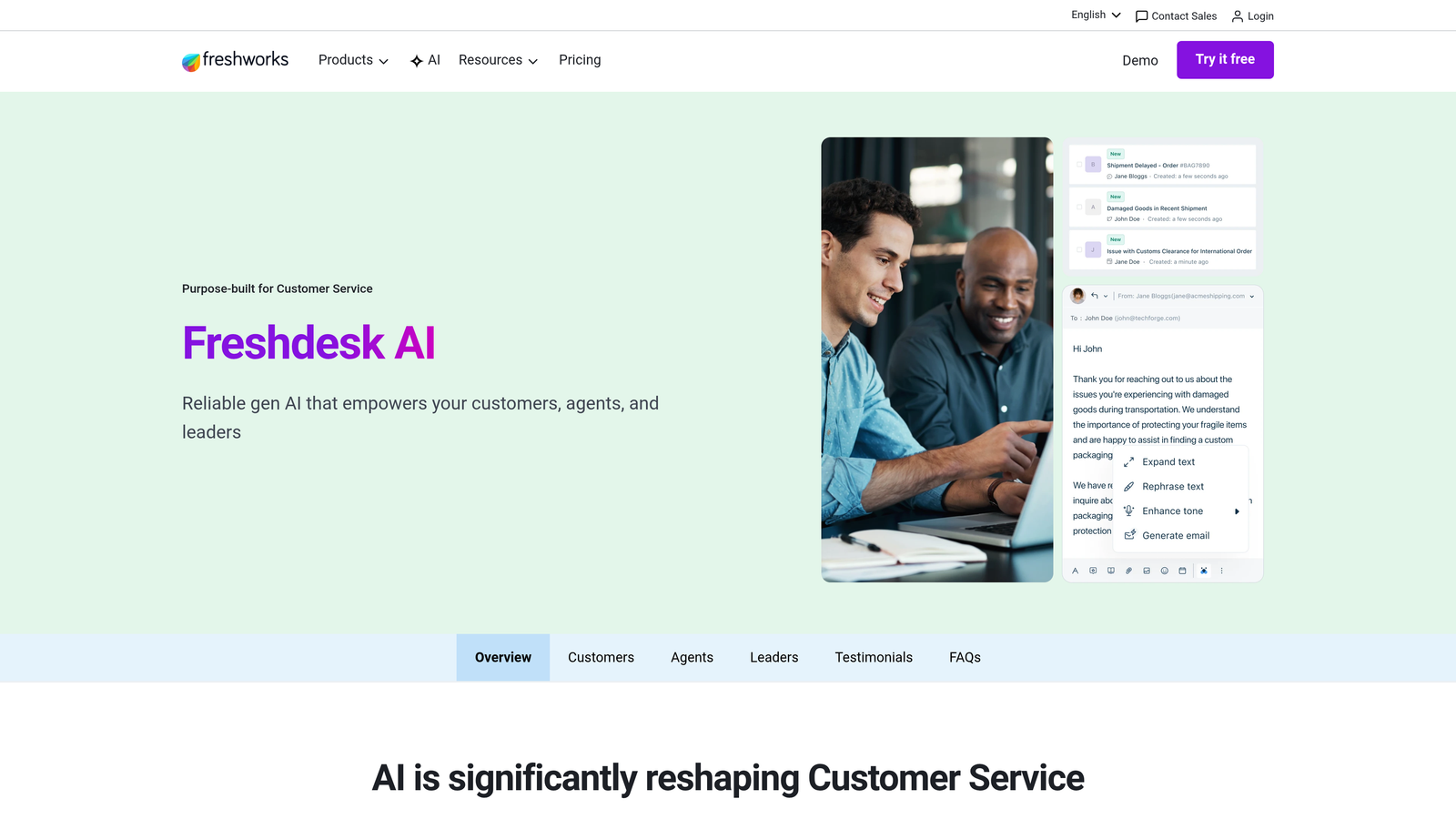
Freshdesk Freddy AI is the AI engine powering automated ticket resolution, agent assistance, and intelligent workflows within the Freshdesk customer support suite.
Where This Tool Shines
Freshdesk's main competitive advantage in the enterprise space is the value-to-cost ratio. Freddy AI delivers solid automated resolution, agent copilot functionality, and intelligent routing at price points that are meaningfully lower than Zendesk's AI tiers or Salesforce's licensing structure. For enterprises where budget scrutiny is real, this matters.
Freddy Copilot's agent-assist capabilities are well-regarded for reducing average handle time, with response suggestions and conversation summaries that help agents move faster without sacrificing quality. The built-in analytics layer also provides useful visibility into team performance trends and AI effectiveness over time.
Key Features
Freddy AI Agent: Customer-facing AI that handles automated resolutions for common requests without human agent involvement.
Freddy Copilot: Agent-assist layer providing real-time response suggestions, conversation summaries, and contextual knowledge recommendations.
Intelligent Ticket Management: AI-powered classification, prioritization, and routing to ensure tickets reach the right team with relevant context already attached.
AI Analytics: Built-in reporting on team performance, resolution trends, and AI effectiveness with actionable insights surfaced automatically.
Competitive Pricing: Meaningful cost advantage compared to Zendesk and Salesforce equivalents for similar core AI capabilities.
Best For
Mid-market companies scaling toward enterprise, or enterprise teams with budget constraints who need solid AI capabilities without the premium pricing of Zendesk Suite or Salesforce. Also a good fit for teams already invested in the Freshworks ecosystem.
Pricing
Pro plan at $49/agent/month includes Freddy AI features. Enterprise plan at $79/agent/month adds advanced capabilities. Pricing confirmed at time of writing; verify current rates with Freshworks.
7. Forethought
Best for: Enterprises wanting to add AI intelligence to an existing helpdesk without replacing it.
Forethought is an AI platform that layers intelligent triage, automated resolution, and agent assistance on top of existing helpdesk systems including Zendesk, Salesforce, and ServiceNow.
Where This Tool Shines
Forethought's architectural approach is deliberately additive. Rather than asking enterprises to rip and replace their existing helpdesk, it sits on top of Zendesk, Salesforce, ServiceNow, and others, adding AI intelligence without disrupting established workflows. For large enterprises with significant helpdesk investments and complex change management requirements, this is a meaningful advantage.
The predictive analytics module for ticket volume forecasting is a standout feature for enterprise support operations leaders. Being able to anticipate volume spikes and optimize staffing proactively is genuinely valuable at scale, and it's a capability that many pure-play AI support platforms don't prioritize.
Key Features
AI-Powered Triage: Classifies and routes tickets intelligently before agents see them, ensuring proper prioritization and assignment from the moment a ticket is created.
Solve (Customer-Facing AI): AI agent that resolves common customer requests autonomously, reducing ticket volume reaching human agents.
Assist (Agent-Facing AI): Surfaces relevant knowledge articles and suggested responses to agents during live interactions, accelerating resolution.
Helpdesk Agnostic: Designed to work on top of Zendesk, Salesforce, ServiceNow, and other major platforms without requiring a migration.
Predictive Analytics: Forecasts ticket volume trends to support staffing optimization and proactive capacity planning.
Best For
Enterprises with established helpdesk platforms who want AI capabilities without a full platform migration. Particularly valuable for operations teams who need predictive staffing intelligence alongside AI resolution.
Pricing
Custom pricing based on ticket volume and the specific modules selected. Contact Forethought for a quote based on your current helpdesk platform and expected usage.
8. Cognigy
Best for: Regulated industries and enterprises needing voice AI automation with flexible on-premise or private cloud deployment.
Cognigy is an enterprise conversational AI platform specializing in voice and chat automation, with deployment options spanning SaaS, private cloud, and fully on-premise environments.
Where This Tool Shines
Cognigy occupies a specific and important niche: enterprises that need serious voice AI capabilities and can't use a standard SaaS deployment model. Financial services, healthcare, and government organizations operating under strict data residency or sovereignty requirements have options with Cognigy that simply aren't available from most other platforms on this list.
The voice AI capabilities are genuinely enterprise-grade, with deep integrations into major contact center platforms including Genesys, Avaya, and NICE. For enterprises running large phone-based support operations, this is a meaningful differentiator. The visual conversation flow builder also handles enterprise-level complexity well, supporting sophisticated multi-turn conversation logic without requiring custom code for every edge case.
Key Features
Advanced Voice AI: Phone-based support automation with natural language understanding built for enterprise contact center environments.
Flexible Deployment: On-premise, private cloud, and SaaS options to meet strict data residency, sovereignty, and compliance requirements.
Visual Flow Builder: Enterprise-grade conversation design tool that handles complex multi-turn logic without requiring extensive custom development.
Contact Center Platform Integration: Native integrations with Genesys, Avaya, NICE, and other major contact center infrastructure providers.
Multilingual LLM Support: LLM-powered natural language understanding across multiple languages for global enterprise deployments.
Best For
Regulated industries requiring on-premise or private cloud deployment, and enterprises running significant phone-based support volume who need voice AI that integrates with existing contact center infrastructure.
Pricing
Custom enterprise pricing, typically quoted based on conversation volume and deployment model. Engage Cognigy's enterprise sales team for a deployment-specific quote.
9. Kustomer
Best for: High-volume, relationship-driven support operations in D2C, retail, and e-commerce wanting a CRM-native support platform.
Kustomer is a CRM-native customer service platform with a timeline-based customer view and AI-powered automations designed for support operations where customer relationship context is as important as ticket resolution speed.
Where This Tool Shines
Kustomer's timeline-based customer view is its most distinctive feature. Every interaction a customer has had, across every channel, appears in a unified chronological view that gives agents immediate context without hunting through multiple systems. For support operations handling complex customer relationships with long histories, this context is invaluable and meaningfully faster than piecing together context from separate tools.
The built-in CRM eliminates a common enterprise headache: maintaining a separate customer data platform just to give support agents context. For D2C and retail operations in particular, the native e-commerce integrations mean agents and AI bots have order history, shipping status, and return data immediately available during interactions.
Key Features
Timeline-Based Customer View: Aggregates all customer interactions and data across channels into a single chronological view, giving agents and AI immediate, complete context.
AI-Powered Chatbots and Workflows: Automated resolution for common requests with intelligent workflow routing for more complex issues.
Omnichannel Inbox: Unified inbox spanning email, chat, social, SMS, and voice for consistent customer experience management.
Built-In CRM: Native customer data management eliminates the need for a separate CRM or data platform for support operations.
E-Commerce Integrations: Strong native integrations with e-commerce platforms for retail and D2C support operations needing order and fulfillment context.
Best For
D2C brands, retail operations, and any enterprise where long-term customer relationship context is central to support quality. Less suited for pure B2B SaaS environments where product-context AI guidance matters more than purchase history.
Pricing
Enterprise plan at $89/user/month. Ultimate plan at $139/user/month includes advanced AI capabilities and analytics. Pricing verified at time of writing; confirm current rates with Kustomer directly.
Choosing the Right Enterprise AI Support Platform
The honest answer is that no single platform is right for every enterprise. The best choice depends heavily on your existing stack, your support channels, your industry's compliance requirements, and what you're actually trying to optimize for.
Here's a practical way to think through the decision:
If you're already on Zendesk or Freshdesk: Evaluate the native AI tiers before adding another vendor. Zendesk AI and Freddy AI both offer solid capabilities without migration complexity. If the native AI falls short, Forethought is worth evaluating as an additive layer.
If you're standardized on Salesforce: Einstein Service Cloud is the natural path, particularly if your sales and service teams need to share customer context in real time.
If you're in a regulated industry or need voice automation: Cognigy's flexible deployment options and contact center integrations make it the strongest fit for environments where SaaS deployment isn't an option.
If you're a B2B SaaS or product-led company: Halo AI's page-aware agents, deep integration stack, and business intelligence layer are built specifically for this context. The ability to see what users see, generate bug reports automatically, and surface revenue signals from support interactions is a fundamentally different capability than what traditional helpdesk AI provides.
If you're a high-volume D2C or retail operation: Kustomer's CRM-native timeline view and e-commerce integrations give your team and AI agents the relationship context that drives better outcomes in relationship-driven support environments.
The broader market shift worth keeping in mind: enterprises are moving away from measuring AI support platforms on deflection rates and toward measuring them on full resolution rates. The platforms that will win enterprise contracts in 2026 and beyond are the ones that can demonstrate they actually solve customer problems, not just redirect them.
Your support team shouldn't scale linearly with your customer base. Let AI agents handle routine tickets, guide users through your product, and surface business intelligence while your team focuses on complex issues that need a human touch. See Halo in action and discover how continuous learning transforms every interaction into smarter, faster support.