AI Support Pricing Models Explained: How to Choose the Right Structure for Your Team
Understanding the major ai support pricing models—from per-seat and per-conversation to resolution-based structures—helps B2B teams cut through vendor confusion and accurately forecast costs before committing to a platform. This guide breaks down how each model works, what assumptions drive it, and how to match the right pricing structure to your team's actual support volume and goals.
 Matt PattoliFounder13 min read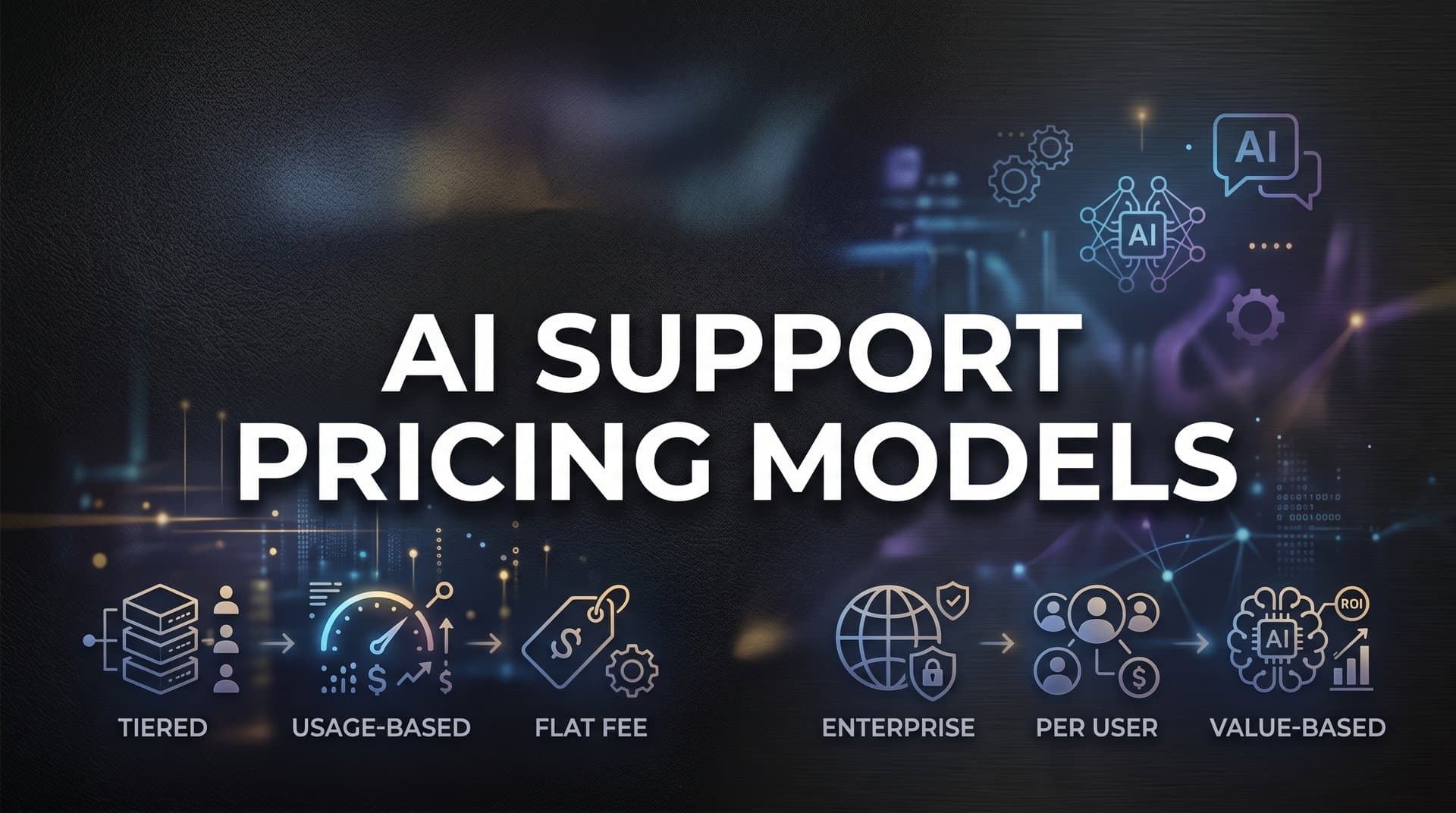
You've finally carved out time to evaluate AI customer support tools. You pull up three pricing pages, and within five minutes you're more confused than when you started. One vendor charges per seat. Another charges per conversation. A third has a "resolution-based" model that sounds great but comes with enough asterisks to fill a legal brief. And none of them make it easy to compare apples to apples.
This is one of the most common frustrations B2B buyers face when shopping for AI support tooling in 2026. The feature comparisons are hard enough, but the pricing structures are often deliberately opaque, making it nearly impossible to forecast what you'll actually spend once you're live and handling real ticket volume.
The good news: once you understand the core pricing models in the AI customer support space, the landscape becomes much clearer. Each model reflects a different set of assumptions about how AI creates value, and understanding those assumptions helps you spot which structure aligns with your team's reality and which ones carry hidden risks.
This guide breaks down the four main ai support pricing models you'll encounter, explains what each one means for your budget and your growth trajectory, and gives you a practical framework for evaluating vendors on your shortlist. Whether you're a Head of Support trying to build a business case, a VP of CX comparing platforms, or a product ops leader thinking about automation at scale, this is the clarity you've been looking for.
Here's what we'll cover: per-seat pricing and why it's a poor fit for AI-first tools, usage-based models and their unpredictability risks, flat-rate subscriptions and where they break down, and the emerging resolution-based model that's increasingly seen as the gold standard. We'll also look at what a vendor's pricing structure actually signals about their product, and close with a practical evaluation checklist.
The Four Pricing Models You'll Actually Encounter
Before diving into the tradeoffs of each model, it helps to have a clear taxonomy. The AI customer support market has converged around four primary pricing structures, each with its own logic, its own strengths, and its own failure modes.
Per-seat (agent-based) pricing: This is the legacy model inherited from traditional helpdesk software. You pay a monthly fee for each human agent or user who has access to the platform. Zendesk built its business on this model, and many vendors have carried it into their AI feature sets. The cost scales with your team size, not with how much the AI actually does.
Per-conversation or per-resolution pricing: Here, cost is tied directly to AI activity. Per-conversation models charge for each support interaction the AI handles, regardless of outcome. Per-resolution models are more specific: you pay only when the AI fully resolves a ticket without requiring human escalation. Both are usage-based in spirit, but the resolution variant has much stronger alignment with the value you're actually receiving.
Tiered flat-rate (subscription) pricing: A fixed monthly fee that unlocks a defined set of features and a volume cap on conversations or tickets. This is the model most familiar to SaaS buyers and the one finance teams tend to prefer. It's predictable until you grow past a tier threshold, at which point it can become expensive quickly.
Outcome-based pricing: The most evolved form of resolution-based pricing, where the vendor's revenue is directly tied to measurable outcomes, typically autonomous ticket resolution without escalation. This model signals the highest degree of vendor confidence in their AI's actual performance. It's the direction the market is moving, particularly among AI-native platforms that have built for autonomous resolution from the ground up.
Each of these models reflects a different answer to the same question: what are you actually paying for? Per-seat says you're paying for access. Per-conversation says you're paying for activity. Resolution-based says you're paying for outcomes. Flat-rate says you're paying for a bundle. That distinction matters more than any individual feature on a support automation pricing comparison spreadsheet.
Now let's go deeper on each one, starting with the model that causes the most frustration for AI-focused buyers.
Per-Seat Pricing: A Legacy Model in the Wrong Context
Per-seat pricing made perfect sense when helpdesk software was designed around human agents. Every agent needed a login, a workflow, a queue, and a license. Charging per seat was a clean, auditable way to tie revenue to usage. The problem is that this logic doesn't survive contact with AI.
When the "agent" handling your tickets is software, the concept of a seat becomes arbitrary. AI doesn't need a login. It doesn't clock in and out. It doesn't have a shift schedule or a capacity limit in the same way a human does. Charging per seat for an AI-augmented platform is essentially charging you for a human-shaped container that your AI doesn't need.
The more insidious problem is the scaling dynamic this creates. As your human team grows, your per-seat costs go up, even if the AI is handling an increasing share of your volume. Think about what that means in practice: you hire three new support agents to handle a growing customer base, and your AI support costs increase, even though the AI's workload may not have changed at all. You're paying more for the AI platform as a consequence of growing your human team, which is the opposite of the efficiency story AI vendors typically pitch.
This misalignment is especially pronounced for teams that are actively trying to reduce their reliance on headcount growth. If the pricing model penalizes you for having more agents, it creates a perverse incentive structure right at the moment when the AI should be delivering the most leverage.
That said, per-seat pricing isn't always the wrong choice. For smaller teams with stable headcount, where the primary use case is AI as a co-pilot layer sitting alongside human agents rather than replacing ticket volume autonomously, per-seat can offer simplicity. If your team of eight agents isn't going to grow significantly in the next year, and you're mainly using AI for suggested replies and knowledge base surfacing, the per-seat model is at least predictable.
The red flag to watch for is when a vendor is using per-seat pricing not out of simplicity, but because their AI isn't capable of autonomous resolution. If the AI fundamentally needs a human in the loop for most interactions, per-seat pricing makes sense from the vendor's architecture. But that also tells you something important about what you're actually buying.
Usage-Based Pricing: Flexibility With a Catch
Per-conversation and per-resolution pricing have an intuitive appeal. You only pay when the AI is working. If ticket volume is low, your bill is low. If the AI handles a lot of interactions, you pay more, but presumably because it's delivering more value. It feels like a fair deal.
And in many ways it is, right up until your support volume spikes unexpectedly.
Support volume is not a smooth, predictable curve. It's seasonal, it's event-driven, and it can move fast. A major product launch, a pricing change, a service outage, or a viral moment on social media can send your ticket volume up sharply within hours. Under a per-conversation model, that spike translates directly into a billing spike. Suddenly, a month that was supposed to cost a predictable amount becomes a budget conversation with your finance team.
This unpredictability is one of the most commonly cited frustrations in post-purchase reviews of AI support tools. Buyers often underestimate how spiky their volume actually is until they're living under a usage-based model and watching the meter run during an incident.
Per-resolution pricing addresses part of this problem by adding an outcome filter. You're not charged for every conversation the AI touches, only for the ones it fully resolves without a human stepping in. Failed interactions, escalations, and handoffs don't hit your bill. This is a meaningful improvement in alignment: the vendor is sharing some of the risk of low-quality AI performance.
Resolution-based pricing is increasingly seen as the most ROI-aligned variant in the market. Intercom, for instance, has publicly moved its Fin AI product toward a resolution-based model, which signals broader industry momentum in this direction. When a vendor prices on resolutions, they're making a bet on their own AI's performance. That's a fundamentally different relationship than charging you for every message sent.
The practical consideration for buyers is this: if your ticket mix is heavily weighted toward repetitive, low-complexity queries, resolution-based pricing is likely to work in your favor. The AI should resolve most of them autonomously, and you pay only when it succeeds. If your support is technically complex with a high escalation rate, you may find that resolution-based pricing becomes expensive relative to what you're actually getting, because many tickets will require human involvement and won't trigger a charge anyway. In that case, you're paying for a capability the AI is only partially delivering.
Flat-Rate Subscriptions: Predictable Until You Scale
Tiered subscription pricing is the model most B2B SaaS buyers are comfortable with, and for good reason. A fixed monthly fee makes procurement straightforward, simplifies budget forecasting, and removes the anxiety of watching a usage meter. Finance teams tend to approve flat-rate contracts more readily than variable-cost models, which matters when you're navigating internal procurement processes.
For teams in a stable growth phase with reasonably predictable ticket volume, flat-rate subscriptions can work well. You know what you're paying, you can plan around it, and there are no surprises at the end of the month.
The breakdown happens at the edges of the tier. Volume caps are where flat-rate models create the most friction. If your subscription includes a cap of, say, a certain number of conversations per month, crossing that threshold mid-month can trigger expensive overage fees or force an unplanned tier upgrade. For a support team dealing with a product launch or a seasonal spike, this can mean a significant unplanned cost at exactly the moment when your team is already stretched.
Feature gating is the other major frustration with tiered models. The capabilities that actually matter for serious AI support deployments, including advanced analytics, multi-channel support, deep integrations with your CRM and product stack, and business intelligence features, are frequently locked behind enterprise tiers. What looks like a competitive price on the starter or growth plan often strips out the functionality that would make the AI genuinely useful at scale.
This is worth probing carefully during vendor evaluations. Ask specifically which features are included at each tier, and map those features against your actual use cases before comparing sticker prices. A flat-rate plan that looks affordable may require an enterprise upgrade the moment you need integrations with your existing tools or access to meaningful reporting.
Flat-rate pricing is not inherently bad. It's a legitimate model with real advantages for the right buyer. But it works best when the tier you're buying genuinely includes everything you need, and when your volume is unlikely to push you into overage territory during normal operations.
What the Pricing Model Reveals About the Product
Here's a perspective that doesn't appear on most vendor comparison guides: a vendor's pricing structure is one of the most honest signals you'll get about what their product actually does.
Think about it from the vendor's side. If you're confident your AI will autonomously resolve a high percentage of tickets, resolution-based pricing is a natural fit. You're betting on your own performance, and you're asking customers to pay only when you deliver. That takes confidence in the underlying technology. Vendors who price this way are effectively saying: "We believe our AI will resolve your tickets. If it doesn't, you don't pay."
Contrast that with a vendor who insists on per-seat pricing or high flat-rate entry tiers. This structure is more consistent with a human-first architecture where AI is a feature layer added on top of a traditional helpdesk workflow. The pricing reflects the underlying design: the system was built around human agents, and the AI is a supplement rather than the primary resolution engine. That's not necessarily wrong, but it is a different product category than a purpose-built AI support platform.
When evaluating vendors, it's worth asking directly: "What percentage of tickets does your AI resolve autonomously, without any human involvement?" The answer, and the vendor's comfort level in answering it, tells you a lot. A vendor pricing on resolutions should be able to give you a meaningful answer to that question. A vendor pricing on seats may not have a clear answer, because autonomous resolution isn't the core value proposition their architecture is built around.
Integration depth is another area where pricing structure reveals product reality. Features like customer health signals, anomaly detection, and connections to tools like Linear, Slack, HubSpot, and Stripe require genuine architectural investment. These capabilities are rarely included in base tiers, even when they're advertised on the marketing page. Always ask specifically what's included at the tier you're evaluating, and get it in writing before signing.
The broader principle: don't just evaluate pricing as a cost question. Evaluate it as a product signal. The structure tells you who the vendor built the product for, how confident they are in its performance, and where the real value is locked.
Evaluating AI Support Pricing for Your Specific Situation
General principles are useful, but pricing decisions ultimately come down to your specific numbers, your ticket mix, and your growth trajectory. Here's a practical framework for working through the evaluation.
Start with your cost-per-ticket baseline. Divide your total monthly support spend, including salaries, tooling, and overhead, by your monthly ticket volume. This gives you a current cost-per-ticket figure. Any AI pricing model you're evaluating should be benchmarked against this number. If a resolution-based model charges a per-resolution fee that's lower than your current cost-per-ticket, and the AI can handle a meaningful share of your volume, the math is likely to work in your favor. For a deeper look at this calculation, see our guide on how to calculate support cost per ticket.
Map your ticket mix honestly. Not all tickets are equal candidates for AI resolution. Pull a sample of your last month's ticket volume and categorize by complexity. Repetitive, low-complexity queries, such as password resets, billing questions, feature how-tos, and status checks, are strong candidates for autonomous AI resolution. Highly technical issues, account escalations, and emotionally sensitive interactions typically require human judgment. The higher your proportion of repetitive tickets, the more favorable usage-based and resolution-based pricing will be. If your support is predominantly complex and technical, flat-rate may actually be the safer bet.
Account for total cost of ownership, not just the subscription fee. Implementation fees, onboarding costs, integration setup, and training time are often not reflected on the pricing page. Ask vendors directly for a full cost breakdown that includes these elements. A platform with a lower monthly fee but a significant implementation cost may be more expensive in year one than a platform with a higher subscription but faster time-to-value.
Stress-test the model against your volume spikes. Look at your ticket volume history and identify your highest-volume months. Run the usage-based pricing model against those months. If the numbers become uncomfortable during peak periods, factor that into your evaluation. Ask vendors whether they offer volume caps, overage protection, or annual commit options that smooth out the variability.
Ask about what happens when the AI doesn't resolve a ticket. Under resolution-based pricing, escalated or failed interactions shouldn't cost you. Confirm this explicitly. Under per-conversation pricing, every interaction costs something regardless of outcome. Understanding this distinction is critical for forecasting your actual spend under realistic operating conditions. Learning how to measure support automation success can help you set the right benchmarks before you commit to a model.
Choosing the Model That Fits Your Team's Reality
At the core of every ai support pricing decision is a tradeoff between three things: predictability, alignment, and simplicity. Flat-rate subscriptions win on predictability. Resolution-based pricing wins on alignment with value delivered. Per-seat pricing wins on simplicity, at least for small, stable teams.
The right choice depends on where you are as an organization. If you're early in your AI support journey and primarily using AI as a co-pilot alongside human agents, per-seat or flat-rate may be the right starting point. If you're scaling and want pricing that reflects actual AI performance, resolution-based pricing is worth pursuing, even if it requires more due diligence upfront. If you have highly variable ticket volume, make sure any usage-based model you consider has guardrails against runaway billing during spikes.
Most importantly, use the pricing model as a lens on the product itself. Vendors who price on resolutions are making a bet on autonomous performance. That's the kind of confidence you want from an AI system that's representing your brand to customers at scale.
Your support team shouldn't scale linearly with your customer base. The right AI architecture resolves routine tickets autonomously, guides users through your product in context, and surfaces business intelligence that helps your whole organization, while your human agents focus on the complex issues that genuinely need a human touch. That's the promise of a purpose-built AI support platform, and the pricing model should reflect it.
Halo AI is built on exactly this architecture: AI agents that learn from every interaction, improve their resolution rates over time, and connect to your entire business stack without requiring a bolt-on integration layer. See Halo in action and discover how continuous learning transforms every interaction into smarter, faster support that scales the way AI was meant to.