9 Best AI Support Software Solutions for B2B Teams in 2026
This comprehensive ai support software comparison guide evaluates nine platforms based on autonomous resolution, learning capabilities, and integration depth specifically for B2B teams. Unlike typical vendor claims, this analysis focuses on tools that genuinely reduce manual intervention and scale effectively, helping teams choose between replacing legacy helpdesks or building new AI-powered support infrastructure from scratch.
 Grant CooperFounder11 min read
Finding the right AI support software can feel overwhelming when every vendor claims to offer 'intelligent automation' and 'seamless integration.' The reality? Most platforms still require significant manual intervention, struggle with context, and create more work than they eliminate.
This guide cuts through the noise with a practical comparison of AI support tools that actually deliver on their promises. We've evaluated each platform based on autonomous resolution capabilities, learning mechanisms, integration depth, and real-world scalability for B2B teams.
Whether you're replacing a legacy helpdesk or building your first AI-powered support stack, here's what you need to know.
1. Halo AI
Best for: B2B teams seeking autonomous ticket resolution with continuous learning capabilities
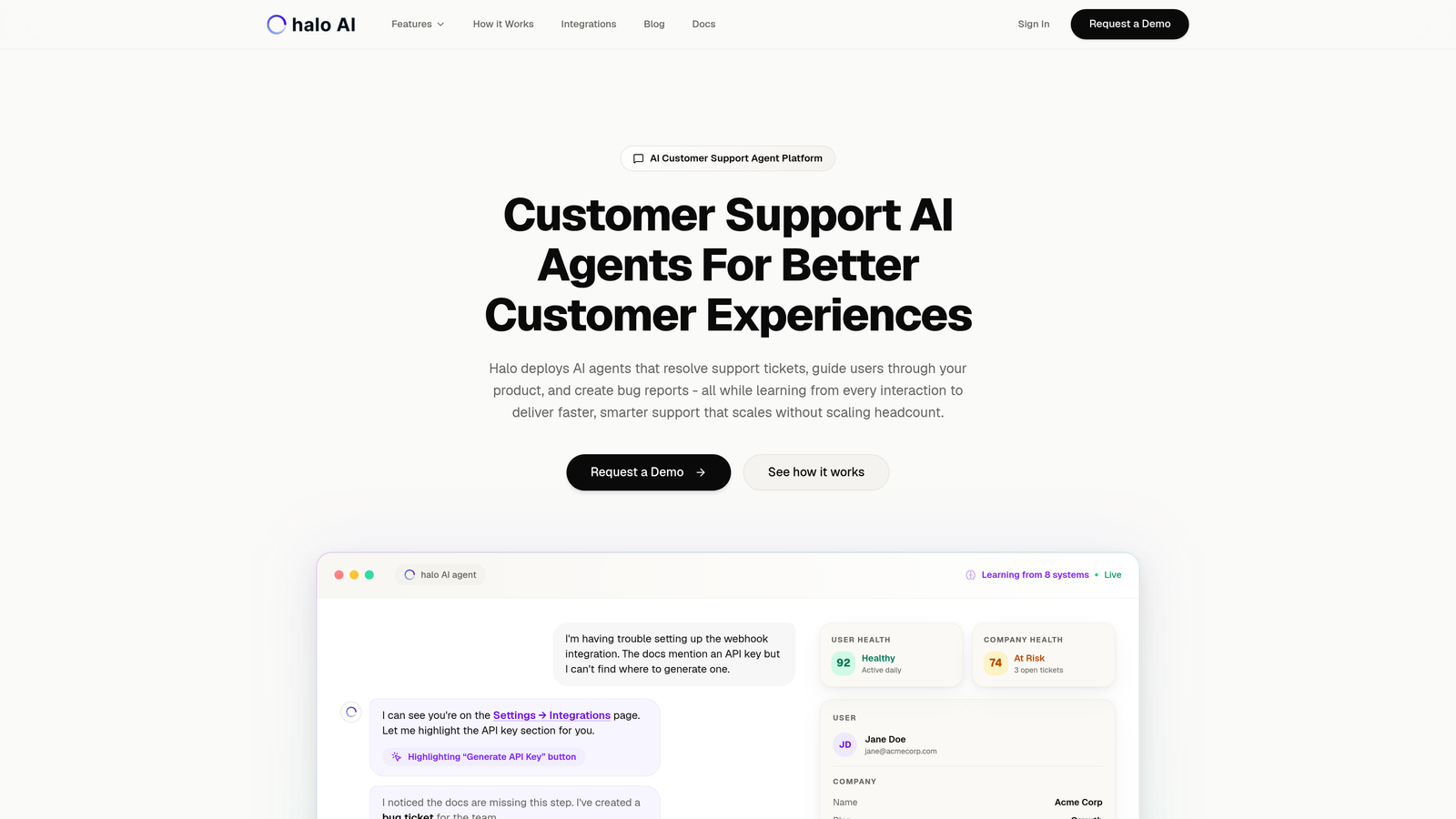
Halo AI is an AI-first customer support platform that deploys autonomous agents to resolve tickets, guide users, and create bug reports without human intervention.
Where This Tool Shines
Halo distinguishes itself through genuine autonomy. While most AI support tools require human oversight for every resolution, Halo's agents independently handle tickets from start to finish, learning from each interaction to improve future responses.
The platform's page-aware capability sets it apart from competitors. The AI can see exactly what users see on their screens, providing contextual guidance that references specific UI elements rather than generic instructions. This visual understanding dramatically reduces the back-and-forth typically required to resolve product-related questions.
Key Features
Autonomous Ticket Resolution: AI agents handle complete ticket lifecycles without requiring human review or approval for routine issues.
Page-Aware Chat Widget: Sees user screens in real-time to provide visual guidance and context-specific solutions referencing actual UI elements.
Smart Inbox with Business Intelligence: Surfaces customer health signals, revenue intelligence, and anomaly detection beyond basic support metrics.
Auto Bug Ticket Creation: Automatically generates engineering tickets in Linear when issues require product fixes, complete with reproduction steps.
Deep Business Stack Integration: Connects to Linear, Slack, HubSpot, Intercom, Stripe, Zoom, PandaDoc, and Fathom for comprehensive context.
Best For
B2B companies with complex products that need AI capable of understanding nuanced contexts. Particularly valuable for teams using helpdesk systems like Zendesk, Freshdesk, or Intercom who want to move beyond basic automation to true autonomous resolution. Ideal when your support volume is growing faster than you can hire.
Pricing
Contact for pricing. Custom pricing based on ticket volume and integration requirements.
2. Intercom Fin
Best for: Teams already using Intercom who want native AI without switching platforms
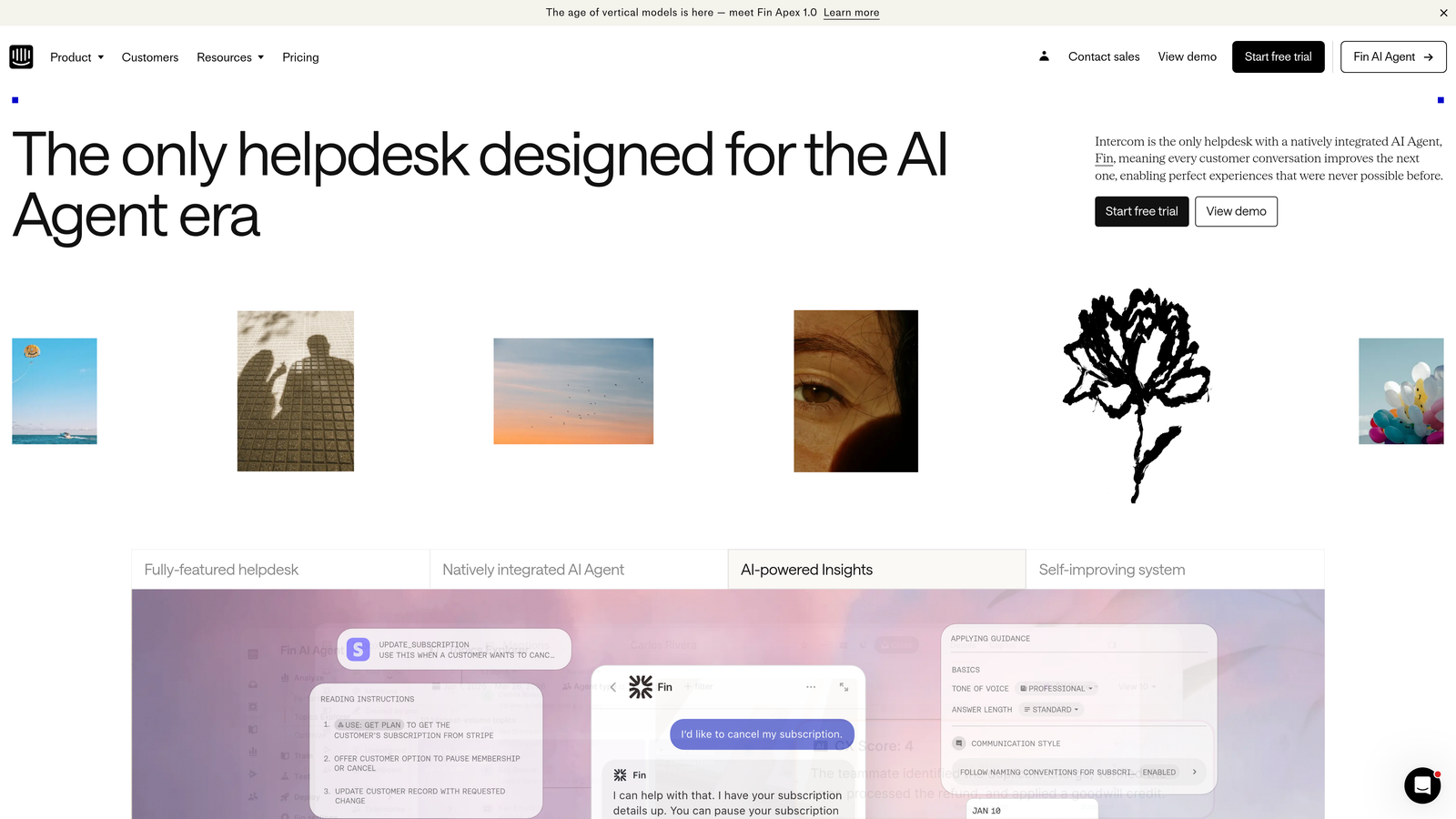
Intercom Fin is a GPT-4 powered AI chatbot built directly into Intercom's customer messaging platform for conversational support.
Where This Tool Shines
Fin's greatest strength is its seamless integration with Intercom's existing ecosystem. If you're already using Intercom for customer messaging, Fin activates with minimal setup and immediately starts learning from your help center content and conversation history.
The handoff experience between AI and human agents happens within the same conversation thread, creating a smooth experience for customers who don't realize they're switching between bot and human. This continuity matters more than most teams realize when measuring customer satisfaction.
Key Features
GPT-4 Powered Responses: Uses advanced language models to generate natural, contextually appropriate answers from your knowledge base.
Seamless Human Handoff: Transfers conversations to live agents within the same thread without requiring customers to repeat information.
Multi-Language Support: Handles customer queries in over 40 languages without requiring separate training for each language.
Learning from Past Conversations: Analyzes historical Intercom conversations to improve response accuracy and identify common patterns.
Built-in Analytics Dashboard: Tracks resolution rates, customer satisfaction, and conversation topics directly within Intercom's reporting interface.
Best For
Companies already invested in the Intercom ecosystem who want to add AI capabilities without managing multiple platforms. Works well for teams prioritizing conversational support over ticket-based workflows, particularly in consumer-facing or high-touch B2B scenarios.
Pricing
Starts at $0.99 per resolution. Pay-per-use model means costs scale directly with AI usage rather than seat-based pricing.
3. Zendesk AI
Best for: Enterprise teams with complex routing needs and existing Zendesk infrastructure
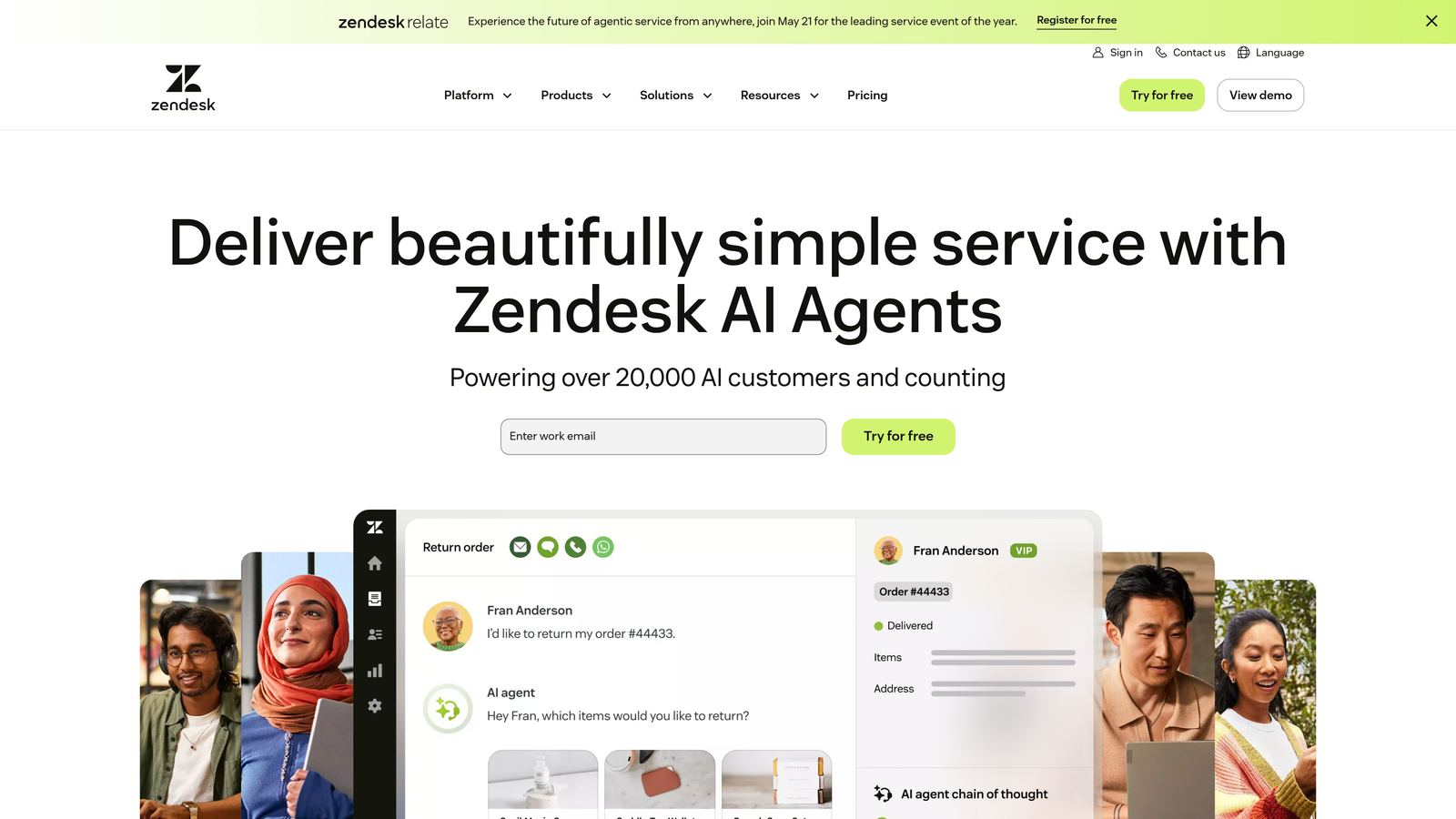
Zendesk AI layers enterprise-grade AI capabilities onto Zendesk's established helpdesk platform with extensive marketplace integrations.
Where This Tool Shines
Zendesk's AI excels at intelligent routing and agent assistance rather than full automation. The intent detection capabilities analyze incoming tickets and route them to the right team or agent based on content, urgency, and historical patterns.
The platform's marketplace advantage becomes significant at enterprise scale. With over 1,500 integrations available, Zendesk AI can pull context from virtually any business system your team uses, though setting up these integrations requires more technical effort than newer platforms.
Key Features
Intent Detection and Routing: Analyzes ticket content to automatically categorize and route to appropriate teams based on detected customer intent.
AI-Powered Agent Assistance: Suggests relevant knowledge base articles and previous similar tickets to agents while they work.
Macro Suggestions: Recommends response templates and workflow automations based on ticket content and agent behavior patterns.
Extensive Marketplace: Access to 1,500+ integrations for connecting Zendesk to your broader business technology stack.
Advanced Analytics: Enterprise-grade reporting on AI performance, agent productivity, and customer satisfaction metrics.
Best For
Large enterprises with established Zendesk deployments who need AI to augment rather than replace their existing workflows. Particularly valuable for organizations with complex routing requirements across multiple departments or product lines.
Pricing
AI add-on starts at $50 per agent per month, added to base Zendesk plan costs. Enterprise features require custom pricing.
4. Freshdesk Freddy AI
Best for: Mid-market teams wanting AI features included in their helpdesk plan
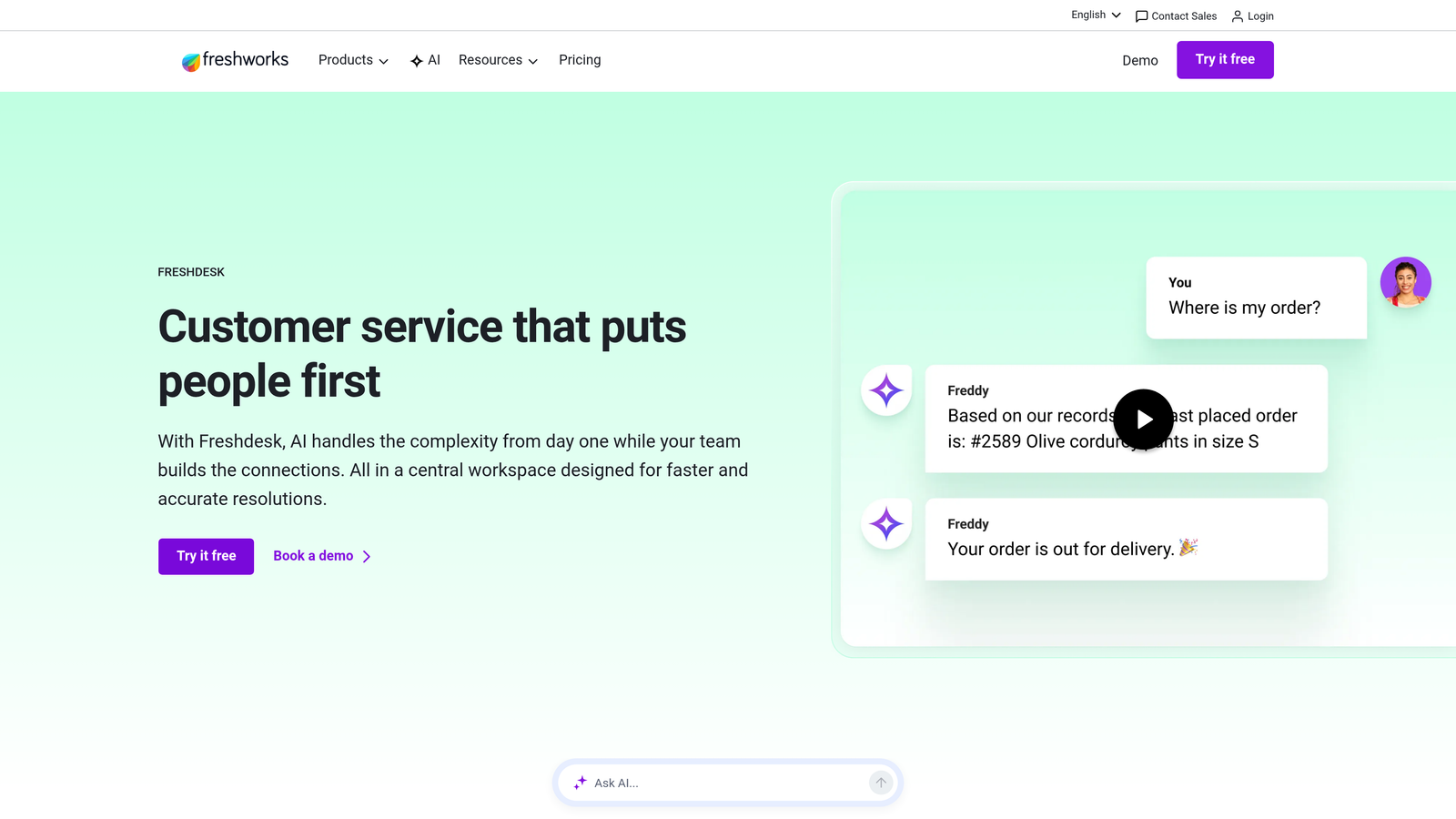
Freshdesk Freddy AI integrates AI automation directly into Freshdesk, offering prediction and suggestion capabilities for growing support teams.
Where This Tool Shines
Freddy AI's practical advantage lies in its predictive capabilities for routine ticket management. The system learns to predict ticket fields, priority levels, and appropriate assignments based on historical patterns, reducing the manual work agents spend on ticket triage.
Being part of the Freshworks unified suite creates value for companies using multiple Freshworks products. Context flows between Freshdesk, Freshsales, and other Freshworks tools without requiring custom integrations or middleware.
Key Features
Ticket Field Prediction: Automatically predicts and populates ticket categories, priorities, and custom fields based on content analysis.
Auto-Assignment: Routes tickets to the most appropriate agent based on skills, workload, and historical resolution patterns.
Canned Response Suggestions: Recommends relevant pre-written responses to agents based on ticket content and customer history.
Thank You Note Detection: Identifies and auto-closes tickets that are simple acknowledgments or thank you messages.
Freddy Self Service: Chatbot for knowledge base search and basic query resolution before tickets reach human agents.
Best For
Mid-market companies seeking AI features without paying separate add-on fees. Particularly valuable for teams already using or planning to adopt other Freshworks products for sales or marketing automation.
Pricing
AI features included in Pro plan at $49 per agent per month. No separate AI licensing required.
5. Ada
Best for: High-volume consumer support teams without technical resources for custom development
Ada provides a no-code AI automation platform designed specifically for consumer-facing brands handling thousands of routine inquiries.
Where This Tool Shines
Ada's visual automation builder allows non-technical team members to create sophisticated conversation flows without writing code. Marketing and support managers can design, test, and deploy AI interactions independently, reducing dependency on engineering resources.
The platform's proactive messaging capabilities enable brands to reach customers before problems escalate. Ada can trigger contextual messages based on user behavior, purchase history, or support patterns, preventing tickets before they're created.
Key Features
Visual No-Code Builder: Drag-and-drop interface for creating conversation flows, decision trees, and automation rules without programming.
Multi-Channel Deployment: Deploy the same AI automation across web, mobile apps, SMS, and social media platforms.
Personalization Engine: Customizes responses based on customer data, purchase history, and previous interaction context.
Proactive Messaging: Triggers contextual support messages based on user behavior patterns or business rules.
Enterprise Security Compliance: Meets SOC 2, GDPR, and HIPAA requirements for regulated industries.
Best For
Consumer brands with high support volumes and repetitive queries. Works particularly well for e-commerce, financial services, and telecommunications companies where most inquiries follow predictable patterns.
Pricing
Custom pricing based on conversation volume and deployment channels. Enterprise features require annual contracts.
6. Kustomer
Best for: Teams needing unified customer views with CRM functionality built in
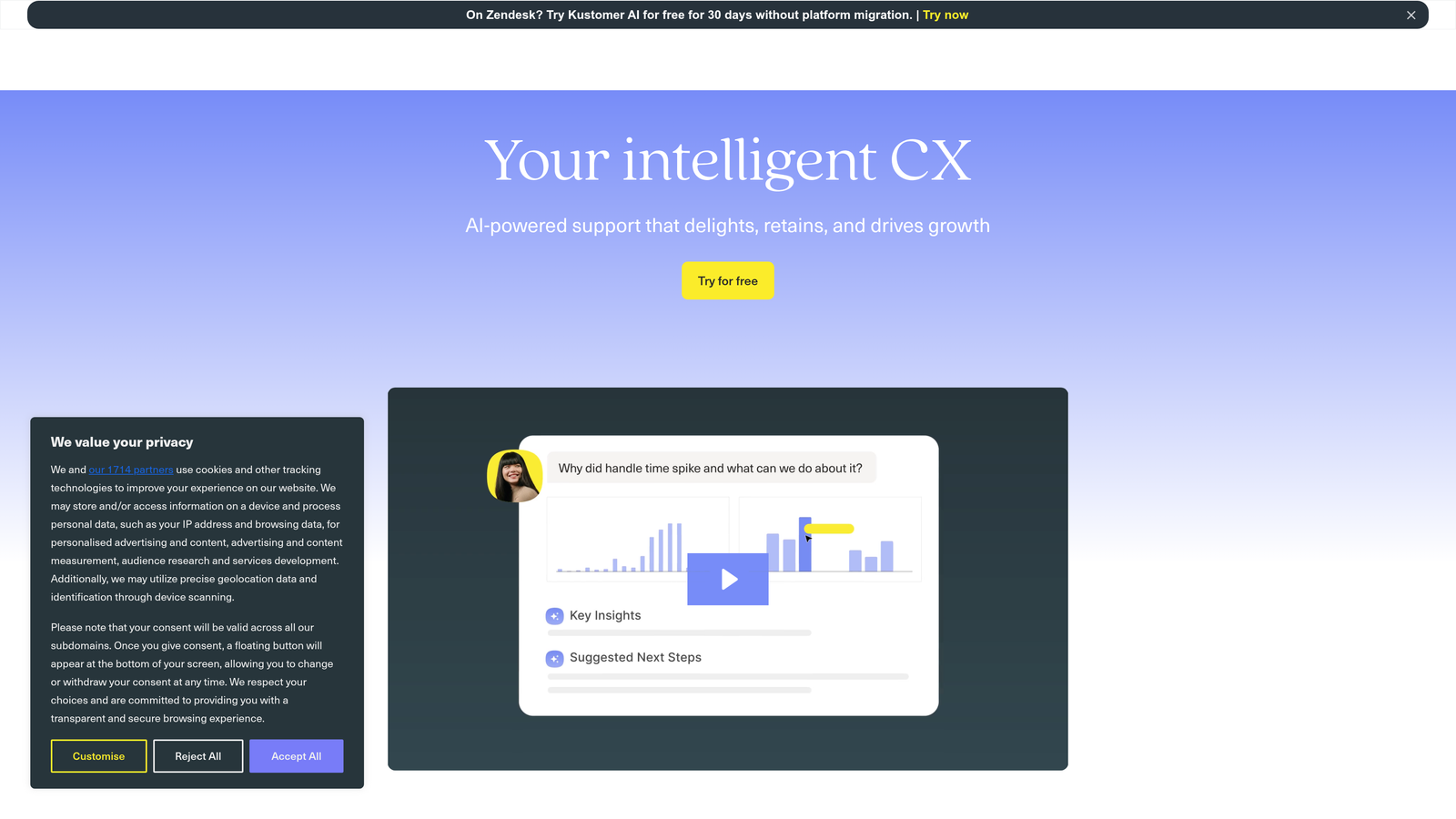
Kustomer combines CRM-first customer service with AI capabilities, providing complete customer timeline views alongside support automation.
Where This Tool Shines
Kustomer's timeline view gives agents complete customer context in a single interface. Every interaction, purchase, support ticket, and custom event appears chronologically, eliminating the need to switch between systems or ask customers to repeat information.
The platform's AI focuses on classification and routing rather than full automation. This approach works well for teams handling complex, high-value customer relationships where context matters more than speed.
Key Features
Complete Customer Timeline: Unified view of all customer interactions, purchases, and support history in chronological order.
AI Conversation Classification: Automatically categorizes and tags conversations based on content, sentiment, and customer intent.
Omnichannel Management: Handle email, chat, social media, SMS, and voice from a single agent interface.
Native CRM Functionality: Built-in customer relationship management without requiring separate CRM integration.
Workflow Automation Engine: Create custom workflows that trigger actions based on customer data, conversation content, or business rules.
Best For
B2B companies with complex customer relationships requiring deep context for every interaction. Particularly valuable for subscription businesses, financial services, or healthcare where customer history significantly impacts support quality.
Pricing
Enterprise plan at $89 per user per month. Custom pricing available for larger deployments with advanced requirements.
7. Forethought
Best for: Teams wanting to add AI to existing helpdesks without platform migration
Forethought functions as an AI layer that works alongside Zendesk, Salesforce, and Freshdesk to automate triage and generate responses.
Where This Tool Shines
Forethought's platform-agnostic approach solves a real problem for enterprises locked into existing helpdesk contracts. Rather than forcing a platform migration, it adds AI capabilities to whatever system you're already using.
The knowledge gap detection feature provides strategic value beyond ticket resolution. Forethought identifies topics where customers frequently need help but documentation doesn't exist, giving content teams clear priorities for knowledge base expansion.
Key Features
SupportGPT: Generative AI that drafts responses based on knowledge base content and previous successful resolutions.
Intelligent Triage and Routing: Analyzes incoming tickets and routes to appropriate teams or suggests self-service resources.
Multi-Platform Compatibility: Works with Zendesk, Salesforce Service Cloud, Freshdesk, and other major helpdesk platforms.
Knowledge Gap Detection: Identifies common customer questions lacking adequate documentation or self-service resources.
Agent Assist: Provides real-time suggestions to agents while they work, including relevant articles and response templates.
Best For
Enterprise teams with significant investment in existing helpdesk platforms who want AI capabilities without switching systems. Works well for organizations with long-term contracts or complex customizations that make migration impractical.
Pricing
Custom pricing based on ticket volume and platform integration complexity. Typically structured as annual contracts for enterprise deployments.
8. Tidio
Best for: Small businesses and startups needing affordable live chat with basic AI
Tidio combines live chat and AI chatbot functionality in an affordable package designed for small teams and e-commerce sites.
Where This Tool Shines
Tidio's free tier provides genuine value for bootstrapped startups. You get functional live chat and basic chatbot capabilities without paying anything, making it accessible for teams testing customer support approaches before committing to paid tools.
The visual chatbot builder strikes a balance between simplicity and capability. Non-technical users can create basic conversation flows in minutes, while more advanced users can build sophisticated automations without writing code.
Key Features
Combined Live Chat and AI: Switch seamlessly between automated bot responses and live agent conversations within the same interface.
Visual Chatbot Builder: Create conversation flows and automation rules using a drag-and-drop interface without coding.
E-commerce Platform Integration: Native integrations with Shopify, WordPress, and WooCommerce for product recommendations and order tracking.
Visitor Tracking: See which pages visitors are browsing and trigger proactive chat based on behavior patterns.
Email Marketing Integration: Capture leads from chat conversations and sync to email marketing campaigns.
Best For
Small e-commerce businesses, solo founders, and early-stage startups with limited budgets. Works particularly well for teams that need basic automation and live chat but aren't ready for enterprise-grade AI platforms.
Pricing
Free tier available with basic features. Paid plans start at $29 per month for additional chatbot conversations and advanced features.
9. Help Scout
Best for: Teams prioritizing human-AI collaboration over full automation
Help Scout takes a human-centric approach to support, using AI to enhance agent capabilities rather than replace human interaction.
Where This Tool Shines
Help Scout's philosophy centers on AI as an assistant, not a replacement. The AI Drafts feature generates response suggestions that agents can edit and personalize, maintaining the human touch while reducing response time.
The shared inbox collaboration model works exceptionally well for small to mid-sized teams. Multiple agents can work from the same queue with collision detection, @mentions, and private notes, creating a collaborative environment that feels more like email than a traditional ticketing system.
Key Features
AI Drafts: Generates initial response drafts based on knowledge base content that agents can customize before sending.
AI Summarize: Creates concise summaries of long conversation threads so agents can quickly understand context.
Shared Inbox Collaboration: Multiple agents work from unified queues with collision detection and internal communication tools.
Beacon Embedded Widget: Provides contextual help and knowledge base search directly within your product interface.
Docs Knowledge Base: Built-in documentation platform with search, categories, and analytics on article effectiveness.
Best For
Small to mid-sized B2B teams that value personal customer relationships and want AI to support rather than replace their agents. Particularly suitable for companies with complex products where human expertise adds significant value to support interactions.
Pricing
Standard plan at $20 per user per month. AI features available in Plus plan at $40 per user per month.
Making the Right Choice
The right AI support software depends on what you're actually trying to solve. If autonomous resolution is your priority and you need AI that genuinely learns from every interaction, Halo AI and Ada lead the pack with fundamentally different approaches—Halo for B2B complexity and continuous learning, Ada for high-volume consumer scenarios.
Already locked into a major helpdesk platform? Intercom Fin, Zendesk AI, and Freshdesk Freddy AI enhance existing systems without requiring migration. Forethought offers similar capabilities if you need platform flexibility across multiple helpdesk systems.
Budget-conscious teams face a clear decision point. Tidio provides genuine functionality at startup-friendly prices, while Help Scout offers more sophistication at mid-market pricing. Both prioritize simplicity over enterprise features.
For teams managing complex B2B relationships, context matters more than automation speed. Kustomer's CRM-first approach and Halo's page-aware capabilities provide the depth needed for high-value customer interactions where generic responses fall short.
The real differentiator isn't the AI technology itself—most platforms use similar underlying models. What separates leaders from followers is how deeply the AI integrates with your business stack, whether it learns from interactions to improve over time, and how much context it can access when resolving customer issues.
Your support team shouldn't scale linearly with your customer base. Let AI agents handle routine tickets, guide users through your product, and surface business intelligence while your team focuses on complex issues that need a human touch. See Halo in action and discover how continuous learning transforms every interaction into smarter, faster support.