9 Best AI Support Software Tools: Real Cost Breakdown for 2026
This guide delivers a transparent AI support software cost breakdown across nine leading platforms, analyzing pricing models, tier inclusions, overage charges, and integration costs. Whether you're evaluating your first AI support tool or reconsidering your current stack, you'll find a clear picture of true total cost of ownership to make a confident, informed decision.
 Matt PattoliFounder13 min read
AI customer support software promises to cut costs and scale your team without hiring linearly. But the pricing pages rarely tell the full story. Per-seat fees, resolution-based billing, overage charges, and integration costs can make your actual spend very different from the headline number.
This breakdown covers nine leading AI support platforms with transparent pricing analysis, so you can compare true total cost of ownership rather than just the starting price. Whether you're evaluating your first AI support tool or reconsidering your current stack, each platform is assessed on pricing model, what's included at each tier, scalability costs, and who gets the best value.
1. Halo AI
Best for: B2B SaaS teams that want AI-first support without bolting AI onto a legacy helpdesk.
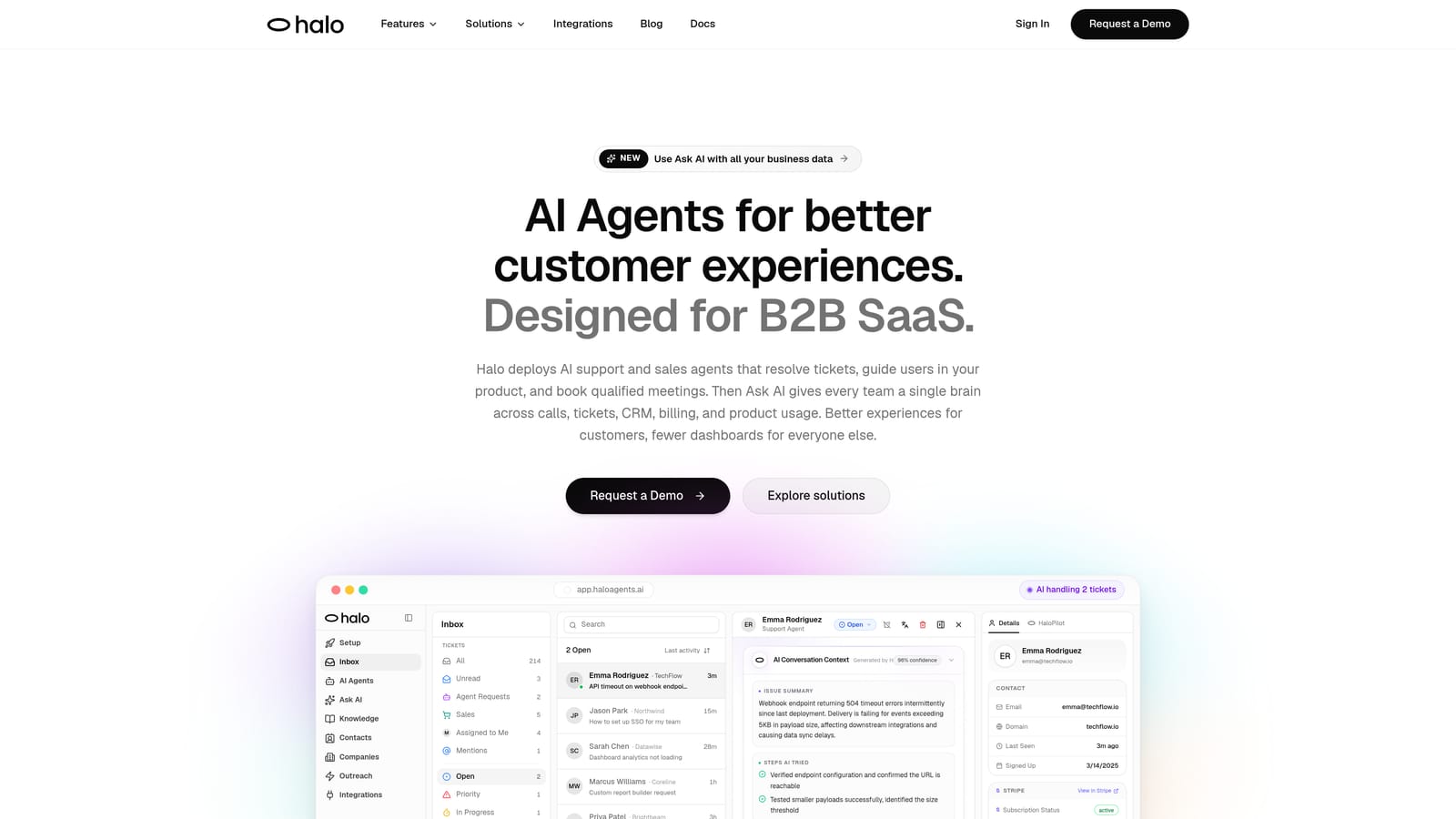
Halo AI is an AI-first customer support platform built specifically for B2B SaaS teams, deploying intelligent agents that resolve tickets, guide users through your product, and surface business intelligence from every interaction.
Where This Tool Shines
Unlike most tools on this list, Halo wasn't built as a traditional helpdesk with AI layered on afterward. The architecture is AI-first from the ground up, which means continuous learning is baked into every interaction rather than added as a feature. Each resolved ticket, handoff, and conversation makes the system smarter over time.
The page-aware chat widget is a genuine differentiator: the AI sees exactly what a user is looking at in your product and delivers contextual guidance based on that view. Combined with auto bug ticket creation routed to Linear and business intelligence signals like churn risk and revenue anomalies, Halo does work that typically requires multiple separate tools.
Key Features
Autonomous Ticket Resolution: AI agents handle support tickets end-to-end with continuous learning from every interaction, improving accuracy over time without manual retraining.
Page-Aware Chat Widget: The AI understands which page a user is on and what they're seeing, enabling contextual guidance that generic chatbots can't provide.
Smart Inbox with Business Intelligence: Surfaces churn signals, customer health scores, revenue anomalies, and other insights beyond standard support metrics.
Auto Bug Ticket Creation: Automatically generates and routes bug reports to Linear or your engineering stack when user-reported issues are detected.
Live Agent Handoff and Integrations: Seamlessly escalates complex issues to human agents and connects with Slack, HubSpot, Stripe, Zoom, Intercom, PandaDoc, and Fathom.
Best For
B2B SaaS product and support teams that want AI doing real work across the entire support lifecycle, not just answering FAQs. Particularly valuable for teams that need support intelligence to feed into product development, customer success, and revenue operations.
Pricing
Pricing varies by team size and usage. Contact haloagents.ai directly for current rates. As an AI-first platform with deep integrations, total cost of ownership should be evaluated against the tools it can replace.
2. Zendesk AI
Best for: Established support teams already on Zendesk who want to layer in AI capabilities.
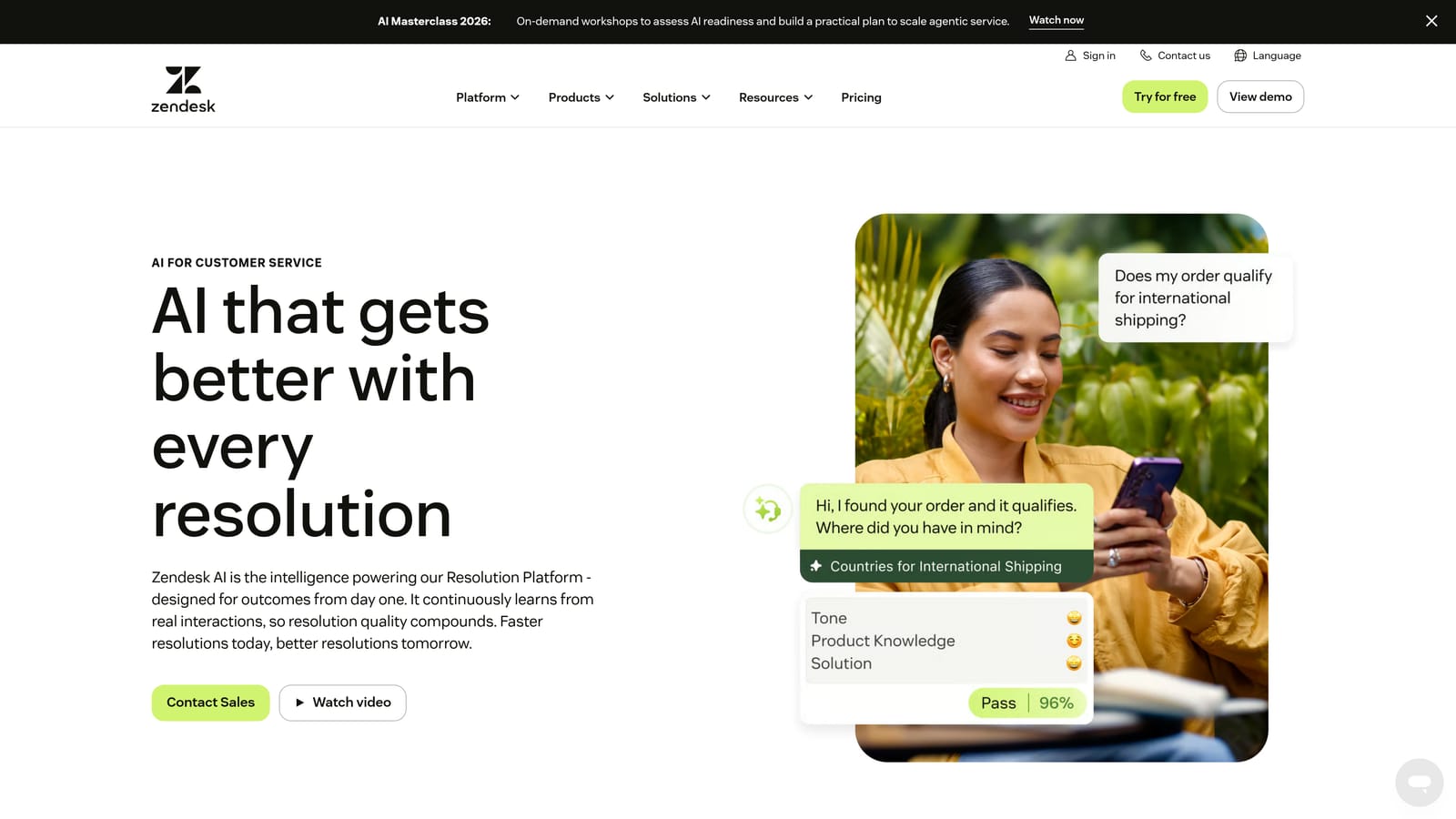
Zendesk AI adds AI agents, intelligent triage, and agent copilot features on top of Zendesk's mature helpdesk platform, making it a natural upgrade path for existing customers.
Where This Tool Shines
Zendesk's AI capabilities benefit from the platform's deep ecosystem: thousands of integrations, a mature knowledge base, and established workflows that many enterprise support teams have built over years. If you're already running Zendesk, the path to AI-assisted support is relatively straightforward.
The Agent Copilot feature is genuinely useful for teams handling complex tickets, offering suggested replies, conversation summaries, and generative AI for knowledge base content creation. Where Zendesk's AI approach becomes complicated is the cost structure.
Key Features
AI Agents: Automated ticket resolution across channels using your knowledge base and content.
Intelligent Triage: Routes tickets based on intent, sentiment, and predicted priority without manual rules.
Agent Copilot: Provides suggested replies, conversation summaries, and drafting assistance for human agents.
Generative AI for Knowledge Base: Assists with creating and updating help articles at scale.
Advanced AI Add-On: Available for Suite Professional and above, unlocking deeper automation and analytics capabilities.
Best For
Mid-market and enterprise teams already invested in the Zendesk ecosystem. Less compelling for teams starting fresh, where the base platform cost plus the AI add-on can add up quickly compared to newer AI-native alternatives.
Pricing
Suite plans run approximately $55 to $115 per agent per month. The Advanced AI add-on is priced separately on top of that. For a 20-agent team, total costs can be substantially higher than the base seat price suggests. Verify current rates at zendesk.com.
3. Intercom Fin AI
Best for: Teams that want resolution-based pricing and are confident in their deflection rates.
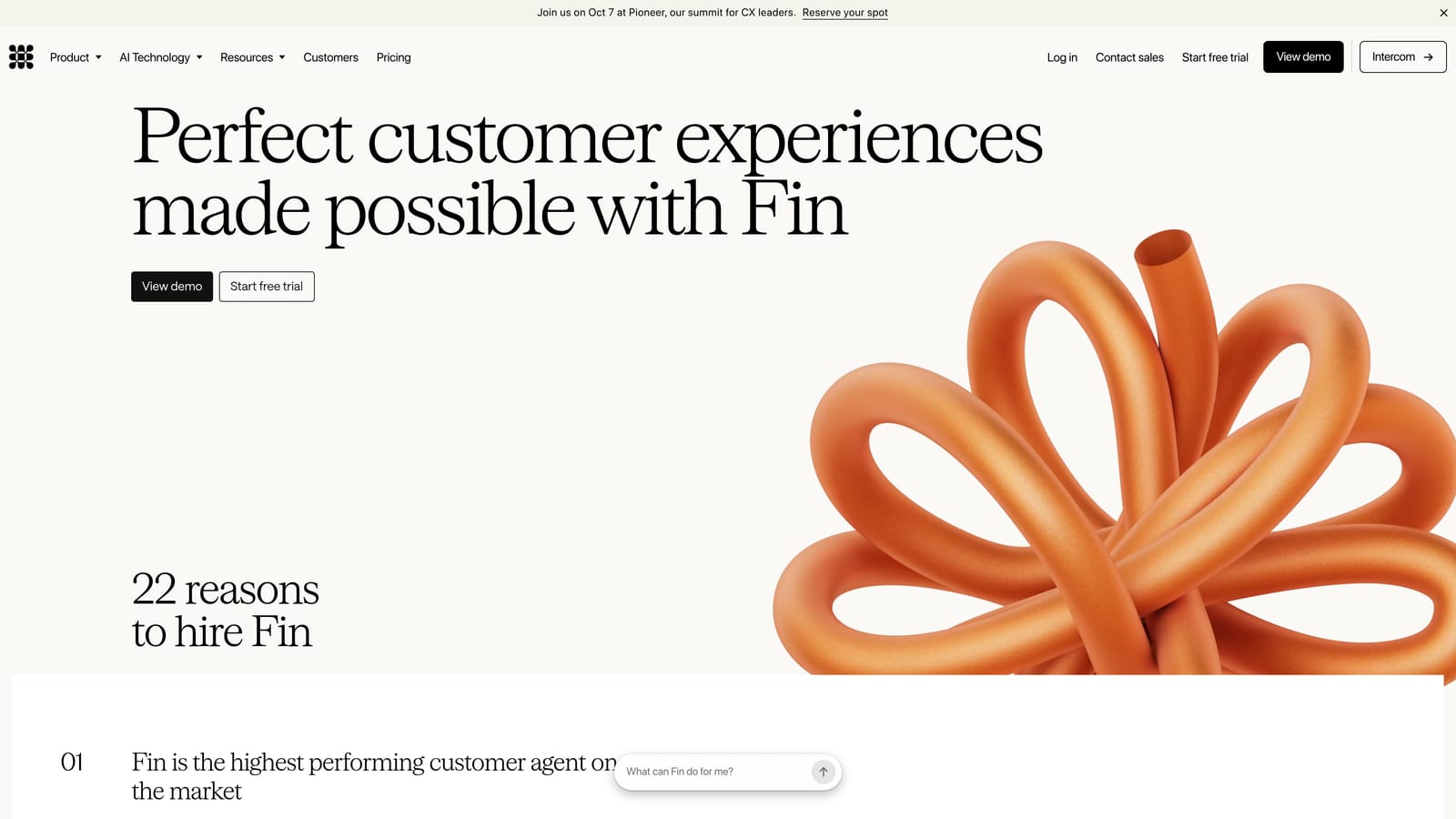
Intercom Fin is Intercom's AI agent that handles support conversations autonomously using your knowledge base, with a per-resolution pricing model that aligns cost directly with AI performance.
Where This Tool Shines
The resolution-based pricing model is conceptually elegant: you pay when the AI successfully resolves a conversation, not just when it tries. This creates a natural incentive for the vendor to improve AI quality. For teams with high deflection rates and predictable volume, it can be very cost-effective.
Fin pulls answers from multiple knowledge sources including docs, URLs, and PDFs, and hands off seamlessly to human agents when it can't resolve. The customizable AI persona means it can match your brand's tone across channels.
Key Features
Resolution-Based Pricing: Charges apply per successfully resolved conversation rather than per seat or per message.
Multi-Source Knowledge: Answers questions using your documentation, website URLs, and uploaded PDFs.
Seamless Human Handoff: Escalates to live agents when AI confidence is low or the issue is too complex.
Omnichannel Deployment: Works across chat, email, and messaging channels from a single configuration.
Customizable AI Persona: Adjustable tone and personality to match your brand voice.
Best For
Teams with consistent, high-volume support where AI deflection rates are predictable. The model becomes expensive if resolution rates are low or if volume spikes unexpectedly, so it suits teams with stable, well-documented support scenarios.
Pricing
Fin AI Agent is approximately $0.99 per resolution, though this varies by plan and contract. The Intercom base platform is priced separately per seat. Total cost depends heavily on your resolution volume and deflection rate. Verify current rates at intercom.com.
4. Freshdesk Freddy AI
Best for: Growing teams that want modular AI capabilities without committing to enterprise pricing.
Freshdesk Freddy AI is Freshworks' modular AI layer for Freshdesk, offering autonomous agents, agent copilot features, and analytics across support tiers with a pay-for-what-you-use structure.
Where This Tool Shines
Freshdesk's tiered approach means you can start with basic AI-assisted features and add capabilities as your team grows. The modular structure also helps with budget predictability: you're not paying for AI features you haven't deployed yet. Freddy AI Copilot in particular gets solid reviews for agent productivity, handling summaries and suggested replies without requiring significant setup.
For teams evaluating AI support for the first time, Freshdesk offers a lower-risk entry point than enterprise platforms. The base helpdesk plans are affordable, and the AI add-ons are clearly scoped.
Key Features
Freddy AI Agent: Autonomous ticket resolution and chat deflection using your knowledge base.
Freddy AI Copilot: Agent assist features including conversation summaries, suggested replies, and drafting help.
Freddy Insights: AI-powered analytics and performance reporting across your support operation.
Modular Add-On Structure: Purchase AI capabilities individually rather than as a bundled tier.
Cross-Plan Availability: AI features available across Growth, Pro, and Enterprise plans at different capability levels.
Best For
SMB to mid-market teams that want a proven helpdesk with AI capabilities they can activate incrementally. Good fit for teams not yet ready to commit to a fully AI-native platform.
Pricing
Freshdesk plans run approximately $15 to $79 per agent per month. Freddy AI Copilot is available as an add-on at approximately $29 per agent per month. Verify current rates at freshworks.com.
5. Salesforce Service Cloud Einstein
Best for: Enterprise teams already in the Salesforce ecosystem that need deep CRM integration with support AI.
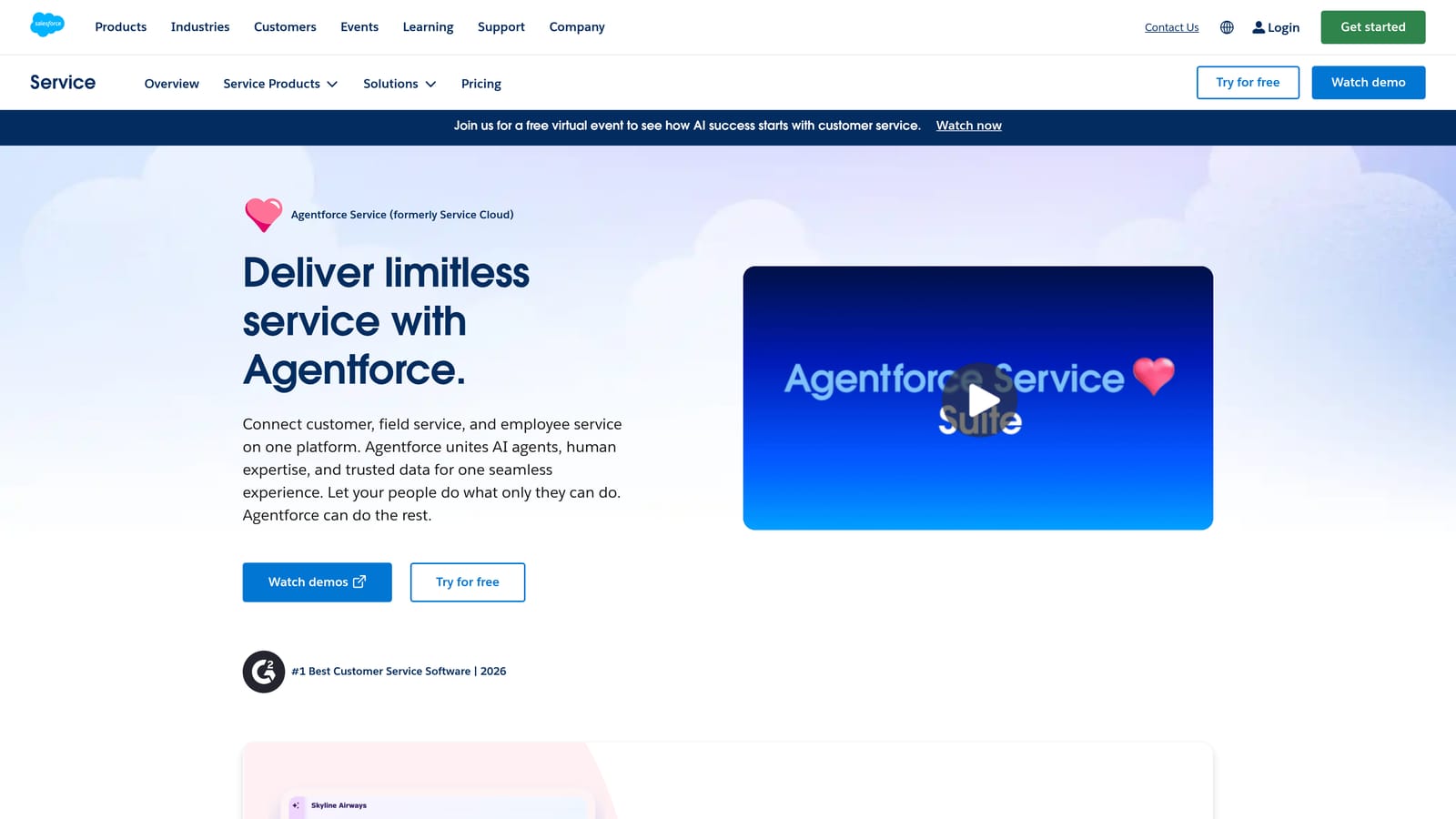
Salesforce Service Cloud Einstein delivers enterprise-grade AI for customer service with Einstein Bots, case classification, and generative AI built into the Salesforce platform.
Where This Tool Shines
If your organization runs Salesforce as its CRM, Service Cloud Einstein offers something other tools can't match: every support interaction is enriched with full CRM context. Agents see account history, deal stage, product usage, and prior cases in a unified workspace. For complex B2B support where customer context matters enormously, this integration is genuinely powerful.
The AI capabilities themselves, including Einstein Copilot for guided agent actions and generative reply drafts, are mature and enterprise-tested. The challenge is that realizing this value requires significant Salesforce expertise and implementation investment.
Key Features
Einstein Bots: Automated self-service across channels with natural language understanding.
AI Case Classification: Automatically tags, routes, and populates case fields to reduce manual triage.
Generative AI for Agents: Reply drafts and knowledge article creation using conversation context.
Unified Agent Workspace: Full CRM data surfaced alongside every support case.
Einstein Copilot: Guided action recommendations for agents handling complex cases.
Best For
Enterprise organizations with existing Salesforce investments and dedicated Salesforce administrators. The platform is overkill for smaller teams and the implementation complexity makes it poorly suited for companies without Salesforce expertise on staff.
Pricing
Service Cloud plans run approximately $75 to $300 per user per month. Einstein AI features are included at higher tiers or available as add-ons, and annual contracts are standard. Implementation costs can be substantial. Verify current rates at salesforce.com.
6. Help Scout
Best for: Small to mid-sized teams that want AI features included in base pricing without separate add-ons.
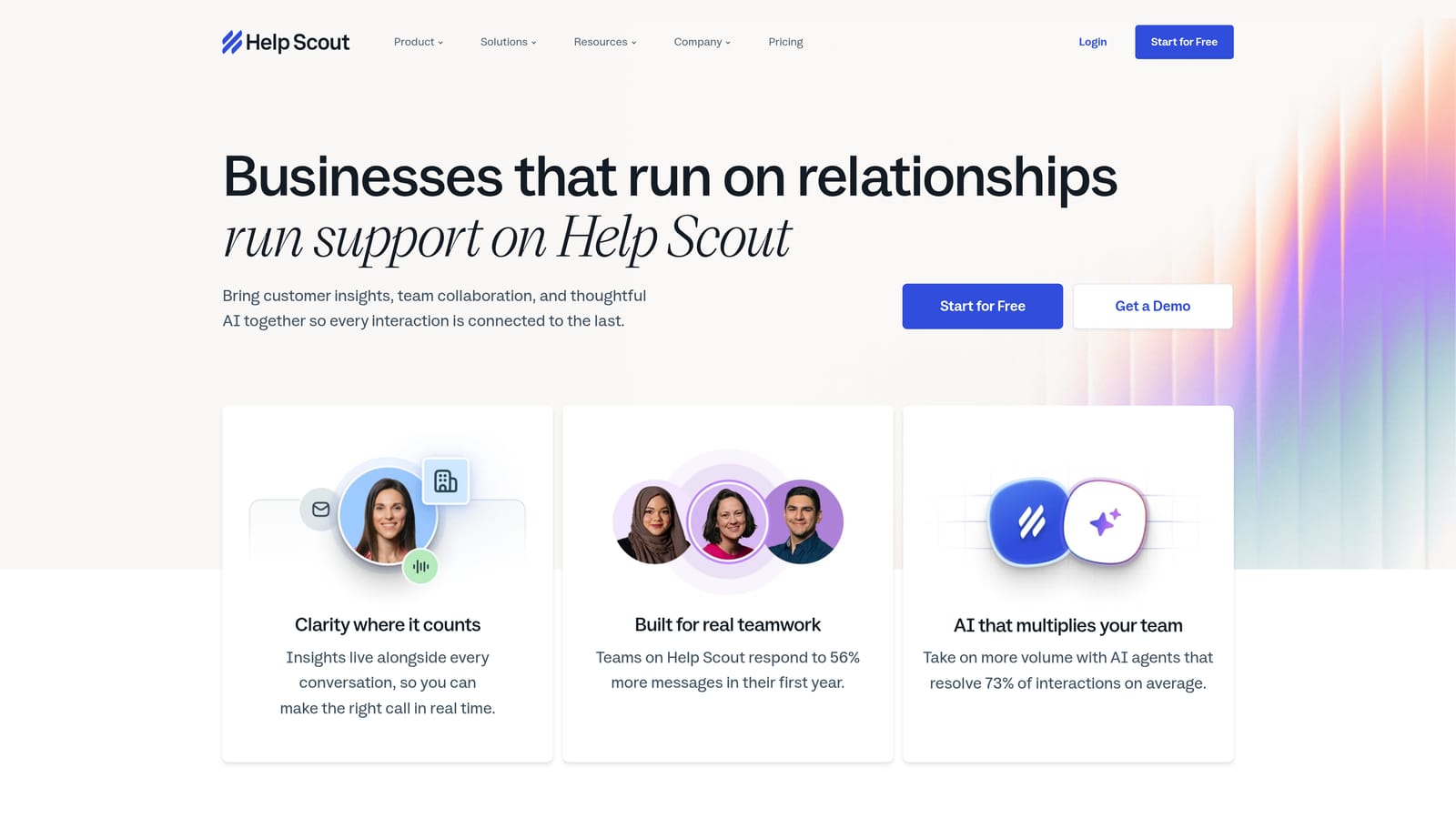
Help Scout is a simple, human-centered helpdesk with AI features built into standard plans, offering a refreshingly transparent pricing model compared to most competitors.
Where This Tool Shines
Help Scout's approach to AI pricing is worth calling out specifically: AI Summarize, AI Assist, and AI Answers are included in standard plans rather than gated behind a separate AI tier or add-on. For small teams watching their per-seat budget closely, this means you're not paying extra to access features that competitors charge significantly more for.
The tool itself is known for being genuinely easy to use. Onboarding is fast, the interface is clean, and the AI features are practical rather than flashy. AI Answers handles self-service using your Docs content, while AI Summarize gives agents instant context when picking up a conversation mid-thread.
Key Features
AI Answers: Automated self-service responses drawn from your Help Scout Docs knowledge base.
AI Summarize: Instant conversation summaries for agents picking up tickets in progress.
AI Assist: Reply drafting and tone adjustment to help agents respond faster and more consistently.
Included AI Pricing: No separate AI add-on required; features are part of standard plan tiers.
Simple Per-User Pricing: No per-resolution fees, no usage-based overages for AI features.
Best For
Small to mid-sized teams that value simplicity and predictable pricing. Less suited for teams that need advanced automation, complex workflows, or deep integrations with CRM and product tools.
Pricing
Plans run approximately $22 to $65 per user per month with AI features included at most tiers. Verify current rates at helpscout.com.
7. Tidio Lyro AI
Best for: SMBs and e-commerce teams that want conversation-based AI pricing with a free starting point.
Tidio Lyro AI is a conversation-based AI agent designed for smaller teams, with a generous free tier and volume-based pricing that scales predictably with usage.
Where This Tool Shines
Lyro's free tier is a genuine entry point, not a stripped-down demo. Teams can test AI-handled conversations before committing to paid plans, which makes the evaluation process low-risk. The conversation-based pricing model also means costs scale directly with usage rather than with headcount, which suits lean teams with variable support volumes.
Setup is notably fast: Lyro can be deployed using existing FAQ content without extensive training data preparation. For e-commerce and SMB teams that don't have a dedicated support operations function, this low-friction setup is a meaningful advantage.
Key Features
Lyro AI Agent: Handles conversations autonomously using FAQ and knowledge content with minimal setup.
Conversation-Based Pricing: Costs scale with monthly AI conversation volume rather than per seat.
Free Tier: Limited monthly AI conversations available at no cost for teams evaluating the tool.
Live Chat Fallback: Escalates to human agents when AI reaches its confidence limits.
Quick Deployment: No extensive training data or knowledge base migration required to get started.
Best For
SMBs, e-commerce teams, and early-stage companies with lower support volumes that want to test AI-assisted support before scaling. Less suited for complex B2B support scenarios requiring deep integrations or multi-step workflows.
Pricing
Free tier available with limited monthly conversations. Paid Lyro plans start at approximately $29 per month and scale by conversation volume. Verify current rates at tidio.com.
8. Kustomer
Best for: Mid-market to enterprise teams that want omnichannel CRM-based support with AI included in per-user pricing.
Kustomer is an omnichannel CRM-based support platform with AI capabilities bundled into per-user pricing, built around a unified customer timeline across all touchpoints.
Where This Tool Shines
Kustomer's unified customer timeline is its core differentiator: every interaction across chat, email, SMS, and social is consolidated into a single view per customer. AI-powered routing and deflection work with this full context, which means smarter triage than platforms that handle channels in isolation.
The fact that AI is included in platform pricing rather than charged separately simplifies cost forecasting. You're not calculating base plan plus AI add-on plus overage; the per-user price is the per-user price. For teams managing high volumes across multiple channels, this bundled approach can represent good value.
Key Features
Omnichannel AI Routing: AI-powered deflection and routing across chat, email, SMS, and social from a unified platform.
Unified Customer Timeline: Full interaction history across all channels consolidated per customer.
Bundled AI Pricing: AI capabilities included in platform pricing with no separate AI add-on fees.
Intelligent Agent Suggestions: Auto-responses and suggested replies for agents handling high volumes.
Workflow Automation: Complex, multi-step support process automation for teams with advanced routing needs.
Best For
Mid-market to enterprise teams handling high omnichannel support volumes who want CRM-style customer context without a full Salesforce implementation. The per-user price is higher than basic helpdesks, so it suits teams where the unified timeline genuinely changes how they work.
Pricing
Plans run approximately $89 to $139 per user per month with AI included. Verify current rates at kustomer.com.
9. Zoho Desk Zia AI
Best for: Budget-conscious teams, especially those already in the Zoho ecosystem, that want solid AI capabilities at the lowest per-seat price on this list.
Zoho Desk offers Zia AI from mid-tier plans onward, delivering sentiment analysis, intelligent routing, and response suggestions at a price point that undercuts most competitors.
Where This Tool Shines
Zoho's pricing is consistently the most affordable per seat among established helpdesk platforms. Zia AI includes practical features like sentiment analysis, automatic ticket tagging, anomaly detection, and response suggestions, which cover the core AI use cases most support teams actually need day-to-day.
For teams already using Zoho CRM, Zoho Analytics, or other Zoho products, the integration depth is a significant advantage. Data flows naturally across the ecosystem without custom connectors or additional integration costs, which helps keep total cost of ownership low.
Key Features
Zia Sentiment Analysis: Automatically detects customer sentiment in tickets to prioritize urgent or at-risk conversations.
Intelligent Ticket Tagging: Auto-tags and categorizes tickets to reduce manual triage work.
Anomaly Alerts: Flags unusual patterns in ticket volume or response times before they become problems.
AI Response Suggestions: Recommends replies and knowledge articles based on ticket content.
Zoho Ecosystem Integration: Deep native integration with Zoho CRM and the broader Zoho product suite.
Best For
Small to mid-market teams with tight budgets, especially those already using Zoho products. The AI capabilities are solid for the price, though teams with complex automation needs or enterprise-scale requirements may find the platform limiting.
Pricing
Plans run approximately $14 to $40 per agent per month. Zia AI is available from the Professional tier at approximately $23 per agent per month. Verify current rates at zoho.com.
Which Tool Is Right for Your Team?
The right AI support platform depends on your team size, existing stack, and how you expect to scale. Here's a quick orientation based on the most common scenarios.
For B2B SaaS teams that want AI doing real work: Halo AI is the standout choice for teams that need more than FAQ deflection. The page-aware context, continuous learning architecture, and business intelligence layer make it a genuine platform rather than a chatbot add-on. If your support operation needs to feed insights into product, customer success, and revenue teams, that's where Halo's depth shows.
For teams already on Zendesk or Freshdesk: Zendesk AI and Freshdesk Freddy AI offer the lowest-friction upgrade paths. Zendesk suits larger teams with existing investment; Freshdesk's modular pricing is better for teams that want to start small and add capabilities incrementally.
For enterprise teams in the Salesforce ecosystem: Service Cloud Einstein is the logical choice, but budget for significant implementation time and Salesforce expertise.
For small teams that want predictable, simple pricing: Help Scout includes AI in base plans without add-on complexity. Zoho Desk Zia offers the lowest per-seat cost for teams that want AI capabilities without the budget for premium platforms.
For SMBs and e-commerce with variable volumes: Tidio Lyro's conversation-based pricing and free tier make it the lowest-risk starting point.
One final note on total cost of ownership: the headline seat price is rarely the full picture. Factor in implementation costs, annual vs. monthly billing differences, AI add-on fees, overage charges for resolution-based models, and the cost of integrations. A platform that appears cheaper per seat can end up costing more once those layers are added.
Your support team shouldn't scale linearly with your customer base. Let AI agents handle routine tickets, guide users through your product, and surface business intelligence while your team focuses on complex issues that need a human touch. See Halo in action and discover how continuous learning transforms every interaction into smarter, faster support.