9 Best AI Support Software Tools Evaluated Against the Criteria That Actually Matter in 2026
This guide benchmarks nine leading AI support platforms against a modern set of AI support software evaluation criteria — including resolution quality, integration depth, autonomy versus control balance, and business intelligence depth — that go far beyond outdated metrics like ticket deflection rates. Whether you're choosing your first AI support layer or migrating off a legacy helpdesk, you'll find a rigorous framework and honest platform assessments to guide your decision.
 Grant CooperFounder14 min read
Choosing AI support software has never been harder, and not because options are scarce. The real challenge is that most evaluation frameworks are stuck in 2020. Ticket deflection rates and average response times are table stakes now. What separates genuinely transformative platforms from expensive chatbot wrappers are criteria like contextual awareness, continuous learning, business intelligence depth, and how gracefully the system hands off to humans when it should.
This guide evaluates nine leading AI support platforms against the criteria B2B product teams and support leaders actually care about: resolution quality, integration depth, autonomy versus control balance, and the ability to surface revenue and health signals rather than just deflecting tickets. Whether you're migrating off a legacy helpdesk, evaluating your first AI support layer, or benchmarking your current tool, this comparison gives you a structured framework alongside honest assessments of each platform.
The Evaluation Criteria That Actually Matter
Before diving into the tools, it's worth naming the framework explicitly. Most buyer guides compare pricing tiers and feature checklists. This one uses six criteria that reflect how AI support actually performs in production environments.
Resolution Quality: Does the AI autonomously resolve tickets, or does it deflect to a human after one exchange? True resolution rate is the metric that matters, not deflection rate.
Contextual Awareness: Can the platform see what page or product state the user is in? Page-aware context dramatically improves response relevance.
Continuous Learning: Does the system improve from resolved tickets and agent corrections, or is it static until manually retrained?
Integration Depth: Does the platform connect to the full business stack, including CRM, billing, project management, and communication tools, or only the helpdesk?
Escalation Design: How gracefully does the AI hand off to human agents? Does it preserve full context during that handoff?
Business Intelligence Output: Does the platform surface insights beyond support metrics, such as customer health signals, product friction patterns, and revenue risk indicators?
With that framework established, here are the top AI support platforms evaluated against each dimension.
1. Halo AI
Best for: B2B SaaS product teams wanting an AI-first support platform with deep business intelligence
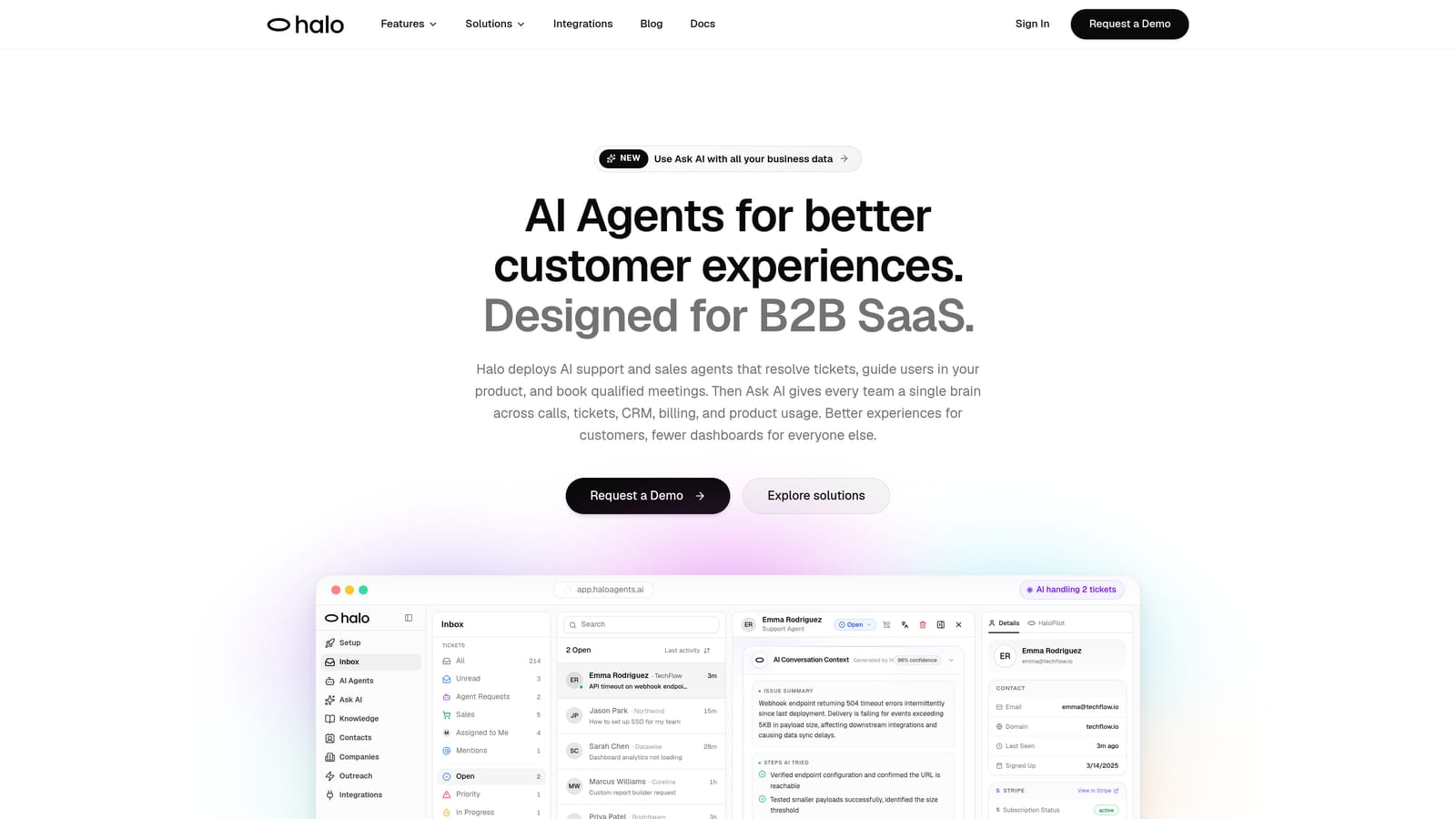
Halo AI is an AI-first customer support platform built specifically for B2B SaaS teams, deploying intelligent agents that resolve tickets autonomously, guide users through your product with page-aware visual context, and surface business intelligence signals that go well beyond support metrics.
Where This Tool Shines
Halo's most distinctive capability is its page-aware chat widget. Unlike conventional support tools that respond to what a user types, Halo's agents can see what the user actually sees on screen, giving responses a level of contextual precision that generic chatbots cannot match. If a user is stuck on your billing settings page versus your onboarding flow, Halo knows the difference and responds accordingly.
The platform's continuous learning loop is also worth noting. Every resolved ticket and every human agent correction feeds back into the system, meaning Halo gets meaningfully smarter over time rather than remaining static between manual retraining cycles. For growing B2B SaaS teams, this compounds quickly.
Key Features
Page-Aware Chat Widget: Sees what users see in real time, enabling highly contextual responses tied to specific product states and pages.
Continuous Learning Loop: AI improves from every resolved ticket and agent correction, reducing manual retraining overhead.
Smart Inbox with Business Intelligence: Surfaces customer health signals, revenue indicators, and anomaly detection alongside standard support metrics.
Auto Bug Ticket Creation: Automatically generates and routes bug reports to Linear or your preferred project management tool without agent intervention.
Live Agent Handoff with Context Preservation: Escalates to human agents with full conversation and context intact, so agents never start from scratch.
Deep Integration Stack: Connects to Linear, Slack, HubSpot, Intercom, Stripe, Zoom, PandaDoc, and Fathom, covering the full B2B SaaS toolchain.
Best For
B2B SaaS product and support teams that want AI to do more than deflect tickets. Halo is particularly well-suited to teams where support data should be informing product decisions, customer success strategy, and revenue health monitoring, not just closing tickets.
Pricing
Contact for pricing. A demo is available at haloagents.ai. Custom pricing reflects deployment scope and integration requirements.
2. Intercom Fin
Best for: Teams already on Intercom who want AI without switching platforms
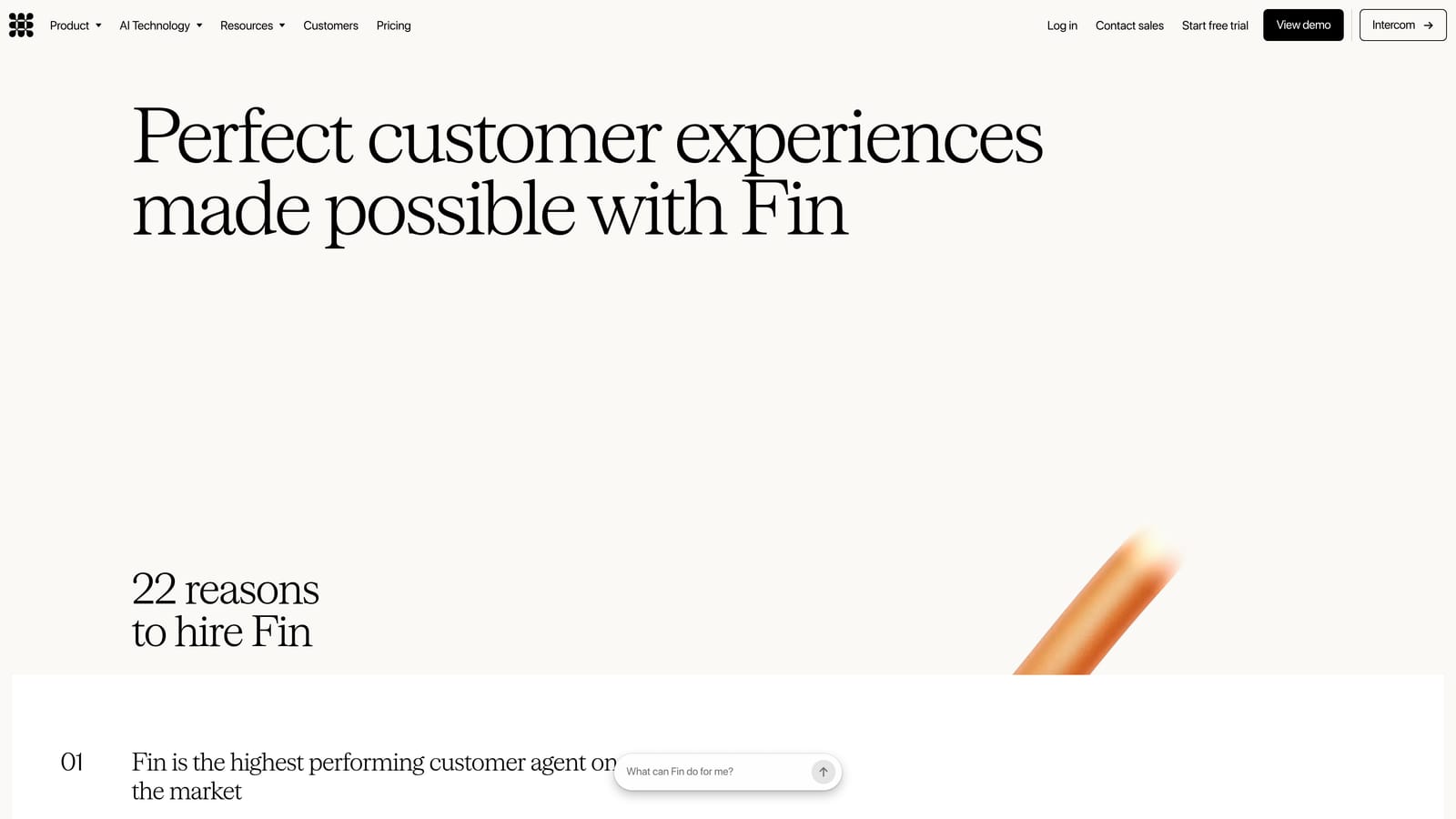
Intercom Fin is Intercom's native AI agent product, built directly into the Intercom platform for teams that want conversational AI without leaving their existing workflow.
Where This Tool Shines
Fin's biggest advantage is its native integration with the Intercom ecosystem. If your team already lives in Intercom's inbox, there's no migration friction, no parallel deployment, and no context-switching between platforms. Fin handles conversations within the same thread your human agents use, which makes escalation feel seamless rather than jarring.
Fin is also trained on your existing help content and conversation history, which gives it a reasonable starting point without extensive custom training. For teams with mature Intercom setups, this translates to faster time-to-value.
Key Features
Conversational AI on Existing Content: Trained on your help center articles and historical conversation data for relevant responses from day one.
In-Thread Escalation: Hands off to human agents within the same Intercom conversation thread, preserving continuity for the customer.
Multilingual Support: Handles conversations across major languages without separate configuration.
AI Resolution Analytics: Provides data on resolution rates, handoff patterns, and AI performance within Intercom's reporting interface.
Native Workflow Integration: Works within existing Intercom inbox, ticketing, and automation workflows without separate deployment.
Best For
Teams with existing Intercom infrastructure who want to add AI resolution capabilities without platform migration. Less compelling for teams not already on Intercom, since much of Fin's value is tied to the broader platform.
Pricing
Included in Intercom plans; Fin AI add-on pricing varies by resolution volume. Contact Intercom for current rates tied to your plan tier.
3. Zendesk AI
Best for: Enterprise teams with significant existing Zendesk infrastructure
Zendesk AI embeds AI capabilities across the Zendesk Suite, including intelligent triage, agent copilot suggestions, and self-service automation designed for large enterprise support operations.
Where This Tool Shines
Zendesk AI is most valuable as an enhancement layer for organizations already deeply invested in the Zendesk ecosystem. The AI-powered triage and routing capabilities are mature, and the agent copilot features, particularly suggested replies and next-best-action recommendations, can meaningfully reduce handle time for high-volume teams.
The AI summarization feature deserves specific mention: for organizations dealing with long, complex ticket threads, having AI condense conversation history before an agent engages is a practical time-saver that doesn't require rethinking existing workflows.
Key Features
Intelligent Ticket Triage: AI-powered classification and routing reduces manual queue management and misdirected tickets.
Agent Copilot: Surfaces suggested replies and next-best-action recommendations in the agent's working view.
Self-Service Automation: AI-powered bots handle common queries without agent involvement.
Ticket Thread Summarization: Condenses long conversation history so agents can get context quickly without reading full threads.
Suite-Native Deployment: No separate implementation required for teams already on Zendesk Suite.
Best For
Enterprise support organizations with established Zendesk deployments looking to add AI augmentation without platform migration. Teams evaluating AI-first alternatives should review the tradeoffs between Zendesk's augmentative approach and autonomous-first platforms.
Pricing
AI features are available on Zendesk Suite plans; an Advanced AI add-on is available at additional cost. Contact Zendesk for current pricing tied to your seat count and plan.
4. Freshdesk Freddy AI
Best for: SMB teams wanting accessible AI support without enterprise-level investment
Freshdesk Freddy AI is Freshworks' AI layer across Freshdesk, spanning customer self-service, agent assistance, and analytics under a unified product umbrella.
Where This Tool Shines
Freddy AI's strongest suit is accessibility. The pricing tiers make AI-powered support achievable for SMB teams that can't justify enterprise platform costs, and the three-part structure (Self Service, Copilot, and Insights) gives teams a clear progression path as their needs grow.
Freddy Copilot's in-context response drafting is genuinely useful for smaller teams where agents handle a wide variety of queries. Having AI surface relevant context and draft responses reduces the cognitive load on generalist agents who aren't subject matter experts in every area they cover.
Key Features
Freddy Self Service: Customer-facing automation that resolves common queries without agent involvement.
Freddy Copilot: In-context agent assistance with response drafting and knowledge surfacing.
Freddy Insights: Analytics layer covering support trends, volume patterns, and team performance.
Pre-Built Bot Templates: Ready-made conversation flows for common support scenarios to accelerate deployment.
Tiered Pricing Structure: Multiple plan levels make AI features accessible at SMB budgets.
Best For
SMB teams on Freshdesk looking to add AI capabilities without switching platforms. Value is tightly coupled to the Freshdesk ecosystem, so teams considering a platform change should factor that dependency into their evaluation.
Pricing
Freddy AI features are included in select Freshdesk plans; Copilot is available as an add-on. Check Freshworks' current pricing page for up-to-date tier details.
5. Forethought
Best for: Support operations teams focused on optimizing triage, routing, and agent workflow efficiency
Forethought is an AI platform focused on intelligent triage, routing, and agent augmentation, designed to optimize the full support workflow from intake to resolution.
Where This Tool Shines
Forethought takes a workflow-optimization approach rather than an autonomous-resolution-first approach. Its Triage product handles intelligent classification and routing with notable precision, reducing the noise that typically slows high-volume support teams. For organizations where getting tickets to the right queue quickly is a major operational bottleneck, Forethought addresses that problem directly.
The Assist product surfaces relevant knowledge in real time as agents work through tickets, which reduces time spent searching and improves response consistency across the team. It's an agent-augmentation tool at its core, and it does that job well.
Key Features
Solve: AI-powered self-service that resolves common tickets without agent involvement.
Assist: Agent copilot that surfaces relevant knowledge articles and context in real time during ticket handling.
Triage: Intelligent classification and routing to the right team, queue, or priority level based on ticket content.
Multi-Helpdesk Integration: Connects with Zendesk, Salesforce Service Cloud, ServiceNow, and other major platforms.
AI Performance Analytics: Tracks AI impact on resolution rates and agent productivity across the workflow.
Best For
Mid-market and enterprise support operations teams where triage accuracy and agent efficiency are primary pain points. Works best as a layer on top of an existing helpdesk rather than as a standalone platform.
Pricing
Custom pricing. Contact Forethought directly for a quote based on your volume and integration requirements.
6. Ada
Best for: Enterprise teams needing highly customizable AI agents with strong governance controls
Ada is an enterprise-grade AI agent platform with no-code conversation design, strong governance controls, and multilingual capabilities built for large-scale support automation.
Where This Tool Shines
Ada's no-code conversation builder gives non-technical teams meaningful control over how AI agents behave without requiring engineering involvement for every change. For enterprises where brand consistency and compliance matter, the ability to design, test, and approve conversation flows visually is a significant operational advantage.
The governance layer is genuinely differentiated at the enterprise level. Content controls, approval workflows, and audit trails give compliance and legal teams the visibility they need before AI responses go live, which is often a hard requirement in regulated industries or large organizations with strict brand standards.
Key Features
No-Code Agent Builder: Visual conversation flow design that non-technical teams can manage independently.
Enterprise Governance: Content controls, approval workflows, and audit trails for compliance and brand safety.
Multilingual Support: Handles conversations across dozens of languages without separate configuration per region.
Cross-Platform Integration: Connects with CRM, helpdesk, and e-commerce platforms across the enterprise stack.
Extended Use Cases: Positions beyond pure support into sales assistance and customer onboarding flows.
Best For
Large enterprises with complex governance requirements, multi-region deployments, or brand interaction needs that extend beyond traditional support into sales and onboarding. Less suited to lean B2B SaaS teams that prioritize speed of deployment over governance depth.
Pricing
Enterprise pricing. Contact Ada for a custom quote based on deployment scope and volume.
7. Tidio Lyro
Best for: Small teams and e-commerce businesses wanting fast AI deployment at accessible pricing
Tidio Lyro is Tidio's AI conversational agent built for SMBs and e-commerce teams, offering fast deployment with pre-trained models and built-in live chat fallback.
Where This Tool Shines
Lyro's deployment speed is its headline advantage. Pre-trained on common support scenarios, it can be up and handling conversations quickly without the lengthy configuration process that enterprise platforms often require. For small teams without dedicated AI or support operations staff, that low barrier to entry is genuinely valuable.
The live chat fallback is cleanly implemented: when Lyro can't resolve a query, it hands off to a human agent without friction. For teams where live chat is already a core channel, this makes the transition to AI-assisted support feel natural rather than disruptive.
Key Features
Pre-Trained AI Model: Lyro arrives ready to handle common support scenarios with minimal setup required.
Live Chat Fallback: Smooth handoff to human agents when AI cannot resolve the query.
E-Commerce and SaaS Templates: Pre-built conversation flows for the most common scenarios in those verticals.
Conversation Analytics: Tracks resolution rates and conversation patterns to identify improvement opportunities.
Accessible Entry Pricing: Affordable starting price makes AI support achievable for very small teams.
Best For
Small businesses, early-stage SaaS teams, and e-commerce operations that want AI support capabilities without enterprise complexity or budget. Integration depth is more limited than enterprise platforms, which matters as teams scale.
Pricing
Lyro is available from approximately $29/month, scaling with conversation volume. Check Tidio's current pricing page for updated tier details.
8. Kustomer
Best for: Brands where full customer relationship context is essential to support quality
Kustomer is a CRM-native support platform where AI is embedded into a unified customer timeline, giving agents and AI bots full relationship context before responding.
Where This Tool Shines
Kustomer's unified customer timeline is the core differentiator. Rather than treating each support interaction as an isolated ticket, Kustomer surfaces the full relationship history, including past purchases, previous conversations, and account status, before any response is generated. For brands where support quality depends heavily on knowing who the customer is and what they've experienced, this context-first model is a meaningful advantage.
The AI-suggested responses benefit directly from that CRM data model. A suggestion informed by a customer's full history is materially different from a suggestion based only on the current ticket, and that difference shows up in response relevance and customer satisfaction.
Key Features
Unified Customer Timeline: Combines all interaction history into a single view accessible to both AI and human agents.
Context-Informed AI Suggestions: Response recommendations draw on full customer history, not just the current conversation.
Omnichannel Support: Handles email, chat, social, and SMS interactions in one unified platform.
Workflow Automation: Routing and SLA management automation within the CRM data model.
Relationship-Aware AI: CRM data model enables AI responses that reflect the customer's actual relationship with the brand.
Best For
Consumer brands, retail operations, and subscription businesses where customer relationship history is central to support quality. Less optimized for pure B2B SaaS use cases where product context and technical triage matter more than relationship history.
Pricing
Enterprise pricing starting at approximately $89/user/month. Contact Kustomer for current rates and volume-based options.
9. Gladly
Best for: Consumer and retail brands prioritizing relationship continuity over ticket deflection metrics
Gladly is a people-based support platform that organizes interactions around customer identity rather than tickets, with AI assist features embedded across all channels.
Where This Tool Shines
Gladly's people-based model is a genuine philosophical departure from ticket-centric platforms. Every interaction a customer has, regardless of channel, lives in a single continuous conversation thread organized around that person's identity. For brands where customers frequently switch channels, this eliminates the frustrating experience of repeating context every time they reach out.
The AI features are designed to enhance that continuity rather than disrupt it. Suggested responses and knowledge surfacing work within the existing conversation thread rather than creating parallel AI interactions, which keeps the experience coherent for both customers and agents.
Key Features
People-Based Conversation Model: Single conversation thread per customer across all channels, organized by identity rather than ticket number.
AI-Powered Agent Assist: Suggested responses and knowledge surfacing embedded in the agent's working view.
Self-Service AI Integration: Self-service capabilities integrated into the same customer conversation thread for continuity.
Task Automation: Automates common workflows without breaking the conversation continuity that defines the platform's model.
High-Relationship Design: Built specifically for consumer and retail environments where relationship quality matters more than pure resolution speed.
Best For
Consumer-facing brands in retail, e-commerce, and hospitality where customer relationship continuity is a competitive differentiator. Less suited to B2B SaaS teams where technical triage, product context, and business intelligence are higher priorities than omnichannel identity threading.
Pricing
Hero plan from approximately $150/agent/month. Contact Gladly for enterprise pricing and volume-based options.
Which Tool Fits Your Situation
The right platform depends heavily on your company profile, your current infrastructure, and which evaluation criteria matter most to your team. Here's a practical reference by use case.
B2B SaaS teams wanting AI-first architecture with business intelligence: Halo AI is purpose-built for this profile. The combination of page-aware context, continuous learning, and smart inbox intelligence addresses needs that legacy helpdesk add-ons were never designed to meet.
Teams already invested in Intercom or Zendesk: Intercom Fin and Zendesk AI are the lowest-friction options if platform migration isn't on the table. Both deliver meaningful AI capabilities within existing infrastructure, though the autonomous-resolution ceiling is lower than AI-first platforms.
SMB teams with limited budget: Freshdesk Freddy AI and Tidio Lyro offer accessible entry points. Lyro wins on speed of deployment; Freddy wins if you're already in the Freshworks ecosystem.
Enterprise teams with governance requirements: Ada's no-code builder and compliance controls make it the strongest fit for large organizations where brand safety and approval workflows are non-negotiable.
Brands where relationship history drives support quality: Kustomer and Gladly are built around this philosophy. Kustomer is stronger for omnichannel CRM depth; Gladly is stronger for consumer brands prioritizing conversation continuity across channels.
Teams focused on triage and agent efficiency rather than autonomous resolution: Forethought's workflow-optimization approach is worth evaluating if your primary bottleneck is routing accuracy and agent productivity rather than self-service resolution rate.
Your support team shouldn't scale linearly with your customer base. Let AI agents handle routine tickets, guide users through your product, and surface business intelligence while your team focuses on complex issues that need a human touch. See Halo in action and discover how continuous learning transforms every interaction into smarter, faster support.