10 Best AI Support Software for Businesses in 2026
Choosing the right AI support software for businesses has never been more critical as B2B companies seek scalable alternatives to traditional customer service hiring. This guide evaluates 10 leading platforms across key criteria including genuine AI capabilities, integration depth, and deployment ease, helping teams confidently select a solution that resolves tickets autonomously and extracts actionable business intelligence from every customer interaction.
 Matt PattoliFounder14 min read
Scaling customer support is one of the most persistent operational challenges for growing B2B companies. Hiring more agents to match customer growth is expensive, slow, and increasingly unnecessary given how far AI support software has matured. Today's best platforms go well beyond scripted chatbots: they resolve tickets autonomously, guide users through your product in real time, and extract business intelligence from every support interaction.
The tools in this list were selected based on five criteria: genuine AI capabilities (not just rule-based automation), integration ecosystem depth, ease of deployment, pricing transparency, and suitability for B2B teams. Whether you're evaluating a full platform switch or adding AI to an existing helpdesk, this breakdown will help you make a confident decision.
1. Halo AI
Best for: B2B SaaS teams wanting an AI-first support platform with built-in business intelligence
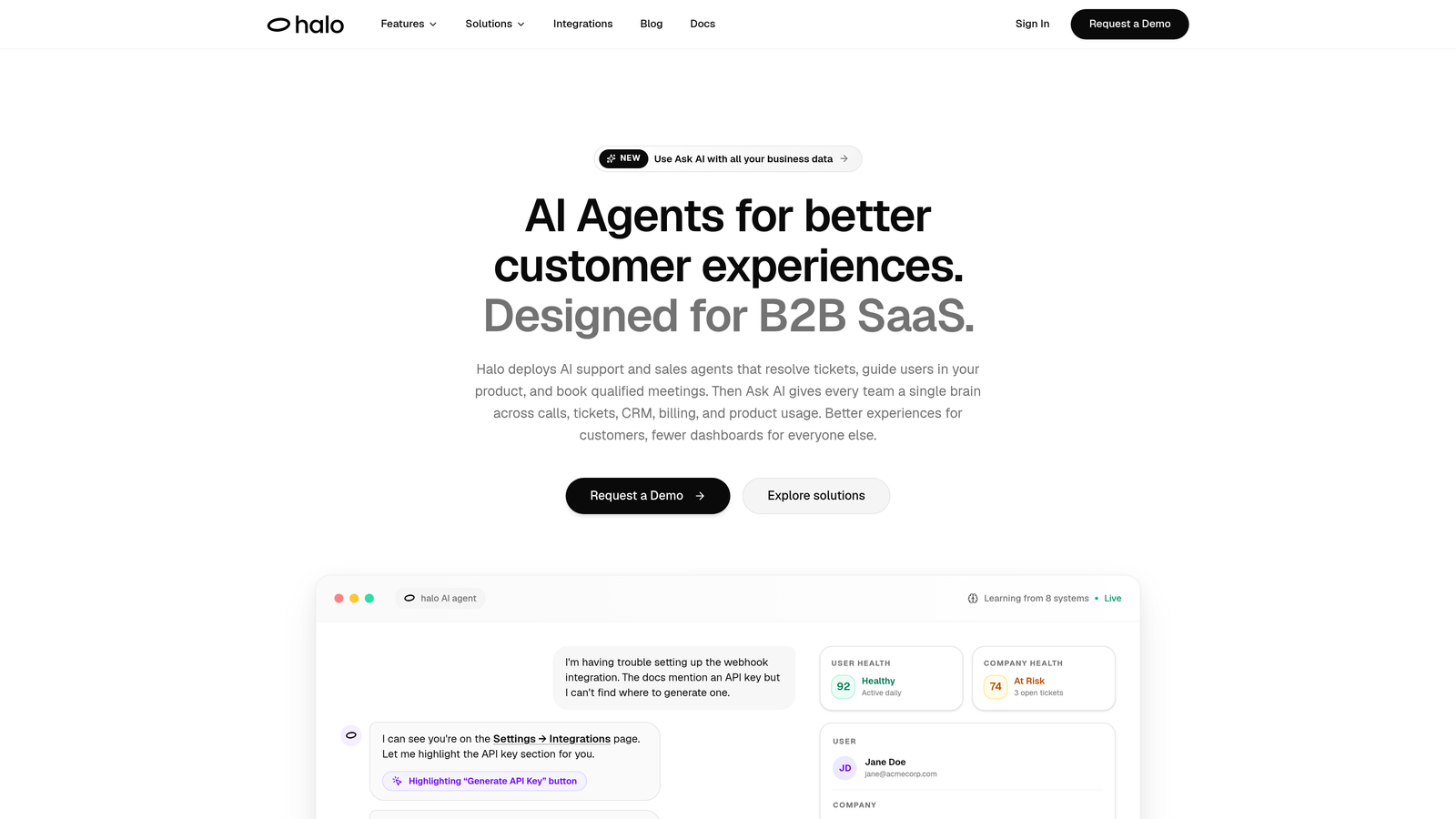
Halo AI is an AI-native customer support platform that deploys autonomous agents to resolve tickets, guide users through your product, and surface business intelligence from support data.
Where This Tool Shines
Most helpdesk platforms were built for human agents first and had AI layered on afterward. Halo AI takes the opposite approach: the entire architecture is designed around autonomous AI agents that learn continuously from every interaction. This distinction matters because AI bolted onto legacy infrastructure often inherits the limitations of that infrastructure.
What genuinely sets Halo apart is its page-aware context engine. The chat widget can see what users see on screen, which means support guidance is tied to the exact page and UI state a user is experiencing. Pair that with business intelligence capabilities that surface customer health signals, revenue insights, and anomaly detection from support data, and you have a platform that delivers value well beyond ticket deflection.
Key Features
Autonomous AI Agents: Resolve support tickets end-to-end without requiring a human agent to intervene on routine issues.
Page-Aware Chat Widget: Provides visual UI guidance by understanding the specific product page and context a user is on.
Smart Inbox with Business Intelligence: Surfaces customer health scoring, revenue insights, and anomaly detection directly from support interactions.
Auto Bug Ticket Creation: Automatically generates bug tickets in Linear and other dev tools when support conversations reveal product issues.
Live Agent Handoff: Escalates complex issues to human agents with full conversation context preserved, so nothing gets repeated.
Deep Integration Stack: Connects with Slack, HubSpot, Intercom, Stripe, Zoom, PandaDoc, and Fathom for a unified operational view.
Best For
Halo AI is purpose-built for product-led B2B SaaS teams that want AI to handle the full support lifecycle, not just deflect tickets. If your team is spending time on repetitive queries, missing customer health signals buried in support threads, or manually filing bug reports, Halo's architecture addresses all three simultaneously.
Pricing
Contact for pricing. Halo AI is designed specifically for B2B SaaS teams, so pricing is tailored to team size and ticket volume rather than a one-size-fits-all seat model.
2. Intercom
Best for: Teams wanting a unified communication platform with a capable AI agent built in
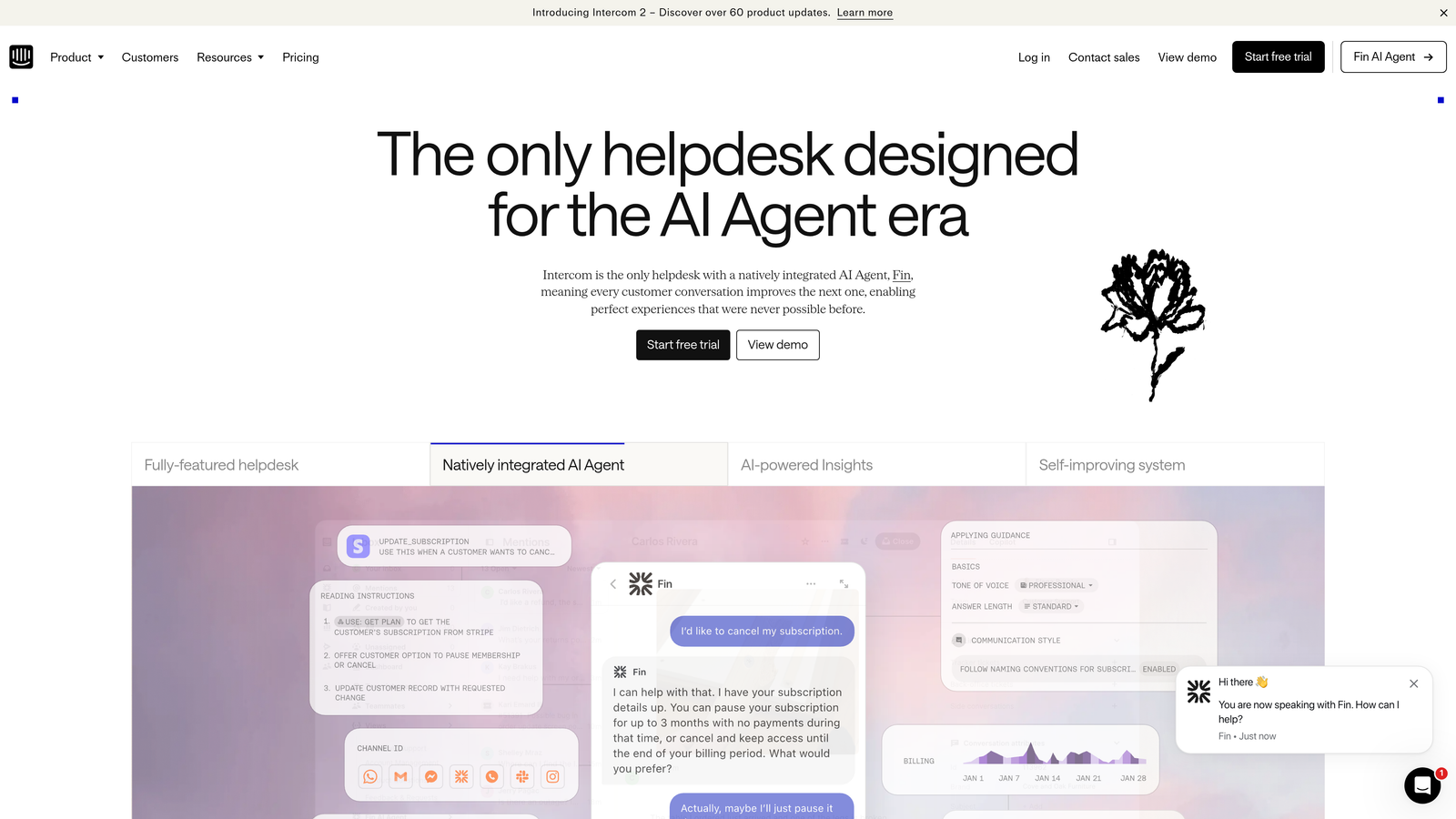
Intercom is a unified customer communication platform featuring Fin, its AI agent for automated resolution across chat, email, and help center channels.
Where This Tool Shines
Intercom has invested heavily in Fin, its AI agent, and the results show. Fin can handle multi-step queries by pulling from your help center content and resolving conversations without routing to a human agent. The omnichannel messenger experience is polished, and the platform's brand recognition means most support teams already have some familiarity with its interface.
The integration marketplace is extensive, and Intercom's in-app messaging capabilities make it a strong fit for SaaS products that want to blend proactive outreach with reactive support in a single tool.
Key Features
Fin AI Agent: Autonomous ticket resolution across channels using your existing help center content as its knowledge base.
Omnichannel Messenger: Unified experience across chat, email, and in-app messaging from one interface.
Custom AI Workflows: Build conversation routing and automation logic without requiring engineering resources.
Integration Marketplace: Rich ecosystem of third-party app connections for CRM, billing, and product tools.
AI Help Center Suggestions: Automatically surfaces relevant articles during conversations to reduce unnecessary ticket creation.
Best For
Teams already using Intercom for customer messaging who want to extend their existing setup with AI resolution rather than migrate to a new platform. Also a strong fit for SaaS companies that want proactive and reactive support in one tool.
Pricing
Starts at $39 per seat per month. Fin AI is charged per resolution, so costs scale with usage rather than being bundled into the base plan.
3. Zendesk AI
Best for: Enterprise teams needing a battle-tested helpdesk with AI layered across the entire support workflow
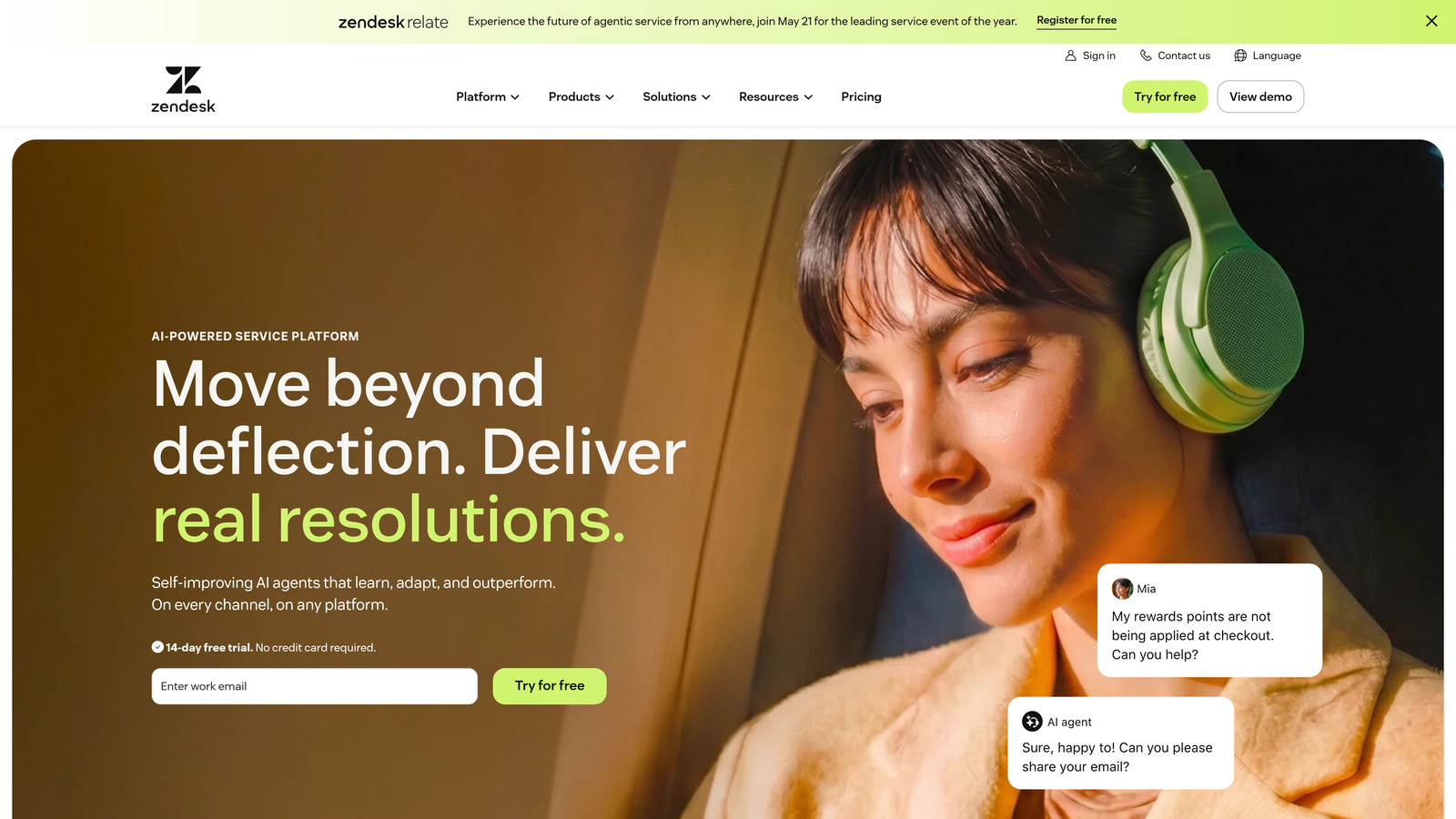
Zendesk is an enterprise-grade helpdesk platform with AI agents, intelligent triage, and agent copilot tools built on one of the largest support data sets in the industry.
Where This Tool Shines
Zendesk's scale is its primary advantage. The platform handles enormous ticket volumes across industries, and its AI capabilities benefit from years of training data. Intelligent triage automatically classifies and routes incoming tickets, while the agent copilot suggests responses and next actions to reduce handle time on complex issues.
The 1,500-plus integration marketplace means Zendesk connects with virtually any tool in your stack. For enterprise teams with complex workflows, existing Zendesk investments, and large agent teams, the AI additions provide meaningful efficiency gains without requiring a platform migration.
Key Features
AI Agents: Automated ticket resolution across channels, handling common queries without human intervention.
Intelligent Triage: Automatic ticket classification, prioritization, and routing based on content and intent.
Agent Copilot: AI-suggested responses, macros, and next-best-action recommendations for human agents.
1,500+ Integrations: One of the largest helpdesk integration ecosystems available.
Advanced Analytics: Detailed reporting dashboards covering ticket volume, resolution times, CSAT, and agent performance.
Best For
Enterprise support teams with high ticket volumes, complex routing needs, and existing Zendesk infrastructure. Less ideal for teams starting fresh who want a fully AI-native architecture rather than AI added to a legacy system.
Pricing
Suite plans start at $55 per agent per month. AI add-ons are available at additional cost, so total pricing can increase significantly depending on the features selected.
4. Freshdesk (Freddy AI)
Best for: SMBs and growing teams wanting affordable helpdesk software with solid AI capabilities
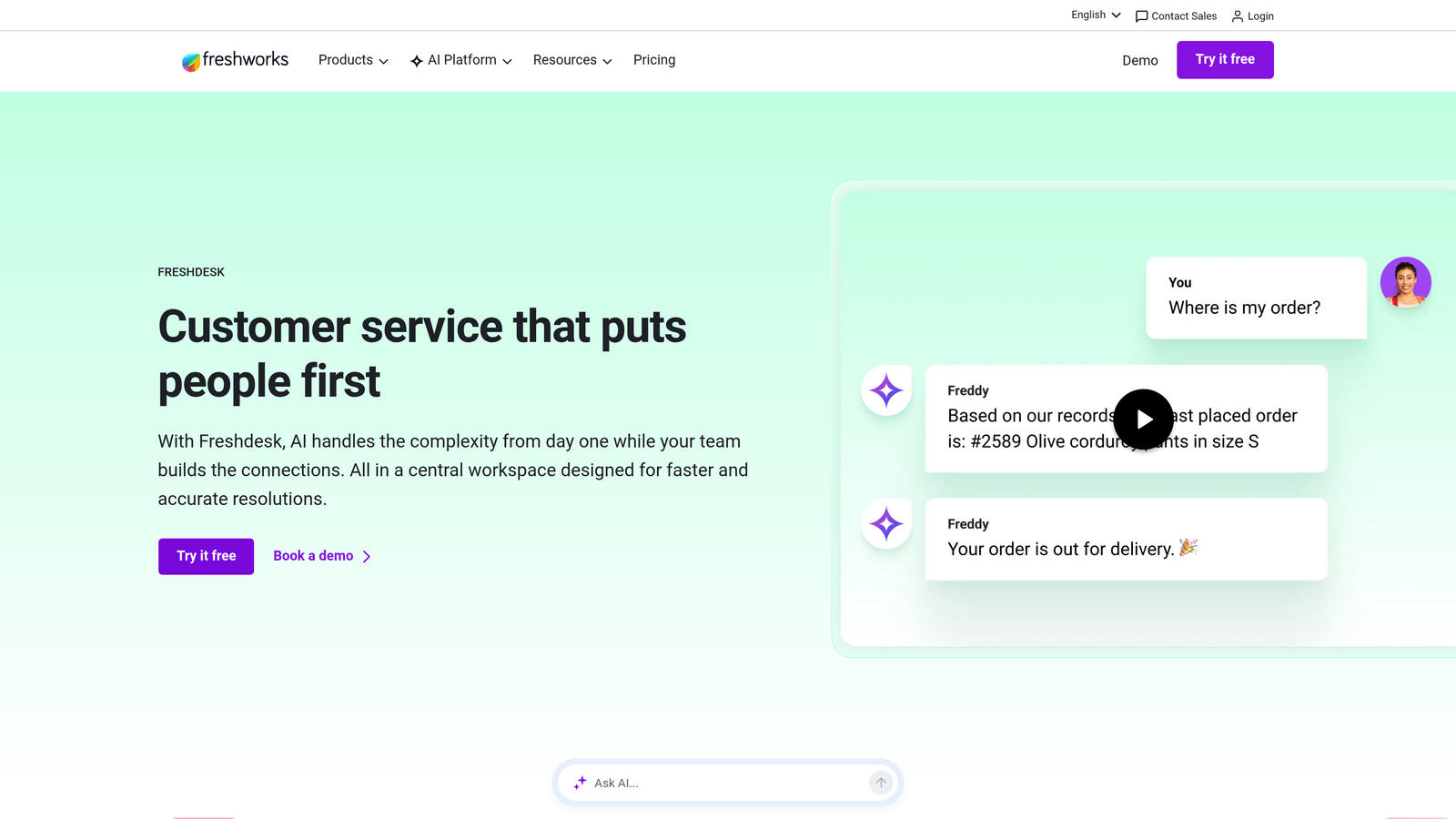
Freshdesk is an accessible helpdesk platform featuring Freddy AI for self-service automation, ticket management, and agent assistance.
Where This Tool Shines
Freshdesk's strongest selling point is its price-to-capability ratio. The free tier makes it accessible for small teams, while Freddy AI adds meaningful automation without requiring a significant budget. The no-code chatbot builder is genuinely approachable for non-technical teams, and the knowledge base integration means Freddy can pull relevant answers from existing documentation.
For teams graduating from manual email-based support who want to introduce AI without a large upfront investment, Freshdesk offers a low-risk entry point.
Key Features
Freddy AI Auto-Resolution: Handles common customer queries automatically using knowledge base content.
No-Code Chatbot Builder: Visual interface for building and managing AI chatbot flows without engineering support.
Automated Ticket Routing: Intelligent prioritization and assignment based on ticket content and agent availability.
AI Knowledge Base Suggestions: Recommends relevant articles to agents and customers during live interactions.
Free Tier: Core helpdesk features available at no cost, making it accessible for early-stage teams.
Best For
Small to mid-sized businesses that need a full-featured helpdesk with AI capabilities at a budget-friendly price point. Also suitable for teams new to helpdesk software who want a straightforward onboarding experience.
Pricing
Free plan available for basic features. Paid plans start at $15 per agent per month, with AI capabilities unlocking at higher tiers.
5. Ada
Best for: Enterprise teams needing high-volume AI resolution across digital and voice channels
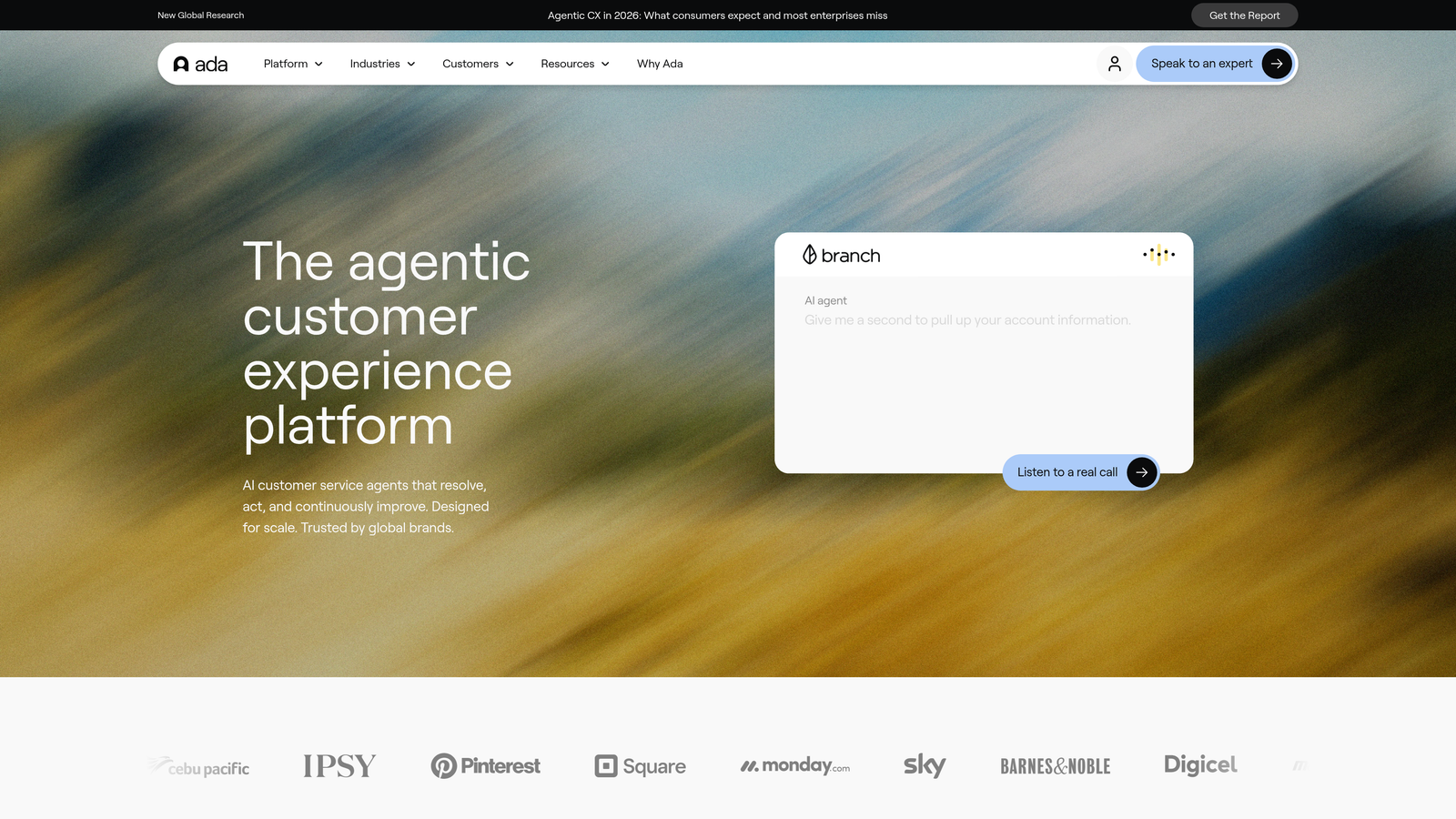
Ada is an enterprise AI agent platform purpose-built for automated customer service resolution at scale, spanning chat, email, voice, and SMS.
Where This Tool Shines
Ada is built around a resolution-first philosophy rather than deflection. The distinction is meaningful: deflection counts a conversation as a win when a customer stops asking, while resolution counts it as a win when the customer's problem is actually solved. Ada's reasoning engine handles multi-step queries that would trip up simpler chatbots, making it a credible option for complex support scenarios.
The no-code platform allows customer service teams to build and update AI agent behavior without engineering dependency, which reduces the time between identifying a gap and fixing it.
Key Features
Resolution-Focused AI Agent: Designed to solve customer problems, not just redirect them to self-service content.
Multimodal Channel Support: Handles chat, email, voice, and SMS from a unified platform.
No-Code Agent Builder: Non-technical teams can build, test, and deploy AI agent behavior independently.
Multi-Step Reasoning Engine: Handles complex queries that require understanding context across multiple conversation turns.
Enterprise Security and Compliance: Built with the access controls and audit capabilities required by large organizations.
Best For
Enterprise customer service teams with high ticket volumes across multiple channels who need AI that can genuinely resolve complex issues, not just handle FAQs. Particularly strong for companies with strict compliance requirements.
Pricing
Custom enterprise pricing. Contact Ada's sales team for a quote based on your volume and channel requirements.
6. Tidio
Best for: Small businesses and e-commerce stores wanting fast, affordable AI chat support
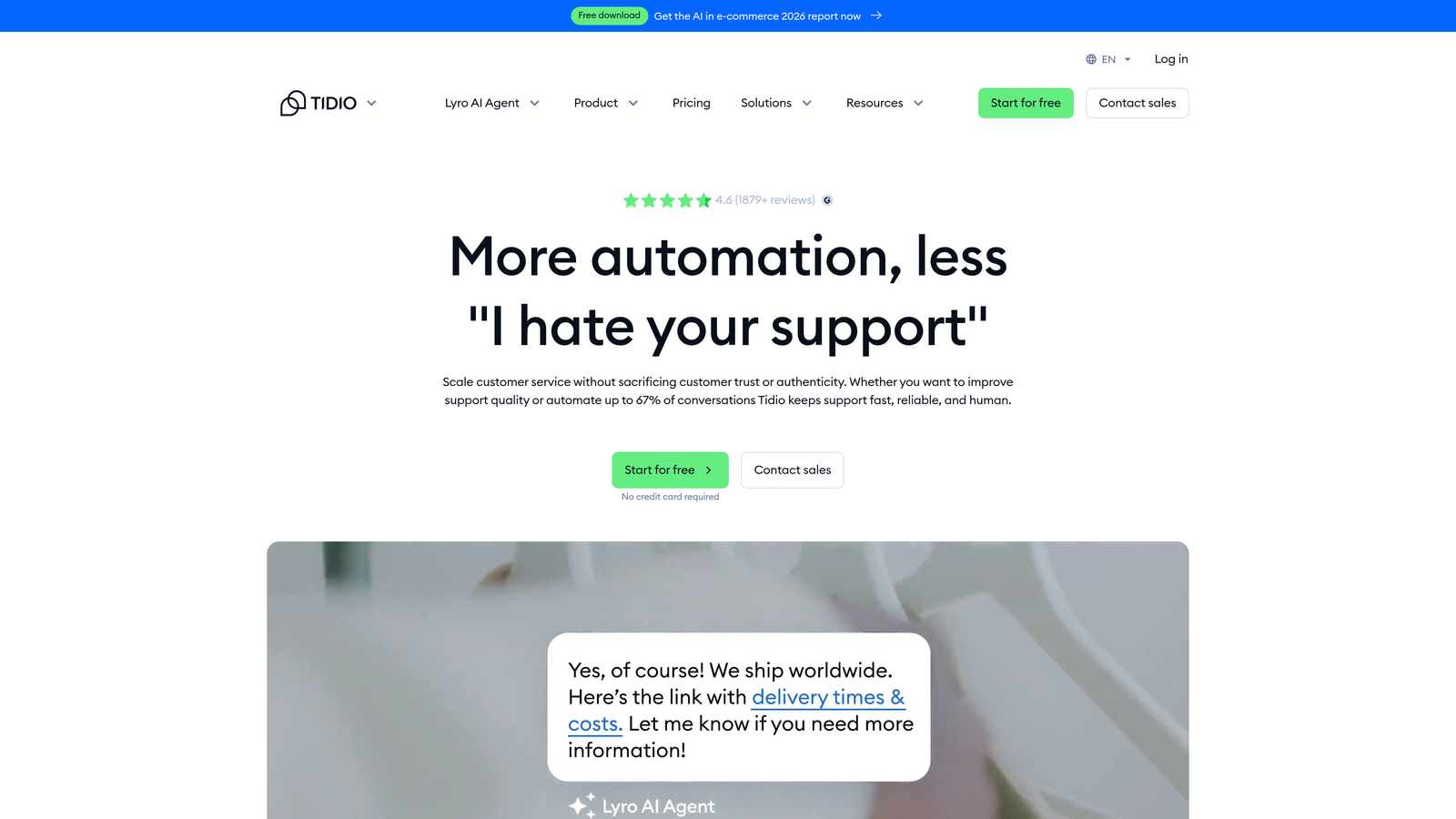
Tidio is a user-friendly AI chatbot and live chat platform designed for small businesses and e-commerce stores that want quick deployment and accessible pricing.
Where This Tool Shines
Tidio's Lyro AI chatbot learns from your existing FAQ content and knowledge base, which means setup time is significantly shorter than platforms requiring extensive training data. The combination of AI automation and live chat in a single widget keeps things simple for small teams that don't want to manage multiple tools.
The native integrations with Shopify, WooCommerce, and WordPress make Tidio a natural fit for e-commerce businesses that need support automation without the complexity of an enterprise platform.
Key Features
Lyro AI Chatbot: Learns from your FAQ and knowledge base to answer customer questions automatically.
Visual No-Code Builder: Drag-and-drop chatbot flow builder with pre-built templates for common scenarios.
E-Commerce Integrations: Native connections to Shopify, WooCommerce, and WordPress for order and product context.
Combined AI and Live Chat: Single widget that handles both automated and human-assisted conversations.
Visitor Tracking: Real-time analytics showing who is on your site and what they're doing before they reach out.
Best For
Small businesses, e-commerce stores, and solopreneurs who want AI-assisted support without enterprise complexity or pricing. Best suited for B2C use cases rather than complex B2B support workflows.
Pricing
Free plan available with limited conversations. AI features through Lyro start at $29 per month, making it one of the most affordable AI support options available.
7. Forethought
Best for: Support teams that want AI triage, resolution, and agent assist layered onto existing helpdesk infrastructure
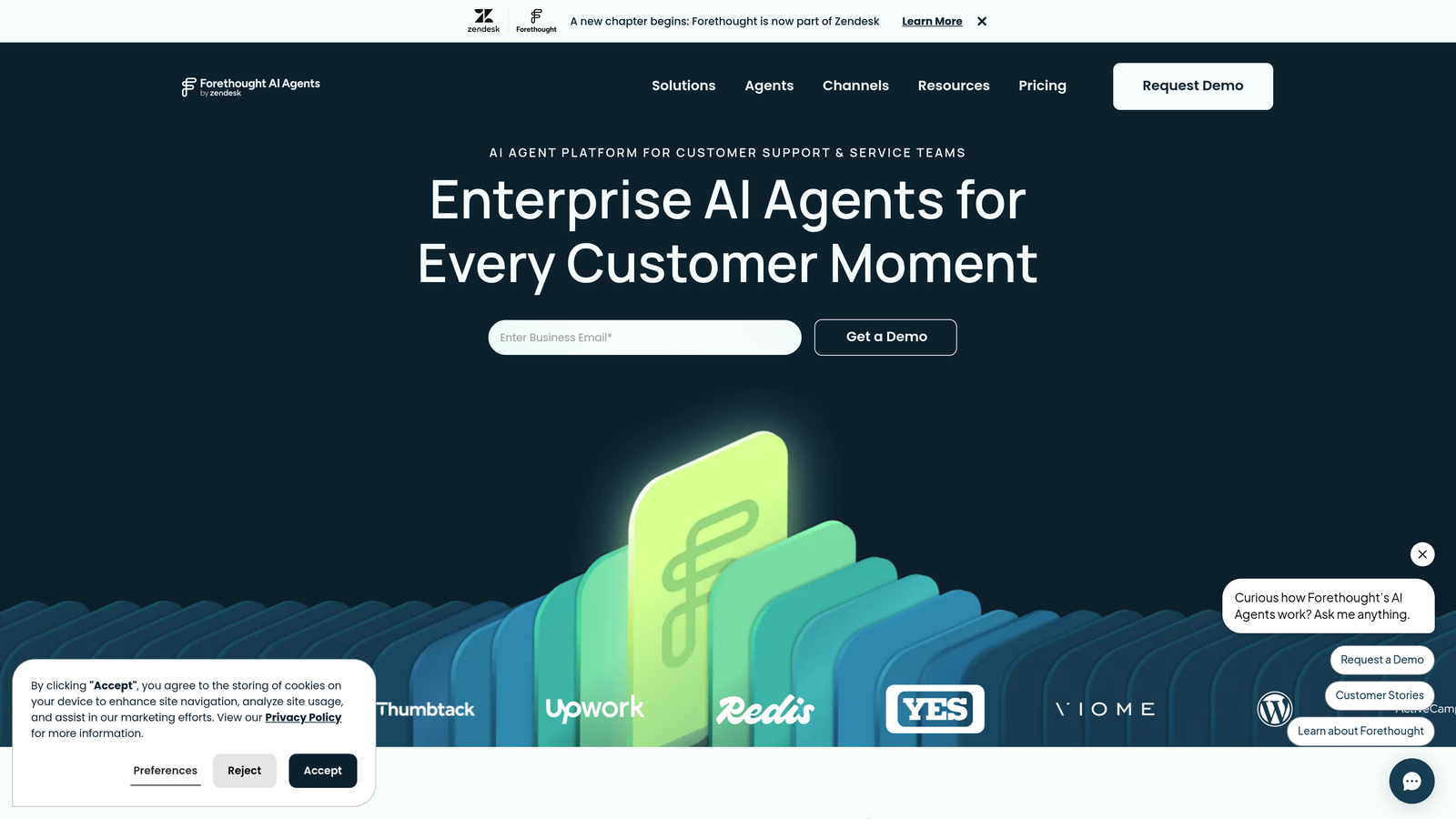
Forethought is an AI platform focused on intelligent ticket triage, automated resolution, and agent copilot capabilities that integrates with your existing helpdesk.
Where This Tool Shines
Forethought is designed to enhance rather than replace your current helpdesk. If your team is deeply embedded in Zendesk or Salesforce and doesn't want to migrate, Forethought adds a sophisticated AI layer on top of your existing workflows. Its product suite covers the full ticket lifecycle: Solve handles autonomous resolution, Triage handles classification and routing, and Assist surfaces relevant knowledge for human agents.
The Discover module adds an analytical dimension, identifying trends and gaps in your support coverage so you can proactively address recurring issues before they generate ticket volume.
Key Features
Solve: AI agent for autonomous ticket resolution on common, repeatable queries.
Triage: Intelligent ticket classification, prioritization, and routing based on content and intent signals.
Assist: Agent copilot that surfaces relevant knowledge and suggests responses during live interactions.
Discover: AI-driven analytics that identify support trends, knowledge gaps, and resolution opportunities.
Helpdesk Integrations: Native connections to Zendesk, Salesforce Service Cloud, and other major platforms.
Best For
Mid-market and enterprise support teams that want to add AI capabilities to an existing helpdesk investment without migrating to a new platform. Particularly valuable for teams with high ticket volume and complex routing requirements.
Pricing
Custom pricing based on ticket volume. Contact Forethought's sales team for a quote tailored to your support operation.
8. Kustomer
Best for: Teams wanting CRM-native support with AI automation and full customer context in one platform
Kustomer is a CRM-powered customer service platform that layers AI automation on a unified customer timeline, providing contextual support without requiring a separate CRM.
Where This Tool Shines
Kustomer's architecture is fundamentally different from traditional helpdesks: every customer interaction is organized around the customer record rather than individual tickets. This means agents and AI systems always have full context about who they're talking to, what they've purchased, and what their history looks like before a single word is typed.
The sentiment analysis and customer intent detection capabilities help prioritize which conversations need immediate attention, making it easier to allocate human agent time where it creates the most impact.
Key Features
Unified Customer Timeline: Full interaction history across every channel organized by customer, not by individual ticket.
AI Chatbots and Workflows: Automated conversation handling and routing built on full customer context.
Omnichannel Support: Email, chat, social media, SMS, and voice managed from a single interface.
CRM-Native Architecture: Built-in customer data management eliminates the need for a separate CRM integration.
Sentiment and Intent Detection: AI signals that identify frustrated customers and high-priority issues for faster escalation.
Best For
Customer service teams in e-commerce, retail, or B2C SaaS that handle high volumes of repeat customers and need full context at every interaction. The CRM-native approach is particularly valuable for teams currently managing a helpdesk and CRM separately.
Pricing
Enterprise plans start at $89 per user per month, positioning Kustomer toward mid-market and enterprise buyers rather than SMBs.
9. HubSpot Service Hub
Best for: Teams already in the HubSpot ecosystem who want support tools tightly integrated with CRM and marketing data
HubSpot Service Hub is a customer service platform built natively on HubSpot's CRM, featuring AI chatbots, shared inbox, ticketing, and knowledge base tools.
Where This Tool Shines
If your team already uses HubSpot for marketing and sales, Service Hub removes the friction of connecting support data to customer records. The Breeze AI chatbot has access to CRM context from the first message, which means it can personalize responses based on deal stage, lifecycle status, and previous interactions without any manual data lookup.
The NPS tracking and customer feedback tools add a voice-of-customer layer that many standalone helpdesks lack, making Service Hub a reasonable choice for teams that want support, CRM, and feedback management in a single platform.
Key Features
Breeze AI Chatbot: Conversational AI with CRM context for personalized, relevant responses from the first interaction.
Shared Inbox: Centralized team inbox with automated ticket routing and assignment rules.
AI-Powered Knowledge Base: Smart search and article suggestions that surface relevant content for agents and customers.
Full HubSpot Integration: Native connection to Marketing Hub, Sales Hub, and CMS Hub for unified customer data.
Customer Feedback and NPS: Built-in survey tools for tracking customer satisfaction and loyalty over time.
Best For
Companies already running HubSpot for marketing and sales who want to extend that investment to support without adding another platform. Less compelling as a standalone support solution if you're not already in the HubSpot ecosystem.
Pricing
Free tools available with limited features. The Professional plan starts at $100 per seat per month, which includes the more advanced AI and automation capabilities.
10. Drift (Salesloft)
Best for: Revenue-focused teams that want AI to bridge customer support and sales pipeline development
Drift, now part of the Salesloft platform, is a conversational AI tool that handles support inquiries while simultaneously identifying revenue opportunities from site visitors.
Where This Tool Shines
Drift occupies a unique position in this list because its primary lens is revenue, not just support efficiency. The platform uses real-time visitor intelligence to identify high-intent accounts and routes them appropriately, whether that means answering a support question or connecting them with a sales rep. For B2B companies where support and sales conversations often overlap, this dual purpose is genuinely useful.
Conversational landing pages allow marketing teams to create targeted engagement experiences for specific account segments, extending Drift's utility beyond the support use case into demand generation.
Key Features
AI-Powered Chatbots: Handle both support inquiries and lead qualification within the same conversation flow.
Real-Time Visitor Intelligence: Identifies who is on your site, their intent signals, and their account status in your CRM.
Conversational Landing Pages: Targeted chat experiences for specific audience segments or account-based campaigns.
Integrated Meeting Scheduling: Allows prospects and customers to book meetings directly within the chat interface.
CRM Integrations: Native connections to Salesforce, HubSpot, and other major CRM platforms for full pipeline visibility.
Best For
B2B companies with an account-based marketing strategy where support and sales interactions frequently overlap. Less ideal for teams focused purely on support efficiency without a revenue intelligence angle.
Pricing
Custom pricing through the Salesloft sales team. Contact them directly for a quote based on your team size and use case.
Which Tool Is Right for Your Team
The right AI support software depends less on feature lists and more on your team's architecture, growth stage, and strategic priorities. Here's how to think through the decision.
For product-led B2B SaaS teams: Halo AI is the standout choice. Its AI-first architecture, page-aware context engine, and business intelligence capabilities go well beyond what traditional helpdesks offer, even with AI add-ons. If you want your support platform to surface customer health signals and automatically file bug reports alongside resolving tickets, Halo is purpose-built for that use case.
For teams already on Intercom or Zendesk: Extending your current platform with their native AI capabilities is often the path of least resistance. Intercom's Fin agent and Zendesk's AI suite both offer meaningful automation without requiring a full migration.
For high-volume enterprise automation: Ada and Forethought are both strong contenders. Ada excels at multimodal resolution across chat, email, and voice, while Forethought is the better choice for teams that want AI layered onto an existing Zendesk or Salesforce investment.
For SMBs and budget-conscious teams: Freshdesk's free tier and Tidio's accessible pricing make both solid entry points. Freshdesk is the better fit for B2B support workflows, while Tidio is purpose-built for e-commerce and B2C use cases.
For CRM-native teams: HubSpot Service Hub is the obvious choice if you're already running HubSpot. Kustomer is worth evaluating if you want CRM and support combined but aren't committed to the HubSpot ecosystem.
For revenue-focused organizations: Drift's positioning at the intersection of support and sales pipeline makes it uniquely suited for account-based B2B teams where those two functions regularly overlap.
Your support team shouldn't scale linearly with your customer base. Let AI agents handle routine tickets, guide users through your product, and surface business intelligence while your team focuses on complex issues that need a human touch. See Halo in action and discover how continuous learning transforms every interaction into smarter, faster support.