9 Best AI Support Software for Ecommerce in 2026
This guide reviews the 9 best AI support software for ecommerce platforms in 2026, evaluating each tool on automation depth, ecommerce integrations, and scalability. Whether you're a DTC brand or large marketplace, these solutions autonomously resolve common tickets, intelligently route complex issues, and deliver instant customer answers around the clock—without requiring headcount to grow alongside your support volume.
 Grant CooperFounder13 min read
Ecommerce support teams face a pressure that most helpdesk tools weren't designed to absorb: customers who want instant answers about their orders, returns, and shipping status at 2am on a Sunday, and they want those answers now. Generic ticketing systems can handle the queue, but they can't resolve it autonomously. AI support software changes that equation by handling common tickets end-to-end, routing complex issues intelligently, and giving your team the context they need to close what's left.
This guide covers the top AI support platforms purpose-built or well-suited for ecommerce operations. Whether you're a DTC brand managing post-purchase chaos or a marketplace juggling thousands of SKUs, there's a tool here that fits your scale and your stack. We evaluated each platform on automation depth, ecommerce integrations, ease of deployment, and how well it scales without requiring you to hire in lockstep with your customer base.
1. Halo AI
Best for: Ecommerce teams that want autonomous AI resolution with business intelligence built in
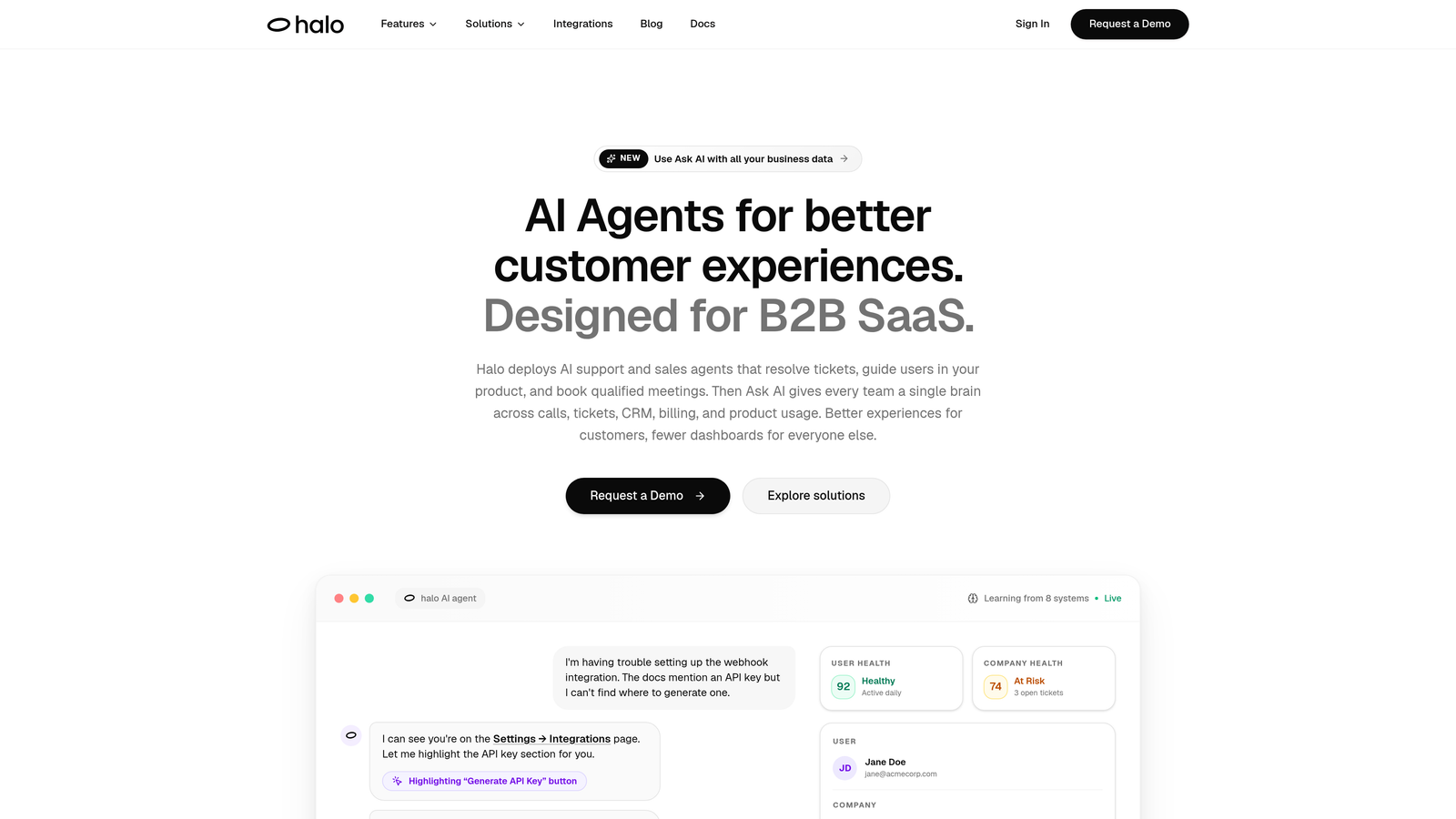
Halo AI is an AI-first customer support platform that deploys autonomous agents to resolve tickets, guide users through your product, and surface actionable business intelligence from every support interaction.
Where This Tool Shines
Most support tools treat AI as a layer on top of an existing helpdesk. Halo AI is built the other way around: the AI agent is the primary resolution engine, not a suggestion engine for human agents. That distinction matters enormously for ecommerce teams dealing with high-frequency, repetitive queries that don't need a human to resolve.
What makes Halo genuinely different is the page-aware context. The AI understands what page a customer is on, what they're looking at, and can provide visual UI guidance in real time. Combined with a smart inbox that surfaces customer health signals, revenue intelligence, and anomaly detection, it goes well beyond ticket deflection into something closer to a business intelligence layer for your support operation.
Key Features
Autonomous AI Agents: Resolve tickets end-to-end without agent involvement, handling the full resolution cycle from first message to close.
Page-Aware Chat Widget: The AI sees what the user sees, providing contextual guidance and visual UI walkthroughs tied to the specific page they're on.
Smart Inbox with Business Intelligence: Surfaces customer health signals, revenue intelligence, and anomaly detection alongside support conversations.
Auto Bug Ticket Creation: Automatically routes product bugs and technical issues to engineering tools like Linear without agent intervention.
Live Agent Handoff: Escalates complex or sensitive issues to human agents seamlessly, with full conversation context preserved.
Broad Integration Stack: Connects with Stripe, HubSpot, Intercom, Slack, Zoom, PandaDoc, and Fathom, covering the full business stack beyond just support.
Best For
Ecommerce brands and product-led teams that want AI to handle the majority of ticket volume autonomously while also generating intelligence about customer behavior, revenue signals, and product health. Particularly strong for teams already using Stripe and HubSpot as core infrastructure.
Pricing
Contact for pricing at haloagents.ai. Custom pricing reflects the platform's autonomous agent architecture and integration depth.
2. Gorgias
Best for: Shopify-native DTC brands that need order data inside every support conversation
Gorgias is a helpdesk built specifically for ecommerce, with deep native integrations into Shopify, WooCommerce, and BigCommerce that surface order data directly inside every ticket.

Where This Tool Shines
Gorgias earns its reputation in the Shopify ecosystem by eliminating the tab-switching that slows agents down. Order status, shipping details, and purchase history appear automatically inside the ticket view, which means agents can action a return or resend a tracking link without leaving the conversation.
The AI automation layer handles the high-frequency queries that dominate ecommerce inboxes: order status, tracking, return eligibility. For brands where those queries make up a significant portion of daily volume, the deflection impact is real. The revenue-per-ticket tracking is also a standout feature for teams that need to justify support investment to leadership.
Key Features
Native Ecommerce Integrations: Deep connections to Shopify, WooCommerce, Magento, and BigCommerce pull order data automatically into every ticket.
AI Automation for Common Queries: Handles order status, returns, and tracking inquiries without agent involvement.
Revenue-Per-Ticket Tracking: Measures the direct revenue impact of support interactions, useful for demonstrating ROI.
Order Management Inside Tickets: Agents can process refunds, edits, and resends directly from the ticket interface.
Multichannel Coverage: Handles email, live chat, Instagram, Facebook, and SMS in one inbox.
Best For
DTC brands running primarily on Shopify that want ecommerce-native context baked into every agent interaction. Also strong for teams that want to track support's contribution to revenue, not just cost reduction.
Pricing
Starts at $10/month with ticket-volume-based pricing. Costs can scale quickly for high-volume stores, so model your expected ticket volume before committing.
3. Freshdesk
Best for: Mid-market omnichannel teams that want a proven, stable platform with AI assist
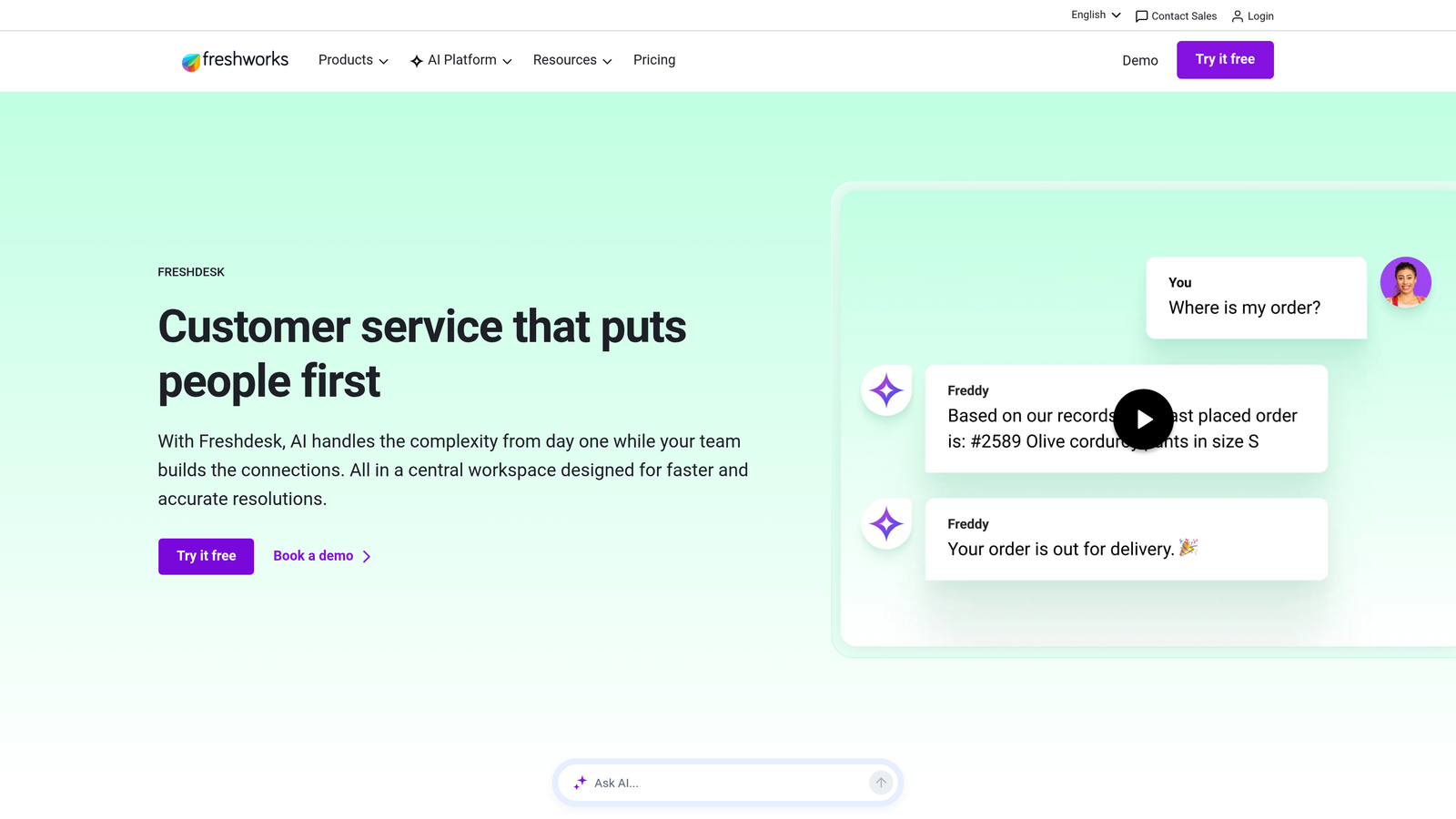
Freshdesk is a mature omnichannel support platform where Freddy AI handles deflection, triage, and agent assist across email, chat, phone, and social channels.
Where This Tool Shines
Freshdesk's strength is breadth. It covers more channels out of the box than most ecommerce-specific tools, and Freddy AI adds meaningful automation without requiring significant configuration work to get started. For teams managing support across email, WhatsApp, phone, and social simultaneously, that omnichannel coverage matters.
The free tier makes it accessible for smaller teams testing AI-assisted support before committing to a paid plan. As teams grow, the platform scales with them without requiring a platform migration.
Key Features
Freddy AI: Handles ticket deflection, intent detection, automated responses, and real-time agent suggestions.
Omnichannel Support: Covers email, live chat, phone, social media, and WhatsApp in a unified inbox.
Ecommerce Integrations: Shopify and WooCommerce connections available through the marketplace.
Agent Assist: AI suggests responses and next best actions to agents during live conversations.
Free Tier Available: Entry point without upfront cost, with paid plans scaling by agent count.
Best For
Mid-market ecommerce teams managing support across multiple channels who want a stable, well-documented platform with AI capabilities layered in. Strong choice for teams that need phone support alongside digital channels.
Pricing
Free plan available; paid plans start from approximately $15 per agent per month, scaling with features and team size.
4. Zendesk
Best for: Enterprise ecommerce operations with complex workflows and multi-brand requirements
Zendesk is an enterprise-grade support platform with AI-powered triage, intent detection, and a vast marketplace of ecommerce integrations suited for complex, multi-brand operations.

Where This Tool Shines
Zendesk's primary advantage is configurability. For enterprise ecommerce brands running multiple storefronts, complex SLA structures, or support operations across regions and languages, the platform's depth is hard to match. The AI layer handles intelligent triage and routing, while the app marketplace fills in integration gaps for virtually any ecommerce stack.
The tradeoff is implementation complexity. Zendesk rewards teams that invest in setup and configuration, but it's not a plug-and-play solution. For smaller teams, that overhead often outweighs the platform's capabilities.
Key Features
Zendesk AI: Intelligent triage, intent detection, and automated ticket routing built into the core platform.
Extensive App Marketplace: Hundreds of integrations covering ecommerce platforms, order management, and CRM tools.
Multi-Brand Support: Manages multiple storefronts and brands from a single instance with separate configurations.
Advanced SLA Management: Granular SLA rules and reporting for teams with complex service level requirements.
Highly Configurable Workflows: Custom triggers, automations, and routing logic for sophisticated support operations.
Best For
Enterprise ecommerce brands and multi-brand retailers that need maximum configurability, strong SLA management, and the flexibility to integrate with a complex existing technology stack.
Pricing
Suite Team plans start from approximately $55 per agent per month. Implementation and customization costs should be factored into total cost of ownership.
5. Tidio
Best for: Small-to-mid ecommerce stores looking for accessible AI chat with quick deployment
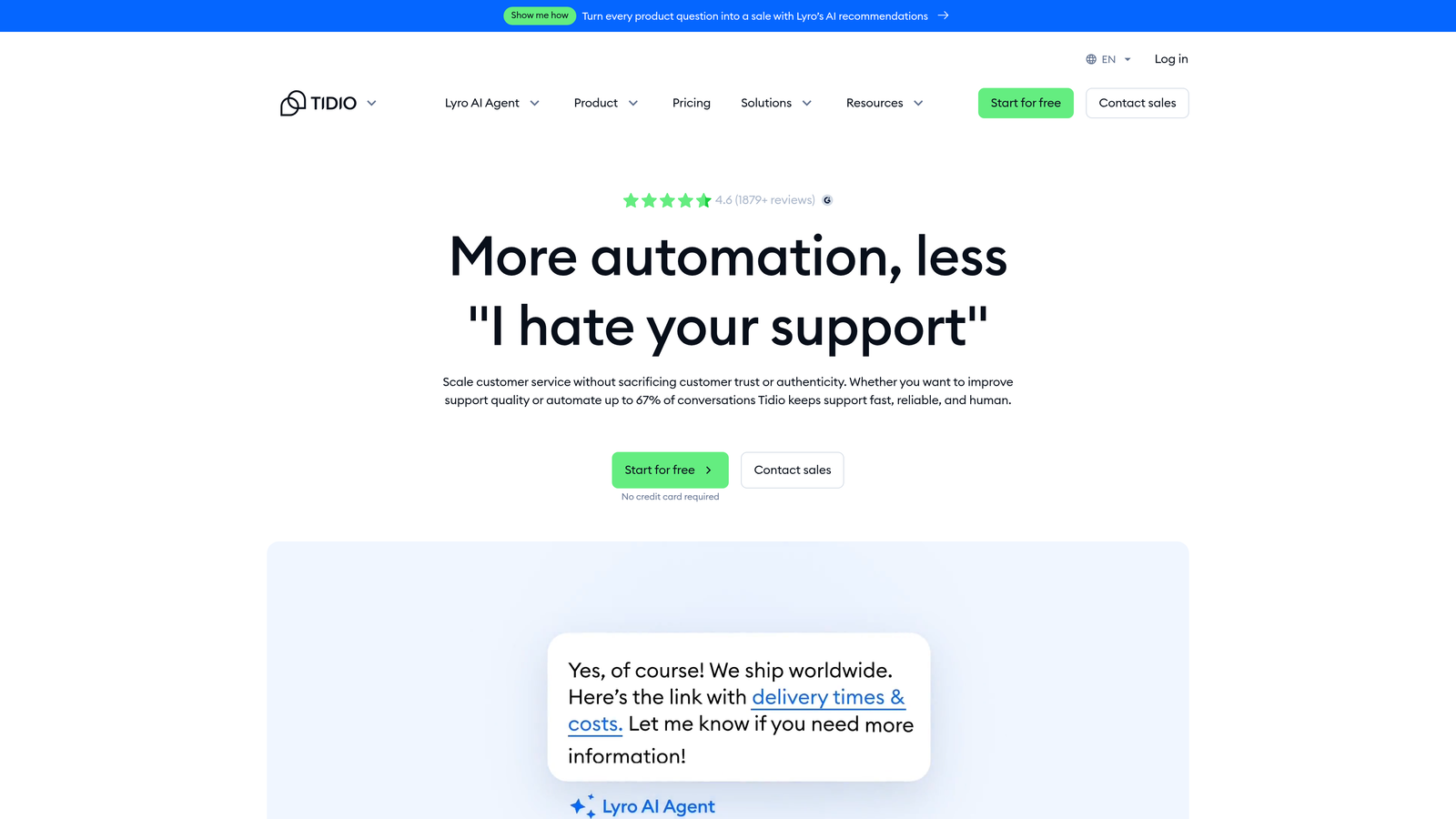
Tidio is an accessible AI support tool built for smaller ecommerce operations, featuring the Lyro AI chatbot with pre-built ecommerce conversation flows and live chat fallback when AI reaches its resolution limit.
Where This Tool Shines
Tidio's appeal is simplicity and speed to value. The Lyro AI chatbot comes with pre-built flows for the most common ecommerce queries: order tracking, return requests, and FAQ responses. For a store owner or small support team without dedicated technical resources, that means meaningful automation without a lengthy setup process.
The live chat fallback is a practical feature that prevents the frustrating dead ends some AI chatbots create. When Lyro reaches the edge of its resolution capability, it hands off to a human agent cleanly rather than looping the customer in circles.
Key Features
Lyro AI Chatbot: Conversational AI with pre-built flows for order tracking, returns, and common FAQs.
Live Chat Fallback: Seamless handoff to human agents when AI cannot resolve the query.
Shopify and WooCommerce Integrations: Native connections to the most common ecommerce platforms for smaller brands.
Visual Chatbot Builder: Drag-and-drop interface for creating custom conversation flows without coding.
Accessible Pricing: Entry-level cost structure designed for smaller ecommerce operations.
Best For
Small-to-mid ecommerce brands on Shopify or WooCommerce that want to automate common queries without a complex implementation. Particularly suitable for stores where the founder or a small team is handling support alongside other responsibilities.
Pricing
Free plan available; Lyro AI starts from approximately $29/month, making it one of the more accessible options on this list.
6. Intercom
Best for: Subscription ecommerce and product-led brands that need proactive messaging alongside support
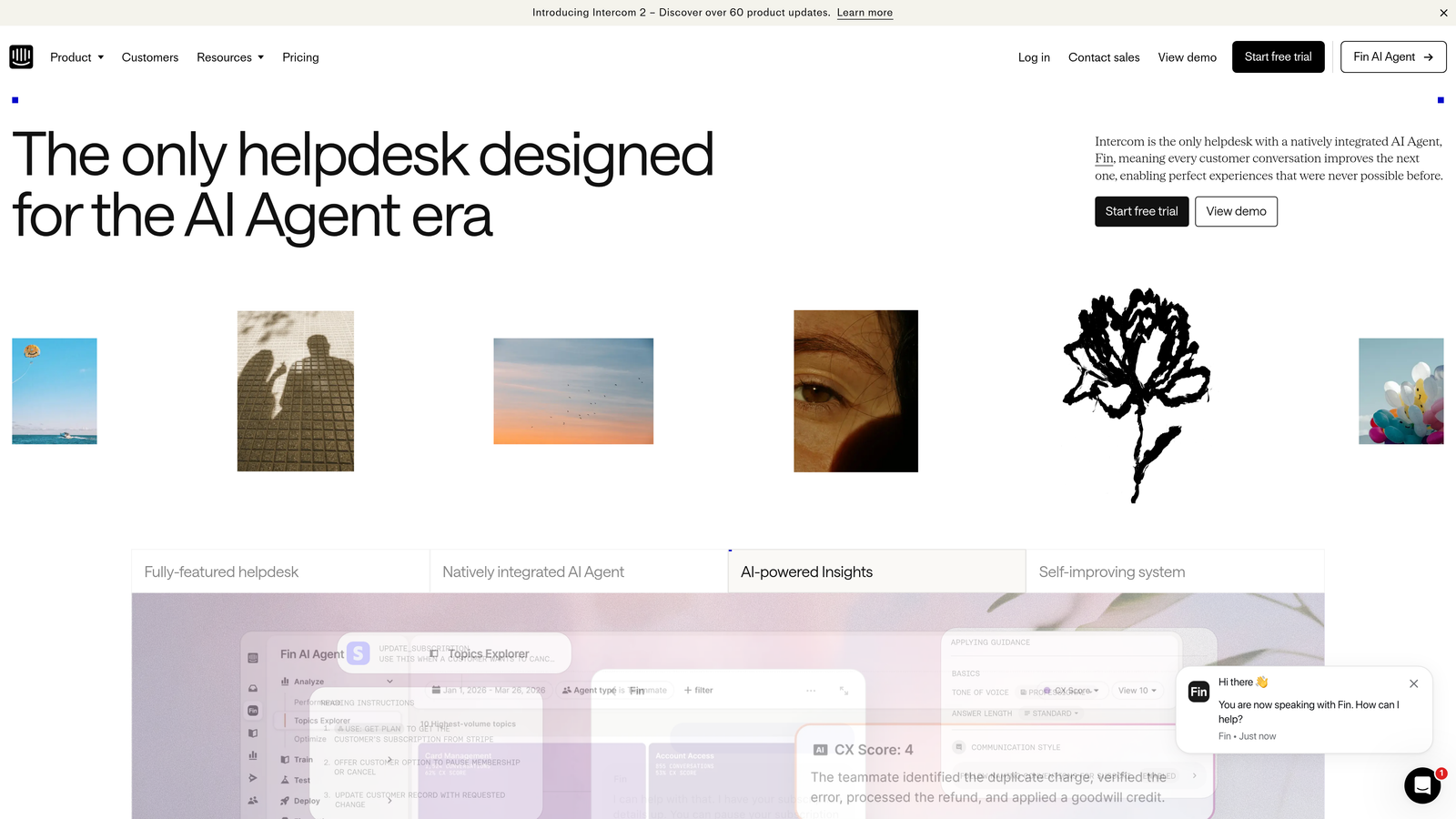
Intercom is a customer communications platform featuring the Fin AI agent, strong proactive messaging tools, and integrations well-suited for subscription ecommerce and product-led brands.
Where This Tool Shines
Intercom's Fin AI agent handles conversational resolution at a quality level that stands out in the market. But what really differentiates Intercom for ecommerce is the proactive messaging layer: product tours, targeted outbound messages, and behavioral triggers that let you reach customers before they need to contact support. For subscription ecommerce brands managing onboarding, retention, and renewals, that proactive capability is genuinely valuable.
The platform is better suited for brands with a product or subscription layer alongside physical goods than for pure-play transactional ecommerce. If your customer relationships extend beyond individual transactions, Intercom's breadth pays off.
Key Features
Fin AI Agent: High-quality conversational AI resolution with strong natural language understanding.
Proactive Messaging: Behavioral triggers and targeted outbound messages for onboarding, retention, and re-engagement.
Product Tours: In-app guidance tools for onboarding customers to new features or workflows.
CRM and Payment Integrations: Connects with Stripe, HubSpot, and Salesforce for customer context in conversations.
Unified Platform: Inbox, help center, and outbound messaging in a single interface.
Best For
Subscription ecommerce brands, direct-to-consumer companies with a digital product component, or any ecommerce business where customer lifecycle management is as important as reactive ticket resolution.
Pricing
From approximately $39 per seat per month; Fin AI resolution pricing is usage-based and varies depending on conversation volume.
7. Richpanel
Best for: Ecommerce brands selling across Shopify, Amazon, and WooCommerce simultaneously
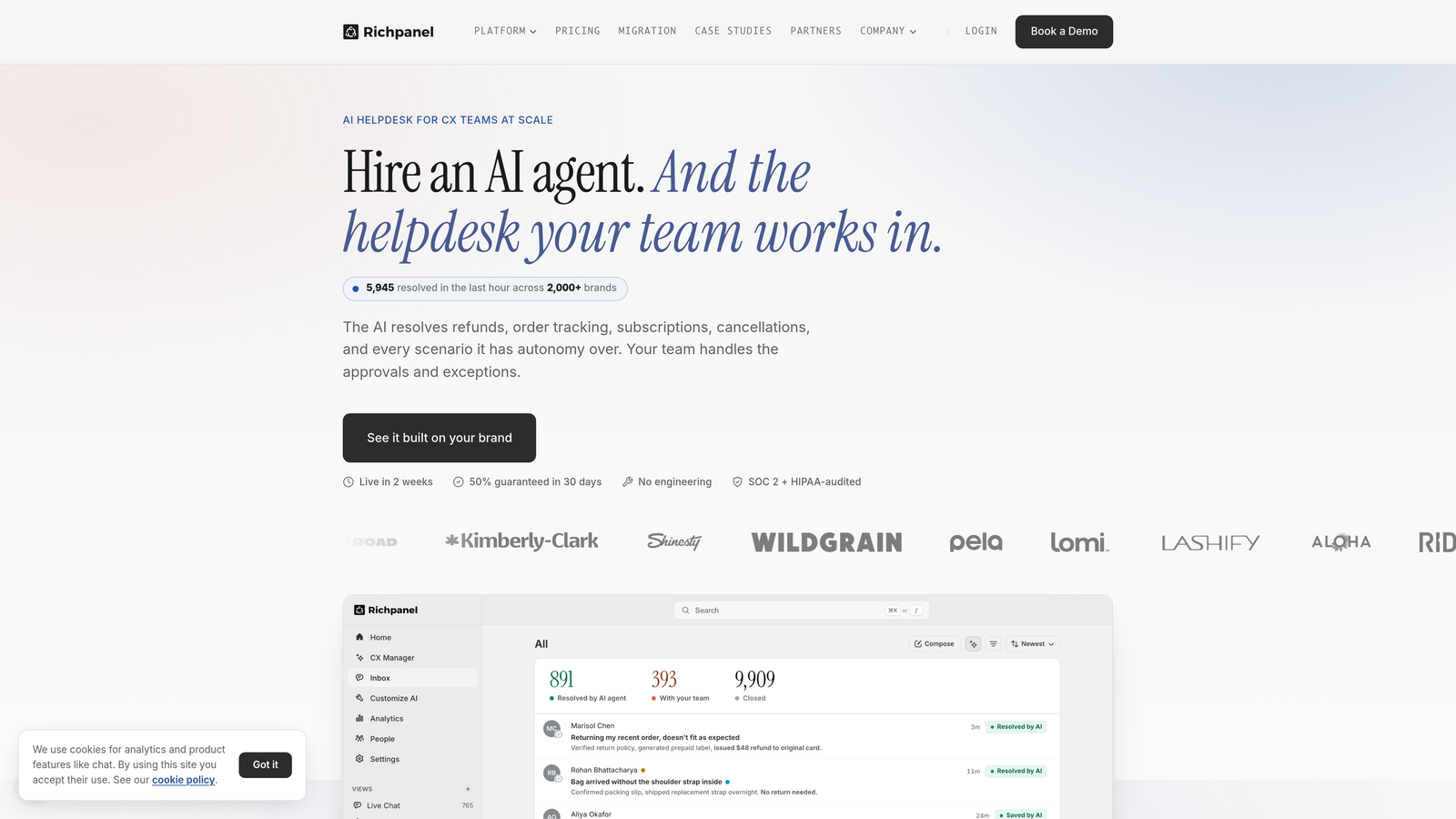
Richpanel is an ecommerce-exclusive support platform that unifies order data from Shopify, Amazon, and WooCommerce with customer conversations in a single, context-rich view.
Where This Tool Shines
Richpanel's defining feature is the unified customer view. When a customer contacts support, agents see their complete order history across every sales channel alongside the conversation itself. For brands selling on multiple platforms simultaneously, that consolidation eliminates the manual data-gathering that slows resolution times.
The self-service portal is another standout: customers can look up orders, initiate returns, and manage their purchases without contacting an agent at all. That deflects a significant portion of the most common ecommerce queries before they ever reach the inbox.
Key Features
Native Multi-Platform Integrations: Deep connections to Shopify, Amazon, WooCommerce, and Magento in a single view.
Unified Customer View: Full order history across all sales channels displayed alongside support conversations.
Customer Self-Service Portal: Lets customers manage orders, returns, and tracking without agent involvement.
AI Query Handling: Automates common queries with full order context; agents receive complete information on escalations.
Multichannel Inbox: Covers email, chat, Facebook, Instagram, and phone in one interface.
Best For
Ecommerce brands operating across multiple sales channels who need a single source of truth for customer order data. Particularly strong for brands where Amazon is a significant sales channel alongside their own storefront.
Pricing
From approximately $29/month with usage-based tiers available as volume scales.
8. Re:amaze
Best for: Growing ecommerce brands that want one tool covering helpdesk, chat, and proactive notifications
Re:amaze is an all-in-one ecommerce support tool combining helpdesk, live chat, chatbot, and push notifications with strong Shopify and BigCommerce integrations.
Where This Tool Shines
Re:amaze earns its place on this list by consolidating capabilities that growing ecommerce brands would otherwise need multiple tools to cover. The in-chat order lookup pulls Shopify and BigCommerce data directly into conversations, and the chatbot builder includes ecommerce-specific templates that get you to automation faster than building from scratch.
The push notification capability is less common in this category and genuinely useful for proactive communication: shipping updates, back-in-stock alerts, and promotional messages without needing a separate tool. For brands that want to reduce their tech stack while maintaining coverage, Re:amaze makes a strong case.
Key Features
In-Chat Order Lookup: Shopify and BigCommerce order data surfaced directly inside live chat conversations.
AI-Powered Canned Responses: Automated response suggestions and workflow automation to speed up agent resolution.
Chatbot Builder with Ecommerce Templates: Pre-built templates for common ecommerce flows, customizable without coding.
Push Notifications: Proactive customer communication for shipping updates, promotions, and re-engagement.
All-Channel Coverage: Email, chat, social, SMS, and voice in one unified interface.
Best For
Growing ecommerce brands on Shopify or BigCommerce that want to consolidate support, chat, and proactive communication into a single platform without enterprise-level complexity or pricing.
Pricing
From approximately $29/month per team member, making it competitive for small-to-mid teams managing multi-channel support.
9. Kustomer
Best for: High-volume ecommerce brands where customer lifetime value and repeat purchase data drive support strategy
Kustomer is a CRM-powered customer support platform that builds a unified customer timeline from purchase history, behavioral data, and support interactions, designed for high-volume ecommerce brands where context depth matters.
Where This Tool Shines
Kustomer's core differentiator is the unified timeline. Rather than treating each support ticket as an isolated event, it builds a continuous view of each customer: every order, every previous interaction, every behavioral signal, all in one place. For high-volume brands where a customer's lifetime value and purchase history should inform how support handles their issue, that depth is genuinely useful.
The built-in CRM component reduces reliance on external customer data tools, which can simplify the stack for brands that currently manage support and customer data in separate systems. The AI handles deflection and routing, while the CRM layer gives agents the context to handle escalations with precision.
Key Features
Unified Customer Timeline: Orders, support tickets, and behavioral data combined in a single chronological view per customer.
AI Deflection and Routing: Automated handling of common queries with intelligent escalation to the right agent.
Built-In CRM: Customer data management without needing a separate CRM tool for support context.
Workflow Automation: Complex, multi-step automation for support processes that go beyond simple ticket routing.
Repeat Purchase Intelligence: Support strategies informed by customer lifetime value and purchase frequency data.
Best For
High-volume ecommerce brands where understanding a customer's full history, lifetime value, and behavioral patterns is as important as resolving their immediate issue. Strong fit for brands with significant repeat purchase rates.
Pricing
Enterprise pricing; contact Kustomer directly for a quote. Best suited for brands where the CRM depth justifies the investment.
Which Tool Is Right for Your Ecommerce Operation?
The right AI support platform comes down to three questions: how deeply does it connect to your ecommerce stack, how much of your ticket volume can it handle autonomously, and does it give your team intelligence or just automation?
Here's a quick guide by use case. For teams that want autonomous AI resolution with business intelligence baked in, Halo AI is the clear starting point. For Shopify-native DTC brands where order context is everything, Gorgias and Richpanel are the strongest options. Enterprise operations with complex workflows and multi-brand requirements will find Zendesk's configurability worth the investment. Smaller stores on a budget should look at Tidio or Re:amaze for accessible automation without enterprise overhead. Subscription or product-led ecommerce brands will get more from Intercom's proactive messaging capabilities. For high-volume brands where CRM depth and customer lifetime value data matter, Kustomer is built for that context. And for mid-market teams managing omnichannel support across email, phone, and social, Freshdesk offers a proven, stable platform.
The common thread across the best performers on this list is that they don't just deflect tickets: they add context, surface signals, and help your team work smarter on the issues that actually require human judgment.
Your support team shouldn't scale linearly with your customer base. Let AI agents handle routine tickets, guide users through your product, and surface business intelligence while your team focuses on complex issues that need a human touch. See Halo in action and discover how continuous learning transforms every interaction into smarter, faster support.