9 Best AI Support Software for Growing Companies in 2026
Growing companies struggling to scale customer support without proportionally scaling headcount can find relief with the right ai support software for growing companies — this guide evaluates nine top platforms for 2026 based on autonomous resolution capability, integration depth, and scalability. From AI-first solutions to hybrid tools, it helps B2B SaaS teams identify the best fit for their current stage and stack.
 Matt PattoliFounder13 min read
Growing companies face a brutal support paradox: your customer base scales faster than your team can hire. Every new user adds tickets, every new feature adds confusion, and every support backlog chips away at retention. AI support software breaks that cycle, but not all platforms are built for companies in growth mode. Some are enterprise-only behemoths. Others are lightweight chatbots that can't handle real complexity.
The best tools sit in the middle: smart enough to resolve tickets autonomously, flexible enough to integrate with your existing stack, and designed to scale without requiring a full re-platform every 18 months. Here are the top AI support platforms worth evaluating in 2026, selected for autonomous resolution capability, integration depth, scalability, pricing transparency, and suitability for B2B SaaS teams.
1. Halo AI
Best for: B2B SaaS teams that want AI-first support with business intelligence built in
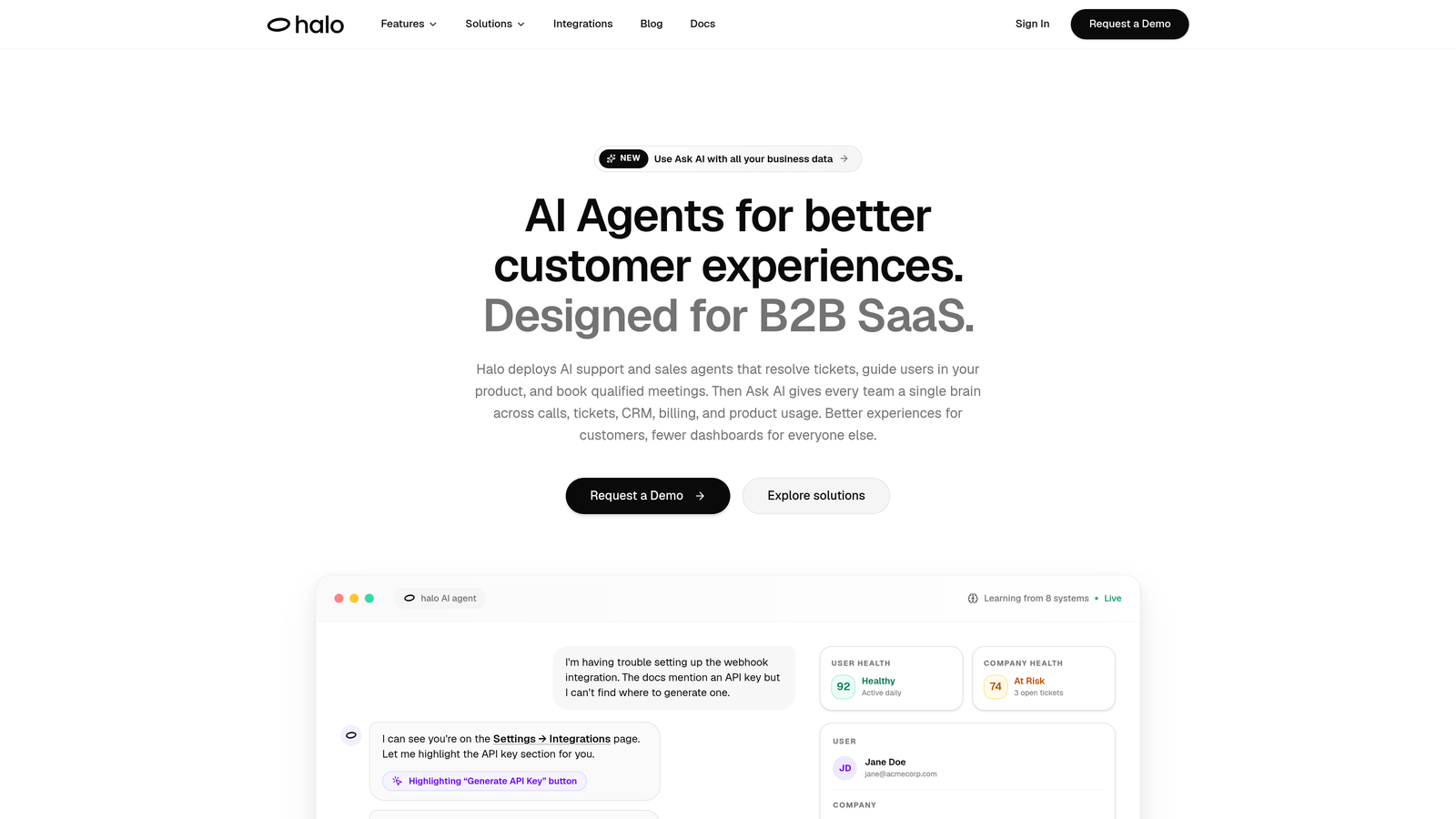
Halo AI is an AI-first customer support platform built specifically for B2B SaaS companies that need autonomous ticket resolution, product guidance, and business intelligence in a single system.
Where This Tool Shines
Most AI support tools start with a helpdesk and bolt on intelligence. Halo starts with intelligence. The architecture assumes autonomous resolution as the default, which means the system is genuinely designed to close tickets without human intervention, not just deflect them to a FAQ page.
What sets Halo apart for growing SaaS companies is the page-aware context engine. The AI understands exactly what a user is looking at inside your product at the moment they reach out, so responses are grounded in real context rather than guesswork. Pair that with a smart inbox that surfaces customer health signals and revenue intelligence alongside support data, and you have a platform that delivers value well beyond ticket deflection.
Key Features
Page-Aware AI Agents: The AI sees what the user sees in your product during the support interaction, enabling precise, contextual guidance rather than generic answers.
Auto Bug Ticket Creation: Automatically routes issues to Linear or your bug tracker without manual triage, closing the loop between support and engineering.
Smart Inbox with Business Intelligence: Surfaces customer health scoring, anomaly detection, and revenue signals from support data, turning your inbox into a product intelligence layer.
Live Agent Handoff: Transfers to human agents with full conversation context preserved, eliminating cold handoffs that frustrate customers.
Deep Integrations: Connects to Linear, Slack, HubSpot, Intercom, Stripe, Zoom, PandaDoc, and Fathom, reducing context-switching across your entire stack.
Continuous Learning: Improves resolution accuracy with every interaction, meaning the system gets meaningfully better the longer you use it.
Best For
B2B SaaS teams, particularly product-led growth companies, that want an AI-first platform rather than a legacy helpdesk with AI features added on. Especially strong for teams where support data should feed back into product decisions and customer success.
Pricing
Contact for pricing at haloagents.ai. Given the platform's depth and integration breadth, it's worth a direct conversation to understand packaging for your team size.
2. Intercom
Best for: Teams that want AI support layered into a mature customer communications platform
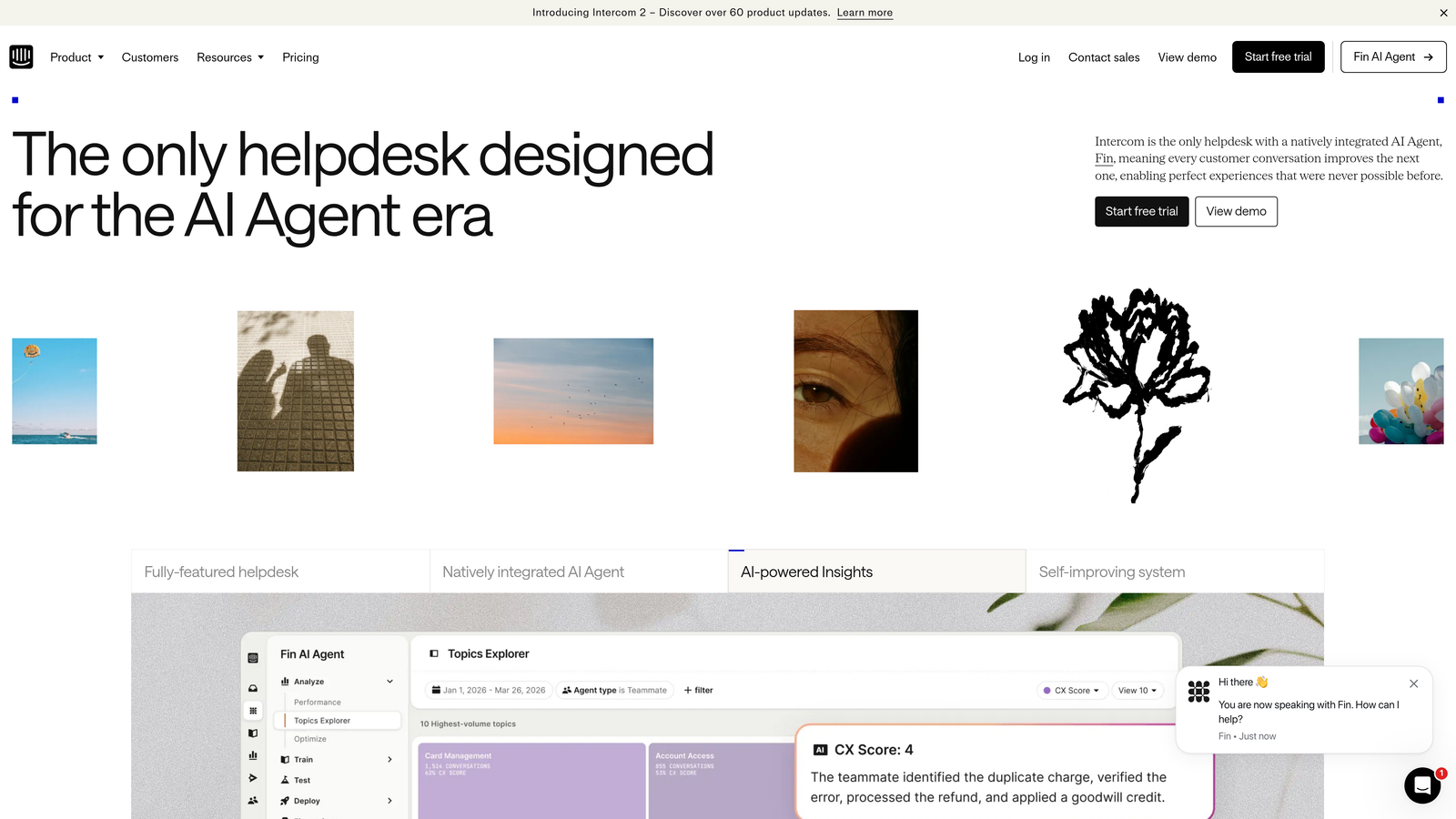
Intercom is a mature customer communications platform with Fin, their AI agent built on large language models, handling front-line support across chat and email.
Where This Tool Shines
Intercom's strength is breadth. It's not just a support tool: it handles onboarding, product tours, sales conversations, and customer messaging alongside support. If you want a single platform managing the entire customer lifecycle, Intercom covers a lot of ground.
Fin, their AI agent, has matured considerably. It handles a meaningful share of inbound conversations autonomously and escalates cleanly to human agents when needed. The AI Copilot feature also assists agents in real-time, making it useful even when full automation isn't the goal.
Key Features
Fin AI Agent: Autonomous conversation handling across chat and email, trained on your help content and product documentation.
Unified Inbox: Combines support, sales, and onboarding conversations in one interface for teams managing multiple customer touchpoints.
Product Tours and In-App Messaging: Proactive onboarding and feature adoption tools alongside reactive support.
AI Copilot: Real-time agent assist with suggested responses and context surfacing during live conversations.
App Marketplace: Extensive integrations and a well-documented API for custom workflows.
Best For
Growing companies that want support, onboarding, and customer messaging unified in one platform. Particularly strong for teams where customer success and support overlap significantly.
Pricing
Starts at approximately $39/seat/month; Fin AI usage is billed per resolution. Verify current pricing at intercom.com as packaging has evolved.
3. Zendesk AI
Best for: High-volume support teams already invested in the Zendesk ecosystem
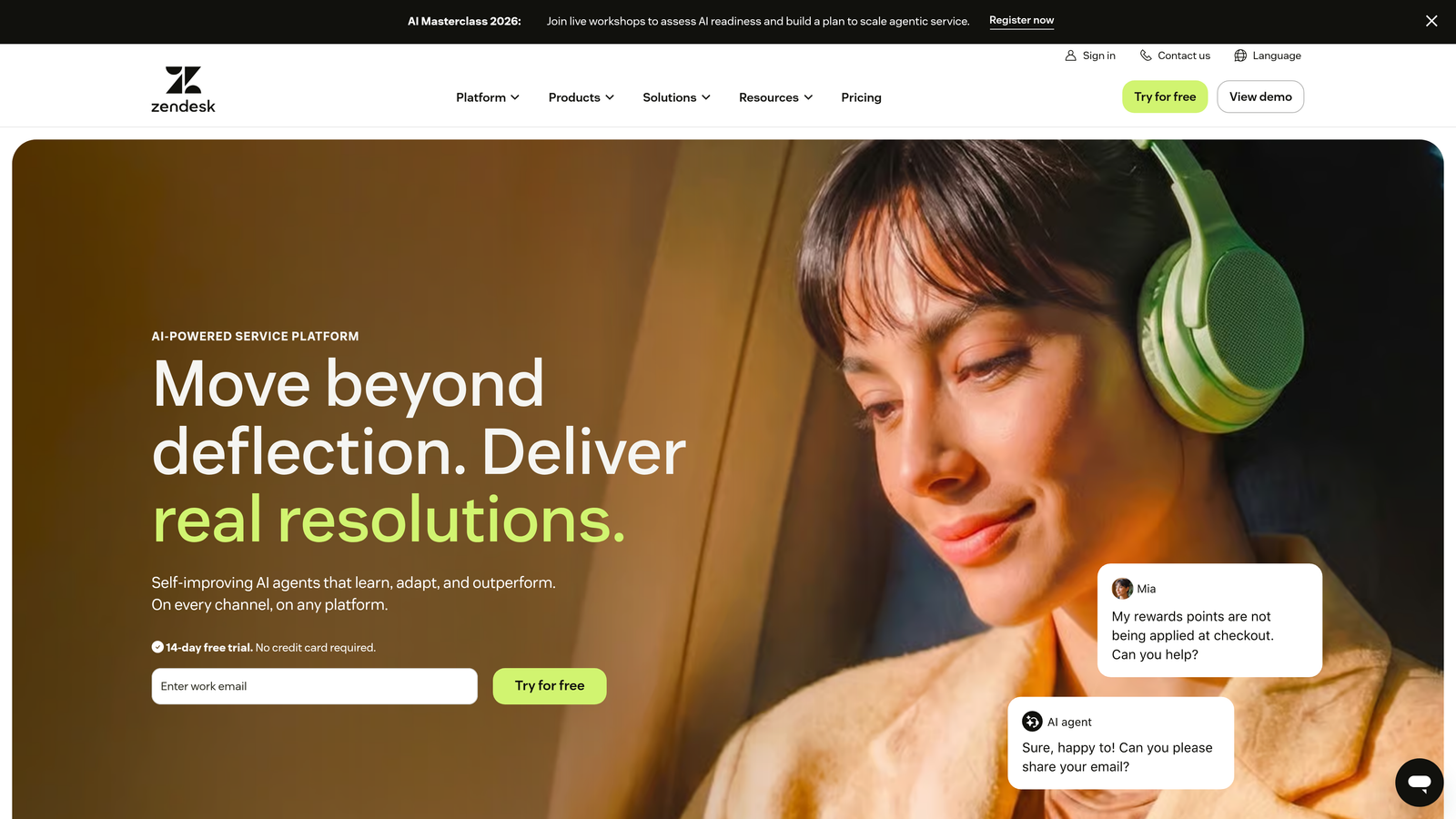
Zendesk AI is an enterprise-grade helpdesk with an Advanced AI add-on that brings intelligent triage, intent detection, agent copilot, and automated workflows to large support operations.
Where This Tool Shines
Zendesk's AI capabilities are most powerful when layered on top of an existing Zendesk deployment. If your team is already running Zendesk workflows, the Advanced AI add-on adds meaningful automation without a platform migration. Intelligent triage, automatic intent detection, and sentiment analysis reduce manual routing work at scale.
For teams starting fresh, the calculus is different. The migration cost and per-seat pricing can be significant, and the AI feels more like an enhancement to a ticket management system than a native intelligence layer. It's best evaluated by teams where Zendesk's routing, SLA management, and reporting infrastructure are already core to operations.
Key Features
Intelligent Triage: Automatic intent, sentiment, and language detection on every incoming ticket for smarter routing.
AI Agent (formerly Answer Bot): Self-service deflection for common questions before tickets reach the queue.
Agent Copilot: Suggested replies and next-best-action recommendations for agents handling complex tickets.
Advanced Routing and SLA Management: Enterprise-grade workflow automation for large, multi-team support organizations.
Robust Reporting and CSAT Analytics: Detailed performance dashboards for support operations leaders.
Best For
Enterprise and mid-market teams already on Zendesk, or teams with complex routing requirements and large support organizations where Zendesk's infrastructure depth justifies the investment.
Pricing
Suite plans from approximately $55/agent/month; Advanced AI is an additional add-on. Verify current pricing at zendesk.com.
4. Freshdesk Freddy AI
Best for: SMB to mid-market teams wanting accessible AI support at competitive pricing
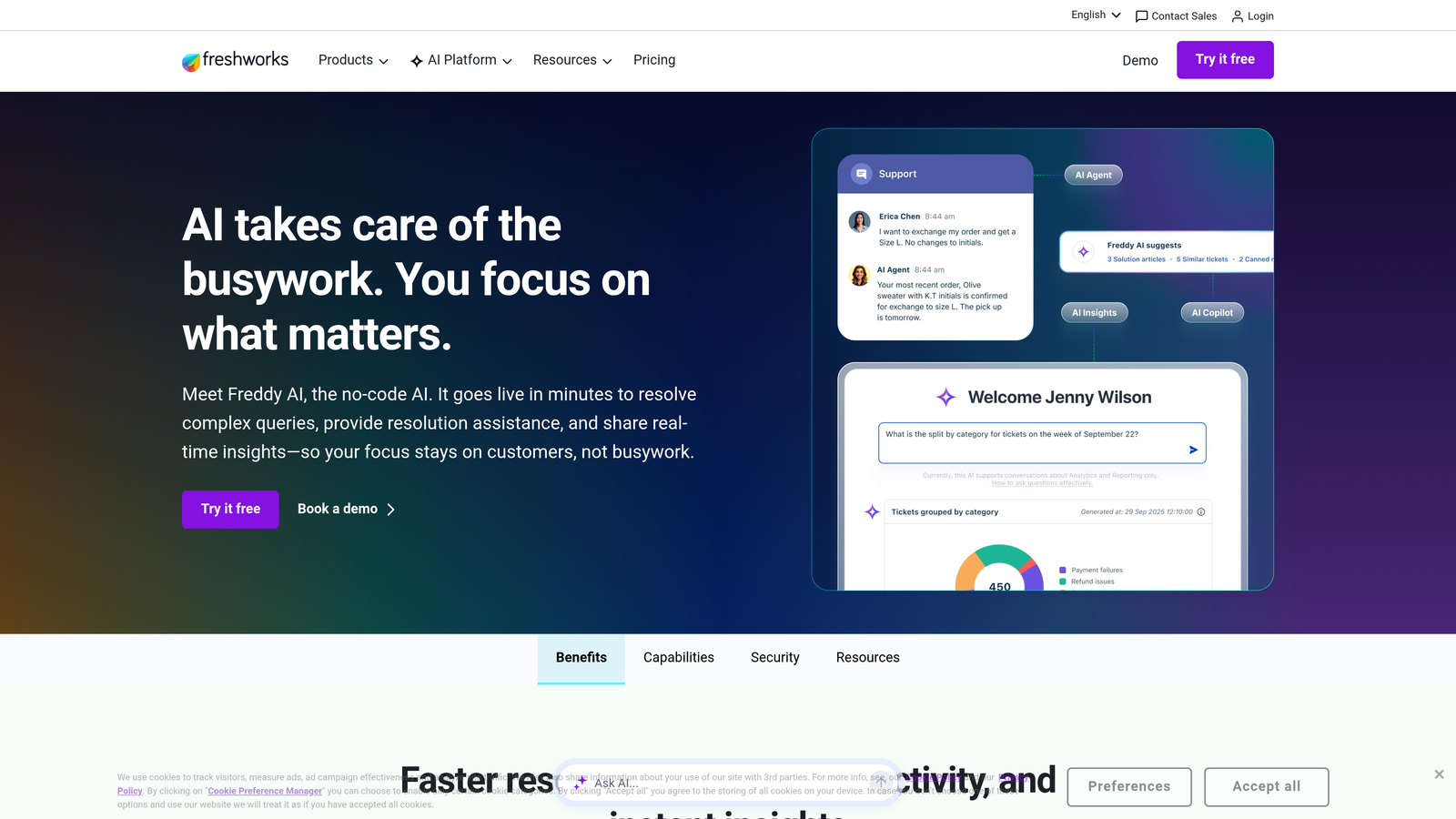
Freshdesk Freddy AI is Freshworks' AI suite embedded across Freshdesk, offering self-service chatbots, agent assist, and analytics under a unified brand at pricing designed for growing teams.
Where This Tool Shines
Freshdesk's biggest advantage is accessibility. The pricing tiers are genuinely competitive compared to Zendesk, and the Freddy AI suite covers the core use cases: customer-facing deflection, agent assist, and analytics. For teams that don't need enterprise-level complexity, it often delivers 80% of the capability at a fraction of the cost.
The no-code chatbot builder (Freddy Self Service) is particularly useful for teams without dedicated technical resources. You can build and deploy automated resolution flows without engineering involvement, which matters when your support team is moving fast.
Key Features
Freddy Self Service: No-code chatbot builder for automated customer-facing resolution across common question types.
Freddy Copilot: In-inbox agent assist with suggested responses, ticket summarization, and reply drafting.
Freddy Insights: AI-powered analytics surfacing trends, CSAT drivers, and volume patterns.
Omnichannel Support: Unified handling across email, chat, phone, and social from one interface.
Accessible Pricing Tiers: Structured for teams scaling from small to mid-market without enterprise commitments.
Best For
SMB and mid-market teams that want solid AI-assisted support without enterprise pricing. Also strong for teams already using other Freshworks products (CRM, ITSM) who want a unified ecosystem.
Pricing
Free plan available; paid plans from approximately $15/agent/month; Freddy AI features unlock on higher tiers. Verify at freshworks.com.
5. Tidio
Best for: Early-stage teams that need fast deployment and conversational AI without complexity
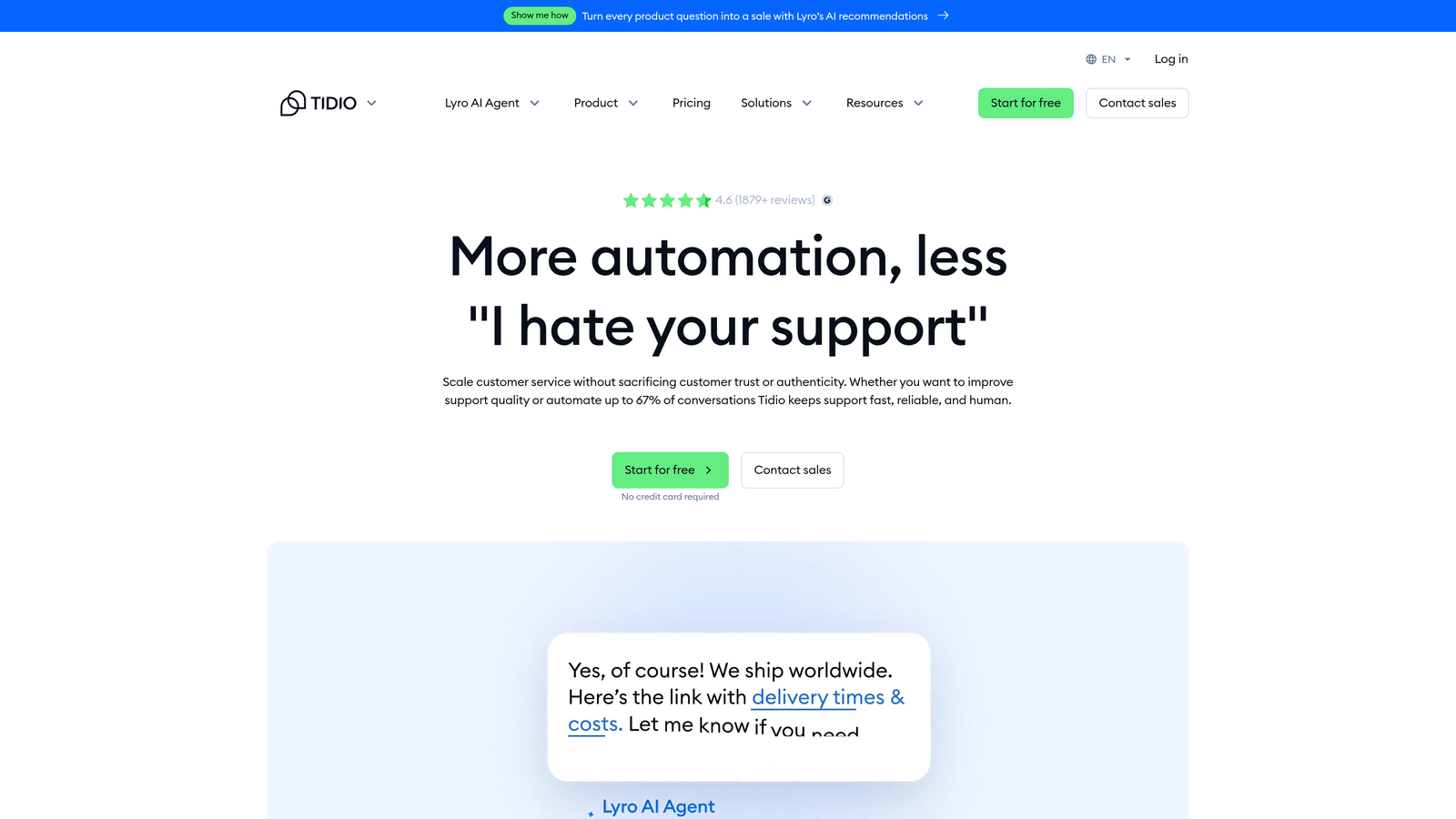
Tidio is a fast-to-deploy live chat and AI platform with Lyro, their conversational AI agent designed to handle common customer questions without human intervention.
Where This Tool Shines
Tidio's standout quality is speed of deployment. For teams that need something live quickly, Tidio can go from signup to active chat widget in under an hour for basic configurations. Lyro, their AI agent, is trained on your support content and handles a solid range of common questions conversationally.
It's worth being clear about scope: Tidio is excellent for straightforward use cases and smaller teams, but it's less suited to complex B2B SaaS support with deep product workflows. Think of it as a strong entry point, particularly if your primary channel is web chat and your support volume is still manageable.
Key Features
Lyro AI: Conversational AI agent trained on your support content, handling common questions autonomously.
Live Chat Widget: Deployable in minutes with minimal technical setup, lowering the barrier for small teams.
Flows (Visual Automation Builder): Drag-and-drop logic for routing, escalation, and conversation branching.
Multi-Channel Integrations: Email and Messenger integrations alongside web chat for broader coverage.
Analytics Dashboard: Conversation volume, resolution tracking, and agent performance metrics.
Best For
Early-stage startups, e-commerce companies, and small teams that need fast deployment and accessible pricing. Less suited to complex B2B SaaS workflows with deep integration requirements.
Pricing
Free plan available; Lyro AI from approximately $29/month. Verify current pricing at tidio.com.
6. Drift (Salesloft)
Best for: B2B companies where support and sales qualification happen in the same conversation
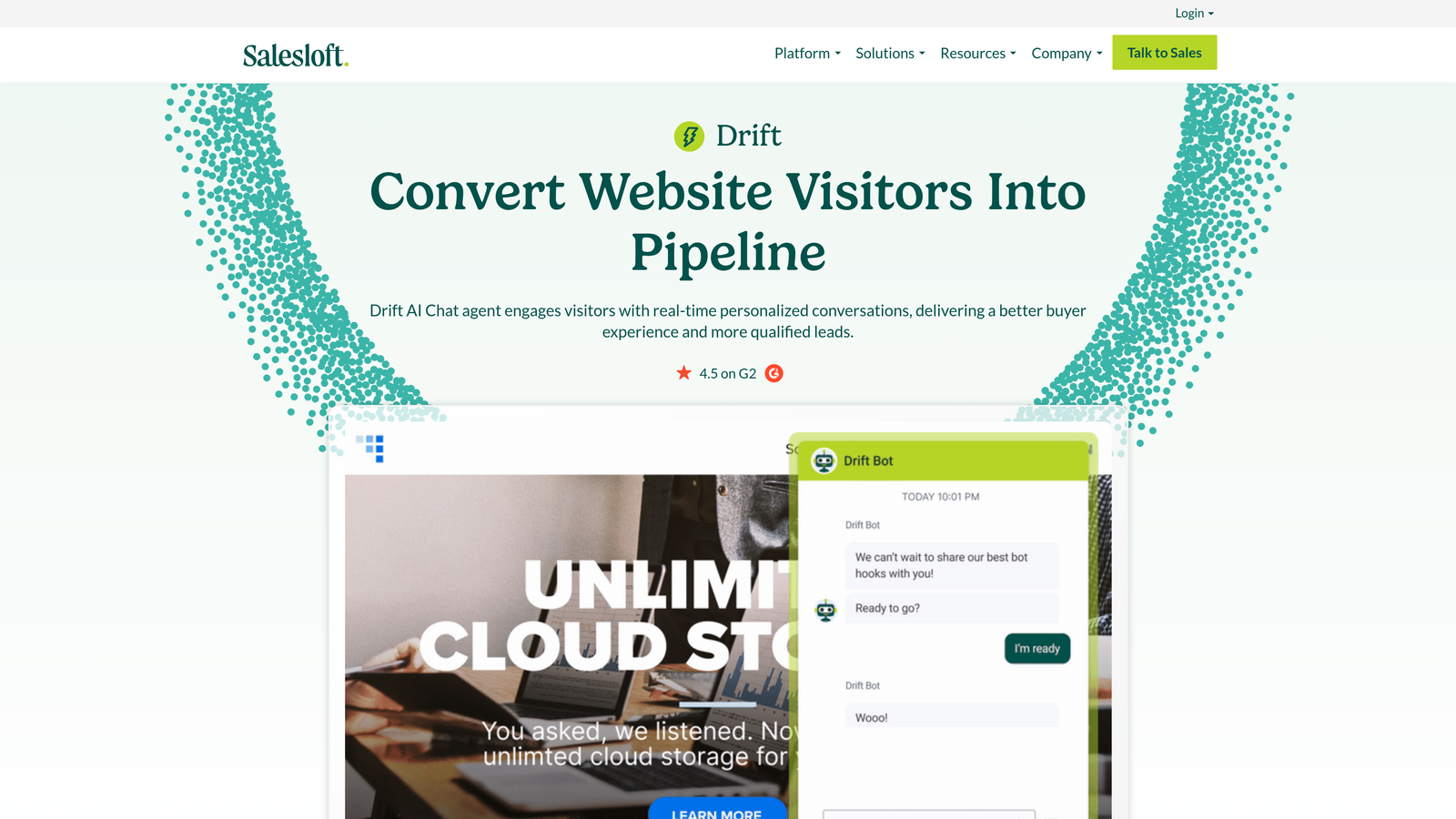
Drift is a conversational AI platform now part of Salesloft, designed for B2B companies where inbound chat serves both support resolution and pipeline qualification simultaneously.
Where This Tool Shines
Drift occupies an interesting position: it's not a pure support tool, and that's intentional. For B2B companies where a prospect asking a product question and a customer asking a support question arrive through the same chat widget, Drift handles both intelligently. The AI can qualify, route, and schedule meetings alongside answering support queries.
Since the Salesloft acquisition, the platform has leaned further into revenue team use cases. If your support and sales motions are tightly coupled, that integration is genuinely valuable. If you're looking for a dedicated support platform, there are better-fit options on this list.
Key Features
AI-Powered Chat: Handles support questions and qualifies sales conversations in the same interface without separate tools.
Bionic Chatbots: Combines AI with human-designed conversation flows for nuanced routing logic.
Meeting Scheduling and Routing: Books meetings directly from chat, reducing friction for sales-adjacent support conversations.
Account-Based Targeting: Delivers different chat experiences to different visitor segments based on firmographic data.
Revenue Platform Integration: Deep connection to Salesforce, HubSpot, and Salesloft's broader revenue workflow.
Best For
B2B companies where support and sales overlap significantly, particularly those already using Salesloft for their revenue team. Less ideal as a standalone support platform for teams with pure support-only needs.
Pricing
Enterprise pricing; contact Drift/Salesloft for current packages. Verify at drift.com.
7. Kustomer
Best for: High-volume support teams where full customer history is central to every interaction
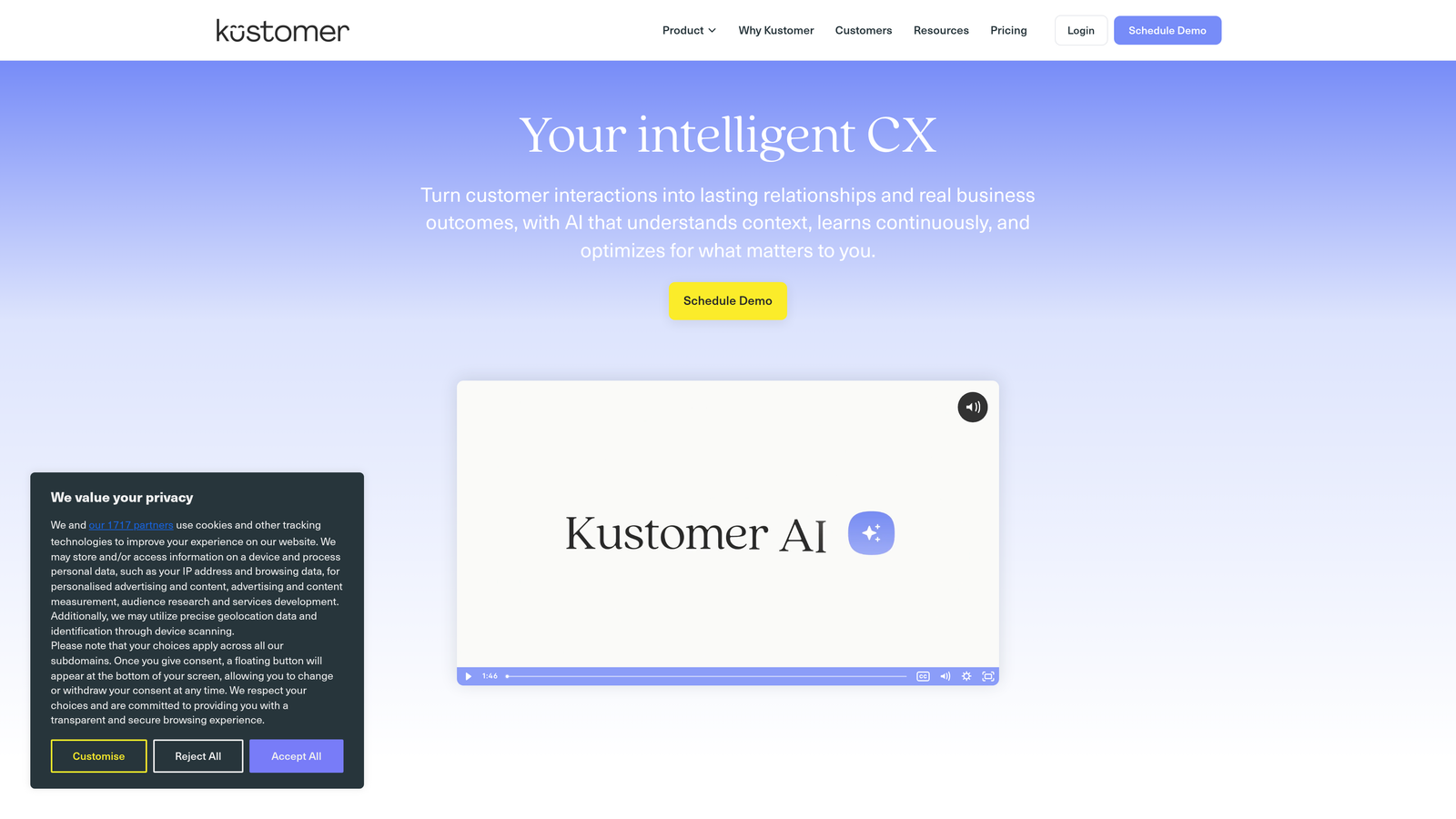
Kustomer is a CRM-native support platform where the customer record, not the ticket, is the center of gravity, with AI workflows built around complete interaction history and context.
Where This Tool Shines
Kustomer's architecture is fundamentally different from ticket-centric platforms. Every interaction, regardless of channel, is organized around the customer timeline. When an agent or AI system responds, it has full historical context: previous issues, purchase history, sentiment patterns, and more. That context makes AI-driven routing and response significantly more accurate.
For high-volume operations handling complex customer relationships, this approach reduces the "explain your problem again" experience that frustrates customers on ticket-centric platforms. The trade-off is price: Kustomer sits at the higher end of the market.
Key Features
Unified Customer Timeline: All interactions across every channel aggregated into a single, chronological customer record.
KustomerIQ: AI for intent detection, sentiment analysis, and automated routing powered by full customer context.
Workflow Automation Builder: Complex multi-step support process automation for high-volume operations.
True Omnichannel: Email, chat, SMS, social, and voice unified in one interface without channel silos.
Deep CRM Data Integration: Pulls in CRM data to enrich AI responses with account and relationship context.
Best For
High-volume support teams, particularly in B2C or complex B2B environments, where customer history and relationship context are critical to resolution quality. Less suited to early-stage teams on tight budgets.
Pricing
From approximately $89/user/month. Verify current pricing at kustomer.com.
8. Help Scout
Best for: Teams where brand voice and personal support quality are non-negotiable differentiators
Help Scout is a deliberately human-centered support platform that uses AI to assist agents rather than replace them, built for companies where the quality of support is a competitive advantage.
Where This Tool Shines
Help Scout takes a principled stance: AI should make human support better, not automate it away. That philosophy shows in the product. The interface is clean and minimal, designed to reduce cognitive load for agents. The AI features (summarization, reply drafting, tone adjustment) enhance what agents write rather than writing for them entirely.
For companies where support quality is a genuine brand differentiator, this approach has real merit. Customers get thoughtful, on-brand responses faster, without the robotic feel that fully automated systems sometimes produce. The trade-off is lower autonomous resolution rates compared to AI-first platforms.
Key Features
AI Summarize: Instant conversation summaries for agents picking up mid-thread, eliminating the need to scroll through history.
AI Assist: Tone adjustment, reply drafting, and translation assistance for agents composing responses.
Beacon: Embeddable help widget with self-service documentation and proactive messaging for users who prefer to self-serve.
Shared Inbox with Collision Detection: Prevents duplicate replies when multiple agents are working the same queue.
Minimal, Low-Distraction Interface: Designed to keep agents focused on the conversation rather than the platform.
Best For
Companies where support quality is a brand differentiator and full automation isn't the goal. Particularly strong for teams in industries where a human touch is expected and valued by customers.
Pricing
From approximately $22/user/month. Verify current pricing at helpscout.com.
9. Forethought
Best for: Teams locked into an existing helpdesk that want AI capabilities without migrating platforms
Forethought is an AI intelligence layer that sits on top of existing helpdesks like Zendesk and Salesforce Service Cloud, adding triage, deflection, and agent assist without requiring a platform migration.
Where This Tool Shines
Forethought solves a specific, common problem: your team is deeply invested in Zendesk or Salesforce Service Cloud, migration isn't realistic, but you need AI capabilities now. Rather than ripping and replacing, Forethought layers on top and adds meaningful automation to what you already have.
The Discover module is particularly useful for growing teams. It analyzes your ticket data to identify the highest-value deflection opportunities and content gaps, giving you a prioritized roadmap for where AI can have the most impact. That kind of intelligence makes it easier to justify the investment internally.
Key Features
Solve: AI agent for automated ticket deflection before conversations reach a human agent.
Triage: Automatic intent detection and routing to the right team or queue based on ticket content.
Assist: In-inbox AI recommendations and knowledge surfacing for agents handling live tickets.
Discover: Analytics module identifying top deflection opportunities and knowledge base content gaps.
Helpdesk-Agnostic Overlay: Sits on top of Zendesk, Salesforce, and ServiceNow without requiring migration or replacing existing workflows.
Best For
Enterprise and mid-market teams already committed to Zendesk, Salesforce Service Cloud, or ServiceNow who want AI capabilities without the disruption and cost of a platform migration.
Pricing
Enterprise pricing; contact for a quote at forethought.ai.
Which Tool Is Right for Your Stage?
The right AI support platform depends less on feature checklists and more on where your company is today and where it's heading in the next 18 months.
If you're a B2B SaaS company that wants AI-first architecture with business intelligence built in, Halo AI is the strongest fit. The page-aware context engine, auto bug ticket creation, and revenue intelligence signals make it genuinely differentiated for product-led teams. If you're already deep in the Zendesk ecosystem and migration isn't on the table, Forethought gives you AI capabilities without disruption. For teams where support and sales overlap in a single chat channel, Drift handles that hybrid motion well.
Intercom is the right call for companies that want support, onboarding, and messaging in one platform. Freshdesk Freddy AI serves SMB and mid-market teams that need solid capabilities at accessible pricing. Help Scout fits companies where support quality is a brand differentiator and full automation would undermine the experience.
For early-stage teams that need something live fast, Tidio gets you there quickly. For high-context, high-volume operations where customer history drives everything, Kustomer is worth the investment. And for enterprise teams committed to Zendesk's infrastructure, Zendesk AI adds meaningful intelligence without switching costs.
Your support team shouldn't scale linearly with your customer base. Let AI agents handle routine tickets, guide users through your product, and surface business intelligence while your team focuses on complex issues that need a human touch. See Halo in action and discover how continuous learning transforms every interaction into smarter, faster support.